Best Reading App for Struggling Readers: 2026 Guide for 5-Year-Olds
What You'll Learn
- Why 90% of "reading apps" actually make struggling readers worse — and the one red flag that tells you immediately
- The brain science behind why your 5-year-old can't just "pick up" reading on their own (hint: it's not a developmental delay)
- What a phonics-based reading app must include to actually move the needle for a kid who's behind
- The specific action plan I use with my own 4-year-old — step by step, no guessing
Your 5-Year-Old Can't Read. Let's Stop Pretending That's Normal.
I'm going to say the thing nobody at your kid's school wants to say.
If your 5-year-old is "struggling with reading," they don't need more time. They don't need to "develop at their own pace." And they absolutely do not need another app that rewards them with digital stickers for tapping pictures of cats while the word "cat" floats by on the screen.
They need systematic phonics instruction. Yesterday.
Look, I get it. You're Googling "best reading app for struggling readers" at 10:47 PM because your kid came home from kindergarten today and still can't sound out "sit." Maybe the teacher said "he's still developing" or "she'll catch up." Maybe you're wondering if something's wrong.
Here's what I know after teaching two of my four kids to read, and being knee-deep in the process with my third: most kids who struggle to read at 5 aren't broken. They've just never been taught properly. The method matters more than the child's "readiness." And many of the most popular apps — I'm talking the ones with millions of downloads and cute animations — rely on picture-cueing, three-cueing strategies, and memorization-first approaches that reading scientists have been raising alarms about for years.
The National Reading Panel settled this back in 2000. Congress literally commissioned a report, assembled a panel of experts, and the conclusion was crystal clear: systematic phonics instruction produces significant benefits for kids in kindergarten through 6th grade. That was 26 years ago. And we're still fighting about it.
The "Wait and See" Lie Will Cost Your Kid Everything
Let me paint you a picture that keeps me up at night.
Your 5-year-old is behind in reading right now. You download a popular app — one of the ones I'll call out in a minute — and your kid plays it for 20 minutes a day. They earn coins. They unlock characters. They look like they're "learning." You feel better.
First grade comes. They're still behind. The teacher says, "Some kids are late bloomers."
Second grade. Still behind. Now they're starting to notice they're different from the other kids. They hate reading time. They fake stomachaches on library day.
Third grade. The cliff.
The Annie E. Casey Foundation published a study in 2010 that found kids who can't read proficiently by the end of 3rd grade are four times more likely to drop out of high school. Four times. And if they're also living in poverty? The odds get even uglier.
The 2022 NAEP scores — that's the Nation's Report Card — showed only 33% of 4th graders read at a proficient level. One in three. And reading scores dropped 3 points from 2019, the largest decline in 30 years.
So when someone tells you to "wait and see," what they're really saying is: "Let's gamble with your child's future and hope it works out."
I don't gamble with my kids. Neither should you.
Why Most "Reading Apps" Are Garbage (Sorry, Not Sorry)
OK so here's where I'm going to make some enemies. I don't care.
A huge share of the top-charting reading apps in 2026 lean heavily on Whole Language or Balanced Literacy-style techniques — picture-cueing, whole-word memorization, leveled-text dependence — the exact behaviors that Emily Hanford's 2023 APM Reports investigation "Sold a Story" exposed as fundamentally flawed. These apps teach kids to do three things:
- Look at the picture and guess the word
- Memorize whole words by shape ("look-say" method)
- Skip words they don't know and use "context clues"
None of that is reading. That's guessing with a screen.
Imagine your kid sees a picture of a dog next to the word "puppy." They tap "puppy." The app plays a celebration sound. Your kid didn't read "puppy." They identified a dog and guessed. Take away the picture, and they're staring at "puppy" like it's hieroglyphics.
Stanislas Dehaene — he's a French neuroscientist at the Collège de France — proved in his book Reading in the Brain (2009) that the human brain is NOT wired to read naturally. Speech? Yes. Reading? No. The brain has to be trained to map letters to sounds through a process called grapheme-phoneme correspondence. There's no shortcut. There's no "readiness" fairy that sprinkles reading dust on your kid at the right age.
The brain builds reading circuits through explicit, systematic phonics instruction. Period.
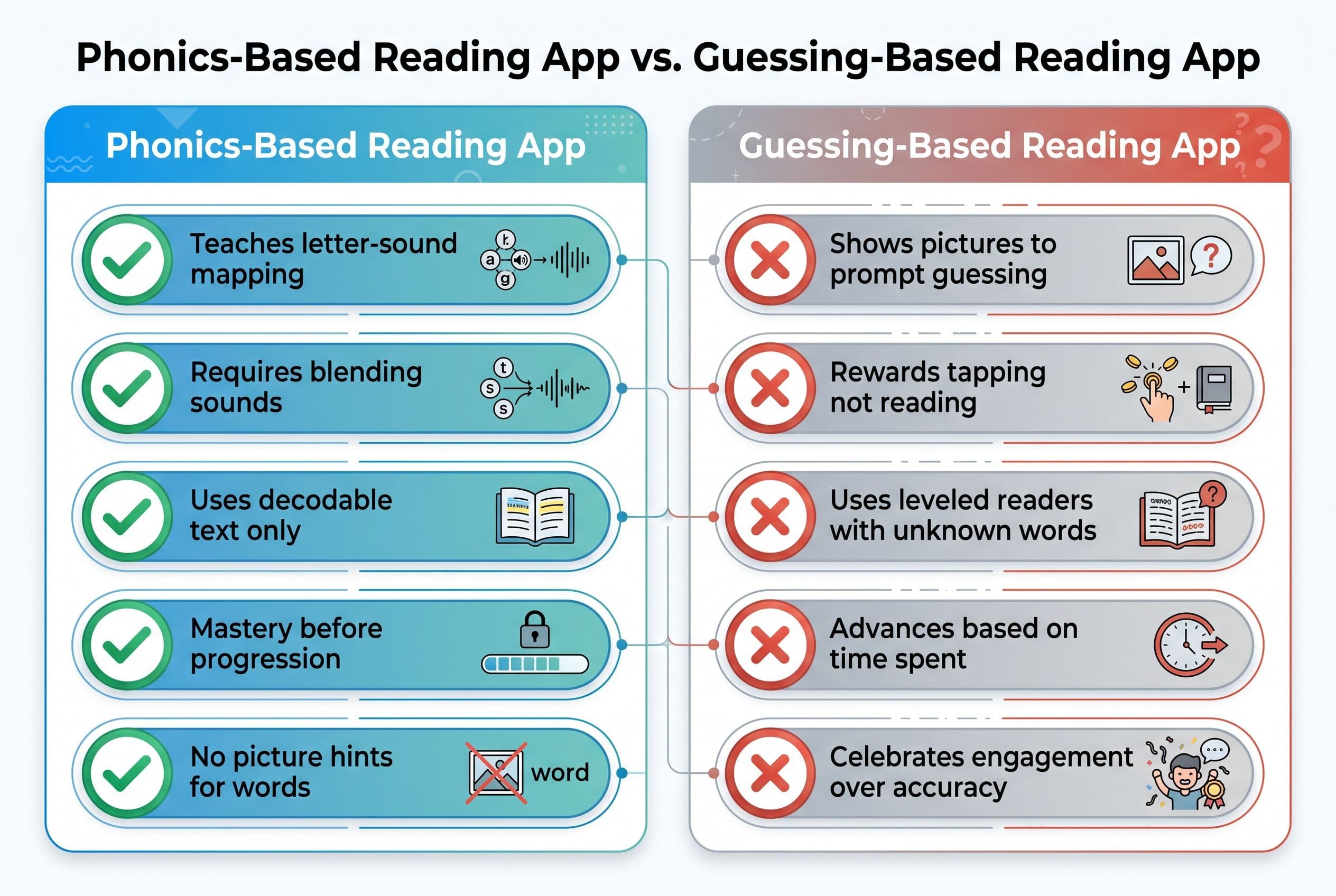
So when you're shopping for the best reading app for a struggling 5-year-old, here's your red flag checklist. If an app does any of these things, delete it:
- Shows pictures alongside words as the primary teaching method. Pictures should illustrate stories, not teach decoding.
- Lets kids skip words or guess. Real reading apps demand accuracy.
- Teaches "sight words" as the foundation instead of as the exception. (Yes, there are some words that need memorizing — "the," "said," "was" — but they shouldn't be the method.)
- Rewards engagement over mastery. If your kid can earn coins without actually reading correctly, the app is optimized for screen time, not literacy.
- Never asks kids to blend sounds. If there's no blending, there's no phonics. It's that simple.
What a Real Reading App Must Do (The Non-Negotiable Checklist)
David Kilpatrick's Equipped for Reading Success (2016) lays out the research on orthographic mapping — the brain process that turns unfamiliar words into instantly-recognized sight words. Here's the kicker: orthographic mapping requires strong phonemic awareness skills. Kids who can't hear and manipulate individual sounds in words can't map those sounds to letters. And they can't become fluent readers.
So the best reading app for struggling readers must do these things:
1. Teach Systematic Synthetic Phonics
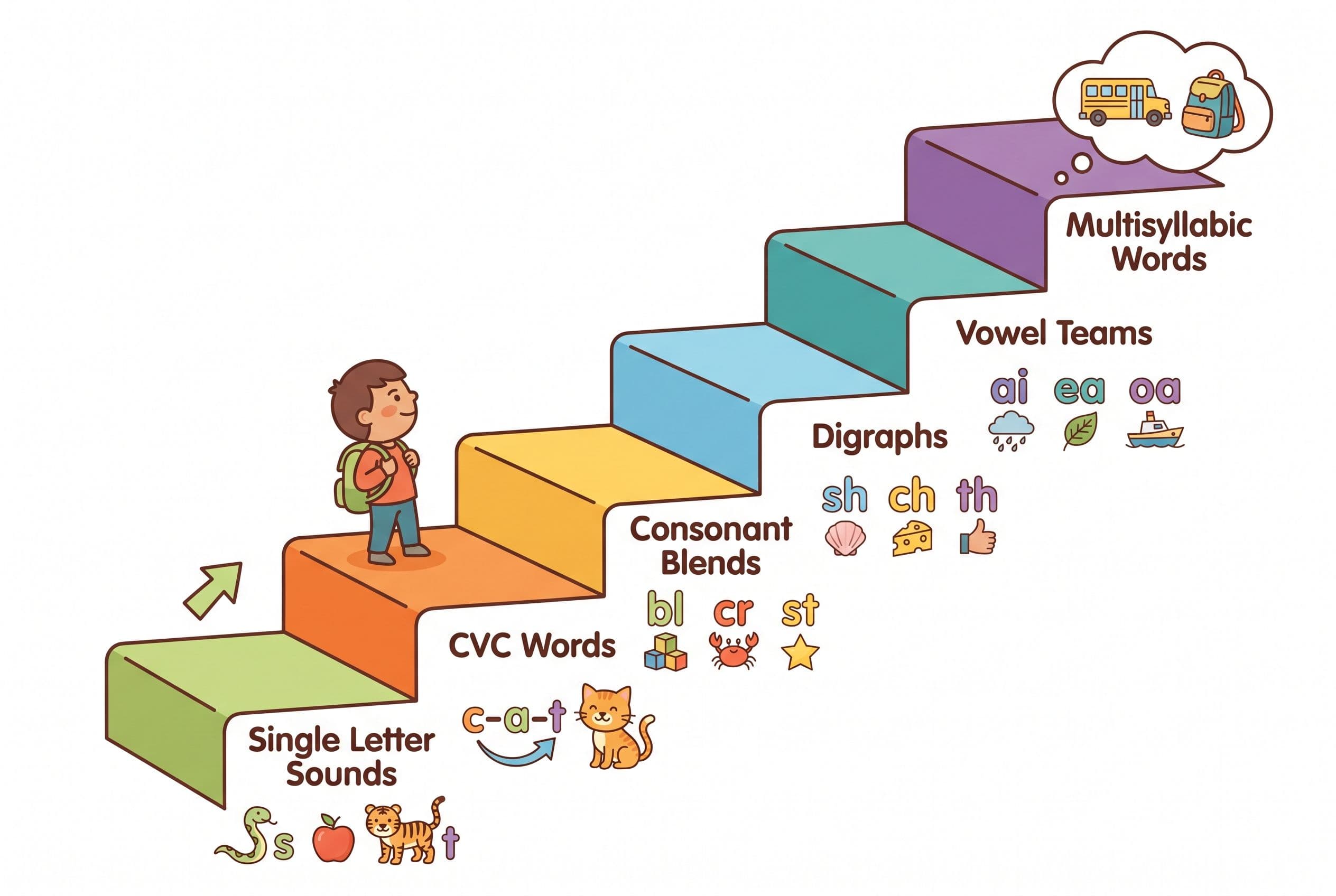
Not random letter-of-the-week nonsense. Systematic means there's a logical sequence — single letter sounds first, then blends, then digraphs (sh, ch, th), then vowel teams, then multisyllabic words. Synthetic means kids learn to blend individual sounds together to form words (c-a-t → cat), not break whole words apart.
This is the approach used in Orton-Gillingham methodology, and it's the foundation of programs like UFLI Foundations and Fundations that schools across the country are adopting.
2. Build Phonemic Awareness Explicitly
Before your kid can map letters to sounds, they need to hear the sounds. Can they tell you the first sound in "map"? Can they segment "dog" into /d/ /o/ /g/? Can they swap the /m/ in "mat" for /s/ and say "sat"?
If they can't, letter instruction alone won't stick. The app needs sound-level exercises.
3. Use Decodable Texts — Not Leveled Readers
This one drives me crazy. Fountas & Pinnell leveled readers are everywhere — in schools, in apps, in those little book bins at the library. But they're Whole Language aligned. They mix in words kids haven't been taught to decode, which forces kids to guess.
Decodable readers only use words with letter-sound patterns the child has already learned. If your kid has learned the sounds for s, a, t, p, i, n — the decodable text only uses words with those letters. "Sat." "Pan." "Tip." "Nap." No guessing required.
Look for apps that use decodable text progression, not leveled readers. Programs like Flyleaf Publishing and High Noon Books get this right in print — a good app should do the same digitally.
4. Demand Accuracy Before Moving On
Mastery-based progression. Not "you tried, here's a sticker." If your kid can't read "sit" correctly, they don't move on to "slip." That's how I run phonics in my house. My 7-year-old didn't get to consonant blends until she had CVC words cold. We drilled "cat, hat, mat, sat, bat" until she could read them without hesitating.
The app should do the same.
5. No Picture-Based Guessing. Ever.
I can't stress this enough. When the app presents a word to read, there should be no picture hint. The child reads the word by decoding it. Sound by sound. Blend it together. Say the word.
That's reading.
Teach Your Kid to Read: The App I Built Because Nothing Else Worked
Real talk — I co-founded Teach Your Kid to Read because I went through this exact nightmare myself.
When I started teaching my oldest to read, I downloaded every top-rated reading app I could find. Spent actual money on some of them. And I watched my kid get really good at tapping pictures and really bad at reading words. She'd look at a picture of a ship and say "boat." She'd see a horse and say "pony." She wasn't reading. She was playing a matching game.
So I threw them all out and went back to the research. Orton-Gillingham principles. Linnea Ehri's phases of word reading development — pre-alphabetic, partial alphabetic, full alphabetic, consolidated. The Clackmannanshire study out of Scotland (Johnston & Watson, 2005) that tracked kids for 7 years and proved synthetic phonics outperformed analytic phonics and whole-word methods.
I took all of that and built the app I wished existed. Here's what makes Teach Your Kid to Read different from the flashy apps burning up the App Store:
- Systematic synthetic phonics sequence — we follow the same scope and sequence that Orton-Gillingham tutors use at $100+/hour
- No picture guessing — when your child sees a word, they decode it. The pictures come after they've read the word correctly, as confirmation, not as a crutch.
- Phonemic awareness built in — sound blending, segmenting, and manipulation exercises are woven into every lesson, because you can't build a house without a foundation
- Decodable text at every level — your kid only reads words they have the tools to decode. No "read this sentence and guess the hard words" nonsense.
- Mastery-based progression — the app doesn't advance until your child demonstrates accuracy. Not speed. Accuracy.
- Parent dashboard — because you need to know exactly where your kid is, not just that they "played for 15 minutes"
This is reading intervention in your pocket. The same methodology that programs like Wilson Reading System and Barton Reading & Spelling use for kids with dyslexia indicators — distilled into a daily app your 5-year-old can use at the kitchen table while you're making dinner.
The Playground Conversation That Changed Another Mom's Mind
I was at a playground in Raleigh last year when another mom told me her kid's school had just switched from Lucy Calkins' Units of Study to a Science of Reading curriculum because of North Carolina's SB 387 — the Excellent Public Schools Act. She was confused and honestly a little annoyed. "He was doing fine before," she said.
I asked if her son could read the word "splint." He's in second grade. He could not.
He stared at it. Looked up at his mom. Looked back down. Said "split." Close, but not right — and he wasn't sounding it out. He was guessing based on the first few letters.
I spent 20 minutes on that playground bench explaining why the switch was happening — Hanford's reporting in "Sold a Story," the NAEP data showing only a third of kids reading proficiently, the neuroscience from Dehaene's lab showing the brain doesn't learn to read naturally the way it learns to speak. Her son wasn't "doing fine before." He was memorizing and guessing, and the old curriculum had trained him to do exactly that.
She went home and listened to the "Sold a Story" podcast that night. Texted me at 11 PM: "I had no idea. Why didn't anyone tell us this sooner?"
That's the question, isn't it? Why didn't anyone tell us?
Well. I'm telling you now. If your 5-year-old is struggling with reading, the answer isn't a "fun" app with dancing letters. The answer is systematic phonics instruction — the same approach that Mississippi used when they passed their Literacy-Based Promotion Act in 2013 and went from 49th to 21st in national reading scores in six years. The same approach that 40+ states have now written into law since 2019.
The science isn't controversial. The only controversy is how long we ignored it.
Your Action Plan: What to Do This Week
Stop scrolling. Here's your step-by-step plan for the next 7 days.
Day 1: Assess Where Your Kid Actually Is
Download Kilpatrick's PAST test (Phonological Awareness Screening Test). It takes about 5 minutes and tells you exactly where the phonological breakdown is. Can your kid identify first sounds? Last sounds? Blend sounds together? Segment words? This is your starting line.
If you want a quicker gut check: ask your kid to tell you the sounds in "map." Not the letters — the sounds. /m/ /a/ /p/. If they can't do it, they need phonemic awareness work before heavy letter-sound instruction will stick.
Day 2: Delete the Garbage Apps
Go through your kid's tablet. Every reading app that uses picture-based guessing? Gone. Every app that lets them "pass" a level without actually reading words? Gone. If you're not sure, open the app and watch your kid use it. Are they looking at pictures or looking at letters? That tells you everything.
Day 3: Download Teach Your Kid to Read
Get the app. Set up your child's profile. The app will start with an assessment to place your kid at the right level — no assumptions, no guessing.
Set a daily time. In my house, phonics happens right after breakfast. Every day. Birthdays, Christmas, vacation. That's one of my Tiger Rules: We Never Skip. 15-20 minutes is enough for a 5-year-old. Consistency beats marathon sessions every single time.
Day 4-7: Establish the Routine
Here's what a daily session should look like:
- Phonemic awareness warm-up (2-3 minutes): Sound blending and segmenting games. "What word do these sounds make: /s/ /i/ /t/?" The app handles this.
- New letter-sound instruction (3-5 minutes): Learn or review a grapheme-phoneme correspondence. Practice writing it. Say the sound. Give a key word.
- Blending practice (5-7 minutes): Read CVC words (consonant-vowel-consonant) using only sounds they've learned. No guessing. Sound it out. Blend it. Say it.
- Decodable text (3-5 minutes): Read a short decodable sentence or passage using only known letter-sound patterns.
- Review (2 minutes): Quick drill of previously learned sounds. Flashcard style.
That's your framework. The app walks you through it, but understanding the why behind each step makes you a better reading coach for your kid.
Benchmarks to Watch For:
DIBELS (Dynamic Indicators of Basic Early Literacy Skills) gives us concrete targets. By mid-kindergarten, your kid should hit roughly 28+ correct letter sounds per minute on the Nonsense Word Fluency subtest. By end of kindergarten, aim for 40+. These aren't arbitrary numbers — they're predictive of future reading success.
If your kid isn't hitting these benchmarks after consistent practice, it might be time for a more thorough evaluation. The International Dyslexia Association estimates that 15-20% of people have some symptoms of dyslexia. Early identification changes outcomes dramatically — a good reading intervention app can be the first step, but some kids need the full Orton-Gillingham or Wilson Reading System approach with a trained specialist.
"But My Kid Hates Phonics Drills" — Yeah, Mine Too. Do It Anyway.
I hear this one constantly. "He doesn't like it." "She gets frustrated." "I don't want reading to be a negative experience."
Listen. My 4-year-old does not love practicing CVC words at the kitchen table. Last Tuesday she told me she'd "rather eat broccoli" than sound out another word. (She despises broccoli.) I told her we'd do five more words and then she could go play. She did five more words. She read "pig" independently for the first time. She grinned so big I thought her face would split.
That moment — that "I did it" moment — doesn't happen if you let them quit because it's hard. The struggle IS the learning. Stanislas Dehaene's research shows the brain literally has to rewire neural pathways to create a reading circuit. That rewiring is effortful. It's supposed to feel hard.
You know what actually creates a negative experience with reading? Being 8 years old and unable to read the word "splint" while your classmates are reading chapter books. That's a negative experience. That's the one that leaves scars.
Phonics drills for 15 minutes a day? That's medicine. It tastes bad going down. But it works.
The Bottom Line: What Makes an App the "Best" for Struggling Readers
I've reviewed dozens of reading apps. I've tested them with my own kids. And I built one because the market was full of pretty, profitable garbage.
The best reading app for a struggling 5-year-old in 2026 is one that:
- Uses systematic synthetic phonics — not random skills, not whole-word memorization
- Builds phonemic awareness as a foundation — because you can't decode what you can't hear
- Features decodable text — not leveled readers full of words your kid can't possibly decode yet
- Demands mastery before progression — your kid proves they know it before moving forward
- Eliminates picture-based guessing — the word is the word. Read it.
- Gives parents data — not just "your child played for 18 minutes" but "your child can decode CVC words with short a and short i at 92% accuracy"
That's Teach Your Kid to Read. That's what I built. That's what I use with my own kids.
Your struggling 5-year-old isn't broken. They've just been given the wrong tools. Give them the right ones.
Frequently Asked Questions
Is it normal for a 5-year-old to not be able to read?
It's common, but "common" doesn't mean "fine." Many kindergarteners haven't yet learned to decode words — but that's usually because they haven't received systematic phonics instruction, not because they aren't ready. Mark Seidenberg, a cognitive scientist at the University of Wisconsin, argued in Language at the Speed of Sight (2017) that most reading difficulties aren't caused by brain deficits — they're caused by inadequate instruction. If your 5-year-old can speak in full sentences, follow multi-step directions, and rhyme words, their brain is ready to learn to read. They just need the right method.
How much time per day should my 5-year-old spend on a reading app?
Fifteen to twenty minutes of focused, systematic phonics practice. Not 45 minutes of game-playing that happens to involve letters. Short, consistent, daily sessions beat long occasional ones every time. I do 15 minutes with my 4-year-old every single morning — and the research on distributed practice backs this up. DIBELS benchmarking data shows consistent daily practice produces faster gains than twice-weekly longer sessions.
What's the difference between a reading app and a reading game app?
A reading app teaches your child to decode words using systematic phonics — letter sounds, blending, segmenting, decodable text. A reading game app keeps your child entertained with animations and rewards while occasionally showing letters. The easiest test: mute the app, remove all pictures, and see if your child can still use it to learn to read actual words. If the answer is no, it's a game, not a reading tool.
Should I use a reading app if I suspect my child has dyslexia?
A phonics-based reading app like Teach Your Kid to Read uses the same Orton-Gillingham principles that are the gold standard for dyslexia intervention. It's a strong starting point. But if your child isn't making progress after 8-12 weeks of consistent daily practice, get a formal evaluation. The International Dyslexia Association recommends early screening — Kilpatrick's PAST test is a quick phonological awareness screener you can do at home. Some kids need the intensity of a full Wilson Reading System or Barton Reading & Spelling program with a trained interventionist.
How do I know if the reading app is actually working?
Track two things: accuracy and independence. After 4-6 weeks of daily use, your child should be able to read CVC words (cat, sit, mop, hen, bug) without picture hints and without guessing. They should be sounding words out, not looking at you for confirmation. If you want hard numbers, the DIBELS Nonsense Word Fluency benchmark for mid-kindergarten is 28+ correct letter sounds per minute. That's a concrete, measurable target — not a vague feeling that things are "getting better."
Part of these guides

Xia Brody
Co-Founder, Teach Your Kid to Read
Mom of 4 who has successfully taught her kids to read. Currently in the trenches with her 4-year-old while her two oldest (10 and 7) devour books on their own. Passionate about phonics-based methods and building a lifelong love of reading.
Related Articles
Best Reading App for a Struggling 7-Year-Old (2026): What Actually Works
Most reading apps for struggling 7-year-olds are glorified guessing games dressed up with cartoon characters. Here's what the science of reading actually says works — and the one app I trust with my own kids.
Read More →
Best Reading App for 4th Graders Behind + Free Plan
Your 9-year-old is guessing at words and hiding books in his backpack. Most reading apps are built for 5-year-olds and will waste his time. Here's what a real 4th grade reading intervention app has to do — and the exact daily plan I use.
Read More →
Best Reading App for 1st Graders Behind: 7 Options Ranked for 2026
Your 1st grader is falling behind in reading and you need an app that actually teaches phonics — not one that rewards guessing with cartoon stars. Here's what the research says works, what doesn't, and the 7 best reading apps for struggling 1st graders in 2026.
Read More →