My 5 Year Old Can't Read Reception: When to Act
What You'll Learn
- The difference between a normal Reception wobble and a reading problem you need to attack now
- The common mistake parents make when their child gets stuck on a word
- Why the Year 1 Phonics Screening Check matters more than book band colours
- A 15-minute daily plan to help your Reception child read without tears, guessing or iPad bribery
Reality Check: If Your 5 Year Old Can't Read Reception Books, Pay Attention
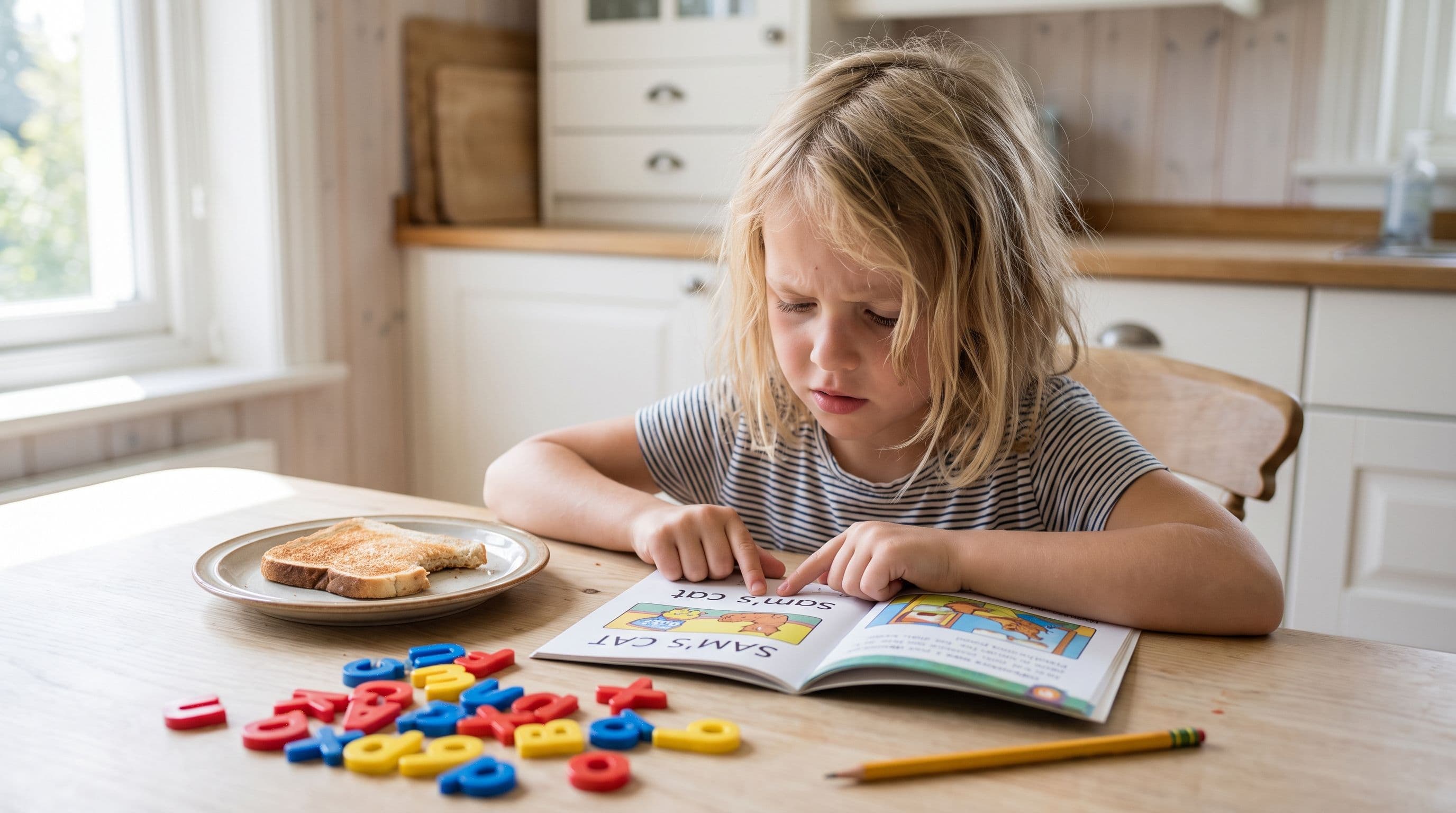
Your child is in Reception (ages 4-5). The book bag comes home. You open the little reader, point to the first word and your child says… nothing.
Or worse, they look at the picture and guess.
If you're searching my 5 year old can't read Reception, here's my honest answer: don't panic, but don't wait.
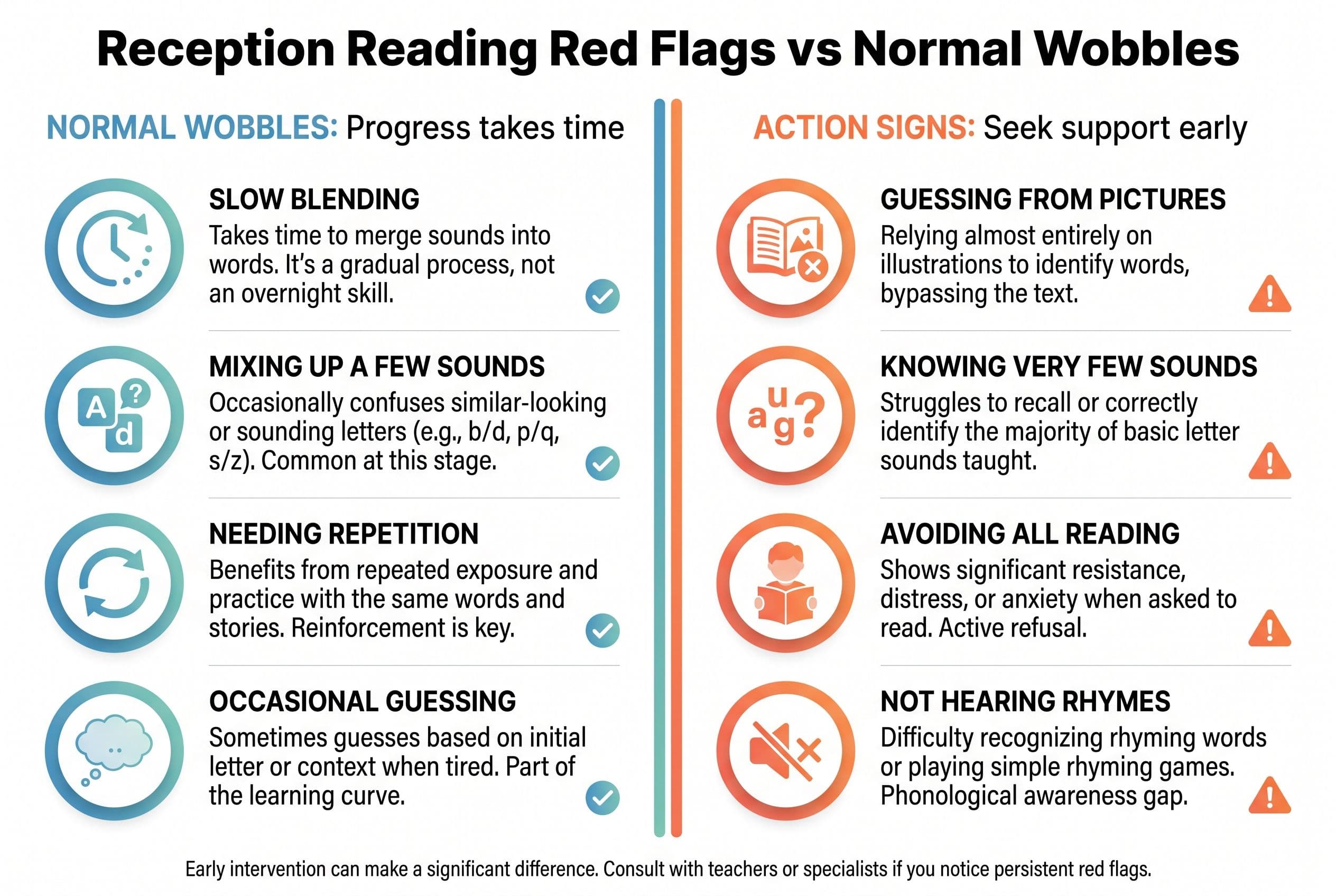
Some Reception children take longer to blend sounds. Fine. Kids aren't factory biscuits. But if your child can't recognise many letter sounds, can't blend simple CVC words like sat, pin and dog, or guesses from pictures instead of looking at the letters, you need a plan.
I'm Xia Brody, co-founder of TeachYourKidToRead.org, a Chinese-American homeschooling mum of four. I'm in the US, but the phonics problem doesn't care about borders. A child in London, Leeds, Cardiff or Auckland still has to map sounds to print the same way.
Reading isn't magic.
It's a taught skill.
And yes, we practise it even when someone would rather lick yoghurt off the table. Ask me how I know.
Tiger Truth: Waiting Can Cost Your Child More Than You Think
Look, I hate the “they'll read when they're ready” line. It sounds gentle. It often does damage.
A Reception child not reading yet may still catch up beautifully with the right daily practice. But a Reception child who spends a whole year memorising books, guessing from pictures and avoiding blending sounds can walk into Year 1 (ages 5-6) already behind.
And Year 1 has a very real checkpoint: the Phonics Screening Check.
In England, children sit the Phonics Screening Check at the end of Year 1. They read 40 words: 20 real words and 20 pseudo-words, often called “alien words”. The expected standard has usually been 32 out of 40. If a child doesn't meet it, they re-sit in Year 2 (ages 6-7).
That check isn't everything. But it tells you something serious: can your child decode unfamiliar words, or are they guessing?
Because guessing falls apart fast.
Imagine Lily sees ship beside a picture of a boat and says “boat”. Everyone smiles because the sentence still sort of makes sense. But Lily didn't read. She used a picture clue. Now put ship on a plain white card with no picture. Gone. Total shutdown.
That's the problem with three-cueing and old Balanced Literacy habits. They train children to look everywhere except the letters.
The APM Reports podcast Sold a Story by Emily Hanford exposed this beautifully and brutally in 2023. After it came out, my neighbour — a teacher who'd taught young children for 18 years — called me almost in tears. She'd used Lucy Calkins' Units of Study for years: three-cueing, MSV, the whole thing. She said, “I've been teaching kids to guess for two decades and I didn't even know it.”
She switched to UFLI Foundations mid-year. It was messy. She had to relearn the method herself first, which is humbling when you've been teaching longer than some parents have been alive. But by spring, her class had jumped an average of 15 points on their nonsense-word decoding checks. For the first time in her career, every single child in that class could decode CVC words by February.
That stuck with me.
The method matters.
What Reception Reading Should Look Like
A 5 year old struggling to read UK books doesn't need shame. They need clear targets.
By the end of Reception, many children can:
- Say most common letter sounds quickly
- Blend simple CVC words like mat, sit, ten and hop
- Read some Phase 2 and Phase 3 graphemes from Letters and Sounds
- Recognise a small number of tricky words like the, to, I and no
- Read short decodable books matched to the phonics they've already learnt
Notice what I didn't say: memorise a levelled book from the pictures.
Reception reading should centre on systematic synthetic phonics. That means your child learns the sound-spelling link, blends sounds left to right, reads words using the code and practises with decodable books.
Read Write Inc, Little Wandle and Jolly Phonics all use explicit phonics routines. Schools vary in quality, of course. A programme on paper doesn't teach your child — a trained adult using it well does.
Reading Readiness: Real Thing or Excuse?
Reading readiness exists. But people abuse the phrase.
A child may need stronger oral language, more attention stamina or more phonological awareness before reading clicks. That's normal. My own 4-year-old can blend beautifully one day and then act like the letter m personally insulted him the next. Welcome to parenting.
But “reading readiness” doesn't mean waiting six months whilst doing nothing.
It means building the foundation:
- Phonological awareness: hearing rhymes and clapping syllables
- Phonemic awareness: identifying the first sound in a word
- Oral blending: “What word is /m/ /a/ /t/?”
- Phonics: linking graphemes to phonemes, like s says /s/
These don't have to line up like soldiers before your child is allowed to touch print. They can grow together. You can play rhyme games, practise oral blending and teach letter-sounds in the same season of life. Shocking, I know.
Linnea Ehri's 2005 work on phases of word reading explains why this matters. Children become better readers as they use more and more sound-spelling knowledge to remember written words. Visual guessing is not a stage we teach on purpose. Orthographic mapping happens when children connect spellings with pronunciations and meanings, so words become automatic over time.
Translation for tired parents: your child has to connect the letters, the sounds and the meaning in their brain. They can't just stare at books and absorb reading through vibes.
Stanislas Dehaene's Reading in the Brain (2009) makes the same point from neuroscience. The brain didn't evolve to read. We train it.
So yes, your child may be “not ready” for fluent reading. But they are ready for sound games, daily letter practice and short blending drills.
No drama. No panic. Just work.
The Common Mistake Parents Make When a Child Gets Stuck
Your child sees cat.
They freeze.
Many parents say, “Look at the picture. What would make sense?”
Nope. Hard no.
That teaches guessing.
Instead, say:
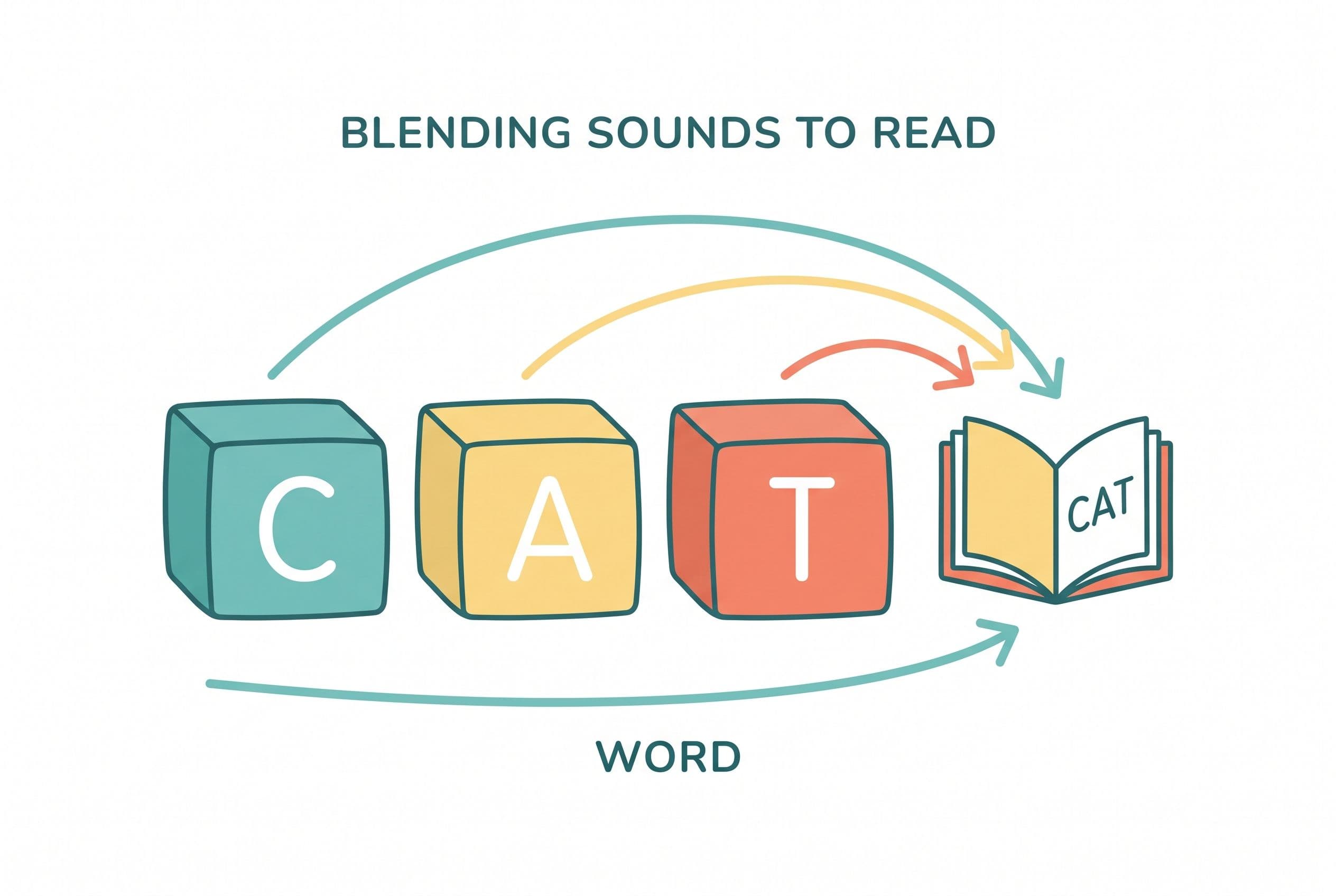
“Point to the first sound. Say each sound. Blend it.”
Then guide:
- /k/
- /a/
- /t/
- cat
Yes, the letter is c, but the sound here is /k/. And please don't add a little “uh” to the consonants. Not /kuh/ /a/ /tuh/. Keep the sounds clean and short, or blending turns into mush.
If they still can't do it, you model it once and have them repeat it. Keep your voice calm. Keep the standard high.
Tiger Rule: No Guessing. Sound it out.
If your child behind in Reception reading has already learnt to guess, you may need to break that habit. It takes patience. It also takes a tiny bit of steel in your spine.
My kitchen-table line is: “Pictures are for enjoying. Letters are for reading.”
Works wonders.
The Research Is Clear: Systematic Phonics Wins
The National Reading Panel — a US federal reading panel, so not a UK policy body — found in its 2000 report that systematic phonics instruction gives children stronger reading outcomes than less explicit approaches.
That doesn't mean every phonics worksheet, every synthetic phonics lesson or every Orton-Gillingham-inspired product is automatically magic. Don't be ridiculous. The research backs explicit, systematic teaching of the code. The quality of the sequence, the teaching and the practice still matter.
The Clackmannanshire study by Johnston and Watson (2005), right there in Scotland, followed children taught synthetic phonics and found strong long-term reading and spelling results. Like all studies, it had design limits, so don't use it like a wooden club at parents' evening. Use it for the big point: systematic phonics deserves serious attention.
Louisa Moats' 1999 paper Teaching Reading IS Rocket Science also nailed the core issue: many teachers never receive deep training in how the English writing system works.
That's why parents can't outsource this completely.
I love good teachers. I really do. But if your child is drowning in phonics, you don't wait until parents' evening, nod politely and hope the book band fairy fixes it.
You help your Reception child read at home.
Every day.
Short. Sharp. Non-negotiable.
The Solution: Teach Your Kid to Read With a Real Phonics Plan
Teach Your Kid to Read uses the boring stuff that works. I say boring with affection.
We're talking:
- Systematic synthetic phonics
- Orton-Gillingham principles
- Sound-by-sound blending
- Decodable word practice
- No guessing from pictures
- Review until mastery
This is how reading becomes independence.
The app doesn't ask your child to memorise random sight words as whole shapes. It doesn't throw them into books they can't decode. It builds the code step by step so your child can read words they've never seen before.
That's the whole point.
If your search history says help my Reception child read, your next move isn't buying fourteen glittery workbooks from the supermarket. The real deal is daily practice with the right sequence.
You want your child to think:
“I know the sounds. I can blend them. I can read this.”
That's confidence rooted in skill, not sticker-chart theatre.
Your 15-Minute Reception Reading Rescue Plan
Do this five or six days a week. Yes, even at weekends. We Never Skip. Birthdays get cake and phonics. Christmas gets presents and phonics. Holidays get sand in your shoes and phonics.
Keep it short. Keep it cheerful. Keep it moving.
1. Check the Sounds First
Start with 5 minutes of grapheme-phoneme practice.
Show letters or digraphs your child has already met at school. Ask for the sound, not the letter name.
Use Phase 2 first:
- s
- a
- t
- p
- i
- n
- m
- d
Then add Phase 3 only when Phase 2 feels quick:
- sh
- ch
- th
- ng
- ai
- ee
- oo
If your child takes three seconds for every sound, don't rush into books yet. Speed matters because blending depends on holding sounds in memory.
2. Drill Oral Blending
Say the sounds. Your child says the word.
Try:
- /s/ /u/ /n/ — sun
- /m/ /a/ /p/ — map
- /f/ /i/ /sh/ — fish
- /ch/ /i/ /p/ — chip
Do this in the car, in the bath, whilst putting shoes on. My 4-year-old has blended words whilst eating toast with jam on his elbow. Literacy is not always elegant.
3. Read CVC Words on Plain Cards
No pictures.
Pictures tempt guessing.
Write three words:
- sat
- pin
- dog
Have your child touch each sound and blend. If they guess, cover the word and reset.
Say: “Try again. Look at the letters.”
That line will save you months of nonsense.
4. Use Decodable Books Only
A decodable book matches the phonics your child knows.
If your child only knows Phase 2 sounds, don't hand them a book full of light, chair and because. That's not reading practice. That's frustration in a book bag.
Ask your reception teacher:
“Is this book fully decodable based on the sounds my child has learnt?”
If the answer gets fuzzy, pay attention.
5. Track One Tiny Win
Don't write a novel. Just track one skill.
For example:
- Monday: read sat, pin, mat with help
- Tuesday: read sat and mat alone
- Wednesday: mixed up p and b
- Thursday: blended five CVC words without guessing
This helps you see progress when the day feels like porridge.
6. Ask for Specific School Feedback
At parents' evening, don't ask, “Is he doing OK?”
That question gets soft answers.
Ask:
- Which phonics phase is my child working in?
- Which graphemes does my child know securely?
- Can my child blend CVC words independently?
- Is my child guessing from pictures?
- What score range would you expect on a Year 1-style alien word check?
Specific questions get specific information.
When Should You Worry?
Worry enough to act if your Reception child:
- Has persistent trouble learning letter sounds, even after regular teaching and review
- Can't blend orally, even with simple sounds like /m/ /a/ /t/
- Guesses words from pictures or first letters
- Avoids reading every single time
- Can't remember sounds from one day to the next
- Has a family history of dyslexia
- Struggles to hear rhymes or break words into sounds
Don't panic. But don't float.
The International Dyslexia Association explains that early signs can include trouble with phonological awareness, letter-sound learning and rapid word recognition. If you see those signs, ask for support early.
You can also use David Kilpatrick's PAST — the Phonological Awareness Screening Test — to look at one part of the picture: phonological awareness. It doesn't diagnose dyslexia, and it doesn't tell you everything about reading. Used by a trained adult or a very informed parent, it can show whether your child struggles with syllables, onset-rime or phoneme-level tasks. Then you take that information to the teacher or SENCO and make a plan like a grown-up with a clipboard and a mission.
That matters because you don't fix blending by reading harder books. You fix the missing sub-skill.
Bottom line: if your gut says something's off, listen.
What If the School Says “They're Still Young”?
Maybe they're right.
Maybe your child just needs more time with Phase 2 and Phase 3. But “more time” should still include daily explicit phonics practice.
Say this kindly but firmly:
“I understand children develop at different rates. Can we agree on the exact sounds and blending targets we'll practise for the next four weeks?”
That's reasonable. That's not being pushy. That's being a literate adult in charge of another future literate adult.
If your child receives random levelled readers they can't decode, ask for decodable books. If they bring home books that require guessing, read them aloud for pleasure, but don't count them as decoding practice.
Pleasure reading and reading instruction are not the same thing.
Both matter. Don't mix them up.
FAQ
Is it normal for a 5 year old in Reception not to read yet?
Yes, it can be normal, especially early in Reception. But by the later part of Reception, your child should usually make progress with letter sounds and simple blending. If they can't blend CVC words or keep guessing from pictures, act now.
Should I teach phonics at home if the school already does it?
Yes. Keep it aligned with school if you can, but don't assume school practice is enough. Five to fifteen minutes a day at home can make a huge difference, especially for a child who needs more repetition.
What books should my Reception child read?
Use decodable books matched to the sounds your child knows. Read Write Inc, Little Wandle and Jolly Phonics schools often send home matched readers. Avoid books that force your child to guess from pictures.
What if my child hates reading practice?
Shorten it. Don't quit it. Do 5 minutes of sounds, 5 minutes of blending and one tiny win. Keep your face calm, your expectations clear and the lesson brief.
Could it be dyslexia?
Maybe, especially if there's a family history or your child struggles with rhyming, sound awareness, letter memory and blending. Ask the school for support and consider a phonological awareness screener like Kilpatrick's PAST.
Final Word: Don't Panic, But Don't Wait
If you're thinking, my 5 year old can't read Reception, the answer isn't panic.
The answer is action.
Teach the sounds. Practise blending. Use decodable books. Ban guessing. Ask sharper questions. Track progress.
Your child doesn't need a magic reading personality. They need a Foundation, a Drill and a grown-up who refuses to drift.
Start today with Teach Your Kid to Read.
Need more support? Visit start lesson one free or get help through contact us today.
Part of these guides

Xia Brody
Co-Founder, Teach Your Kid to Read
Mom of 4 who has successfully taught her kids to read. Currently in the trenches with her 4-year-old while her two oldest (10 and 7) devour books on their own. Passionate about phonics-based methods and building a lifelong love of reading.
Related Articles
My First Grader Can't Read? The 90-Day Catch-Up Plan
If your 6-year-old is guessing at words, memorizing books, or melting down at the page, you don't have a motivation problem — you have an instruction problem. Here's the exact 90-day catch-up plan I'd run, starting tonight.
Read More →
Best Reading App for a Struggling 7-Year-Old (2026): What Actually Works
Most reading apps for struggling 7-year-olds are glorified guessing games dressed up with cartoon characters. Here's what the science of reading actually says works — and the one app I trust with my own kids.
Read More →
Best Reading App for Struggling Readers: 2026 Guide for 5-Year-Olds
Most reading apps for kids are glorified guessing games with cartoon characters. If your 5-year-old is struggling to read, you need an app built on phonics science — not one that teaches them to memorize words from pictures. Here's what actually works in 2026.
Read More →