Reading.com vs Reading Eggs: Which App Is Actually Worth It in 2026?

What You'll Learn
- The phonics methodology problem hiding inside one of these apps that most parents never notice
- Why one of these programs leans on a method that dozens of states are now legislating against — and what that means for your kid
- The specific features that actually matter for reading progress (hint: it's not the animated eggs)
- What I'd recommend instead if neither app fully delivers on Science of Reading principles
Let's Cut to It: Most Reading Apps Are Dressed-Up Guessing Games
Your kid taps some colorful buttons, watches a cartoon chicken dance, earns a virtual trophy, and you think learning happened.
It didn't.
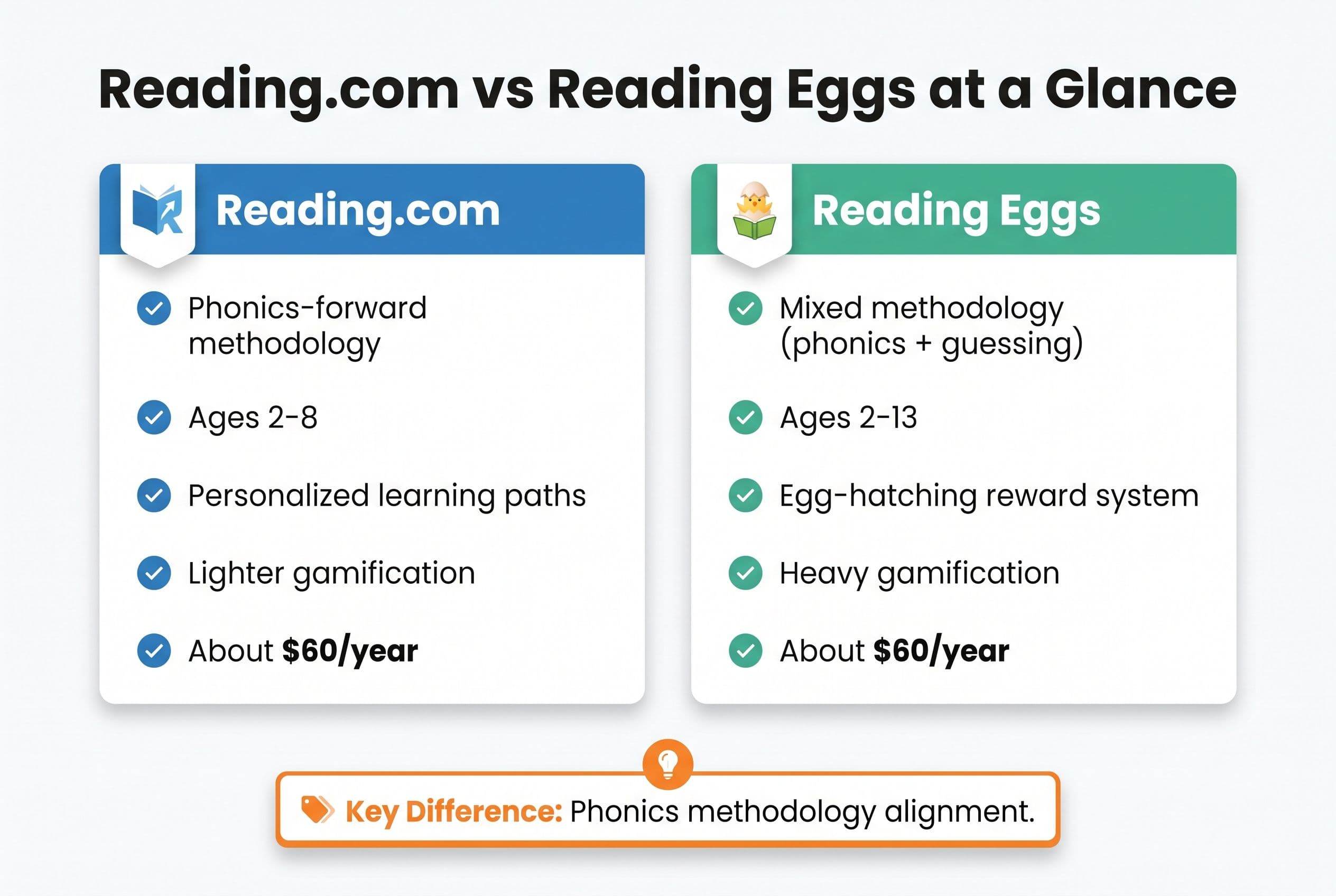
I've spent the last seven years teaching my own kids to read — four of them, ages 10, 7, 4, and 1 — and I've tested more reading apps than I care to admit. Reading.com and Reading Eggs are two of the most popular options parents ask me about, and I get why. They're colorful, they're gamified, and they promise your kid will learn to read while having "fun."
But here's what I've learned the hard way: fun without systematic phonics instruction is just entertainment. And entertainment doesn't teach your kid to decode the word "splint."
I know this because I was at a playground in Raleigh last year when another mom told me her kid's school had just switched from Lucy Calkins to a Science of Reading curriculum because of North Carolina's Excellent Public Schools Act. She was confused. A little annoyed, actually. "He was doing fine before," she said. So I asked if her second grader could read the word "splint." He could not. I spent 20 minutes on that playground bench explaining why the switch was happening — Emily Hanford's APM Reports investigation Sold a Story, the NAEP data showing only 33% of 4th graders read at proficient level, the cognitive neuroscience research — including work from Stanislas Dehaene's lab — showing that reading isn't a natural developmental process like speech. The brain has to be explicitly taught to map print to sounds. She went home and watched the Sold a Story podcast that night. Texted me at 11pm: "I had no idea. Why didn't anyone tell us this sooner?"
That conversation is the reason I'm writing this comparison. Because the app you pick for your kid matters more than you think — and the wrong one can train habits that are genuinely hard to undo.
The Tiger Truth: What Happens When You Pick the Wrong App
Let me be aggressive here because the stakes are real.
Kids who can't read by 3rd grade are four times more likely to drop out of high school. That's from the Annie E. Casey Foundation's 2010 study, and nobody has successfully disputed it since.
The 2022 NAEP — that's the Nation's Report Card — showed reading scores dropped 3 points since 2019. The largest decline in 30 years. And that was before we accounted for the full post-pandemic fallout.
Remedial reading intervention? Private tutoring can easily run you $10,000 to $15,000 per year out of pocket, depending on your region and the intensity of services. Insurance doesn't cover it. Most school-based interventions are understaffed and use outdated methods.
So when I tell you that one of these two apps leans more heavily on a discredited methodology, I'm not being a snob. I'm telling you that the wrong tool can waste the most critical years of your child's reading development.
Let's actually compare them.
Reading Eggs: What You're Actually Getting
Reading Eggs has been around since 2010. It was developed in Australia by ABC Reading Eggs (Blake eLearning) and targets kids ages 2-13. It's one of the most widely marketed reading apps in the world, and it's in a ton of schools.
Here's what it does well:
- Engaging for young kids. The egg-hatching reward system, the animated characters, the mini-games — my 4-year-old was entertained. I'll give it that.
- Broad scope. It covers phonics, sight words, vocabulary, and comprehension across hundreds of lessons.
- Progress tracking. The parent dashboard shows lesson completion and quiz scores.
- Reading Eggspress extends into older readers (ages 7-13) with comprehension-focused content.
Now here's what bothers me — and it's not a small thing.
The Methodology Problem
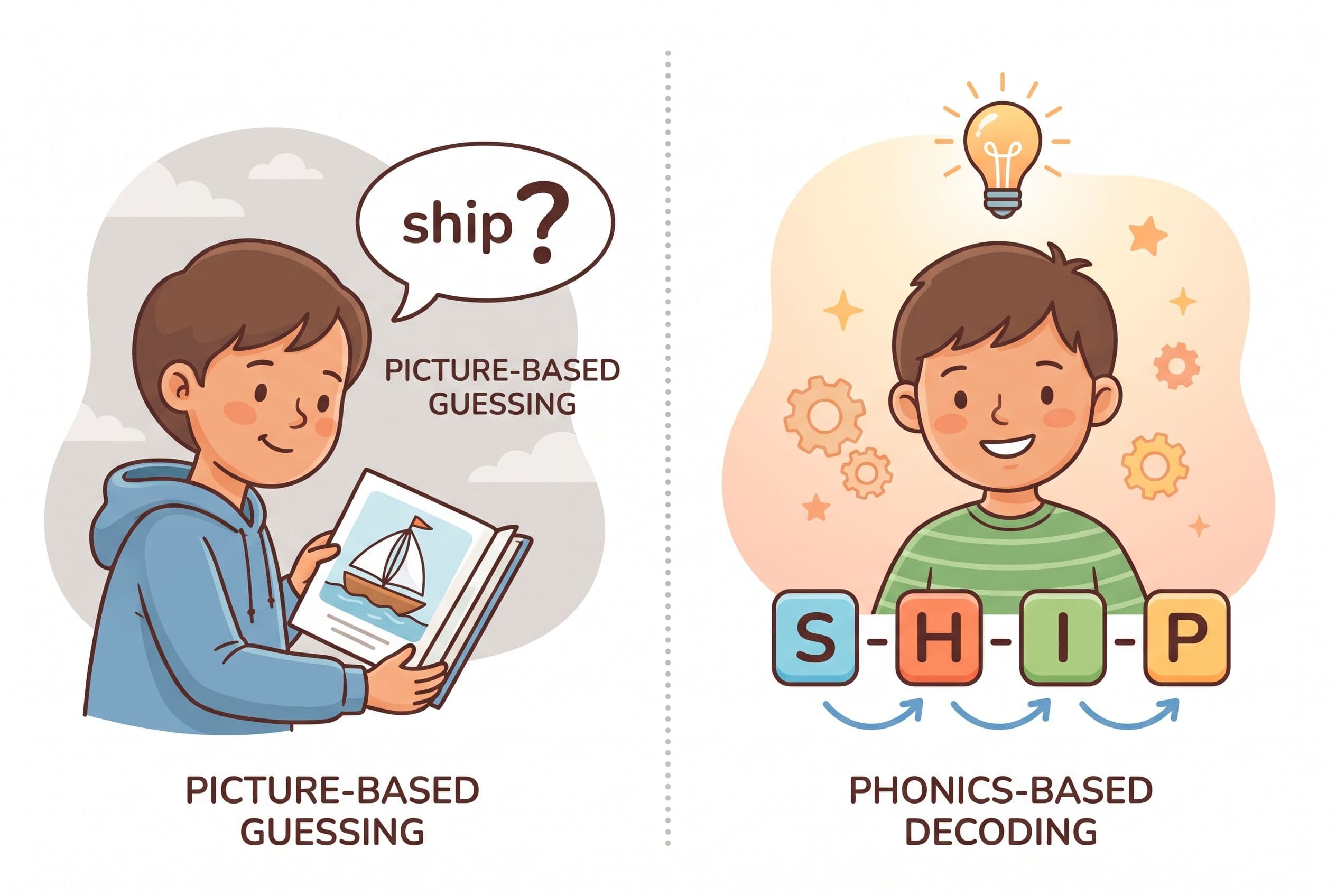
Reading Eggs uses a mixed approach. It teaches some phonics, yes. But it also leans heavily on sight word memorization and contextual guessing strategies. Kids are regularly prompted to look at pictures and predict words. That's Balanced Literacy. That's the exact approach that Emily Hanford exposed in Sold a Story, the method that dozens of states have now passed Science of Reading legislation to move away from.
I watched my 7-year-old use Reading Eggs for a few weeks when a friend recommended it to me. Here's what I noticed: she'd encounter a word she didn't know, glance at the illustration, and guess. The app rewarded her for it because she got the right answer. But she wasn't decoding. She was pattern-matching pictures to words.
That's not reading. That's a party trick.
David Kilpatrick's research in Equipped for Reading Success (2016) explains exactly why this matters. When kids guess instead of orthographically mapping words — connecting each sound to its spelling pattern — they fail to build the neural pathways that make fluent reading automatic. They hit a wall around 2nd or 3rd grade when the texts get harder and the pictures go away.
Reading Eggs isn't all bad. The phonics lessons within it are decent in isolation. But the app doesn't enforce systematic synthetic phonics consistently. It mixes strategies in a way that teaches kids to guess when decoding gets hard.
Cost in 2026: Around $59.95/year for the standard plan, with family plans available. They run frequent sales.
Reading.com: What You're Actually Getting
Reading.com (formerly known as Homer) rebranded a couple years back and positions itself as a "learn to read" app for kids ages 2-8. It's based in New York and has attracted significant venture capital funding.
What it does well:
- Personalized learning paths. It adjusts based on the child's demonstrated skill level, which is better than a one-size-fits-all approach.
- Phonics-forward branding. They explicitly market themselves as phonics-based and reference the Science of Reading in their materials.
- Clean interface. The design is less chaotic than Reading Eggs. Fewer distracting bells and whistles.
- Story integration. It weaves phonics practice into stories, which can help with engagement.
The Reality Check
Reading.com is better on the phonics front than Reading Eggs. I'll say that clearly. It sequences letter-sound instruction more systematically and doesn't lean as heavily on picture guessing.
But.
It's still an app. And no app I've tested fully replicates the kind of explicit, systematic, multi-sensory phonics instruction that methods like Orton-Gillingham deliver. Reading.com doesn't do dictation. It doesn't require the child to physically write or trace letters while saying sounds. It doesn't isolate phonemes the way a structured program like UFLI Foundations or Fundations does in a lesson sequence.
The gamification is lighter than Reading Eggs, which I actually prefer — fewer rewards for guessing, more emphasis on correct decoding. But the pacing can be uneven. My 7-year-old breezed through sections she already knew and then hit a wall when the app jumped to multi-syllable words without enough scaffolding in between.
The adaptive algorithm is smart, but it's not a substitute for a parent (or teacher) who can hear exactly how a child is blending sounds and correct in real time. An app can tell you the kid tapped the wrong answer. It can't tell you the kid is guessing "ship" because she looked at a picture of a boat.
Cost in 2026: Around $7.99/month or roughly $59.99/year. They also run promotions periodically.
Head-to-Head: Reading.com vs Reading Eggs
Let me break this down the way I actually evaluate these things — not with vague "4.5 stars" ratings but with the specific things that matter for whether your kid actually learns to read.
Phonics Methodology
Reading.com wins. It's more aligned with systematic synthetic phonics. Reading Eggs mixes in too many Balanced Literacy strategies — picture guessing, whole-word memorization — that undermine the phonics lessons it does include. The National Reading Panel report from 2000 was clear: systematic phonics instruction produces significant benefits for kids in K-6. Both apps teach some phonics, but Reading.com sequences it more consistently.
Engagement (For the Kid)
Reading Eggs wins. If we're purely talking about which app your kid will beg to play, it's the one with the dancing eggs and the treasure chests. My 4-year-old asks for Reading Eggs. She doesn't ask for Reading.com. But this is exactly the trap I warn parents about. Engagement without correct methodology is just screen time with a phonics veneer.
Parent Oversight & Transparency
Roughly a tie, but both are weak. Neither app gives parents the kind of diagnostic data that actually matters. I want to know: Can my kid segment the phonemes in "splint"? Can she blend CCVC words? What's her nonsense word fluency? If you want that, you need to administer something like Kilpatrick's PAST (Phonological Awareness Screening Test) yourself. It takes about 5 minutes and tells you exactly where the phonological breakdown is. Neither app offers anything close to that level of insight.
Multi-Sensory Instruction
Neither wins. Real multi-sensory phonics instruction — the kind used in Orton-Gillingham, Wilson Reading System, or Lindamood-Bell — involves the child seeing, hearing, saying, AND writing simultaneously. Tapping a screen is one modality. That's it. Neither app does dictation, sandpaper letters, arm tapping, or any of the tactile/kinesthetic methods that decades of research support for building orthographic memory.
Cost
Basically identical in 2026. Both run about $60/year. The real cost question isn't which app is cheaper — it's whether either app is worth $60 when free and low-cost alternatives exist that are more methodologically sound.
Age Range
Reading Eggs has broader coverage (2-13 vs 2-8). Reading.com tops out around age 8, so if you have older kids who need support, Reading Eggs offers Reading Eggspress for comprehension practice. But honestly, if your 10-year-old still needs a reading app, you probably need a structured intervention like Barton Reading & Spelling, not a game.
The Real Question: Is Either App Enough?
No.
I need to be honest with you because that's the whole point of this site.
Both Reading.com and Reading Eggs can serve as supplements to a real reading program. Neither is a reading program on its own. And this is where most parents get tricked. They hand a kid an iPad, the kid taps through lessons for 15 minutes, and the parent assumes instruction happened.
Mark Seidenberg — a University of Wisconsin cognitive scientist — laid this out in Language at the Speed of Sight (2017). He called out the entire reading education establishment for prioritizing engagement over evidence-based instruction. Apps are part of that problem. They prioritize what keeps kids tapping, not what builds the neural circuitry for fluent reading.
Here's what actually works, according to the research:
- Explicit, systematic synthetic phonics taught in a structured sequence (not random letter-of-the-week)
- Multi-sensory practice — seeing, hearing, saying, and writing simultaneously
- Decodable readers that match the phonics patterns taught (not leveled readers like Fountas & Pinnell that encourage guessing)
- Daily practice — 15-20 minutes, every single day, no skipping
- Immediate corrective feedback from a human who can hear how the child is blending
Apps can handle #1 partially. They completely fail at #2, #3, and #5.
What I Actually Recommend (And Use With My Own Kids)
Look, I didn't build TeachYourKidToRead.org because I thought the app market was great. I built it because I saw what was missing.
Teach Your Kid to Read is built on Orton-Gillingham principles — the same methodology that the International Dyslexia Association recommends. Systematic synthetic phonics. Explicit instruction. No guessing from pictures. No "three-cueing" nonsense.
Here's what makes it different from both Reading.com and Reading Eggs:
- It's parent-guided. You're in the loop. You hear your child decode. You correct in real time. The app doesn't replace you — it equips you.
- It follows a strict phonics sequence. No jumping around. No mixing in whole-word memorization to keep things "fun." CVC words before blends. Blends before digraphs. Digraphs before vowel teams. The way the research says it should go.
- No guessing allowed. If the child doesn't know a word, they sound it out. Period. No picture clues. No context clues. Sound. It. Out.
My two oldest — ages 10 and 7 — are both reading well above grade level. My 4-year-old is currently working through CVC words at the kitchen table. On her birthday last month, she did her phonics practice before cake. Tiger Rules. We Never Skip.
The Action Plan: How to Actually Choose (and Use) a Reading App
If you're still deciding between Reading.com and Reading Eggs — or you already have a subscription — here's exactly what I'd do:
Step 1: Test Your Kid's Current Level
Before you spend a dollar on any app, figure out where your child actually is. Download Kilpatrick's PAST (Phonological Awareness Screening Test) — it's free and takes 5 minutes. If your kid can't segment and blend individual phonemes, no app is going to fix that without explicit instruction.
Also check: Can your kid name all 26 uppercase and lowercase letters? All 26 letter sounds (including short vowels)? Can they blend three sounds together orally (not reading, just listening): /k/ /a/ /t/ = cat? If the answer to any of these is no, start there. Not with an app. With you, a whiteboard, and 10 minutes a day.
Step 2: If You Must Choose One, Choose Reading.com
It's more aligned with the Science of Reading. Not perfect. But better than Reading Eggs on methodology. Use it as a supplement for 10-15 minutes a day, not as your primary instruction.
Step 3: Watch Your Kid Like a Hawk
Sit next to them for at least the first two weeks. Watch what they actually do. Are they sounding out words or guessing? Are they looking at pictures before attempting to decode? If you see guessing behavior, the app is training the wrong habit — and you need to intervene immediately.
Step 4: Add a Real Phonics Program
Use the app as dessert. The main course should be a structured phonics program. UFLI Foundations is free and excellent for parents who want a scripted lesson plan. Explode the Code workbooks are cheap and effective for extra decoding practice. Teach Your Kid to Read gives you the full parent-guided system with Orton-Gillingham sequencing.
Step 5: Track Progress With Real Benchmarks
Don't rely on the app's progress dashboard. Use actual benchmarks. The DIBELS 8th Edition benchmark goals give you specific targets by grade level and time of year — check your child's Nonsense Word Fluency (NWF) scores in kindergarten and first grade, and Oral Reading Fluency (ORF) scores starting in first grade. If your kid isn't meeting benchmark at their grade level, the app isn't working. Time to change the plan.
A Final Word From a Mom Who's Done This Four Times
I know the allure of apps. I really do. I have four kids, I'm homeschooling, and some days I would love to hand my 4-year-old an iPad and call it "reading time" while I deal with the 1-year-old eating crayons.
But here's what I keep coming back to: Mississippi went from 49th to 21st in national reading scores in 6 years after passing the Literacy-Based Promotion Act of 2013. They didn't do it with apps. They did it with systematic phonics instruction, teacher training, and early intervention. The dozens of states that have passed Science of Reading legislation since 2019 aren't mandating more screen time. They're mandating better teaching.
Your kid doesn't need a fancier app. Your kid needs you — armed with the right method, showing up for 15 minutes every single day, demanding accuracy, and refusing to let them guess.
Reading.com is a decent supplement. Reading Eggs is a flashy one. Neither is a complete solution.
Teach Your Kid to Read gives you the method, the sequence, and the parent-guided structure that the research actually supports. That's not a sales pitch. That's what I use with my own children.
FAQ
Is Reading.com the same as Homer Reading?
Yes. Reading.com was previously called Homer (or Homer Reading). They rebranded, but the core product and team are the same. The 2026 version has been updated with additional content, but the phonics-forward approach has remained consistent since the rebrand.
Is Reading Eggs based on the Science of Reading?
Not entirely. Reading Eggs incorporates some phonics instruction, but it also uses Balanced Literacy strategies — including picture-based guessing and whole-word memorization — that are not aligned with the Science of Reading as defined by the National Reading Panel or current state legislation. If Science of Reading alignment is your priority, Reading.com is the better choice between the two, though neither fully replaces a structured phonics program.
Can my child learn to read using only an app?
I wouldn't bet on it. Apps can supplement instruction, but they can't provide the multi-sensory, corrective-feedback-rich, explicit phonics teaching that the research supports. Linnea Ehri's phases of word reading development — from pre-alphabetic through consolidated — require iterative, scaffolded instruction that no current app fully delivers. Pair any app with a parent-guided or teacher-led phonics program for real results.
What age is best to start Reading.com or Reading Eggs?
Both apps market to kids as young as 2, but I wouldn't use either as an instructional tool before age 4. Before that, focus on phonological awareness activities — rhyming, clapping syllables, identifying first sounds in words. These pre-reading skills don't require a screen. They require you talking to your child. After age 4, if you use an app, sit with your kid and monitor for guessing behavior.
How does Teach Your Kid to Read compare to these apps?
Teach Your Kid to Read is built on Orton-Gillingham principles with systematic synthetic phonics sequencing — the methodology recommended by the International Dyslexia Association. Unlike Reading.com and Reading Eggs, it's designed as a parent-guided program where you're actively involved in every lesson. No picture guessing. No mixed methodology. It's structured, sequential, and based on the same research that's driving the Science of Reading movement across the country. You can learn more at start lesson one free.

Xia Brody
Co-Founder, Teach Your Kid to Read
Mom of 4 who has successfully taught her kids to read. Currently in the trenches with her 4-year-old while her two oldest (10 and 7) devour books on their own. Passionate about phonics-based methods and building a lifelong love of reading.
Related Articles

Reading Eggs vs ABCmouse vs HOMER: Honest 2026 App Comparison
Not all reading apps are created equal. I broke down Reading Eggs, ABCmouse, and HOMER by their actual phonics instruction, what the reading science says, and which one (if any) deserves your kid's screen time in 2026.
Read More →
Reading.com vs HOMER: Which App Is Better in 2026?
Reading.com and HOMER are two of the most popular reading apps for young kids, but they take very different approaches. Here's a brutally honest comparison of what each app actually does — and what the reading science says about both.
Read More →
Reading Eggs vs ABCmouse: One Teaches Reading, One Doesn't
Both apps look colorful and fun. Only one actually teaches your kid to read using real phonics. Here's my honest breakdown of Reading Eggs vs ABCmouse after using both with my own kids — and why neither app is enough on its own.
Read More →