Reading Eggs vs ABCmouse: One Teaches Reading, One Doesn't
What You'll Learn
- The fundamental difference between an app that entertains and an app that teaches phonics — and how to tell which is which in under 5 minutes
- Why one of these apps relies on the same "three-cueing" guessing method that 40+ states have now moved to restrict or eliminate from classrooms
- The specific phonics gaps both apps leave wide open — and what your kid actually needs to fill them
- A no-nonsense action plan for parents who want their child reading real words, not tapping cartoon eggs for digital rewards
Let's Get Real: Your Kid Tapping a Screen Isn't Reading
Your child has been on ABCmouse for six months. They can navigate the app like a tiny CEO. They collect stickers, "level up," and tell you they finished another "lesson."
But hand them a book with the word brush in it and they stare at you.
Sound familiar?
I see this constantly. Parents email me, DM me, and — in one memorable case — corner me at a Raleigh playground to ask why their kid seems so "smart" on the app but can't decode a simple word on paper. The app gave them confidence. It did not give them phonics.
That's the core problem with the Reading Eggs vs ABCmouse debate. Parents frame it as "which app is better?" when the real question is: does either app actually teach my child to read?
I've looked closely at both. And I'm going to give you the honest answer.
The Tiger Truth: What Happens When You Outsource Reading to an App
Before I break down Reading Eggs or ABCmouse feature by feature, I need you to hear this.
Only 33% of fourth graders in the United States read at a proficient level. That's from the 2022 NAEP — the Nation's Report Card. Two out of three kids can't read grade-level material by fourth grade. And scores have dropped significantly — a 3-point decline compared to 2019, the largest drop in 30 years.
So what? So this: kids who can't read by third grade are four times more likely to drop out of high school. That stat comes from the Annie E. Casey Foundation's 2010 study, and it hasn't gotten better.
The 3rd Grade Cliff is real. After third grade, kids stop learning to read and start reading to learn. If they haven't cracked the code by then, every subject — science, history, even math word problems — becomes a brick wall.
And here's what drives me crazy: parents assume an app is handling it. They see their kid engaged. They see progress bars filling up. They think, "Well, she's learning something." Meanwhile, the app is teaching their child to recognize words by shape and context clues — the exact guessing strategy that the APM Reports investigation "Sold a Story" by Emily Hanford exposed as junk science.
I was at a playground in Raleigh when another mom told me her kid's school had just switched from Lucy Calkins to a Science of Reading curriculum because of North Carolina's SB 387 — the Excellent Public Schools Act. She was confused and honestly kind of annoyed. "He was doing fine before," she said. I asked if her son could read the word splint. He's in second grade. He could not. He looked at it and said "split." Close — but that's a guess, not decoding. I spent twenty minutes on that playground bench explaining why the switch was happening. Hanford's reporting. The NAEP data. The neuroscience from Stanislas Dehaene and other cognitive scientists — Dehaene's book Reading in the Brain (2009) synthesizes extensive evidence showing that the brain doesn't learn to read naturally the way it learns spoken language. Reading has to be trained. Letter by letter. Sound by sound. She went home and watched the "Sold a Story" podcast that night. Texted me at 11pm: "I had no idea. Why didn't anyone tell us this sooner?"
Nobody told her because the apps looked like they were working. The school looked like it was working. Everything looked fine until someone handed her kid a word he'd never seen before and he couldn't decode it.
That's the "Wait and See" lie. And apps that prioritize engagement over systematic phonics are part of the problem.
ABCmouse: The Entertainer
Let me be clear — ABCmouse (by Age of Learning) isn't a bad product. It's a beautifully designed digital playground that covers a mile of content: math, science, art, reading, social studies.
But here's the kicker: ABCmouse is a breadth app, not a depth app. It covers reading the way a buffet covers nutrition — a little bit of everything, none of it systematic.
What ABCmouse Gets Right
- Letter recognition — solid. The songs and games for learning letter names are genuinely decent.
- Vocabulary exposure — the themed units (ocean, farm, space) give kids real-world vocabulary.
- Engagement — the reward system, the avatars, the tickets, the hamster. (Yes, there's a virtual hamster.) Kids want to use it.
What ABCmouse Gets Wrong
- No systematic phonics sequence. This is the big one. ABCmouse doesn't follow a scope and sequence that moves from simple grapheme-phoneme correspondences to complex phonics rules in a logical order. It bounces around. A child might encounter the "sh" digraph before they've mastered all single consonant sounds. That's like teaching multiplication before addition.
- Heavy reliance on sight word memorization. ABCmouse treats high-frequency words as shapes to memorize, not as words to decode. This is the old Whole Language playbook. David Kilpatrick's Equipped for Reading Success (2016) explains why this fails: kids who memorize words by visual shape hit a wall around second grade when they encounter thousands of new words they can't just recognize on sight. The brain needs orthographic mapping — connecting sounds to letters — to store words permanently.
- Picture-based guessing. Many of ABCmouse's reading activities show a picture alongside the word. The child isn't decoding; they're looking at a picture of a dog and saying "dog." Imagine your kid looking at the word ship and saying "boat" because there's a picture of a boat next to it. That's not reading. That's a parlor trick.
- No decodable readers. ABCmouse's "books" are leveled readers — the kind aligned with Fountas & Pinnell levels. These look great on paper (Level A! Level B! Level C!), but they're designed around the whole-language approach: predictable patterns, picture cues, and repetitive sentence structures. Your child learns to predict, not decode. If you want real reading growth, you need decodable readers — texts where every word can be sounded out using the phonics rules the child has already learned. Look for readers from Flyleaf Publishing or High Noon Books instead.
Bottom line: ABCmouse is educational entertainment. It's not a reading program.
Reading Eggs: The Phonics App (With Caveats)
Reading Eggs (by Blake eLearning, an Australian company) markets itself specifically as a reading program. And compared to ABCmouse? It actually earns that label.
What Reading Eggs Gets Right
- Systematic phonics instruction. Reading Eggs follows a scope and sequence. It starts with letter sounds (not letter names — that matters), moves to CVC words, introduces digraphs and blends in a logical order, and builds toward multisyllabic words. This aligns with what the National Reading Panel recommended in its landmark 2000 report: systematic, explicit phonics instruction produces significant reading gains.
- Blending practice. The app actually asks kids to blend sounds together — /c/ /a/ /t/ → cat. This is the fundamental skill. If your child can't blend, they can't decode.
- Decodable books built in. Reading Eggs includes decodable readers that match the phonics lesson the child just completed. So after learning the short /a/ sound, they read a book with cat, sat, mat, hat. Every word is decodable with the skills they already have. This is how confidence and competence build together.
- Phonemic awareness activities. The early levels include rhyming, initial sound identification, and sound segmentation. These map to what Linnea Ehri's phases of word reading development (2005) describe as the move from the pre-alphabetic to the partial alphabetic phase.
What Reading Eggs Gets Wrong
- It still gamifies too much. The eggs. The critters. The golden eggs. The map. At some point, your kid is more focused on hatching a digital pet than on the sound /th/ makes.
- The assessment is weak. Reading Eggs places your child on a "map" based on a short quiz, but it doesn't give you the diagnostic data you need. Compare that to something like Kilpatrick's PAST (Phonological Awareness Screening Test) — a 5-minute assessment that tells you exactly where the phonological breakdown is. Reading Eggs gives you a progress bar. You need a diagnosis.
- It doesn't do enough with phonemic awareness at the advanced level. Phonemic awareness isn't just "what sound does B make?" At the advanced level, it's phoneme deletion (say 'steam' without the /t/ sound) and phoneme substitution (change the /m/ in 'map' to /t/). These are strong predictors of early reading success — alongside letter-sound knowledge and decoding practice. Reading Eggs touches the basics but doesn't drill deep.
- No handwriting component. Writing and reading are deeply connected neurologically. Dehaene's research shows that the motor act of forming letters strengthens the brain's letter-sound connections. An app, by definition, can't teach handwriting. Your kid taps and swipes. They don't form letters.
- It's still a screen. And screen time for 3-5 year olds comes with real tradeoffs. The American Academy of Pediatrics recommends no more than one hour of screen time per day for kids ages 2-5.
The Head-to-Head: Reading Eggs vs ABCmouse for Kindergarten
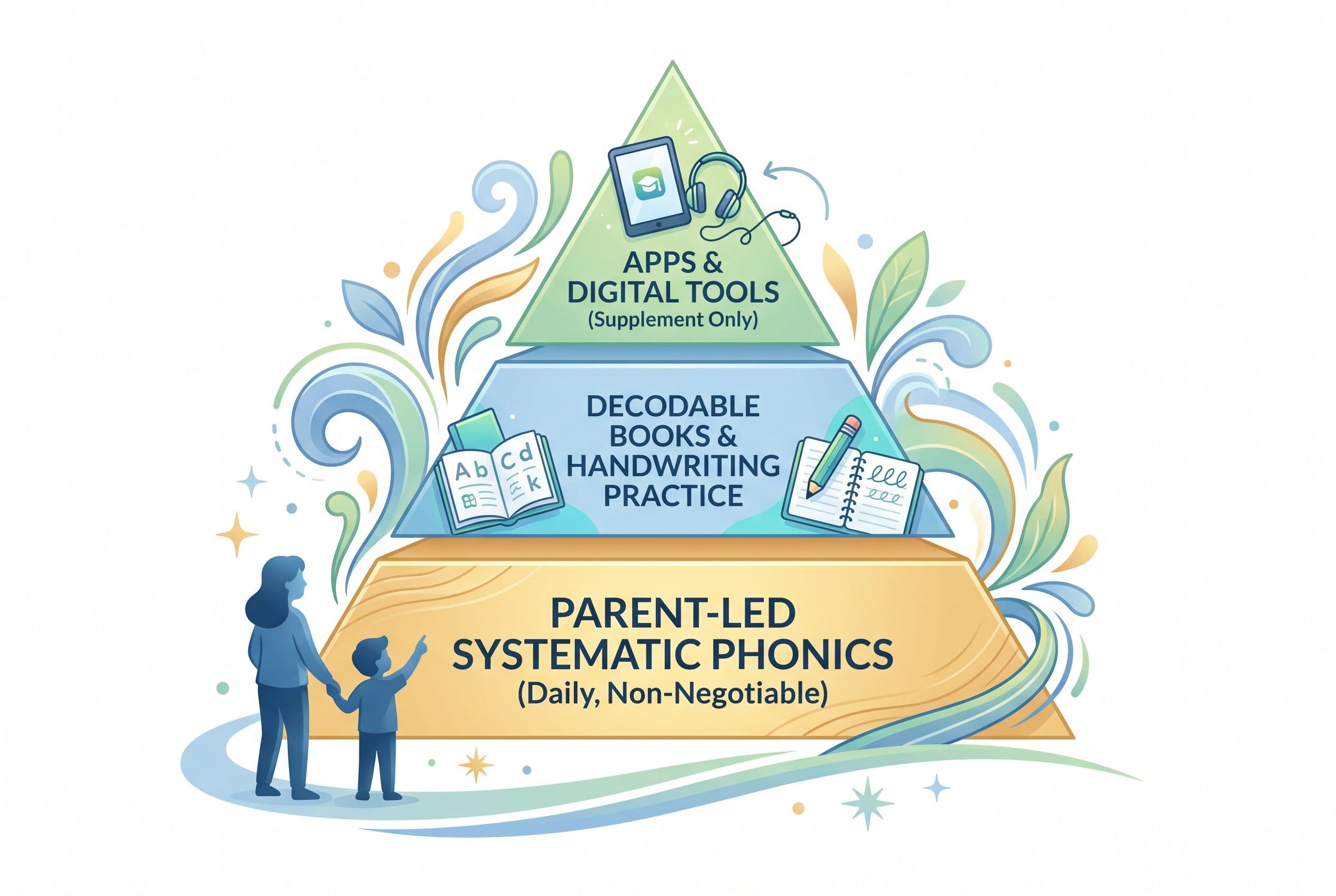
Here's the no-nonsense comparison for parents deciding between ABCmouse vs Reading Eggs for kindergarten:
| Feature | Reading Eggs | ABCmouse |
|---|---|---|
| Systematic phonics sequence | Yes | No |
| Decodable readers | Yes (built in) | No (leveled readers) |
| Blending instruction | Explicit | Minimal |
| Phonemic awareness | Basic to moderate | Basic |
| Scope | Reading-focused | Multi-subject |
| Engagement/gamification | High (too high, honestly) | Very high |
| Handwriting | No | No |
| Diagnostic assessment | Weak | None |
| Price | $99.99/year (as of Oct 2026) | Check ABCmouse's site for current pricing |
| Free trial | Yes (30 days) | Yes (30 days) |
If you're choosing between Reading Eggs or ABCmouse strictly for reading instruction, Reading Eggs wins. It's not even close. Reading Eggs teaches phonics. ABCmouse teaches a little of everything and a lot of nothing.
But — and this is important — Reading Eggs alone is not enough.
Why Neither App Is Enough (And What Actually Works)
Here's the thing nobody making these comparison articles will tell you: no app, by itself, will teach your child to read.
I don't care how good the app is. I don't care how many awards it won. I don't care if it was designed by a team of PhDs in white lab coats.
Reading is not a passive activity. It requires a child to look at squiggles on a page, connect those squiggles to sounds stored in their brain, blend those sounds into a word, and then connect that word to meaning. This is what Scarborough's Reading Rope model shows — it's a braid of word recognition skills (phonics, phonemic awareness, sight recognition) AND language comprehension skills (vocabulary, syntax, background knowledge) that have to twist together.
An app can drill some of the phonics piece. But it can't:
- Hear your child's specific errors. When Emmett says /f/ instead of /th/, I catch it in real time and correct it. An app doesn't hear him.
- Adjust on the fly. If a lesson is too hard, I back up. If it's too easy, I skip ahead. Apps move on a track. Your kid might need to go off-road.
- Teach handwriting. Letters need to be formed by hand. Period.
- Build oral reading fluency. Your child needs to read aloud to a human who listens, corrects, and provides feedback. Not to a cartoon frog that gives them a gold star regardless.
- Develop comprehension through conversation. "What do you think happens next?" "Why did the character do that?" "What does reluctant mean?" These conversations build the language comprehension strand of the Reading Rope. No app does this well.
Louisa Moats said it in 1999 in her paper Teaching Reading IS Rocket Science for the American Federation of Teachers: teaching reading requires deep knowledge of how language works. It's not something you can automate.
The Real Solution: Systematic Phonics Instruction With a Real Human
So what actually works?
Systematic synthetic phonics, taught explicitly, by a person who knows the scope and sequence and won't let your kid skip steps or guess.
That's what programs built on Orton-Gillingham principles deliver. That's what the Science of Reading movement — the one that's driven policy changes in 40+ states since 2019, from Mississippi's Literacy-Based Promotion Act to Colorado's READ Act to North Carolina's SB 387 — is demanding schools adopt.
And that's exactly what we built Teach Your Kid to Read to do.
Our program uses systematic synthetic phonics — the same methodology proven by the National Reading Panel, backed by Dehaene's neuroscience research, and validated by real-world results (Mississippi went from 49th to 21st in national reading scores in six years after implementing systematic phonics). It's designed so that YOU teach your child. Not a cartoon. Not a gamified egg. You.
Here's why that matters: you know your kid. You hear their errors. You see when they're frustrated versus when they're lazy. You can tell the difference between "I don't understand" and "I don't feel like trying." No algorithm on earth can do that.
Your Action Plan: What to Do Right Now
Stop debating Reading Eggs vs ABCmouse and start doing this:
Step 1: Assess where your child actually is. Don't trust the app's progress bar. Give them a real phonemic awareness screening. Kilpatrick's PAST test takes about 5 minutes and tells you exactly which phonological skills your child has mastered and which ones are missing. You can find it in his book Equipped for Reading Success or ask your child's school if they use DIBELS. A quick DIBELS nonsense word fluency (NWF) screening can tell you whether your child's decoding is on track — ask the school for their benchmark chart so you know where your kid stands. By mid-kindergarten, most kids should be blending at least some CVC words; if decoding has stalled, don't wait.
Step 2: Get a systematic phonics program and commit to it. Whether it's Teach Your Kid to Read, UFLI Foundations, Explode the Code workbooks, or Logic of English — pick a program that follows a scope and sequence and stick with it. Daily. My Tiger Rule: We Never Skip. We do phonics on birthdays, Christmas, and vacation. Five to fifteen minutes a day is all it takes. But it has to happen every day.
Step 3: Use decodable readers, not leveled readers. After each phonics lesson, your child reads a book that only contains words they can decode with the skills they've learned so far. No guessing from pictures. No memorizing sentence patterns. Real decoding. Bob Books are a great starting point. Flyleaf Publishing makes excellent decodable texts for older beginners.
Step 4: Kill the guessing. If your child looks at a word and guesses, stop them. Cover the picture. Point to the word. "Sound it out." My other Tiger Rule: No Guessing. Every time your child guesses and you let it slide, you're training their brain to skip the decoding process. You're reinforcing the exact habit that will make reading harder later.
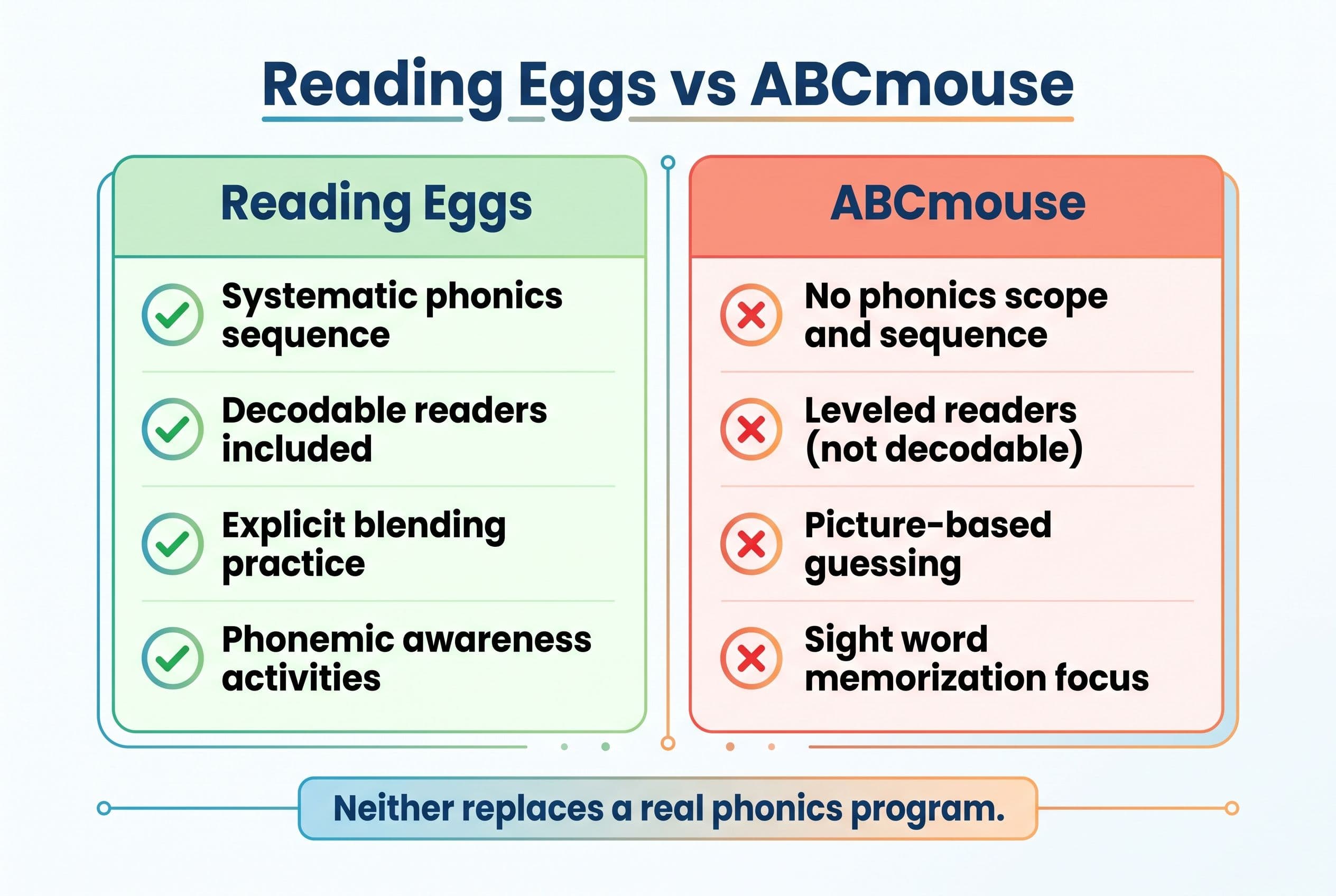
Step 5: If you use an app, use it as a supplement — not the main course. Reading Eggs can reinforce what you're teaching. ABCmouse can be screen time that isn't totally brainless. But neither one replaces you sitting with your child, pointing at letters, and making them blend sounds. Real talk — there's no app that replaces a parent who shows up every day.
Step 6: Track progress with real benchmarks. By end of kindergarten, your child should decode CVC words (cat, pin, bug) independently, know all 26 letter sounds (and common digraphs like sh, ch, th), and read simple decodable sentences without guessing. If they can't? Don't wait. Don't "give it time." Get help now. The International Dyslexia Association has a provider directory if you suspect a learning difference. Remedial reading programs can cost $10,000-$15,000 per year. The research consistently shows early intervention is cheaper, faster, and more effective than waiting — so don't sit on this.
The Bottom Line on Reading Eggs vs ABCmouse in 2026
If someone puts a gun to my head and says "pick one," I pick Reading Eggs. It teaches phonics. ABCmouse doesn't. For a reading app comparison, that's really all you need to know.
But here's what I actually think: neither app is the answer. They're tools. A hammer is a tool. You still need the carpenter.
You're the carpenter.
Your child needs you — a real human who teaches them to decode, corrects their errors, reads with them every night, and refuses to accept guessing as a strategy. That's what Teach Your Kid to Read gives you: the knowledge, the scope and sequence, and the daily structure to make it happen.
Mississippi proved it works. The Science of Reading isn't a fad. It's not a political football. It's decades of cognitive science finally making it into classrooms — and into your living room, if you'll let it.
Your kid's reading future isn't going to be decided by which app has the better cartoon character. It's going to be decided by what you do in the next six months.
So stop scrolling comparison reviews. Start teaching.
Frequently Asked Questions
Is Reading Eggs or ABCmouse better for my 3-year-old?
For a 3-year-old, neither app should be your primary reading tool. At three, focus on phonemic awareness — rhyming games, clapping syllables, identifying beginning sounds in words. Do this out loud, no screen needed. If you insist on an app, Reading Eggs Junior (their 2-4 age range product) introduces letter sounds in a reasonable sequence. ABCmouse at age 3 is mostly songs and games — fine for entertainment, but don't confuse it with reading instruction.
Can ABCmouse teach my child to read by itself?
No. ABCmouse doesn't follow a systematic phonics scope and sequence, doesn't use decodable readers, and relies heavily on picture cues and sight word memorization. These are the exact strategies that Emily Hanford's "Sold a Story" investigation exposed as ineffective. ABCmouse can supplement letter recognition and vocabulary, but it won't teach decoding.
How much screen time should I allow for reading apps?
The American Academy of Pediatrics recommends a maximum of one hour of screen time daily for kids ages 2-5. I'd limit reading app time to 10-15 minutes and spend the rest of your "reading instruction" time on real phonics instruction at the table — with books, letter tiles, whiteboards, and your voice. Screen time is the dessert. Phonics instruction is the meal.
What are the best Reading Eggs alternatives in 2026?
If you want app-based phonics: Homer and Phonics Hero both follow a systematic sequence. But my honest recommendation? Skip the app hunt and use a human-led systematic phonics program. Teach Your Kid to Read, UFLI Foundations, Logic of English, and Explode the Code all give you a clear scope and sequence with explicit phonics instruction. Use the app for 10 minutes of reinforcement after you've done the real lesson.
My child loves ABCmouse. Should I take it away?
Not necessarily — just stop counting it as reading instruction. Let them play ABCmouse for the art, music, and science content. It's decent screen time. But add a separate, systematic phonics block to your day. Even 10-15 minutes of real phonics instruction (blending sounds, reading decodable words, practicing letter formation) will do more for your child's reading ability than an hour on ABCmouse.

Xia Brody
Co-Founder, Teach Your Kid to Read
Mom of 4 who has successfully taught her kids to read. Currently in the trenches with her 4-year-old while her two oldest (10 and 7) devour books on their own. Passionate about phonics-based methods and building a lifelong love of reading.
Related Articles
Reading Eggs vs ABCmouse for 5-Year-Olds: Best Pick
Choosing between Reading Eggs and ABCmouse? Here’s the no-fluff mom verdict on which app actually teaches a 5-year-old to read — and where both fall short.
Read More →
Reading Eggs vs ABCmouse Cost: 2026 Price Breakdown
Comparing Reading Eggs vs ABCmouse cost? Here’s the 2026 price breakdown, what each app teaches, and why I’d choose phonics-first instruction over reward-heavy screen time.
Read More →
ABCmouse vs Reading Eggs for 7-Year-Olds: Best Fit?
Choosing between ABCmouse and Reading Eggs for a 7-year-old? Here’s the no-fluff parent breakdown: who each app fits, where they fall short, and what I’d use first for a struggling reader.
Read More →