Reading Eggs vs ABCmouse Cost: 2026 Price Breakdown
Reading Eggs vs ABCmouse Cost in 2026: Which Reading App Is Worth It?
What You'll Learn
- The price difference between Reading Eggs, ABCmouse, and a cheaper reading app alternative
- The one feature that makes a reading app worth paying for (hint: it’s not animated prizes)
- Why “my kid likes it” doesn’t mean “my kid is learning to read”
- The exact action step I’d take before spending another month on a reading app
Reality Check
Reading apps are cheap compared with tutoring. But cheap garbage is still garbage.
If your child spends 20 minutes clicking around a colorful app and still guesses “pony” for “horse” because the picture looks right, that’s not reading. That’s expensive screen time with confetti.
So if you’re comparing reading eggs vs abcmouse cost, don’t only ask, “Which one costs less?” Ask the tiger-mom question: Which one teaches my child to decode words without guessing?
The Verdict: Reading Eggs vs ABCmouse Cost in 2026
Here’s the short answer before we do the deep dive.
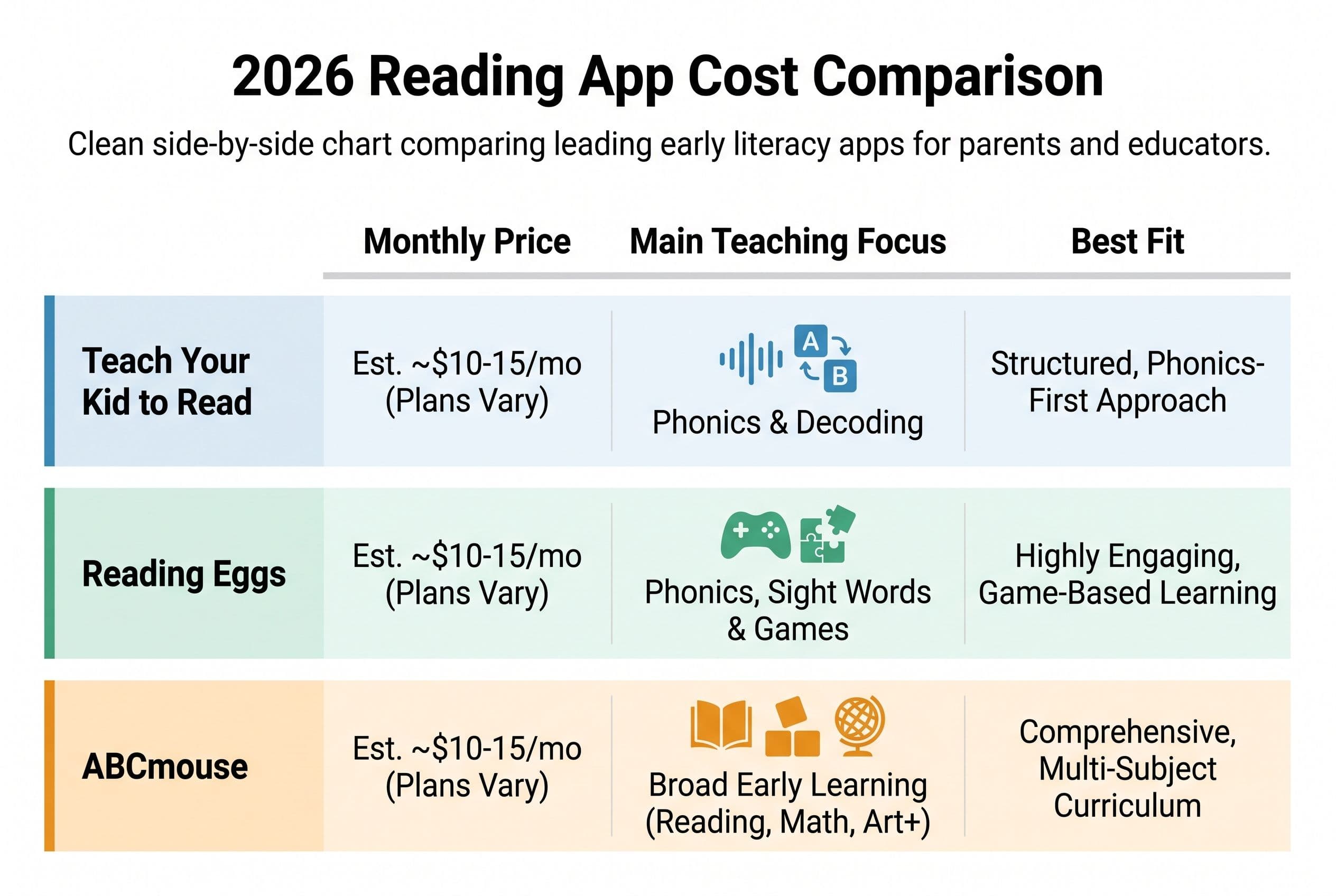
| Rank | App | 2026 Price | What It Teaches | Best For |
|---|---|---|---|---|
| #1 | Teach Your Kid to Read | Lesson one free with no card; from lesson two, 7-day free trial, then US$9.95/month | Systematic phonics, decoding, no guessing | Ages 3-7, especially beginners |
| #2 | Reading Eggs | Often around US$9.99/month or annual plans that vary by promo | Phonics, games, some structured lessons | Ages 4-7 who like game-based practice |
| #3 | ABCmouse | Often around US$12.99/month or discounted annual plans | Broad early learning, reading mixed with math and games | Ages 2-8 needing general enrichment |
If you want my blunt mom answer: I’d start with Teach Your Kid to Read because it focuses on the one job that matters — turning letters into sounds and sounds into words. Lesson one is free with no card and nothing to cancel; from lesson two the whole program is a 7-day free trial, then US$9.95 a month, and you can start lesson one free.
Tiger Truth: The Cheapest App Can Still Cost You
Here’s the thing. A reading app cost comparison means nothing if the app trains the wrong habit.
The National Reading Panel report from 2000 — yes, the big US federal reading panel report — found that systematic phonics instruction gives kids significant reading benefits. Stanislas Dehaene’s Reading in the Brain (2009) explains why: the brain doesn’t naturally read. We train it.
That’s why guessing from pictures drives me bananas.
I was at a playground in Raleigh when another mom told me her kid’s school had just switched from Lucy Calkins to a Science of Reading curriculum because of North Carolina’s SB 387, the Excellent Public Schools Act — a US state law. She felt confused and a little annoyed. “He was doing fine before,” she said.
So I asked if her son could read the word splint. He was in 2nd grade (ages 7-8).
He couldn’t.
I spent 20 minutes on that playground bench explaining why the switch was happening: Emily Hanford’s APM Reports investigation Sold a Story, the NAEP data, and Dehaene’s neuroscience showing that kids don’t just absorb reading like they absorb speech. That mom went home and listened to Sold a Story that night. At 11 p.m. she texted me: “I had no idea. Why didn’t anyone tell us this sooner?”
Exactly.
Parents don’t need more cheerful dashboards. They need the truth before the 3rd grade (ages 8-9) cliff.
On the 2022 NAEP / The Nation’s Report Card, only 33% of US 4th graders scored at or above proficient in reading. That’s not a tiny problem. That’s a five-alarm fire with phonics flashcards on the kitchen table.
Deep Dive: Reading Eggs vs ABCmouse vs Teach Your Kid to Read
#1 Teach Your Kid to Read: Best Cheaper Reading Eggs Alternative
Teach Your Kid to Read is the app I wish every parent tried before paying for a giant “learning platform” stuffed with rewards, mini-games, and digital noise.
The price is simple: lesson one is free with no card and nothing to cancel. From lesson two, the whole program is a 7-day free trial, then US$9.95/month.
That matters because parents hate surprise paywalls. I do too. I have four kids, one snack budget, and no patience for “free” apps that suddenly want my credit card after my child names three letters.
What makes it different?
It teaches reading like a skill:
- Letter sounds first
- Blending sounds into words
- Short, controlled practice
- No guessing from pictures
- Daily phonics drill
- Mastery before moving ahead
That’s the Foundation.
This lines up with Orton-Gillingham principles: explicit, sequential, multisensory instruction. No, your child doesn’t need a dyslexia diagnosis to benefit from clear phonics. My 4-year-old was practicing CVC words at our kitchen table last Tuesday while my 1-year-old tried to eat a blue crayon. We still did the lesson.
Tiger Rule: We Never Skip.
Birthdays? Five minutes.
Vacation? Five minutes.
Christmas morning? Fine, after stockings. I’m not a monster.
The point isn’t torture. The point is Independence. If a child can decode map, sit, fog, and chat, that child starts building orthographic mapping — the brain process David Kilpatrick explains in Equipped for Reading Success (2016), where words become instantly recognized because the sounds and spellings bond together.
That’s the real deal.
Teach Your Kid to Read works best for parents who want a direct path and don’t need the app to babysit. You still sit nearby. You still listen. You still correct guessing. But you get a clear sequence so you’re not wandering through random “literacy activities” hoping something sticks.
#2 Reading Eggs: Good Phonics Practice, But Watch the Game Layer
Now let’s talk Reading Eggs pricing 2026.
Reading Eggs often sits around US$9.99/month, though annual discounts and promos change. Some families may see bundle pricing with Mathseeds or other programs. Check the current checkout page before you commit, because app pricing loves to play hide-and-seek.
Reading Eggs does include phonics. That’s a win.
It also includes games, rewards, animations, songs, and a lot of visual stimulation. Some kids love that. My 7-year-old would absolutely chase digital prizes if I let him. The kicker is this: rewards can motivate practice, but they can also replace effort.
Ask yourself:
- Does my child read the word, or does he wait for a clue?
- Does she sound out unfamiliar words, or click until something works?
- Can he transfer the skill to a paper Bob Books reader?
- Can she read without the app’s sound effects and cheering?
That transfer piece matters. If your child completes a lesson in Reading Eggs but can’t read a simple decodable sentence like “The cat sat on the mat,” you don’t have Mastery yet.
Reading Eggs can work as practice, especially for kids who already understand basic grapheme-phoneme correspondence. But if your child struggles to blend sounds, I’d keep the adult close and make sure the game layer doesn’t hide weak decoding.
Use it with a parent ear nearby. Not as a digital babysitter.
#3 ABCmouse: Broad Early Learning, Weakest for Serious Reading Instruction
Now for ABCmouse pricing 2026.
ABCmouse often costs around US$12.99/month, with discounted annual offers popping up often. It covers reading, math, art, songs, puzzles, science, and general early learning. For ages 2-8, it can feel like a giant digital preschool.
That’s the problem.
If you want general enrichment, ABCmouse may be fine. If you want focused reading instruction, it can feel like taking your child to a buffet when what they need is protein.
Reading needs a sequence. Sound-symbol mapping. Blending. Segmenting. Decodable text. Review. Correction.
ABCmouse has reading activities, but reading shares space with everything else. Your child may spend 15 minutes decorating a virtual room and 4 minutes touching letters. That’s not enough if your kid is behind.
Real talk — I’m not paying US$12.99/month for my child to earn digital tickets while avoiding the hard work of decoding.
And yes, some kids learn from broad apps. Some kids also teach themselves to read from cereal boxes. Great. I’m happy for those unicorn children. But if you’re reading this because your child is stuck, guessing, or resisting books, you don’t need more variety.
You need a tighter drill.
Reading App Cost Comparison: What Parents Miss
Most parents compare monthly fees and stop there. Big mistake.
A reading app can cost US$9.95/month, US$9.99/month, or US$12.99/month and still be a bad deal if it doesn’t teach the skill you bought it for.
Here’s how I’d compare value:
| Question | Why It Matters |
|---|---|
| Does it teach phonics in a planned sequence? | Kids need explicit instruction, not random exposure |
| Does it stop guessing? | Guessing blocks decoding habits |
| Does it use decodable words and sentences? | Children need words that match what they’ve learned |
| Can parents see the skill being practiced? | You need to know if your child is blending or clicking |
| Does it transfer to real books? | App success means nothing if paper books still cause tears |
Louisa Moats’ 1999 paper Teaching Reading IS Rocket Science said the quiet part out loud: teaching reading takes knowledge. It’s not vibes. It’s not “just read more books.” Reading aloud builds vocabulary and love of stories, yes. But decoding needs direct instruction.
That’s why a cheaper reading eggs alternative only helps if it teaches better habits.
The Feature That Disqualifies a Reading App
Guessing.
Hands down.
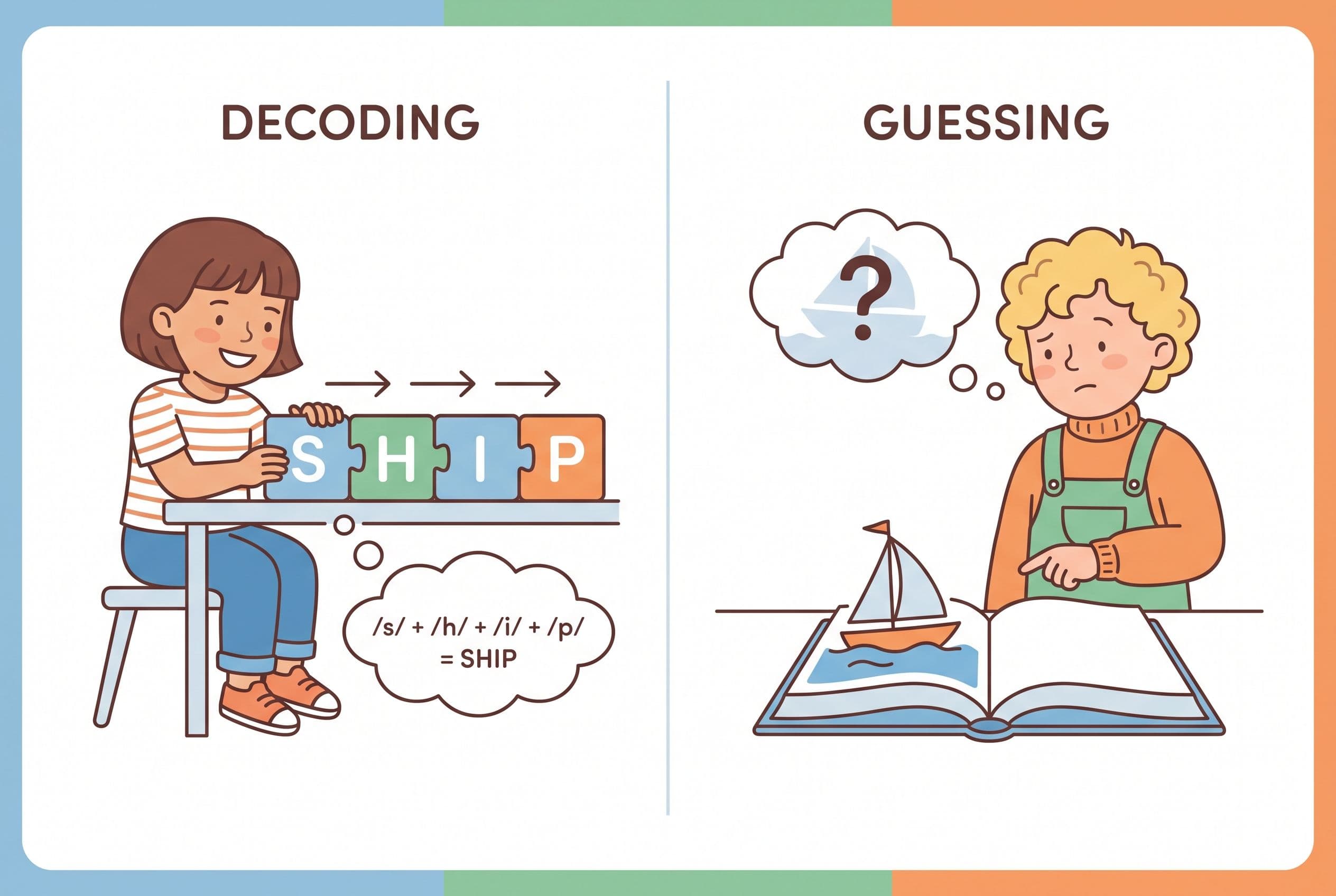
If an app teaches or rewards guessing from pictures, context, first letters, or sentence patterns, I’m out.
Imagine your child sees a picture of a boat and the sentence says, “The ship is red.” She says “boat” because the picture shows a boat. The app praises her because the meaning is close enough.
Nope.
That’s not reading. That’s a trap wearing a cute cartoon hat.
The word is ship. Your child needs to look at sh, know the sound, blend /sh/ /i/ /p/, and say ship. That’s phonemic awareness plus phonics doing its job.
Linnea Ehri’s phases of word reading development, including her 2005 work on sight word learning, show that children move toward full alphabetic reading when they connect letters to sounds in words. They don’t become strong readers by memorizing shapes or guessing from pictures.
This is why Fountas & Pinnell leveled readers make me twitchy. They’re everywhere, but they’re whole-language aligned. For early readers, look for decodable readers instead — Bob Books, Flyleaf Publishing, High Noon Books, or controlled readers tied to a program like UFLI Foundations or Fundations.
What About Free Trials?
A reading app free trial can help, but only if you test the right thing.
Don’t ask, “Did my child enjoy it?”
Ask:
- Did my child sound out words?
- Did the app correct errors?
- Did the lesson build on the last one?
- Did my child read a word outside the app after practice?
- Did I understand what skill the app taught that day?
Teach Your Kid to Read gives lesson one free with no card and nothing to cancel. From lesson two, the whole program is a 7-day free trial, then US$9.95/month. Reading Eggs and ABCmouse also use trial and discount models, but the pricing and promos can shift, so check the current offer before you sign up.
Bottom line: don’t let a free trial become three forgotten subscriptions. Put a cancellation reminder on your phone like a grown-up. I say this with love because I have absolutely paid for a forgotten app while yelling at my kids to find their shoes.
The Action Step: How to Choose This Week
Here’s your no-drama plan.
- Test several real words your child hasn’t memorized. Pick words that use patterns your child has actually been taught. Try words like chap, mend, or frog for simpler checks, and save a word like splint for a child who has been taught blends and can handle a tougher cold read.
- Watch the strategy. Does your child sound it out, guess from the first letter, or look around for picture clues?
- Check phonemic awareness. Ask, “What sounds do you hear in ship?” If your child can’t isolate /sh/ /i/ /p/, start there.
- Use a named screener if you’re worried. The PAST test from David Kilpatrick is a quick phonological awareness screener that can show where the sound-awareness breakdown may be. It doesn’t diagnose the whole reading problem by itself, because of course it doesn’t. DIBELS also gives useful fluency data; for example, nonsense word fluency checks whether a child can apply letter-sound knowledge to unfamiliar words. If your child keeps struggling, get a broader look from a qualified teacher, reading specialist, or evaluator.
- Pick the app that attacks the weakest skill. If decoding is weak, choose systematic phonics over a broad preschool platform.
- Try it for 7 days with a parent sitting nearby. No couch scrolling while your kid clicks randomly. Sit there. Correct guessing. Praise accuracy.
- Retest with paper. After a week, hand your child a decodable book or simple word list using the patterns they’ve practiced. If the skill doesn’t transfer yet, that’s your first red flag — not a courtroom verdict, but enough for Tiger Mom to pay attention.
If you want the cleanest starting point, try Teach Your Kid to Read first: lesson one is free with no card and nothing to cancel; from lesson two, the whole program is a 7-day free trial, then US$9.95/month.
My Final Take on Reading Eggs vs ABCmouse Cost
If you’re comparing reading eggs cost vs abcmouse, the monthly price difference isn’t huge. Reading Eggs often costs a little less than ABCmouse, depending on promos. Teach Your Kid to Read sits in the same budget zone at US$9.95/month after the trial.
But the best value isn’t the app with the most games. It’s the app that gives your child the shortest path to decoding real words.
For broad preschool fun, ABCmouse has plenty.
For game-based reading practice, Reading Eggs can help.
For parents who want phonics-first reading instruction without the fluff, I’d start with Teach Your Kid to Read.
Because reading isn’t optional. It’s a survival skill. And no app gets a pass from me unless it helps a child look at a word, sound it out, and read it accurately.
Start with the app that teaches the skill directly.
FAQ
Is Reading Eggs cheaper than ABCmouse in 2026?
Usually, Reading Eggs appears slightly cheaper month-to-month than ABCmouse, but promos change often. Reading Eggs commonly sits around US$9.99/month, while ABCmouse often lists around US$12.99/month. Always check the live checkout page before buying.
What is the best cheaper Reading Eggs alternative?
Teach Your Kid to Read is my pick if you want a cheaper reading eggs alternative focused on phonics. Lesson one is free with no card and nothing to cancel; from lesson two, the whole program is a 7-day free trial, then US$9.95/month.
Is ABCmouse good for teaching reading?
ABCmouse can support general early learning, but I wouldn’t use it as my main reading instruction for a struggling child. It covers many subjects, so reading can get buried under games, songs, puzzles, and rewards.
Does my child need phonics if they already know some sight words?
Yes. Sight words without phonics can turn into memorized guessing. Strong readers connect sounds to spellings through orthographic mapping, which needs phonemic awareness and phonics.
How long should my child use a reading app each day?
Start with 10-15 focused minutes daily. Short, accurate practice beats long, sloppy screen time. Sit nearby and stop guessing immediately.

Xia Brody
Co-Founder, Teach Your Kid to Read
Mom of 4 who has successfully taught her kids to read. Currently in the trenches with her 4-year-old while her two oldest (10 and 7) devour books on their own. Passionate about phonics-based methods and building a lifelong love of reading.
Related Articles
Reading Eggs vs ABCmouse: One Teaches Reading, One Doesn't
Both apps look colorful and fun. Only one actually teaches your kid to read using real phonics. Here's my honest breakdown of Reading Eggs vs ABCmouse after using both with my own kids — and why neither app is enough on its own.
Read More →
Teach Your Monster to Read vs Reading Eggs: 2026 Honest Comparison
Both apps promise to teach your kid to read, but one leans harder on phonics science and the other leans on flashy gamification. Here's my unfiltered breakdown of Teach Your Monster to Read vs Reading Eggs — what works, what doesn't, and what's still missing from both.
Read More →
ABCmouse vs Reading Eggs for 4-Year-Olds: 2026 Honest Breakdown
Both ABCmouse and Reading Eggs claim to teach your preschooler to read. But do they actually deliver systematic phonics — or just colorful distractions? Here's my honest breakdown after testing both with my own kids.
Read More →