Reading.com vs HOMER vs Reading Eggs: 2026 Apps Ranked

Your child can collect digital rewards and still struggle to read a three-letter word without help. That’s the problem behind this reading.com vs homer vs reading eggs comparison: you’re buying reading instruction, not evidence that your child can tap a screen.
I’m Xia Brody, a Chinese-American homeschooling mum of four, ages 10, 7, 4 and 1. I’ve taught my oldest two to read, and I’m currently teaching my four-year-old. Around here, an impressive animation doesn’t get the final vote. Independent reading does.
What You’ll Learn
- Which of these four apps fits parent-led teaching versus broader independent practice.
- What I’d check before trusting an app’s progress report.
- Why one unfamiliar word changed a playground conversation about reading.
- How to make a subscription decision without turning your child into an app-hopping experiment.
Here’s the reality check: phonics somewhere inside an app doesn’t automatically mean a clear, systematic phonics programme. You need to know what your child learns next and whether they can apply it away from the screen.
For this reading app comparison for parents, I rank beginner-decoding fit first, followed by parent involvement, scope and payment clarity. This is a comparison of publicly described approaches, not hands-on competitor testing or evidence that one app produces superior outcomes. Bottom line: the ranking reflects my priorities for teaching a beginner.
The Verdict
For reading.com vs homer vs reading eggs, my preference is a focused, adult-supported starting point—not the biggest activity collection. I’ve included our app as a fourth option because parents searching this comparison often also want a reading.com alternative.
| Rank and app | Teaching approach | Price or payment model | Age fit |
|---|---|---|---|
| 1. Teach Your Kid to Read | Focused phonics practice; my pick for a parent-supported routine | Lesson one is free with no card and nothing to cancel; from lesson two the whole program is a 7-day free trial, then US$9.95 a month | My recommendation: beginning readers around 4–7, depending on skill |
| 2. Reading.com | Publicly describes parent-child lessons built around systematic phonics | Monthly or yearly subscription; check the current price | Stated ages 3–8 |
| 3. Reading Eggs | Reading activities across several strands; Fast Phonics specifically focuses on systematic synthetic phonics | Subscription; listed 30-day free trial; check current price and terms | Overall 2–13; core Reading Eggs 3–7; Fast Phonics 5–10 |
| 4. HOMER | Broader early-learning experience that includes phonics and reading activities | Subscription; listed 30-day free trial; check current price and terms | Listings say 2–8; Begin’s product page says 2–6 |
Full disclosure: I co-founded Teach Your Kid to Read, so weigh my #1 pick accordingly; the rest of the ranking is based on the criteria above.
For a focused parent-supported starting point, I recommend Teach Your Kid to Read: start lesson one free; lesson one is free with no card and nothing to cancel; from lesson two the whole program is a 7-day free trial, then US$9.95 a month.
Competitor subscription amounts vary by location, platform and promotion. Check your local checkout total, renewal date and cancellation route rather than trusting an old screenshot. No-brainer? Yes. Easy to forget at bedtime? Also yes.
Tiger Truth: Familiar Pages Can Hide a Reading Gap
At a playground in Raleigh, North Carolina, another mum told me her child’s school had switched from Lucy Calkins to a Science of Reading curriculum. She connected the change to North Carolina’s SB 387, the Excellent Public Schools Act of 2021—a US state law that strengthened science-of-reading requirements.
“He was doing fine before,” she said, confused and a little annoyed. Her son attended US second grade (ages 7–8). I asked whether he could read splint. He couldn’t.
One word doesn’t diagnose a reading difficulty. But the kicker is that familiar stories can hide weak decoding, while an unfamiliar word exposes what a child actually does with letters. We spent 20 minutes on that bench talking about instruction rather than reading levels.
I explained Emily Hanford’s 2022 Sold a Story reporting, national assessment results and Stanislas Dehaene’s Reading in the Brain (2009). Dehaene describes how learning to read changes brain networks; children don’t acquire print reading simply through exposure the way they acquire spoken language. That evening, she listened to the podcast. At 11pm, she texted: “I had no idea. Why didn’t anyone tell us this sooner?”
The numbers deserve attention: 33% of US fourth-grade students (ages 9–10) reached NAEP Proficient or above in reading in 2022, according to The Nation’s Report Card. I’m keeping the 2022 figure cited at the time of writing here; the 2024 results have since been released, so don’t mistake this for the latest figure. NAEP Proficient isn’t the same as everyday “grade-level” performance, and the remaining 67% weren’t all unable to read. Still, that’s a serious national warning—not a reason to panic about your individual child.
Don’t wait for repeated failure to crush their confidence. Older struggling readers can improve, but “let’s give it another year” isn’t an intervention plan. Neither is another subscription.
Ranked: Four Reading Apps for Beginning Readers
1. Teach Your Kid to Read: My Pick for a Focused Routine
I put our app first for parents who want a clear place to begin phonics practice together. The offer stays straightforward: lesson one is free with no card and nothing to cancel; from lesson two the whole program is a 7-day free trial, then US$9.95 a month.
My recommendation comes with homework for the grown-up. Sit beside your child. Listen to their sounds. After the lesson, check one small skill on paper. The app shouldn’t become a babysitter with an educational badge.
The methodological target is systematic synthetic phonics: teach sound–letter relationships in a planned sequence, then teach children to blend those sounds into words. The US National Reading Panel report (2000) found benefits from systematic phonics instruction. That supports the teaching approach; it doesn’t constitute a clinical trial of our app.
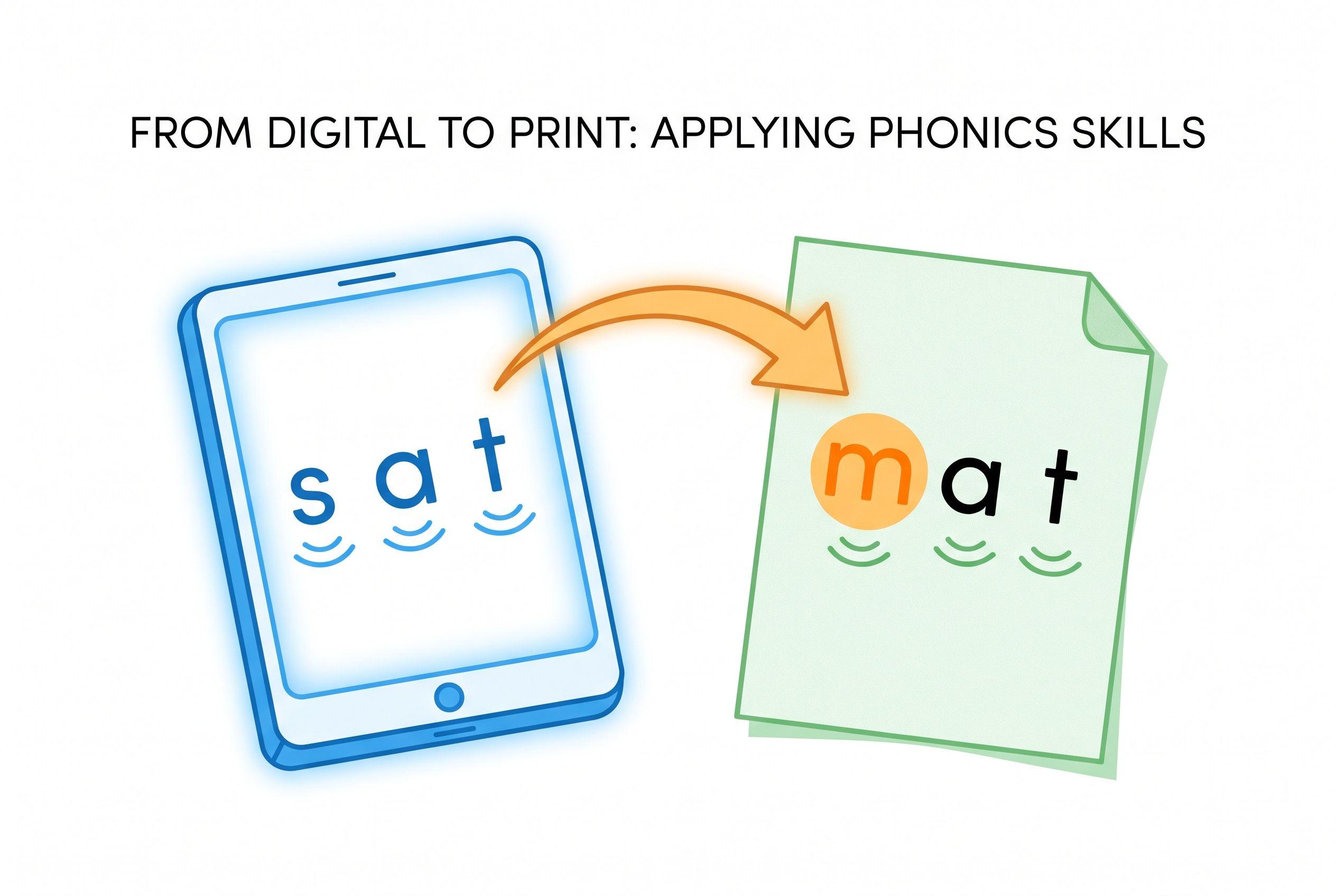
Here’s what that means at my kitchen table. If we’re practising sat, I want /s/ /a/ /t/ followed by sat, not a lucky answer after three hints. Then I might change the first letter to make mat, provided we’ve taught that sound. Same pattern. New word. Real evidence.
I also want explicit modelling and cumulative review—the kinds of instructional principles parents may encounter in Orton-Gillingham teaching. That doesn’t make every phonics app an Orton-Gillingham programme, and I’m not claiming specialist certification for ours.
My disqualifier applies to our app too: if your child completes activities but can’t demonstrate the target skill without screen cues, investigate. They may need an easier starting point, clearer adult feedback or specialist support. Don’t mistake completion for mastery.
Reading also needs vocabulary, conversation and understanding. Keep reading rich stories aloud while your child works on decoding simpler print. Those jobs complement each other; neither replaces the other.
2. Reading.com: A Strong Fit for Parent-Child Lessons
In a reading.com vs homer decision, Reading.com makes more sense to me when the priority is a focused parent-child reading routine. Its public materials describe systematic phonics and shared lessons. Its stated age range runs from 3–8.
That parent role matters. An adult can hear when a child adds an extra vowel to a consonant—saying “muh” instead of /m/, for example—and help before the habit complicates blending. Hands down, listening beats assuming the screen caught everything.
Reading.com sits second here because our own focused starting option leads my ranking, not because I have comparative outcome data proving Reading.com teaches less effectively. I don’t.
My fit disqualifier: if you need an app your child can use without consistent adult participation, its parent-child emphasis may not suit your household. That’s a scheduling mismatch, not a phonics flaw.
Before paying, check the current monthly and yearly prices and preview the expected adult role. A reading.com alternative only helps if its routine fits the time you can actually protect.
3. Reading Eggs: Useful Breadth, but Choose the Right Strand
The biggest issue in a reading.com vs reading eggs comparison is scope. Reading Eggs covers several products and age bands, so “we use Reading Eggs” doesn’t tell me which instruction your child receives.
The stated ranges distinguish Reading Eggs Junior for ages 2–4, core Reading Eggs for 3–7, Fast Phonics for 5–10 and Reading Eggspress for 7–13. Fast Phonics publicly describes a systematic synthetic phonics approach. Don’t treat those different strands as interchangeable.
For families who want a wider collection of reading activities, that breadth can help. The flip side? More choice gives parents another job: selecting work that matches the child’s actual skill rather than their favourite activity.
My fit disqualifier: if you can’t identify the phonics sequence your beginner follows, don’t assume browsing the wider programme supplies one. Check the strand and lesson content first.
Rewards aren’t automatically bad. I object when collecting them replaces reading practice, not when a small celebration follows genuine effort. Check the subscription’s current price and listed trial terms, then judge learning away from the screen.
4. HOMER: Better Fit for Broader Early Learning
HOMER includes reading and phonics within a broader early-learning experience. Its listings state ages 2–8, while Begin’s product page says 2–6. That difference alone should remind us that a marketing age band doesn’t tell us the correct lesson placement.
In reading.com vs homer, I’d favour the former for a parent specifically seeking a focused decoding routine. HOMER may appeal more when the goal includes varied early-learning activities rather than reading instruction alone.
Here’s the thing: broad doesn’t mean bad. A two-year-old exploring sounds and stories has different needs from a seven-year-old who can’t blend sun. Buying the same style of experience for both would miss the point.
My fit disqualifier: don’t choose a broad learning subscription as your sole response to an established decoding difficulty without checking its instructional sequence and arranging appropriate support.
HOMER lists a subscription with a 30-day free trial; check current local terms. I have no basis to label it a picture-guessing programme, just as I have no basis to promise its activities will solve a particular child’s reading difficulty.
The Action Step: Make the Choice With Print, Not Promises
Your best reading app 2026 comparison needs a tiny real-world check. Not a stopwatch showdown. Not a performance for Grandma. Just enough information to choose the next sensible lesson.
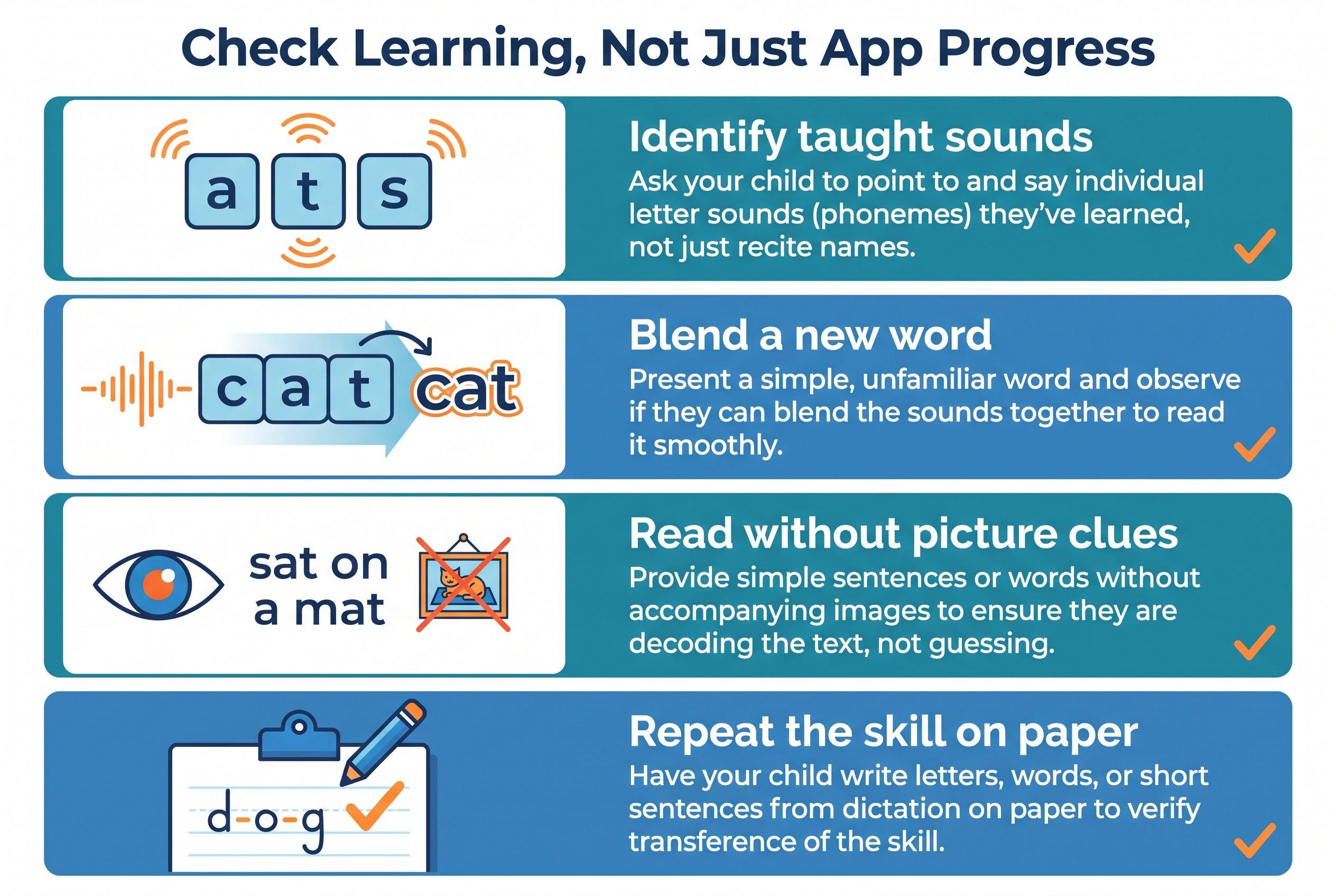
- Check a few taught sounds. Show five lowercase letters your child has already learned. Ask for sounds, not just names. Note which ones need help.
- Check blending. Offer three unfamiliar words using only taught correspondences—for example, sat, mat and Sam if those letters are familiar. Model one if necessary; don’t turn difficulty into an interrogation.
- Choose by need. Prioritise parent-supported phonics for a beginner. Consider broader activities as a supplement, not proof that decoding instruction has happened.
- Practise briefly and transfer. Try five to ten attentive minutes, adjusting for age and stamina. Afterwards, ask your child to read one suitable word on paper. Record independent reading separately from prompted reading.
- Act on persistent difficulty. Ask a teacher or reading specialist about a suitable assessment. Kilpatrick’s PAST checks aspects of phonological awareness; it doesn’t diagnose dyslexia or measure every part of reading. For our app, lesson one is free with no card and nothing to cancel; from lesson two the whole program is a 7-day free trial, then US$9.95 a month.
My Tiger Rules are “No Guessing” and “We Never Skip.” No guessing means return to the letters rather than prompting “What would make sense?” Never skip means protect a manageable habit, even on holiday—not force lessons through illness, exhaustion or distress. A birthday review can take one minute. Cake remains on the agenda.
Before You Subscribe
The best kids reading app isn’t necessarily the one with the most activities. It’s the one that helps your child practise the right skill while giving you a routine you can maintain. Bottom line: demand evidence in print.
Still unsure where to begin? You can take the 2-minute reading check for an initial steer, not a diagnosis. If your child consistently struggles despite explicit teaching, speak with their teacher or a qualified reading specialist instead of cycling through apps.
For a focused first lesson together, consider Teach Your Kid to Read: lesson one is free with no card and nothing to cancel; from lesson two the whole program is a 7-day free trial, then US$9.95 a month.
FAQ
Which wins: Reading.com vs HOMER vs Reading Eggs?
For a focused parent-child phonics routine, I favour Reading.com among those three. Reading Eggs offers broader reading options, including Fast Phonics. HOMER suits broader early-learning goals. My overall ranked first choice is our app, with the founder relationship disclosed above—not a claim of independently proven superiority.
Is Reading Eggs just a guessing programme?
No. That blanket description would misrepresent its offerings, particularly Fast Phonics. Check the specific strand and watch whether your child reads unfamiliar words from letters rather than relying on pictures or memorised sentences.
Can an app replace a parent or reading specialist?
Don’t count on it. Apps can organise practice, but adults still need to monitor understanding and transfer. Persistent difficulty calls for assessment and targeted teaching, especially if your child struggles to learn sound–letter relationships despite clear instruction.
Should my three-year-old start formal reading lessons?
Not necessarily. Keep shared stories, conversation and playful sound activities central. Offer brief letter-sound practice if your child shows interest, but don’t treat an app’s minimum age as a deadline for reading. Early support means responding to needs—not rushing every preschooler.
From teachyourkidtoread.org/blog/reading-com-vs-homer-vs-reading-eggs-2026-apps-ranked
Part of these guides

Xia Brody
Co-Founder, Teach Your Kid to Read
Mom of 4 who has successfully taught her kids to read. Currently in the trenches with her 4-year-old while her two oldest (10 and 7) devour books on their own. Passionate about phonics-based methods and building a lifelong love of reading.
Related Articles

Reading Eggs vs Hooked on Phonics vs HOMER: 2026 Ranked
A finished lesson doesn't necessarily mean your child can read the words. Here's how I rank four reading apps, what I'd check before subscribing and why decoding beats digital rewards.
Read More →
Reading.com vs Reading Eggs Cost: Cheapest 2026 Pick
Comparing Reading.com vs Reading Eggs cost? Here’s the no-fluff 2026 breakdown of pricing, phonics quality, free trials, and which app I’d actually use with my own kid.
Read More →
Reading.com vs Hooked on Phonics: Which Is Better? (2026)
Reading.com gets my vote between the two for parent-led phonics; Hooked on Phonics deserves a look if you want its app-and-print approach. Here's how they compare with two alternatives, including what you'll pay and what you'll need to do yourself.
Read More →