Reading Eggs vs HOMER for a 4-Year-Old: My 2026 Pick (and Why)
What You'll Learn
- The phonics gap most parents miss when choosing between HOMER and Reading Eggs — and why it matters more than star ratings
- Which app actually follows the Science of Reading principles that dozens of states are now pushing into law
- The one thing neither app does that your 4-year-old desperately needs (and how to fill that gap for free)
- My specific pick for 2026 — with the exact ages, stages, and scenarios where each app works best
Let's Get Real About Reading Apps for 4-Year-Olds
Your kid is four. They're obsessed with dinosaurs or princesses or both. They can maybe sing the alphabet song. And you're scrolling through the App Store at 10:47 PM trying to figure out which reading app will actually teach them something before kindergarten.
Sound familiar?
Here's the thing — I've been exactly where you are. Three times, actually. When my oldest was four, I downloaded every reading app I could find. HOMER. Reading Eggs. Starfall. ABCmouse. A few sketchy ones I won't name. I treated my iPad like a laboratory and my kid like a willing (mostly) test subject.
And what I found is that most parents are asking the wrong question. It's not "HOMER vs Reading Eggs." It's "Does either of these apps teach my kid to actually decode words using systematic synthetic phonics — or are they just dressed-up guessing games with cute animations?"
That's the question. Let me answer it.
The Tiger Truth: What Happens If You Pick Wrong
I don't say this to scare you. OK, actually, I do say this to scare you a little. Because the stakes are that high.
Only 33% of 4th graders in America read at a proficient level on the 2022 NAEP. That's the Nation's Report Card. Two out of three kids in this country can't read well enough to learn from a textbook by fourth grade.
And the 2022 NAEP scores? They dropped from 2019 levels — the largest decline in over 30 years.
A widely cited Annie E. Casey Foundation analysis (Hernandez, 2011) found that students who weren't proficient readers by 3rd grade were far more likely to fail to graduate — especially when combined with poverty. The exact risk varies by context, but the pattern is consistent and alarming.
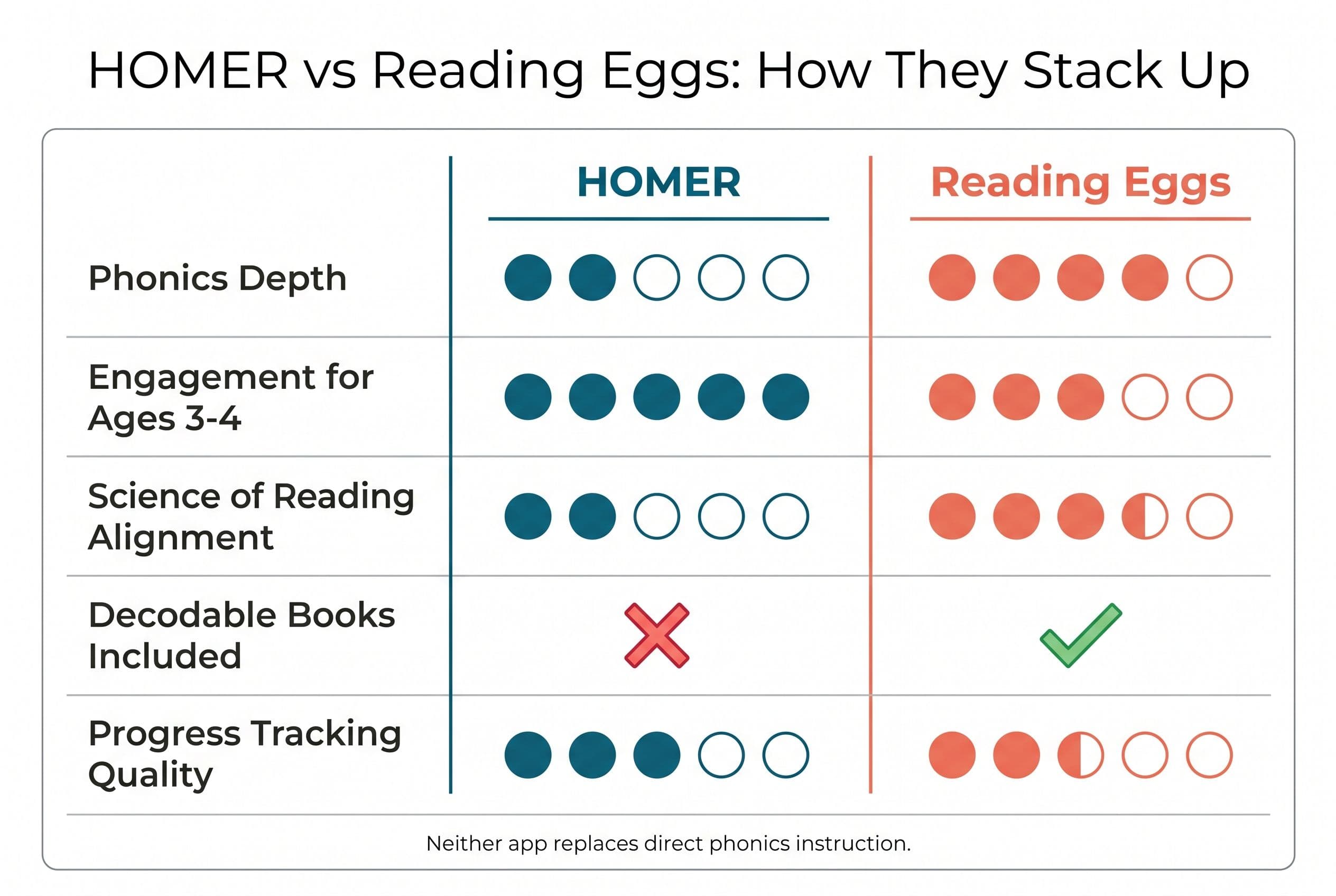
So when you're choosing a reading app for your 4-year-old, you're not choosing a toy. You're choosing a tool. And a bad tool doesn't just waste time — it teaches bad habits.
I was at a playground in Raleigh last spring when another mom told me her kid's school had just switched from Lucy Calkins' Units of Study to a Science of Reading curriculum because of North Carolina's SB 387 — the Excellent Public Schools Act. She was confused and honestly kind of annoyed. "He was doing fine before," she said. I asked if her second grader could read the word splint. She pulled him over. He looked at it and said "split." Close — but he was guessing. He dropped the n because he wasn't actually decoding. He was approximating.
I spent twenty minutes on that playground bench explaining why the switch was happening — Emily Hanford's "Sold a Story" investigation, the NAEP data, the neuroscience from Stanislas Dehaene's lab showing the brain doesn't learn to read naturally the way it learns to speak. She went home and listened to the full "Sold a Story" podcast that night. Texted me at 11 PM: "I had no idea. Why didn't anyone tell us this sooner?"
Nobody tells us. That's the problem. And that's why the app you choose matters — because it's either reinforcing the guessing habits that got us into this mess, or it's building real decoding skills sound by sound.
HOMER: What It Actually Does
HOMER (formerly known as HOMER Reading) positions itself as a "learn to read" program for kids ages 2-8. It creates a personalized "reading pathway" based on your child's interests and current skill level.
Here's what I like:
- It starts with phonological awareness. Letter sounds, rhyming, initial sound identification. The early levels do touch real pre-reading skills.
- The interest-based approach. My 4-year-old picked "animals" and "space" as her interests, and the stories reflected that. She was engaged. I'll give them that.
- It moves in a sequence. There's a progression — it's not just random games.
Here's what concerns me:
- The phonics instruction is shallow. HOMER introduces letter sounds, but the blending practice is minimal. My daughter could tap on the letter m and hear "mmm" — but the app didn't spend nearly enough time teaching her to blend /c/ /a/ /t/ into "cat" without support. Blending is the whole game. That's where Linnea Ehri's research on phases of word reading development (2005) becomes relevant — kids need to move from the partial alphabetic phase to the full alphabetic phase, and that transition requires extensive blending practice.
- Too much swiping, not enough reading. A lot of the "reading" activities are really listening activities. The app reads TO the child. That's fine for vocabulary and comprehension exposure, but it's not teaching decoding.
- The "personalization" can become a crutch. If a kid struggles, the app sometimes routes around the hard stuff instead of drilling it. Tiger moms don't route around hard stuff. We drill it until it's automatic.
Bottom line: HOMER is a decent exposure tool. It's not a reading instruction program.
Reading Eggs: What It Actually Does
Reading Eggs (by the Australian company Blake eLearning) targets ages 2-13 and has been around since 2010. It's more structured than HOMER, and it leans harder into explicit phonics instruction.
Here's what I like:
- More systematic phonics coverage. Reading Eggs teaches letter-sound correspondences, blending, segmenting, and moves through CVC words, digraphs, blends, and vowel teams in a clearer sequence. It's not Orton-Gillingham level systematic, but it's closer than HOMER.
- The "map" structure. Kids progress through numbered lessons on a visual map. Each lesson builds on the last. There's less wandering.
- Actual decoding practice. The app asks kids to sound out words, not just recognize them. There's a meaningful difference between "tap the picture that matches the word" and "blend these sounds together to read the word." Reading Eggs does more of the latter.
- Decodable books built in. After certain lesson milestones, kids unlock short decodable readers that use only the phonics patterns they've learned. This is a big deal. David Kilpatrick's "Equipped for Reading Success" (2016) makes the case that orthographic mapping — the process by which words become permanently stored in memory — requires repeated successful decoding, not memorization. Decodable texts support that.
Here's what concerns me:
- The gamification is HEAVY. Golden eggs. Rewards. Critters to collect. My 7-year-old got so focused on collecting pets in his "house" that he was rushing through phonics lessons to get to the reward. The tail was wagging the dog.
- Some lessons still use picture clues. I caught a few exercises where my kid could guess the word from the illustration instead of decoding it. This drives me absolutely crazy. The National Reading Panel report from 2000 — the one Congress commissioned — was clear: systematic phonics instruction produces significant benefits over non-systematic or no-phonics approaches. Picture guessing is the opposite of phonics.
- The pacing can be uneven. Some skills get tons of practice. Others feel rushed. The app doesn't always catch when a kid has "passed" a level by guessing rather than truly mastering the skill.
Head-to-Head: HOMER vs Reading Eggs for a 4-Year-Old
Let me break this down the way I actually think about it — as a mom who's currently teaching a 4-year-old to read while also keeping a 1-year-old from eating crayons.
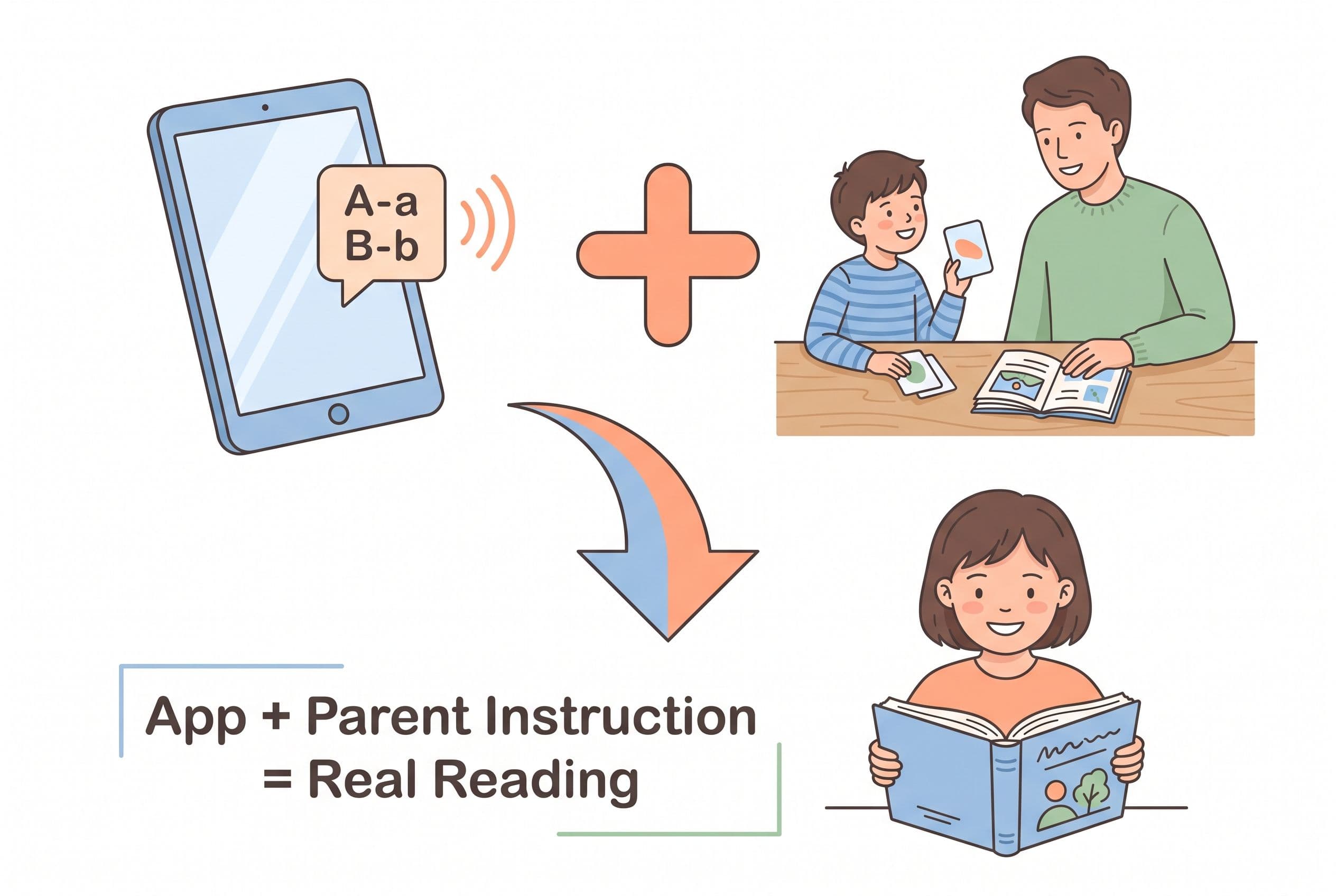
Phonics Instruction Quality
Reading Eggs wins. It's more systematic, more explicit, and spends more time on blending and segmenting — the skills that actually transfer to real reading. HOMER introduces sounds but doesn't drill them deep enough.
Engagement for a 4-Year-Old
HOMER wins. The stories are more engaging, the interface is more intuitive for little fingers, and the interest-based personalization keeps kids coming back. My daughter will voluntarily open HOMER. She needs encouragement to open Reading Eggs.
Alignment with Science of Reading
Reading Eggs wins — but with caveats. Neither app is fully aligned with the Science of Reading the way a structured literacy program like UFLI Foundations or Fundations would be. But Reading Eggs is closer. It teaches grapheme-phoneme correspondence more explicitly and includes decodable readers. HOMER leans more toward a "balanced" approach that mixes some phonics with some whole-language-style exposure — and if you've been following the reading wars at all, you know that "balanced literacy" is the approach that dozens of states are now legislating away from.
Mississippi saw notable gains on NAEP 4th-grade reading after passing their Literacy-Based Promotion Act in 2013 — a package of reforms that emphasized strong phonics instruction, teacher coaching, and accountability. They climbed from near the bottom of state rankings to the middle of the pack within several years. That wasn't an accident.
Assessment and Progress Tracking
Tie — and both are weak. Neither app gives you the kind of diagnostic data you'd get from a real assessment like Kilpatrick's PAST (Phonological Awareness Screening Test) or DIBELS. Both give you progress dashboards, but they track completion, not mastery. There's a massive difference. Your kid can complete a level by getting 70% right and still move forward. Mastery means automatic, effortless accuracy.
Price (2026)
HOMER: Roughly $9.99/month or around $60/year on sale. Reading Eggs: Roughly $13/month or around $80/year, though they frequently run half-price promotions.
Neither will break the bank. But neither will replace actual instruction, either. More on that in a sec.
The Honest Truth: Neither App Is Enough
Look, I know that's not the answer you were hoping for. You wanted me to say "Pick this one and your kid will be reading chapter books by kindergarten." I can't say that. Because it's not true.
Here's what Mark Seidenberg — a cognitive scientist at the University of Wisconsin — wrote in "Language at the Speed of Sight" (2017): learning to read requires explicit, systematic instruction with feedback from a knowledgeable teacher. Not an algorithm. Not a cartoon egg.
Apps can supplement instruction. They can provide extra practice. They can keep skills warm between lessons. But they can't replace a parent or teacher sitting with a child, hearing them decode words in real time, correcting errors immediately, and making sure they're blending sounds and not guessing from pictures.
I had my 4-year-old practicing CVC words at the kitchen table last Tuesday. She looked at "hug" and said "hot." Know why? She saw the h and guessed. An app might have let that slide — given her another try, played a hint sound, moved on. I didn't let it slide. I covered the picture with my hand, pointed to each letter, and we sounded it out: /h/ /ŭ/ /g/. She got it. That correction took eight seconds. But those eight-second corrections, repeated hundreds of times over months, are what build a reader.
No app does that.
My 2026 Pick: Reading Eggs + Real Phonics Instruction
If you're forcing me to choose between HOMER and Reading Eggs for a 4-year-old — and you're only going to use one — I'd pick Reading Eggs. The phonics instruction is more systematic, the decodable readers are a genuine value-add, and it does a better job teaching blending.
But here's my actual recommendation: Use Reading Eggs as a supplement to real, structured phonics instruction.
That can look like:
- 10-15 minutes of explicit phonics instruction per day — with YOU, not an app. Use a structured curriculum. UFLI Foundations is free and excellent. Explode the Code workbooks are cheap and effective. Logic of English has a preschool-friendly program.
- 10-15 minutes of Reading Eggs — as practice and reinforcement of the skills you've already taught. Make sure the app level matches what you're teaching. Don't let your kid race ahead in the app while they're still shaky on blending.
- 5-10 minutes of decodable book reading — real books, real pages, your kid pointing at words and sounding them out while you sit next to them. Bob Books Set 1 is the classic starting point. Flyleaf Publishing and High Noon Books make excellent decodable readers too.
That's 25-40 minutes total. Every day. Yes, including birthdays. Yes, including vacation. (We Never Skip. That's a Tiger Rule in our house.)
What About Teach Your Kid to Read?
Real talk — I co-founded start lesson one free because I couldn't find an app that did what I actually needed: systematic synthetic phonics instruction built on Orton-Gillingham principles, with real blending practice, zero picture-guessing, and a structure that parents could follow without a teaching degree.
Teach Your Kid to Read isn't trying to be HOMER or Reading Eggs. We're not gamifying reading with golden eggs and cartoon pets. We're teaching kids to decode — sound by sound, blend by blend, in the sequence that reading science says works.
If you're already using Reading Eggs or HOMER and you're seeing your kid guess at words, stall on blending, or "read" by memorizing instead of decoding — that's the gap we fill. Check it out at TeachYourKidToRead.org or call us at (407) 707-6850.
The Action Plan: What to Do This Week
Don't overthink this. Here's your step-by-step:
Step 1: Assess where your kid actually is. Can they name all 26 letters? Do they know at least 20 letter sounds? Can they hear the first sound in a word ("What sound does map start with?")? If yes to all three, they're ready for blending instruction. If not, start there.
Step 2: Pick your phonics instruction method. This is the non-negotiable core. You — a human parent — teaching phonics. UFLI Foundations (free online), Explode the Code (cheap workbooks), or Teach Your Kid to Read (our program). Pick one. Stick with it.
Step 3: Add Reading Eggs as practice. Download it. Set it up. Let your kid do 10-15 minutes per day after their phonics lesson. Make sure the app level matches their instruction level — don't let the app jump ahead.
Step 4: Read decodable books together every night. Not leveled readers (those are whole-language aligned — Fountas & Pinnell levels sound fancy but they encourage guessing). Decodable readers. Bob Books, Flyleaf Publishing, or the free decodable texts on Reading Rockets.
Step 5: Track progress monthly. Here's a simple home benchmark: write nonsense CVC words (like bif, tup, lem) on flashcards and have your kid sound them out for one minute. At age 4, if they're accurately sounding out 5-8 per minute and improving over time, you're on track. No guessing allowed. (If your child's school uses DIBELS, check with them on which edition and benchmarks they track — the specific targets vary by edition and time of year.)
Frequently Asked Questions
Is HOMER or Reading Eggs better for a 3-year-old?
For a 3-year-old, HOMER might be a slightly better fit because its early levels focus more on letter recognition and phonological awareness games (rhyming, initial sounds) in a highly engaging way. Reading Eggs' early levels also cover these skills but the interface is a bit more demanding for tiny fingers. That said, at age 3, the best thing you can do is read aloud to your kid, sing alphabet songs, and play rhyming games. Apps are optional at 3. They become more useful at 4.
Can Reading Eggs or HOMER replace phonics tutoring?
No. And I say that as someone who builds reading programs. An app can't hear your child read. It can't catch the subtle difference between a real decode and a lucky guess. It can't adjust in real time the way a skilled parent or tutor can. Apps are practice tools. They're the batting cage, not the coach. If your child is showing signs of a reading difficulty — they can't blend three sounds together by mid-kindergarten, they confuse similar-looking letters persistently after age 5, they resist reading or get extremely frustrated — get a professional evaluation and look into a structured literacy program like Barton Reading & Spelling or Wilson Reading System.
How long does it take a 4-year-old to learn to read?
Every kid is different, and I refuse to give you a fake timeline. What I can tell you is this: with 15-20 minutes of daily systematic phonics instruction, most typically developing 4-year-olds can learn to decode CVC words (cat, sit, hug) within 2-3 months and read simple decodable sentences within 4-6 months. Some kids fly. Some kids need more repetition. The key variable isn't intelligence — it's consistency. We Never Skip.
Are there free alternatives to HOMER and Reading Eggs?
Starfall (starfall.com) offers free phonics games that are reasonably well-aligned with systematic phonics. Khan Academy Kids is free and includes some early literacy content. UFLI Foundations (from the University of Florida Literacy Institute) provides free phonics lesson plans you can teach yourself. And honestly? A $5 pack of Explode the Code workbooks from a used bookstore will teach your kid more phonics than a $100/year app subscription — if you sit down and do the lessons with them.
What's wrong with letting my kid use pictures to guess words?
Everything. When a child looks at a picture of a boat and says "boat" instead of decoding the word "ship," they're not reading. They're guessing. And guessing works often enough in easy books that it looks like reading. But it falls apart completely when the books get harder and the pictures disappear. This is exactly what the "Sold a Story" investigation by Emily Hanford at APM Reports documented — millions of kids were taught to use pictures, context, and first-letter cues instead of decoding. The result? A national reading crisis. No guessing. Sound it out. Every time.
Part of these guides

Xia Brody
Co-Founder, Teach Your Kid to Read
Mom of 4 who has successfully taught her kids to read. Currently in the trenches with her 4-year-old while her two oldest (10 and 7) devour books on their own. Passionate about phonics-based methods and building a lifelong love of reading.
Related Articles
Teach Your Monster to Read vs Reading Eggs: 2026 Honest Comparison
Both apps promise to teach your kid to read, but one leans harder on phonics science and the other leans on flashy gamification. Here's my unfiltered breakdown of Teach Your Monster to Read vs Reading Eggs — what works, what doesn't, and what's still missing from both.
Read More →
ABCmouse vs Reading Eggs for 4-Year-Olds: 2026 Honest Breakdown
Both ABCmouse and Reading Eggs claim to teach your preschooler to read. But do they actually deliver systematic phonics — or just colorful distractions? Here's my honest breakdown after testing both with my own kids.
Read More →
Reading Eggs vs HOMER Australia: Best Prep App?
Choosing between Reading Eggs and HOMER for your 4–6 year old? Here’s the blunt phonics-first comparison Australian parents need before Prep, Foundation or Kindy.
Read More →