Best Phonics Apps for 2nd Graders: 6 Picks Ranked
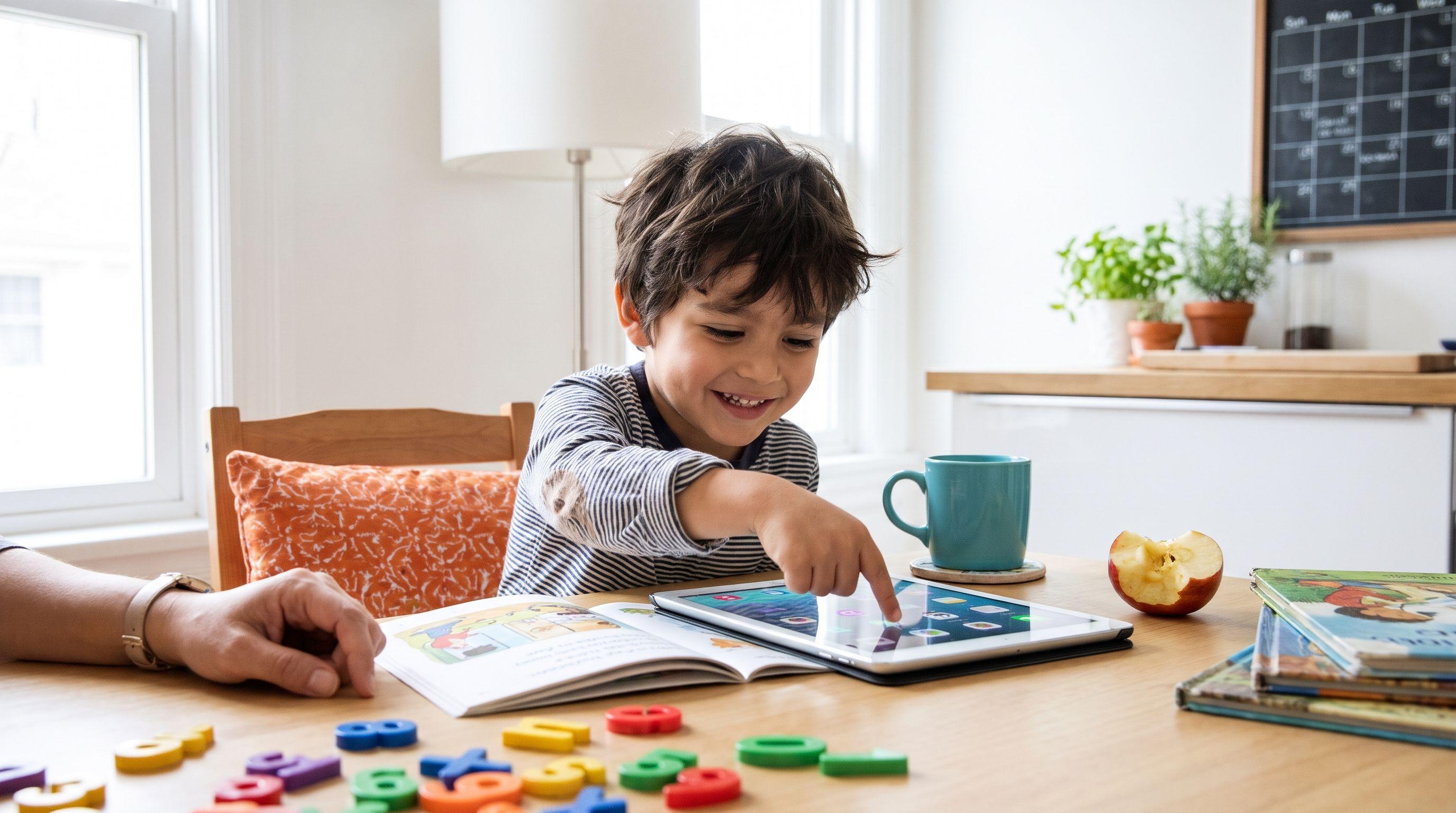
Even the best phonics apps for 2nd graders won't fix a vowel pattern nobody has taught your child.
What You'll Learn
- Teach Your Kid to Read ranks first for parent-led phonics practice; choose something else if you need independent use.
- Reading.com, Reading Eggs, Nessy, Hooked on Phonics and Khan Academy Kids fill out the ranking, with different strengths and costs.
- Match the app to the missing skill, not just the age label: blending, vowel patterns and connected reading need different practice.
- Check reading away from the screen. Completed activities don't prove your child can decode an unfamiliar word.
For 2nd graders (ages 7–8), the problem often hides inside otherwise convincing reading. Imagine a child who reads ship correctly but calls shine “shin.” That's a specific teaching target, not a reason to restart the entire alphabet.
I'm Xia Brody, and my homeschooling table currently serves four kids, ages 10, 7, 4 and 1. I've taught my two oldest to read, and I'm working through the early steps with my 4-year-old. Honestly, I want a phonics app to make the next teaching move clear—not give me another dashboard to admire.
The Verdict
How we ranked
- Clear phonics sequence: Children need instruction that builds on sounds and patterns they've learned.
- Decoding practice: Reading unfamiliar words matters more than collecting completed activities.
- Adult visibility: Parents need to hear errors and know what to practice next.
- Skill fit and value: A subscription only earns its place if it addresses your child's actual gap.
These are curriculum-fit judgments from product descriptions, not results from hands-on competitor testing. The best-for column gives my recommendations; it doesn't replace each product's stated age range.
| Rank and app | What it teaches, as described by the product | Price / pricing model | Best-for age and fit—my judgment |
|---|---|---|---|
| 1. Teach Your Kid to Read | Step-by-step phonics, word blending and short decodable stories from lesson two | Lesson one free, then 7-day trial, US$9.95/month | Ages 7–8 who need adult-led decoding practice |
| 2. Reading.com | Describes a parent-and-child early reading program with guided phonics lessons | US$12.49/month (checked October 2026); yearly US$74.94 (checked October 2026) | Ages 7–8 needing guided foundational instruction |
| 3. Reading Eggs | Describes a reading suite; its Fast Phonics component focuses on phonics | Subscription; 30-day free trial | Ages 7–8 whose families want phonics within a wider reading suite |
| 4. Nessy | Describes reading and spelling instruction with a focus on learners with dyslexia | From US$15.50/month (checked October 2026), home subscription | Ages 7–8 needing a reading-and-spelling focus |
| 5. Hooked on Phonics | Describes phonics-based beginning reading instruction | Subscription; 7-day free trial in the app | Ages 7–8 revisiting beginning reading skills |
| 6. Khan Academy Kids | Describes early learning across literacy and other subjects | Free; no ads or subscriptions | Ages 7–8 needing no-cost supplementary practice |
Full disclosure: I co-founded Teach Your Kid to Read, so weigh my #1 pick accordingly; the rest of the ranking is based on the criteria above.
Prices checked October 2026.
For side-by-side decoding instruction, I recommend Teach Your Kid to Read: start lesson one free. Lesson one is free, with no card and nothing to cancel. From lesson two, the whole program is a 7-day free trial, then US$9.95 a month.
The Tiger Truth: Waiting Doesn't Teach the Missing Pattern
Only 31% of US 4th graders (ages 9–10) scored at or above Proficient in reading on the 2024 NAEP. That doesn't mean everyone below that threshold can't read. It does show why “school will sort it out eventually” isn't a plan.
The 2000 report from the National Reading Panel, a US federal panel, found benefits from systematic phonics instruction. That supports teaching phonics—not a claim that researchers validated any app in this ranking.
As school reading gets longer, weak decoding can make independent work exhausting. Don't wait for book avoidance to become a daily battle. Teach the missing pattern now, and request school support alongside home practice if difficulties persist.
Ranked: The 6 best phonics apps for 2nd graders
1. Teach Your Kid to Read: Best for Side-by-Side Instruction
This is my first pick when a parent wants help teaching, not just help occupying a child. You sit alongside your reader for about 15 minutes a day. The app guides what you listen for and how you correct a mistake.
The 50 lessons follow a fixed order. They move from single letter sounds through digraphs such as sh, ch and th, then blends, vowel teams, silent e, prefixes and suffixes. That sequence matters when your child knows some patterns but guesses through others.
Lesson one introduces m, s, p and short a. Your child hears each sound, taps the matching letter, then blends and builds am, map and sap. There's no story in that lesson. From lesson two, each lesson includes a short story built from sounds taught so far.
For an older beginner, I wouldn't automatically camp on map. The lessons page lets a parent see every lesson and jump to any of them. Check what your child can read accurately, then choose the first shaky pattern. A parent “mastered this” button can skip some practice activities in later lessons.
The course also teaches a small set of common irregular words by sight, calling them “leap words.” During home practice, I still want a child to notice the letters rather than treat the whole word as a picture. Linnea Ehri's 2005 review, Learning to Read Words: Theory, Findings, and Issues, explains how connections between spelling and speech support word learning—often called orthographic mapping.
You can use the program on iPhone, iPad, Android or the web, with several children on one account. For my ranking criteria, the strongest combination is a clear sequence, real-word blending and an adult hearing the reading directly.
The limitation: The app doesn't listen to your child or check pronunciation; the parent does. Families who need independent use or automatic spoken-reading correction should choose something else.
2. Reading.com: Best Alternative for Guided Parent Participation
Reading.com describes an early reading program that brings parent and child together for guided phonics instruction. Its stated ages are 3–8, so a second grader sits near the upper end of its advertised range.
I rank it second because parent participation fits my adult-visibility criterion. Hearing “slip” when the page says split tells you more than watching a completion animation. The useful question is whether the lesson helps you teach that missing sound.
For skill fit, inspect the sequence before committing. A child who already blends comfortably needs more than another round of introductory sound practice. Age eligibility doesn't tell you where the useful instruction begins.
My verdict: A sensible alternative for families seeking guided foundational reading together. Compare the teaching format and placement options, rather than assuming the higher subscription price means better results. For another focused comparison, read Reading.com vs Hooked on Phonics.
3. Reading Eggs: Best for a Wider Reading Suite
Reading Eggs describes several components for different reading stages. For this search, pay particular attention to Fast Phonics, which lists ages 5–10. The main Reading Eggs component lists ages 3–7, while Eggspress lists ages 7–13.
Those distinctions matter. A parent shopping for a second grade phonics practice app could choose a wider reading activity when the child really needs explicit work on vowel patterns.
I rank the suite third for its range of possible uses, but breadth also creates a selection job for the adult. Start with your child's decoding gap and inspect the relevant phonics sequence. Don't assume every activity within a reading subscription serves the same purpose.
My verdict: Choose this when you want phonics within a broader reading subscription and you're willing to select the appropriate component. For a closer comparison of two options here, see Hooked on Phonics vs Reading Eggs.
4. Nessy: Best to Investigate for Reading and Spelling Difficulties
Nessy describes reading and spelling instruction with particular attention to learners with dyslexia. Its stated ages are 6–11, which makes it worth investigating for a second grader who needs more foundational work without an exclusively preschool focus.
Reading and spelling belong in the same conversation. A child might recognize train but write tran. That gives you a reason to check how firmly the child understands the vowel spelling, not simply assign more reading minutes.
Against my criteria, Nessy's reading-and-spelling focus makes it a relevant candidate. Before paying, check the lesson sequence and what parents can actually see about errors; don't assume that a specialized description guarantees the right fit.
My verdict: Put Nessy on your shortlist when reading and spelling both cause trouble. Persistent difficulty also calls for assessment and targeted teaching—an app can't diagnose dyslexia or replace individual support.
5. Hooked on Phonics: Best for Revisiting Beginning Reading
Hooked on Phonics describes beginning reading instruction built around phonics. Its App Store listing gives ages 3–8, and its site describes coverage through second grade.
That makes it relevant, but coverage isn't placement. If your child needs basic blending instruction, a beginning-reading program may fit. If your child reads short words accurately but stumbles over longer ones, inspect the later content before choosing it.
For adult visibility, I recommend sitting close enough to hear the actual reading regardless of the delivery format. You want evidence of accurate decoding, not just evidence that your child finished a session.
My verdict: Consider it for a foundational reset. In a phonics app for second grade, the deciding factor should be the next pattern your child needs—not the familiarity of the product name.
6. Khan Academy Kids: Best No-Cost Supplement
Khan Academy Kids states an age range of 2–8 and offers literacy within a broader early-learning program. It's free, with no ads or subscriptions.
That removes a real barrier. A family can add practice without taking on another recurring bill, and broader learning content may suit a child who needs variety.
I rank it sixth for this specific query because broad early learning isn't the same purchasing target as focused second grade decoding instruction. Choose literacy activities deliberately, then check whether your child can apply the skill outside the app.
My verdict: A useful no-cost supplement, particularly when budget drives the choice. If your child repeatedly misses the same spelling pattern, pair supplementary activities with explicit teaching instead of hoping more screen time will fill the gap.

Turn the Ranking Into a Teaching Decision
Even the best phonics apps for 7 year olds won't suit every seven-year-old. One child needs to blend s-a-t. Another needs to distinguish hop from hope. A third decodes accurately but doesn't understand the passage.
Those aren't interchangeable problems.
Use what to expect at age 7 and the second grade reading benchmarks for context, rather than treating an app's age badge as an assessment. If your child reads words accurately but struggles to explain them, a decoding-only program won't address the whole problem.
My rule is no guessing. Pictures can help a child discuss a story, but they shouldn't replace reading its print. If a child says “boat” for ship, point back to the letters and teach the sounds. Don't congratulate a lucky interpretation of the illustration.
Your Action Step: Check, Choose, Teach
- Find the first shaky pattern. Use our free phonics skill check. Your child reads real and made-up words while you mark responses; the check identifies a first pattern to practice. Treat it as a teaching starting point, not a diagnosis.
- Choose one app for that need. Pick parent-led instruction if you can sit alongside your child. Pick broader supplementary practice only if it matches your goal. Six subscriptions won't create one coherent lesson.
- Listen before helping. Let your child attempt the word. If shop becomes “sop,” point to sh, model its sound, then have your child blend again. Keep the correction short and calm.
- Move the skill off-screen. Write a few words using the taught pattern on paper. Include a new example, explain unfamiliar meanings and ask your child to read a suitable sentence. That's your transfer check.
- Review the errors and seek help when needed. Note the pattern, the mistake and the correction that helped. If accurate reading remains difficult despite consistent instruction, contact the teacher or a qualified reading specialist rather than cycling through apps.
Ready to try a lesson with your child beside you? Lesson one is free.

I keep phonics practice at home short enough to repeat. My “We Never Skip” rule means protecting the habit, not pushing an exhausted child through a miserable session. On a crowded day, review a familiar pattern; when a child needs rest, use judgment.
The best phonics apps for 2nd graders make purposeful teaching easier. They don't make your attention unnecessary. Start with the missing skill, hear the reading yourself and choose the program that fits that job.
If side-by-side instruction fits your family, begin with lesson one.
FAQ
Which phonics app is best for a second grader who guesses words?
My first pick is Teach Your Kid to Read when an adult can participate. Its parent-led format lets you hear mistakes and correct them during practice. Choose lessons by the child's missing skills, not age alone.
Is a phonics app enough for a struggling reader?
Sometimes home practice helps address a specific gap, but an app isn't a complete response to persistent difficulty. Ask the school or a qualified specialist to assess reading needs while you continue supportive practice. Don't delay help until a subscription ends.
What's the best free option on this list?
Khan Academy Kids offers free access with no ads or subscriptions. It's a broad early-learning supplement rather than my first choice for focused decoding intervention. Teach Your Kid to Read offers lesson one free; continued access follows its trial and subscription terms.
Should a second grader still practice basic phonics?
Yes, if those skills remain shaky. Check actual reading before assigning beginner work: a child who already blends short words accurately may need vowel patterns or longer-word instruction instead. Keep the material respectful and the target specific.
From teachyourkidtoread.org/blog/best-phonics-apps-for-2nd-graders-6-picks-ranked
Part of these guides

Xia Brody
Co-Founder, Teach Your Kid to Read
Mom of 4 who has successfully taught her kids to read. Currently in the trenches with her 4-year-old while her two oldest (10 and 7) devour books on their own. Passionate about phonics-based methods and building a lifelong love of reading.
Related Articles
6 Best Learn-to-Read Apps for 1st Graders, Ranked (2026)
My first pick puts a parent beside the child for short, ordered phonics lessons. Compare all six apps by decoding focus, adult involvement and cost before you commit.
Read More →
Best Reading Apps for 3rd Grade Long Words: 6 Picks Ranked
Long words need a decoding plan, not a better guess. Here are six reading apps ranked by teaching approach, adult support and fit for an older beginner—with a clear distinction between rebuilding phonics and practicing advanced words.
Read More →
6 Orton-Gillingham Apps for 1st Graders at Home, Ranked
An OG label doesn't tell you whether an app teaches your child to decode. Here are six options for home practice, their limits and the parent-led routine that matters more than screen-time streaks.
Read More →