6 Orton-Gillingham Apps for 1st Graders at Home, Ranked
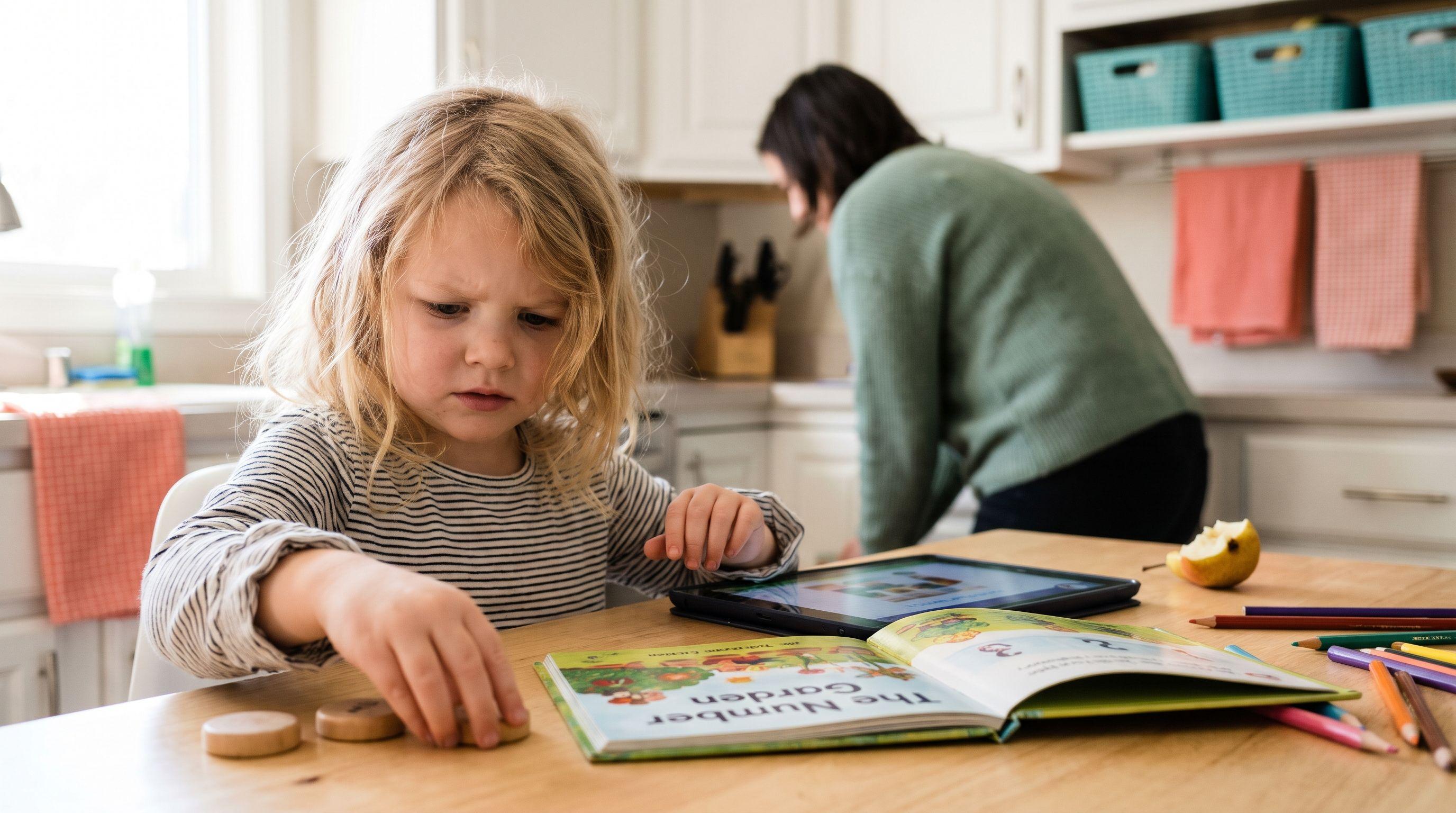
Your child finishes a reading game, earns three stars and still can't read map on a cereal-box scrap. That's not independence. That's a reason to look more closely at the instruction.
If you're choosing Orton-Gillingham apps for 1st graders (ages 6–7), here's my answer: choose explicit sound-to-print teaching, then check what your child can read away from the screen. An OG label alone proves nothing.
What You'll Learn
- Which six options deserve a look—and why they aren't six interchangeable OG programmes.
- The difference between useful phonics practice and a reward-filled guessing session.
- What one playground conversation taught me about apparently successful readers.
- How to check whether an app lesson transfers to actual reading.
Look, I'm Xia Brody, a Chinese-American homeschooling mum with children aged 10, 7, 4 and 1. I've taught my oldest two to read, and I'm currently teaching my four-year-old while the youngest contributes enthusiastic background noise. Sound familiar?
Here's the kicker: an app can't deliver everything a responsive reading teacher does. I've widened this list to include structured phonics alternatives because six genuinely equivalent, specialist OG apps would misrepresent the choices. My ranking prioritises parent involvement, explicit decoding, cumulative practice and useful transfer—not a claim of comparative research or hands-on competitor testing.
The Verdict
The ages below describe my recommended fit unless I explicitly identify a product's stated range. Competitor costs vary by platform and location; check the current price before subscribing.
| Rank and app | Teaching approach and limitation | Price model | Best-for age or fit |
|---|---|---|---|
| 1. Teach Your Kid to Read | My parent-led phonics pick; don't treat it as specialist OG therapy | Lesson one is free with no card and nothing to cancel; from lesson two the whole program is a 7-day free trial, then US$9.95 a month | My recommendation: ages 6–7 needing adult-supported foundational practice |
| 2. Nessy Reading & Spelling | Structured reading and spelling with a dyslexia focus; not individual tutoring | Home subscription; check current price | Stated ages 6–11 |
| 3. Reading.com | Parent-and-child phonics lessons; not a substitute for diagnostic teaching | Monthly or yearly subscription; check current price | Stated ages 3–8 |
| 4. Reading Eggs: Fast Phonics | Dedicated systematic synthetic phonics component; distinguish it from the wider suite | Subscription; check current price | Fast Phonics stated ages 5–10 |
| 5. Teach Your Monster to Read | Phonics and blending through a game; adult checks still matter | Free on computers; one-time paid app; check current app price | Stated ages 3–6; my pick for younger beginners or foundational review |
| 6. Hooked on Phonics | Phonics-led lessons and practice; not personalised OG intervention | Subscription; check current price | Stated ages 3–8 |
Full disclosure: I co-founded Teach Your Kid to Read, so weigh my #1 pick accordingly; the rest of the ranking is based on the criteria above.
I recommend Teach Your Kid to Read for parent-supported practice: start lesson one free. Lesson one is free with no card and nothing to cancel; from lesson two the whole program is a 7-day free trial, then US$9.95 a month.
Tiger Truth: Looking Successful Isn't the Same as Reading
I was at a playground in Raleigh, North Carolina, when another mum told me her child's school had switched from Lucy Calkins to a Science of Reading curriculum. She connected the change to North Carolina's SB 387, the Excellent Public Schools Act—a US state law enacted in 2021. She sounded annoyed. “He was doing fine before,” she said.
I asked whether he could read splint. He was in second grade (ages 7–8). He couldn't.
One word doesn't diagnose a reading difficulty, of course. But it started a useful conversation about whether he could decode unfamiliar words or mainly recognise familiar books. We spent 20 minutes on that bench discussing Emily Hanford's reporting, US reading results and the neuroscience Stanislas Dehaene explains in Reading in the Brain (2009): learning to read recruits and changes brain networks through instruction and experience.
She listened to Hanford's Sold a Story, which began in 2022, that night. At 11 pm, she texted: “I had no idea. Why didn't anyone tell us this sooner?”
That's the gut punch. On the 2022 US NAEP, 37% of fourth graders (ages 9–10) scored below NAEP Basic in reading. That isn't a dyslexia diagnosis, and NAEP categories aren't interchangeable with school grade-level judgments. It still represents a serious warning.
As school reading grows more demanding, weak decoding can make independent assignments exhausting. Waiting can mean another term of avoidance and widening gaps. Bottom line: act early, but don't mistake urgency for a prediction that your child can't catch up.
Ranked: Orton-Gillingham Apps for 1st Graders at Home
1. Teach Your Kid to Read — My Parent-Led Pick
I rank our app first for the family who wants to take an active teaching role rather than hand over a tablet and hope. That's my priority—not proof that our app outperforms every competitor.
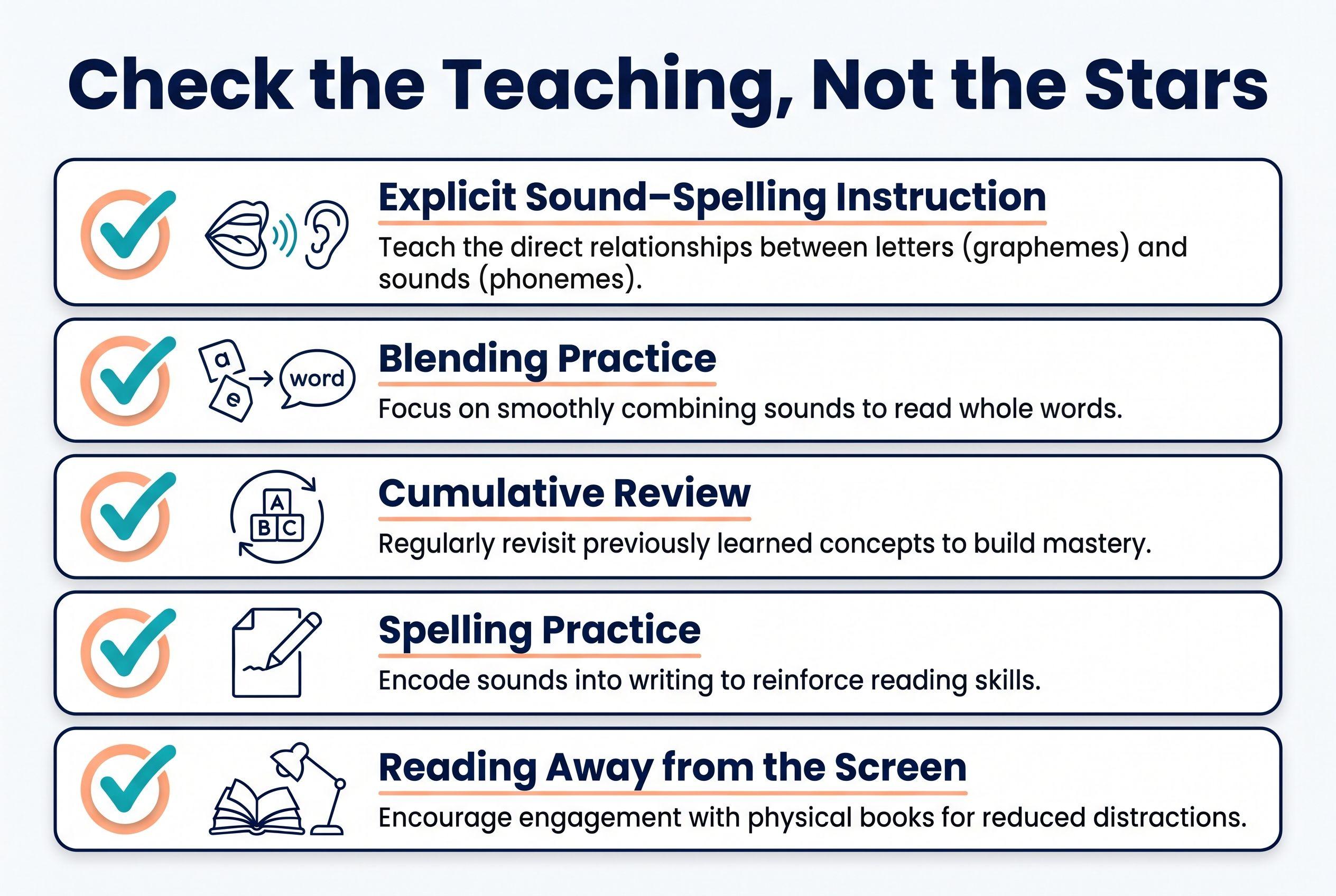
Here's the teaching standard I bring to it: teach a sound–spelling relationship, model blending, practise it and revisit it. Systematic synthetic phonics teaches children to combine sounds to read words. OG teaching shares explicit, cumulative instruction but also places substantial weight on diagnostic, responsive teaching. The terms aren't identical.
The 2000 report from the US National Reading Panel found benefits from systematic phonics instruction. It didn't evaluate our app, and it doesn't establish that every product advertising phonics delivers equally strong teaching. No shortcuts there.
For home practice, pair the lesson with movable letters and a pencil. If your child reads sat, ask them to build it, say its sounds and write it. That connects reading and spelling instead of treating each screen as an isolated activity.
My tiger rule is No Guessing. If a child sees ship and says “boat,” I don't celebrate a clever picture inference as word reading. I point to sh, supply the sound if necessary and help them blend the whole word.
The deal-breaker for any alternative is a task that lets pictures or rewards replace decoding. I don't claim every competitor below does that; parents should inspect the actual tasks. Our app also doesn't replace specialist assessment or individual intervention.
Lesson one is free with no card and nothing to cancel; from lesson two the whole program is a 7-day free trial, then US$9.95 a month. Choose it for supported practice, not a promise of instant reading mastery.
2. Nessy Reading & Spelling — Best Dyslexia-Focused Alternative
Nessy describes a structured approach to reading and spelling, with particular attention to children with dyslexia. Its stated ages of 6–11 make it a relevant option for this list, especially when a child needs foundational practice without a preschool presentation.
The useful question isn't “Does it look entertaining?” Ask whether its sequence addresses your child's actual gaps and whether you can connect practice to spelling on paper. That's the real deal.
Limitation: dyslexia-friendly software doesn't automatically provide the diagnostic teaching an individual child needs. If your child repeatedly struggles to blend three sounds despite explicit instruction, don't make another subscription your entire intervention plan. Nessy uses a home subscription; check the current price.
3. Reading.com — Best Alternative for Adult Participation
Reading.com presents its lessons as a parent-and-child activity built around phonics. Its stated range is ages 3–8, so a beginning first-grade reader falls within that range.
I like adult participation as a selection criterion. A parent can hear whether mmm-aaa-p becomes map or dissolves into a guess—something a completed activity alone may not reveal. Hands down, listening matters.
Limitation: a guided sequence still needs adult judgment when a child gets stuck. Don't move forward merely because the next lesson exists. Check whether your child can read unfamiliar words containing the same spellings. Reading.com offers monthly or yearly subscriptions; check current pricing rather than relying on an old comparison chart.
4. Reading Eggs: Fast Phonics — Best Dedicated Phonics Component
For this comparison, I mean Fast Phonics, not every activity in the Reading Eggs collection. Fast Phonics targets ages 5–10 and presents systematic synthetic phonics instruction.
That distinction matters. A large learning library can contain useful practice without giving your child the most suitable route through it. Keep your eye on the sequence, not the size of the menu.
Limitation: parents need to select the relevant component and check transfer beyond the game. The kicker is that an impressive activity count tells you little about independent decoding. Ask your child to read three fresh examples after a session. The wider service uses a subscription; check the current price and what your plan includes.
5. Teach Your Monster to Read — Best Low-Cost Practice Route
Teach Your Monster to Read uses a game format to practise letter–sound relationships and blending. Its stated ages are 3–6; I include it for younger beginners and children who need foundational review, not as a universal age-seven recommendation.
Computer access is free, while the app uses a one-time purchase model. Check the current app price. That's a useful distinction if your budget is tight.
Limitation: game progress can't tell you everything about reading accuracy. No-brainer check: put the device aside and ask for the same skill on paper. If your child needs older-looking materials or intensive individual teaching, this may not be the right fit. Fun can support repetition; it can't replace the skill.
6. Hooked on Phonics — Best Familiar Phonics-Led Alternative
Hooked on Phonics offers phonics-led instruction and reading practice for a stated age range of 3–8. It belongs here as an alternative for families comparing foundational reading tools, not because I classify it as equivalent to individual OG instruction.
Look for a close match between the sound patterns your child practises and the material they subsequently read. That's the point of controlled practice: children apply what they've learned instead of meeting a wall of untaught spellings.
Limitation: a general phonics sequence may not supply enough individual adjustment for persistent difficulties. Bottom line, judge accuracy away from the app. It uses a subscription model; check the current price and the contents of the particular offer you choose.
What an OG Label Can—and Can't—Tell You
Searching for an og phonics app 1st grade can produce a jumble of games, curricula and specialist services. Don't let the label do your thinking.
Orton-Gillingham describes an instructional approach, not one universal app curriculum. Explicit instruction, cumulative review and responsiveness to errors matter more than tracing a letter on glass. Multisensory activity should connect sounds with print—not simply keep fingers busy.
Here's the practical distinction:
- Phonemic awareness: hearing and manipulating individual speech sounds without needing print.
- Phonics: connecting those sounds to written letters and spelling patterns.
- Orthographic mapping: forming lasting connections between a word's spelling, pronunciation and meaning.
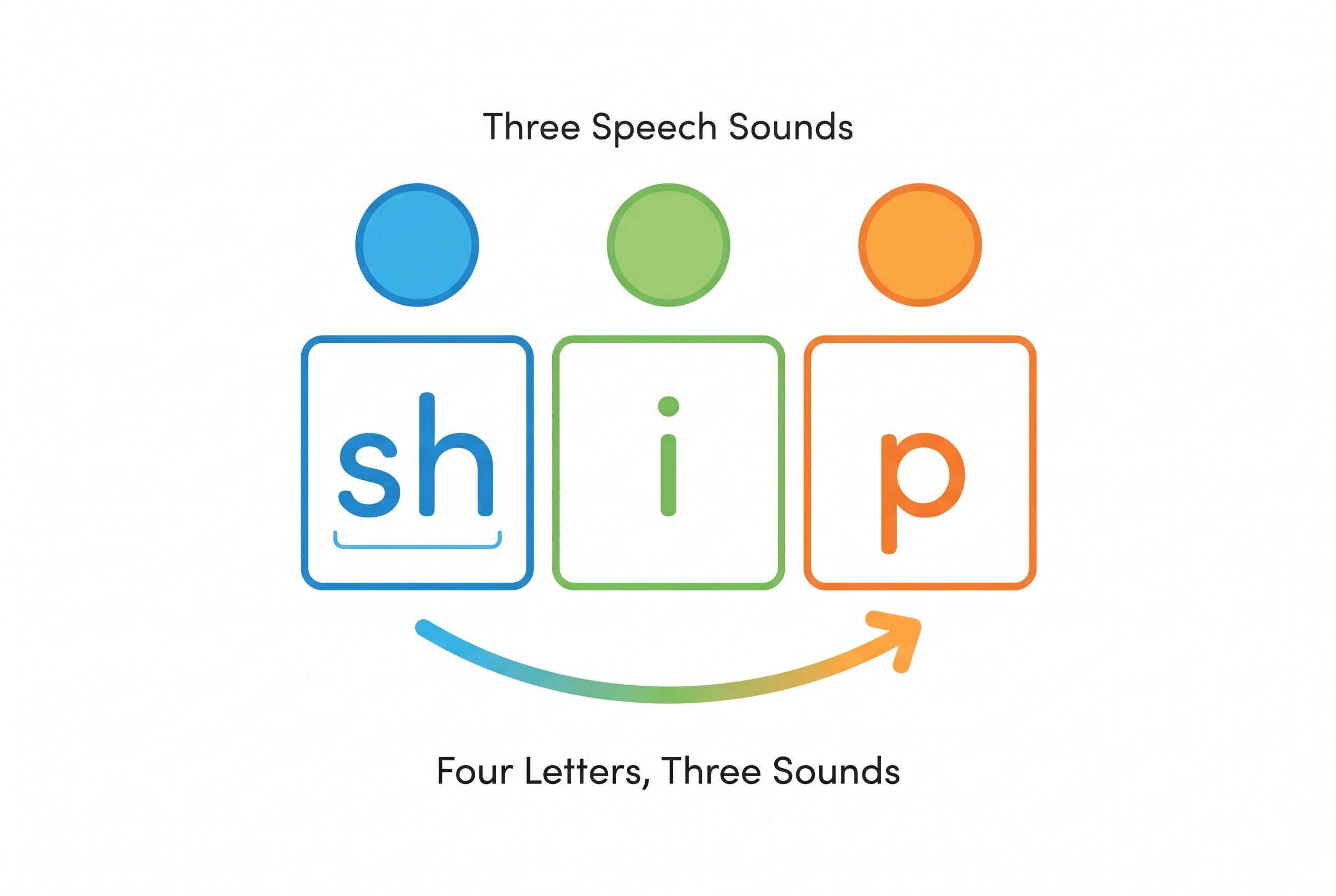
For example, ship has four letters but three phonemes: /sh/ /i/ /p/. Count the sounds with three counters, then replace them with sh, i and p. That's purposeful practice. Confetti is optional.
Any orton gillingham app for kids should sit within a wider plan that includes conversation, read-alouds and comprehension. Decoding gives children access to printed words; language knowledge helps those words mean something.
Your Action Step: A Short Daily Routine
For orton gillingham at home, start with observable skills rather than a shopping marathon. This routine takes roughly 10–15 minutes; shorten it if attention or frustration calls for a break.
- Check the starting point. Ask for a few taught letter sounds, oral blending and three simple printed words. Record the exact errors. A school specialist can use DIBELS screening measures to investigate risk; don't improvise its administration or treat an internet cutoff as a diagnosis.
- Teach one small target. For sh, say /sh/, show the spelling and contrast it with a familiar sound. Don't introduce five new patterns because the tablet battery looks optimistic.
- Blend and spell. Read ship, shop and shut only if the remaining spellings are familiar. Say the sounds, build each word and write one from dictation.
- Read connected print. Choose a short sentence using taught patterns. Supply any necessary untaught word rather than prompting a picture guess.
- Check transfer tomorrow. Present a fresh word with the same pattern. If your child struggles, reteach and reduce the difficulty instead of charging ahead.
If our parent-led option fits, lesson one is free with no card and nothing to cancel; from lesson two the whole program is a 7-day free trial, then US$9.95 a month.
My rule is We Never Skip the habit—not “we force a distressed child through a full lesson.” On a birthday or holiday, that might mean two minutes of comfortable review. Illness, disability and overload call for judgment, not guilt.
Keep a small record: “Monday: read ship independently; confused shop and stop.” That's more useful than “did reading.” If difficulties persist, request assessment and targeted support while continuing appropriate teaching. Don't wait for an app to diagnose dyslexia.
Ready to compare a lesson with the standards above? Lesson one is free with no card and nothing to cancel; from lesson two the whole program is a 7-day free trial, then US$9.95 a month.
FAQ
Are these all genuine Orton-Gillingham apps?
No. This ranking includes structured phonics alternatives alongside dyslexia-focused software. An OG label doesn't establish certification, individual diagnostic teaching or evidence that a specific product improves outcomes. Check the teaching sequence and your child's response.
Can an app replace a dyslexia specialist?
No. An app can provide practice, but persistent reading difficulties warrant assessment and targeted instruction. Ask the professional how they measure decoding, spelling and progress—not just which programme they prefer.
How long should first grade phonics practice take?
Try a manageable 10–15-minute home session and adjust to your child. That's a practical starting point, not a prescribed intervention dose. Some children need more intensive professional support alongside short home practice.
Should my child use pictures when reading?
Pictures can support discussion and comprehension. They shouldn't replace decoding a printed word. If your child says “pony” for horse, acknowledge the picture discussion, then return attention to the actual spelling.
Which option costs the least?
Teach Your Monster to Read offers free computer access; its mobile app uses a one-time purchase. Compare the access route you need and check current competitor prices. Cheapest isn't always the best instructional fit, but a bigger bill doesn't guarantee better reading either.
From teachyourkidtoread.org/blog/6-orton-gillingham-apps-for-1st-graders-at-home-ranked

Xia Brody
Co-Founder, Teach Your Kid to Read
Mom of 4 who has successfully taught her kids to read. Currently in the trenches with her 4-year-old while her two oldest (10 and 7) devour books on their own. Passionate about phonics-based methods and building a lifelong love of reading.
Related Articles
Best Reading Apps for 1st Graders: 6 Skill Picks
Looking for the best reading apps for 1st graders? Here are 6 skill-based picks ranked by phonics strength, decoding practice, fluency support, and what parents need to watch closely.
Read More →
Best Orton-Gillingham Reading Apps: 6 Ranked for 2026
An OG label doesn't guarantee good reading instruction. Here's how six reading apps compare for a 7-year-old who needs stronger decoding skills—and where an app needs backup from a real person.
Read More →
Reading Eggs vs ABCmouse for Dyslexia: Parent Pick
Choosing between Reading Eggs and ABCmouse for a child with dyslexia signs? I’m comparing them as a phonics mom, not a sticker-chart enthusiast. Here’s the no-nonsense 2026 pick.
Read More →