6 Best Science of Reading Apps for 7-Year-Olds, Ranked
Seven candles on the birthday cake don't tell me which vowel patterns a child can read. Hearing that child tackle an unfamiliar word tells me much more. That's how I approach choosing the best science of reading apps for 7-year-olds.
The Verdict
How we ranked
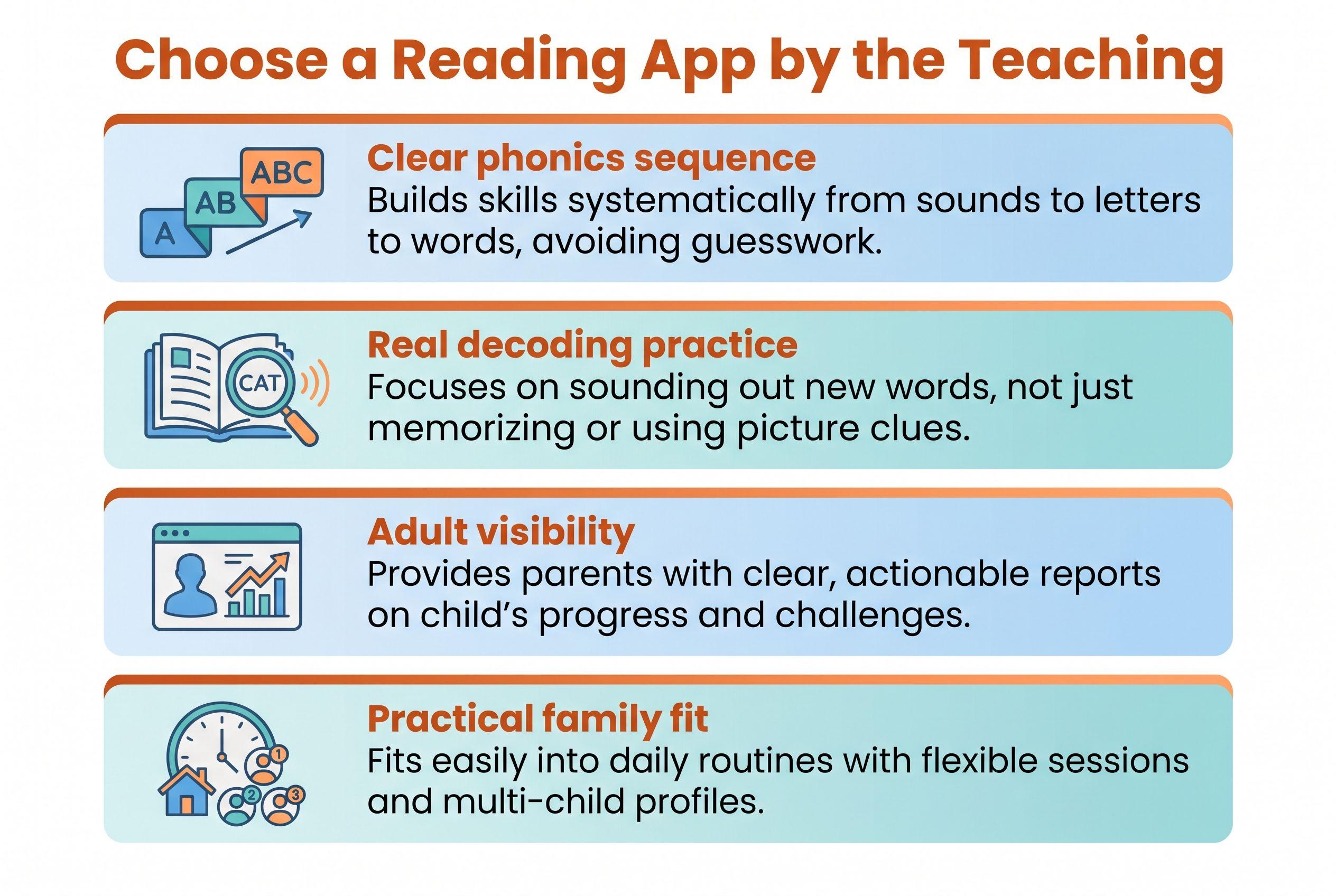
- Clear phonics sequence: Small, ordered steps help parents spot gaps instead of jumping between unrelated activities.
- Actual decoding practice: Children need to read unfamiliar words, not identify pictures or memorize a screen.
- Adult visibility: Parents need to hear errors and understand the next teaching step.
- Practical fit: Cost, adult time and appropriate difficulty matter more than a long feature list.
| Rank and app | What it teaches or how it describes itself | Price / pricing model | Best-for age and fit |
|---|---|---|---|
| 1. Teach Your Kid to Read | Step-by-step phonics with an adult; blending and short stories from lesson two | Lesson one free, then 7-day trial, US$9.95/month | My recommendation: age 7 when foundational decoding needs attention |
| 2. Reading.com | Describes a parent-and-child approach to phonics and early reading | US$12.49/month (checked October 2026); yearly US$74.94 (checked October 2026) | Stated ages 3–8; consider for shared lessons |
| 3. Reading Eggs | Describes a reading suite with phonics, reading activities and comprehension; includes Fast Phonics | US$13.99/month (checked October 2026) or US$99.99/year (checked October 2026), Reading & Math, up to 4 children; 30-day free trial | Stated ages 2–13 overall; Fast Phonics 5–10 |
| 4. Nessy | Describes reading and spelling instruction with structured practice | From US$15.50/month (checked October 2026), home subscription | Stated ages 6–11; consider for reading-and-spelling gaps |
| 5. Teach Your Monster to Read | Describes game-based practice in sounds, blending and early reading | Free on computers; app US$8.99 (checked October 2026), one-time purchase | Stated App Store ages 3–6; my age-7 pick only for earlier skills |
| 6. Khan Academy Kids | Describes early literacy activities within a broader learning program | Free; no ads or subscriptions | Stated ages 2–8; my pick for supplementary practice |
Full disclosure: I co-founded Teach Your Kid to Read, so weigh my #1 pick accordingly; the rest of the ranking is based on the criteria above.
Prices checked October 2026.
I recommend Teach Your Kid to Read for a seven-year-old who needs an adult beside explicit phonics practice: start lesson one free. Lesson one is free, with no card and nothing to cancel. From lesson two, the whole program is a 7-day free trial, then US$9.95 a month.
This is a comparison of described approaches and practical fit, not hands-on competitor testing or a ranking of proven product outcomes. Availability and checkout offers can differ by country.
The Tiger Truth: Waiting Doesn't Teach Decoding
Only 31% of US fourth graders (ages 9–10) scored at or above Proficient in reading on the 2024 NAEP. That doesn't mean everyone below Proficient can't read. It does mean parents shouldn't assume that moving through school automatically brings strong reading skills.
The US National Reading Panel, in its 2000 report, found benefits from systematic phonics instruction. Linnea Ehri's 2005 review, Learning to Read Words: Theory, Findings, and Issues, explains how connections between spellings and sounds support accurate word recognition.
Neither source proves that a particular app works. They support the teaching principles behind this comparison: teach sound–spelling relationships explicitly, practice blending and build accurate recognition through reading.
The realistic risk of doing nothing? More difficult books arrive while the same decoding gaps remain. A child may start avoiding reading. Act on the gap now without treating a seven-year-old's struggle as a permanent verdict.
Ranked: The 6 Best Science of Reading Apps for 7-Year-Olds
1. Teach Your Kid to Read: Best for Parent-Led Phonics
This is my first choice among the best science of reading apps for 7-year-olds when the parent wants to teach alongside the child. It offers 50 lessons in a fixed order, with about 15 minutes of side-by-side work each day.
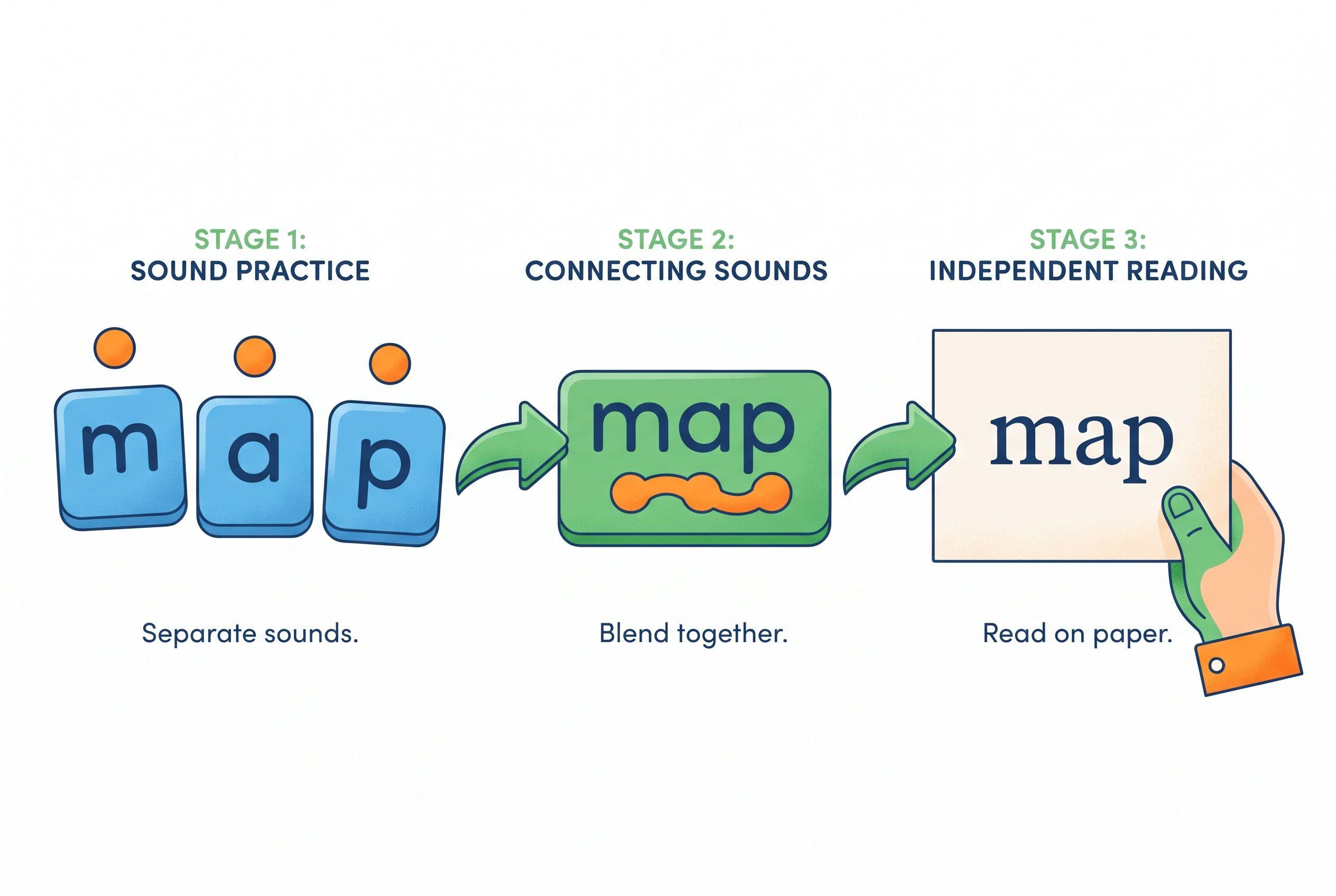
Lesson one teaches m, s, p and short a. Your child hears each sound, taps the matching letter, then blends and builds am, map and sap. There's no story in that first lesson. From lesson two, each lesson includes a short story using sounds taught so far.
That sequence matters. A seven-year-old who recognizes letter names but can't blend doesn't need a random collection of harder activities. They need a manageable connection between the sounds they know and the words they can read.
Later lessons cover digraphs such as sh, ch and th, plus blends, vowel teams, silent e, prefixes and suffixes. The program also teaches a small set of common irregular words by sight, calling them “leap words.” I wouldn't confuse that limited practice with guessing whole sentences from pictures.
For adult visibility, the app teaches the parent what to listen for and how to correct mistakes. The lessons page lets parents view every lesson and jump to any of them, so I recommend checking the child's skills before choosing a starting point. It runs on iPhone, iPad, Android and the web.
The limitation: it has no mode for a child to use alone. Pick something else if you need independent practice while you work; every lesson assumes an adult alongside.
My verdict: the strongest fit here for a parent who wants a clear teaching sequence and plans to hear the reading—not merely supervise a screen.
2. Reading.com: Best Alternative for Shared Lessons
Reading.com describes a parent-and-child phonics approach, and its stated ages of 3–8 include this reader's age. That makes it a relevant alternative rather than a preschool product awkwardly stretched to fit.
On my ranking criteria, its shared format gives parents a useful opportunity to hear decoding. Before subscribing, examine how its lesson sequence matches the patterns your child already knows and where new-word reading happens.
Here's the distinction I care about: a child completing an activity isn't necessarily a child reading the print. During any shared lesson, ask your child to read the word before you supply it. Adult presence helps only if the adult listens.
My verdict: consider it when you want another parent-led option. Compare the actual starting lesson and your family's routine rather than assuming two phonics subscriptions will teach equally well for your particular child.
3. Reading Eggs: Best for Families Wanting Broader Reading Practice
Reading Eggs describes several strands: Reading Eggs for ages 3–7, Fast Phonics for ages 5–10 and Eggspress for ages 7–13, within its wider ages 2–13 offering.
For parents comparing systematic phonics apps for 7-year-olds, look specifically at Fast Phonics. Don't assume every activity across the suite serves the same teaching purpose. Broader reading work and targeted decoding practice aren't interchangeable.
Imagine a child who understands a story read aloud but stalls on stamp. That child needs work with the printed sounds and blending—not simply more questions about the story. A broader suite can help a family cover several needs, but the parent still needs to choose the right strand.
My verdict: a practical choice when you want more than phonics in one subscription. It ranks below the shared-lesson options because breadth can make the next teaching step less obvious to a busy parent.
For another comparison, read ABCmouse vs Reading Eggs for 7-Year-Olds: Best Fit?.
4. Nessy: Best to Investigate for Reading-and-Spelling Gaps
Nessy's stated ages of 6–11 make it age-relevant, and it describes structured reading and spelling practice. I like considering those skills together: asking a child to spell a word can reveal a sound they missed while reading it.
Still, a description isn't an individual teaching plan. Check the starting activities, the order of patterns and what information you can actually use to guide practice. Adult visibility means more than an attractive dashboard; it means knowing what your child needs help with.
For a child with persistent difficulties, don't let the app search delay a professional assessment. An app can't diagnose dyslexia or determine the full support a child needs.
My verdict: worth investigating when both decoding and spelling cause difficulty. Judge its practice against your child's identified gaps, and use specialist guidance when those gaps persist.
5. Teach Your Monster to Read: Best Budget Option for Earlier Skills
Teach Your Monster to Read describes game-based practice with sounds, blending and early reading. Computer access costs nothing, which gives families a low-risk way to explore the fit.
Its App Store age range is 3–6. My recommendation for age seven is skill-based, not a claim that the product advertises that age range. An older beginner may need earlier phonics content without needing another speech about being behind.
The game format can make practice appealing, but keep the target visible. Ask your child to read a few words away from the game. If success disappears with the game cues, you haven't yet established reliable decoding.
My verdict: consider it for earlier skills on a tight budget. Choose a different option if the content feels too young or your child already reads those patterns accurately.
6. Khan Academy Kids: Best Free Supplement
Khan Academy Kids serves stated ages 2–8 and offers literacy within a broader learning program. It has no ads or subscriptions.
That makes it useful to consider for extra activities, particularly when budget limits your choices. However, a broad early-learning program isn't automatically the clearest route through a specific seven-year-old's phonics gaps.
I rank it sixth for this narrow job, not because free learning has less value. During practice, identify the literacy task and listen for actual reading. Don't count time spent elsewhere in the program as decoding practice.
My verdict: a sensible supplement. If your main problem is inaccurate word reading, keep a clear phonics sequence at the center of your teaching.
Match the App to the Reading Problem
The best science of reading apps for 7-year-olds aren't necessarily the ones with the most activities. They're the ones that fit the next teachable skill.
Letter sounds without blending: choose clear modeling and repeated opportunities to join sounds into words. A child who says /m/ /a/ /p/ but can't say map needs help with blending, not another alphabet celebration.
Guessing from pictures: insist on attention to the print. Pictures can support discussion and vocabulary; they shouldn't supply an unknown printed word. My Tiger Rule is “No Guessing.” That means I help with the sounds rather than demand an unsupported struggle.
Accurate reading without understanding: phonics alone won't address the whole problem. Discuss vocabulary and meaning, and choose support that addresses comprehension. Teach Your Kid to Read focuses on phonics and decoding, so I wouldn't recommend it as the answer to that different need.
Search phrases like “science of reading phonics apps age 7” and “evidence aligned reading apps for kids” help you find options. They aren't quality seals. Ask what the child actually practices.
Action Step: Choose From a Skill Check, Not a Screenshot
- Find the first uncertain pattern. Use our free phonics skill check. Your child reads real and made-up words while you record right or wrong responses; the result identifies a pattern to practice. Treat it as a starting point, not a diagnosis.
- Check the wider picture. Use our free reading-level-by-age check and compare your observations with what to expect at age 7. An age alone doesn't identify a teaching level.
- Listen before helping. Note whether your child guesses, loses a sound or can't blend. If spoken-sound tasks also cause difficulty, ask a teacher or specialist about David Kilpatrick's PAST, the Phonological Awareness Screening Test. It isn't a complete reading assessment.
- Choose one matching lesson. Start with a pattern your child needs, then ask for accurate reading of words containing that pattern. Don't purchase several subscriptions to avoid making a teaching decision.
- Check transfer away from the app. Write a few words using the taught pattern on paper. If your child can't read them, return to teaching rather than racing onward. Persistent difficulty deserves school or specialist support alongside practice.
If that check points to foundational decoding and you can sit alongside your child, try the first lesson together.
My “We Never Skip” rule means protecting a small reading routine, not forcing a full lesson through illness or distress. Some days, a brief review makes more sense. Accuracy matters more than maintaining a performance streak.
If the struggle extends beyond choosing software, my homeschool reading programs for a struggling seven-year-old comparison looks at broader teaching options.
For tonight, keep the decision small: hear your child read, identify one gap and teach that gap. If parent-led phonics fits, lesson one is free.
FAQ
What are the best science of reading apps for 7-year-olds?
For parent-led decoding, my first pick is Teach Your Kid to Read, followed by Reading.com. Reading Eggs, Nessy, Teach Your Monster to Read and Khan Academy Kids suit different needs. This ranking compares teaching descriptions and practical fit, not proven head-to-head outcomes.
Does “science of reading” mean an app has research proving it works?
No. Research supports teaching practices such as systematic phonics, but that doesn't establish evidence for every app using similar language. Separate the evidence for the teaching approach from evidence for the specific product.
Is 15 minutes a day enough?
About 15 minutes matches Teach Your Kid to Read's session format, not a universal intervention prescription. A child with persistent difficulties may need more explicit instruction and specialist support. Watch accuracy and transfer rather than promising results by a particular date.
Should a seven-year-old use a reading app alone?
Some products offer independent activities, but listen to reading regularly so mistakes don't stay hidden. Teach Your Kid to Read requires an adult alongside. Choose another option if independent use is your main requirement.
Can a reading app replace dyslexia support?
No. It can provide practice, but persistent decoding or spelling difficulties warrant assessment and targeted teaching. Bring specific examples of errors to your child's teacher or a qualified reading specialist instead of waiting for another subscription to solve the problem.
From teachyourkidtoread.org/blog/6-best-science-of-reading-apps-for-7-year-olds-ranked
Part of these guides

Xia Brody
Co-Founder, Teach Your Kid to Read
Mom of 4 who has successfully taught her kids to read. Currently in the trenches with her 4-year-old while her two oldest (10 and 7) devour books on their own. Passionate about phonics-based methods and building a lifelong love of reading.
Related Articles
7 Best Science of Reading Apps for 6-Year-Olds, Ranked (2026)
Phonics practice matters more than digital prizes. Here’s my ranking of seven reading apps for a 6-year-old, with clear prices, honest limitations and a plan for checking whether the learning sticks.
Read More →
6 Best Reading Apps for 7-Year-Olds with Speech Delay, Ranked
A pronunciation error doesn't automatically mean a reading error. Here are six reading apps ranked for phonics practice with a speech-delayed seven-year-old, with clear limits on what each can offer.
Read More →
6 Best Reading Apps for 6-Year-Olds with Dyslexia and ADHD, Ranked
My first pick is parent-led phonics, not an app that keeps a child busy. Compare six options by teaching approach, adult involvement and price—and see when your child needs more than an app.
Read More →