Reading Eggs Alternatives for Dyslexia: 7 Better Apps (2026 Picks)

What You'll Learn
- Why Reading Eggs specifically fails kids with dyslexia (and the one design flaw that makes it worse)
- The non-negotiable feature every dyslexia-friendly reading app must have — and most don't
- 7 reading eggs alternatives ranked by how closely they follow Orton-Gillingham principles
- The free screening test you can give your kid at home in 5 minutes to find out exactly where their phonological processing breaks down
The Uncomfortable Truth About Reading Eggs and Dyslexia
Let me be blunt. Reading Eggs is a fine app for kids who are developing typically. It's colorful, it's engaging, and your kid will love the little avatar rewards.
But if your child has dyslexia — or you even suspect they might — Reading Eggs is likely reinforcing the exact habits that hold dyslexic readers back. Less time on explicit decoding, more reliance on context and guessing. The result? Slower gains in decoding and word reading accuracy, right when your kid can least afford to lose ground.
I know that's harsh. Stay with me.
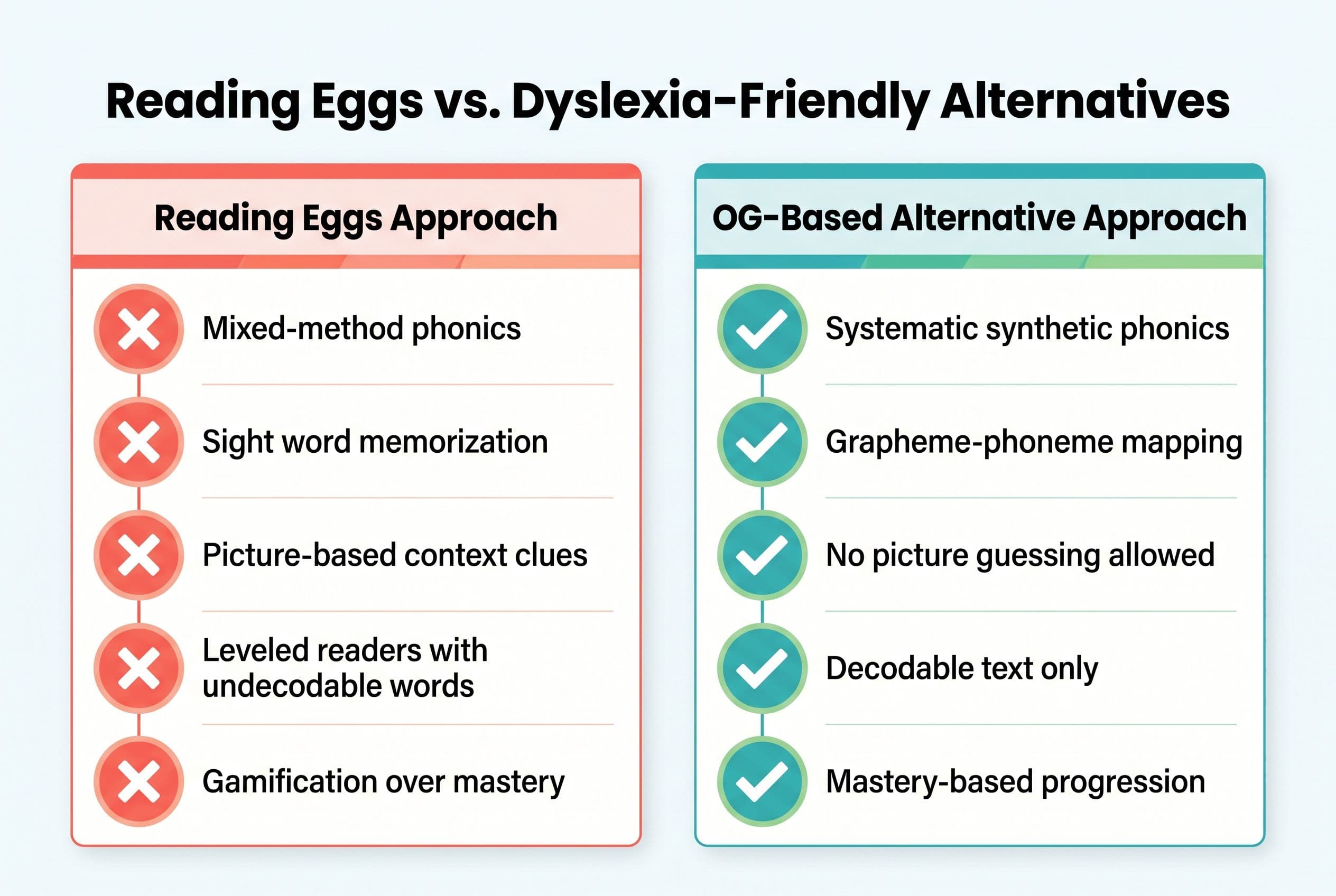
Reading Eggs uses a mixed-method approach. There's some phonics in there, sure. But it also leans heavily on sight word memorization, contextual guessing from pictures, and a leveled reading structure that looks an awful lot like the Balanced Literacy approach that's been failing kids for 30 years. The app presents whole words early and often, before kids have mastered the underlying letter-sound correspondences. For a typical reader, their brain fills in the gaps. For a dyslexic reader? Those gaps become canyons.
Here's the thing most parents don't realize: dyslexia isn't a vision problem. It's a phonological processing problem. David Kilpatrick's research — his 2016 book Equipped for Reading Success is the gold standard here — shows that dyslexic kids struggle specifically with orthographic mapping. That's the brain's process of bonding a word's pronunciation to its spelling so you can recognize it instantly. Here's the key: orthographic mapping doesn't happen through sheer repetition. It happens when a child can accurately analyze the sounds in a word and match them to the correct spellings — through guided, accurate decoding and strong phonemic awareness. Typical readers build these connections almost automatically after a few successful decoding attempts. Dyslexic kids can be exposed to a word dozens of times, but without the phonemic analysis skills to break it apart, the mapping never locks in.
Know what makes orthographic mapping harder? Presenting words before the kid has the phonemic awareness to break them apart. Which is exactly what Reading Eggs does.
So your kid plays the games. Gets the dopamine hits. Earns the little golden eggs. And still can't read the word "ship" without looking at the picture and guessing "boat."
Sound familiar?
The Tiger Truth: What Happens When You Keep Using the Wrong Tool
I'm not going to sugarcoat this part.
The 2022 NAEP — the Nation's Report Card — showed that only about a third of 4th graders scored at or above Proficient in reading. That score dropped 3 points from 2019, which NAEP called the largest decline in reading since 1990. And that's the average. For kids with learning disabilities, the numbers are catastrophic.
The Annie E. Casey Foundation's 2010 report found that kids who can't read proficiently by 3rd grade are 4 times more likely to drop out of high school. Four times. That's not a scare tactic. That's data.
And here's the kicker: the average private Orton-Gillingham tutor charges $80-$150 per hour. A full remediation program through something like Lindamood-Bell can run to thousands of dollars a year. Insurance doesn't cover it. Most school districts don't provide it until a kid is already two grade levels behind — and by then you've lost years.
Every month you spend on the wrong app is a month your kid isn't building the neural pathways they need. Stanislas Dehaene's work in Reading in the Brain (2009) proved that the brain doesn't learn to read naturally — it has to be trained. The "reading circuit" gets built through systematic, explicit instruction. Not through games. Not through guessing. Not through cute animated eggs.
The clock is ticking. The 3rd grade cliff is real. And Reading Eggs isn't going to get your dyslexic kid over it.
What a Real Dyslexia-Friendly Reading App Must Have
Before I give you the alternatives, you need to know what to look for. Because the app stores are full of "reading apps" that are just digital flashcards with cartoon characters bolted on.
A legitimate reading eggs alternative for dyslexia needs ALL of these:
1. Systematic Synthetic Phonics Not "some phonics mixed in." The entire program must be built on a systematic, sequential phonics scope and sequence. Letters and sounds taught in a specific order, from simple to complex, with nothing skipped. This is what the National Reading Panel report in 2000 found — systematic phonics instruction produces significant benefits for reading, and the effects are strongest for kids at risk of reading failure.
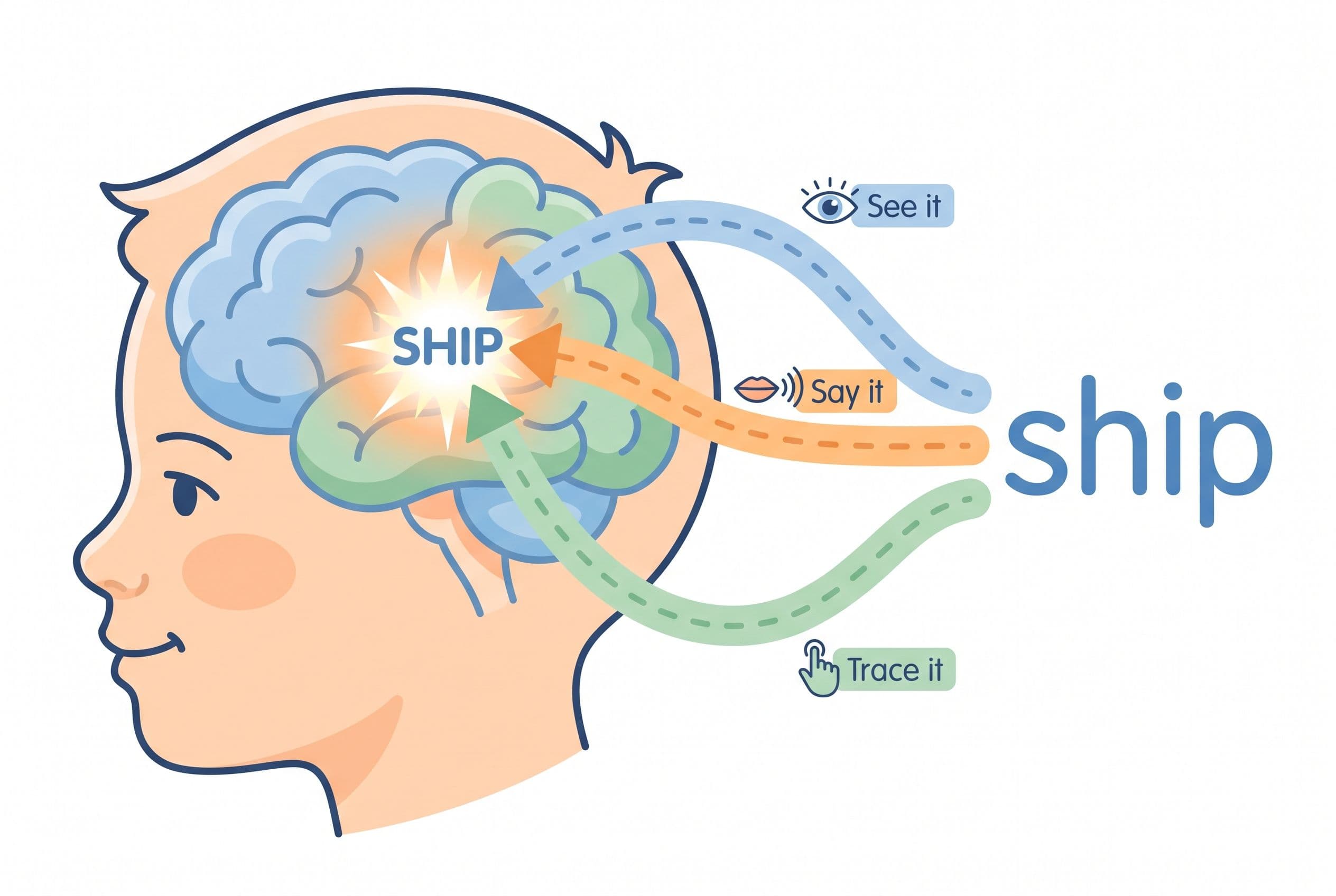
2. Orton-Gillingham Principles Orton-Gillingham isn't a single program — it's an approach. Multisensory, structured, sequential, diagnostic, and prescriptive. The kid sees the letter, says the sound, traces it with their finger. Multiple pathways into the brain. For dyslexic learners, this isn't optional. It's the whole ballgame.
3. Decodable Text (Not Leveled Text) This is where most apps fail. Leveled readers (like the Fountas & Pinnell system) are organized by "difficulty" but include words the child hasn't been taught to decode yet. They're literally designed to encourage guessing. Decodable readers only include words with phonics patterns the child has already mastered. Big difference.
4. No Picture-Based Guessing If the app shows a picture of a dog next to the word "dog" and expects the kid to "read" it — that's not reading. That's a matching game. Dyslexic kids need to decode from the letters, not the context.
5. Built-In Review and Mastery Checks Dyslexic kids need more repetitions to achieve orthographic mapping. The app should cycle back to previously taught patterns and require mastery before moving on.
7 Reading Eggs Alternatives That Actually Work for Dyslexia
OK, here's what you came for. I've evaluated these against the principles above — and against my experience homeschooling a kid who struggled with phonological processing (my 7-year-old, who's now reading chapter books — but it took the right tools and a LOT of consistency). I've also run several of these past friends who are certified Orton-Gillingham practitioners.
I'm ranking these by how closely they follow OG principles and how well they serve kids with dyslexia specifically.
1. Teach Your Kid to Read App
Real talk — this is our app, so I'm biased. But I'm also listing it first because I built it to solve exactly this problem.
Teach Your Kid to Read follows systematic synthetic phonics based on Orton-Gillingham principles. Every lesson teaches a specific grapheme-phoneme correspondence. Kids practice blending in isolation before they ever see a word in context. There's no picture guessing. No sight word memorization. No "three-cueing" nonsense.
The app uses multisensory input — kids hear the sound, see the letter, and interact with the blending process. It's sequential and cumulative, meaning nothing gets skipped and everything spirals back for review. For dyslexic learners, this structure is everything.
I had my 4-year-old on this app last week doing CVC words at the kitchen table while I fed the baby. She blended "m-a-p" independently for the first time. No guessing. No looking at pictures. Just straight decoding. That's the standard.
2. UFLI Foundations (with the Digital Companion)
UFLI Foundations was developed at the University of Florida's Literacy Institute. It's a structured literacy curriculum, not technically an app — but they've released digital companion materials that work beautifully on tablets.
The scope and sequence is rock solid. It follows the science of reading to the letter. Each lesson has explicit phonics instruction, blending practice, dictation, and decodable connected text.
Here's a story that shows you why this matters. After Emily Hanford's Sold a Story came out, my neighbor — a first-grade teacher with 18 years in the classroom — called me practically in tears. She'd been using Lucy Calkins' Units of Study her entire career. Three-cueing, MSV, the whole nine yards. She told me, "I've been teaching kids to guess for two decades and I didn't even know it."
She switched her classroom to UFLI Foundations mid-year. It was messy — she had to relearn everything herself first, staying up late watching the training videos while her own kids slept. But by spring, her students' DIBELS scores had jumped an average of 15 points on nonsense word fluency. She told me that was the first time in her career where every single kid in her class could decode CVC words by February. Every. Single. Kid.
That includes three students who had been flagged for dyslexia evaluation. Systematic phonics didn't "cure" their dyslexia — nothing does — but it gave them the explicit instruction their brains needed.
UFLI is free, by the way. The lesson plans are all online. The digital components are minimal compared to a full app experience, which is the main drawback for parents wanting something their kid can do independently.
3. Explode the Code Online
Explode the Code has been around since the 1970s as a workbook series, and the online version is a solid reading eggs replacement for dyslexic learners. It's systematic, it's explicit, and it doesn't rely on contextual guessing.
The digital platform takes the workbook exercises and makes them interactive. Kids work through phonics patterns in a controlled sequence. There's lots of repetition, which is exactly what struggling readers need.
The downside? It's not the most visually exciting app in the world. Your kid isn't going to beg to play it the way they beg for Reading Eggs. And honestly? I'm fine with that. We're not here for entertainment. We're here for reading.
4. Reading Horizons Elevate
Reading Horizons uses a methodology they call the "42 Sounds of English" system, and it's heavily influenced by Orton-Gillingham principles. The Elevate platform is their digital version, and it's one of the more polished apps like Reading Eggs for struggling readers.
What I like: it uses a marking system where kids physically interact with words to identify vowel sounds, consonant sounds, and syllable patterns. That multisensory element is key for dyslexic learners. It also adjusts pacing based on student performance, so kids who need more repetitions get them automatically.
Check the Reading Horizons site for current subscription pricing — what you're paying for is actual structured literacy, not a gamified guessing factory.
5. Logic of English Foundations App
Logic of English is one of my favorite curriculum programs, period. The Foundations level is designed for kids ages 4-7, and the app companion follows their scope and sequence.
What sets it apart: it teaches phonograms (letter-sound combinations) systematically and explicitly addresses the rules of English spelling. Kids learn why the silent E changes the vowel sound, not just that it does. For dyslexic learners, understanding the logic behind English orthography reduces the cognitive load of reading.
The app is designed to be used alongside parent instruction, not as a standalone. So if you want something your kid does completely independently on an iPad while you cook dinner — this isn't it. But if you're willing to sit with your kid for 15-20 minutes a day and use the app as a practice tool, it's outstanding.
6. Barton Reading & Spelling System (Video-Based Tutoring)
Barton isn't an app in the traditional sense — it's a video-based tutoring system that uses physical tiles and structured lesson plans. But I'm including it because it's one of the most effective Orton-Gillingham programs for dyslexia, and recent versions have added digital components that make it more accessible.
Susan Barton designed this system specifically for parents and tutors who are NOT trained reading specialists. Each lesson comes with a video showing you exactly what to do and say. You follow the script. Your kid manipulates letter tiles. It's multisensory, sequential, and explicit.
The catch: it's expensive — check the Barton site for current pricing. But compare that to $150/hour for a private OG tutor, and it starts to look like a bargain. The International Dyslexia Association recognizes OG-based approaches as the gold standard for dyslexia intervention, and Barton follows those principles closely.
7. Lexia Core5
Lexia Core5 is widely used in schools and has a strong research base. It's an adaptive reading program that addresses phonological awareness, phonics, structural analysis, fluency, vocabulary, and comprehension.
For dyslexic learners, the adaptive pacing is helpful — the program automatically adjusts difficulty and provides additional practice when a student struggles. It also generates detailed reports that show you exactly where your kid is breaking down.
The downside for homeschool parents: Lexia is primarily sold to schools, and getting a family subscription can be tricky and expensive. If your kid's school uses it, great — make sure they're getting maximum time on it. If you're homeschooling, the other options on this list are more accessible.
How to Screen Your Kid Before You Pick an App
Before you spend money on any reading eggs alternative, do this first. Seriously.
David Kilpatrick developed the PAST — the Phonological Awareness Screening Test. It takes about 5 minutes, it's free, and it tells you exactly where your child's phonological processing breaks down. Is it at the syllable level? The onset-rime level? The individual phoneme level?
This matters because a kid who can't segment individual phonemes needs a different starting point than a kid who can segment but can't blend. The right app at the wrong starting level is almost as useless as the wrong app.
Here's how to do it:
- Download the PAST — search "Kilpatrick PAST test" and you'll find the PDF. It's free.
- Administer it one-on-one in a quiet room. No distractions. Follow the script exactly.
- Score it — the test tells you which phonological level your child has mastered and where they stall out.
- Match the app to the level — if your kid is stuck at basic phoneme segmentation, start with an app that heavily drills individual sounds before blending (Teach Your Kid to Read, UFLI, or Barton). If they can segment and blend but struggle with more complex patterns, Logic of English or Reading Horizons will serve them better.
Many DIBELS benchmarks expect scores in the high 20s or above on nonsense-word letter-sounds (NWF-CLS) by mid-kindergarten — but cut points vary by edition, so check your school's specific benchmark table. If your kid is well below that, don't wait. Don't "give it another semester." Start intervention now.
According to NAEP data, roughly a third of fourth graders score Below Basic in reading. The research is clear — early intervention is everything. The "wait and see" approach is the "wait and fail" approach.
The Bottom Line: Stop Using a General Tool for a Specific Problem
Reading Eggs is a general-purpose reading app built for typical learners. Using it for a dyslexic kid is like using a butter knife as a screwdriver. It sort of fits. It sort of turns. But it's not going to get the job done, and you might strip the screw permanently.
Mississippi proved what happens when you commit to the right approach. Their Literacy-Based Promotion Act of 2013 mandated evidence-based reading instruction statewide. They went from 49th in national reading scores to 21st in six years. They didn't do it with cute apps and golden eggs. They did it with systematic, explicit phonics instruction grounded in the science of reading.
Your dyslexic kid deserves that same approach. Not a gamified guessing game.
Here's your action plan:
- Give your kid the Kilpatrick PAST test this week. Today if you can.
- Based on the results, pick one app from this list that matches their level.
- Commit to 15-20 minutes a day. Every day. Birthdays, holidays, vacation. We never skip.
- Track progress monthly. Use DIBELS benchmarks if your school provides them, or re-administer the PAST every 8 weeks.
- If you're not seeing measurable progress after 6-8 weeks, switch approaches. Don't wait.
Teach Your Kid to Read was built for exactly this situation — a parent who needs a structured, systematic, Orton-Gillingham-aligned tool that their kid can use daily without a teaching degree. Try it. Give it 30 days. If your kid isn't making measurable progress in phoneme blending and CVC decoding, I want to hear about it.
Call us at (407) 707-6850 or visit start lesson one free to get started.
Frequently Asked Questions
Is Reading Eggs bad for all kids, or just kids with dyslexia?
Reading Eggs isn't terrible for typically developing readers who already have strong phonological awareness. Those kids can handle the mixed-method approach because their brains fill in the phonological gaps naturally. But for kids with dyslexia or any phonological processing weakness, the app's reliance on sight word memorization and picture-based context actively reinforces bad habits. It teaches them to guess instead of decode — and once a kid learns to guess, that habit is extremely hard to break.
How do I know if my child has dyslexia or is just a slow reader?
The short answer: get a formal evaluation from a psychologist who specializes in learning disabilities. But before you spend $2,000-$4,000 on a full psychoeducational evaluation, try Kilpatrick's PAST test at home. If your child stalls at basic phoneme manipulation tasks — like asking them to say "cat" without the /k/ sound — that's a red flag for phonological processing difficulties, which is the core deficit in dyslexia. Also look for family history (dyslexia is highly genetic), difficulty rhyming, and trouble learning letter-sound correspondences despite repeated instruction.
Can an app really replace an Orton-Gillingham tutor for dyslexia?
Honestly? For moderate to severe dyslexia, no. A trained OG tutor provides diagnostic, prescriptive instruction that adapts in real time to your child's specific error patterns. No app can fully replicate that. But for mild dyslexia, or as a daily practice supplement alongside tutoring, a well-designed OG-based app can provide the repetitions your kid needs to build orthographic mapping. Think of it this way: the tutor teaches the skill, the app drills the skill. Both matter.
How long does it take for a dyslexic child to learn to read with the right program?
Every kid is different, and I refuse to give you a fake timeline. What I can tell you is that Linnea Ehri's research on phases of word reading development shows that most kids move through the phases — pre-alphabetic, partial alphabetic, full alphabetic, and consolidated alphabetic — over months, not weeks. For dyslexic learners, each phase takes longer and requires more explicit instruction and repetition. With the right program used consistently (15-20 minutes daily), most families I've worked with see measurable progress on DIBELS or PAST benchmarks within 8-12 weeks. Full reading fluency can take 1-3 years of systematic intervention.
My school uses Reading Eggs in the classroom. What should I do?
Supplement at home with a structured literacy program. Don't wait for the school to change. Over 40 states have now passed science of reading legislation since 2019, so change is coming — but it's slow. Colorado's READ Act, Ohio's Third Grade Reading Guarantee, Florida's Just Read initiative — these laws are pushing schools toward evidence-based instruction, but implementation takes years. In the meantime, your kid needs intervention now. Use one of the apps from this list at home for 15-20 minutes daily. You're not undermining the teacher. You're filling a gap the school hasn't closed yet.
Part of these guides

Xia Brody
Co-Founder, Teach Your Kid to Read
Mom of 4 who has successfully taught her kids to read. Currently in the trenches with her 4-year-old while her two oldest (10 and 7) devour books on their own. Passionate about phonics-based methods and building a lifelong love of reading.
Related Articles
Reading Eggs Alternatives Australia: 6 Better Picks
Looking for Reading Eggs alternatives Australia parents can trust? Here are 6 stronger picks for real phonics, less guessing and better reading practice in 2026.
Read More →
Reading Eggs vs ABCmouse for Dyslexia: Parent Pick
Choosing between Reading Eggs and ABCmouse for a child with dyslexia signs? I’m comparing them as a phonics mom, not a sticker-chart enthusiast. Here’s the no-nonsense 2026 pick.
Read More →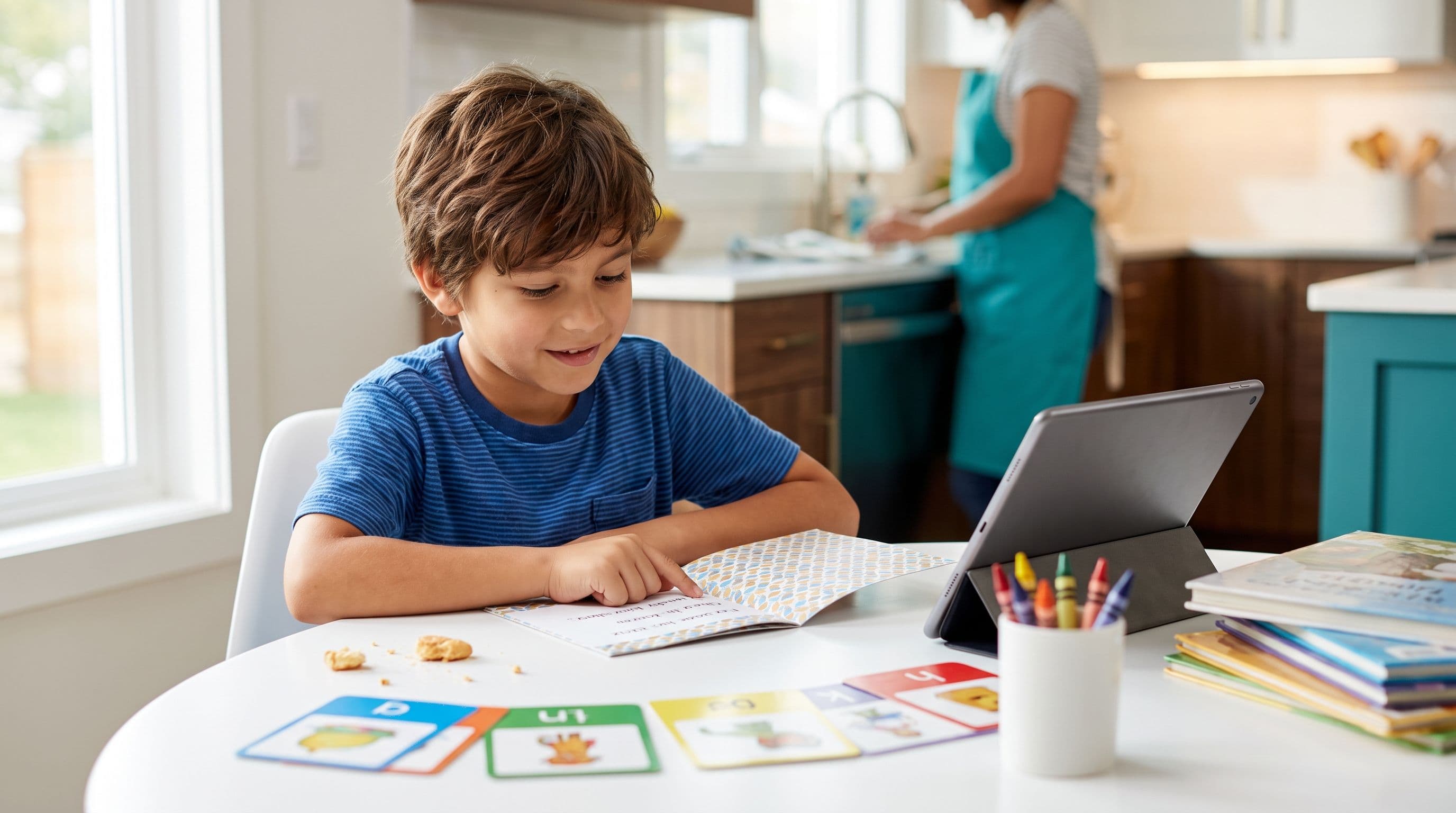
Reading Eggs vs ABCmouse Cost: 2026 Price Breakdown
Comparing Reading Eggs vs ABCmouse cost? Here’s the 2026 price breakdown, what each app teaches, and why I’d choose phonics-first instruction over reward-heavy screen time.
Read More →