Reading Eggs Alternatives Australia: 6 Better Picks
What You'll Learn
- The Reading Eggs feature I’d side-eye before paying another month
- Which apps teach real phonics and which ones lean too hard on games
- The cheaper than Reading Eggs Australia options worth checking first
- The one question to ask before you buy any reading app for Prep, Foundation or Kindy (ages 5-6)
Reality Check
Your child doesn’t need more screen confetti. Your child needs to read a word like splint without guessing “spin” because the first two letters look close enough — once they’ve actually been taught those consonant clusters, obviously. We’re not throwing a Prep kid into the deep end and then acting shocked when they sink.
Reading Eggs is popular in Australia. I get it. It’s colourful, familiar and lots of schools mention it. But popular doesn’t always mean best for decoding, spelling and long-term reading Independence.
If you’re searching for reading eggs alternatives australia, you’re probably asking the right question: “Is this app actually teaching my kid to read, or just keeping them busy?” Good. That’s the no-brainer question.
The Verdict: Best Reading Eggs Alternatives Australia Parents Should Check First
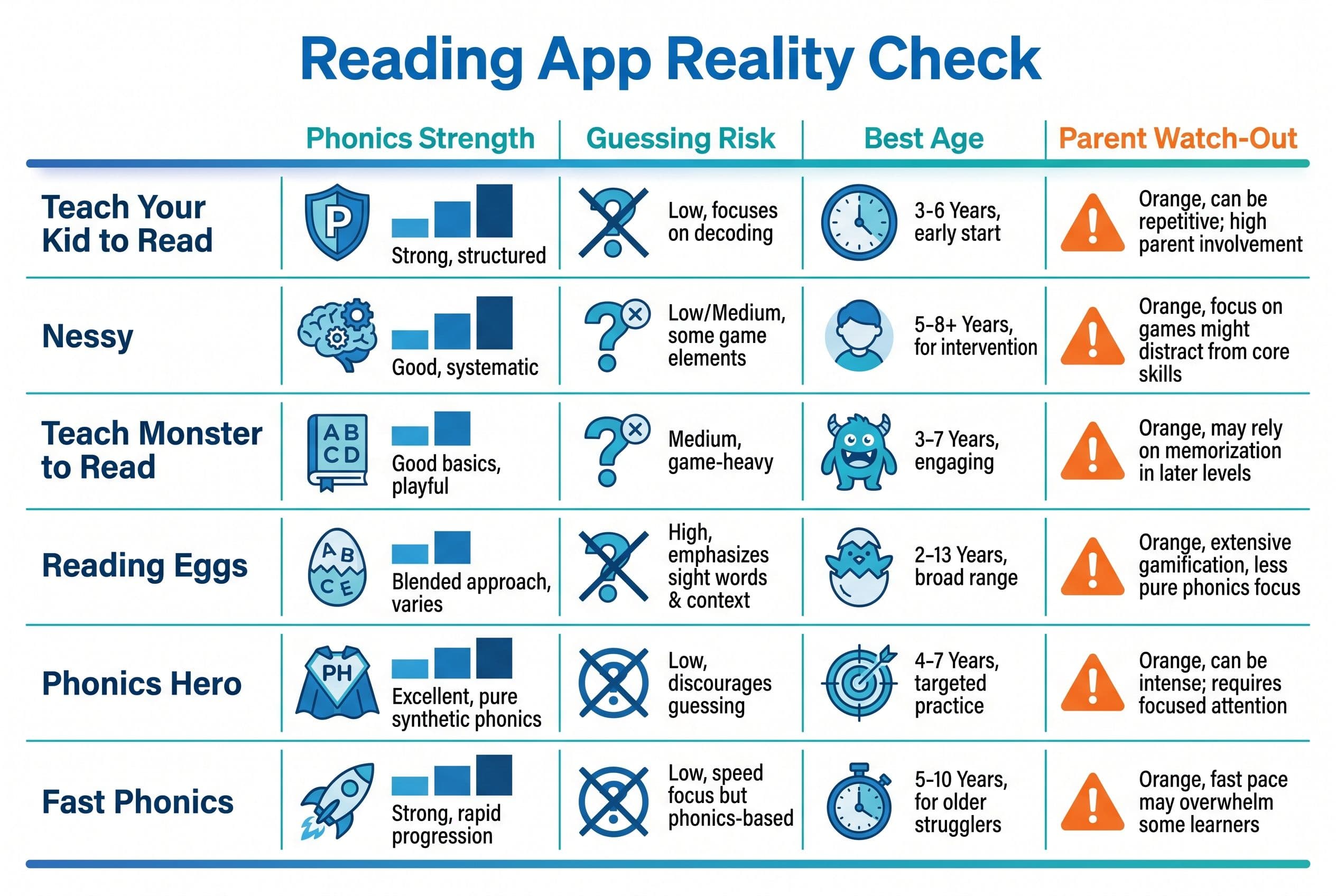
| Rank | App | What it teaches | Approx. cost | Best for |
|---|---|---|---|---|
| 1 | Teach Your Kid to Read | Systematic synthetic phonics, blending, no guessing | Lesson one free with no card; then 7-day trial, A$9.95/month | Ages 4-7 |
| 2 | Nessy Reading & Spelling | Structured phonics and dyslexia-friendly practice | Paid subscription | Ages 5-9 |
| 3 | Teach Monster to Read | Early phonics through games | Often low-cost or free promos | Ages 4-6 |
| 4 | Reading Eggs | Mixed phonics, sight words, games and rewards | Check current Reading Eggs Australia cost | Ages 4-8 |
| 5 | Phonics Hero | Synthetic phonics with decodable practice | Paid subscription | Ages 4-7 |
| 6 | ABC Reading Eggs Fast Phonics | More phonics-focused than regular Reading Eggs | Often bundled | Ages 5-7 |
My top pick is Teach Your Kid to Read because it teaches the child to attack the code: sound, blend, read, repeat. Lesson one is free with no card and nothing to cancel; from lesson two the whole programme is a 7-day free trial, then A$9.95 a month. You can start lesson one free and see whether your child tolerates real phonics before you pay.
Tiger Truth: The App Choice Matters More Than Parents Think
Here’s the thing: reading isn’t natural. Speaking is natural. Reading is a human invention, and the brain has to build new pathways for print.
Stanislas Dehaene’s Reading in the Brain (2009) explains this beautifully — and a little terrifyingly. The brain must connect visual symbols to speech sounds. That doesn’t happen because a child stares at cute books long enough.
The US National Reading Panel found in 2000 that systematic phonics instruction gives children real reading benefits, especially in the early years. Johnston and Watson’s Clackmannanshire study in Scotland (2005) found strong word reading and spelling outcomes for children taught synthetic phonics compared with children taught by analytic phonics methods. That’s evidence for the teaching approach, not a magic stamp for any one app. But it does tell us where to look: explicit phonics, blending and lots of practice. This isn’t a vibe. It’s reading science.
Australian parents should also care because early-years phonics checks are now part of the conversation in several states, but the rules aren’t identical everywhere and they can shift. South Australia made the Year 1 Phonics Check mandatory in government schools in 2018, NSW followed for public schools in 2021, and other states and territories have had different trials, checks or school-level approaches. Translation: check your state’s current policy for this year, because tiger mum does not have time for stale government paperwork. The commonly used check includes 40 words: 20 real words and 20 pseudo-words. Your child can’t pass that kind of task by memorising pictures or guessing from context.
Real talk — that check exposes weak decoding fast.
1. Teach Your Kid to Read: Best Overall Reading Eggs Alternative
Teach Your Kid to Read is my #1 pick for parents who want direct, structured phonics without turning the lesson into a circus.
I’m a Chinese-American homeschooling mum of four, and I’m in the trenches with my 4-year-old right now. Last Tuesday at the kitchen table, we worked on CVC words with magnetic letters while the baby tried to eat a crayon. Glamorous? No. Effective? Hands down.
The app follows the same basic logic I use at home:
- Teach the sound clearly
- Practise blending left to right
- Read words the child can actually decode
- Stop guessing from pictures
- Build Mastery before moving on
That last one matters. A lot of reading apps reward speed, clicking and random success. Teach Your Kid to Read rewards the actual Skill: decoding.
The best part? It doesn’t pretend lesson one tells the whole story. Lesson one is free with no card and nothing to cancel. From lesson two, the whole programme is a 7-day free trial, then A$9.95 a month. That’s honest. No sneaky “surprise, now pay” nonsense.
Why I Like It Better Than Reading Eggs
Reading Eggs can feel busy. Some kids love the maps, eggs, songs and rewards, but the kicker is this: rewards can replace instruction if you’re not careful.
Teach Your Kid to Read keeps the main thing the main thing. Phonics. Blending. Decodable words. No guessing.
It lines up better with what Linnea Ehri described in her 2005 work on phases of word reading development. Children move from partial alphabetic guessing toward full alphabetic reading when they map letters to sounds and store words through orthographic mapping. That’s the real deal.
If your child is in Prep/Foundation/Kindy (ages 5-6) or Year 1 (ages 6-7), this is the stage where you don’t want fluff. You want Foundation, Drill and Mastery.
2. Nessy Reading & Spelling: Best for Dyslexia Indicators
Nessy has a strong reputation for children with dyslexia indicators. It uses structured phonics, spelling and memory supports in a way many kids find less shamey than worksheet-heavy practice.
If your child mixes up sounds, forgets words they “knew yesterday” or melts down during reading, Nessy deserves a look. It’s not magic, but it does understand that struggling readers need explicit teaching and lots of repetition.
I’d pair it with an assessment like David Kilpatrick’s PAST — the Phonological Awareness Screening Test. The PAST takes about 5 minutes once you know how to give it, and it can show whether the breakdown sits in syllables, onset-rime or phonemes. That’s parent gold.
Nessy can be stronger than Reading Eggs for kids who need more structure. The downside? Some children still need an adult beside them saying, “No guessing. Say the sounds.” Apps don’t replace you. Sorry. I wish they did on laundry day.
3. Teach Monster to Read: Best Budget Pick
Teach Monster to Read is one of the better-known apps like Reading Eggs Australia parents often mention because it’s playful and often cheaper.
It works best for early phonics: letter sounds, blending and first words. If your child is 4 or just starting school, this can be a sweet entry point.
But don’t confuse “cute” with complete. Teach Monster can help, but I wouldn’t use it as the only reading programme for a child who’s already behind in Year 1 (ages 6-7) or Year 2 (ages 7-8). At that point, you need tighter lessons, more controlled text and fewer distractions.
Bottom line: good starter. Not my top pick for serious catch-up.
4. Reading Eggs: Popular, Polished and Not Always Enough
Let’s talk about the big orange egg in the room.
This isn’t a Reading Eggs hate session. Some children enjoy it. Some schools use it. Many parents have watched their kids happily log in while dinner burns behind them. Been there.
But a fair Reading Eggs review Australia parents can trust has to ask: does it teach decoding cleanly enough?
Regular Reading Eggs includes phonics, sight words, stories, activities and reward systems. That mix can help some kids. It can also blur the line between reading and clicking through activities.
The danger is that children learn to use partial cues:
- First letter
- Picture clue
- Repeated sentence pattern
- Memory from yesterday
- Lucky guess
That’s not reading. That’s a literacy magic trick, and the rabbit eventually bites.
Emily Hanford’s APM Reports podcast Sold a Story exposed how guessing-based reading ideas infected classrooms for years. The same idea can sneak into apps when children rely on pictures, patterns or memorised levels instead of grapheme-phoneme correspondence.
What About Reading Eggs Australia Cost?
The Reading Eggs Australia cost changes with plans, bundles and promotions, so check the current price before you compare. Also check what you’re paying for: Reading Eggs, Fast Phonics, Mathseeds or a family bundle.
If you want something cheaper than Reading Eggs Australia, don’t just chase the lowest monthly fee. Ask this instead: “Will this app make my child better at sounding out unfamiliar words?”
That’s the money question.
5. Phonics Hero: Best Straight Synthetic Phonics Option
Phonics Hero teaches synthetic phonics in a structured way, and I like that. It gives children practice with sounds, blending, spelling and reading words.
For Australian families, it may feel more aligned with the Year 1 Phonics Check than general game-based reading apps. Pseudo-words don’t care whether your child has seen the word before. They test whether your child can decode the patterns they’ve been taught.
That said, some children find Phonics Hero less shiny than Reading Eggs. Good. Shiny isn’t the goal. Reading is the goal.
If your child needs clear practice and you’re willing to sit nearby, this can work well. If your child needs stronger parent guidance, I’d still put Teach Your Kid to Read above it.
6. ABC Reading Eggs Fast Phonics: Better Than Regular Reading Eggs, But Still Check the Fit
Fast Phonics is the part of the Reading Eggs family I’d take more seriously for decoding. It focuses more directly on phonics than the broader Reading Eggs programme.
If you already have a subscription, try Fast Phonics before paying for another app. Watch closely, though. Don’t just ask, “Did my child finish the level?” Ask:
- Can they read the word without the picture?
- Can they read a pseudo-word with the same pattern?
- Can they spell the sound pattern back to you?
- Can they read it again tomorrow?
That last question is savage. It reveals everything.
The Playground Moment That Changed One Mum’s Mind
I was at a playground in Raleigh once when another mum told me her child’s school had switched away from Lucy Calkins-style lessons and moved to a Science of Reading curriculum. She sounded confused and a bit annoyed. “He was doing fine before,” she said.
So I asked one question: “Can he read the word splint?”
He was in his second year of school. He’d already been taught short vowels and consonant clusters, so this wasn’t me being dramatic for sport. He couldn’t read it.
We sat on that bench for 20 minutes while our kids climbed, argued over a swing and ignored the snacks we packed like fools. I explained Hanford’s reporting, Dehaene’s neuroscience and why schools were finally moving away from cueing and guessing. She went home and listened to Sold a Story that night. At 11pm she texted me: “I had no idea. Why didn’t anyone tell us this sooner?”
That’s exactly how I feel about reading apps. Why doesn’t anyone tell parents sooner that “my child likes it” isn’t the same as “my child is learning to decode”?
How to Choose Between Reading Eggs vs Alternatives
Use this checklist before you pay for anything.
1. Check for Real Phonics
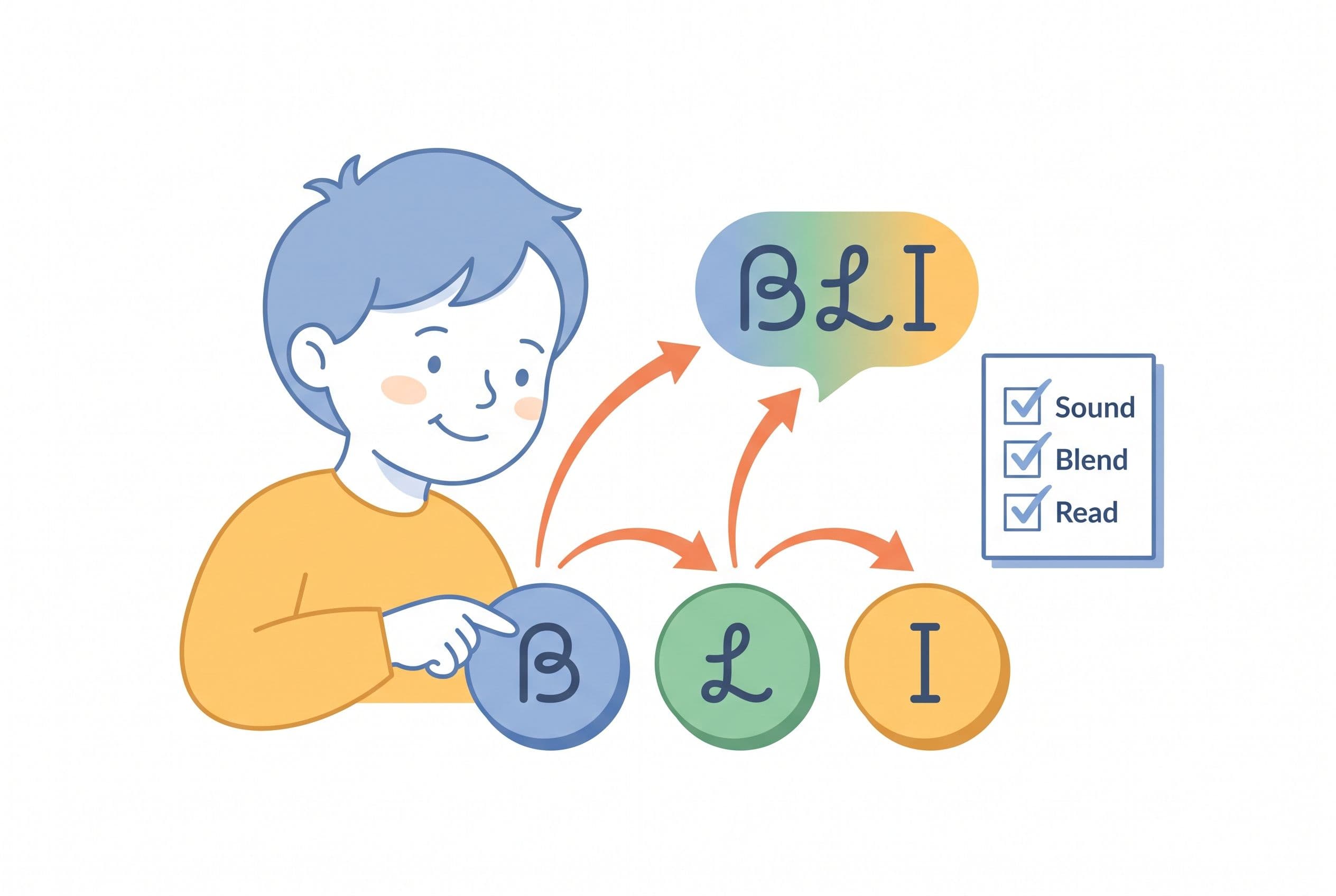
The app should teach letter-sound relationships in a clear order. It should show children how to blend sounds into words.
If it relies on memorising whole words, guessing from pictures or repeated sentence patterns, run. Politely, but run.
2. Look for Decodable Readers
Decodable readers match the phonics your child has learnt. If your child knows s, a, t, p, i, n, they should read words like sat, pin, tap, not random storybooks full of spelling patterns your child hasn’t learnt yet.
Australian parents may hear schools mention InitiaLit, MultiLit or MiniLit. Those names matter because they sit closer to explicit, evidence-based instruction than old balanced literacy habits.
3. Test With a Made-Up Word
Show your child a pseudo-word like mip, sog or flent — but match it to what they’ve actually been taught. If they’ve only learnt simple CVC words, stick with mip or sog. Save flent for when consonant blends are fair game. We’re testing decoding, not setting traps like tiny literacy goblins.
Demonstrate one first: “This says m-i-p, mip. Your turn.” Then try several with the same taught pattern.
If they panic because they’ve never seen it before, don’t diagnose them from one word. Please. Take a breath. It’s a sign to look closer at blending and letter-sound knowledge. The Year 1 Phonics Check uses pseudo-words for this exact reason: it shows whether children can apply the code, not just recognise memorised words.
4. Watch for Reward Addiction
Rewards aren’t evil. I’m not a monster. I’ve bribed a child with chocolate chips during phonics and lived to tell the tale.
But if the reward becomes the lesson, you’ve got a problem. Your child should remember the sound pattern, not just the dancing character.
5. Sit Beside Your Child for One Lesson
Don’t outsource the first week. Sit there. Listen.
You’ll hear whether your child is blending or guessing. You’ll hear whether the app corrects mistakes or lets them click through. This is where the rubber meets the road.
The Action Step: Pick One App and Run a 7-Day Reading Test
Here’s your no-drama plan.
- Choose one app from the list — don’t download six and call it research.
- Start with Teach Your Kid to Read if you want the cleanest phonics-first option.
- Sit with your child for 10 minutes a day for 7 days.
- Write down 5 words they can read on Day 1.
- Add 3 pseudo-words with the same taught pattern.
- Test the same words on Day 7 without pictures.
- If your child guesses, stop and return to blending.
- If your child reads accurately, keep going.
That’s it. Simple. Not easy, but simple.
Lesson one is free with no card and nothing to cancel; from lesson two the whole programme is a 7-day free trial, then A$9.95 a month.
My Final Pick
If you want my tiger-mum answer, choose Teach Your Kid to Read first.
Reading Eggs is polished. Nessy is helpful for dyslexia indicators. Phonics Hero is solid. Teach Monster is budget-friendly. Fast Phonics improves the Reading Eggs picture.
But if your goal is real reading — not guessing, not clicking, not collecting digital prizes — start with the app that treats phonics as non-negotiable.
Your child doesn’t need more busywork. Your child needs the code.
FAQ
What is the best Reading Eggs alternative in Australia?
For phonics-first instruction, I’d start with Teach Your Kid to Read. It keeps the focus on sounds, blending and decoding instead of games that distract from the Skill.
Is there anything cheaper than Reading Eggs Australia?
Yes. Teach Monster to Read can be cheaper, and Teach Your Kid to Read costs A$9.95/month after lesson one and the 7-day trial. Compare current prices before buying because Reading Eggs Australia cost can change with bundles.
Is Reading Eggs bad for kids?
No, but it may not be enough for every child. If your child guesses from pictures, memorises levels or struggles with unfamiliar words, move toward systematic synthetic phonics and decodable readers.
What should my Year 1 child practise for the Phonics Check?
Practise letter-sound correspondences, blending, segmenting and pseudo-words matched to the sound patterns they’ve been taught. The commonly used Year 1 Phonics Check format includes 40 words — 20 real words and 20 made-up words — so memorising books won’t cut it.
Are apps enough to teach reading?
Sometimes they help a lot, but your child still needs an adult listening for guessing, correcting errors and demanding accuracy. Ten focused minutes with you beats an hour of random clicking.
Part of these guides

Xia Brody
Co-Founder, Teach Your Kid to Read
Mom of 4 who has successfully taught her kids to read. Currently in the trenches with her 4-year-old while her two oldest (10 and 7) devour books on their own. Passionate about phonics-based methods and building a lifelong love of reading.
Related Articles
ABCmouse vs Reading Eggs Cost: Which Is Cheaper in 2026?
ABCmouse and Reading Eggs both look cute. But price means nothing if your child is still guessing at words. Here’s the no-nonsense 2026 cost comparison parents actually need.
Read More →
Reading Eggs vs ABCmouse Cost: 2026 Price Breakdown
Comparing Reading Eggs vs ABCmouse cost? Here’s the 2026 price breakdown, what each app teaches, and why I’d choose phonics-first instruction over reward-heavy screen time.
Read More →
Reading Eggs vs Teach Your Monster: Best for Aussie Prep
One is free and genuinely phonics-first. One is a paid subscription and does more, but lets your child guess. Here's the honest comparison for Prep, Foundation and Kindy parents — plus the daily routine that matters more than either app.
Read More →