Reading Eggs vs Teach Your Monster: Best for Aussie Prep

What You'll Learn
- Which of these two apps actually teaches decoding — and which one quietly lets your child guess their way through
- The exact point in the phonics sequence where Teach Your Monster to Read stops dead (most parents don't notice until it's too late)
- What Reading Eggs really costs in Australia, and whether the yearly plan is worth it for a Prep kid
- The 15-minute nightly routine that will do more for the Year 1 Phonics Check than either app ever will
Reality Check: An App Can't Hear Your Child
Your Prep kid is on the iPad, tapping happily, and a cheerful voice says "Great job!" every eleven seconds.
And you have no idea whether they can actually read.
That's the honest starting point for anyone googling reading eggs vs teach your monster to read australia at 9pm on a Tuesday. Both apps are decent. Neither one is a reading programme. They're practice tools — and practice tools only work if somebody has already taught the skill.
Quick admission before we go further: I'm an American homeschooling mum of four. But the phonics problem doesn't care about borders, and your Year 1 Phonics Check is honestly a better accountability tool than anything we've got. So let's use it.
Here's the thing — the difference between these two apps isn't graphics or price. It's whether the app trains your child's brain to map sounds to letters, or trains them to recognise word shapes and guess. Stanislas Dehaene showed this in Reading in the Brain (2009): the brain has no reading module. It has to build one, letter-sound by letter-sound. An app that skips that step isn't teaching reading. It's teaching clicking.
The Tiger Truth: The Check Is Coming, and It Uses Fake Words
If your child is in Prep (Victoria and Queensland), Foundation (the national curriculum name) or Kindy (New South Wales and WA — yes, the name changes at every border, I know), the Year 1 Phonics Check is coming for them somewhere in the next 12 to 24 months.
I'm deliberately vague on that, and here's why: it depends on your state, whether the check is mandated where you live, when in Year 1 your school runs it, and your child's birthday relative to the cutoff. A March-born Prep kid in Queensland and a June-born Kindy kid in NSW are not on the same clock. Ring the school office and ask when they administer it. Takes two minutes and beats guessing.
Forty words. Half of them aren't real words. Vosh. Blan. Thazz.
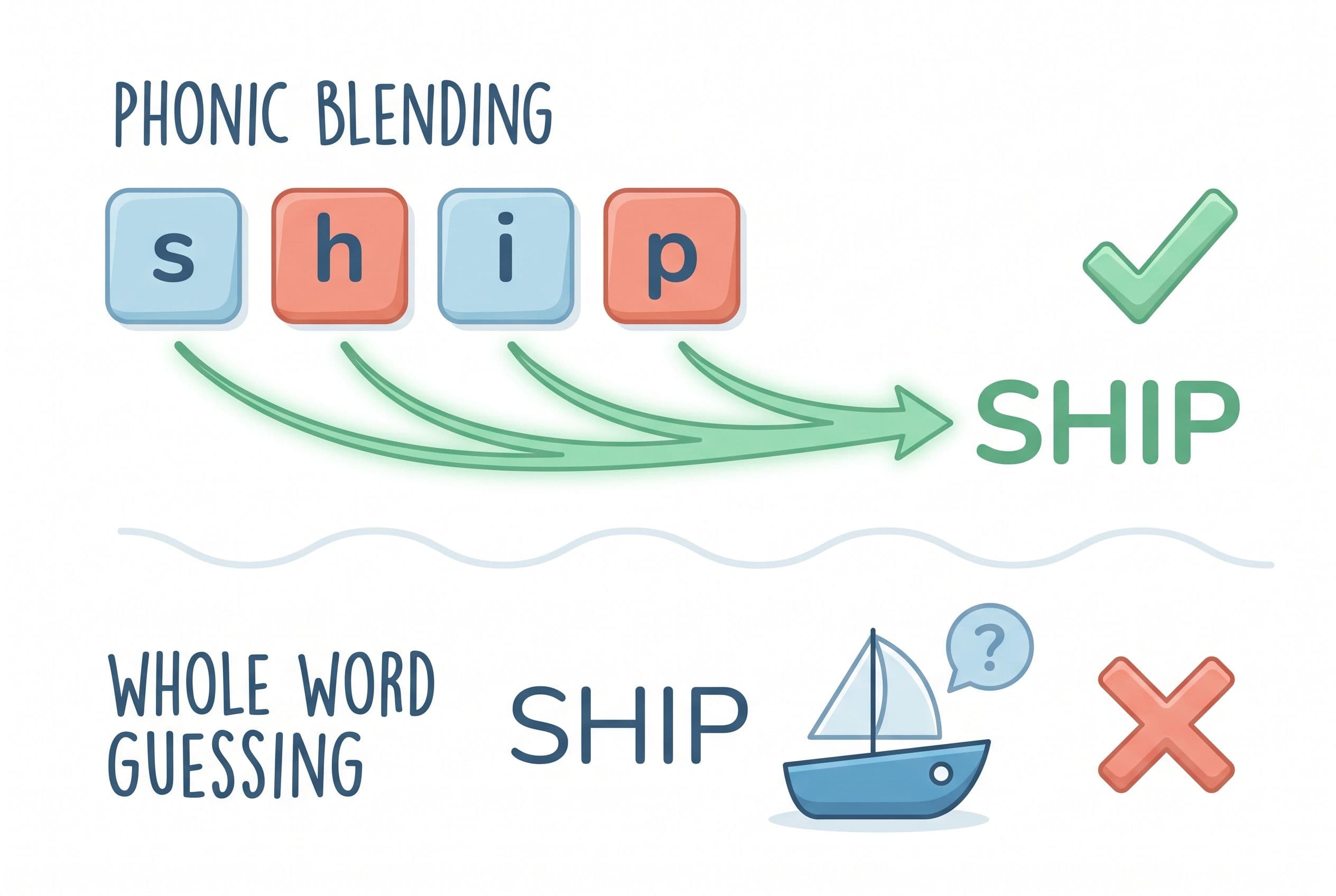
Why fake words? Because you cannot guess them. You cannot look at a picture and say "boat." You cannot remember them from a levelled reader. You have to decode, left to right, sound by sound. That check was designed specifically to catch children who look like readers but are actually memorising.
South Australia made the check mandatory in 2018 and NSW followed in 2021. And when SA first ran it, a large share of Year 1 students didn't meet the expected benchmark — the numbers have shifted with each cohort and each reporting method, so I'm not going to throw a precise figure at you. The uncomfortable part isn't the exact percentage anyway. It's who those kids were. Not lazy kids. Not bad schools. Kids who'd been taught to use pictures and first letters and context clues instead of the code.
And real talk — the kids who don't meet the benchmark in Year 1 don't magically sort themselves out over the summer holidays. Reading gaps widen. The child who can't decode stops volunteering to read aloud, starts saying "I'm just not a reading person" at age seven, and by Year 3 is doing worksheets they can't read while their mates move on to chapter books. Intervention isn't cheap either — a term of one-to-one tutoring runs A$60-A$100 an hour in most capital cities, and MiniLit or MultiLit sessions through a private provider add up fast.
All of that is preventable with about fifteen minutes a day, starting now.
Teach Your Monster to Read: Free, Genuinely Phonics-First, and It Stops
Let's start with the one everyone recommends because it's free.
Teach Your Monster to Read was built by the Usborne Foundation with input from reading researchers, and it's mapped to a proper synthetic phonics sequence — the same shape as the UK's Letters and Sounds progression that most Australian school programmes are now aligned to.
What it does well:
- Teaches letter-sound correspondences in a sensible order (s, a, t, p, i, n — not A-B-C)
- Makes the child blend sounds to read the word, not guess it
- Uses pseudo-words in some activities, which is exactly the skill the Year 1 check tests
- Free on desktop and laptop through a browser. Genuinely free, no card, no trial countdown
- The tablet version is a one-off purchase, usually around A$8-A$10, not a subscription
Where it falls over:
- It ends. The three games take you to roughly the end of the Letters and Sounds phase 5 territory — digraphs, some alternative spellings, simple sentences. That's a mid-Year-1 skill set. After that, your child has finished the monster and you're on your own.
- No writing. Zero. And Louisa Moats has been saying for decades that spelling and reading are two sides of the same coin — encoding locks in decoding.
- It can't hear the child. Your kid clicks the sound. The app has no idea whether their mouth actually produced /sh/ or /ch/.
- The game-to-learning ratio drifts. There's a lot of monster customisation. My four-year-old spent eleven minutes choosing eyeballs one afternoon. Eleven minutes.
Bottom line on teach your monster australia: it's the best free phonics sequence going, and if you're choosing purely on cost, this is your best free reading app australia option. Just know it's a starter, not a finisher.
Reading Eggs: The Aussie Favourite, With One Big Catch
Reading Eggs is Australian — built by Blake eLearning in Sydney — so the voices sound right, the spelling is right, and it's the one your child's teacher probably mentioned at the parent night.
What it does well:
- A far longer sequence: 120+ lessons in the core map, then Reading Eggspress for comprehension into upper primary
- Actual e-books, many of them decodable at the early levels
- Placement test at signup so a Prep kid doesn't start at zero if they already know their sounds
- Progress reporting a parent can actually read
- Covers reading, some spelling, and maths (Mathseeds) on the family plans
The catch — and this one drives me a bit mad:
Reading Eggs is not a pure systematic synthetic phonics programme. It's a blend. Sitting alongside the sound-based lessons are sight word memorisation drills — whole words flashed up to be learnt by shape and repetition.
Now, some high-frequency words genuinely are irregular in English (said, was, one). Fine. But David Kilpatrick's work in Equipped for Reading Success (2016) showed how words get stored permanently in the first place: orthographic mapping. The child connects the sounds in the spoken word to the letters on the page, and that's what glues it into memory. Not repetition of the visual shape. When an app trains a child to recognise word pictures, it's building the wrong habit — the exact habit the pseudo-words on the Year 1 check are designed to expose.
The other issue: the reward loop is loud. Golden eggs, avatars, a shop. A determined five-year-old can click through a lesson at speed for the eggs and retain very little. I've watched it happen at my own kitchen table.
Reading Eggs cost in Australia
At the time of writing, Reading Eggs runs roughly A$10-A$15 a month depending on whether you pay monthly or take the annual plan — call it about A$120-A$180 a year for a family subscription, with a free trial period upfront. Check the current pricing before you commit, because it moves and there are frequent discount offers.
Is it worth it? If your child needs a structured path that keeps going for two or three years, and you'll actually sit next to them — yes, reasonable value. If you're buying it so they'll leave you alone for twenty minutes — you've just bought a very expensive digital dummy.
Head to Head: Reading Eggs vs Teach Your Monster for Prep
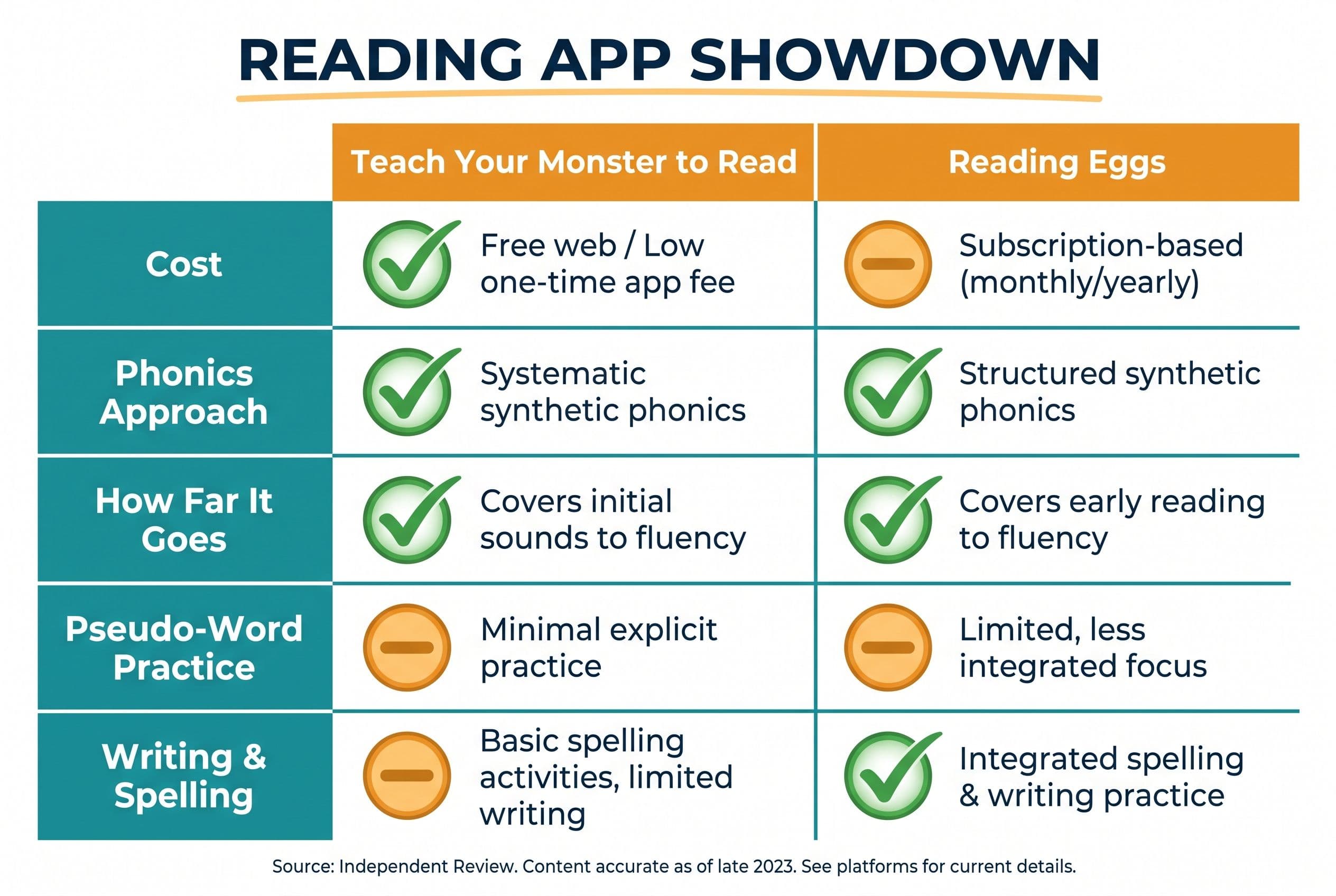
| Teach Your Monster | Reading Eggs | |
|---|---|---|
| Cost | Free on browser, ~A$8-10 one-off on tablet | ~A$120-180/year |
| Phonics purity | Strong systematic synthetic phonics | Blended — phonics plus sight-word memorisation |
| How far it goes | Ends around mid-Year-1 level | Continues into upper primary |
| Pseudo-word practice | Yes | Limited |
| Writing/spelling | None | Some |
| Guess-proofing | High | Moderate |
| Best for | Prep/Foundation/Kindy starters, tight budgets | Families wanting one long structured path |
My call for a Prep-aged child: start with Teach Your Monster to Read. It's free, it's tighter on decoding, and for a five-year-old you're only after twenty solid minutes of screen practice a few times a week anyway. When your child finishes the monster — around the time they hit Year 1 — then decide whether Reading Eggs is worth the subscription for the next stage.
And if you want proper free phonics games australia to fill the gap, print a set of sound cards and play "I spy with my little ear" in the car. Costs nothing, works better than most apps.
The Bit Neither App Can Do
Here's the story that changed how I think about all of this.
After Emily Hanford's "Sold a Story" came out in 2023, my neighbour rang me almost in tears. She'd taught six- and seven-year-olds for eighteen years. Her whole career she'd used Lucy Calkins' Units of Study — three-cueing, MSV, the lot. Look at the picture. Look at the first letter. What would make sense?
She said, "I've been teaching kids to guess for two decades and I didn't even know it."
So she blew up her own classroom mid-year and switched to UFLI Foundations. It was messy. She had to relearn phonics herself first, at night, after work, at forty-three years old. But by the end of that school year her class's scores on a nonsense-word decoding screener had jumped about 15 points on average — and she told me it was the first time in eighteen years that every single child in her room could decode CVC words with months of the year still to go.
The part that stuck with me: she didn't buy an app. She changed what she did with her mouth and her ears for fifteen minutes a day.
That's the whole thing. Mark Seidenberg made the same argument in Language at the Speed of Sight (2017) — the method is the variable, not the technology. The US National Reading Panel reached the same conclusion back in 2000, and the Clackmannanshire study out of Scotland (Johnston & Watson, 2005) tracked children for seven years and found the synthetic phonics group running years ahead of the analytic phonics group on word reading and spelling.
None of that research says "pick the right app." It says teach the code, systematically, and don't let the child guess.
The Solution: An App That Won't Let Them Guess
This is where I'll be straight with you about what we built. Teach Your Kid to Read is built on Orton-Gillingham principles and systematic synthetic phonics — sounds introduced in a research-backed order, every new sound built on the last, nothing skipped.
What's different from the two apps above:
- No picture cues. Ever. If your child can't decode it, they don't get to guess it.
- The child says the sound out loud and blends before the word is revealed — the routine that builds orthographic mapping instead of shape memory.
- Pseudo-words are built into the practice, so nothing about the Year 1 Phonics Check will be a surprise.
- Encoding alongside decoding. They read the word, then they write it.
- A parent script, so you know exactly what to say when your child stalls on a word.
It's designed for a parent and a child sitting together, not for a child alone with a tablet. That's the point.
Ready to stop the guessing? Start the 15-minute routine with Teach Your Kid to Read →
The Action Step: Your 15-Minute Prep Routine
Stop researching apps. Do this instead, starting tonight.
- Test the foundation first. Kilpatrick's PAST (Phonological Awareness Screening Test) takes about five minutes and it's free to find online. It tells you whether your child can hear and manipulate sounds at all — because if they can't pull the /m/ off the front of mat, no phonics app on earth will stick. Fix that first.
- Set the daily slot and never move it. Ours is after dinner, before dessert. Fifteen minutes. We never skip — not on birthdays, not on holidays, not on Christmas. My seven-year-old did sounds in the car on the way to the airport last January. She survived.
- Five minutes of sounds, five minutes of blending, five minutes of a decodable reader. That's the whole structure. Sound cards, then CVC words on a whiteboard (sat, pin, mud, log), then a decodable text — not a levelled reader with a picture on every page. Look for proper decodable sets; if your school uses InitiaLit, ask which decodable series they send home.
- Ban guessing out loud. When they stall, you say: "Sound it out. First sound?" You do NOT say "look at the picture" or "what word would make sense there?" That's three-cueing and it's the exact thing my neighbour spent eighteen years accidentally teaching.
- Add the app as dessert, not dinner. Teach Your Monster or Reading Eggs after the fifteen minutes, three or four times a week, twenty minutes max.
- Screen with fake words once a month. Write six pseudo-words on a whiteboard — vosh, blan, thazz, pim, glut, skeep. If they decode five out of six, you're on track for the Year 1 check. If they freeze, you've found your next month's work.
One last thing. The Simple View of Reading (Gough & Tunmer, 1986) says reading comprehension equals decoding multiplied by language comprehension. Multiplied. If decoding is zero, the answer is zero — no matter how many books you've read aloud or how bright your child is.
So teach the decoding. The apps can help. They just can't do it for you.

Xia Brody
Co-Founder, Teach Your Kid to Read
Mom of 4 who has successfully taught her kids to read. Currently in the trenches with her 4-year-old while her two oldest (10 and 7) devour books on their own. Passionate about phonics-based methods and building a lifelong love of reading.
Related Articles
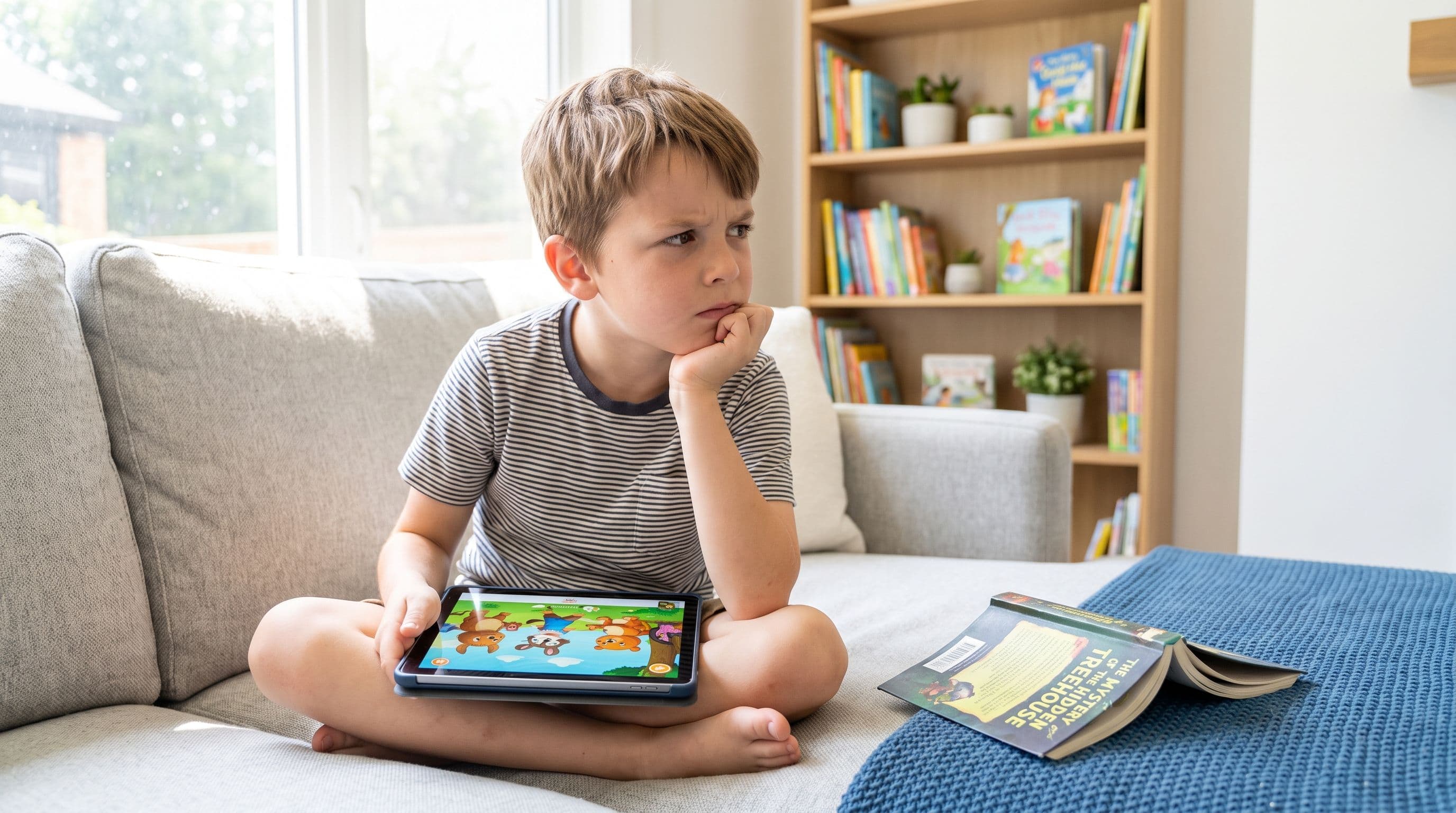
Teach Your Monster to Read vs Reading Eggs: 2026 Honest Comparison
Both apps promise to teach your kid to read, but one leans harder on phonics science and the other leans on flashy gamification. Here's my unfiltered breakdown of Teach Your Monster to Read vs Reading Eggs — what works, what doesn't, and what's still missing from both.
Read More →
Best Free Reading Apps for Kids: 7 Truly Free Picks (2026)
Most "free" reading apps aren't free — they're a 7-day trial with a credit card form at the end. Here are 7 that are genuinely free, which ones actually teach phonics, and the one thing no app can do for your child.
Read More →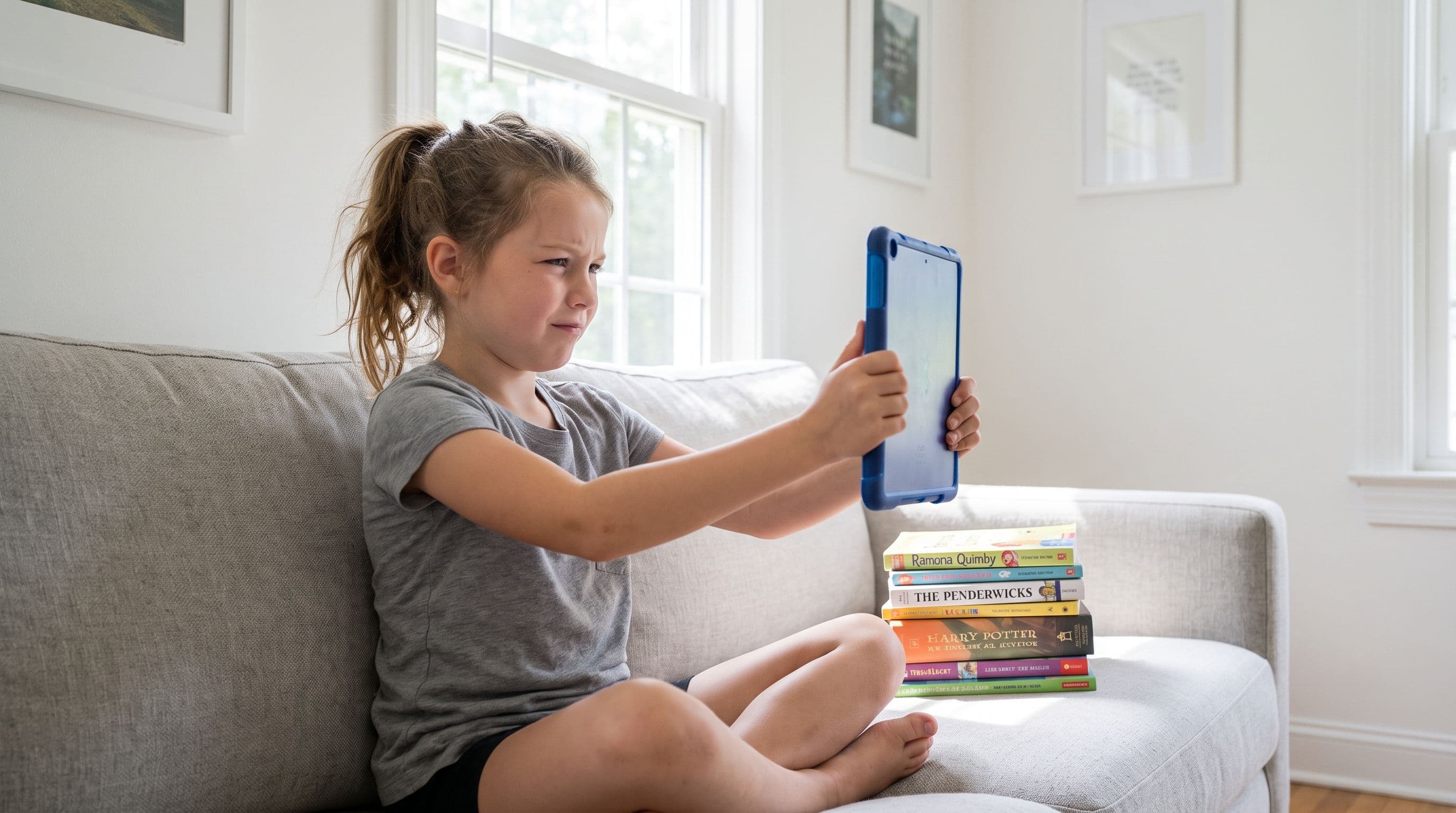
Reading.com vs Reading Eggs: Which App Is Actually Worth It in 2026?
Two of the biggest reading apps for kids go head-to-head. I've tested both with my own children, dug into the phonics methodology behind each, and I have strong opinions. Here's my honest 2026 breakdown of Reading.com vs Reading Eggs.
Read More →