Teach Your Monster vs Reading Eggs UK: Phonics Winner
What You'll Learn
- The phonics app mistake that makes children look busy but leaves them guessing.
- Why the Year 1 phonics check changes the whole conversation for UK parents.
- Where Teach Your Monster to Read UK and Reading Eggs UK help — and where they fall short.
- The app I’d use first if my child needed systematic phonics at home.
Reality Check
Your child can tap monsters, collect eggs, win stars and still fail to read ship without guessing from the picture.
That’s not reading. That’s app-shaped noise.
If your child is in Reception (ages 4-5) or Year 1 (ages 5-6), you don’t need more screen glitter. You need a clean phonics sequence, daily practice and a hard family rule: No Guessing. Sound it out.
The Verdict: Best Phonics App UK
Here’s my straight answer on Teach Your Monster vs Reading Eggs UK.
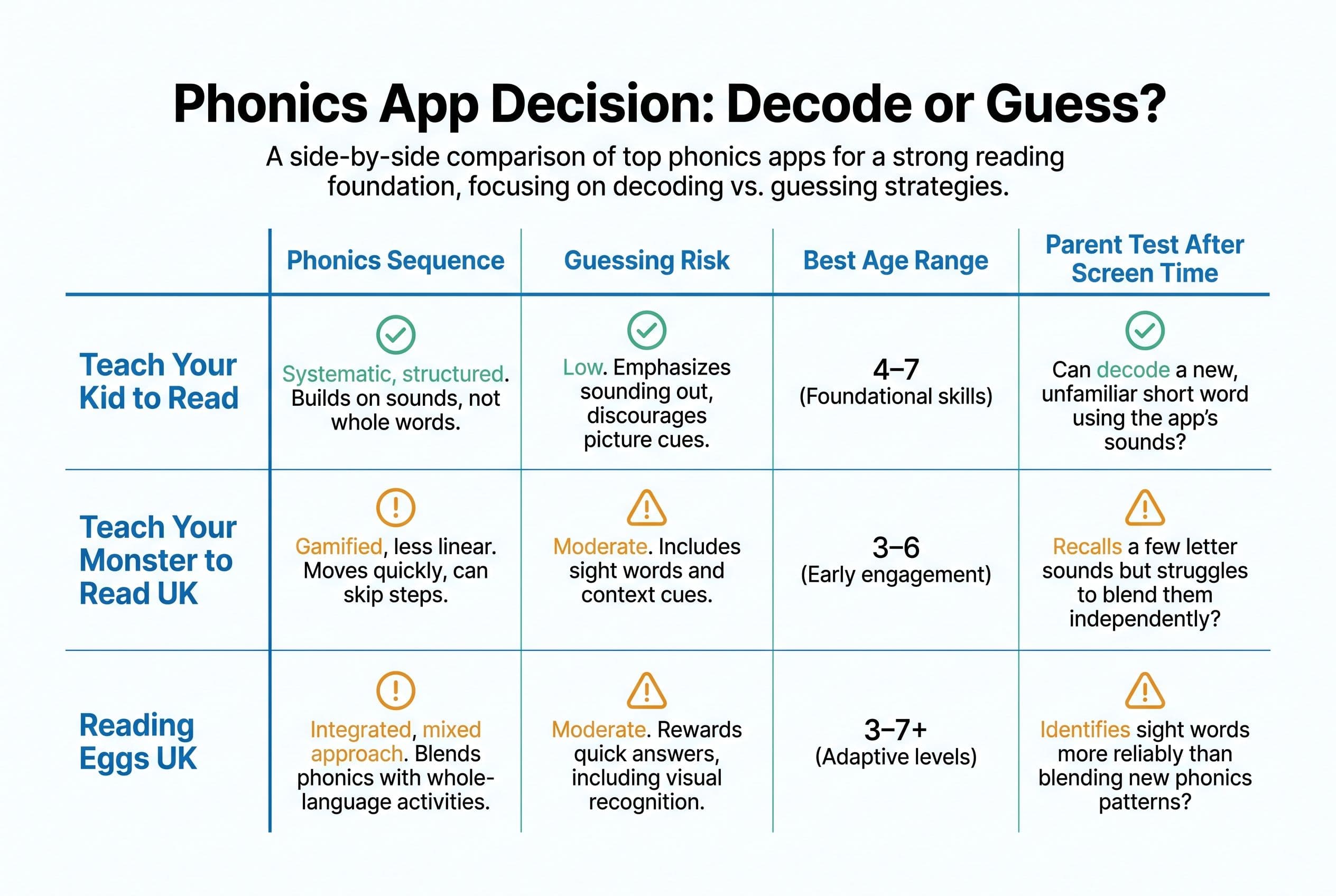
| Rank | App | What it teaches | Price | Best for |
|---|---|---|---|---|
| #1 | Teach Your Kid to Read | Systematic synthetic phonics with no guessing | Lesson one free with no card and nothing to cancel; from lesson two the whole programme is a 7-day free trial, then US$9.95/month | Reception to Year 2 home phonics practice |
| #2 | Teach Your Monster to Read UK | Letter sounds, blending and phonics games | Often free on web; paid app varies by store | Nursery to early Reception |
| #3 | Reading Eggs UK | Mixed literacy skills, rewards and reading activities | Subscription pricing varies | Children who already know basic phonics |
If I had a Reception child who needed the cleanest path from letter sounds to real reading, I’d start with Teach Your Kid to Read through start lesson one free because it keeps the parent focused on daily phonics mastery instead of letting the child wander through reward screens.
Tiger Truth: The Year 1 Phonics Check Is Coming
UK parents, this is the bit I’d put on a sticky note on your fridge.
At the end of Year 1 (ages 5-6), children in England take the Phonics Screening Check. It has 40 words: 20 real words and 20 pseudo-words, often called alien words. The expected standard has commonly been 32 out of 40.
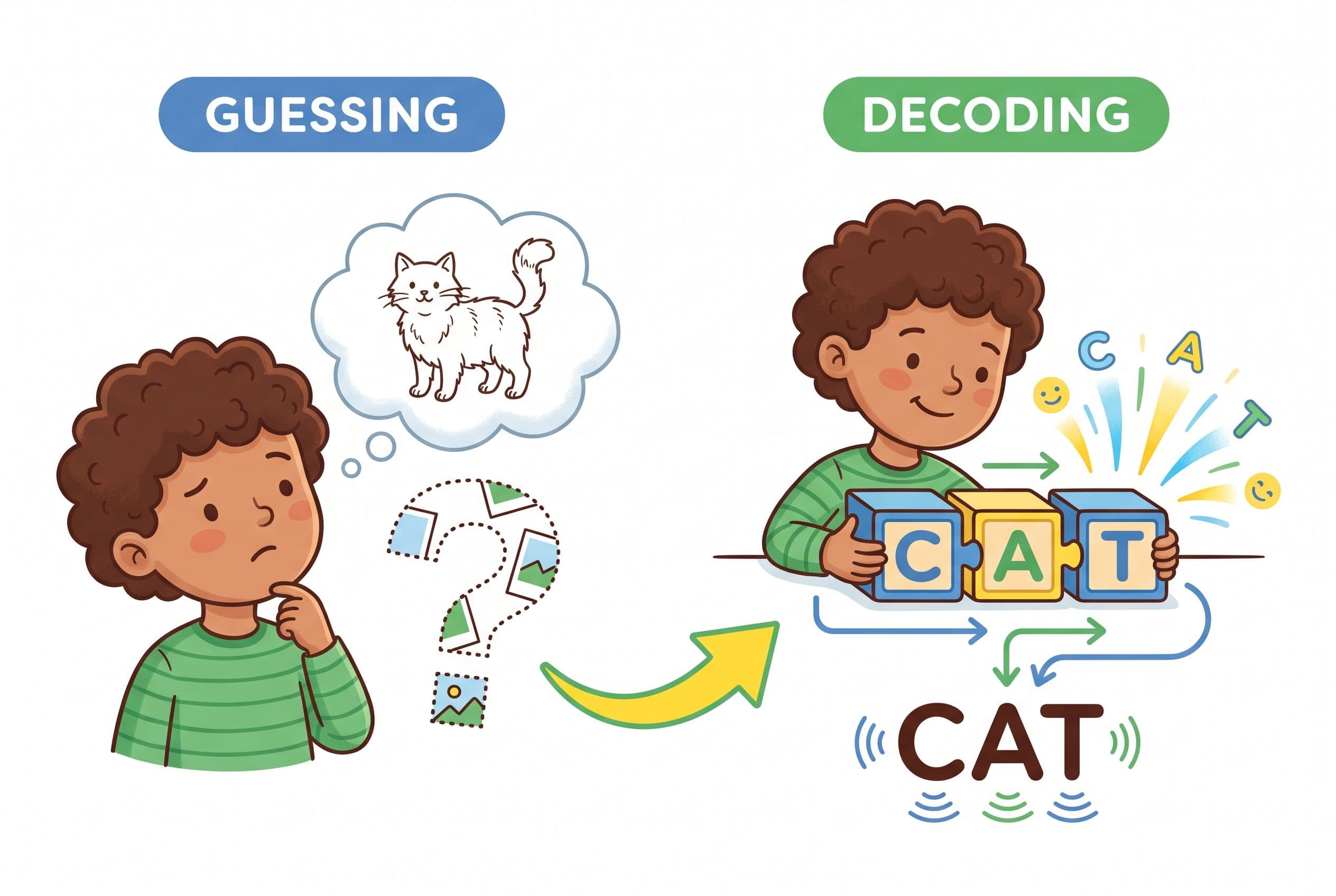
That means your child can’t pass by memorising book-bag stories or guessing from pictures. Alien words expose guessing fast. Brutally fast.
If the word is splent, the child has to map graphemes to phonemes, blend left to right and say the sounds. No picture. No clue. No “it starts with s so maybe snake?”
That’s why this matters.
I’m in the US, but the phonics problem doesn’t care about borders. I was once at a playground in Raleigh when another mum told me her child’s school had switched from Lucy Calkins to a Science of Reading curriculum because of North Carolina’s SB 387, the Excellent Public Schools Act. She felt annoyed because, as she put it, “He was doing fine before.” I asked if her child could read splint. He was in second grade, roughly Year 3 age. He couldn’t.
So I sat on that playground bench for 20 minutes explaining Emily Hanford’s APM Reports series Sold a Story, the US NAEP data everyone had been arguing about and Stanislas Dehaene’s neuroscience showing the brain doesn’t learn to read naturally. That night she watched the podcast and texted me at 11pm: “I had no idea. Why didn’t anyone tell us this sooner?”
Honestly? That text lives rent-free in my brain.
Because parents are not lazy. They’re misled.
Deep Dive: Teach Your Kid to Read
#1 Teach Your Kid to Read: Best for Real Phonics Practice
Teach Your Kid to Read wins for me because it starts where reading actually starts: sounds, blending, decoding and mastery.
Not vibes. Not guessing. Not “look at the picture and think what would make sense.” That approach drives me bananas.
The app follows systematic synthetic phonics principles: teach the sound-spelling link, practise it, blend it, read it in words, then build from there. That lines up with what the 2000 National Reading Panel — a US federal reading panel — found about systematic phonics producing strong reading gains, especially when children receive it early. To be clear, that research supports systematic phonics as an approach. It doesn’t prove any single app is magic fairy dust. No app gets that crown without direct outcome evidence.
The Clackmannanshire study by Johnston and Watson in Scotland (2005) also matters here. Those children received synthetic phonics, and the long-term results were strong enough that phonics advocates still cite that study for a reason. It compared synthetic phonics instruction with other approaches used at the time, but like all studies, it wasn’t a perfect clone of your kitchen table, your child or this app. Still, the point stands: explicit phonics instruction has serious evidence behind it. It wasn’t a cute theory. It was children reading better.
Here’s what I like as a mum teaching real children at a real kitchen table:
- The lessons move in a planned order.
- Children practise grapheme-phoneme correspondence.
- The child reads words by blending, not guessing.
- The parent can see whether the child actually knows the skill.
- It fits short daily practice, which is the only kind most families can keep alive.
I had my 4-year-old at the kitchen table last Tuesday doing CVC words while my 1-year-old tried to eat a crayon. Glamorous? No. Useful? Yes.
That’s the real deal.
A good phonics app shouldn’t replace you. It should make you harder to fool. If your child clicks through ten minutes of phonics games but still can’t blend m-a-t afterwards, that’s your snapshot: the skill isn’t independent yet.
Use Teach Your Kid to Read if your child:
- Knows some letter names but not letter sounds.
- Guesses words from pictures.
- Struggles to blend sounds into words.
- Needs Reception phonics practice at home.
- Is heading towards the Year 1 phonics check and freezes on alien words.
Bottom line: this is the best phonics app UK parents should consider if the goal is decoding, not digital babysitting.
#2 Teach Your Monster to Read UK: Fun, Useful, But Watch the Gaps
Teach Your Monster to Read UK has a lot going for it.
It’s bright. It’s friendly. Children usually like it. For Nursery and early Reception, it can help with letter sounds, blending practice and confidence. If your child resists phonics, the monster world can lower the temperature in the room. No-brainer.
But here’s the kicker: a fun app can make parents relax too soon.
If your child plays happily but can’t read a decodable book without help, don’t count screen time as reading instruction. Count it as support.
Teach Your Monster to Read can work well alongside school schemes like Read Write Inc, Little Wandle or Jolly Phonics, especially if your child needs more sound practice. But I wouldn’t rely on it as the whole home plan for a child approaching the Year 1 phonics check.
Check these things after your child plays:
- Can they say the sound without the app prompt?
- Can they blend the sounds into a word?
- Can they read the same pattern on paper?
- Can they read pseudo-words like vap, chom or splig?
If the answer is no, the game didn’t stick yet. Practise again. We Never Skip.
#3 Reading Eggs UK Review: Big, Busy and Not My First Pick for Phonics
Reading Eggs UK has plenty inside it: activities, books, rewards, comprehension tasks and literacy games.
Some children love it. Some parents love that it keeps children occupied. I get that. I have four kids. Sometimes a quiet screen feels like oxygen.
But for phonics? I’m pickier.
My concern with Reading Eggs is that the reward system can start driving the session instead of the reading skill. Children chase the egg, the badge, the next animation. Meanwhile, you’re thinking, “Great, he practised reading for 20 minutes.” Did he though?
Ask him to read brush from a plain card afterwards. That’s the test.
Reading Eggs UK may suit children who already understand basic phonics and need extra practice across reading skills. But if your child still guesses, skips sounds or memorises whole books from the book bag, I’d put a cleaner phonics programme first.
Real talk — a child who can recite a levelled reader from memory may still fail on an alien word. Fountas & Pinnell-style levelled readers trained a lot of children to use pictures and sentence patterns. That isn’t decoding.
For UK parents, decodable readers matter. Look for books that match your child’s phonics phase, whether that’s Letters and Sounds Phase 2, Phase 3, Phase 4 or Phase 5.
What the Research Says About Phonics Apps
Reading is not natural.
Speech develops naturally for most children because human brains evolved for spoken language. Reading came much later. The brain has to connect visual symbols to speech sounds and meaning.
Stanislas Dehaene explains this in Reading in the Brain (2009). The reading circuit has to be trained. It doesn’t magically appear because a child loves stories.
Linnea Ehri’s 2005 work on phases of word reading also helps explain why guessing fails. Children move from pre-alphabetic guessing into partial alphabetic reading, then full alphabetic decoding and consolidated alphabetic reading. Separately, orthographic mapping is the process where the child bonds the spelling, pronunciation and meaning of a word in memory. That’s how words become instantly recognisable without the child guessing from a picture like a tiny detective with bad evidence.
David Kilpatrick’s Equipped for Reading Success (2016) makes this painfully practical. If a child has weak phonemic awareness, they won’t map words well. They may memorise ten words today and forget eight tomorrow.
So what should a phonics app do?
It should give repeated practice in:
- Hearing individual sounds in words.
- Matching letters to sounds.
- Blending sounds from left to right.
- Reading decodable words before tricky words pile up.
- Applying the skill away from the screen.
That’s why I don’t rank apps by cuteness. I rank them by whether they help a child read an unfamiliar word without guessing.
How to Choose Reading Apps for Reception
Reception children don’t need a giant literacy circus.
They need short, direct, successful practice. Ten minutes done daily beats one heroic Saturday session where everyone cries and someone spills Ribena on the phonics cards.
Use this checklist before paying for any app.
1. Does it teach sounds before books?
Your child needs letter-sound knowledge first. If the app throws them into stories too soon, they’ll guess.
2. Does it use decodable words?
A decodable word uses sounds your child has already learnt. That’s how mastery grows.
3. Does it stop picture guessing?
If your child can answer from the illustration without reading the word, the app has a design problem.
4. Can you test the skill on paper?
After app time, write three words on paper. Ask your child to sound them out.
Try:
- sat
- pin
- chop
- rain
- splig
If your child can only read inside the app, they don’t own the skill yet.
5. Does it match school phonics?
Ask your reception teacher which scheme school uses: Read Write Inc, Little Wandle, Jolly Phonics or another programme. Then keep home practice aligned.
Don’t create a phonics soup.
The Action Step: My 7-Day Phonics App Test
Before you commit to Teach Your Monster vs Reading Eggs UK — or any best phonics app UK list — run this simple test.
- Pick 5 target sounds. Choose sounds your child has learnt at school, such as s, a, t, p, i.
- Use one app for 10 minutes daily. No app-hopping. No “let’s try everything.”
- After the app, test on paper. Write three real words and two alien words.
- Watch for guessing. If they look at your face, the ceiling or the picture, stop and say, “Sound it out.”
- Track accuracy. Write down how many they read without help.
- Check blending. Can they say the sounds and then push them together?
- Repeat at the end of the week. If accuracy improves, good — you’re seeing movement in independent decoding. If not, don’t panic and don’t shrug. Keep tracking with comparable unfamiliar words using sounds they’ve been taught, and talk to the teacher if the struggle sticks around.
This isn’t a lab study. School lessons, parent help, repeated practice and plain old child-development weirdness all affect the result. But it will tell you something parents desperately need to know: can my child read the word away from the app?
For a deeper check, Kilpatrick’s PAST — the Phonological Awareness Screening Test — can show where the sound-level breakdown happens. It takes only a few minutes when you know how to give it, and it’s far more useful than vague “he’s just not ready” talk.
If you want a clean place to start, use Teach Your Kid to Read: lesson one is free with no card and nothing to cancel; from lesson two the whole programme is a 7-day free trial, then US$9.95 a month.
Final Recommendation
If your child is in Nursery, Teach Your Monster to Read UK can be a sweet introduction.
If your child already decodes and wants broad reading practice, Reading Eggs UK may add variety.
But if your child is in Reception or Year 1 and you care about phonics mastery, I’d choose Teach Your Kid to Read first. The goal is simple: your child sees an unfamiliar word, says the sounds, blends the word and reads it without panic.
That’s independence.
That’s the foundation.
And yes, we practise on birthdays, holidays and chaotic Tuesdays when someone has lost one shoe. We Never Skip.
FAQ
Is Teach Your Monster to Read UK good for phonics?
Yes, especially for early letter sounds and phonics games in Nursery or Reception. I’d treat it as support, not the whole reading plan, because children still need direct blending practice away from the screen.
Is Reading Eggs UK good for Reception?
Reading Eggs UK can help some Reception children, but it may feel too busy for children who still need clean sound-by-sound instruction. If your child guesses words, start with a more systematic phonics programme first.
What is the best phonics app UK parents should try first?
For structured home practice, I’d start with Teach Your Kid to Read. Lesson one is free with no card and nothing to cancel; from lesson two the whole programme is a 7-day free trial, then US$9.95 a month.
How do I help my child prepare for the Year 1 phonics check?
Practise decoding daily with real and pseudo-words. Use decodable readers, review Letters and Sounds phases and stop guessing immediately. Alien words reveal whether the phonics is real.
Should I use an app instead of school phonics homework?
No. Use the app alongside phonics homework and book-bag reading. Ask the teacher which scheme school uses, then keep home practice consistent.
Part of these guides

Xia Brody
Co-Founder, Teach Your Kid to Read
Mom of 4 who has successfully taught her kids to read. Currently in the trenches with her 4-year-old while her two oldest (10 and 7) devour books on their own. Passionate about phonics-based methods and building a lifelong love of reading.
Related Articles
Reading Eggs vs ABCmouse for 5-Year-Olds: Best Pick
Choosing between Reading Eggs and ABCmouse? Here’s the no-fluff mom verdict on which app actually teaches a 5-year-old to read — and where both fall short.
Read More →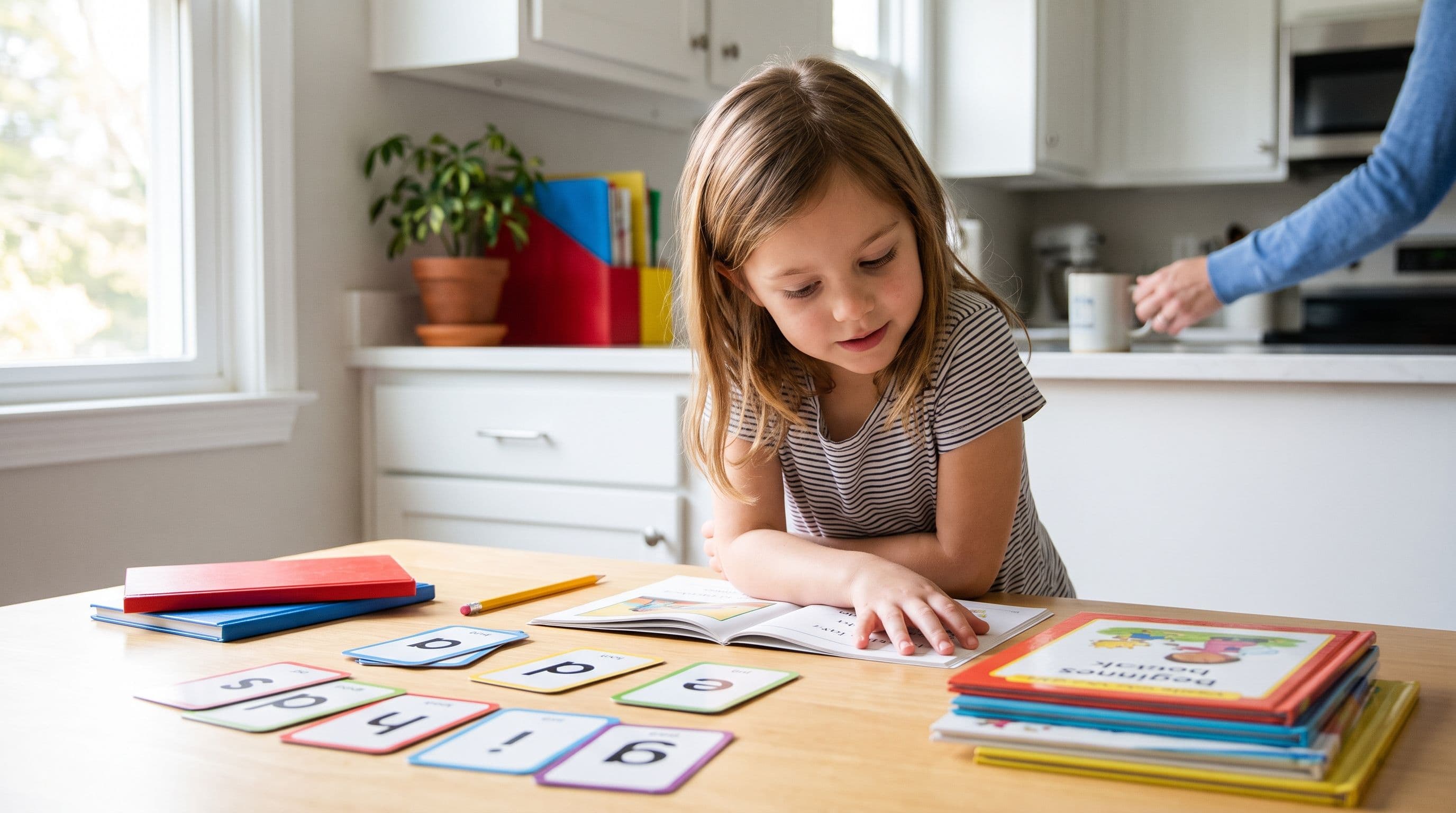
Reading.com vs Teach Your Monster to Read: Parent Pick
Choosing between Reading.com and Teach Your Monster to Read? Here’s the no-fluff parent pick from Xia Brody: what each app teaches, where it falls short, and which reading app I’d use for kindergarten phonics.
Read More →
Reading Eggs vs Teach Your Monster: Best for Aussie Prep
One is free and genuinely phonics-first. One costs about A$120 a year and does more, but lets your child guess. Here's the honest comparison for Prep, Foundation and Kindy parents — plus the daily routine that matters more than either app.
Read More →