Reading Eggs vs HOMER Australia: Best Prep App?
What You'll Learn
- The app mistake that makes 5-year-olds look busy while their decoding stays weak
- Why the Year 1 Phonics Check changes the game for Australian parents
- Where Reading Eggs, HOMER and Teach Your Kid to Read differ on real phonics
- The fastest way to spot whether your child is sounding out or guessing from pictures
Reality Check
Your child doesn’t need a cuter reading app. Your child needs to crack the alphabetic code.
If your 5-year-old can tap a screen for 25 minutes but still can’t blend s-a-t into sat, that’s not reading practice. That’s digital babysitting wearing a literacy costume. Sound familiar?
I’m Xia Brody, a Chinese-American homeschooling mum of four. I’m in the US, but the phonics problem doesn’t care about borders. Australian kids in Prep, Foundation or Kindy (ages 5–6, depending on your state) still need the same thing my kids need: letter sounds, blending practice and no guessing. Non-negotiable.
The Verdict: Best Reading App for 4–6 Year Olds in Australia
Here’s the short answer before we get into the weeds.
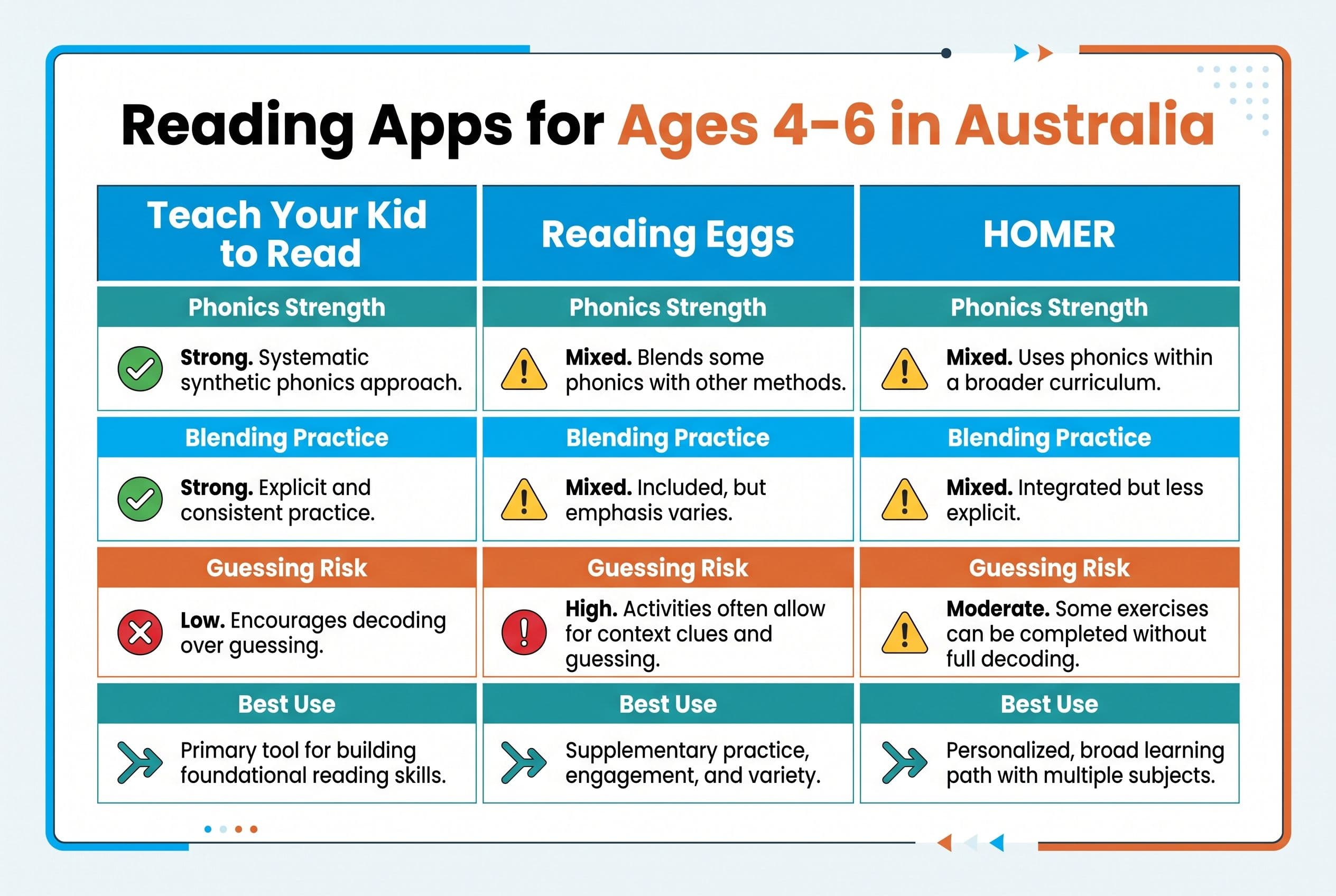
| Rank | App | What it really teaches | Price | Best for |
|---|---|---|---|---|
| #1 | Teach Your Kid to Read | Systematic synthetic phonics, blending, no guessing | Lesson one free with no card and nothing to cancel; from lesson two, 7-day free trial, then US$9.95/month | Ages 4–6 who need a clear phonics Foundation |
| #2 | Reading Eggs | Broad literacy games, some phonics, lots of rewards | Often around A$13–A$15/month, varies by plan | Kids who already tolerate screen lessons well |
| #3 | HOMER | Story-based early literacy, interests-based activities | Pricing varies by region and plan | Younger children who need gentle exposure |
If you want a phonics app for Prep that puts decoding first, start with Teach Your Kid to Read. Lesson one is free with no card and nothing to cancel; from lesson two the whole programme is a 7-day free trial, then US$9.95 a month through start lesson one free.
Bottom line: Reading Eggs vs HOMER Australia is a fair comparison, but I wouldn’t choose either as my main phonics spine for a 4–6 year old who needs to learn to read. I’d use a systematic synthetic phonics path first, then let games sit on the side.
Tiger Truth: The Year 1 Phonics Check Is Coming
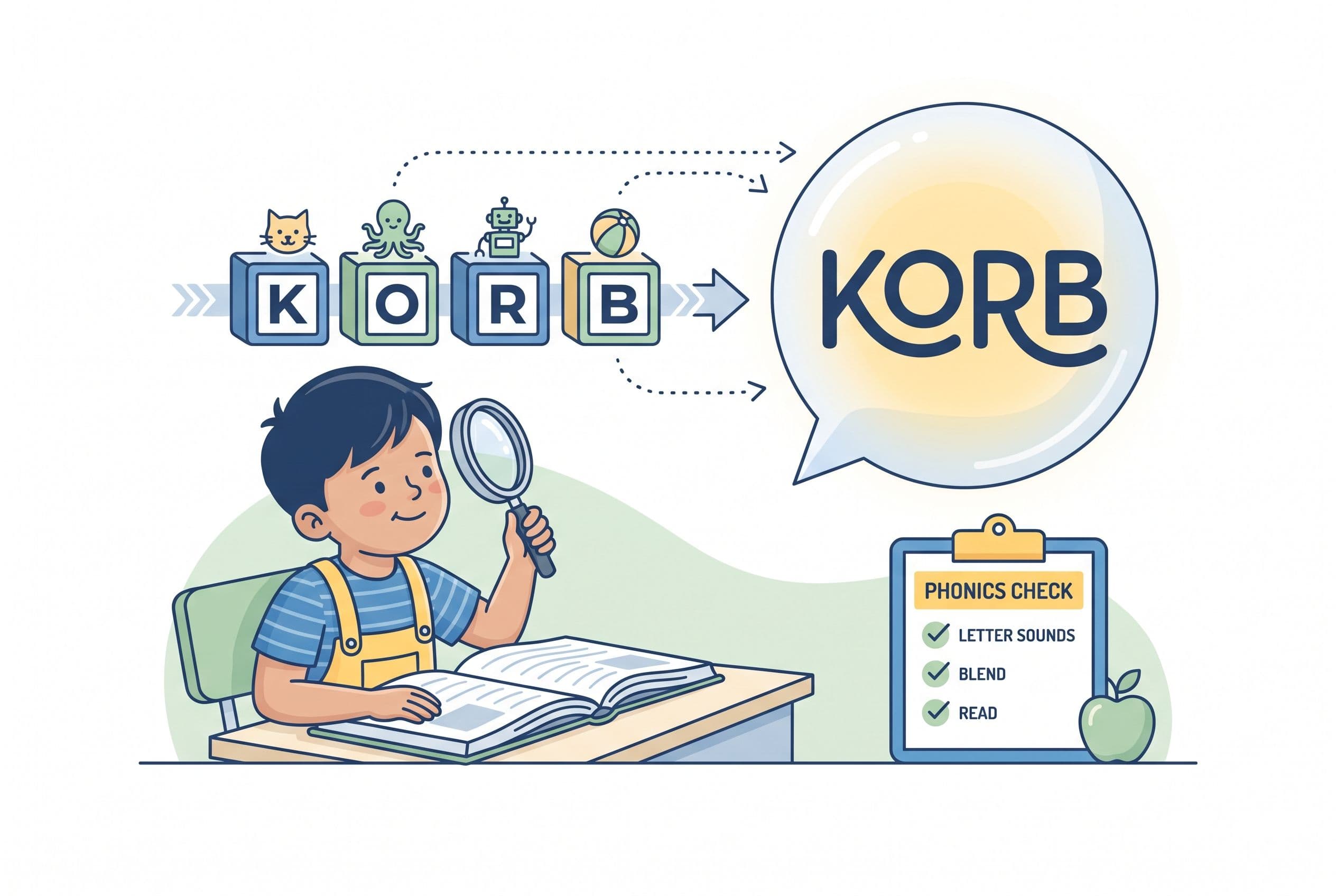
Australian parents, listen closely. The Year 1 Phonics Check matters because it asks the exact question many cute apps avoid: Can your child decode unfamiliar words?
South Australia made the check mandatory in 2018. NSW followed in 2021. Other jurisdictions and sectors have moved in this direction too, though the details aren’t identical everywhere, so check your own education department or school. The commonly used Year 1 Phonics Screening Check format has 40 items: 20 real words and 20 pseudo-words. That means your child can’t memorise the page, guess from a picture or charm the teacher with confidence. They must sound it out.
That’s the kicker.
A child who has learnt to guess from context might look fine in Prep. They might “read” predictable books beautifully: “I see the dog. I see the cat. I see the...” Then you put splint or chob in front of them and the wheels fall off.
I’ve seen this panic up close. I was once at a playground in Raleigh when another mum told me her child’s school had switched from Lucy Calkins to a Science of Reading curriculum because of North Carolina’s SB 387, the Excellent Public Schools Act. Yes, that’s a US state law, not Australian policy. But the reading problem? Same beast. She felt confused and annoyed because, in her words, her son had been doing fine before. I asked whether he could read the word splint. He was in Year 2 age range. He couldn’t.
So I sat on that playground bench for 20 minutes explaining why schools were changing: Emily Hanford’s APM Reports investigation Sold a Story, the neuroscience from Stanislas Dehaene’s Reading in the Brain (2009), and the ugly truth that reading doesn’t develop naturally like speech. The brain has to get trained to connect speech sounds to print. She watched Sold a Story that night and messaged me at 11pm: “I had no idea. Why didn’t anyone tell us this sooner?”
That line still makes me mad.
Deep Dive: Reading Eggs vs HOMER vs Teach Your Kid to Read
#1 Teach Your Kid to Read: Best Phonics Spine for Ages 4–6
Teach Your Kid to Read wins because it starts where reading actually starts: sounds mapped to letters, then blending, then decoding.
No guessing from pictures. No “look at the first letter and think what would make sense.” Absolutely not. That habit is reading poison in glitter packaging.
The app follows systematic synthetic phonics. That means your child learns grapheme-phoneme correspondence — the link between letters and sounds — in a planned order. Then they practise blending those sounds into real words. This is the Foundation skill behind decoding.
The 2000 National Reading Panel report — a US federal reading panel, so label it properly — found that systematic phonics instruction gives children significant benefits in learning to read. That report supports systematic phonics; it doesn’t prove every synthetic phonics programme is automatically better than every other option. The Clackmannanshire study from Scotland, Johnston and Watson (2005), is often cited because children taught with synthetic phonics showed strong later reading and spelling results, though the follow-up wasn’t a neat forever-controlled app comparison. Still, it matters for Australian families because Scotland, like Australia, uses alphabetic English. The brain work doesn’t change at the border.
Here’s what I like as a mum teaching real children, not imaginary app-store children:
- Lessons stay short enough for a 4-year-old attention span
- The sequence doesn’t jump around like a caffeinated kangaroo
- The child practises letter sounds before being asked to read full words
- Blending practice gets treated as a Skill, not a cute extra
- Parents can sit beside the child and hear whether decoding is happening
I had my 4-year-old at the kitchen table last Tuesday working on CVC words while the baby tried to eat a crayon. Very glamorous. We did m-a-t, s-a-t, t-a-p. She wanted to guess after the first sound because she is tiny and dramatic. I pointed to each letter and said, “Sound. Sound. Blend.” We did it again. No skipping.
That’s the work.
Teach Your Kid to Read fits families who want direct instruction without building a whole homeschool shelf of programmes. It isn’t trying to be a cartoon carnival. It’s trying to teach your child to read.
Now, a fair warning: no app replaces a parent listening. You still need to sit close enough to catch guessing. If your child says pony for horse because the picture looks close, stop them immediately. “Try again. Look at the letters.” That’s the Tiger Rule: No Guessing.
#2 Reading Eggs Australia: Fun, Broad and Sometimes Too Busy
Reading Eggs is popular in Australia for a reason. Parents know the name. Schools mention it. Kids like the games. The interface feels cheerful, and many children will happily use it without a wrestling match.
That’s good.
But here’s my issue: happy clicking doesn’t always equal reading Mastery.
Reading Eggs includes phonics, sight words, songs and activities. It can help with letter sounds and early confidence. Some children do learn useful skills from it, especially if a parent sits nearby and checks whether the child can transfer that skill to a plain decodable word on paper.
But it can feel broad rather than sharply phonics-first. If your child needs explicit blending practice, you must watch closely. Rewards can become the main event. I’ve seen kids rush through literacy games for the animation at the end, then freeze when asked to read fan, ship or that without the screen helping.
Real talk — that’s not a small problem.
Australian Prep and Year 1 (ages 6–7) classrooms increasingly use decodable readers because they match what children have been taught. That’s the right move. If an app gives your child words they haven’t learnt the code for yet, they start relying on memory, pictures or vibes. Vibes don’t pass the Year 1 Phonics Check.
Use Reading Eggs as a supplement if your child enjoys it. But if your child still struggles to blend, don’t mistake app progress badges for decoding progress. Sit beside them and ask:
- “What sound does this letter make?”
- “Can you say each sound?”
- “Now blend it without looking at the picture.”
- “Can you read the same word on paper?”
That last one catches everything. Hands down.
#3 HOMER Reading App Australia: Gentle, But Not My First Pick for Prep Phonics
HOMER leans into personalised learning, stories and child interests. For some 4-year-olds, that gentle approach feels less intimidating than a more direct phonics lesson. I get the appeal. Nobody wants to start every reading session with tears and a tiny person sliding under the table.
But if you’re searching HOMER reading app Australia because your child is heading into Prep or Foundation soon, ask one hard question: will this app teach my child to decode unfamiliar words?
That’s the whole game.
HOMER can build vocabulary, listening comprehension and interest in books. Those matter. Scarborough’s Reading Rope reminds us that skilled reading needs both word recognition and language comprehension. But for ages 4–6, many struggling beginners don’t need more story exposure first. They need the alphabetic code drilled clearly.
Mark Seidenberg’s Language at the Speed of Sight (2017) calls out the idea that children can learn to read mainly through exposure. Exposure alone is not a reliable teaching plan; children benefit from explicit, systematic instruction in the code. Speech develops naturally for most children. Reading doesn’t. Print is an invention, and the brain needs training.
So I’d place HOMER behind a direct phonics programme. Use it for enrichment if your child likes stories. Don’t use it as your main decoding plan if your child can’t yet blend.
The Feature That Disqualifies an App for Me
If an app encourages guessing from pictures, context or first letters, I’m out.
I don’t care how cute the dinosaur is. I don’t care if the reward song is catchy. If the app lets a child “read” by matching pictures or predicting a repeated sentence pattern, it trains the wrong reflex.
Linnea Ehri’s 2005 work on phases of word reading explains why. Children move from pre-alphabetic guessing to partial alphabetic reading, then full alphabetic reading, then consolidated patterns. We want them mapping sounds to letters so words stick in long-term memory. David Kilpatrick’s Equipped for Reading Success (2016) calls this orthographic mapping.
In plain mum language: your child needs to connect the sounds in spoken words to the letters on the page. That’s how ship becomes instantly recognised later. Not because they saw a boat picture 47 times.
This one drives me crazy because guessing looks fluent at first. It fools adults. A child sees a picture of a dog and says “puppy” when the word says dog. Everyone smiles because the meaning is close.
No. Stop smiling.
The letters matter.
What Australian Parents Should Look For in a Phonics App for Prep
If you want the best reading app for 5 year old Australia searches can throw at you, ignore half the marketing. Look for the actual teaching sequence.
A strong phonics app for Prep should have:
- Explicit letter sounds taught one at a time
- Blending practice every lesson, not once a week
- Decodable words matched to sounds already taught
- No picture guessing as a reading strategy
- Short daily lessons that don’t fry the child’s brain
- Parent visibility so you can hear mistakes
- Review loops because children forget things overnight like tiny adorable goldfish
If your school uses InitiaLit, MultiLit or MiniLit, great. Those names usually mean someone is taking structured literacy seriously. Ask the teacher which sounds your child has learnt, then match home practice to that sequence. Don’t jump to long vowel teams if your child still can’t blend m-a-p.
And please, don’t buy twelve programmes because you’re anxious. Pick one clear spine. Practise daily. Add decodable readers. Keep it boring enough to work.
I say this with love: parents often chase novelty because repetition feels too simple. But repetition is where Mastery lives.
My Practical Test: Is Your Child Really Reading?
Try this tonight. It takes five minutes.
Write these on paper with no pictures:
- sat
- map
- pin
- hop
- splat
- chob
Ask your child to read them. Don’t help. Don’t point at the cat on the couch. Don’t say, “What would make sense?” Just watch.
This is an informal check, not a diagnosis. Tiger mum hat on, but let’s not pretend six words can tell you everything. First, make sure your child has actually been taught the sounds and spellings in the words you show them. Tell them the made-up word is supposed to be silly and fake, because some children get offended by nonsense words like you’ve personally insulted their stuffed animals.
If your child can read sat, map, pin and hop, nice. If splat causes trouble, it might mean consonant blends need more practice, or it might mean your child was tired, distracted or hasn’t had enough practice with that pattern yet. Try several similar words over a few days before you decide what needs teaching. If chob makes your child furious because it isn’t a real word, congratulations, you’ve just found something worth watching before the Year 1 Phonics Check.
Pseudo-words help show whether the child can decode instead of memorise.
For a deeper screen, parents and tutors sometimes use Kilpatrick’s PAST — the Phonological Awareness Screening Test. It takes only a few minutes once you know how to give it, and it can show whether the breakdown sits in syllables, onset-rime or phonemic awareness. That’s useful because phonological awareness and phonemic awareness aren’t the same thing. Phonemic awareness means hearing and working with individual sounds. That’s the sharp tool your child needs for decoding.
Action Step: What I’d Do This Week
Here’s the plan. No drama. No 90-minute literacy boot camp. Just consistent Skill work.
- Pick your main phonics spine. Use Teach Your Kid to Read if you want direct, systematic synthetic phonics. Use Reading Eggs or HOMER only as extras if they don’t replace decoding practice.
- Run the no-picture word test. Try CVC words and one pseudo-word. If your child guesses, you’ve found the problem.
- Practise 10 minutes a day. Letter sounds first, then blending. Keep it short and sharp.
- Use decodable readers. Choose books that match the sounds your child has learnt. Avoid predictable leveled readers that reward guessing.
- Ask your teacher about the school sequence. If your child uses InitiaLit, MultiLit or MiniLit, match home practice where you can.
- Check again every fortnight. Use plain words on paper. The app score matters less than whether your child can decode without help.
- Ban guessing. Say, “Look at the letters. Sound it out.” Every time. Yes, even when dinner is burning.
If you want the cleanest first step, start the first Teach Your Kid to Read lesson today. Lesson one is free with no card and nothing to cancel; from lesson two the whole programme is a 7-day free trial, then US$9.95 a month.
Final Take: Reading Eggs vs HOMER Australia
So where do I land on Reading Eggs vs HOMER Australia?
Reading Eggs gives more structured literacy activity than HOMER for many children, so I’d rank it above HOMER if you’re choosing only between those two. HOMER feels gentler and more story-rich, which can suit a younger child who needs warm exposure to books.
But if your real goal is decoding by Prep or Year 1, I’d put Teach Your Kid to Read first because it treats phonics as the main event. Not a side quest. Not a reward pathway. The main event.
The Year 1 Phonics Check doesn’t care whether your child liked the app. It checks whether your child can read words, including words they’ve never seen before. That’s why systematic phonics wins.
Give your child the Foundation. Keep the practice short. Demand accuracy. Be warm, but don’t be mushy about the standard.
Reading is survival Skill.
Start with the lesson that teaches your child to sound out, not guess. Lesson one is free with no card and nothing to cancel; from lesson two the whole programme is a 7-day free trial, then US$9.95 a month.
FAQ
Is Reading Eggs better than HOMER for Australian 5-year-olds?
Usually, yes, if you’re choosing only between Reading Eggs and HOMER. Reading Eggs includes more direct literacy activities and phonics-style practice. But I’d still use a stronger systematic phonics spine if your 5-year-old needs to learn blending and decoding.
Is HOMER available in Australia?
Many Australian families can access HOMER, though pricing and availability can vary by region and app store. Before paying, check whether it teaches explicit letter sounds and blending practice, not just stories and early literacy games.
What is the best reading app for a 5 year old in Australia?
For a 5-year-old in Prep, Foundation or Kindy, choose an app that teaches systematic synthetic phonics, daily blending and decodable words. My pick is Teach Your Kid to Read as the main phonics programme, with Reading Eggs or HOMER only as optional extras.
Should my child practise pseudo-words before the Year 1 Phonics Check?
Yes, but don’t make it weird or stressful. Pseudo-words help show whether your child can decode unfamiliar words. Practise simple made-up words after your child knows the relevant sounds.
Can an app replace reading with a parent?
No. An app can guide the lesson, but a parent needs to hear whether the child is guessing or decoding. Sit nearby for 10 minutes. Correct guessing immediately. That small daily habit changes everything.
Part of these guides

Xia Brody
Co-Founder, Teach Your Kid to Read
Mom of 4 who has successfully taught her kids to read. Currently in the trenches with her 4-year-old while her two oldest (10 and 7) devour books on their own. Passionate about phonics-based methods and building a lifelong love of reading.
Related Articles

Reading Apps for 5-Year-Olds: 6 Skill-Level Picks
Most reading apps for 5-year-olds look cute. Too many teach guessing, tapping, and screen-zombie habits instead of real decoding. Here’s how I’d pick a phonics app by skill level if I were sitting at your kitchen table.
Read More →
Reading Eggs vs Teach Your Monster: Best for Aussie Prep
One is free and genuinely phonics-first. One costs about A$120 a year and does more, but lets your child guess. Here's the honest comparison for Prep, Foundation and Kindy parents — plus the daily routine that matters more than either app.
Read More →
Reading Eggs vs HOMER for a 4-Year-Old: My 2026 Pick (and Why)
Both Reading Eggs and HOMER promise to teach your preschooler to read. But one leans harder into systematic phonics, and the other leans into engagement. Here's my honest breakdown after testing both with my own kids — and why neither one is enough on its own.
Read More →