ABCmouse vs Reading Eggs Cost: Cheapest Pick in 2026
What You'll Learn
- The cheapest reading app for kids in 2026 when you compare price and actual phonics instruction
- The sneaky mistake parents make when they compare ABCmouse pricing against Reading Eggs cost 2026
- Why a cute app can still leave your child guessing at words (and yes, that should bother you)
- The one feature I’d pick over games, badges, songs, and cartoon eggs every single time
Reality Check
Your kid doesn't need another adorable app that keeps them busy while you make dinner.
Your kid needs to read.
That’s the whole ballgame. If you’re comparing ABCmouse vs Reading Eggs Cost, don’t just ask, “Which one is cheaper?” Ask, “Which one teaches my child to decode words without guessing?” Because US$9.95 a month for real phonics beats US$5 a month for digital confetti and bad habits. Hands down.
And honestly? I say this as a mom who has paid for plenty of kid apps, regretted half of them, and watched my own 4-year-old try to turn a phonics lesson into a negotiation treaty at the kitchen table last Tuesday.
The Verdict: Cheapest Pick for 2026
Here’s the fast answer before we get into the weeds.
Price note because I’m not here to trick you: competitor subscription prices change constantly. These are common public monthly price snapshots, but check each checkout page before you buy because annual deals, bundles, and promos can move the math.
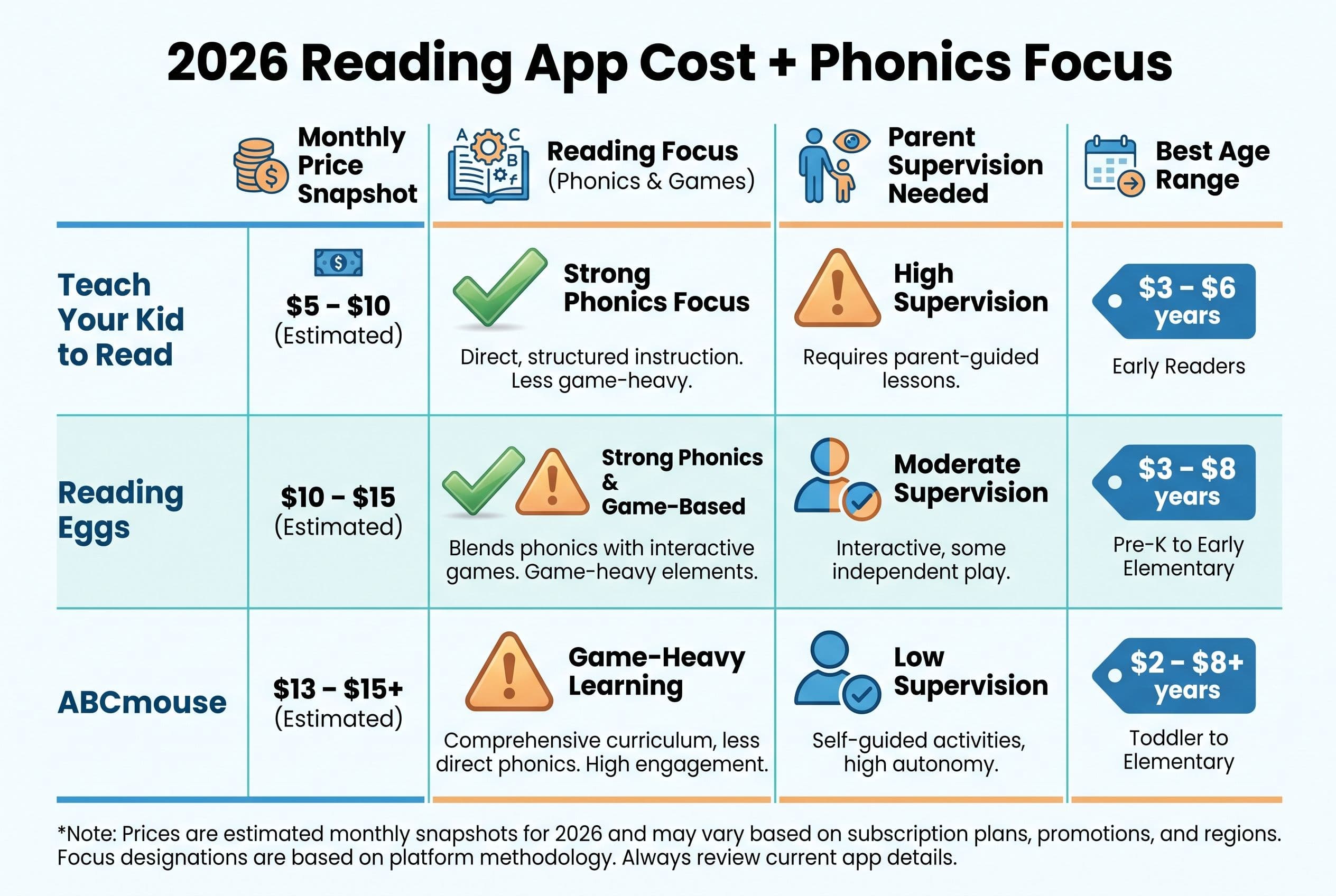
| Rank | App | 2026 Price Snapshot | What It Teaches | Best For |
|---|---|---|---|---|
| #1 | Teach Your Kid to Read | Lesson one is free with no card and nothing to cancel; from lesson two, 7-day free trial, then US$9.95/month | Systematic phonics, no guessing, parent-led mastery | Ages 3-7 |
| #2 | Reading Eggs | Commonly around US$9.99/month or annual plans; check checkout page for current offers | Phonics plus games and rewards | Ages 3-7 |
| #3 | ABCmouse | Commonly around US$12.99/month, with discounted annual offers at times; check checkout page | Broad early learning, some reading content | Ages 2-8 |
If you want the cheaper reading app for kids that focuses on real phonics instead of keeping your child entertained, I’d start with Teach Your Kid to Read: start lesson one free. Lesson one is free with no card and nothing to cancel; from lesson two the whole program is a 7-day free trial, then US$9.95 a month.
Bottom line: Reading Eggs usually beats ABCmouse on monthly reading-specific value, but Teach Your Kid to Read beats both if your goal is decoding, not digital babysitting.
Tiger Truth: Cheap Gets Expensive Fast
Look, I love saving money. I have four kids. I can stretch leftovers like an Olympic sport.
But reading failure? That gets expensive.
Only 33% of US 4th graders (ages 9-10) scored at or above proficient in reading on the 2022 NAEP / The Nation's Report Card. That’s not a tiny problem. That’s a five-alarm fire with laminated sight-word flashcards thrown on top.
Donald J. Hernandez’s 2011 report, Double Jeopardy: How Third-Grade Reading Skills and Poverty Influence High School Graduation, found that students who didn’t read proficiently by 3rd grade were four times more likely not to graduate from high school on time than proficient readers. That’s an association, not a magic crystal ball. But it’s still the 3rd Grade Cliff. I hate that phrase because it sounds dramatic, but the data backs it up.
And remediation? It can get ugly fast. If a family pays US$75-US$125 an hour for private reading tutoring or dyslexia therapy twice a week during the school year, that can land in the US$6,000-US$10,000+ range before you even blink. More intensive help can go higher. Insurance usually doesn’t cover tutoring. The real deal is this: a cheap app that fails to teach decoding can cost you far more later.
ABCmouse vs Reading Eggs Cost: The Deep Dive
#1 Teach Your Kid to Read: Best Price for Real Phonics Mastery
Teach Your Kid to Read costs less than many streaming subscriptions, and unlike another cartoon show, it actually builds a survival Skill.
Here’s the honest offer again because I won’t play pricing games with parents: lesson one is free with no card and nothing to cancel; from lesson two the whole program is a 7-day free trial, then US$9.95 a month.
What makes it different?
It teaches reading the way the brain learns written language: sound by sound, pattern by pattern, word by word. No guessing from pictures. No “look at the first letter and think what makes sense.” No nonsense.
The 2000 National Reading Panel report found that systematic phonics instruction produces significant benefits, especially for younger children and struggling readers. Stanislas Dehaene’s Reading in the Brain (2009) explains why: the brain doesn’t absorb reading naturally like spoken language. We train it.
That means your child needs:
- Grapheme-phoneme correspondence — matching letters to sounds
- Blending practice — /m/ /a/ /t/ becomes “mat”
- Segmenting — hearing each sound in a spoken word
- Orthographic mapping — locking words into memory by sound-symbol connection
- Decodable text — words your child can actually sound out
That’s why I care less about how cute the dashboard looks and more about whether your child can read “splint” without melting into a puddle.
I was at a playground in Raleigh when another mom told me her child’s school had just switched from Lucy Calkins to a Science of Reading curriculum because of North Carolina’s SB 387, the Excellent Public Schools Act. That’s a US state law, so if you’re outside the US, translate that as: her school finally ditched guessing strategies and moved toward evidence-based phonics.
She was confused and a little annoyed. “He was doing fine before,” she told me while our kids attacked the climbing frame like tiny parkour criminals.
I asked if her son could read the word “splint.” He was in 2nd grade (ages 7-8). He couldn’t.
So I spent 20 minutes on that playground bench explaining why the switch was happening: Emily Hanford’s APM Reports / “Sold a Story” investigation, the NAEP data, and Dehaene’s neuroscience showing reading doesn’t develop naturally. That night, she watched the podcast and texted me at 11 p.m.: “I had no idea. Why didn’t anyone tell us this sooner?”
That moment lives rent-free in my brain.
Because parents aren’t lazy. Most parents just haven’t been told what to look for.
Teach Your Kid to Read keeps the target plain: decoding mastery. Not badges. Not “engagement” as a fancy word for distraction. Mastery.
#2 Reading Eggs: Good Value, But Watch the Game Layer
Now let’s talk reading eggs cost 2026.
Reading Eggs often lands around US$9.99 per month, with annual discounts and bundles depending on country and promotion. That makes it close to Teach Your Kid to Read on sticker price and cheaper than ABCmouse if you’re comparing month-to-month plans.
Reading Eggs does include phonics, letter sounds, sight words, and leveled activities. Many parents like it because kids enjoy it. I get that. If your child resists anything that smells like school, Reading Eggs can feel like a no-brainer.
But here’s the kicker: rewards can start driving the session more than the reading does.
If your child races through a lesson for eggs, coins, pets, characters, or whatever the prize system offers, you need to watch accuracy like a hawk. Are they reading? Or are they tapping until something sparkles?
That difference matters.
I’d rather see a child read five CVC words correctly — sat, pin, map, hot, cub — than spend 25 minutes collecting cartoon prizes while guessing. Real talk.
Reading Eggs can work best when a parent sits nearby and says:
- “Sound it out.”
- “No guessing.”
- “Try that word again.”
- “Point to each sound.”
- “Read the sentence one more time with accuracy.”
Use Reading Eggs if your child loves the format and you’ll supervise. Don’t use it as a silent babysitter and assume reading will magically happen.
Magic is not a reading strategy.
#3 ABCmouse: Broad Learning, Higher Risk of Reading Drift
ABCmouse pricing in 2026 commonly sits around US$12.99 per month, though the company often runs discounted annual plans. Parents see the sale price and think, “Great, this covers everything.”
And yes, ABCmouse covers a lot: reading, math, art, music, science, social studies, games, puzzles, songs.
That’s exactly my problem.
ABCmouse is broad. If you want an all-purpose early learning app for a 3-year-old who wants songs, matching games, and basic concepts, fine. It can keep a child busy. It may introduce letters and sounds. It may support vocabulary and early school readiness.
But if your search is ABCmouse vs Reading Eggs Cost because your child needs to learn to read, ABCmouse starts to look less like a reading app and more like an activity buffet.
Buffets are fun. They’re also where my kids try to eat rolls, grapes, and dessert for dinner.
The reading instruction can get buried under the everything-else. If your child needs explicit phonics, you don’t want them wandering through a digital theme park hoping they bump into decoding practice.
This is where I get strict.
For reading, I want a tight sequence. Letter sounds. Blending. Decodable words. Fluency. No detours through virtual hamster habitats.
Quick Cost Comparison: Reading Eggs vs ABCmouse Price
If you only compare sticker prices, Reading Eggs usually wins over ABCmouse month to month.
| Feature | Reading Eggs | ABCmouse |
|---|---|---|
| Typical monthly cost | About US$9.99/month | About US$12.99/month |
| Annual discounts | Often available | Often available |
| Reading focus | Stronger | Broader, less focused |
| Game/reward load | High | High |
| Best use | Supervised phonics practice | General early learning |
So yes, if your choice is only Reading Eggs vs ABCmouse price, I’d pick Reading Eggs for reading.
But if your choice includes Teach Your Kid to Read, I’d pick the app built around parent-led phonics mastery for US$9.95/month after the trial.
The Real Problem: Guessing Looks Like Reading Until It Doesn’t
This one drives me crazy.
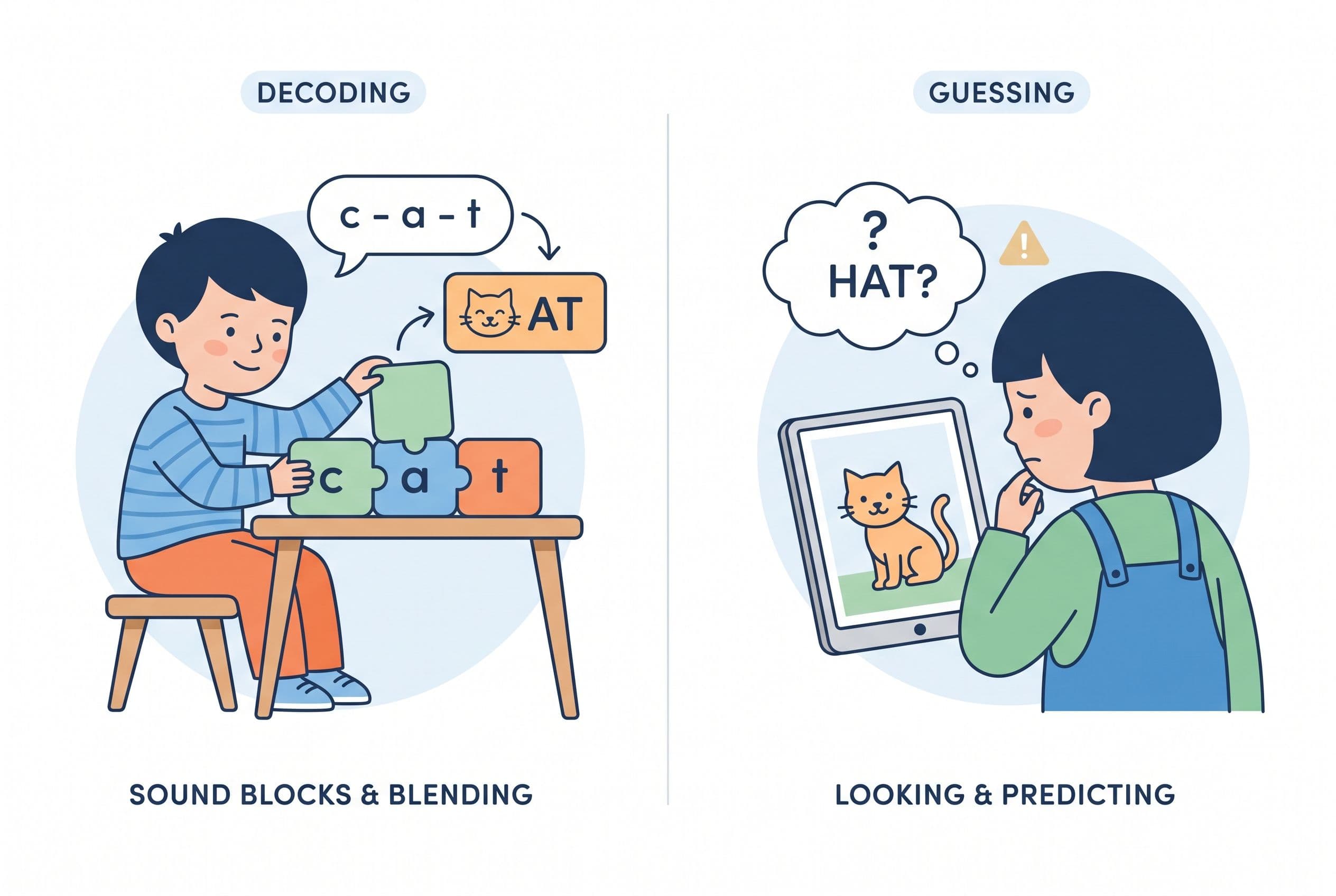
A child looks at a picture of a horse and says “pony” while the printed word says “horse.” An adult smiles because the child understood the picture.
Nope.
That’s not reading. That’s guessing with confidence.
Balanced Literacy and Whole Language methods trained too many kids to use pictures, sentence patterns, and context clues before decoding. Emily Hanford’s Sold a Story reporting exposed how deeply those methods spread through schools and teacher training. Louisa Moats’ 1999 paper, Teaching Reading IS Rocket Science, said the quiet part out loud decades ago: teaching reading requires explicit knowledge of language structure.
If an app encourages your child to infer, match, memorize, or tap through without sounding out, stop and check what’s happening.
Ask your child to read words with sound-spelling patterns they’ve already been taught. If they’ve learned short /a/, /m/, /s/, /t/, then “mat” and “sat” are fair game. If they haven’t learned consonant blends yet, “splint” is not a fair test. We’re checking instruction, not setting traps like tiny literacy goblins.
You can also try nonsense words like:
- mip
- lat
- shum
- fep
- sost
Why nonsense words? Because they can show whether your child is decoding instead of memorizing. DIBELS, the Dynamic Indicators of Basic Early Literacy Skills, includes nonsense word measures for exactly this reason. But don’t grab one random benchmark number from the internet and start diagnosing your child at the kitchen table. DIBELS scores depend on the edition, measure, grade, time of year, and scoring rules. Correct letter sounds are not the same thing as whole words read correctly.
No need to obsess over one number at home. Use this as a smoke alarm.
If your child knows songs, letters, and app characters but can’t blend simple taught patterns like /s/ /a/ /t/, the foundation may have cracks. Or they may be tired. Or they may not have been taught that pattern well yet. One missed word is not a diagnosis. A pattern of missed words after clear instruction? That’s when I’d ask the teacher for a real reading assessment and get structured help.
What I’d Pay For — And What I’d Skip
Here’s my mom-of-four, no-sugarcoating checklist.
Pay For This
- Systematic synthetic phonics: Sounds taught in a planned order
- Decodable reading: Books and sentences your child can actually sound out
- Mastery checks: The app doesn’t move on just because your child clicked fast
- Parent visibility: You can tell what your child learned and what they missed
- No guessing prompts: The app doesn’t train picture-reading
Be Suspicious Of This
- Too many rewards per minute
- “Read” buttons that play the word too quickly
- Leveled readers with patterns like “I see the...” before kids can decode
- Vague progress reports that say “great job” but don’t show Skill gaps
- Apps that mix reading with so many activities your child avoids hard decoding
Fountas & Pinnell levels are everywhere, but they come from a whole-language-aligned world. If you want decodable readers, look at Bob Books, UFLI Foundations materials, Flyleaf Publishing, High Noon Books, or a structured Orton-Gillingham-based program like Logic of English, Barton Reading & Spelling, or Wilson Reading System for kids with dyslexia indicators.
Wilson uses 12 steps and controlled readers. It’s intense. It also respects the fact that struggling readers need direct instruction, not vibes.
The Action Step: Pick the App Without Getting Fooled
Do this before you pay for any reading app.
- Set your goal. If your goal is general preschool enrichment, ABCmouse may fit. If your goal is reading, narrow the field fast.
- Test decoding with taught patterns. Write five short words your child has actually been taught how to sound out. If short vowels and CVC words are taught, try mat, sip, log, hen, cup.
- Add one harder word only if it’s fair. Try “splint” for older early readers who have learned blends. Don’t coach. Watch what happens.
- Try a nonsense word. Use “mip” or “lat” if those sound-spellings have been taught. If your child freezes, they may rely on memory instead of decoding.
- Check the app lesson. Does it teach letter-sound mapping and blending directly? Or does it bury reading inside games?
- Watch one full session. Sit beside your child. Count how many times they actually read words aloud.
- Choose mastery over entertainment. Pick the app that makes your child sound out words, even if the lesson feels less flashy.
- Use a quick screener if you’re worried. Kilpatrick’s PAST, the Phonological Awareness Screening Test, takes about 5 minutes when you know how to administer it and helps pinpoint phonological breakdowns.
If your child is guessing, stalling, memorizing, or melting down over simple taught CVC words, start with Teach Your Kid to Read and keep the routine short, daily, and non-negotiable. And if the struggle keeps showing up after clear instruction, talk to the teacher and ask for a real reading assessment. Kitchen-table checks are clues, not court verdicts.
My 2026 Recommendation by Family Type
If You Want the Cheapest Serious Reading Option
Pick Teach Your Kid to Read.
At US$9.95/month after lesson one and the 7-day trial, it gives you focused phonics without the “please buy a bigger bundle” feeling. It’s the option I’d choose for a parent who says, “Xia, I don’t have time to become a reading specialist. Just tell me what to do.”
If Your Child Needs Motivation and You’ll Supervise
Pick Reading Eggs over ABCmouse.
Reading Eggs cost 2026 pricing usually comes in lower than ABCmouse monthly pricing, and it has a stronger reading identity. But sit close. The rewards can become the main event if you let them.
If You Want a Big Early Learning App
Pick ABCmouse only if reading isn’t the urgent goal.
ABCmouse pricing can make sense if you want one app for lots of subjects and your child is very young. But for a child who needs decoding practice, I wouldn’t make it your main reading tool.
If Your Child Shows Dyslexia Red Flags
Don’t rely on any app alone.
Look into evidence-aligned intervention, structured literacy, and programs with Orton-Gillingham principles. The International Dyslexia Association has parent-friendly information on dyslexia signs and structured literacy. If your child struggles to rhyme, blend, segment, remember letter sounds, or read simple words after consistent instruction, move now. Don’t wait and see.
The Final Call: Cheapest Isn’t Always Cheapest
So, who wins ABCmouse vs Reading Eggs Cost in 2026?
If you compare only those two, Reading Eggs usually wins for reading value. It tends to cost less monthly and focuses more directly on reading than ABCmouse.
But my top pick is Teach Your Kid to Read because it costs US$9.95/month after the honest trial setup and stays locked on the thing that matters: phonics mastery.
Reading is not optional. It’s not a personality trait. It’s not something we hope the school handles while we cross our fingers.
We drill the sounds. We demand accuracy. We build independence.
That’s the tiger mom rule: We Never Skip. No Guessing.
If you’re ready to stop comparing cute apps and start teaching your child to read, start with lesson one today. It’s free with no card and nothing to cancel; from lesson two the whole program is a 7-day free trial, then US$9.95 a month.
FAQ
Is Reading Eggs cheaper than ABCmouse in 2026?
Usually, yes. Reading Eggs commonly prices around US$9.99/month, while ABCmouse commonly lists around US$12.99/month, though both companies run annual discounts and promotions. Always check the current checkout page before you buy.
Is ABCmouse good for learning to read?
ABCmouse can support early learning, letter exposure, and preschool skills. But I wouldn’t use it as my main reading program for a child who needs explicit phonics and decoding practice. It covers many subjects, so reading can get diluted.
What is the cheapest reading app for kids that teaches phonics?
Teach Your Kid to Read is my pick for focused phonics value: lesson one is free with no card and nothing to cancel; from lesson two, you get a 7-day free trial, then it’s US$9.95/month. Reading Eggs is also close in price and can work well with parent supervision.
Should I choose Reading Eggs or ABCmouse for a 5-year-old?
For kindergarten (age 5) reading practice, I’d choose Reading Eggs over ABCmouse if those are your only two options. But I’d choose a more direct phonics-first program if your child is struggling to blend sounds or decode CVC words.
How do I know if my child is guessing instead of reading?
Cover the picture and ask your child to read a word with sound-spelling patterns they’ve already been taught. Then try a fair nonsense word like “mip” or “lat.” If they can’t sound it out after clear instruction, they may be relying on memory, pictures, or context instead of decoding.

Xia Brody
Co-Founder, Teach Your Kid to Read
Mom of 4 who has successfully taught her kids to read. Currently in the trenches with her 4-year-old while her two oldest (10 and 7) devour books on their own. Passionate about phonics-based methods and building a lifelong love of reading.
Related Articles
Reading Eggs vs ABCmouse Cost: 2026 Price Breakdown
Comparing Reading Eggs vs ABCmouse cost? Here’s the 2026 price breakdown, what each app teaches, and why I’d choose phonics-first instruction over reward-heavy screen time.
Read More →
Reading Eggs vs Teach Your Monster: Best for Aussie Prep
One is free and genuinely phonics-first. One costs about A$120 a year and does more, but lets your child guess. Here's the honest comparison for Prep, Foundation and Kindy parents — plus the daily routine that matters more than either app.
Read More →
Reading Eggs vs ABCmouse: One Teaches Reading, One Doesn't
Both apps look colorful and fun. Only one actually teaches your kid to read using real phonics. Here's my honest breakdown of Reading Eggs vs ABCmouse after using both with my own kids — and why neither app is enough on its own.
Read More →