Reading App vs Tutor for Dyslexia: 2026 Cost Guide + What Actually Works
What You'll Learn
- The real 2026 cost of dyslexia tutoring vs. reading apps (spoiler: the gap is enormous, but price isn't the whole story)
- The specific research-backed method both options MUST use — and how to spot the fakes
- When a reading app is genuinely enough for a struggling reader, and the exact warning signs that mean you need a human tutor
- How to use a structured phonics app as the daily backbone so tutoring sessions actually stick
The Price Tag Nobody Tells You About Until It's Too Late
Your kid just got flagged. Maybe the school said "below grade level." Maybe a private evaluator used the word dyslexia. Maybe you've been watching your 7-year-old guess at every single word and you finally Googled it at midnight.
Now you're staring at two options: a reading app for $15 a month, or a specialized tutor who charges $125 an hour.
And your brain is doing the math while your stomach drops.
Here's what nobody in the education world wants to say out loud: the cost of NOT intervening is catastrophically higher than either option. The Annie E. Casey Foundation's 2010 report, Early Warning! Why Reading by the End of Third Grade Matters, found that kids who couldn't read proficiently by 3rd grade were four times as likely to drop out of high school compared to proficient readers. Four times. That's not a scare tactic — that's an association drawn from a longitudinal dataset, and while factors like poverty and chronic absence also play a role, the correlation between early reading failure and later dropout is staggering.
So let's stop pretending this is a "wait and see" situation. It's not. It's a "figure out what works and do it NOW" situation.
I'm going to break down exactly what tutoring and apps actually cost in 2026, what the research says about each, and — this is the part most "guides" skip — how to combine them so your kid gets maximum results without bankrupting your family.
The Tiger Truth: What Happens When You Do Nothing
I need you to hear this before we talk money.
The 2022 NAEP — that's the Nation's Report Card — showed only 33% of 4th graders read at a proficient level. One in three. And for kids with dyslexia, which affects roughly 15-20% of the population according to the International Dyslexia Association? Their odds are even worse without explicit, systematic intervention.
David Kilpatrick lays this out with brutal clarity in Equipped for Reading Success (2016). Kids with weak phonological processing don't just "grow out of it." They don't catch up by reading more books. They need targeted, systematic instruction that rewires how their brain maps sounds to letters — what researchers call orthographic mapping. Without it, these kids memorize a few hundred words by sheer visual memory, hit a wall around 2nd or 3rd grade, and start falling behind in every subject. Because you can't do math word problems if you can't read the words.
The average private remedial reading program runs $10,000-$15,000 per year. Insurance doesn't cover it. Schools often don't provide enough.
That's the real cost of "let's wait and see."
2026 Dyslexia Tutor Costs: The Honest Breakdown
Let's talk numbers. Real ones.
What You'll Pay for a Qualified Dyslexia Tutor
| Tutor Type | Typical 2026 Rate | Sessions Needed | Annual Cost Estimate |
|---|---|---|---|
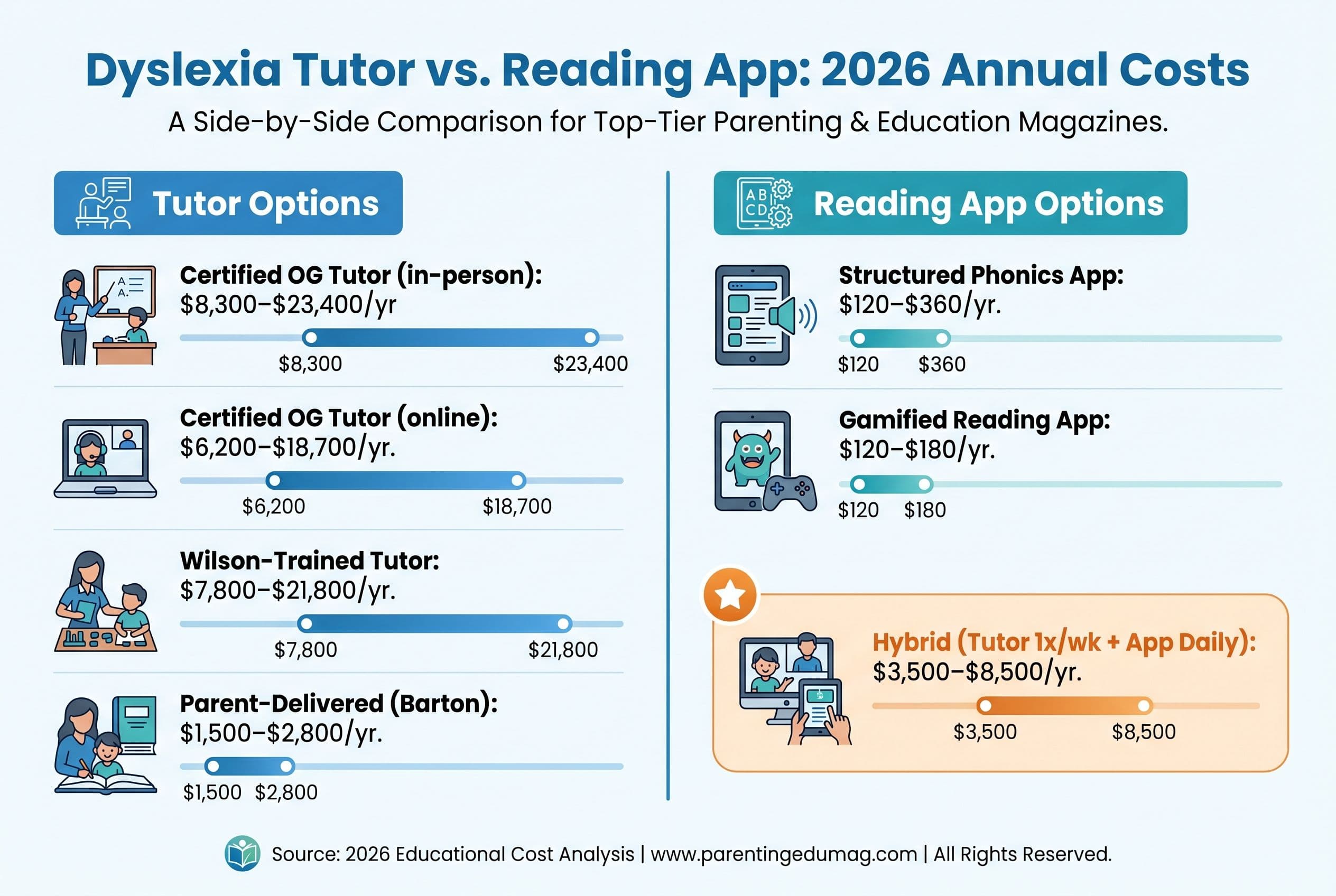
| Certified Orton-Gillingham tutor (in-person) | $80–$150/hour | 2-3x per week | $8,300–$23,400/year |
| Certified OG tutor (online) | $60–$120/hour | 2-3x per week | $6,200–$18,700/year |
| Wilson Reading System trained tutor | $75–$140/hour | 2-3x per week | $7,800–$21,800/year |
| Barton Reading & Spelling (parent-delivered with training) | $300–$400 for materials per level | 4-5x per week (you teach) | $1,500–$2,800/year total |
| College student / uncertified "reading tutor" | $25–$50/hour | Varies | $2,600–$7,800/year |
Those bottom-row uncertified tutors? I put them there because parents find them on Wyzant and Varsity Tutors all the time. And look — some are great. But many of them are using Fountas & Pinnell leveled readers and three-cueing strategies. They're teaching your dyslexic kid to guess from context and pictures, which is literally the opposite of what they need.
The kicker is this: not all tutoring is equal. A tutor using evidence-based structured literacy (Orton-Gillingham principles, systematic synthetic phonics, multisensory instruction) will get results. A tutor who tells your kid to "look at the picture and think about what word would make sense" is setting fire to your money.
After Emily Hanford's Sold a Story investigation came out in 2023, my neighbor — a first-grade teacher for 18 years — called me almost in tears. She'd been using Lucy Calkins' Units of Study curriculum her entire career. Three-cueing, MSV, the whole nine yards. She said, "I've been teaching kids to guess for two decades and I didn't even know it." She switched her classroom to UFLI Foundations mid-year. It was messy. She had to relearn everything herself first. But by spring, her kids' DIBELS scores jumped an average of 15 points on nonsense word fluency. She told me it was the first time in her career where every single kid in her class could decode CVC words by February. Every. Single. One.
If a whole classroom of first-graders can make that leap with the right method, imagine what your one child can do with focused, daily practice using the right approach.
That's the question. Not "app or tutor." The question is: does it use the right method?
2026 Reading App Costs: What You're Actually Getting
Now let's look at the other side of the ledger.
What You'll Pay for a Reading App
| App Type | Typical 2026 Cost | Method Used | Daily Practice? |
|---|---|---|---|
| Teach Your Kid to Read | Free–$29.99/month (depends on tier) | Systematic synthetic phonics, OG-aligned | Yes, daily structured lessons |
| Generic "learn to read" apps (Homer, Hooked on Phonics app) | $7–$13/month | Mixed — some phonics, some whole-word | Varies |
| Gamified reading apps (Reading Eggs, ABCmouse) | $10–$15/month | Light phonics, heavy gamification | Inconsistent |
| Audiobook/read-along apps (Epic!) | $10–$13/month | Exposure, NOT instruction | No direct teaching |
So you're looking at maybe $120–$360 per year for an app versus $6,000–$23,000 per year for a qualified tutor.
That's not a small difference. That's a "do we refinance the house" difference.
But here's where I have to be the tiger mom for a second. An app that doesn't teach systematic phonics is not a reading intervention. It's a screen-time snack. ABCmouse is cute. Reading Eggs has nice animations. But cute animations don't build orthographic mapping. Cute animations don't systematically move a child through Linnea Ehri's phases of word reading development — from pre-alphabetic to partial alphabetic to full alphabetic to consolidated.
You need an app that does what a good OG tutor does: explicit instruction in grapheme-phoneme correspondence, blending practice, controlled decodable text, and cumulative review. That's what Teach Your Kid to Read was built to do.
So... Is a Reading App Enough for Dyslexia?
Real talk — it depends on the severity.
I'm going to give you the honest answer that no app company wants to give you and no tutor wants to give you either (because both have financial incentives to say "pick me").
When an App Can Be Your Primary Tool
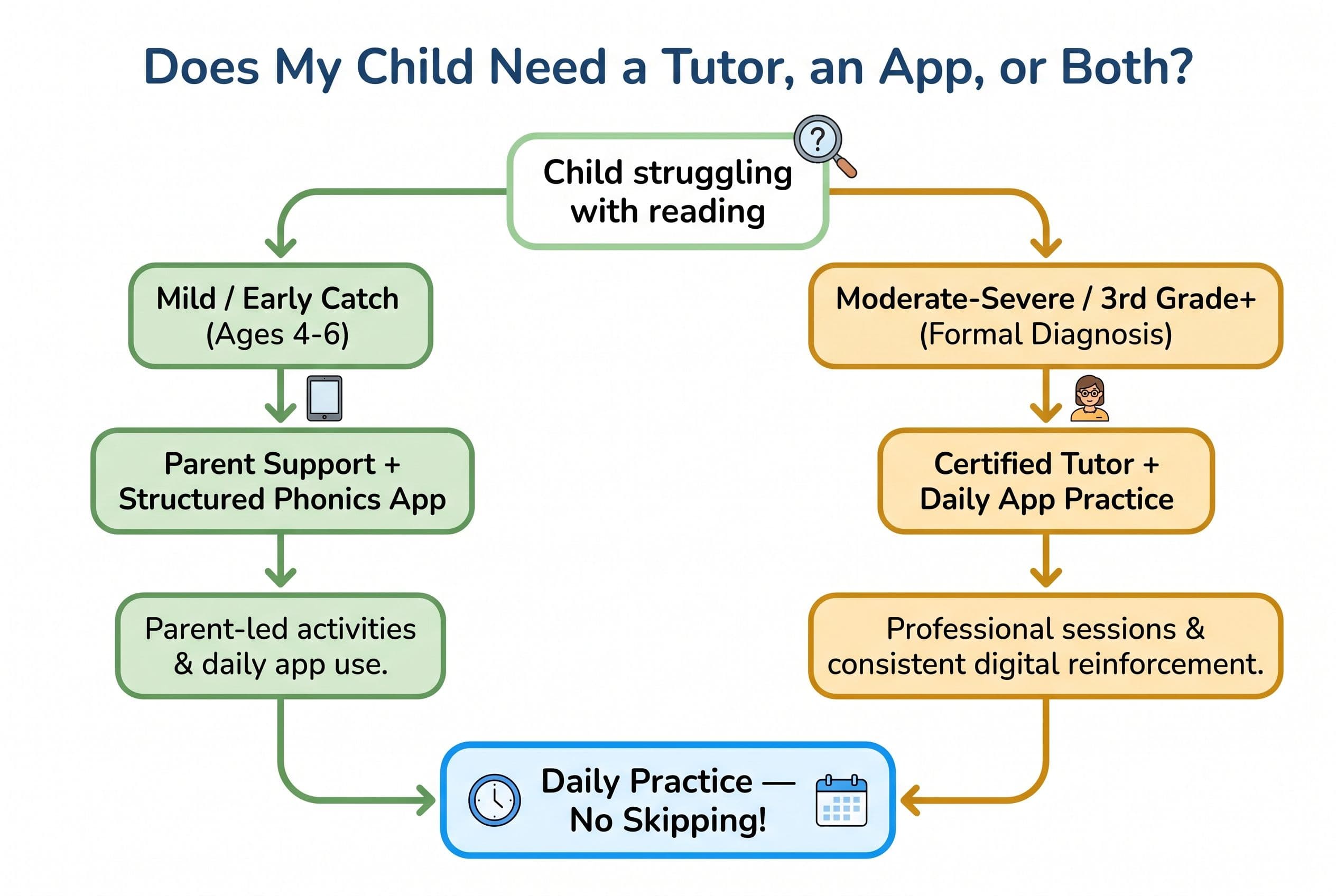
- Mild phonological processing weakness. Your kid is a slow reader but CAN decode when they focus. They score in the "strategic" or "some risk" range on DIBELS, not "intensive."
- Early intervention (ages 4-6). You caught it early. The neural pathways are still highly plastic. Consistent daily app practice with a systematic phonics program — 15-20 minutes a day, every single day — can be transformative.
- You're an engaged parent who will sit with your kid. This is non-negotiable. A 6-year-old with dyslexia cannot learn to read by themselves on a tablet. You park yourself next to them. You make them sound it out instead of guessing. You enforce the "No Guessing" rule.
- You supplement with Kilpatrick-style phonemic awareness drills. His PAST (Phonological Awareness Screening Test) takes about 5 minutes to administer and tells you exactly where the phonological breakdown is. Then you do targeted phonemic manipulation exercises alongside the app.
When You Need a Human Tutor (Non-Negotiable)
- Your child has been formally diagnosed with moderate to severe dyslexia. I'm talking about scores below the 10th percentile on standardized phonological processing assessments.
- They're already in 3rd grade or beyond and reading more than 2 years below grade level. The window is closing. You need intensive, expert-guided intervention — the Wilson Reading System's 12-step program, or Lindamood-Bell's Seeing Stars/Visualizing & Verbalizing protocols.
- Co-occurring issues. Dyslexia plus ADHD. Dyslexia plus language processing disorder. Dyslexia plus anxiety around reading (which is almost every kid who's struggled for years). A skilled tutor can adjust in real-time in ways no app can.
- Your child has hit a plateau. They made progress with the app for 3-4 months, then stalled. Something specific is blocking them — maybe it's vowel teams, maybe it's syllable division — and they need a trained eye to diagnose the exact breakdown point.
The Hybrid Approach: What I Actually Recommend
OK, here's where I stop being diplomatic and start being the mom who's taught three kids to read (with number four coming up fast behind them).
Use both. But not the way you think.
Most parents who can afford it hire a tutor for 2 sessions a week and assume that's enough. It's not. Two hours a week of anything doesn't build mastery. You wouldn't learn piano with two lessons and zero practice, right?
Here's the approach I recommend — and it's backed by what we know about distributed practice and memory consolidation from Mark Seidenberg's Language at the Speed of Sight (2017):
The Hybrid Model That Actually Works
-
Tutor: 1-2 sessions per week for diagnostic assessment, targeted skill instruction, and progress monitoring. The tutor identifies what's broken and teaches the strategy to fix it. ($60-$150/session)
-
Structured phonics app: 5-7 days per week, 15-20 minutes daily. This is your practice engine. This is where the repetition happens. This is where the brain actually rewires. ($0-$30/month)
-
Parent involvement: every single session. You sit with your kid during app time. You enforce accurate decoding. You celebrate small wins. You track progress.
This hybrid approach drops your annual cost from $12,000+ (tutor only) to roughly $4,000-$8,000 (fewer tutor sessions + daily app practice). And honestly? The daily app practice matters MORE than the tutoring sessions, because repetition is what builds automaticity. The tutor is your guide. The app is your gym.
How to Tell if Your Current Approach Is Working
Whichever path you choose, you need benchmarks. Not feelings. Not "he seems like he's improving." Data.
Here's what to measure and when:
Monthly Check: Nonsense Word Fluency
Use a DIBELS-style nonsense word fluency (NWF) probe. You can find free ones from the University of Oregon's DIBELS website. Your kid reads made-up words like "bim," "taf," "plid" for one minute. This tells you if they're actually decoding or just memorizing real words.
DIBELS reports NWF using two metrics: CLS (Correct Letter Sounds) and WWR (Whole Words Read). The benchmark numbers vary depending on which edition your school uses (6th, 7th, or 8th) and the time of year (beginning, middle, or end). Don't guess at the cut scores — look up the benchmark table for your specific DIBELS edition and time-of-year at the University of Oregon site, or ask your child's school which edition they use and what the grade-level targets are.
The point is simple: if those numbers aren't going up after 6-8 weeks of intervention (app or tutor), something needs to change.
Every 3 Months: Kilpatrick's PAST
The Phonological Awareness Screening Test gives you a detailed map of where your child's phonemic awareness breaks down. Can they delete sounds? Substitute sounds? Manipulate phonemes in blends? Each level tells you exactly what to work on next.
A tutor should be doing this automatically. If you're app-only, you need to run this yourself. It's free, it's available in Kilpatrick's Equipped for Reading Success, and it takes about 5 minutes.
The No-Guessing Test (My Personal Favorite)
Hand your kid a book they've never seen before — a decodable reader that matches their current phonics level. If they can read 90%+ of the words accurately by sounding them out (not guessing, not looking at pictures), you're on track. If they're looking at the pictures and saying words that "make sense" but don't match the text? Red flag. That's three-cueing. That's guessing. Stop everything and fix the method.
What About School-Based Intervention? The Free Option Nobody Trusts
Yeah, I know. Your school offers "reading support." Maybe they pulled your kid for 30 minutes of small-group instruction three times a week.
Here's the problem: until very recently, most schools were using interventions based on balanced literacy principles. The 40+ states that have passed Science of Reading legislation since 2019 are changing this — Mississippi's Literacy-Based Promotion Act of 2013 is the gold standard, taking the state from 49th to 21st in national reading scores in six years. But legislation and classroom reality are two very different things.
Ask your school three questions:
-
What curriculum does your reading interventionist use? If they say "Leveled Literacy Intervention" (LLI) by Fountas & Pinnell, that's whole-language aligned. If they say UFLI Foundations, Wilson Reading System, or Orton-Gillingham-based programs — you're in better shape.
-
How many minutes per day of explicit phonics instruction does my child receive? The answer should be at least 30 minutes of focused, systematic instruction. Not "we embed phonics in our reading block."
-
What assessment do you use to monitor progress? DIBELS, AIMSweb, or PALS are evidence-based. If they can't name their tool or they say "running records" only, that's a red flag.
School-based intervention is free. But free intervention using the wrong method isn't just useless — it's harmful. It teaches your kid to compensate and guess, which makes it harder to unteach later.
The Simple View of Reading: Why Method Matters More Than Money
Gough and Tunmer laid this out in 1986 and it still holds: Reading Comprehension = Decoding × Language Comprehension. That's it. That's the whole model.
If decoding is zero, it doesn't matter how smart your kid is or how vast their vocabulary is. Zero times anything is zero.
Dyslexia is primarily a decoding problem. These kids often have strong (sometimes exceptional) language comprehension. They're smart. They understand stories. They can have sophisticated conversations. But they can't crack the code.
So when you're evaluating whether to spend money on an app or a tutor, ask one question: does this tool systematically teach decoding through explicit phonics instruction?
If yes — it can work.
If no — it's entertainment, and you're wasting time your kid doesn't have.
Teach Your Kid to Read was built on this exact principle. Systematic synthetic phonics. Orton-Gillingham-aligned methodology. Daily practice in 15-minute structured lessons. Decodable text that matches what your kid has actually been taught — not leveled readers full of words they haven't decoded yet.
Your Action Plan: 5 Steps Starting This Week
Stop researching. Start doing. Here's exactly what to do:
Step 1: Screen your child's phonological awareness. Download Kilpatrick's PAST from his book or find a version online. Administer it this weekend. It takes 5 minutes and gives you a clear picture of where your child's skills break down.
Step 2: Start daily structured phonics practice immediately. Download Teach Your Kid to Read and begin at the level that matches your child's current skills. Commit to 15-20 minutes every single day. Birthdays, holidays, vacation — we never skip. That's the tiger rule.
Step 3: Decide if you need a tutor based on severity. If your child scored below the 10th percentile on phonological processing assessments, or they're already in 3rd grade and reading 2+ years behind, get a certified Orton-Gillingham or Wilson-trained tutor. Use the app as daily practice between sessions.
Step 4: Set measurable benchmarks. Run a nonsense word fluency probe today. Write down the number. Do it again in 6 weeks. If you don't see growth, change something — the tool, the method, or the time commitment.
Step 5: Eliminate guessing immediately. If your child looks at a picture to guess a word, cover the picture. If they say a word that starts with the right letter but isn't the right word ("said 'boat' when the word was 'big'"), stop them. Make them point to each letter and produce each sound. This is non-negotiable. Guessing is not reading.
Frequently Asked Questions
Can a reading app replace a dyslexia tutor entirely?
For mild cases caught early (ages 4-6), a well-designed systematic phonics app with daily parent involvement can absolutely be your primary tool. But for moderate to severe dyslexia — especially in kids already past 2nd grade — you need a certified tutor to provide the diagnostic precision and real-time adjustment that apps can't match yet. The research-backed approach is a hybrid: tutor for strategy instruction 1-2 times per week, app for daily practice 5-7 days per week.
How much does a dyslexia tutor cost in 2026?
Certified Orton-Gillingham tutors charge $80-$150/hour for in-person sessions and $60-$120/hour for online sessions. Wilson Reading System-trained tutors fall in a similar range at $75-$140/hour. With the recommended 2-3 sessions per week, you're looking at $6,000-$23,000 per year. Parent-delivered programs like Barton Reading & Spelling can cut costs to $1,500-$2,800/year since you do the teaching yourself after training.
What's the best reading app for kids with dyslexia?
The best app uses systematic synthetic phonics and Orton-Gillingham-aligned methodology — not gamification or whole-word memorization. Teach Your Kid to Read is built on these principles with daily structured lessons and decodable text that matches what your child has actually been taught. Avoid apps that rely on leveled readers, picture-guessing, or "balanced" approaches. The method matters far more than the animation quality.
How long does dyslexia intervention take to show results?
With consistent daily practice (15-20 minutes on a structured phonics app, plus tutor sessions if needed), most children show measurable improvement within 6-8 weeks on nonsense word fluency probes. Significant reading gains — like moving from frustration level to instructional level — typically take 6-12 months of consistent, evidence-based intervention. If you don't see progress within 8 weeks, the method or the tool needs to change.
Will my child's school provide dyslexia support for free?
Most public schools are legally required to provide reading intervention, and many are transitioning to Science of Reading-based methods thanks to the 40+ states that have passed literacy legislation since 2019. However, quality varies wildly. Ask what specific curriculum the interventionist uses and what assessment they track progress with. If they're using UFLI Foundations or Wilson and monitoring DIBELS scores, great. If they're using Fountas & Pinnell leveled readers and running records, that's whole-language methodology — and you'll need to supplement or replace their approach at home.
Your kid isn't broken. Their brain just processes written language differently. But that brain WILL learn to read — with the right method, the right daily practice, and a parent who refuses to wait and see.
Start with Teach Your Kid to Read today. Fifteen minutes a day. Every day. No excuses.
Questions? Call us at (407) 707-6850 or visit contact us today to get started.
Part of these guides

Xia Brody
Co-Founder, Teach Your Kid to Read
Mom of 4 who has successfully taught her kids to read. Currently in the trenches with her 4-year-old while her two oldest (10 and 7) devour books on their own. Passionate about phonics-based methods and building a lifelong love of reading.
Related Articles
Best Reading App for a 5-Year-Old with Dyslexia: 2026 Picks
A dyslexic 5-year-old doesn't need guessing games or pretty animations. They need systematic phonics, daily drill, parent coaching, and a plan that refuses to wait.
Read More →
Best Reading App for a 4-Year-Old with Dyslexia Signs: My Top Pick
If your 4-year-old mixes up sounds, guesses from pictures, or avoids letters, don’t wait and see. Here’s my tiger-mom ranking of reading apps that help — and the ones I’d skip.
Read More →
Best Reading App for a 6-Year-Old with Dyslexia: 2026 Picks
If your 6-year-old with dyslexia is guessing at words, cute reading games won’t fix it. Here’s how to choose a structured literacy app that builds decoding skill instead of wasting precious time.
Read More →