Best Reading App for Struggling Readers in 2026 (Honest Reviews + What Actually Works)

What You'll Learn
- Why 90% of "reading apps" on the App Store will actually make your struggling reader worse — and the one red flag that exposes them instantly
- The specific brain science that explains why your kid can "read" at school but can't decode a word like "splint" at home
- What a real reading intervention app must include (hint: if it doesn't have systematic synthetic phonics, delete it today)
- The exact action plan I use with my own 4-year-old — including the benchmarks that tell you it's working
Your Kid Isn't "A Little Behind." Your Kid Can't Read.
Let's skip the gentle opening.
If you're Googling "best reading app for struggling readers" at 10pm while your kid sleeps, something is wrong. You know it. The teacher's vague reassurances at conferences — "he's making progress," "she just needs more time" — aren't cutting it anymore. Your gut says the gap is growing.
Your gut is right.
Here's what I've learned from teaching four kids and talking to hundreds of parents: the word "struggling" is doing a lot of heavy lifting. It's softening the blow. What "struggling reader" usually means is this — your child has been in school for one, two, maybe three years, and they still cannot independently decode unfamiliar words. They guess. They look at the picture. They memorize the pattern of the page. They are performing reading without actually reading.
I was at a playground in Raleigh last spring when another mom told me her kid's school had just switched from Lucy Calkins to a Science of Reading curriculum because of North Carolina's SB 387 — the Excellent Public Schools Act. She was confused and honestly a little annoyed. "He was doing fine before," she said. So I asked her a simple question: can your son read the word "splint"? He's in second grade. She pulled him over. He could not. He stared at it, looked up at her, and said "split?" Then "spring?" Then nothing. He was guessing. That's not reading. That's a coin flip with consonants.
I spent twenty minutes on that playground bench explaining why the switch was happening — Emily Hanford's APM Reports investigation "Sold a Story" that blew the lid off Balanced Literacy, the NAEP data showing only 33% of fourth graders read at proficient level, the neuroscience from Stanislas Dehaene's lab proving the brain doesn't learn to read naturally the way it learns to speak. She went home and watched the "Sold a Story" podcast that night. Texted me at 11pm: "I had no idea. Why didn't anyone tell us this sooner?"
Nobody told her because the system wasn't built to tell her. It was built to sell her leveled readers and crossed fingers.
So now you're here. Looking for an app. And I'm going to be straight with you — most reading apps for kids who are behind are garbage. Beautiful, colorful, five-star-rated garbage. But a few are built on real reading science. Let me show you the difference.
The Tiger Truth: What Happens If You Pick the Wrong App (Or Do Nothing)
I don't say this to scare you. I say it because the research scares me, and I think you deserve the same information.
The Annie E. Casey Foundation's 2010 study found that kids who can't read proficiently by the end of third grade are four times more likely to drop out of high school. Four times. That's not a gentle statistical nudge. That's a cliff.
The 2023 NAEP scores — the Nation's Report Card — showed reading scores dropped 3 points since 2019. That's the largest decline in 30 years. And that was before the post-pandemic slide got fully measured.
Know what the worst part is? The window for intervention is small and it closes fast. Reid Lyon's research at the NICHD showed that if you intervene in kindergarten or first grade, you can close reading gaps for 90% of struggling readers. Wait until third grade? That number drops to about 25%. By fifth grade, you're looking at $10,000 to $15,000 per year for private reading intervention — programs like Wilson Reading System or Lindamood-Bell — and insurance doesn't cover it.
So when I say the app you choose matters, I mean it the way a doctor means it when they tell you to take the antibiotics. This isn't optional. This isn't "enrichment." For a struggling reader, the right app is triage.
The wrong app? It's a pacifier. It makes everyone feel better while the problem gets worse.
Why Most "Reading Apps" Are Making Things Worse
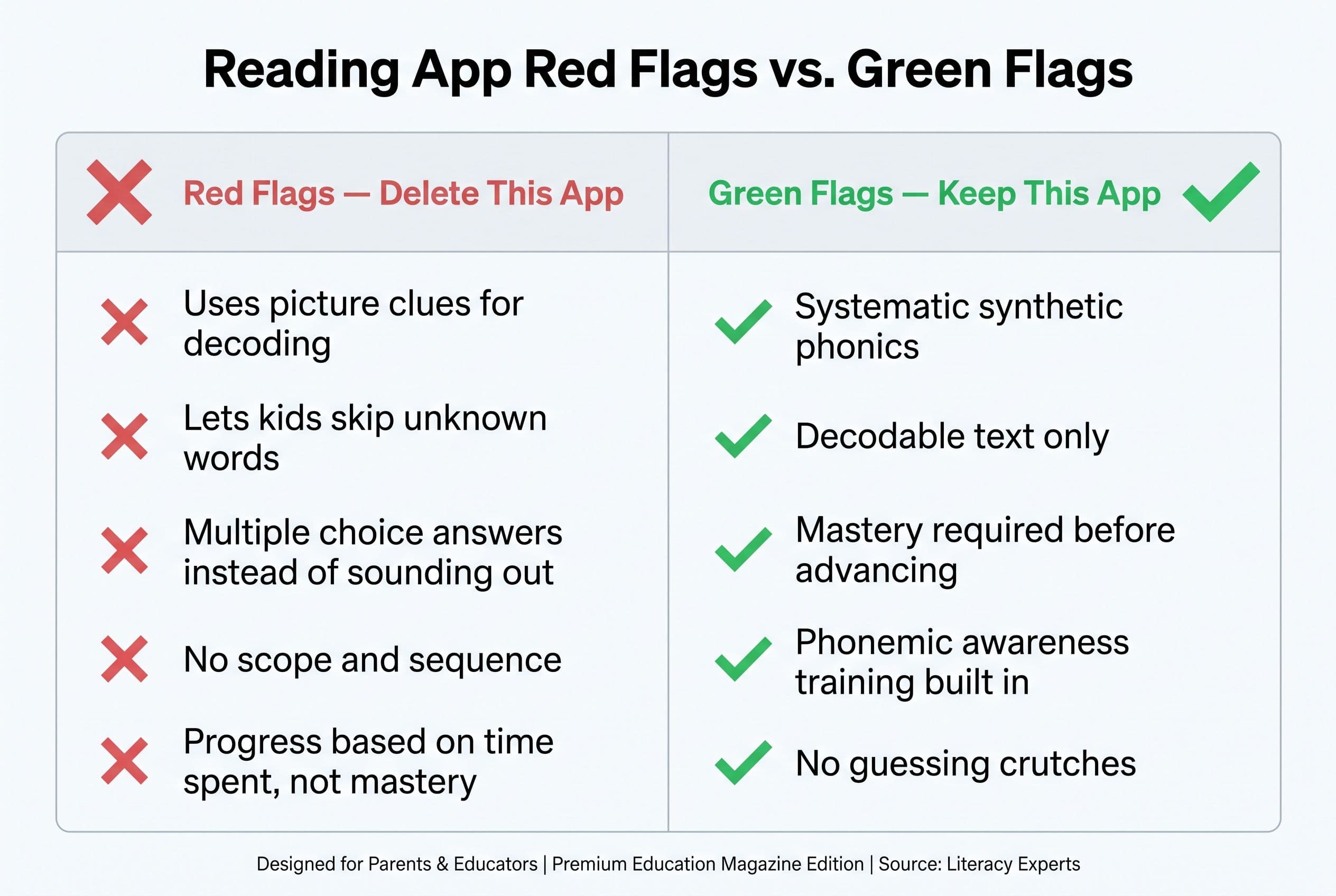
Here's my quick-and-dirty test for any reading app. Open it up. Watch what happens when your kid encounters a word they don't know.
Does the app:
- Show a picture and let them guess? DELETE IT.
- Read the word aloud for them so they can "move on"? DELETE IT.
- Let them tap three multiple-choice options? DELETE IT.
- Skip the decoding entirely and focus on "comprehension questions"? DELETE IT.
A real reading app for a struggling reader must force the child to sound out the word. Phoneme by phoneme. Blending left to right. No guessing. No picture clues. No skipping.
This is what Louisa Moats was talking about in her landmark 1999 paper "Teaching Reading IS Rocket Science" for the American Federation of Teachers — reading instruction requires explicit, systematic, sequential phonics. If the app doesn't do that, it's not a reading intervention. It's a toy.
And look, I get it. Toys are fun. Your kid likes them. The app has great reviews because kids enjoy playing it and parents enjoy the quiet. But David Kilpatrick's research in "Equipped for Reading Success" (2016) makes this devastatingly clear: kids who struggle with reading almost always have a deficit in phonological processing — the ability to manipulate individual sounds in words. No amount of picture-matching or story-listening fixes that. You have to directly train the phonological system.
That's what orthographic mapping is. It's the brain's process of bonding the sounds in a word (phonemes) to the letters that represent them (graphemes) so that the word becomes permanently stored in memory. Strong readers do this automatically after a few exposures. Struggling readers? Their orthographic mapping is inefficient — often because phonemic awareness and decoding weren't built strongly enough, or because their instruction never gave them enough practice. Either way, the mapping process isn't doing its job.
An app that lets your kid guess from context is literally bypassing that weak system instead of fixing it.
What a Real Reading Intervention App Must Have
OK so let me get specific. When I evaluate any reading app for struggling readers — whether it's for one of my own kids or for the parents I coach — I look for five non-negotiable features. I call them the Tiger Checklist.
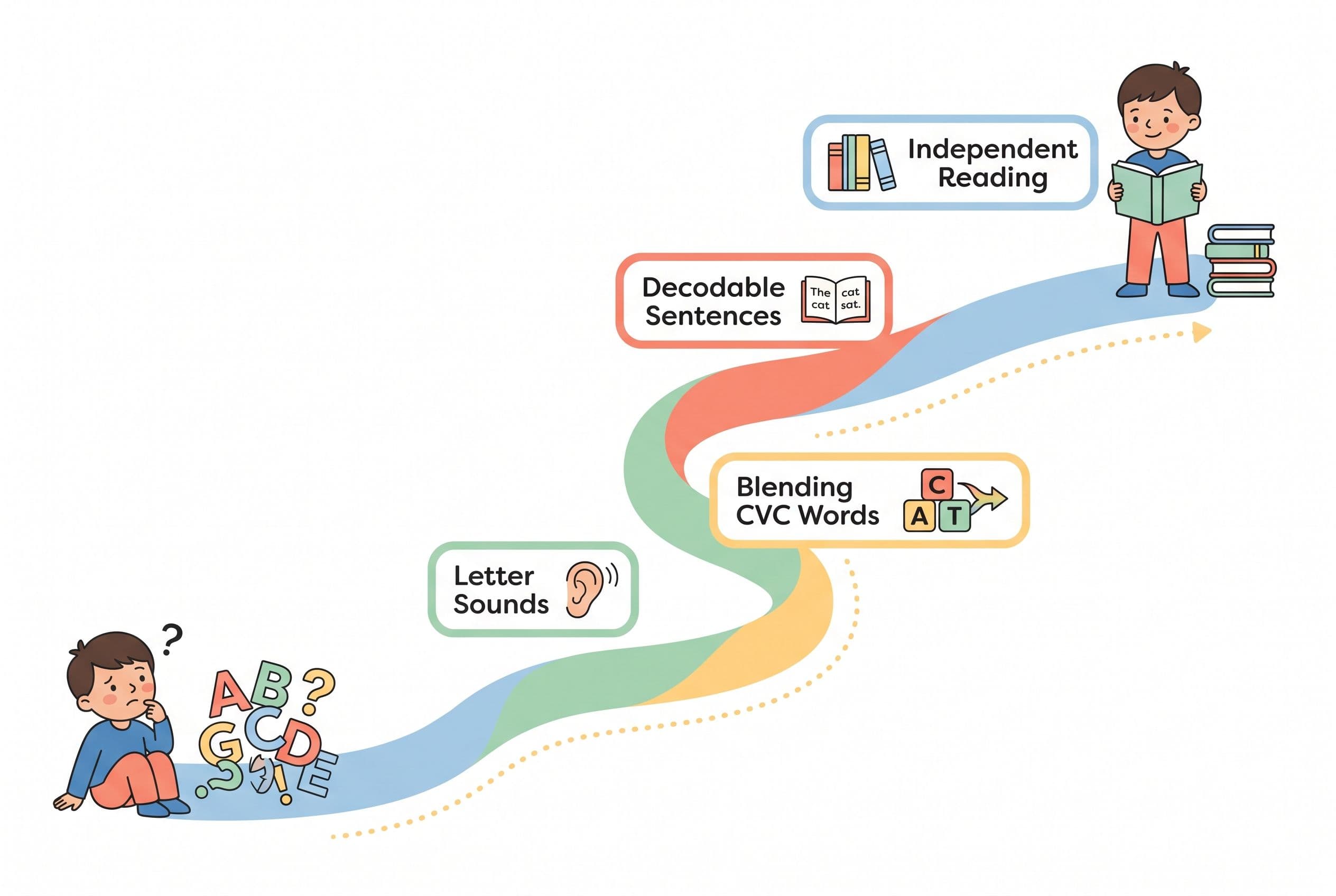
1. Systematic Synthetic Phonics
The app must teach letter-sound correspondences in a logical, cumulative sequence. Not random. Not "whatever letter the kid is interested in this week." Systematic means there's a scope and sequence — a planned order. Synthetic means the child learns to blend individual sounds together to form words, not guess whole words from memory or context.
This is the approach validated by the Clackmannanshire study (Johnston & Watson, 2005) out of Scotland — seven years of longitudinal data showing that kids taught with synthetic phonics outperformed analytic phonics kids in reading, spelling, and comprehension.
2. Decodable Text (Not Leveled Readers)
After learning a set of letter-sound correspondences, the child should practice reading decodable text — passages that only use the phonics patterns they've already been taught. This is the opposite of what Fountas & Pinnell leveled readers do, which throw kids into "Level C" books full of words they can't actually decode and encourage them to use picture clues and sentence patterns to guess.
Real talk — if an app uses leveled readers, it's whole-language in a tech costume.
3. Phonemic Awareness Training
Before or alongside phonics instruction, the app needs to build phonemic awareness — the ability to hear, isolate, and manipulate individual sounds in spoken words. Can your child tell you the three sounds in "map"? (/m/ /a/ /p/) Can they swap the /m/ for /t/ and get "tap"? If not, phonics instruction won't land because there's nothing for the letters to attach to.
Kilpatrick's PAST test (Phonological Awareness Screening Test) takes about five minutes and tells you exactly where the phonological breakdown is. Any decent reading app should be training these skills directly.
4. Mastery-Based Progression
The child should not be able to skip ahead. Period. Each level or lesson should require demonstrated mastery — usually 80-90% accuracy — before moving on. This is how Orton-Gillingham-based programs work, and it's the backbone of every effective reading intervention I've ever seen.
If your kid can tap through lessons without actually mastering the content, the app is rewarding speed, not skill.
5. No Guessing Crutches
No picture clues during decoding practice. No multiple choice. No "skip" buttons. No AI reading the word aloud after two seconds of silence. The child must do the work. That's where the learning happens — in the productive struggle of sounding out an unfamiliar word and getting it right.
I know that sounds harsh. It's not. It's the most loving thing you can do. My 7-year-old is a confident, independent reader today because I never let him guess. Not once.
The Best Reading App for Struggling Readers in 2026: My Honest Pick
I've tested a lot of apps. I've spent money on subscriptions I canceled within a week. I've watched my kids interact with programs that claim to "teach reading" but actually teach tapping and swiping.
Here's my honest pick for the best reading app for struggling readers in 2026: Teach Your Kid to Read.
And yes, I'm biased — I co-founded it. But here's why I co-founded it: because nothing else on the market met all five criteria on my Tiger Checklist. I built the thing I couldn't find.
What Makes It Different
Teach Your Kid to Read is built on Orton-Gillingham principles — the same methodology used in clinical reading interventions like the Wilson Reading System and Barton Reading & Spelling. It uses systematic synthetic phonics with a carefully designed scope and sequence. Every lesson builds on the last. Every word the child reads is decodable based on patterns they've already mastered.
There are no picture clues. No guessing. No multiple choice. The child sees a word, sounds it out phoneme by phoneme, blends, and reads. If they get it wrong, the app walks them through the correct decoding — it doesn't just say "try again" or give them the answer.
It includes built-in phonemic awareness training. It tracks mastery automatically so parents can see exactly where their child is — not a vague "Level 3" but specific data on which grapheme-phoneme correspondences they've mastered and which ones need more practice.
And it works on a phone. Or a tablet. For about 15 minutes a day.
Why This Matters for Struggling Readers Specifically
Here's the thing about struggling readers — they've already experienced failure. They know they're behind. They've been the kid who can't read aloud in class. The kid who gets pulled out for "extra help." The kid who says "I'm stupid" even though they're not.
The last thing that kid needs is another flashy app that secretly lets them cheat their way through. They need an app that actually teaches them to decode so they can experience real success — the kind where they look at a word they've never seen before, sound it out, and get it right. That moment changes everything. I've watched it happen with my own kids. The look on their face when they decode a new word independently? That's not gamification. That's genuine confidence.
How to Help a Struggling Reader at Home: The Full Action Plan
The app is the engine. But you're the driver. Here's exactly what I'd tell you to do if you were sitting at my kitchen table (which is usually covered in flashcards and goldfish cracker crumbs).
Step 1: Find Out Where They Actually Are
Don't guess. Assess.
Ask your child's school if they've administered DIBELS (Dynamic Indicators of Basic Early Literacy Skills) or AIMSweb screening. If they have, get the scores. The benchmarks are public — for example, DIBELS nonsense word fluency expects 28+ correct letter sounds per minute by mid-kindergarten and 58+ by end of first grade. If your kid is below benchmark, you have a number. Numbers don't lie.
If the school won't share data (or doesn't screen — yes, this still happens), download Kilpatrick's PAST test yourself. It's free online. It takes five minutes. It tells you exactly which level of phonological awareness your child has mastered and where it breaks down.
Step 2: Start the App. Today. Not Monday.
Open Teach Your Kid to Read. Do the first lesson together. Sit next to your child. Watch them work. Don't hover, but don't leave the room either. Your presence communicates: this matters.
Fifteen minutes a day. Every day. Yes, on weekends. Yes, on vacation. Yes, on their birthday. (Welcome to the Tiger Rules.)
In my house, the rule is simple: We Never Skip. My 10-year-old knows this. My 7-year-old knows this. My 4-year-old is learning it right now. Phonics happens before screens, before play dates, before dessert.
Step 3: Kill the Guessing Habit
This one's going to be hard because your child's school may have actively trained them to guess. If they were in a Balanced Literacy classroom, they learned the "three-cueing" system — look at the picture, think about what makes sense, look at the first letter and guess.
You have to undo that. Here's how:
When your child encounters a word they don't know, say: "Don't guess. Sound it out." Every time. No exceptions. If they look at the picture, cover it. If they skip the word, go back. If they say a word that starts with the same letter but isn't the right word (like saying "house" when the word is "horse"), stop them and say: "Look at all the letters. What sounds do you see?"
This is non-negotiable. Guessing is the enemy. I'm not being dramatic — Mark Seidenberg, a University of Wisconsin cognitive scientist, wrote an entire book about this. "Language at the Speed of Sight" (2017) laid out in devastating detail how the three-cueing system contradicts everything we know about how the brain processes text.
Step 4: Track Progress Weekly
Every Friday, I do a quick check with my kids. Can they read a list of words that use the patterns we practiced that week? Not from memory — novel words they haven't seen before. CVC words like "vig" and "nop" (nonsense words are great for this because they can't be memorized — that's literally why DIBELS uses them).
If they get 8 out of 10 right, we move on. If not, we repeat the week. No shame. No drama. Just: "We're going to practice these sounds more. You're getting stronger."
Step 5: Read Real Books Together
The app is the workout. Books are the game.
After your child's daily app session, read together. Choose decodable readers that match their current phonics level — Bob Books are great for early stages, Flyleaf Publishing for slightly more advanced readers. Avoid leveled readers (the ones with letters like "Level D" on the back) because they're whole-language aligned and will reintroduce the guessing habits you're trying to eliminate.
As they progress, mix in real children's literature that you read aloud while they follow along. This builds vocabulary and background knowledge — the other half of Scarborough's Reading Rope that pure phonics can't cover alone.
What About Apps for Dyslexia?
Let me be direct. If your child has been diagnosed with dyslexia — or if you suspect it — you need more than an app. You need a structured literacy intervention, ideally delivered by a trained Orton-Gillingham practitioner or through a program like Wilson Reading System (which uses 12 steps and a controlled reader — it's intense but it works).
But here's what the International Dyslexia Association will tell you: the methodology for teaching kids with dyslexia is the same methodology that works for all struggling readers. Systematic, explicit, sequential phonics with multisensory reinforcement. The difference is intensity and duration — kids with dyslexia need more reps, more practice, and more time.
Teach Your Kid to Read uses these exact principles. It won't replace a trained specialist for a child with severe dyslexia, but it's a powerful daily practice tool that reinforces the same skills. And for kids who are "struggling" but don't have a formal diagnosis — the ones who just never got proper phonics instruction? It might be all they need.
The kicker is this: roughly 95% of struggling readers can learn to read with proper instruction. That's straight from the NICHD research. Only about 5% have neurological differences severe enough to require intensive clinical intervention. So before you panic about dyslexia, ask yourself: has my child ever received systematic phonics instruction? If the answer is no — or "I'm not sure" — start there.
The Policy Landscape Is Changing — But Not Fast Enough
I mentioned North Carolina's SB 387 earlier. That mom on the playground in Raleigh? Her kid's school was switching to Science of Reading because the state required it. That's huge.
Over 40 states have now passed Science of Reading legislation since 2019. Mississippi led the way with their Literacy-Based Promotion Act of 2013 — they went from 49th to 21st in national reading scores in six years. Six years! Ohio has the Third Grade Reading Guarantee. Florida has its third-grade retention policy under Just Read, Florida!
But here's what those laws can't do: they can't go home with your kid. They can't sit next to your child at the kitchen table at 6:30am and practice blending /sh/ + /i/ + /p/ to get "ship." They can't cover the picture when your kid tries to guess. They can't say "don't guess, sound it out" four hundred times until it becomes automatic.
That's your job. And the right app makes that job possible even if you've never taught reading before.
How to Tell If It's Working: Benchmarks That Matter
Don't rely on the app's star ratings or badge system to tell you your kid is progressing. Use real benchmarks.
| Milestone | Target | How to Test |
|---|---|---|
| Letter-sound knowledge | All 26 letters + key digraphs (sh, ch, th) | Point to letters randomly, child says the sound — not the name |
| CVC word decoding | Read novel CVC words (not memorized) | Use nonsense words: "bim," "tup," "rav" |
| DIBELS NWF benchmark (mid-K) | 28+ correct letter sounds per minute | Time them for 1 minute reading nonsense words |
| DIBELS NWF benchmark (end of 1st) | 58+ correct letter sounds per minute | Same as above |
| Connected text reading | Read decodable sentences without guessing | Listen for accuracy, not speed |
If your child hits these benchmarks within the expected timeframe, the app (and your consistency) is working. If they're plateauing after 6-8 weeks of daily practice, that's when you consider a formal evaluation — talk to your pediatrician about a referral for psychoeducational testing, or contact your school district about an evaluation under IDEA.
FAQs About Reading Apps for Struggling Readers
"My kid hates reading apps. How do I get them to do it?"
You don't make it optional. I know that sounds blunt, but hear me out — does your kid "hate" brushing their teeth? Probably. They still do it. Reading practice is hygiene for the brain. In my house, the app comes before any screen time. Period. Fifteen minutes of phonics, then they can have their show. The resistance usually fades within two weeks once they start experiencing actual success.
"Is Teach Your Kid to Read good for kids with dyslexia?"
It's built on the same Orton-Gillingham principles used in dyslexia intervention programs. For mild to moderate reading difficulties — even those associated with dyslexia — it's an excellent daily practice tool. For severe dyslexia, pair it with a trained specialist. But start the app now while you wait for evaluations and appointments, because those waitlists can be months long and every day of practice matters.
"My child's school uses Fountas & Pinnell leveled readers. Isn't that good enough?"
No. Fountas & Pinnell is whole-language aligned. Their leveled reading system encourages the exact guessing strategies that the Science of Reading research has debunked. If your school uses F&P, your child needs a systematic phonics supplement at home — and a good app is the easiest way to provide that.
"How long until I see results?"
Every child is different, and I won't make false promises. But with 15 minutes of daily practice using a systematic phonics app, most parents report noticeable improvement in decoding skills within 4-6 weeks. That doesn't mean your child will be reading chapter books by month two. It means they'll start sounding out words instead of guessing — and that behavioral shift is the first and most important sign of progress.
"Are free reading apps worth it?"
Some free apps have decent phonics content — Teach Your Kid to Read offers free foundational lessons so you can see the methodology before committing. But be skeptical of any free app funded primarily by ads or in-app purchases, because their business model depends on engagement (keeping your kid tapping) rather than outcomes (teaching your kid to read). Those are very different incentives.
Bottom Line
The best reading app for struggling readers in 2026 isn't the one with the most downloads or the cutest characters. It's the one built on the same phonics science that the National Reading Panel validated over two decades ago — the science that Mississippi used to leap from 49th to 21st in reading, the science that 40+ states are now writing into law.
Your kid doesn't need more screen time. They need the right screen time. Fifteen minutes a day of systematic synthetic phonics, delivered through an app that refuses to let them guess, practiced with a parent who refuses to let them skip.
That's the formula. It's not complicated. It's just hard to do consistently.
But you're here. You're reading this at — what, 10:30pm? While your kid sleeps? That tells me you're the kind of parent who will do the hard thing.
So do it. Start tomorrow morning. Before breakfast.
Download Teach Your Kid to Read today and see the methodology for yourself. If you want to talk to a real person about your child's specific situation, call us at (407) 707-6850. We answer the phone. Because this stuff matters too much for a chatbot.
Part of these guides

Xia Brody
Co-Founder, Teach Your Kid to Read
Mom of 4 who has successfully taught her kids to read. Currently in the trenches with her 4-year-old while her two oldest (10 and 7) devour books on their own. Passionate about phonics-based methods and building a lifelong love of reading.
Related Articles

Best Reading App for 1st Graders Behind: 7 Options Ranked for 2026
Your 1st grader is falling behind in reading and you need an app that actually teaches phonics — not one that rewards guessing with cartoon stars. Here's what the research says works, what doesn't, and the 7 best reading apps for struggling 1st graders in 2026.
Read More →
Best Reading App for 4th Graders Behind + Free Plan
Your 9-year-old is guessing at words and hiding books in his backpack. Most reading apps are built for 5-year-olds and will waste his time. Here's what a real 4th grade reading intervention app has to do — and the exact daily plan I use.
Read More →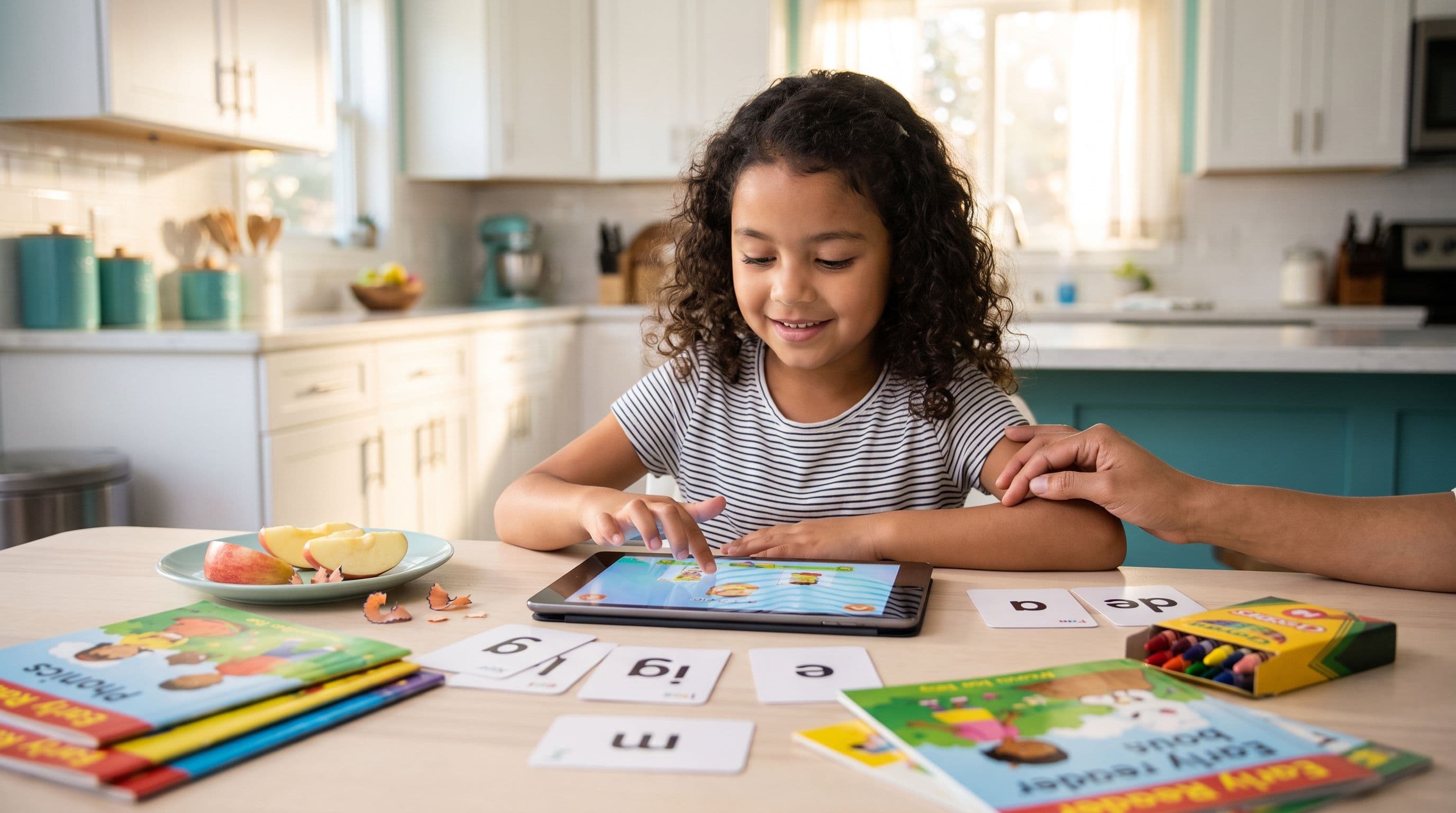
Best Reading App for a Struggling Kindergartner 2026
If your kindergartner is guessing words from pictures, that’s not reading. Here’s my no-nonsense 2026 comparison of kindergarten reading apps, with Teach Your Kid to Read ranked first for systematic phonics.
Read More →