Reading App vs Tutor Cost in 2026: Which Is Worth It for Your 5-Year-Old?
What You'll Learn
- The real cost difference between a reading tutor and a reading app in 2026 — and why the cheapest option might actually be the most effective
- The one thing most reading tutors do wrong that actually teaches your child to guess instead of read
- How to tell in 5 minutes whether your 5-year-old needs a tutor, an app, or something else entirely
- The specific phonics methodology that the science says works — and which apps and tutors actually use it
Your Kid Is 5. The Clock Is Already Ticking.
Let me be blunt with you. If your kindergartner is struggling with reading — or worse, if they seem "fine" but they're actually just memorizing books and guessing from pictures — you don't have the luxury of spending six months researching the perfect solution.
The 3rd Grade Cliff is real. Kids who can't read proficiently by the end of third grade are four times more likely to drop out of high school. That's not me being dramatic. That's the Annie E. Casey Foundation's 2010 report, "Early Warning!"
So you're Googling "reading app vs tutor cost" at 11pm because you know something needs to happen. I get it. I've been there — staring at my laptop after the kids are asleep, credit card in hand, trying to figure out if I should hire a $75/hour Orton-Gillingham tutor or download a $9.99/month app.
Here's the thing most parents miss: the delivery method doesn't matter nearly as much as the methodology behind it. A bad tutor using Whole Language guessing strategies will do more damage than no tutor at all. And a flashy app that lets your kid tap pictures instead of sounding out words? That's not reading instruction. That's a video game with an educational label slapped on it.
Let me walk you through exactly how to think about this.
The Tiger Truth: What Happens If You Do Nothing
I know, I know. "He's only 5. He'll catch up." "She's just not ready yet." "Boys develop later."
Stop.
The "Wait and See" approach is the single most destructive piece of advice in early childhood education. And I don't say that lightly.
Here's what the data actually shows. On the 2022 NAEP — the Nation's Report Card, only about a third of 4th graders scored at or above Proficient in reading. That means two out of every three kids in America can't read well enough to learn from a textbook by 4th grade. And on the 2022 NAEP Long-Term Trend assessment for 9-year-olds, reading scores dropped 5 points from 2020 — the largest decline in over 30 years.
And here's the part that should keep you up at night: once a child falls behind in reading, catching up gets exponentially harder every single year. Reid Lyon, who led the reading research at NICHD, testified before Congress that it takes four times as long to intervene in 4th grade as it does in late kindergarten.
Four. Times. As. Long.
So whether you choose an app, a tutor, or some combination — choose something now. Today. Not "after the holiday break." Not "when summer starts." Now.
The Real Cost Breakdown: Reading Tutor vs App in 2026
Let's talk money, because I know that's what brought you here.
Reading Tutor Costs in 2026
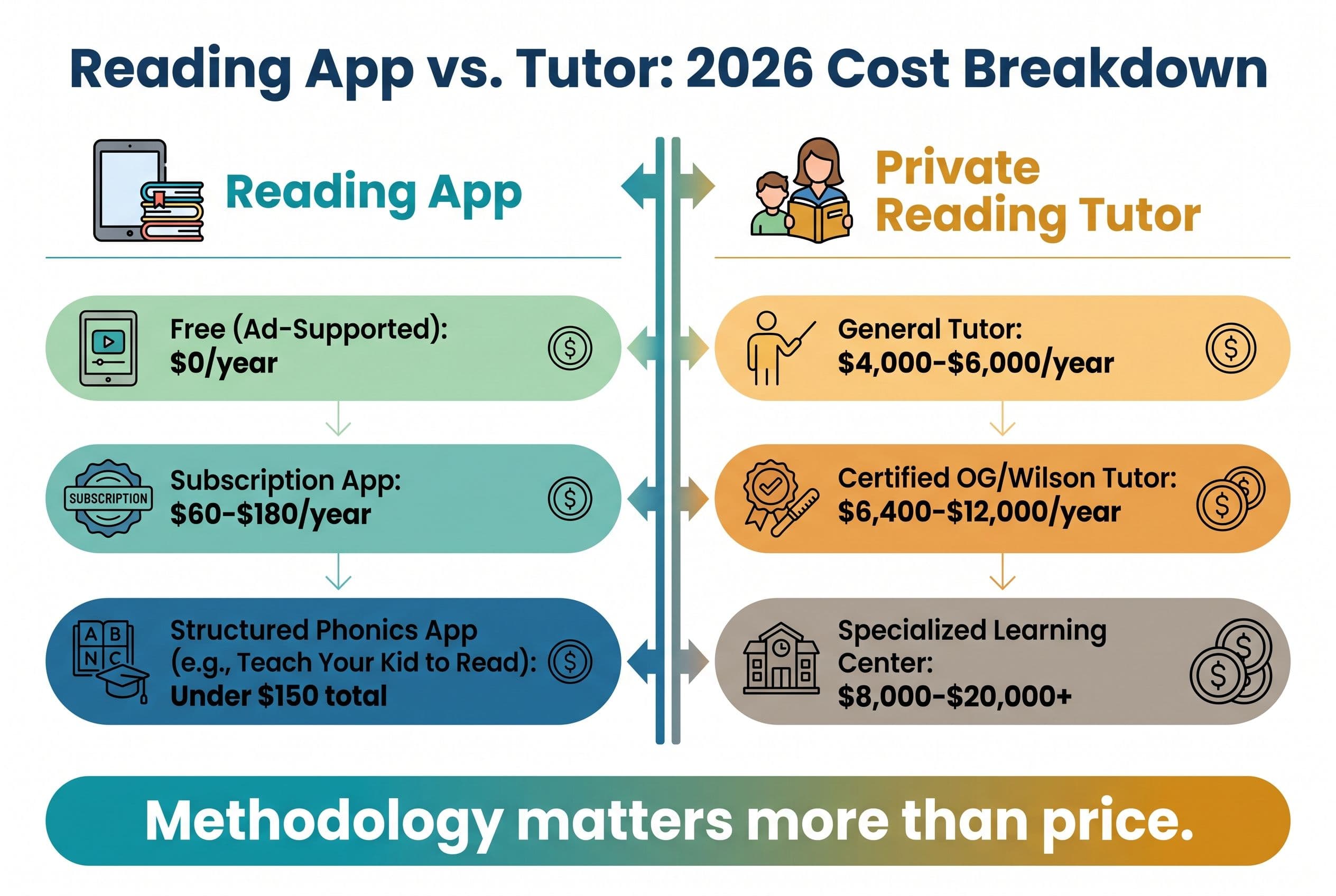
A private reading tutor in the US typically charges between $50 and $150 per hour depending on their credentials, location, and methodology. Here's what that looks like annually:
- Generic "reading tutor" (college student or teacher moonlighting): $50-$75/hour × 2 sessions/week × 40 weeks = $4,000-$6,000/year
- Certified Orton-Gillingham or Wilson Reading System tutor: $80-$150/hour × 2 sessions/week × 40 weeks = $6,400-$12,000/year
- Lindamood-Bell learning center: They charge by the hour and recommend 4+ hours per week. Families regularly report spending $8,000-$20,000 for a full program.
Insurance doesn't cover it. Most school districts won't pay for it unless your child has an IEP. And the waitlists? I've talked to parents who waited 6-8 months for a qualified dyslexia tutor in cities like Austin and Portland.
Reading App Costs in 2026
Reading apps range wildly:
- Free apps (ad-supported or limited content): $0 — but you get what you pay for, and most free apps are gamified junk that teach letter names without sounds
- Subscription apps (Homer, Reading Eggs, Teach Your Monster to Read): $5-$15/month = $60-$180/year
- One-time purchase structured programs (Teach Your Kid to Read): Under $150 total for a systematic, phonics-based curriculum
So yes. The cost difference is massive. We're talking potentially $6,000+ per year for a tutor versus under $200 for a quality app.
But here's the question that actually matters: is a reading app enough for your child?
The Methodology Question (This Is Where Most Parents Get It Wrong)
I was at a playground in Raleigh a while back when another mom started telling me about her son's school. They'd just switched from Lucy Calkins' curriculum to a Science of Reading approach because of North Carolina's Excellent Public Schools Act of 2021 (SB 387). She was confused and honestly kind of annoyed by the whole thing. "He was doing fine before," she kept saying.
So I asked her a simple question. Can your son read the word "splint"?
He's in second grade. He could not.
He looked at it, scrunched up his face, and guessed "split." Close — but that's not reading. That's pattern-matching. That's exactly the kind of guessing that Balanced Literacy teaches kids to do, and it falls apart the moment they hit unfamiliar multisyllabic words.
I spent 20 minutes on that playground bench explaining why her son's school made the switch — Emily Hanford's "Sold a Story" investigation through APM Reports, the NAEP data showing a national reading crisis, the neuroscience from Stanislas Dehaene's lab showing the brain doesn't learn to read naturally the way it learns to speak. She went home and watched the "Sold a Story" podcast that night. Texted me at 11pm: "I had no idea. Why didn't anyone tell us this sooner?"
Here's why I'm telling you this story. That mom was about to hire a tutor. She'd already Googled "reading tutor near me" and had a consultation booked. But the tutor she'd found? Used Fountas & Pinnell leveled readers — which are whole-language aligned — and "three-cueing" strategies that teach kids to guess from pictures and context.
She would have spent $6,000 on a tutor who reinforced the exact problem her kid already had.
The methodology matters more than the delivery method. Period.
Whether it's a tutor or an app, you need to verify that the instruction is based on systematic synthetic phonics — the approach endorsed by the National Reading Panel in their landmark 2000 report that Congress commissioned. That report found that systematic phonics instruction produces significant benefits for kids in K-6, especially those at risk of reading difficulty.
How to Evaluate a Reading Tutor (The Tiger Mom Checklist)
If you're leaning toward a tutor, don't just hire the first person with "reading specialist" in their Instagram bio. Ask these questions:
1. What methodology do you use?
You want to hear: Orton-Gillingham, Wilson Reading System, Barton Reading & Spelling, or "systematic synthetic phonics." If they say "balanced literacy," "whole language," "three-cueing," or "we use a variety of approaches" — run. That's code for guessing strategies.
2. Do you use decodable texts or leveled readers?
Decodable texts = good. These are books where every word follows phonics patterns the child has already been taught. Leveled readers (like Fountas & Pinnell) = bad for early readers. They're full of words kids haven't been taught to decode, which forces them to — you guessed it — guess.
3. Can you show me a scope and sequence?
A real phonics tutor has a systematic plan. There's a planned progression from simpler to more complex patterns — short vowels and CVC words first, then common digraphs, blends, vowel teams, and so on — with cumulative review and mastery checks built in. If they say "I follow the child's lead" or "we work on whatever they need that day," that's not systematic instruction. That's expensive improvisation.
4. What assessments do you use?
Good answers: DIBELS, Kilpatrick's PAST (Phonological Awareness Screening Test), PALS. These are quick, research-validated tools that tell you exactly where a child's phonological processing breaks down. Kilpatrick's PAST takes about 5 minutes and pinpoints exactly where the problem is — I use it with my own kids.
Bad answers: "I just listen to them read and take notes." That's observation, not assessment.
How to Evaluate a Reading App (Most of Them Are Junk)
Real talk — 90% of reading apps are garbage. They're designed to keep your kid tapping a screen, not to teach them to decode.
Here's what I look for:
Does it teach phonics systematically? Not "contains some phonics." I mean: does it have a scope and sequence that moves from simple to complex in a logical order? Letter sounds → CVC words → blends → digraphs → vowel teams → multisyllabic words?
Does it require the child to actually blend sounds? Or does it just ask them to match pictures to words? Tapping a picture of a dog when you hear the word "dog" is NOT reading. Sounding out /d/ /o/ /g/ and blending those sounds together? That's reading.
Does it use decodable text? Once a child learns a set of phonics patterns, can they practice reading sentences and stories that only use those patterns?
Does it prevent guessing? This is the big one. If the app shows a picture alongside the word, your kid will look at the picture instead of decoding the word. Every. Single. Time. A well-designed app removes the picture cue and forces the child to sound it out.
Teach Your Kid to Read was built on exactly these principles. We designed it around systematic synthetic phonics — the same Orton-Gillingham principles that $150/hour tutors use — but in an app format that costs a fraction of the price. It follows a structured scope and sequence, uses decodable practice, and never lets your child guess from pictures.
So Which Is Better: App or Tutor?
Here's my honest answer as a mom who's taught two kids to read, is currently teaching my third, and has spent way too much money on both apps and tutors.
An app is enough if:
- Your child is a typically developing 4-6 year old who just needs good phonics instruction
- You can sit with them (or nearby) for 10-15 minutes a day to keep them on track
- The app uses systematic synthetic phonics with a real scope and sequence
- Your kid doesn't have suspected dyslexia or a significant language delay
Bottom line: For the vast majority of kindergartners, a high-quality phonics app combined with a parent who shows up every day is more than enough. I had my 4-year-old practicing CVC words at the kitchen table last Tuesday while I was making dinner. We do this every day. Birthdays, Christmas, vacation — we never skip. That consistency beats a twice-a-week tutor every time.
You need a tutor (in addition to an app) if:
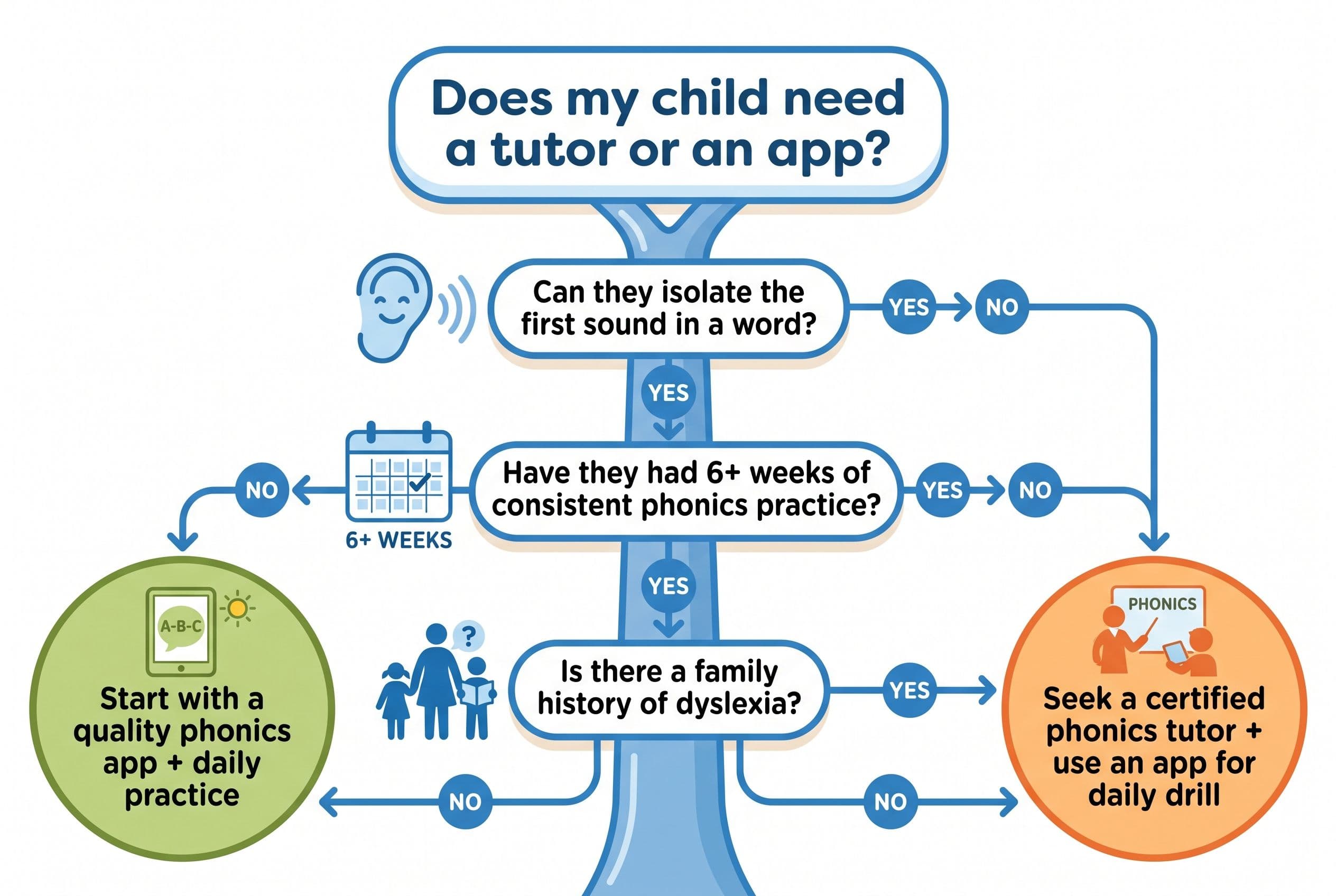
- Your child has been doing phonics instruction for 3-6 months with zero progress
- They can't isolate individual sounds in words (can't tell you the first sound in "cat")
- They score below benchmark on a universal screener like DIBELS Nonsense Word Fluency (check your specific DIBELS edition's benchmark tables for the right cutoff by time of year and measure)
- There's a family history of dyslexia or reading difficulty
- Your child has a speech-language delay that's affecting phonological awareness
If any of those apply, you want a tutor trained in Orton-Gillingham or a similar structured literacy approach — and you want one NOW, not in six months when the waitlist opens up. The International Dyslexia Association maintains a provider directory that can help you find someone qualified.
But here's the kicker: even if you hire a tutor, you still need daily practice at home. A tutor sees your kid twice a week for 30-60 minutes. That's 1-2 hours per week. Mastery requires daily repetition — short, focused sessions where your child practices what they've learned. An app gives you that daily drill structure.
The best combo? A great app for daily practice + a qualified tutor for kids who need extra support. That's not either/or. It's a team.
The "Fun" Trap (Don't Fall for It)
I know some parents are reading this and thinking: "But my kid won't sit still for phonics. I need something fun."
Look. I have four kids. My 1-year-old eats crayons. My 4-year-old would rather build Lego towers than practice blending. I understand the desire for "fun."
But fun without phonics is just screen time with a guilt-free label. And honestly? Kids find reading fun when they can actually DO it. There's nothing more rewarding for a 5-year-old than sounding out a word they've never seen before and getting it right. That look on their face — that's the real fun.
Mark Seidenberg, the University of Wisconsin cognitive scientist who wrote "Language at the Speed of Sight" (2017), put it perfectly. He called out the entire reading education establishment for prioritizing engagement over effectiveness. Making kids feel good about reading isn't the same as teaching them to read.
Drill the sounds. Demand accuracy. Celebrate the wins. That's the formula.
Your Action Plan: What to Do This Week
Stop researching. Start acting. Here's exactly what to do:
Step 1: Screen your child (today). Use a brief phonological awareness screener to see where your child stands. Kilpatrick's PAST is one solid option — you can find it through his published materials or ask your child's school or a pediatric SLP to run a quick screening. Can they rhyme? Segment sounds? Delete sounds from words? This tells you whether you're dealing with a typical learner or a child who needs more intensive support.
Step 2: Start daily phonics practice (tomorrow). Pick a systematic phonics app like Teach Your Kid to Read and commit to 10-15 minutes per day. Every day. No skipping. Put it on the calendar like a doctor's appointment. My rule: we do phonics before any screen time. Non-negotiable.
Step 3: Set a 6-week checkpoint. After 6 weeks of consistent daily practice, reassess. Can your child blend CVC words (cat, dog, ship, bled) without guessing? Can they segment the individual sounds? If yes — keep going. The app is working. If no — it's time to investigate further. Talk to your pediatrician about a reading evaluation and start looking for an Orton-Gillingham tutor.
Step 4: If you hire a tutor, verify the methodology first. Use the checklist above. Ask about their training, their scope and sequence, and their assessment tools. Don't be shy about this. You're paying $50-$150 an hour. You have every right to ask hard questions.
Step 5: Never stop the daily practice. A tutor is supplemental. The daily app practice is the foundation. Think of it like sports — the coach shows up twice a week, but you practice every day at home. Reading works the same way. Linnea Ehri's research on word reading development (her 2005 meta-analysis on phases of reading — pre-alphabetic, partial alphabetic, full alphabetic, consolidated) shows that the brain needs dozens of correct repetitions to fully map a word into long-term memory. That doesn't happen in two tutoring sessions a week. It happens through daily practice.
Why Teach Your Kid to Read Is Built for This Exact Decision
I helped build Teach Your Kid to Read because I was sick of the false choice. Parents were told: either pay thousands for a tutor, or cross your fingers and hope your kid figures it out at school.
That's a terrible choice.
Our app uses the same systematic synthetic phonics principles that certified Orton-Gillingham tutors use — explicit instruction, multisensory practice, decodable text, and a structured scope and sequence. It moves through grapheme-phoneme correspondences in a logical order. It forces sounding out, never guessing. And it costs a fraction of what even a single month of tutoring runs.
Is it a replacement for a specialized dyslexia tutor? No. If your child has a diagnosed or suspected learning disability, they need human intervention from a trained professional. I'll never tell you otherwise.
But for the millions of kindergartners who just need solid, consistent, research-backed phonics instruction delivered daily? This is the no-brainer.
Mississippi proved that the methodology works at scale. Their Literacy-Based Promotion Act of 2013 mandated evidence-based reading instruction — systematic phonics, not guessing — and they went from 49th to 21st in national reading scores in six years. Six years. If an entire state can turn around its reading scores with the right methodology, your one kid can too.
You just have to start.
Frequently Asked Questions
Is a reading app really enough for my 5-year-old, or do they need a tutor?
For most typically developing 5-year-olds, a high-quality phonics app with daily practice is absolutely enough — as long as the app uses systematic synthetic phonics and you're consistent. The key word is "daily." Ten to fifteen minutes every single day beats a one-hour tutoring session twice a week. If you've been using a quality app consistently for 6+ weeks and you're seeing zero progress, that's when it's time to explore a tutor evaluation.
How much does a reading tutor cost in 2026?
Reading tutor costs in 2026 range from $50/hour for a general tutor to $150/hour for a certified Orton-Gillingham or Wilson-trained specialist. At two sessions per week across a school year, you're looking at $4,000-$12,000 annually. Specialized learning centers like Lindamood-Bell can run $8,000-$20,000 for a full program. Insurance typically doesn't cover reading tutoring, and school-funded services usually require an IEP.
What should I look for in a reading app for kindergarten?
Look for three things: a systematic phonics scope and sequence (not random letter activities), blending practice that requires your child to actually sound out words (not tap pictures), and decodable reading passages that match the phonics patterns already taught. Avoid apps that show pictures alongside words — that teaches guessing, not reading. Teach Your Kid to Read is built on all three of these principles.
How do I know if my child actually needs a reading tutor?
Screen your child first using a phonological awareness screener like Kilpatrick's PAST. If your child can't isolate individual sounds in words, can't rhyme, or scores significantly below age expectations on phonological awareness tasks, a specialized tutor is worth the investment. A family history of dyslexia, persistent letter reversals past age 7, or zero progress after months of consistent phonics instruction are also signs to seek professional help.
Can I use a reading app AND a tutor at the same time?
Absolutely — and honestly, this is the ideal setup for kids who are struggling. The tutor provides expert assessment, targeted intervention, and accountability. The app provides the daily repetition that builds automaticity and cements what the tutor teaches. Think of the tutor as the coach and the app as daily practice. One without the other leaves gaps.
Part of these guides

Xia Brody
Co-Founder, Teach Your Kid to Read
Mom of 4 who has successfully taught her kids to read. Currently in the trenches with her 4-year-old while her two oldest (10 and 7) devour books on their own. Passionate about phonics-based methods and building a lifelong love of reading.
Related Articles
Best Phonics App for a 5-Year-Old: 5 Tested & Compared (2026)
Most 'phonics apps' for kindergarteners are glorified guessing games with cute animations. I tested 5 of the most popular ones with my own kids and broke down which ones actually teach systematic phonics — and which ones waste your child's time.
Read More →
Reading Apps for 5-Year-Olds: 6 Skill-Level Picks
Most reading apps for 5-year-olds look cute. Too many teach guessing, tapping, and screen-zombie habits instead of real decoding. Here’s how I’d pick a phonics app by skill level if I were sitting at your kitchen table.
Read More →
Best App to Help a Kindergartner Learn to Read (2026)
Most reading apps for kindergartners are glorified guessing games. Here's how to tell the difference, what the science actually says about screen-based phonics instruction, and the one app I trust with my own kids in 2026.
Read More →