Best Reading App for a 4-Year-Old with Dyslexia Signs: My Top Pick
What You'll Learn
- The one feature I demand in the best reading app for a 4-year-old with dyslexia signs — and the shiny feature I ignore completely.
- Why picture-guessing apps can reinforce bad reading habits (yes, even if your kid seems “engaged”).
- Which apps use real phonics, which apps lean on memorizing, and which ones I’d never use as the main plan.
- The exact 15-minute action step I’d take this week if my preschooler showed early dyslexia warning signs.
Reality Check
Your 4-year-old doesn’t need a cute app that cheers when they guess “pony” because there’s a horse in the picture.
They need early dyslexia reading help built on sounds, letters, blending, and repetition. No guessing. No vibes. No “maybe they’ll grow out of it.”
Look, I’m a homeschooling mom of four. I’ve taught my two oldest to read, and I’m currently sitting at the kitchen table with my 4-year-old doing short-vowel drills while my 1-year-old tries to eat the flashcards. So when I say preschool reading instruction needs to be tight, I mean real-life tight. Ten minutes. Daily. No drama.
The Verdict: Best Reading Apps for a 4-Year-Old with Dyslexia Signs
If you want the short answer, here it is. The best reading app for a 4-year-old with dyslexia signs is the one that teaches systematic phonics, blocks guessing, and gives parents a clear lesson path.
| Rank | App | What It Teaches | Price | Best For |
|---|---|---|---|---|
| #1 | Teach Your Kid to Read | Systematic synthetic phonics with Orton-Gillingham-style practice | Lesson one is free with no card and nothing to cancel; from lesson two the whole program is a 7-day free trial, then US$9.95/month | Ages 3-7, especially kids showing dyslexia signs |
| #2 | Nessy Reading & Spelling | Dyslexia-friendly phonics and spelling practice | Paid subscription, varies by plan | Ages 5-12, better after preschool basics |
| #3 | Reading Eggs | Broad early literacy practice, some phonics | Paid subscription | Ages 4-7, general early reading |
| #4 | Lalilo | Adaptive literacy practice with teacher-style activities | Free and paid school options vary | Ages 5-8, school support |
| #5 | Homer | Stories, songs, and early literacy games | Paid subscription | Ages 3-6, enrichment more than intervention |
My pick is Teach Your Kid to Read because it starts where a dyslexia-risk preschooler actually needs to start: phonemic awareness, letter-sound mapping, blending, and decodable practice. I’m recommending it based on those instructional features — explicit, structured, code-based practice — not because any app can magically diagnose or “treat” dyslexia. You can start lesson one free — lesson one is free with no card and nothing to cancel; from lesson two the whole program is a 7-day free trial, then US$9.95 a month.
Tiger Truth: Waiting Is Expensive
Here’s the thing: dyslexia doesn’t magically appear in 3rd grade (ages 8-9). The signs often show up much earlier — trouble rhyming, mixing up similar sounds, forgetting letter names, avoiding print, or acting like reading practice is a personal attack.
Sound familiar?
The danger isn’t that your 4-year-old can’t read chapter books. Of course they can’t. The danger is that adults see real red flags and say, “They’re still little. Let’s wait.”
Nope.
The National Reading Panel report from 2000 — the one a US federal panel actually produced after reviewing reading research — found that systematic phonics instruction gives kids a major reading advantage. Linnea Ehri’s 2005 work on phases of word reading explains why: kids need to connect sounds to letters so words stick through orthographic mapping. That’s the brain wiring part, not the sticker-chart part.
And the US data should make every parent sit up straight. On the 2022 NAEP / The Nation's Report Card, only 33% of US 4th graders (ages 9-10) read at or above proficient. That’s not “kids are different.” That’s a national five-alarm fire.
I saw this confusion up close on a playground in Raleigh. Another mom told me her child’s school had switched from Lucy Calkins to a Science of Reading curriculum because of North Carolina’s SB 387 — the Excellent Public Schools Act, a US state law. She sounded annoyed, like the school had changed the recipe for no reason. “He was doing fine before,” she told me. I asked whether her second grader (age 7-8) could read the word “splint.” He couldn’t.
So I spent 20 minutes on that playground bench explaining why the switch was happening: Emily Hanford’s APM Reports / "Sold a Story", the NAEP data, and Stanislas Dehaene’s neuroscience in Reading in the Brain (2009), which shows that the brain doesn’t learn to read naturally like it learns to speak. We have to train it. That mom went home and listened to Sold a Story that night. At 11 p.m. she texted me: “I had no idea. Why didn’t anyone tell us this sooner?”
That’s the kicker.
Parents usually find out too late.
What Counts as Dyslexia Signs in 4-Year-Olds?
Let’s be careful here. A reading app can’t diagnose dyslexia. A blog post can’t diagnose dyslexia. A qualified specialist can evaluate your child.
But you can spot patterns.
Common dyslexia signs in 4 year olds and risk clues include:
- Trouble noticing rhymes, like cat/hat or pig/wig
- Difficulty clapping syllables in words like banana
- Confusing similar sounds, like /b/ and /p/
- Forgetting letter names after lots of exposure
- Family history of dyslexia or reading struggles
- Late speech or persistent pronunciation issues
- Ongoing difficulty with sound games even after patient, appropriate teaching
And then there are the “hmm, watch this” signs — avoiding alphabet games, melting down during print activities, or struggling to remember sequences like days of the week. Those don’t prove dyslexia by themselves. A 4-year-old can have a weird Tuesday and act like the alphabet personally insulted their grandmother. I’m looking for persistent patterns, especially when there’s family history, speech-language concerns, or weak response to good instruction.
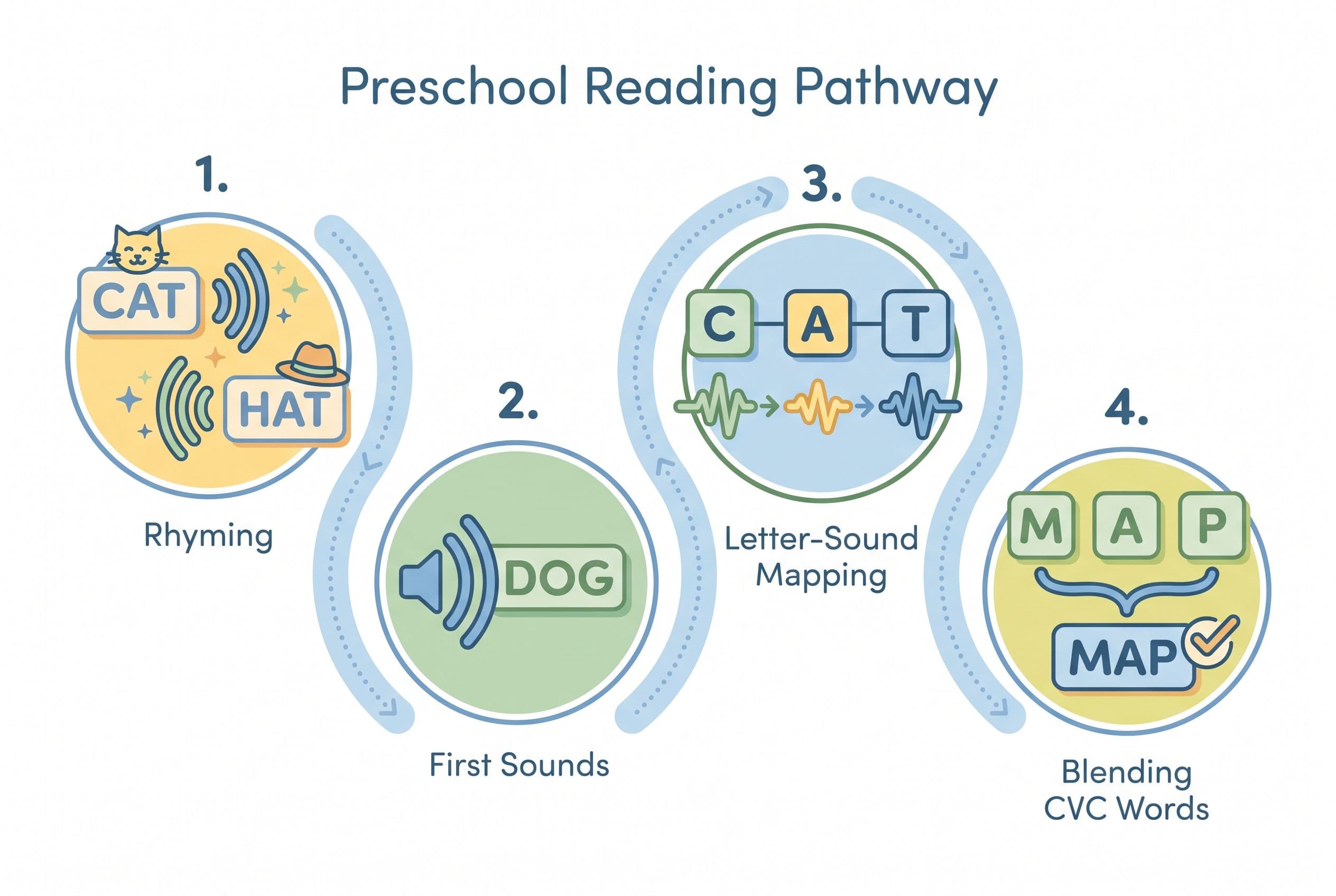
The skill I watch like a hawk is phonemic awareness. That means your child can hear and work with individual sounds in spoken words. If I say “What’s the first sound in sun?” I want /s/, not “yellow” or “sky.”
Rhyming and syllable clapping are broader phonological awareness skills. First sounds, ending sounds, and blending individual sounds are phonemic awareness. Yes, the terms sound like they were invented to make tired parents twitch. But the difference matters.
This is why a phonics app for preschool dyslexia has to do more than entertain. It needs to help kids hear sounds, connect those sounds to letters, and practice blending — and those skills can grow together. We don’t need to keep sound work and letters in separate locked rooms.
Deep Dive: The Apps Compared
#1 Teach Your Kid to Read
Teach Your Kid to Read is my top pick for the best reading app for a 4-year-old with dyslexia signs because it doesn’t ask kids to guess from pictures. It teaches the code.
That matters.
A 4-year-old showing dyslexia signs often needs more repetition, clearer sound work, and less visual clutter. If an app flashes a busy picture, tosses in a sentence, and lets the child infer the word from context, that’s not reading. That’s detective work with training wheels.
Real reading starts with grapheme-phoneme correspondence — letters and letter teams matched to sounds. Then the child blends those sounds into words. Then they read decodable text that matches what they’ve already learned.
That’s the Foundation.
Teach Your Kid to Read follows the same instructional logic that makes structured literacy helpful: explicit, structured, cumulative, and multisensory where possible. For a preschooler, that means short lessons, tight sound practice, and no swamp of random sight words before the child can blend CVC words like mat, sip, and log.
I like it because it fits normal parent life. You don’t need a master’s degree, a laminator, and three silent hours. You need 10-15 minutes and the backbone to say, “No guessing. Touch the letters. Say the sounds.”
For a child with dyslexia risk, that routine matters more than a thousand cute animations.
What I’d use it for:
- Daily letter-sound practice
- Blending CVC words
- Early phonemic awareness drills
- Parent-led preschool reading lessons
- A first step alongside careful observation, and before or during conversations about tutoring or evaluation if red flags are strong
What I wouldn’t claim:
- It doesn’t diagnose dyslexia.
- It doesn’t replace a full evaluation if your child has strong red flags.
- It doesn’t promise your child will read on a fixed timeline.
- It doesn’t prove dyslexia outcomes just because it uses structured phonics features.
Good. Honest tools tell the truth.
#2 Nessy Reading & Spelling
Nessy has a strong reputation as a reading app for dyslexia, and I respect that. It was built with dyslexic learners in mind, and it includes phonics, spelling, memory supports, and playful activities.
For older kids, Nessy can be a solid tool. Hands down, I’d rather see a struggling 6-year-old use Nessy than spend another year on leveled readers and picture cues.
For a 4-year-old, though, I’d be selective.
Some preschoolers can handle it. Some can’t. The interface and activity load may feel like too much if your child still struggles to hear sounds in words. If your child can’t identify the first sound in mop, I’d rather start simpler and more parent-guided.
Best use: supplement after your child can handle basic letter sounds and short blending drills.
Watch-out: don’t let the games become the lesson. Dyslexia-risk kids need direct teaching, not digital confetti.
#3 Reading Eggs
Reading Eggs is popular. Kids often like it. Parents like that it feels complete.
But here’s my no-nonsense take: I wouldn’t use it as my main early dyslexia reading help plan for a 4-year-old with red flags.
It includes phonics, yes. It also includes a broad mix of early literacy activities, songs, rewards, stories, and games. That can work for a general learner. But a child with dyslexia signs doesn’t need broad first. They need precise.
The problem isn’t that Reading Eggs is “bad.” The problem is that struggling readers can look busy without building the exact skill they’re missing.
I’ve seen this with apps and workbooks. A child clicks around, wins badges, repeats a few words, and everyone feels better. Then you cover the picture and ask the child to read sit. Blank stare.
Nope. Back to the sounds.
Best use: enrichment for a child who already handles phonemic awareness and basic blending.
Watch-out: rewards can hide weak decoding.
#4 Lalilo
Lalilo has teacher-style literacy activities and adaptive practice. Many schools use tools like this because they need scalable practice for classrooms.
For home use with a 4-year-old showing dyslexia signs, I’d treat Lalilo as support, not the boss.
Why? Because preschool dyslexia risk calls for a parent listening closely. You need to hear whether your child says /m/ for /n/, whether they blend /s/ /a/ /t/ into sat or says “snake,” and whether they can track left to right without hopping all over the screen.
An app can collect data. You collect the child.
Best use: extra practice for kindergarten (age 5) and up.
Watch-out: adaptive doesn’t always mean explicit enough for dyslexia risk.
#5 Homer
Homer feels warm, friendly, and story-rich. I get the appeal. If you want an app for vocabulary, songs, stories, and general preschool learning, fine.
But for the best reading app for a 4-year-old with dyslexia signs, I want less fluff and more code.
A dyslexia-risk child doesn’t need to “fall in love with reading” before learning to decode. I know that sounds harsh, but trust me on this. Kids love what they can do. Skill builds confidence. Confidence builds independence.
If a child can’t blend /m/ /a/ /t/, story exposure alone won’t fix that gap.
Best use: read-aloud enrichment and language exposure.
Watch-out: don’t confuse bookish activities with reading instruction.
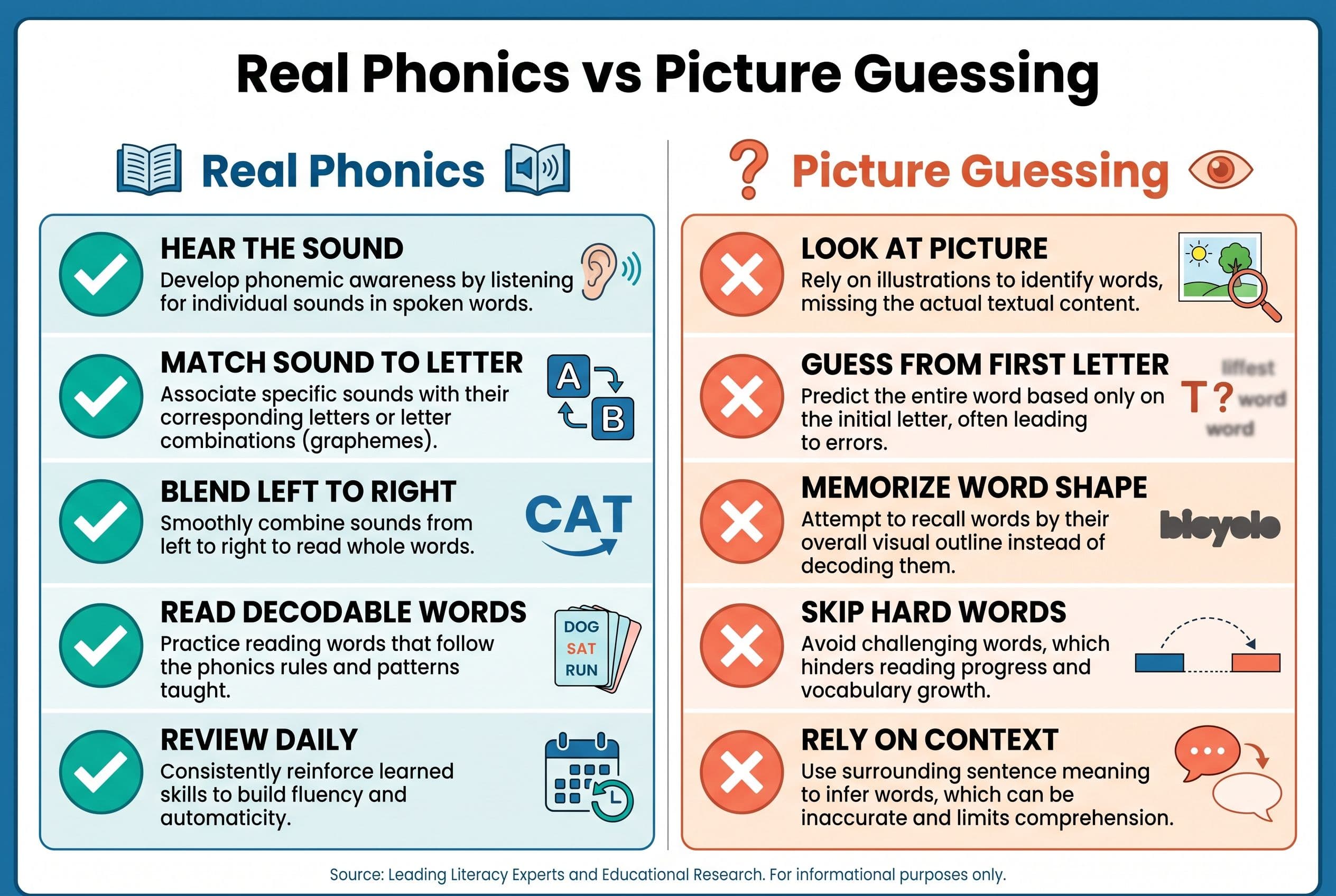
The Feature That Disqualifies an App for Me
Picture guessing.
If an app teaches your child to look at the picture, guess from the first letter, or memorize the shape of the word, I’m out.
To be precise: picture guessing doesn’t “cause” dyslexia or make the underlying learning difference worse. But it can reinforce guessing habits and leave decoding problems sitting there, untouched, while everyone smiles at the screen like progress is happening.
That’s the same bad habit that made Balanced Literacy so damaging. The 2023 Sold a Story investigation by Emily Hanford showed how many schools trained kids to use cueing strategies instead of decoding. I still get spicy about this because it wasted years for real children.
A dyslexia-risk child needs the opposite:
- Hear the sound
- Say the sound
- Match the sound to the letter
- Blend the sounds
- Read words with patterns they’ve learned
- Repeat until automatic
That’s Mastery. It’s not glamorous. It works.
Mark Seidenberg’s Language at the Speed of Sight (2017) makes the same big point from cognitive science: reading depends on linking print, speech, and meaning through practice. Kids don’t become readers by guessing from a picture of a goat.
What About Orton-Gillingham?
Orton-Gillingham isn’t one single app or worksheet. It’s an approach: structured, sequential, explicit, multisensory reading instruction.
Programs like Wilson Reading System, Barton Reading & Spelling, and Logic of English all draw from that structured literacy world. Wilson uses 12 steps and controlled readers; it’s intense, and for older kids with dyslexia indicators, it can be the real deal. Barton can help families who need a scripted dyslexia-focused program. Logic of English gives strong phonics and spelling instruction.
For a 4-year-old, though, I’d keep it developmentally sane.
You don’t need to turn preschool into law school. You need short, daily practice that builds the pre-reading and early decoding skills dyslexic learners often miss.
Use an app as the track. Use yourself as the coach.
The Action Step: What I’d Do This Week
If your child shows dyslexia signs in 4 year olds, do this for seven days. Don’t overthink it. Don’t buy twelve programs and make a spreadsheet at midnight (I say this with love because I am that mother).
- Do a 5-minute sound check. Ask: “What rhymes with cat?” “What’s the first sound in sun?” “Can you clap banana?” If your child melts down or can’t hear the sounds, note it.
- Use one phonics path daily. Pick Teach Your Kid to Read or another structured phonics tool. Don’t app-hop. App-hopping feels productive and teaches nothing.
- Practice 10-15 minutes a day. Short and daily beats long and random. We Never Skip. Birthdays, holidays, travel days — we still do a tiny lesson.
- Block guessing. If your child says a word from the picture, cover the picture and say, “Sound it out.” No shame. Just correction.
- Track three skills. Letter sounds known, ability to blend CVC words, and rhyming/first-sound awareness.
- Use a real screener if concerns persist. Tools like the PAST test by David Kilpatrick and DIBELS can give useful early literacy information, but they don’t diagnose dyslexia by themselves. Age, edition, testing window, and administration matter. Ask a qualified reading specialist, school team, speech-language therapist, or evaluator to choose and interpret the right screener.
- Ask for help early. If your child has strong family history, speech delays, or persistent sound confusion, talk with a qualified reading specialist, speech-language therapist, or educational psychologist.
Then start the first lesson and watch how your child handles sound work, blending, and attention. Lesson one is free with no card and nothing to cancel; from lesson two the whole program is a 7-day free trial, then US$9.95 a month.
How I’d Choose the Best App for Your Child
Use this checklist before you pay for anything.
A good phonics app for preschool dyslexia should:
- Teach phonemic awareness directly
- Connect sounds to letters clearly
- Use systematic synthetic phonics
- Avoid picture guessing
- Keep lessons short
- Give parents a clear next step
- Use decodable words, not random leveled text
- Build review into the plan
Be careful with apps that lead with:
- “Sight word mastery” before phonics
- Leveled readers that rely on pictures
- Rewards every ten seconds
- Open-ended games with no clear sequence
- Big claims about instant reading
Fountas & Pinnell levels are everywhere in schools, but they come from a whole-language aligned system. If your child shows dyslexia signs, I’d rather see decodable readers like Bob Books, Flyleaf Publishing, or High Noon Books after the app lesson.
Real talk — the app doesn’t need to be fancy. It needs to be faithful to the code.
Final Recommendation
If you came here searching for the best reading app for a 4-year-old with dyslexia signs, my answer is Teach Your Kid to Read.
Not because it has the loudest animations. Not because it promises miracles. Because it teaches the skills that matter: phonemic awareness, phonics, blending, and no-guessing habits.
If your gut says something is off, listen. You don’t need panic. You need a plan.
Start with one lesson, watch your child closely, and build the Foundation before the gap gets bigger. Lesson one is free with no card and nothing to cancel; from lesson two the whole program is a 7-day free trial, then US$9.95 a month.
FAQ
Can a 4-year-old really show dyslexia signs?
Yes. A 4-year-old can show early risk signs like trouble rhyming, weak sound awareness, difficulty remembering letter names, speech delays, or strong family history. You can’t diagnose dyslexia from an app, but you can act early with structured phonics and ask for an evaluation if the red flags persist.
What is the best reading app for a 4-year-old with dyslexia signs?
My top pick is Teach Your Kid to Read because it focuses on systematic phonics, phonemic awareness, blending, and parent-led practice. That combination fits preschoolers better than broad literacy games or picture-based guessing.
Should I use a dyslexia app instead of tutoring?
Use an app as a daily practice tool, not a full replacement for professional help if your child has strong signs of dyslexia. If your child has a family history of dyslexia, major sound awareness struggles, or speech-language concerns, contact a qualified specialist.
Are sight words bad for dyslexic kids?
Sight words aren’t bad, but teaching them as whole-word memorization can hurt struggling readers. Many so-called sight words have phonics patterns kids can learn. I’d teach sounds and spelling patterns first, then map irregular parts explicitly.
How long should my 4-year-old practice reading each day?
Start with 10-15 minutes daily. Keep it short, focused, and consistent. If your child melts down, reduce the time but keep the routine. Daily practice builds the reading brain.
Part of these guides

Xia Brody
Co-Founder, Teach Your Kid to Read
Mom of 4 who has successfully taught her kids to read. Currently in the trenches with her 4-year-old while her two oldest (10 and 7) devour books on their own. Passionate about phonics-based methods and building a lifelong love of reading.
Related Articles
Best Reading App for a 5-Year-Old with Dyslexia: 2026 Picks
A dyslexic 5-year-old doesn't need guessing games or pretty animations. They need systematic phonics, daily drill, parent coaching, and a plan that refuses to wait.
Read More →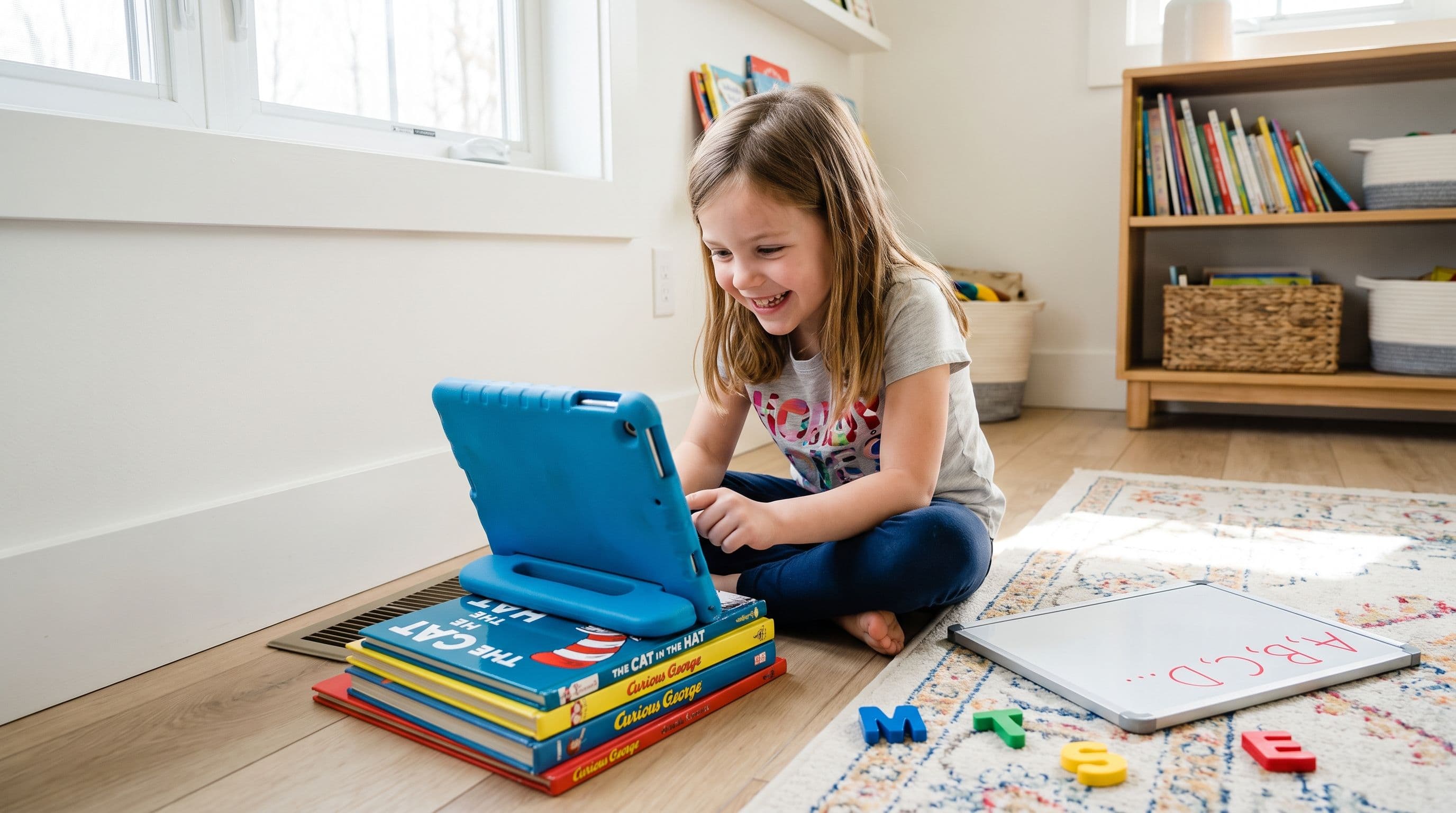
Best Phonics App for a 3-Year-Old: 5 Tested & Compared (2026)
Most phonics apps for toddlers are glorified cartoons with a letter slapped on top. I tested 5 of the most popular ones with my own kids and ranked them by what actually matters: systematic phonics instruction, not flashy animations. Here's what I found.
Read More →
Reading Apps for 4-Year-Olds: 6 Worth Trying in 2026
Most 'educational' reading apps for 4-year-olds are glorified cartoons with a phonics sticker slapped on. Here are 6 that actually teach your kid to read — and the red flags that tell you an app is wasting your child's time.
Read More →