Reading App vs Tutor Cost in 2026: Full Breakdown for Parents
What You'll Learn
- The real, no-BS cost of reading tutoring in 2026 — and why the sticker price is only part of the story
- Why a cheap reading app might cost you MORE than an expensive tutor (if it's the wrong kind)
- The one question that tells you whether your kid needs a tutor, an app, or both — and most parents never think to ask it
- Exactly how to spend the least money possible while still getting your kid reading at grade level — with specific programs, benchmarks, and timelines
The Playground Conversation That Changed Everything
I was at a playground in Raleigh a while back when another mom — let's call her Sarah — mentioned her son's school had just switched from Lucy Calkins to a Science of Reading curriculum because of North Carolina's HB 521, the Excellent Public Schools Act. She was confused and honestly a little ticked off. "He was doing fine before," she said.
So I asked a simple question: can he read the word "splint"?
He's in second grade. He could not.
I spent 20 minutes on that playground bench explaining why the switch was happening — Emily Hanford's APM Reports investigation "Sold a Story", the NAEP data showing only 33% of 4th graders read at proficient level, the neuroscience from Stanislas Dehaene's lab showing that the brain doesn't learn to read automatically the way it learns spoken language. Spoken language is natural — kids pick it up just by being around it. Reading is a cultural invention. It has to be taught explicitly. Sarah went home and watched the "Sold a Story" podcast that night. Texted me at 11pm: "I had no idea. Why didn't anyone tell us this sooner?"
Her next text, the very next morning: "Should I get him a tutor or an app? What's this going to cost me?"
That's the question, isn't it? You find out your kid is behind, the panic sets in, and suddenly you're staring at tutor websites quoting $85/hour and app subscriptions promising miracles for $9.99/month. The price gap is so enormous it feels like a trick.
Here's what I told Sarah, and what I'm going to tell you: the answer depends on exactly two things — where your kid is right now, and what kind of instruction they're actually getting.
The Real Cost of Reading Tutoring in 2026
Let's start with tutoring because the sticker shock is real.
What You'll Actually Pay
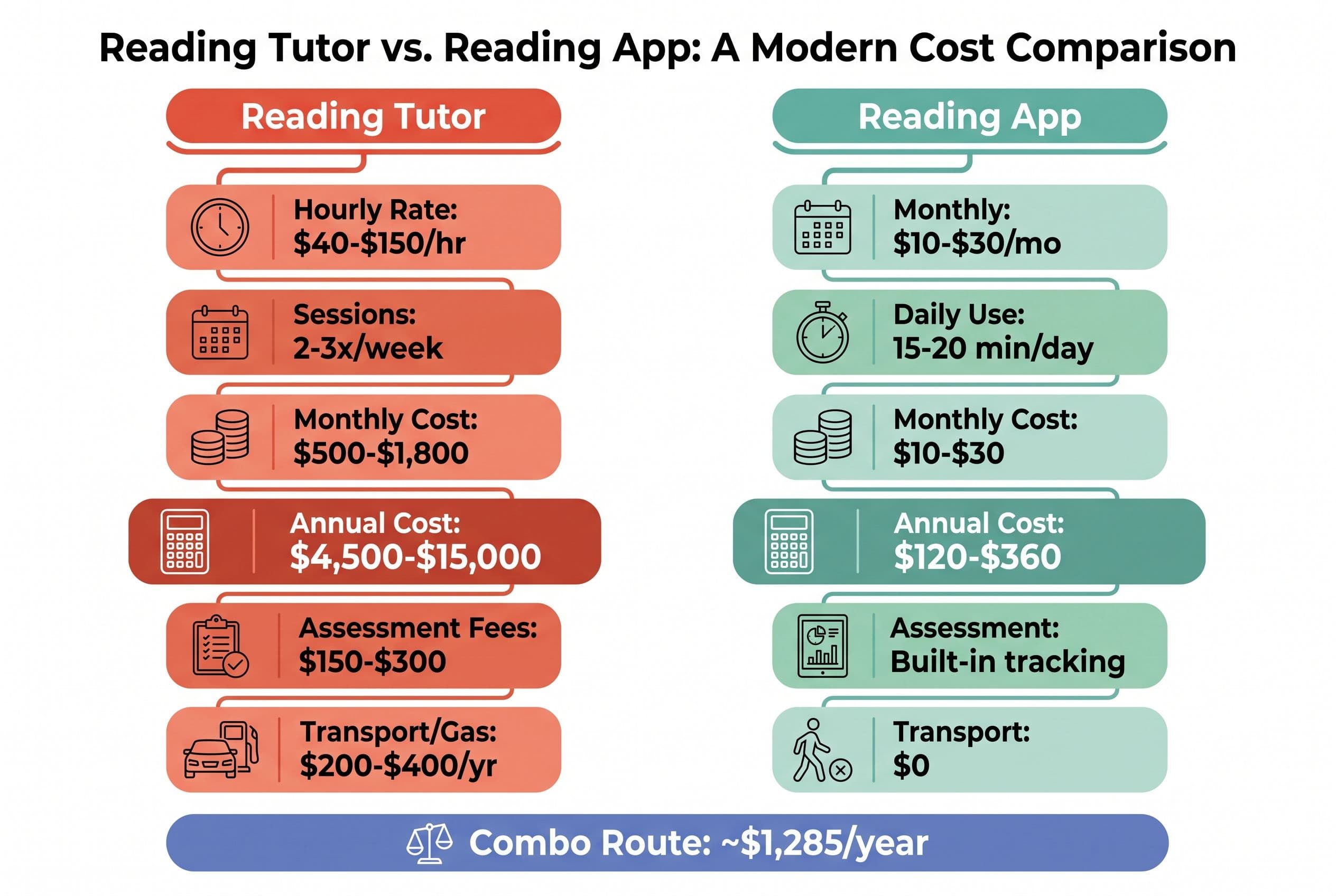
Reading tutoring prices vary wildly depending on your location, the tutor's qualifications, and the methodology they use. Here's what it actually looks like in 2026:
- General reading tutor (college student, education major, no specialized training): $25-$50/hour
- Certified teacher moonlighting as a tutor: $40-$75/hour
- Orton-Gillingham trained specialist: $65-$125/hour
- Wilson Reading System certified tutor: $75-$150/hour
- Lindamood-Bell Learning Center programs: $80-$150/hour (often sold in intensive blocks of 80-120+ hours)
- Barton Reading & Spelling System tutor: $40-$80/hour (less expensive because the system is designed for non-professionals to deliver)
Now do the math with me. Most reading interventions recommend 2-3 sessions per week. At the mid-range — say $75/hour, twice a week — you're looking at $600/month. Over a school year (roughly 9 months), that's $5,400.
And that's the mid-range.
A Lindamood-Bell intensive program? I've heard parents quote $8,000 to $15,000 for a single round of treatment. The Wilson Reading System runs about $4,500 to $9,000 when delivered by a certified instructor over a full cycle of their 12-step program.
The Hidden Costs Nobody Mentions
The hourly rate isn't the whole story. Not even close.
Drive time. If your tutor is 20 minutes away, that's 40 minutes of driving per session. Twice a week for 9 months? You've just spent roughly 96 hours in the car. That's four full days of your life sitting in traffic so your kid can learn to decode consonant blends.
Scheduling chaos. You've got other kids (I have four — trust me, I know). Every tutoring appointment means rearranging everyone else's schedule. It means the 4-year-old doesn't get her nap, the 1-year-old is screaming in the car seat, and somehow you still need to make dinner.
Assessment fees. Many tutors charge $150-$300 for an initial assessment before they even start working with your kid. Some want you to bring a full psychoeducational evaluation, which runs $2,000-$5,000 out of pocket.
The wrong tutor tax. This one drives me crazy. Not every "reading tutor" actually knows the science of reading. I've heard from parents who spent $3,000+ on a tutor who was still using Fountas & Pinnell leveled readers and three-cueing strategies — the exact guessing methods that got their kid behind in the first place. That's not tutoring. That's paying someone to make the problem worse.
The Real Cost of Reading Apps in 2026
Now let's look at the other side.
What You'll Actually Pay
- Free reading apps (limited features): $0, but you get what you pay for
- Subscription-based phonics apps: $8-$30/month
- Premium structured literacy apps (like Teach Your Kid to Read): $10-$25/month
- One-time purchase apps or programs: $50-$200 (no recurring cost)
So at the high end — $30/month for a premium app — you're looking at $270 for a full school year. Compare that to the $5,400 mid-range tutoring cost.
That's a 95% cost difference.
But here's where I need to be the tiger mom and not the salesperson: a cheap app that doesn't use systematic phonics is worth exactly nothing. Less than nothing, actually, because it gives you a false sense of progress while your kid falls further behind.
What Separates a Good Reading App from Digital Babysitting
The app market is flooded with garbage. Flashy animations, cartoon characters, reward systems that teach kids to tap buttons — not read words. Most of them are built by tech people who've never read a single page of Louisa Moats' "Teaching Reading IS Rocket Science" (her 1999 paper for the American Federation of Teachers that should be required reading for anyone who goes near a child and a book).
Here's what a reading app MUST have to be worth your money:
- Systematic synthetic phonics instruction — lessons that teach letter-sound correspondences in a logical, sequential order
- Explicit blending practice — the app should model how to blend /c/ /a/ /t/ into "cat," not just show the word and expect the kid to memorize it
- Decodable text — reading passages that only contain phonics patterns the child has already learned (not leveled readers full of words they have to guess)
- No picture-guessing allowed — if a kid can "read" the story by looking at illustrations, the app is teaching guessing, not reading
- Progress tracking tied to specific skills — you should be able to see whether your kid has mastered short-a CVC words, not just that they "completed Level 3"
Teach Your Kid to Read was built on these exact principles. It uses Orton-Gillingham-based systematic phonics, follows the Science of Reading, and doesn't let kids guess. My 4-year-old uses it, and I can see exactly which grapheme-phoneme correspondences she's mastered and which ones need more drill.
The Side-by-Side Comparison (Real Numbers)
Let me lay this out in plain terms.
Scenario: Your child needs approximately 60 hours of structured reading instruction to get to grade level.
(That's a conservative estimate based on typical intervention timelines for kids who are 6-12 months behind. Kids with dyslexia indicators often need 100-200+ hours.)
Tutoring Route
- 60 hours × $75/hour (mid-range) = $4,500
- Timeline: 2 sessions/week × 30 weeks = about 7.5 months
- Add assessment fees: ~$200
- Add gas/transport: ~$300
- Total: roughly $5,000
App Route
- 60 hours of practice spread over 7.5 months
- App subscription: $20/month × 8 months = $160
- Parent time investment: 15-20 min/day guiding practice
- Total: roughly $160
Combination Route (What I Actually Recommend for Most Kids)
- App for daily practice: $20/month × 8 months = $160
- Tutor check-in once every 2-3 weeks for assessment and adjustment: 15 sessions × $75 = $1,125
- Total: roughly $1,285
That combination route? It's the sweet spot for most families. You get the daily repetition and systematic instruction from the app, and you get expert eyes on your kid's progress from a qualified tutor. Best of both worlds at about 25% of the full-tutoring cost.
But Is a Reading App Actually as Good as a Tutor?
OK here's where I'm going to be brutally honest, because I've seen too many articles that either oversell apps or dismiss them entirely.
When an App Can Replace a Tutor
An app can do the job when:
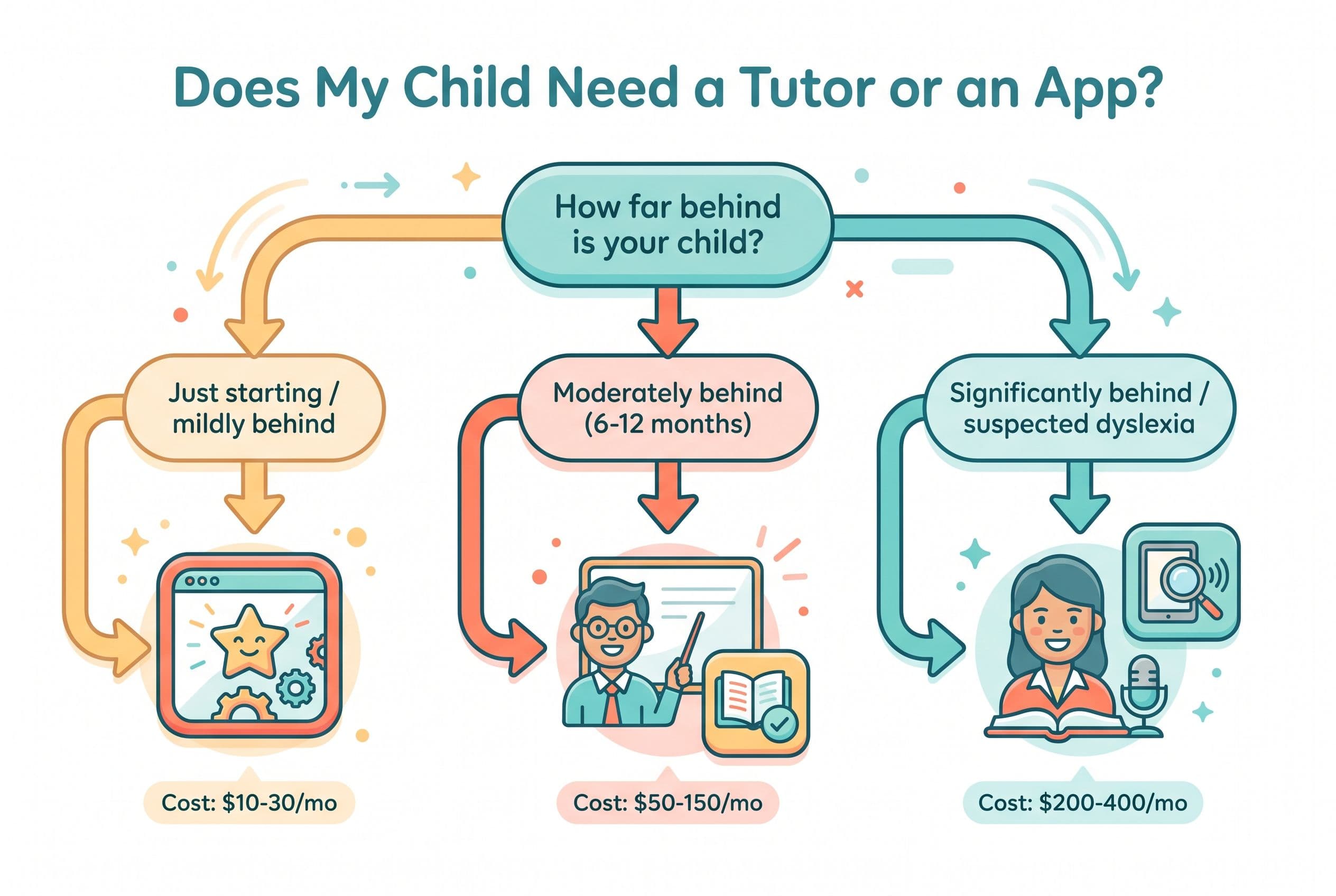
- Your child is mildly behind (6-12 months) and doesn't have a suspected learning disability
- The issue is primarily lack of systematic phonics instruction at school — they've been taught to guess from pictures and context clues, and they just need proper decoding instruction
- You, the parent, can sit with them for 15-20 minutes a day and guide the practice (this is non-negotiable — a reading app is not meant to be handed to a kid like a game and walked away from)
- Your child is a preschooler or young kindergartener just learning to read — you're building the foundation from scratch, not remediating a problem
I taught my two oldest kids to read without a tutor. My 10-year-old was reading chapter books independently by age 6. No tutoring. Systematic phonics at home every single day. We Never Skip — that's our family rule. Birthdays, holidays, vacation. We read and we drill.
When You Need a Tutor (Don't Mess Around)
An app is not enough when:
- Your child is more than a year behind in reading
- There are signs of dyslexia or another learning disability — persistent difficulty with accurate and automatic word reading, poor phonemic awareness (can't segment or blend individual sounds in words), trouble mapping sounds to letters, slow labored decoding even with familiar patterns, and family history of reading difficulties. Letter reversals past age 7 can be a clue alongside these other signs, but reversals alone don't tell you much.
- Your child has been through multiple interventions and nothing has clicked
- You've tried consistent daily app practice for 8-12 weeks with no measurable progress
- Your child has significant attention or behavioral challenges that make independent app work impossible
Look — David Kilpatrick's research on orthographic mapping (laid out in his 2016 book "Equipped for Reading Success") shows that some kids have a phonological processing deficit that makes it physically harder for their brains to map sounds to letters. These kids need one-on-one expert instruction. An app can supplement that instruction, but it can't replace it.
If you suspect this is your child, get them assessed. Kilpatrick's PAST (Phonological Awareness Screening Test) takes about 5 minutes and tells you exactly where the phonological breakdown is happening. Any qualified reading specialist can administer it. You can even find the PAST protocol online and do a rough screen yourself.
How to Tell Where Your Kid Actually Is (Before You Spend a Dime)
Before you open your wallet for either a tutor or an app, do a quick assessment. You don't need a $3,000 psychoeducational evaluation to figure out the basics.
The 5-Minute Kitchen Table Assessment
Grab a piece of paper and write these words:
Level 1 (CVC words): cat, sit, hug, pen, dot
Level 2 (blends/digraphs): ship, clap, frog, thin, stamp
Level 3 (silent-e / vowel teams): make, slide, boat, rain, cute
Level 4 (multisyllabic): sunset, napkin, fantastic, splendid
Have your child read each word without help. No pictures. No context. No "What word would make sense here?" Just the word on the page.
Note where they break down.
- Can't do Level 1? They need systematic phonics from the beginning. An app like Teach Your Kid to Read is a great starting point. Start today — not next week.
- Solid on Level 1, struggles at Level 2? They have some foundation but need explicit instruction on blends and digraphs. An app with systematic progression handles this well.
- Falls apart at Level 3 or 4? This is where it gets nuanced. If they're sounding out slowly but accurately, they might just need more practice (app territory). If they're wildly guessing — saying "boat" for "boot" or "make" for "mike" — there might be a deeper phonological issue that warrants a tutor evaluation.
This isn't a formal assessment. DIBELS or the Kilpatrick PAST will give you much more precise data. But this 5-minute exercise tells you roughly where you are and saves you from panicking into a $100/hour tutoring commitment you might not need.
The Tiger Mom's Decision Framework
Here's exactly how I'd spend my money if I were starting from scratch.
Step 1: Start with the App ($10-$25/month)
Pick a quality, phonics-based reading app. Teach Your Kid to Read follows Orton-Gillingham principles and systematic synthetic phonics — the same methodology used in programs like Wilson Reading System and UFLI Foundations.
Commit to 15-20 minutes per day. Every day. We Never Skip.
Step 2: Track Progress for 8 Weeks
After 8 weeks of consistent daily practice, assess again. Use the kitchen table test above, or better yet, use a DIBELS 8 Nonsense Word Fluency screener (the CLS — Correct Letter Sounds — measure). Approximate benchmarks vary by district, but typical mid-kindergarten targets are around 28+ correct letter sounds per minute, and mid-first-grade targets are around 50+. Check with your school for their specific benchmark goals, since these can differ by edition and timing window.
Is your kid making measurable progress? Great. Keep going with the app.
Step 3: Escalate If Needed
No progress after 8 weeks of consistent daily practice? Now it's time to bring in a tutor. But not just any tutor.
Ask these questions before hiring anyone:
- "What reading methodology do you use?" (Correct answers: Orton-Gillingham, Wilson, Lindamood-Bell, systematic synthetic phonics. Red flag answers: "balanced literacy," "I use a mix of strategies," "we focus on comprehension.")
- "Do you use decodable readers or leveled readers?" (Decodable = good. Leveled = run.)
- "How do you assess phonological awareness?" (If they look at you blankly, find someone else.)
- "Can you administer the Kilpatrick PAST?" (If yes, you've probably found someone who knows what they're doing.)
Step 4: Use the App + Tutor Combo
If you do hire a tutor, keep the app going for daily practice between sessions. The tutor provides expert guidance and addresses specific skill gaps. The app provides the daily repetition that builds automaticity. Together, they're more effective than either one alone — and cheaper than tutoring five days a week.
The Real Cost of Doing Nothing
I need to hit you with this because some parents are still in "wait and see" mode.
The Annie E. Casey Foundation's 2010 study found that kids who can't read proficiently by the end of 3rd grade are four times more likely to drop out of high school. Four times.
The 2022 NAEP — the Nation's Report Card — showed that only 33% of 4th graders read at proficient level. That means two out of every three kids in this country aren't reading where they should be. And the 2022 scores showed the largest decline in 30 years, dropping significantly from 2019 levels.
Mississippi proved this problem is fixable. Their Literacy-Based Promotion Act of 2013 mandated evidence-based reading instruction and 3rd grade retention for kids who couldn't pass. But it wasn't just the retention — it was the whole package: teacher training, coaching, curriculum overhauls, universal screening, and early intervention. The result? They went from 49th to 21st in NAEP 4th-grade reading scores between 2013 and 2019. It works. But only if you actually do it.
So what does doing nothing actually cost?
- Remedial reading programs later: $10,000-$15,000 per year. Insurance doesn't cover it.
- Special education services: an average of $10,000+ per year above general education costs
- Retention (repeating a grade): one of the strongest predictors of eventually dropping out
- The self-esteem hit: I can't put a dollar figure on what it does to a 9-year-old who knows — absolutely knows — that every other kid in the class can read and they can't
A $20/month app that you use consistently for a year costs $240. A tutor for 8 weeks costs maybe $1,200. Waiting costs infinitely more.
The Bottom Line: What Should You Actually Do?
Real talk — here's my recommendation based on four kids and thousands of hours of reading instruction:
If your kid is 3-5 and just starting out: Use an app. Teach Your Kid to Read was literally built for this. Sit with them 15-20 minutes a day and do the work. You don't need a tutor for a kid who's learning to read for the first time — you need systematic instruction and consistency.
If your kid is 5-7 and mildly behind: Start with an app for 8-12 weeks of consistent daily practice. Assess progress. Escalate to the app + tutor combo if you're not seeing gains.
If your kid is 7+ and significantly behind: Get a qualified tutor assessment NOW while simultaneously starting daily app practice. Don't wait. Don't "see how they do this semester." For many kids, 3rd grade is when weak decoding and fluency finally blow up — the texts get harder, the pictures disappear, and suddenly everything is content reading. That's when kids who've been getting by on guessing hit a wall. Don't let your kid slam into it.
If your kid has suspected dyslexia: Get a professional evaluation. Use a structured literacy program (Orton-Gillingham, Wilson, Barton) with a trained tutor. Use the app for daily reinforcement between sessions. This is the one scenario where the tutoring cost is worth every single penny.
The kicker is that most kids — the vast majority — don't need a $100/hour tutor. They need someone to sit with them and teach phonics properly for 15 minutes a day. That someone can be you.
Frequently Asked Questions
How much does a reading tutor cost per hour in 2026?
Reading tutoring costs range from $25/hour for a college student or general tutor to $150/hour for a certified specialist using programs like Wilson Reading System or Lindamood-Bell. The national average for a qualified reading tutor sits around $60-$85/hour. Specialists trained in Orton-Gillingham methodology typically charge $65-$125/hour. Most intervention plans recommend 2-3 sessions per week, so monthly costs range from $500 to $1,800+ depending on the tutor's qualifications and your location.
Can a reading app really replace a reading tutor for a struggling reader?
For kids who are mildly behind — typically 6-12 months below grade level — a well-designed phonics app with daily parent involvement can absolutely close the gap without a tutor. The key is that the app must use systematic synthetic phonics (not guessing or memorization), and a parent must sit with the child during practice. For kids with suspected dyslexia or significant reading delays (more than a year behind), an app works best as a supplement to expert tutoring, not a replacement. Try 8 weeks of consistent daily app practice first and assess progress before committing to expensive tutoring.
What should I look for in a reading app for my struggling reader?
Look for five non-negotiables: systematic synthetic phonics instruction that teaches sounds in a logical sequence, explicit blending practice, decodable text (not leveled readers), no picture-guessing strategies, and progress tracking tied to specific phonics skills. Avoid apps that are mostly games with minimal actual reading instruction. Teach Your Kid to Read is built on Orton-Gillingham principles and follows the Science of Reading. Programs like Explode the Code and Logic of English also offer quality digital components.
How do I know if my child needs a tutor or just more practice?
Give your child the kitchen table word test: write CVC words (cat, sit), then blends (clap, ship), then silent-e words (make, slide), then multisyllabic words (sunset, fantastic). If they can sound out words slowly but accurately, they likely need more practice — an app handles that. If they're guessing wildly, substituting words that look nothing alike, or can't blend individual sounds into words at all, a tutor evaluation is warranted. The Kilpatrick PAST (Phonological Awareness Screening Test) gives a more precise picture and takes about 5 minutes to administer.
Is it worth paying for an expensive Orton-Gillingham tutor?
If your child has dyslexia or a significant phonological processing deficit, yes — hands down. Orton-Gillingham is the gold standard for structured literacy intervention, and a trained OG tutor can identify and address specific skill gaps that an app can't. But if your child is mildly behind due to poor classroom instruction (which is the case for millions of kids post-Balanced Literacy), you can often get the same systematic phonics foundation from a quality app at a fraction of the cost. Start with the app. Escalate to the tutor if 8-12 weeks of daily practice doesn't produce measurable gains.
Part of these guides

Xia Brody
Co-Founder, Teach Your Kid to Read
Mom of 4 who has successfully taught her kids to read. Currently in the trenches with her 4-year-old while her two oldest (10 and 7) devour books on their own. Passionate about phonics-based methods and building a lifelong love of reading.
Related Articles
Reading App vs Tutor: 2026 Cost Comparison (Full Breakdown)
A reading tutor can cost $3,000-$9,000+ per year. A quality phonics app might run you $50-$150. But cheaper doesn't always mean better — and expensive doesn't always mean effective. Here's the real 2026 cost breakdown every parent needs before writing that first check.
Read More →
Reading App vs Tutor: 2026 Cost Comparison (Real Numbers)
A private reading tutor runs $50-$120 per hour. A phonics app costs $10-$20 per month. But cheaper doesn't always mean better — and expensive doesn't guarantee results. Here's the real 2026 cost comparison, plus what the reading science actually says about both options.
Read More →
Reading App vs Tutor for Dyslexia: 2026 Cost Guide + What Actually Works
Dyslexia tutoring runs $60-$150/hour. Reading apps cost $10-$30/month. But which one actually teaches your kid to read? Here's the honest 2026 cost breakdown — and what the research says about when an app is enough and when it's not.
Read More →