Reading App vs Tutor: 2026 Cost Comparison (Full Breakdown)
What You'll Learn
- The real 2026 price tag of private reading tutors vs. phonics-based reading apps (the numbers will make your stomach drop)
- Why the most expensive option isn't automatically the best — and the one question that separates a great tutor from a $75/hour waste of time
- The hidden cost nobody talks about: what happens financially and academically when you wait too long to act
- A step-by-step decision framework so you can stop agonizing and start getting your kid reading
The $9,000 Question No One's Asking
Here's what I actually want to know: how is it possible that in 2026, with more educational technology than at any point in human history, only 33% of 4th graders read at a proficient level on the NAEP?
That number hasn't budged. The 2023 NAEP scores actually showed reading scores dropped 3 points since 2019 — the largest decline in 30 years. And the 2024 numbers didn't recover.
So parents are panicking. Rightly so.
And the first thing most panicking parents do is Google "reading tutor near me" or "best reading app for kids." Then they see the prices. Then they panic more.
I get it. I've been there. When my oldest was 5 and I realized his preschool had been teaching him to guess at words from pictures — classic Balanced Literacy nonsense — I went into full research mode. I priced out Orton-Gillingham tutors in our area. I looked at every reading app with more than 4 stars. I made a spreadsheet. (Yes, I'm that mom.)
What I found is that the reading app vs tutor cost debate is real, but most parents are framing the question wrong. They're asking "which is cheaper?" when they should be asking "which one actually uses the science of reading — and will my kid stick with it?"
Let me break this down.
The 2026 Cost of a Private Reading Tutor: Real Numbers
Let's talk money. Not vague "it depends" money. Real, call-them-up-and-ask money.
In 2026, here's what private reading tutoring actually costs across the U.S.:
- General reading tutor (college student, education major, no specialized training): $30-$50/hour
- Certified teacher moonlighting as a tutor: $50-$80/hour
- Orton-Gillingham or Wilson Reading System trained specialist: $80-$150/hour
- Lindamood-Bell clinical program: fees vary by center, and an intensive program can run to thousands of dollars (try not to cry)
Now multiply. Most tutors recommend 2-3 sessions per week. Let's say you go with a solid, OG-trained specialist at $100/hour, twice a week.
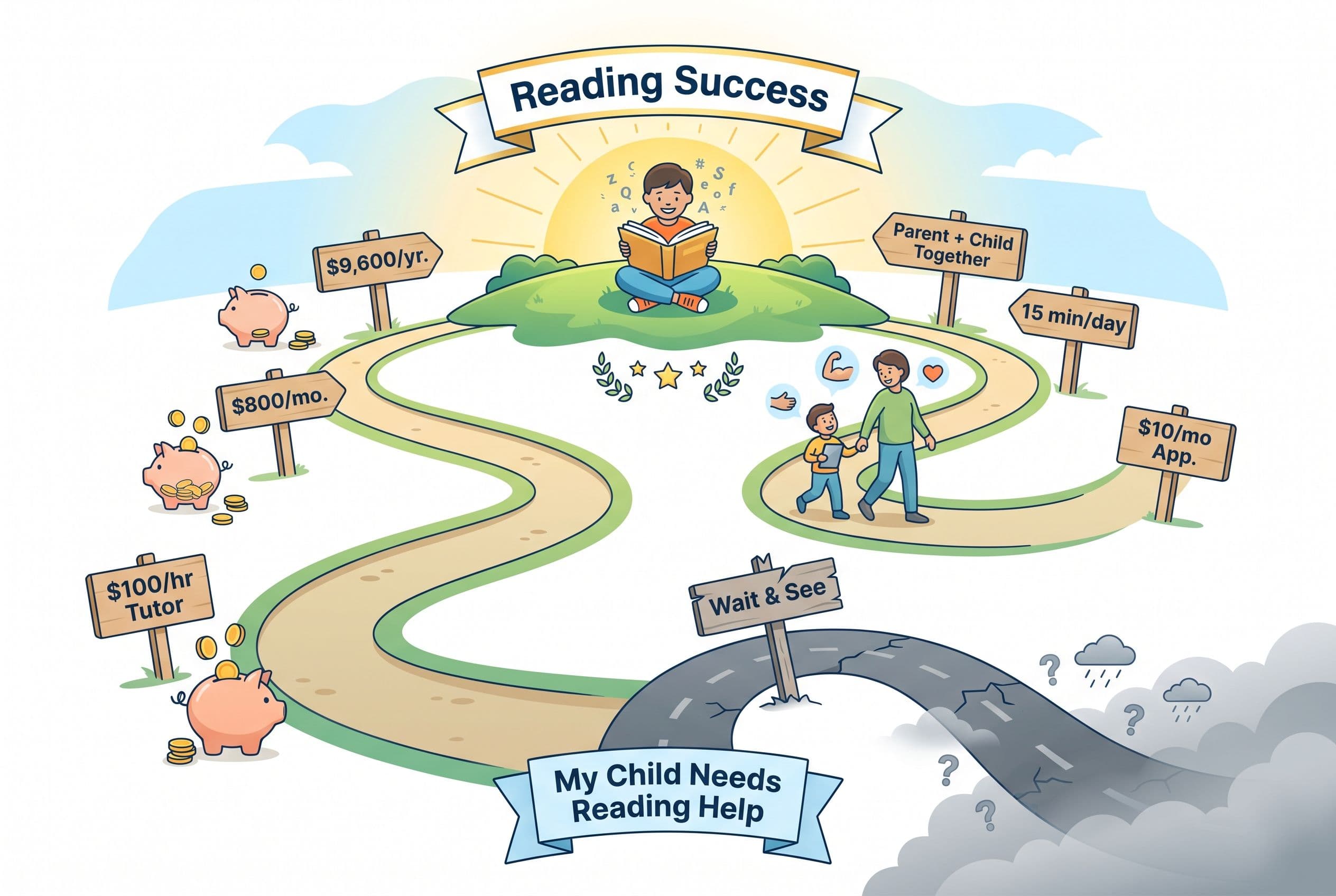
That's $800/month. $9,600/year.
A Lindamood-Bell intensive? A single summer program can run to thousands of dollars. I've talked to parents who've spent a small fortune on Lindamood-Bell. They didn't get a car that year. They got their kid reading. Worth it? For many of them, yes — because it worked. But that doesn't make it accessible.
And here's the kicker: the $30/hour college student tutor? There's a decent chance she was trained in Balanced Literacy and is having your kid use "context clues" and picture-guessing strategies. You know, the exact methods that APM Reports' "Sold a Story" investigation by Emily Hanford showed are inconsistent with the research on how skilled word reading actually develops — and can actively undermine decoding growth, especially for at-risk kids.
So you might be paying $30/hour for someone to actively make your kid worse at reading.
Cool. Cool cool cool.
The 2026 Cost of Reading Apps: The Real Breakdown
Now let's look at the app side.
Reading apps in 2026 range from free (ad-supported, usually junk) to about $150/year for premium subscriptions. Some charge monthly, some annually, some are one-time purchases.
Here's a rough breakdown:
- Free apps (ad-supported or limited content): $0 — but you get what you pay for, and many use whole-language methods
- Budget apps (basic phonics games, limited scope): $5-$15/month
- Mid-range structured apps (systematic phonics curriculum, progress tracking): $10-$25/month or $50-$150/year
- Premium app + live tutoring combos: $100-$300/month
Teach Your Kid to Read falls in the structured, systematic phonics category — the kind built on actual reading science, not gamified guessing. And compared to that $9,600/year tutor? The math isn't even close.
But — and I need to be honest here because that's what I do — an app isn't magic. No app is. An app is a tool. A really good tool, when it's built on the right methodology, but still a tool that requires a parent to show up.
So Which One Actually Works? The Science Check
Before we compare costs any further, we need to talk about what the research actually says about how kids learn to read. Because if the method is wrong, it doesn't matter if it costs $10 or $10,000.
The National Reading Panel — the one Congress commissioned back in 2000 — reviewed decades of reading research and concluded that systematic phonics instruction produces significant benefits for kids in K-6, especially those at risk for reading difficulty. Not whole language. Not balanced literacy. Not "just read to them a lot and they'll figure it out." Systematic. Explicit. Phonics.
Stanislas Dehaene, the French neuroscientist who wrote Reading in the Brain (2009), showed through brain imaging that reading isn't biologically natural the way spoken language is. Unlike speech, there's no pre-wired reading circuit waiting to activate. Learning to read actually recruits and reorganizes existing visual and language networks — including what researchers call the "visual word form area" — to decode text. It's incredible, actually. But it doesn't happen by osmosis. The brain has to be explicitly taught to connect letters to sounds.
David Kilpatrick's Equipped for Reading Success (2016) goes even further. He explains orthographic mapping — the process by which the brain stores words for instant retrieval. And he shows that this process depends entirely on strong phonemic awareness and phonics knowledge. Kids who skip that foundation never map words efficiently. They're stuck guessing forever.
So here's the question that matters more than cost:
Does the tutor or app use systematic, explicit phonics instruction?
If yes, you're on the right track. If no, you're burning money.
The One Question That Separates a Great Tutor From a $75/Hour Waste
I was at a playground in Raleigh last spring when I got into a conversation with another mom. Her son's school had just switched from Lucy Calkins' Units of Study to a Science of Reading curriculum because of North Carolina's SB 387 — the Excellent Public Schools Act. She was confused and honestly kind of annoyed about it. "He was doing fine before," she told me.
So I asked her: can your son read the word "splint"?
He's in second grade. She pulled him over. He could not.
He stared at it. He said "split." Then "spent." Then he looked at his mom for help. Classic three-cueing behavior — he was trying to guess, not decode.
I spent 20 minutes on that playground bench explaining why the switch was happening. I told her about Emily Hanford's reporting. The NAEP data. Dehaene's neuroscience showing the brain doesn't just learn to read by exposure. She went home and listened to the Sold a Story podcast that night. Texted me at 11pm: "I had no idea. Why didn't anyone tell us this sooner?"
Here's why I'm telling you this story in an article about cost.
That mom was about to hire a tutor. She'd already gotten a recommendation from another school parent — a retired teacher who charged $60/hour. I asked her one question: "Find out if she uses systematic phonics or if she uses leveled readers and three-cueing."
She asked. The tutor used Fountas & Pinnell leveled readers.
Real talk — Fountas & Pinnell levels are everywhere. Schools love them. But they're whole-language aligned. They encourage kids to use picture clues, sentence structure, and context to "read" words they can't actually decode. That's not reading. That's guessing with extra steps.
If that mom had hired that tutor at $60/hour, twice a week, for a year? $6,240 spent on a methodology that the science says doesn't work.
So before you compare reading app vs tutor cost, ask the tutor these questions:
- "Do you use systematic, explicit phonics instruction?" (If they say "balanced" or "eclectic" or "we follow the child," run.)
- "Which program or approach do you follow?" (Good answers: Orton-Gillingham, Wilson Reading System, Barton Reading & Spelling, UFLI Foundations. Bad answers: "I create my own materials" with no named methodology.)
- "Do you use decodable readers or leveled readers?" (Decodable = good. Leveled = red flag.)
- "How do you assess progress?" (Good answer: phonemic awareness screeners, DIBELS benchmarks. Bad answer: "I can just tell they're improving.")
A great tutor who uses the right methodology? Worth every penny. Even at $100/hour. A mediocre tutor using debunked methods? Not worth $10.
The Hidden Cost Nobody Talks About: Waiting
OK so here's where I get aggressive, because this one drives me crazy.
The most expensive option isn't the tutor. It isn't the app. It's doing nothing.
The Annie E. Casey Foundation's 2010 study found that kids who can't read proficiently by 3rd grade are 4 times more likely to drop out of high school — a risk that's even more pronounced for children growing up in poverty or facing other compounding disadvantages. It's not destiny for any individual kid, but it's a massive, well-documented risk multiplier. And the takeaway doesn't change: early decoding matters. A lot.
Mississippi figured this out. They passed the Literacy-Based Promotion Act of 2013, mandated evidence-based reading instruction, and went from 49th to 21st in national reading scores in six years. They didn't wait and see. They didn't hope kids would "catch up." They acted.
Ohio's Third Grade Reading Guarantee holds kids back if they can't pass the reading assessment. Florida's been doing the same with their 3rd grade retention policy. Over 40 states have now passed Science of Reading legislation since 2019.
Why? Because the research is clear. The Simple View of Reading (Gough & Tunmer, 1986) tells us that reading comprehension = decoding × language comprehension. If decoding is zero, the whole equation is zero. It doesn't matter how smart your kid is or how big their vocabulary is.
And remediation later? That's where costs explode. A private reading intervention program for an older struggling reader runs $10,000-$15,000 per year. Insurance doesn't cover it. Schools have waitlists months long. And the emotional damage — the shame, the anxiety, the "I'm stupid" belief that calcifies in a child's brain — that's a cost you can't put a number on.
So when you're comparing reading app vs tutor cost, add a third column: the cost of waiting. It dwarfs both.
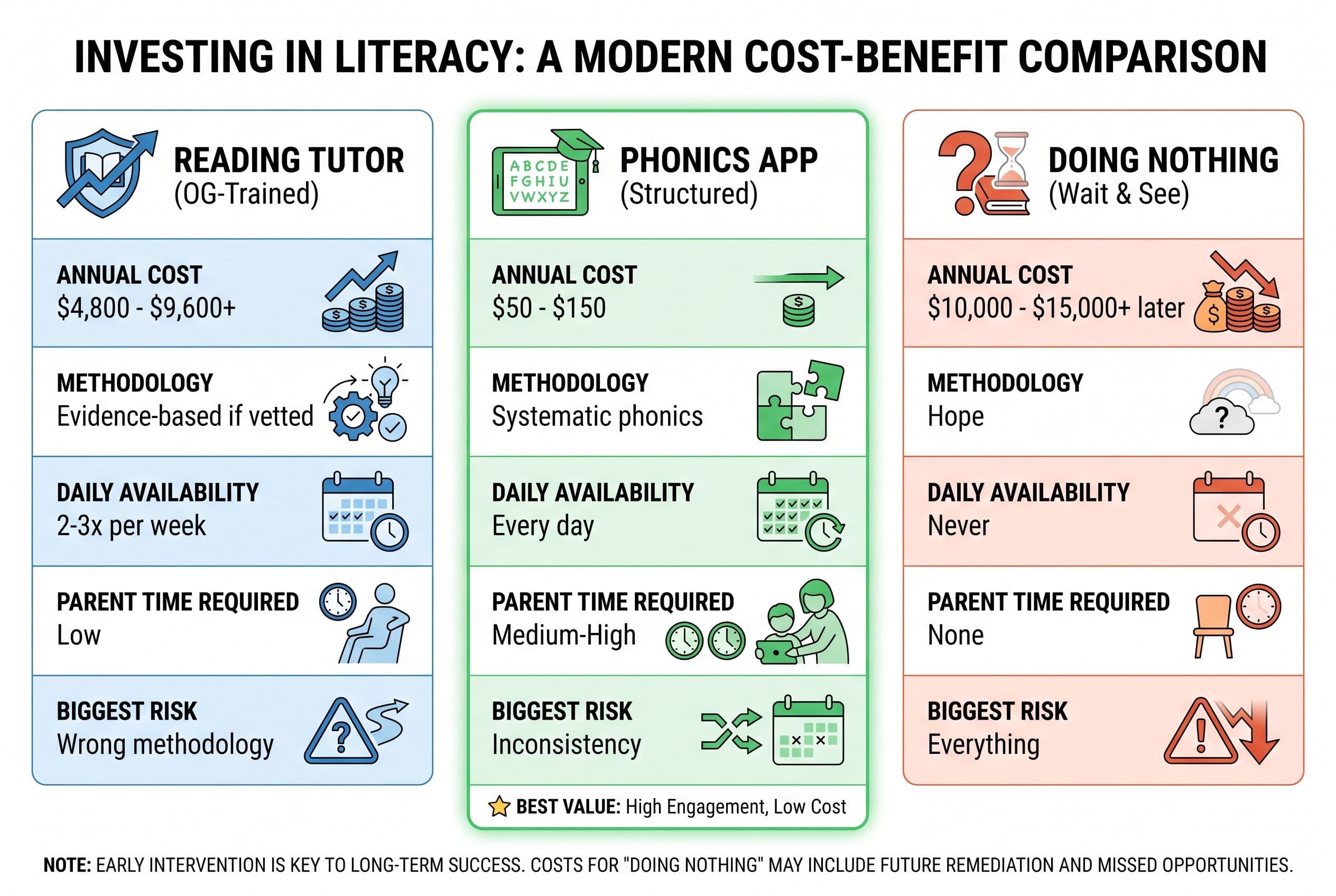
Reading App vs Tutor: The Real Comparison Chart
Let me lay this out clearly.
Private Reading Tutor (Quality, OG-Trained)
- Cost: $4,800-$9,600+/year
- Methodology: Usually strong (if you vet properly)
- Personalization: High — a human adjusting in real time
- Consistency: Depends on scheduling, cancellations, tutor availability
- Parent involvement: Low — you drop off and pick up
- Scalability: One child at a time
- Biggest risk: Hiring someone who uses the wrong methodology
Structured Phonics App (Like Teach Your Kid to Read)
- Cost: $50-$150/year
- Methodology: Varies wildly by app — vet the approach (systematic phonics or bust)
- Personalization: Medium — good apps adapt to the child's pace
- Consistency: High — available every single day, no cancellations, no snow days
- Parent involvement: Medium to high — you need to sit with your kid, especially early on
- Scalability: All your kids, one subscription
- Biggest risk: Parents treating it as a babysitter instead of a teaching tool
Doing Nothing / "Wait and See"
- Cost: $10,000-$15,000+/year for remediation later. Plus emotional damage. Plus lost years.
- Methodology: Hope. (Hope is not a methodology.)
- Personalization: N/A
- Consistency: Consistently bad
- Parent involvement: None — that's the problem
- Scalability: The problem scales beautifully to all your kids
- Biggest risk: Everything
The bottom line? A high-quality reading app built on systematic phonics gives you 80-90% of what a good tutor provides at about 1-2% of the cost. The trade-off is your time. You have to show up. You have to sit with your kid. You have to enforce the "No Guessing" rule yourself.
In my house, we call it the Tiger Rule: We Never Skip. Phonics happens on birthdays. On Christmas. On vacation. My 4-year-old practiced CVC words at the kitchen table last Tuesday while his older brother did math beside him. It took 15 minutes. He decoded "c-a-t," "s-i-t," and "h-o-p" without guessing. That's a win worth more than any tutor session.
When a Tutor IS Worth the Money
I don't want to be unfair here. There are real situations where a tutor isn't just worth it — a tutor is necessary.
Hire a specialist tutor if:
- Your child has been diagnosed with dyslexia or shows strong indicators (the International Dyslexia Association estimates 15-20% of the population has some degree of dyslexia)
- Your child is already behind grade level by a year or more and needs intensive, targeted intervention
- You've been consistent with a quality app or home program for 3+ months and aren't seeing progress
- You genuinely cannot sit with your child for 15-20 minutes a day (no judgment — single parents working two jobs exist, and they deserve support)
But even then, demand these things:
- The tutor must use a named, evidence-based program. Orton-Gillingham. Wilson. Barton. Not vibes.
- Ask for phonemic awareness screener or DIBELS assessment data at intake and every 6-8 weeks. You want numbers, not "she's doing great!"
- By mid-kindergarten, most DIBELS benchmark tables expect kids to produce a meaningful number of correct letter-sounds per minute on the Nonsense Word Fluency measure. The exact cut-scores vary by edition, so ask your tutor to show you the benchmark chart they're using — and where your child falls on it. If your tutor can't cite specific benchmarks, they're guessing at your child's progress the same way they might be teaching your child to guess at words.
When an App Is the Smarter Move
A structured reading app is your best bet if:
- Your child is 3-6 and just starting to learn to read (you don't need a $100/hour specialist for letter-sound correspondence — you need consistency)
- You can commit to 15-20 minutes a day sitting with your child
- Your budget doesn't allow for $500+/month in tutoring
- You have multiple kids who all need reading instruction (one subscription vs. three tutor slots — do the math)
- Your child is on track but you want to accelerate or reinforce what school is teaching
When I first started teaching my oldest to read, I tried everything — books, workbooks, magnetic letters on the fridge. What I didn't have was a systematic, structured sequence that told me exactly what to teach next. I was winging it. And honestly? Winging it works for some things — dinner, for example — but not for phonics.
That's why I helped build Teach Your Kid to Read. It follows systematic synthetic phonics principles grounded in Orton-Gillingham methodology. It tells you what comes next. It tracks where your child is. And it costs less than a single hour with most private tutors.
But — and I'll say this until I'm blue in the face — you still have to show up. An app on a tablet in your kid's lap while you scroll Instagram is not reading instruction. It's screen time with an educational veneer. Sit with them. Listen to them sound out words. Correct the guessing. Celebrate the wins.
Your Action Plan: Deciding in the Next 48 Hours
Stop overthinking this. Here's what to do right now.
Step 1: Assess where your child is today.
Use a phonemic awareness screener to find out exactly where the breakdown is. Kilpatrick's PAST (Phonological Awareness Screening Test) is one great option — you can find it in his book Equipped for Reading Success or through authorized resources. You can also ask your child's school for a quick phonological awareness screening; most schools have one available. Budget 5-15 minutes in a quiet room, depending on your child's level.
Step 2: Check your budget honestly.
Can you afford $500-$1,000/month for a quality tutor? If yes, and your child is significantly behind, start interviewing tutors TODAY using the four questions I listed above. Don't wait for school to figure it out.
If that's not in the budget — and for most families, it's not — start with a systematic phonics app immediately. start lesson one free
Step 3: Set the schedule and never break it.
15-20 minutes a day. Every day. We Never Skip. Put it on the calendar. Before screen time. Before dessert. Before anything optional. Reading is not optional.
Step 4: Track progress with real data.
Every 6-8 weeks, re-administer a phonemic awareness screener. Check your app's built-in progress data. If you're using a tutor, demand DIBELS or AIMSweb benchmark scores. You want numbers going up. Not feelings. Numbers.
Step 5: Escalate if needed.
If after 3 months of consistent daily practice (and I mean consistent — not "most days" or "when we remember") your child isn't making measurable progress, escalate to a specialist tutor. Get a formal evaluation through your school district (it's free — they're legally required under IDEA) or through a private evaluator. Understood.org has great guides on how to request an evaluation.
Don't skip straight to Step 5. Don't skip straight to the most expensive option because panic feels productive. Start where the research says to start: with systematic, explicit phonics instruction, delivered consistently, at whatever price point you can sustain.
FAQ: Reading App vs Tutor Cost in 2026
Is a reading tutor worth it in 2026?
It depends entirely on the tutor's methodology. A tutor trained in Orton-Gillingham, Wilson Reading System, or another evidence-based systematic phonics approach? Absolutely worth it, especially for kids with dyslexia or those significantly behind. A tutor using Balanced Literacy, three-cueing, or Fountas & Pinnell leveled readers? You're paying $60-$150/hour for someone to teach your child to guess. Ask about methodology before you ask about price.
Can a reading app replace a tutor?
For most kids who are just learning to read or who are mildly behind, a quality phonics-based app combined with daily parent involvement can deliver results comparable to private tutoring — at a fraction of the cost. The key is parent involvement. You can't hand your kid a tablet and walk away. But if you commit to 15-20 minutes a day of guided practice, a structured app like Teach Your Kid to Read provides the same systematic phonics sequence a good tutor would follow.
How much does a reading tutor cost per month in 2026?
Expect to pay $240-$600/month for a general reading tutor (2 sessions/week at $30-$75/hour) or $640-$1,200/month for an Orton-Gillingham or Wilson-trained specialist (2 sessions/week at $80-$150/hour). Lindamood-Bell clinical programs run even higher. A quality phonics app costs $5-$15/month, making it roughly 40-100x cheaper per month.
What should I look for in a reading app for struggling readers?
Three non-negotiables: (1) It must use systematic synthetic phonics — teaching letter-sound correspondences in a structured sequence, not random phonics games or whole-word memorization. (2) It must use decodable texts, not leveled readers that encourage guessing. (3) It must track progress with real data so you can see whether your child is advancing. Bonus: look for apps built on Orton-Gillingham principles, which is the gold standard for struggling readers.
At what point should I switch from an app to a tutor?
Give a quality phonics app 3 months of truly consistent daily use (15-20 minutes every day, with you present and engaged). If after 3 months your child isn't showing measurable improvement — they can't segment and blend sounds, they're not advancing through CVC words, their screener scores aren't improving — it's time to escalate. Get a formal reading evaluation and hire a specialist tutor trained in an evidence-based program. The earlier you escalate, the better the outcomes.
Your kid's reading ability isn't something to gamble on. Whether you choose an app, a tutor, or both — make sure the method is right, the practice is daily, and the guessing stops today. contact us today
Part of these guides

Xia Brody
Co-Founder, Teach Your Kid to Read
Mom of 4 who has successfully taught her kids to read. Currently in the trenches with her 4-year-old while her two oldest (10 and 7) devour books on their own. Passionate about phonics-based methods and building a lifelong love of reading.
Related Articles
Reading.com vs Reading Eggs Cost: Cheapest 2026 Pick
Comparing Reading.com vs Reading Eggs cost? Here’s the no-fluff 2026 breakdown of pricing, phonics quality, free trials, and which app I’d actually use with my own kid.
Read More →
ABCmouse vs Reading Eggs Cost: Which Is Cheaper in 2026?
ABCmouse and Reading Eggs both look cute. But price means nothing if your child is still guessing at words. Here’s the no-nonsense 2026 cost comparison parents actually need.
Read More →
Reading Eggs vs ABCmouse Cost: 2026 Price Breakdown
Comparing Reading Eggs vs ABCmouse cost? Here’s the 2026 price breakdown, what each app teaches, and why I’d choose phonics-first instruction over reward-heavy screen time.
Read More →