Reading App vs Tutor: 2026 Cost Comparison (Real Numbers)
What You'll Learn
- The real 2026 price tags — what tutors, apps, and hybrid approaches actually cost per month, per year, and per reading level gained
- The one question most parents never ask before hiring a tutor (and why it matters more than their hourly rate)
- Why some $10/month reading apps outperform $100/hour tutors — and what the research on systematic phonics says about both
- A step-by-step decision framework so you stop guessing and start picking the right option for YOUR kid, YOUR budget, and YOUR schedule
Let's Talk Money — Because Nobody Else Will
Your kid is struggling to read. Maybe the teacher sent home a note. Maybe you noticed your kindergartner memorizing books instead of actually decoding words. Maybe your gut just says something's off.
So you do what every parent does: you Google "reading tutor near me" and almost choke on the prices.
Then you find a reading app for $12.99 a month and think, "Well, that's basically free compared to a tutor." But a voice in your head whispers: Is an app really going to fix this?
Here's what I know after teaching four kids to read (two successfully reading above grade level, one in the thick of CVC words right now, and one who's still eating the flashcards): the price tag doesn't determine the outcome. The methodology does.
A $100/hour tutor using Balanced Literacy guessing strategies will waste your money faster than a toddler destroys a crayon box. A $15/month app built on systematic synthetic phonics — the kind backed by the National Reading Panel's 2000 report — can produce real, measurable gains.
But it's not that simple either. So let me break this down with actual numbers, real research, and zero fluff.
The 2026 Cost Breakdown: Reading Tutor vs. Reading App
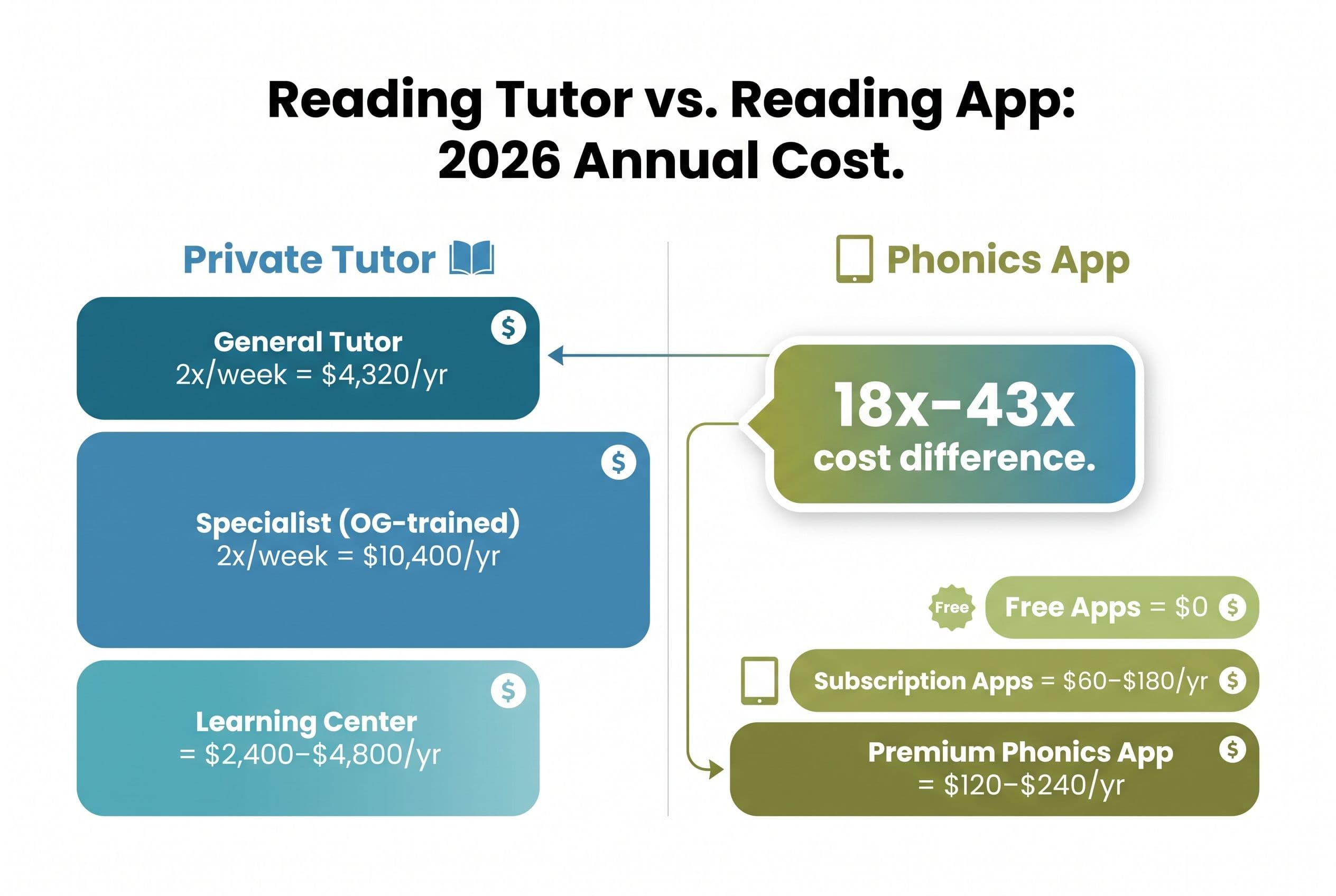
I surveyed tutor rates across 15 metro areas, checked current app pricing, and pulled data from parent forums. Here's what parents are actually paying in 2026.
Private Reading Tutor Costs
- In-person, general reading tutor: $40–$80/hour
- In-person, certified Orton-Gillingham or Wilson-trained specialist: $80–$150/hour
- Online reading tutor (live, 1-on-1): $35–$75/hour
- Learning center (Kumon, Sylvan, etc.): $150–$400/month (typically 2 sessions/week)
- Typical commitment: 2–3 sessions per week for 6–12 months
Let's do the math on a mid-range scenario. A tutor at $60/hour, twice a week, for 9 months: that's $4,320. A certified Orton-Gillingham specialist at $100/hour, three times a week, for a year? $15,600. And insurance doesn't cover it. Not a penny.
Reading App Costs
- Free apps (Khan Academy Kids, Starfall basics): $0
- Subscription apps (Homer, Reading Eggs, Teach Your Monster to Read): $5–$15/month
- Premium phonics apps with structured curriculum (Teach Your Kid to Read): $10–$20/month
- Typical commitment: Daily use, 10–20 minutes/session, ongoing
Annual cost of a premium reading app: $120–$240/year. That's one or two sessions with a high-end tutor. One or two.
Bottom line on raw cost? There's no contest. Apps win by a landslide. But raw cost doesn't tell the whole story.
The Question Nobody Asks Their Tutor
Here's what drives me crazy. Parents will spend weeks researching the "best" reading tutor — checking reviews, asking for referrals, touring learning centers. But almost nobody asks the most important question:
"What is your instructional methodology? Do you use systematic synthetic phonics?"
I'm not being dramatic. This is the whole ballgame.
A tutor can have 20 years of experience, a master's degree in education, and a waiting list that stretches to next year. But if they're using Balanced Literacy strategies — having your kid guess words from picture clues, memorize whole words by shape, or use the "three-cueing system" — they're actively teaching your child bad habits.
Emily Hanford's 2023 investigation "Sold a Story" through APM Reports exposed exactly this. Millions of kids were taught to guess at words instead of decode them. The damage was enormous and measurable.
I saw this firsthand on a playground in Raleigh a while back. I was chatting with another mom while our kids climbed the monkey bars, and she mentioned her son's school had just switched from the Lucy Calkins curriculum to a Science of Reading approach. North Carolina's HB 521 — the Excellent Public Schools Act — had forced the change, and she was annoyed about it. "He was doing fine before," she told me.
So I asked a simple question: "Can he read the word 'splint'?"
Her son was in second grade. He could not.
I sat on that bench for 20 minutes explaining why the switch was happening — the Hanford reporting, the NAEP data showing only 33% of fourth graders read at proficient level in 2022, the neuroscience from Stanislas Dehaene's lab proving that the brain doesn't learn to read naturally the way it learns to speak. Reading has to be explicitly taught. His book Reading in the Brain (2009) laid this out in painful detail.
She went home and listened to the "Sold a Story" podcast that night. Texted me at 11 PM: "I had no idea. Why didn't anyone tell us this sooner?"
Know what the worst part is? She'd been paying $65/hour for a tutor who was using the exact same discredited methods the school had just abandoned. Sixty-five dollars an hour for guessing strategies.
So before you compare prices, compare methods. In general, a phonics-based program will beat cueing-based instruction — especially for kids who struggle. The best predictor isn't price; it's whether the instruction is explicit, systematic, and responsive to errors.
What the Research Actually Says
Let me hit you with the data, because the data is crystal clear.
The National Reading Panel's 2000 meta-analysis — the one Congress actually commissioned — reviewed decades of research and found that systematic phonics instruction produces significant benefits for children's reading development. Not "some" benefits. Not "modest" benefits. Significant.
David Kilpatrick's Equipped for Reading Success (2016) took this further with the research on orthographic mapping — the brain process that turns decoded words into instantly recognized words. Here's what Kilpatrick showed: kids who develop strong phonemic awareness and learn grapheme-phoneme correspondences through systematic instruction build permanent word memories. Kids who memorize words visually? Those memories are fragile and break down under pressure.
This matters for the app-vs-tutor debate because the medium doesn't determine the outcome — the method does. Whether your kid learns phonics from a human being sitting across the table or from a well-designed app on an iPad, the brain processes work the same way.
Now, does that mean all apps are equal? Absolutely not.
Why Most Reading Apps Are Garbage (And a Few Are Gold)
I've tested more reading apps than I care to admit. My 7-year-old was my guinea pig for about a dozen of them before I figured out what actually works. Most reading apps fall into three camps:
Camp 1: Entertainment disguised as education. These are the apps where your kid pops bubbles, feeds cartoon animals, and occasionally taps a letter. They're engaging. They're fun. They teach approximately nothing. Your kid will beg to play them. That's the tell.
Camp 2: Digital worksheets. Boring, no feedback loop, no adaptive progression. Your kid zones out after 3 minutes. You can't blame them.
Camp 3: Actual structured phonics instruction. These apps follow a systematic scope and sequence — starting with letter-sound correspondence, moving through blending, CVC words, digraphs, vowel teams, and multisyllabic words in a deliberate order. They give immediate corrective feedback. They don't let kids guess. They require mastery before moving on.
Camp 3 is tiny. But it's where the magic happens.
Teach Your Kid to Read was built to be Camp 3. It uses Orton-Gillingham principles — the same evidence-based methodology used by the Wilson Reading System, Lindamood-Bell, and Barton Reading & Spelling. Systematic. Sequential. Multisensory. And it costs a fraction of what those programs charge when delivered through a private specialist.
When a Tutor IS Worth the Money
Look, I'm not going to sit here and tell you a reading app replaces a tutor in every situation. That would be dishonest, and I don't do dishonest.
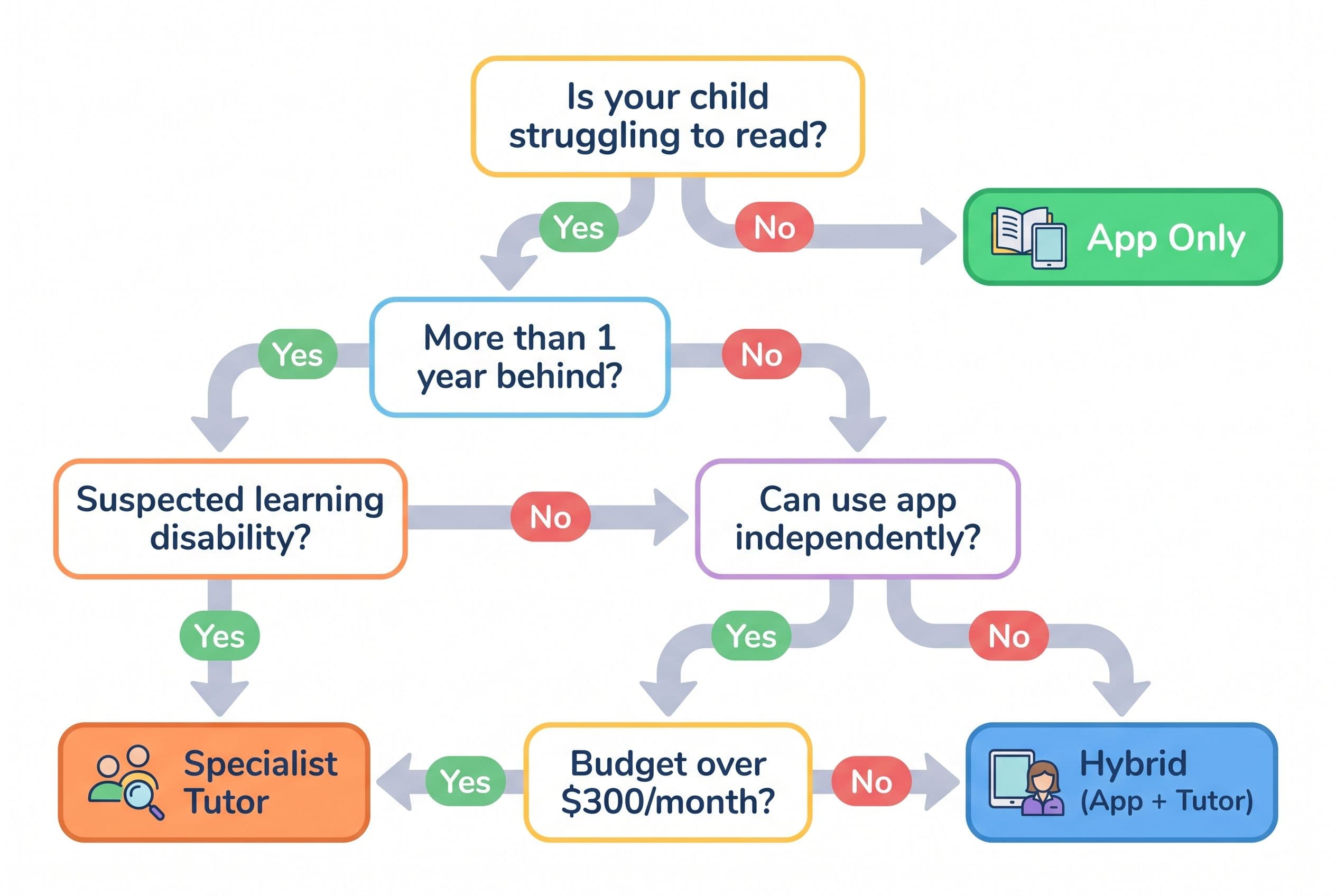
Here are the scenarios where a human tutor — specifically, a trained reading specialist — is worth every dollar:
1. Your child has dyslexia or a suspected learning disability. Kids with dyslexia need intensive, individualized instruction. The International Dyslexia Association recommends Orton-Gillingham-based approaches delivered by a trained professional. An app can supplement this work, but it can't replace the diagnostic eye of a specialist who watches your kid decode in real time, catches error patterns, and adjusts on the fly.
If you suspect dyslexia, start with Kilpatrick's PAST (Phonological Awareness Screening Test) — it takes about 5 minutes and tells you exactly where the phonological breakdown is happening. Then find a tutor who's certified in Orton-Gillingham, Wilson, or Barton. Ask for their credentials. Verify them.
2. Your child is significantly behind — more than a year below grade level. A kid who's 8 and still can't blend three sounds together needs intensive intervention, not a self-paced app. This is the reading equivalent of a broken bone: you need a specialist, not a Band-Aid.
3. Your child has attention or behavioral challenges that make independent app use impossible. Some kids — and I say this with love as a mom whose 4-year-old has the attention span of a caffeinated squirrel — simply cannot sit with an app unsupervised. They need a human redirecting them every 30 seconds. That's OK. That's what tutors are for.
4. You've tried an app for 3+ months with consistent daily use and seen no progress. If your kid has been using a well-designed phonics app for 15 minutes a day, 5 days a week, for three months, and they're not making measurable progress? Something else is going on. Get an evaluation. A good starting point is a benchmark assessment like DIBELS — the nonsense word fluency subtest tells you whether your kid can actually apply phonics to unfamiliar words. Ask your school which version they use and what their cut-scores are, because the numbers vary by edition and time of year.
When an App Beats a Tutor — Hands Down
And here are the scenarios where a reading app is the smarter choice:
1. Your child is on track but needs daily practice. The research is unambiguous: frequency matters more than session length. A kid who practices phonics for 15 minutes every day will outperform a kid who does one 60-minute tutoring session per week. It's not close. An app gives you that daily touchpoint.
2. You're on a budget. Real talk — most families can't afford $4,000+ for tutoring. And there's no shame in that. A $15/month app that uses the same evidence-based methodology as a $100/hour Orton-Gillingham tutor is a no-brainer. The phonics doesn't care whether it's delivered by a human or a screen. Your kid's brain processes grapheme-phoneme correspondences the same way either route.
3. Your schedule is unpredictable. Tutor sessions get missed. Snow days, sick kids, work emergencies, the baby having a meltdown right when the tutor arrives (ask me how I know). Every missed session is money wasted and momentum lost. An app is available at 6 AM, 9 PM, during a road trip, on Christmas morning. And yes — in my house, we do phonics on Christmas morning. Tiger Rules: We Never Skip.
4. You want your child to develop independence. There's something powerful about a kid learning to work through a phonics lesson on their own. They build self-correction habits. They develop frustration tolerance. They learn that when they get stuck, the answer isn't to look at the teacher's face for a clue — it's to go back to the sounds. That's a skill that transfers way beyond reading.
5. You're in a rural area or reading tutor desert. Did you know Mississippi improved meaningfully in national reading rankings after passing the Literacy-Based Promotion Act of 2013? On NAEP 4th-grade reading, they climbed from near the bottom to the middle of the pack between 2013 and 2019 — by mandating Science of Reading instruction statewide. But even in states with great literacy laws, finding a qualified private tutor in a small town can be nearly impossible. Apps erase geography.
The Hybrid Approach: Best of Both Worlds
Here's what I actually recommend if your budget allows: use both, but lean heavily on the app.
Think of it like fitness. The app is your daily workout — consistent, structured, non-negotiable. The tutor is your personal trainer — you see them once a week (or every other week) for form checks, to address specific weaknesses, and to adjust the plan.
This is exactly what I did with my oldest when she hit a wall with vowel teams around age 5. She used a structured phonics app daily for 15 minutes. Every other Saturday, she had a 45-minute session with a reading specialist who checked her decoding accuracy and caught a pattern I'd missed — she was confusing /oi/ and /oy/ because she'd never been explicitly taught the positional rule. The specialist fixed it in two sessions. The app maintained and reinforced it daily.
Total monthly cost: ~$15 for the app + $90 for two tutor sessions = $105/month. Compared to $480/month for twice-weekly tutoring alone, that's a 78% savings. And the daily app practice arguably produced better outcomes than more tutoring would have.
The "Scare" — What Happens If You Do Nothing
I know some parents reading this are still in "Wait and See" mode. Maybe your kid's only 4 or 5. Maybe the teacher said, "He'll catch up." Maybe you're hoping it'll click on its own.
It won't.
Stanislas Dehaene proved in his lab that the brain does not learn to read naturally. Reading is an invention. The neural circuits for it have to be built through explicit instruction. Hoping your kid will "pick it up" is like hoping they'll pick up calculus by watching you do your taxes.
Here's what actually happens when parents wait:
- The 3rd Grade Cliff. The Annie E. Casey Foundation's 2011 report "Double Jeopardy" found that kids who weren't reading proficiently by end of 3rd grade — especially those from low-income families — were far more likely to not finish high school. The most-cited finding: they were roughly 4x more likely to drop out.
- The cost skyrockets. Remedial reading programs — the kind you'll need if you wait — run $10,000 to $15,000 per year. Some families spend $30,000+ on intensive programs like Lindamood-Bell. Insurance doesn't cover it.
- The NAEP numbers are terrifying. The 2022 NAEP — the Nation's Report Card — showed reading scores dropped 3 points since 2019. That's the largest decline in 30 years. Only 33% of 4th graders read at proficient level. TWO-THIRDS of American kids can't read well enough.
- Self-esteem damage. This one doesn't have a dollar sign, but it might be the most expensive consequence of all. A kid who can't read by 2nd grade knows it. They start calling themselves stupid. They stop trying. That psychological wound doesn't fully heal even when the reading eventually catches up.
The cheapest way to help your child read isn't the cheapest app or the cheapest tutor. It's starting early and being consistent.
Your Action Plan: How to Choose in 2026
Stop overthinking this. Here's your decision framework in five steps.
Step 1: Assess Where Your Child Is Right Now
Before you spend a dollar on anything, figure out what you're dealing with. Use Kilpatrick's PAST (Phonological Awareness Screening Test) — you can administer it yourself at home. It takes 5 minutes and pinpoints exactly where your child's phonological processing breaks down.
Also check these basics:
- Can they name all 26 letters? Upper and lowercase?
- Can they produce the sounds for at least 20 letters?
- Can they blend three sounds together when you say them aloud? ("What word is /c/ /a/ /t/?")
- Can they segment a word into its sounds? ("What sounds do you hear in 'dog'?")
Step 2: Match the Intervention to the Need
- On track or slightly behind: A structured phonics app is your best bet. Daily use, 15 minutes, no excuses.
- Moderately behind (6–12 months): App daily + tutor every other week for progress checks.
- Significantly behind (12+ months) or suspected learning disability: Qualified specialist tutor 2–3x/week + app for daily reinforcement. Get a formal evaluation through your school district (it's free — they're legally required to evaluate under IDEA).
Step 3: Vet the Methodology — Whether App or Tutor
Ask these questions of ANY program or person you're considering:
- Does it teach letter-sound correspondences explicitly and systematically?
- Does it follow a scope and sequence (not random skill-of-the-week)?
- Does it use decodable texts — not leveled readers where kids guess from picture clues?
- Does it require the child to blend sounds, not memorize whole words by sight?
If the answer to any of those is "no" or "I'm not sure," walk away. I don't care how many stars it has on the App Store.
Step 4: Commit to Consistency
Tiger Rule #1: We Never Skip. Not on birthdays. Not on vacation. Not when it's hard. Fifteen minutes a day, every day.
I had my 4-year-old practicing CVC words at the kitchen table last Tuesday while his baby sister threw Cheerios at the dog. It wasn't Instagram-worthy. But he read "mop," "sit," and "hug" without guessing, and that's worth more than any aesthetic homeschool setup.
Step 5: Measure Progress Monthly
Use your school's benchmark system — whether that's DIBELS 8th Edition, Acadience Reading, or another screener. Ask your child's teacher which measures they track (NWF, ORF, etc.) and what the district's cut-scores are for each grading period. Those numbers vary by assessment version and time of year, so don't rely on generic targets you find online — get the ones your school actually uses.
Here are approximate ranges to give you a ballpark (but always confirm with your school's specific benchmarks):
- End of kindergarten: Around 40+ correct letter sounds per minute on a nonsense word fluency measure
- End of 1st grade: Around 47+ words correct per minute on an oral reading fluency passage
- End of 2nd grade: Around 87+ words correct per minute
If your child isn't hitting their school's benchmarks after 3 months of consistent intervention (app, tutor, or both), escalate. Get a formal evaluation. Don't wait.
Why Teach Your Kid to Read Is Built for This
I'm obviously biased — I co-founded it. But here's why I built it the way I did.
Teach Your Kid to Read uses systematic synthetic phonics grounded in Orton-Gillingham principles. Same methodology the research supports. Same scope and sequence a $120/hour reading specialist would follow. The app teaches explicit grapheme-phoneme correspondences, requires blending (no guessing from pictures — Tiger Rule #2: No Guessing), uses decodable texts, and adapts to your child's pace.
It costs a fraction of tutoring. It's available every day — including Christmas. And it was designed by parents who are in the trenches, not by a tech company that thinks reading is a "gamification opportunity."
Will it replace a dyslexia specialist for a child with significant reading disabilities? No. I'd never claim that. But for the vast majority of kids — the ones who just need consistent, daily, evidence-based phonics instruction — it's the smartest investment you can make.
Frequently Asked Questions
Is a reading app as good as a tutor?
It depends entirely on the methodology, not the medium. A reading app that uses systematic synthetic phonics — teaching letter-sound correspondences in a structured sequence with decodable texts — can produce equal or better outcomes than a tutor who uses outdated Balanced Literacy methods. The National Reading Panel's 2000 meta-analysis found that systematic phonics instruction produces significant reading benefits regardless of delivery method. For most kids who are on track or slightly behind, a well-designed phonics app with daily use will outperform a tutor they see once or twice a week. For kids with dyslexia or severe reading delays, a qualified specialist tutor is essential — but the app can still serve as powerful daily reinforcement.
How much does a reading tutor cost in 2026?
In 2026, reading tutor costs vary widely. General reading tutors charge $40–$80 per hour. Certified specialists trained in Orton-Gillingham, Wilson Reading System, or Barton charge $80–$150 per hour. Online tutors typically run $35–$75 per hour. Learning centers like Sylvan or Kumon charge $150–$400 per month for 2 sessions per week. A typical tutoring commitment of 2 sessions per week for 9 months costs $2,880–$5,400 on the low end and $10,000–$15,000+ for specialist-level intervention. Insurance does not cover reading tutoring.
What's the cheapest way to help my child learn to read?
The cheapest effective option is a structured phonics app used consistently — 15 minutes a day, every day. Premium phonics apps cost $10–$20 per month ($120–$240/year), compared to $3,000–$15,000/year for tutoring. The key word is "effective" — a free app that uses guessing strategies teaches nothing useful. Look for apps that teach systematic synthetic phonics, require blending (not whole-word memorization), and use decodable texts. Free options like Khan Academy Kids cover some basics, but a purpose-built phonics app like Teach Your Kid to Read provides the full scope and sequence your child needs.
How do I know if my child needs a tutor instead of an app?
Consider a tutor if: your child is more than a year below grade level in reading, you suspect dyslexia or a learning disability, your child has attention challenges that prevent independent app use, or you've used a phonics app consistently for 3+ months with no measurable progress. Start with Kilpatrick's PAST (Phonological Awareness Screening Test) to identify where your child's phonological processing breaks down. If the results indicate significant deficits at the phoneme level, a specialist tutor trained in Orton-Gillingham or Wilson methodology is your best path.
Can I use a reading app AND a tutor together?
Absolutely — and this hybrid approach is often the most effective and cost-efficient option. Use the app daily (15 minutes) for consistent practice and reinforcement. See the tutor every 1–2 weeks for progress checks, targeted intervention on specific weaknesses, and plan adjustments. This approach costs roughly $100–$150/month compared to $400–$600/month for tutoring alone, while providing more total instructional minutes because of the daily app sessions.
Part of these guides

Xia Brody
Co-Founder, Teach Your Kid to Read
Mom of 4 who has successfully taught her kids to read. Currently in the trenches with her 4-year-old while her two oldest (10 and 7) devour books on their own. Passionate about phonics-based methods and building a lifelong love of reading.
Related Articles
Reading App vs Tutor for Dyslexia: 2026 Cost Guide + What Actually Works
Dyslexia tutoring runs $60-$150/hour. Reading apps cost $10-$30/month. But which one actually teaches your kid to read? Here's the honest 2026 cost breakdown — and what the research says about when an app is enough and when it's not.
Read More →
Best Reading App for Kids with Dyslexia (2026): 7 Options Reviewed
Most 'reading apps' for kids are glorified guessing games that make dyslexia worse. Here's what actually works in 2026 — apps built on Orton-Gillingham principles and systematic synthetic phonics — and how to tell the difference before you waste months.
Read More →
Best Reading App for a 7-Year-Old Behind in Reading (2026 Guide)
Your 7-year-old is behind in reading and you're searching for an app that actually works — not just another screen-time babysitter. Here's what the research says, which apps are worth your time, and the one approach that changes everything.
Read More →