Best Reading App for a 7-Year-Old Behind in Reading (2026 Guide)
What You'll Learn
- Why most "reading apps" for struggling 7-year-olds are digital guessing games — and the one feature that separates real instruction from animated nonsense
- The specific research on tech-based reading interventions — what the data actually says about effect sizes (spoiler: some approaches are 2x more effective than others)
- A playground conversation that changed a mom's entire understanding of why her second grader couldn't decode the word "splint"
- The exact steps to pair a reading app with hands-on phonics so your kid doesn't just tap a screen — they actually learn to read
Your 7-Year-Old Can't Read. Let's Stop Dancing Around It.
I'm going to say the thing nobody at school pickup wants to say: if your 7-year-old is behind in reading, an app alone won't fix it.
But the right app, paired with the right approach? That's a different story.
Here's what I see constantly. A parent Googles "best reading app for 7 year old behind" at 10:47 PM, downloads three apps with cartoon characters and five-star ratings, hands their kid the iPad, and hopes for the best. Two months later? The kid can navigate the app's reward system like a Wall Street day trader but still can't read the word "frog" without guessing.
I get it. You're scared. You're tired. And the school keeps saying "he'll catch up" or "she just needs more time." Real talk — that's the most dangerous advice in education right now, and I'm going to show you why.
The Tiger Truth: What Happens if You Do Nothing
Let me hit you with numbers that should make you lose sleep.
According to the Nation's Report Card — the NAEP — only 35% of fourth graders scored at or above the Proficient level in reading in 2019. That means 65% of fourth graders were reading below Proficient. Nearly two out of every three kids. And it's gotten worse since then. The 2022 NAEP scores showed the largest decline in reading since 1990.
Mid-school-year DIBELS assessment data from Amplify shows that only about 58% of 2nd graders are ready for core reading instruction. Across K-2, just 56% of students are on track for learning to read.
Your kid is in second grade. Your kid is 7. This is the year the gap either closes or becomes a canyon.
The Annie E. Casey Foundation's 2010 study found that kids who can't read proficiently by the end of third grade are four times more likely to drop out of high school. Four times. That's not a vague warning from a worrier mom — that's longitudinal data.
And the financial hit? Remedial reading programs — the good ones, like Wilson Reading System or Lindamood-Bell — can run to thousands of dollars a year out of pocket. Insurance doesn't cover it. Most school districts have waitlists months long.
So when I say a reading app is part of the solution, I mean it. But only if you pick the right one and use it the right way.
The Playground Conversation That Changed Everything
I was at a playground in Raleigh last year when another mom told me her kid's school had just switched from Lucy Calkins to a Science of Reading curriculum because of North Carolina's SB 387 — the Excellent Public Schools Act. She was confused and honestly kind of annoyed about the whole thing. "He was doing fine before," she said, with that tone parents get when they think the school is overcomplicating things.
So I asked her a simple question: can your son read the word "splint"?
He's in second grade. He could not.
He looked at it and said "split." Close, right? Except close doesn't count in reading. Close means he's guessing based on the first few letters — which is exactly what Lucy Calkins' three-cueing system taught him to do. Look at the picture. Think about what makes sense. Use the first letter as a clue.
That's not reading. That's a parlor trick.
I spent 20 minutes on that playground bench walking her through what had happened — Emily Hanford's "Sold a Story" investigation that blew the lid off Balanced Literacy, the NAEP data showing the crisis in black and white, the neuroscience from Stanislas Dehaene's lab (his book Reading in the Brain, 2009) proving that the brain doesn't learn to read naturally the way it learns to speak. Reading is a code. You have to explicitly teach the code.
She went home and listened to the "Sold a Story" podcast that night. Texted me at 11 PM: "I had no idea. Why didn't anyone tell us this sooner?"
Nobody tells you. That's the problem. And that's why you're on Google right now searching for a reading app for your struggling 7-year-old instead of getting clear answers from your kid's school.
What the Research Actually Says About Reading Apps
OK so here's where it gets interesting — because the research on tech-based reading interventions isn't a slam dunk in either direction. It's nuanced, and the details matter.
Cheung and Slavin (2012) at Johns Hopkins reviewed 20 studies covering about 7,000 struggling readers in K-6. The overall effect of educational technology on reading outcomes was positive but modest — an effect size of +0.14. That's real, but it's not earth-shattering.
But here's the kicker: not all technology-assisted programs are created equal. That meta-analysis looked at ed-tech broadly — not just apps you'd download from the App Store. And within their findings, programs that integrated technology into small-group instruction (like those based on the Lindamood approach, which is typically clinician-delivered) showed effect sizes around +0.32 — more than double the average. Supplemental computer-based models showed more modest effects. The takeaway? Technology works best when it's woven into structured, human-led instruction — not used as a standalone babysitter.
A more recent meta-analysis by Alqahtani in Research in Developmental Disabilities synthesized 30 randomized controlled trials with 4,851 elementary students who had reading difficulties. The overall effect was statistically significant (g = 0.35), a small-to-moderate improvement. That's meaningful — especially when the alternative is doing nothing.
And Dahl-Leonard and colleagues analyzed 53 studies of technology-delivered literacy instruction for K-5 students and found a significant main effect (g = 0.24, p < .001). Technology-delivered instruction works. It just works better when it's systematic, phonics-based, and not a glorified game.
Bottom line? A reading app can genuinely help your behind 7-year-old. But you have to choose one built on the science of how reading actually works — not one that just makes your kid feel good while they guess at words.
What Makes a Reading App Actually Work for Struggling Readers
Before I give you my picks, you need to know what to look for. Because the App Store is a minefield of pretty garbage.
The Non-Negotiables
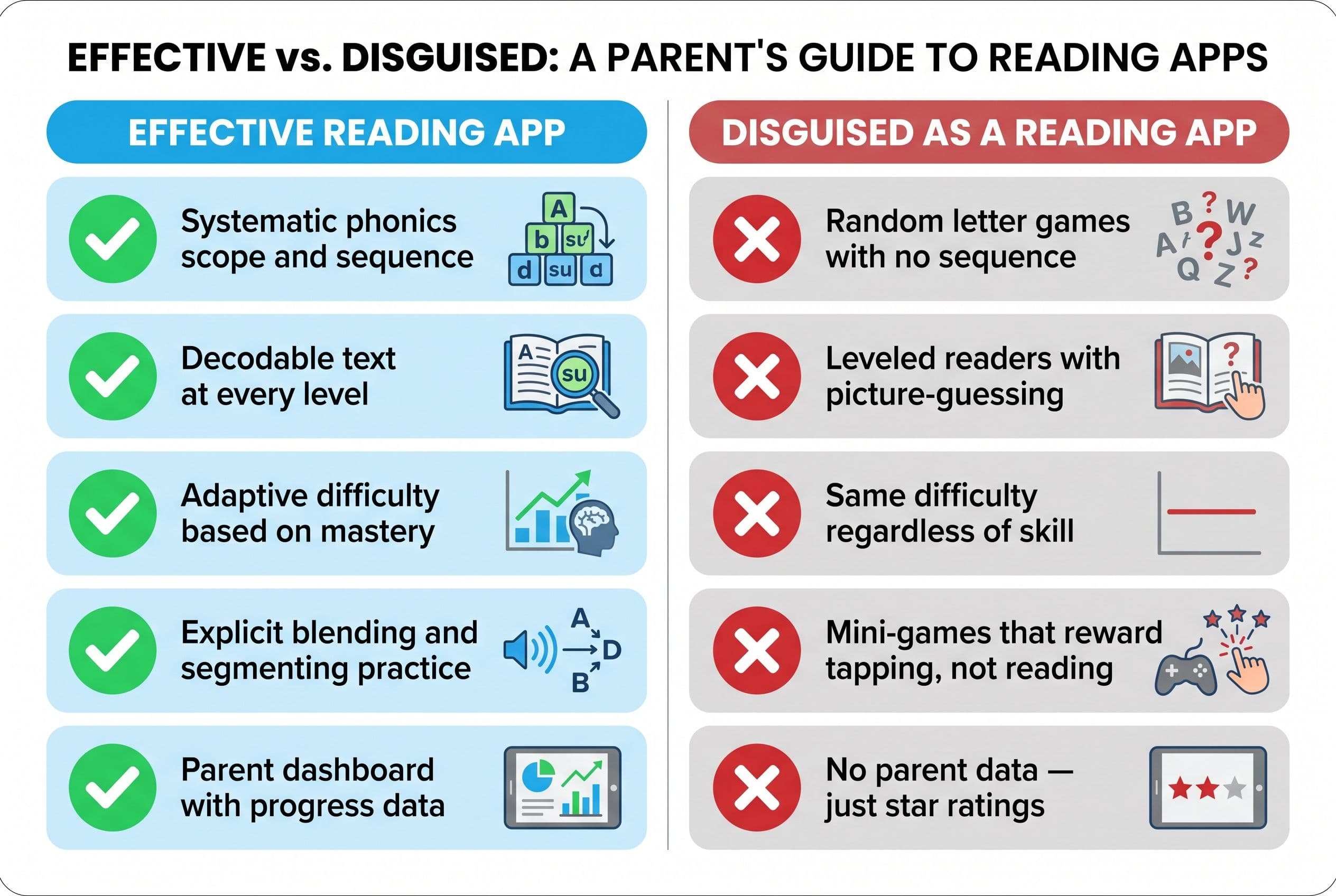
1. Systematic Synthetic Phonics The app must teach letter-sound correspondences (grapheme-phoneme correspondences, if you want the fancy term) in a logical sequence. Not random. Not "letter of the week." A structured scope and sequence that builds from simple CVC words (cat, sit, hop) to consonant blends, digraphs, vowel teams, and multisyllabic words.
David Kilpatrick's Equipped for Reading Success (2016) nails this — the research on orthographic mapping shows that kids need to connect sounds to letter patterns through phonemic proficiency. An app that skips this step is a toy, not a tool.
2. Decodable Text — Not Leveled Readers If the app has your kid reading stories where they have to guess words from context or pictures, close it. Delete it. Throw the iPad in a lake. (OK don't actually do that.)
Decodable readers use only the letter-sound patterns the child has already been taught. Leveled readers — like Fountas & Pinnell's system — throw in words the kid can't possibly decode yet and ask them to "use strategies" to figure them out. That's the three-cueing system. That's guessing. We don't guess in this house.
3. Adaptive Difficulty A 7-year-old behind in reading might be at a kindergarten level, a first-grade level, or somewhere in between. The app needs to meet your kid where they actually are — not where their age says they should be. Lexia Core5 Reading does this well; it adapts in real time based on performance data.
4. Explicit Blending Practice The app should force your kid to blend sounds together, not just identify individual letters. Knowing that "s" says /s/ is useless if they can't blend /s/ /i/ /t/ into "sit." This is where so many apps fail. They teach letters in isolation and never bridge to actual reading.
5. Progress Data for Parents You need to see what your kid is doing. Not just "Great job! 🌟" but actual data: which letter patterns they've mastered, where they're getting stuck, how many minutes they spent on task vs. how many minutes they spent watching animated rewards. If the app doesn't give you a parent dashboard with real data, it's hiding something.
The Red Flags
- Heavy reliance on picture clues. If there's a picture of a dog next to the word "dog" and the kid just matches image to word — that's not reading.
- More game time than instruction time. Some apps are 80% mini-games and 20% phonics. Flip that ratio or move on.
- No phonics scope and sequence. If you can't find a published scope and sequence on the app's website, they don't have one.
- "Whole word" memorization as the primary method. Sight word drills have a place — but only AFTER phonemic awareness and basic decoding are solid. Linnea Ehri's research on phases of word reading (2005) makes this crystal clear: kids move through pre-alphabetic, partial alphabetic, full alphabetic, and consolidated phases. You can't skip to the end.
My Picks: Best Reading Apps for a 7-Year-Old Behind in Reading
I've compared a lot of these. Here's my honest take.
Teach Your Kid to Read
This is the one I built with my co-founder because nothing else did what I needed. It's systematic synthetic phonics based on Orton-Gillingham principles — the same methodology used in the Wilson Reading System and Barton Reading & Spelling. It's designed for parents who want to be involved (yes, you), not as a babysitter.
The scope and sequence starts at letter-sound correspondence and builds through blending, CVC words, consonant blends, digraphs, r-controlled vowels, vowel teams — the whole thing. Decodable text at every stage. No guessing. No picture clues. No three-cueing garbage.
For a 7-year-old who's behind, you start wherever the gap is. If they don't have solid letter-sound automaticity yet, you start there — no shame, no judgment. My oldest needed to go back and shore up vowel sounds even though she "knew her letters." Knowing letter names isn't the same as knowing letter sounds. That distinction trips up almost every parent I talk to.
Lexia Core5 Reading
Used in about 1 in 4 U.S. schools. It's adaptive, research-backed, and aligned with Science of Reading principles. The downside? It's designed for school settings, and individual family licenses can be harder to get. Also, it works best with a teacher or parent reviewing the data — it's not truly self-guided for a struggling reader.
Nessy
Designed specifically for kids with dyslexia, ages 6 and up. It uses a multisensory approach aligned with Orton-Gillingham methodology. The games are engaging without being overstimulating, and it covers phonics, spelling, and reading comprehension. If your 7-year-old has dyslexia indicators (or you suspect they might), Nessy is a strong choice.
Hooked on Phonics
The app version uses a multisensory approach — music, videos, games, and decodable books. It teaches letter-sound relationships and blending systematically. It's simpler than Lexia or Nessy and works well for parents who want something their kid can do somewhat independently. The limitation: it may not be intensive enough for a significantly behind reader.
What About Reading Eggs, Homer, and ABCmouse?
I know these are popular. I know they have millions of downloads. But here's my issue: several of these apps lean heavily on engagement over instruction. They prioritize keeping your kid on the app (because subscription revenue) over systematic phonics progression. Some mix in whole-language approaches. Some use leveled text instead of decodable text.
Research from the National Literacy Trust in the UK found a correlation between reading printed books and stronger reading skills — kids who read print (exclusively or alongside screens) tended to have better reading outcomes than those who read only on screens. The medium matters. The method matters more.
If you're going to use an app, pair it with printed decodable readers. Bob Books, Flyleaf Publishing decodables, or High Noon Books are all solid options.
The App Is Not Enough: Xia's 7-Year-Old Reading Rescue Plan
I'm going to give you the same plan I give every parent who emails me in a panic because their 7-year-old is behind.
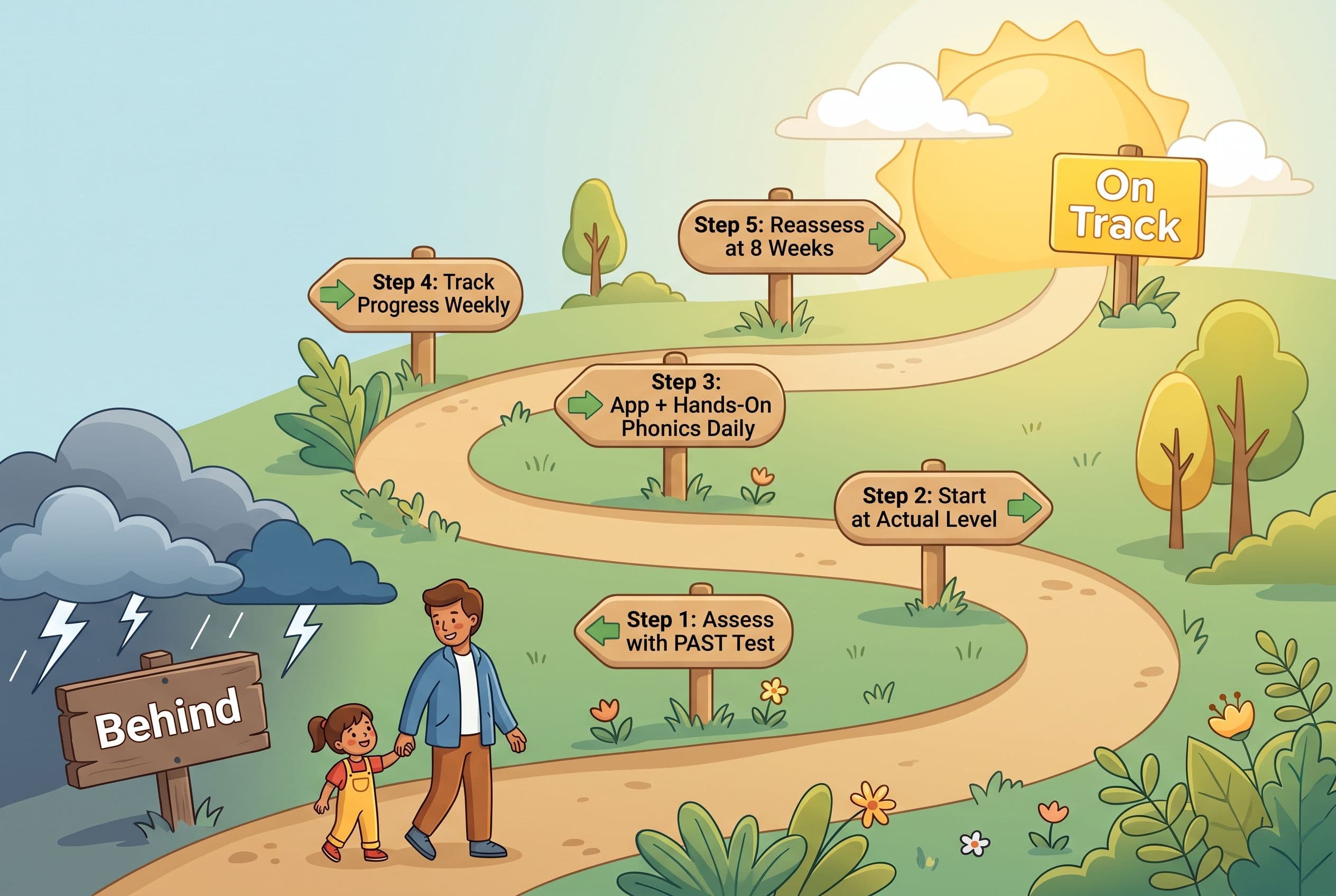
Step 1: Find Out Where They Actually Are
Don't guess. Don't assume. Use Kilpatrick's PAST test (Phonological Awareness Screening Test) — it takes about 5 minutes and tells you exactly where the phonological breakdown is. Is it at the syllable level? The onset-rime level? Individual phoneme manipulation? You need to know.
If you want formal benchmark data, ask your school about DIBELS assessment results or PALS (Phonological Awareness Literacy Screening). DIBELS nonsense word fluency benchmarks expect 28+ correct letter sounds per minute by mid-kindergarten. If your 7-year-old can't hit that, you know exactly how far back you need to go.
Step 2: Start the App at Their Actual Level (Not Their Age Level)
This is where pride kills progress. Your kid is 7. They're "supposed to be" in second grade. But if they can't blend CVC words reliably, they need to start at the CVC level — even if that feels like "going backward."
With Teach Your Kid to Read, you drop in at the right skill level and work forward. Fifteen minutes a day, minimum. Every day. Yes, weekends. Yes, holidays.
Tiger Rule #1: We Never Skip.
Step 3: Supplement with Hands-On Phonics (15 Minutes Daily)
The app handles the structured scope and sequence. But your kid also needs tactile, multisensory reinforcement away from the screen. Here's what I do with my 4-year-old (and what I did with my two oldest):
- Magnetic letter tiles on the fridge. Build the word. Break it apart. Rebuild it. Change one sound. "That says 'cat.' Change the /k/ to /b/. Now what does it say?" That's phoneme manipulation — the skill Kilpatrick's research shows is most predictive of reading success.
- Whiteboard dictation. I say a word, she writes it. No copying. She has to segment the sounds herself and match each sound to a letter. This is encoding — the flip side of decoding — and it strengthens orthographic mapping like nothing else.
- Decodable readers out loud. Not "look at the picture and guess." Sound. It. Out. Every word. Tiger Rule #2: No Guessing.
Step 4: Track Progress Weekly
Every Sunday night, I do a quick check. Can they read 5 new words they haven't practiced? Can they spell 3 words from dictation using patterns they've learned? How's their fluency — are they reading CVC words in under 3 seconds each, or still laboring?
If you're using Lexia Core5 or Teach Your Kid to Read, pull the data from the parent dashboard. Look for mastery, not just completion. Your kid clicking through a lesson doesn't mean they learned it.
Step 5: Reassess in 8 Weeks
Run the PAST test again. Compare. If they haven't moved up at least one level, something needs to change — more intensity, different approach, or a professional evaluation for a potential learning disability like dyslexia. The International Dyslexia Association estimates that 15-20% of the population has some symptoms of dyslexia. That's not rare. That's one in five kids.
Don't wait and see. Assess and act.
What About Schools? Aren't They Supposed to Handle This?
Look, I want to believe the system works. I really do.
But 40+ states have now passed Science of Reading legislation precisely because the system wasn't working. Mississippi's Literacy-Based Promotion Act of 2013 took them from 49th to 21st in national reading scores in 6 years — but only because they mandated evidence-based phonics instruction, universal screening, and retention for kids who couldn't read by third grade.
States across the country are passing new literacy laws — requiring evidence-based curricula, educator training, and universal K-3 literacy screening — but full implementation takes years. These are steps in the right direction. But your kid is 7 right now. They can't wait for policy to catch up.
Ohio's Third Grade Reading Guarantee means your kid could be retained if they can't pass the state reading assessment. Florida has a similar retention policy. These aren't scare tactics — they're real consequences that are happening to real kids this year.
You are your child's best reading teacher. An app is a tool that helps you do that job. But you are the teacher.
The One Thing Most Parents Get Wrong About Reading Apps
They treat the app like a tutor and walk away.
An app is not a tutor. A tutor responds to your child's facial expression when they're confused. A tutor notices that your kid is whispering the wrong sound under their breath before selecting the right answer. A tutor catches the pattern of errors that reveals the real gap.
The app delivers the content. You deliver the teaching.
Sit with your kid for at least the first 10 sessions. Watch what they do. Listen to how they blend. Notice which sounds they confuse (/b/ and /d/ is the classic one, but I also see a lot of /e/ and /i/ confusion). Then, when they do their app time independently, you review the data afterward.
Research on structured technology interventions with struggling early readers — including studies with second graders using assistive technology tools — consistently shows substantial improvement in reading skills. But here's what people skip over: those studies involved structured intervention with the technology, not free-play app time. The technology was a delivery mechanism for systematic instruction. Huge difference.
Vavasseur, Crochet, and Dempster (2016) found the same thing — struggling readers in grades 1-5 using iPad-based literacy interventions showed growth across all five areas of effective reading instruction, but the qualitative data pointed to engagement being highest when a teacher or parent was actively involved.
The app works with you. Not instead of you.
FAQs: Reading Apps for 7-Year-Olds Behind in Reading
Can a reading app really help my 7-year-old catch up?
Yes — if it's the right app used the right way. Multiple meta-analyses consistently show small-to-moderate positive effects from technology-based reading interventions for struggling readers. But the key word is "intervention," not "entertainment." The app needs systematic phonics instruction, decodable text, adaptive difficulty, and parent involvement. Handing your kid a random reading game won't cut it.
How do I know if my 7-year-old has dyslexia or is just behind?
Start with Kilpatrick's PAST test — it screens phonological awareness in about 5 minutes and identifies exactly where the breakdown is. If your child struggles with phoneme-level tasks (deleting, substituting individual sounds), that's a red flag for dyslexia. Ask your school for a DIBELS or PALS screening. If they stall, get a private evaluation from a reading specialist certified by the International Dyslexia Association. Don't wait for the school to "watch and monitor" for another year.
How many minutes a day should my 7-year-old use a reading app?
Fifteen to twenty minutes of focused, structured phonics app time daily is the sweet spot. More than that and you hit diminishing returns — attention fades, frustration builds, and you're just racking up screen time without learning gains. Pair those 15-20 minutes with 15 minutes of offline phonics practice (magnetic tiles, whiteboard dictation, decodable readers) for a total of 30-35 minutes of reading instruction per day.
What's the difference between a "reading app" and a "reading game"?
A reading app follows a systematic phonics scope and sequence, teaches blending and decoding explicitly, uses decodable text, adapts to your child's level, and provides parent-facing progress data. A reading game has cartoon characters collecting coins while occasionally tapping on letter sounds between mini-games. If the app doesn't have a published scope and sequence and a parent dashboard, it's a game. Games are fine for entertainment. They're not reading instruction.
Should I stop read-alouds and just use the app?
Absolutely not. Read-alouds build vocabulary, background knowledge, comprehension, and — honestly — the love of stories that makes a kid want to read. The Simple View of Reading (Gough & Tunmer, 1986) says Reading Comprehension = Decoding × Language Comprehension. The app builds the decoding side. Read-alouds build the language comprehension side. You need both. Read to your kid every single night — books well above their current reading level so they hear rich language and complex stories. Then use the app to build the decoding skills so they can eventually read those books themselves.
Part of these guides

Xia Brody
Co-Founder, Teach Your Kid to Read
Mom of 4 who has successfully taught her kids to read. Currently in the trenches with her 4-year-old while her two oldest (10 and 7) devour books on their own. Passionate about phonics-based methods and building a lifelong love of reading.
Related Articles
My First Grader Can't Read? The 90-Day Catch-Up Plan
If your 6-year-old is guessing at words, memorizing books, or melting down at the page, you don't have a motivation problem — you have an instruction problem. Here's the exact 90-day catch-up plan I'd run, starting tonight.
Read More →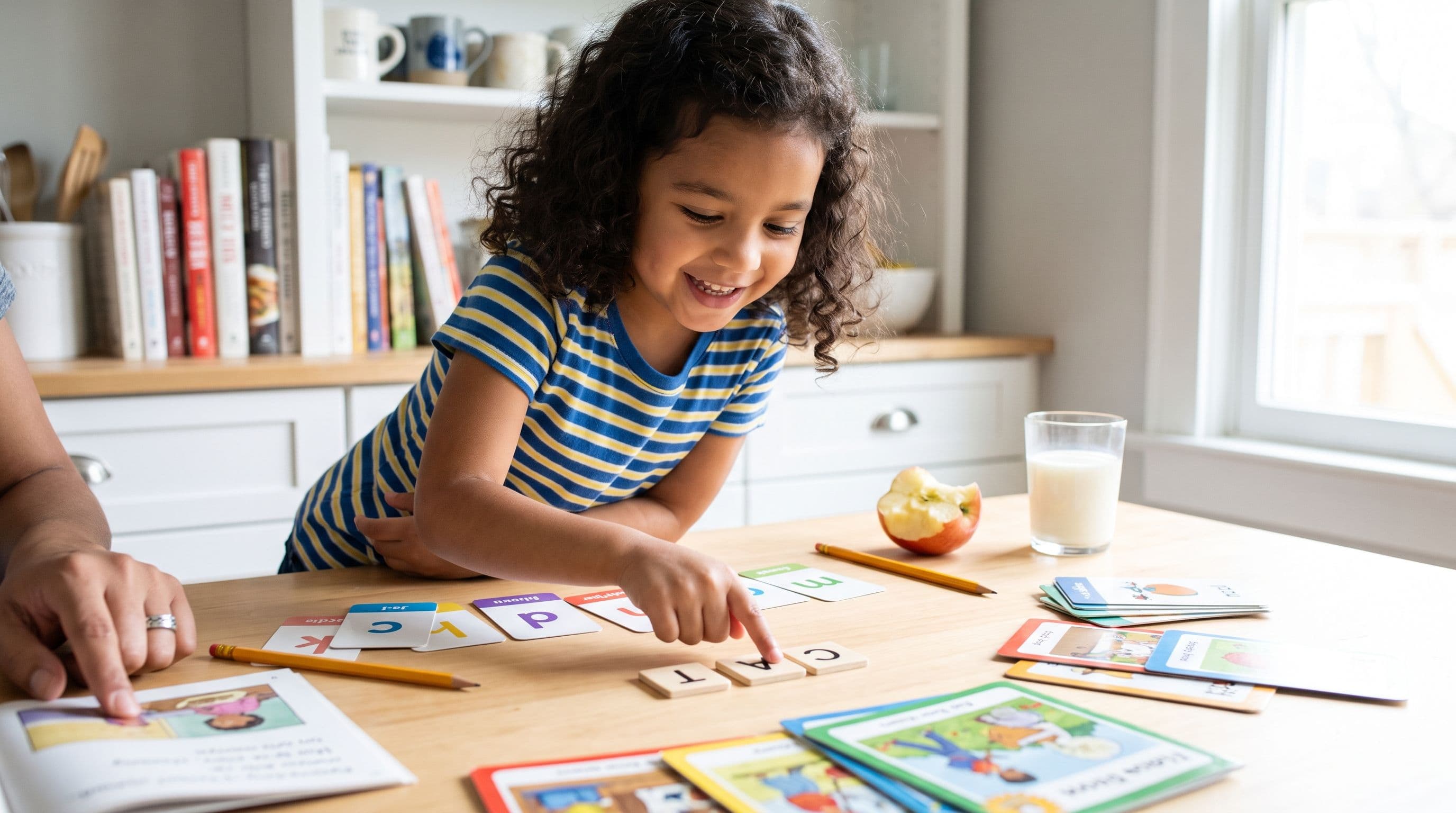
My 9 Year Old Can't Read: Parent Action Plan
If your 9-year-old can't read, don't wait for school to fix it someday. Here's how to check their reading level, stop guessing habits, and start a real phonics-based intervention at home.
Read More →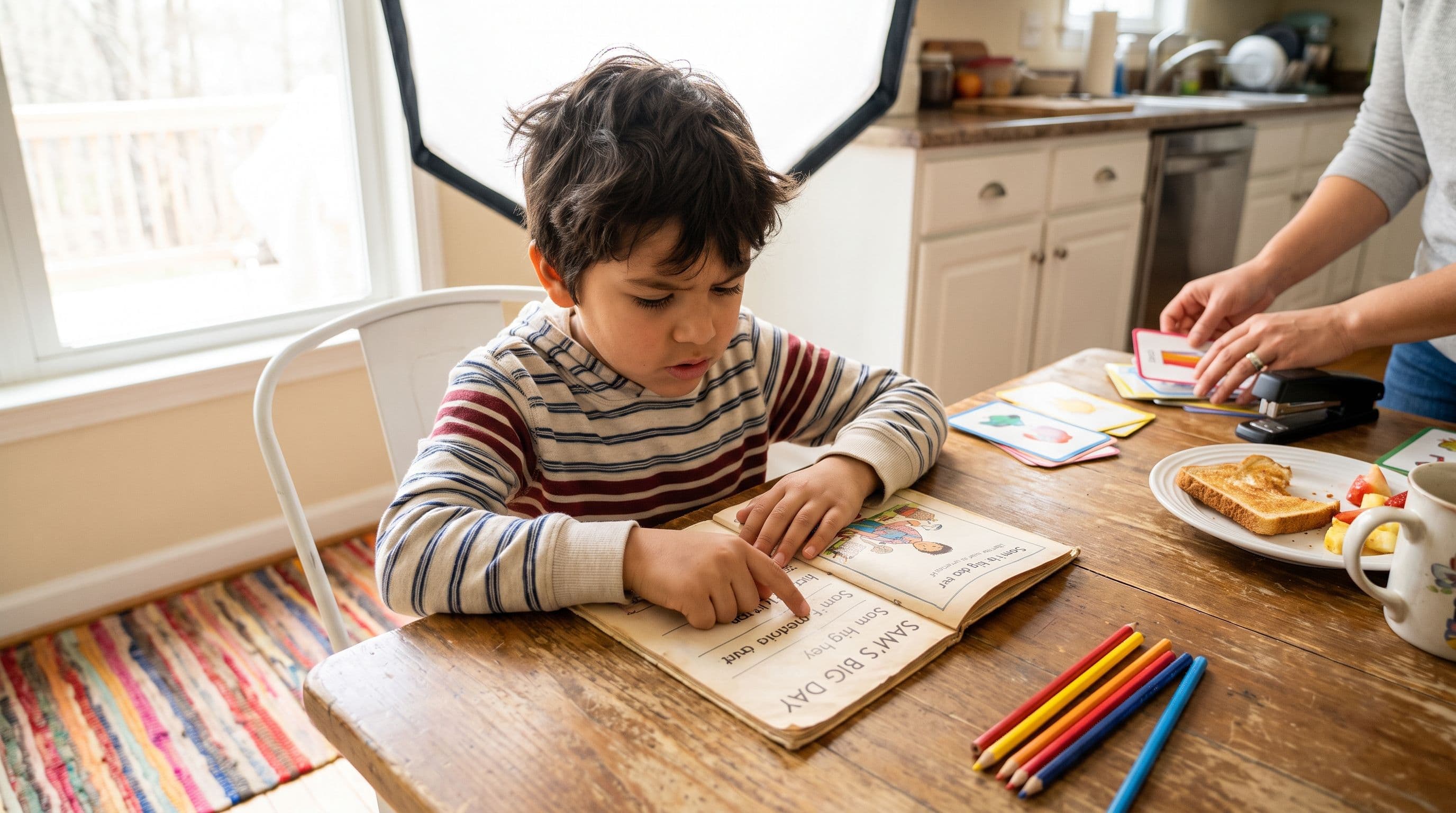
My 7 Year Old Can't Read: 9 Steps to Act Now
If your 7-year-old still can't read, don't panic—but don't wait. Here's how to check the gap, stop guessing habits, and start a real phonics plan at home.
Read More →