Best Reading App for a Struggling 6-Year-Old (2026): What Actually Works
What You'll Learn
- Why the most popular kids' reading apps are actually reinforcing the wrong reading habits — and the one red flag that gives it away in seconds
- The specific phonics methodology your struggling 6-year-old's brain needs (hint: it's the same approach that drove Mississippi's dramatic rise in national reading scores)
- How to tell the difference between a reading app that teaches real decoding and one that just teaches your kid to guess better
- A concrete 15-minute daily routine you can start tonight that pairs the right app with real-world practice
Your 6-Year-Old Is Struggling to Read. Let's Stop Dancing Around It.
Your kid is in first grade — or about to be — and something feels off.
Maybe they're memorizing books instead of reading them. Maybe they look at the picture of a dog and say "puppy" when the word on the page is "pup." Maybe the teacher said they're "developing at their own pace" and you nodded, but in your gut, you know that's code for "we're not going to do anything about this yet."
So you did what every modern parent does. You searched for the best reading app for a struggling 6-year-old.
And now you're drowning in options. ABCmouse. Homer. Hooked on Phonics. Reading Eggs. Teach Your Monster to Read. Epic. Endless Alphabet. The App Store has literally thousands of "reading" apps, and most of them have 4+ star ratings and glowing reviews from parents who — I say this with love — don't know what to look for.
Here's the thing. Most reading apps aren't teaching reading. They're teaching guessing. They're digital flash cards with cartoon wrappers. And if your child is already struggling, the wrong app doesn't just waste your time. It actively makes the problem worse by reinforcing the exact habits that got your kid stuck in the first place.
I know this because I've been exactly where you are — twice with my own kids, and dozens of times coaching other parents through it.
The Tiger Truth: What Happens If You Pick Wrong (or Do Nothing)
I'm not going to be gentle here, because gentle doesn't help your kid.
The 3rd Grade Cliff is real. Kids who can't read proficiently by the end of third grade are four times more likely to drop out of high school. That's not my opinion — that's from the Annie E. Casey Foundation's 2010 study, "Early Warning! Why Reading by the End of Third Grade Matters." Four times more likely.
And we're not talking about a small number of kids. The 2022 NAEP — the Nation's Report Card — showed that only 33% of fourth graders in the United States read at a proficient level. One in three. Let that hit you.
The 2022 NAEP scores also confirmed a 3-point drop since 2019 — the largest decline in over 30 years. The pandemic accelerated it, but let's be honest: the decline was already happening because most schools were using reading methods that don't work.
So what does this mean for your struggling 6-year-old right now?
It means the window is open. Wide open. A 6-year-old who's behind is not a lost cause — not even close. But a 6-year-old who stays behind for two more years? That kid hits third grade unable to read, and suddenly they're not "learning to read" anymore. They're supposed to be "reading to learn." Science. Social studies. Word problems in math. Everything depends on reading, and they can't do it.
Private reading intervention — a trained Orton-Gillingham tutor, for example — runs $10,000 to $15,000 a year. Insurance doesn't cover it. Most schools don't offer it until a child is already years behind, because the "wait and see" approach is baked into the system.
Your 6-year-old doesn't have time for "wait and see." And a bad reading app is just "wait and see" with a screen.
Why 90% of "Reading Apps" Are Garbage (Yes, Really)
I need you to understand something that changed everything for me when I first started teaching my oldest to read.
There are two fundamentally different philosophies about how kids learn to read:
Systematic phonics: Teach children the code. Letters represent sounds. You blend those sounds together to decode words. Most words are decodable when kids know the code — and even the tricky high-frequency words (like "said" or "one") become teachable when you map the sounds to the spelling explicitly. This is what the science supports — overwhelmingly, repeatedly, for decades.
Whole Language / Balanced Literacy / "three-cueing": Teach children to guess. Look at the picture. Think about what word would make sense. Look at the first letter and predict. This is what most American schools taught for 30 years. This is what Emily Hanford exposed in her 2022 APM Reports podcast "Sold a Story." And this is what most popular reading apps still do.
Here's how to spot the difference in about 10 seconds.
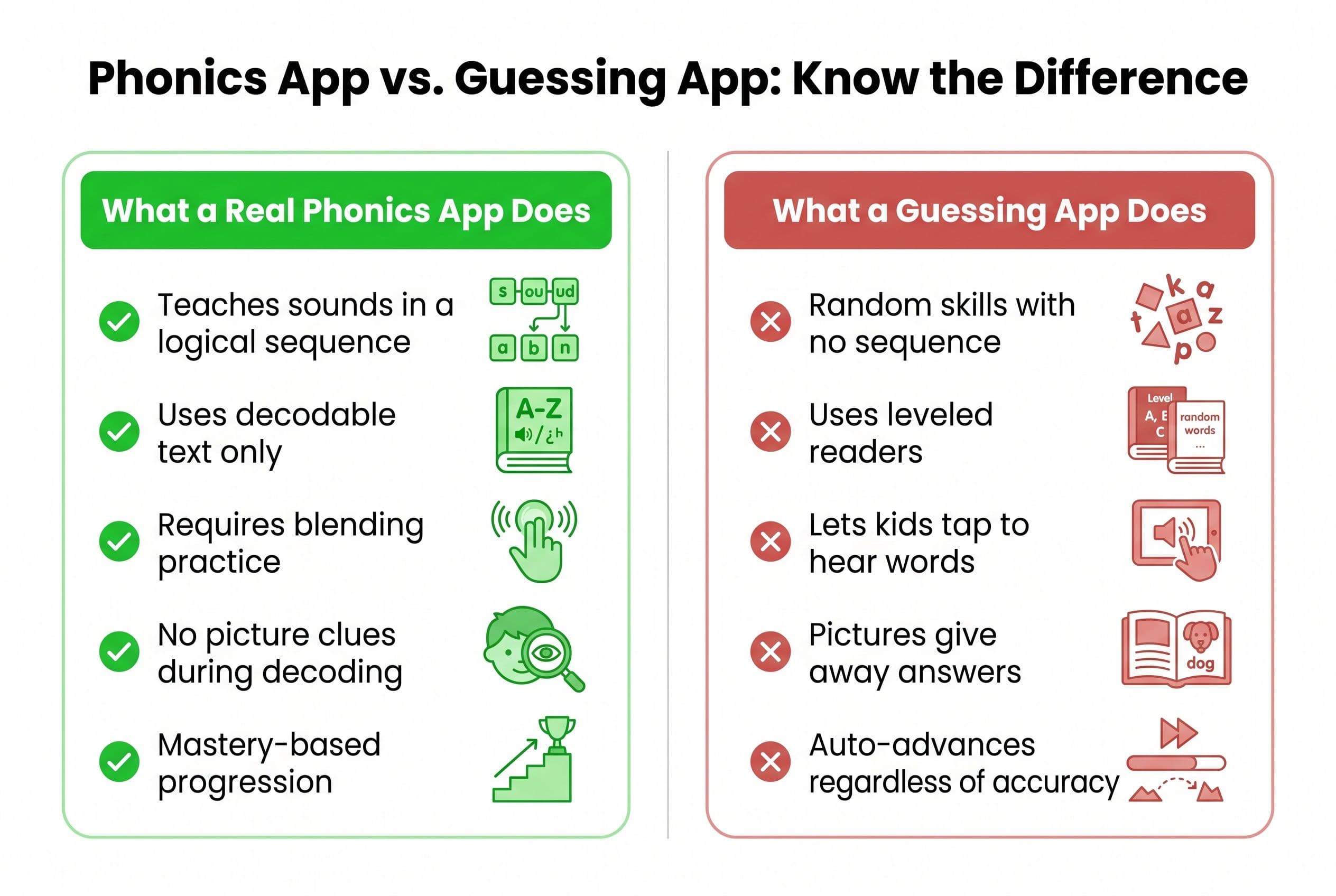
Open the app. Watch what happens when your child encounters a word they don't know. Does the app:
- Show a picture that gives away the word? That's guessing, not reading.
- Let the child tap the word and hear it read aloud? That's memorization, not decoding.
- Offer multiple choice with pictures? That's a matching game, not phonics.
Or does the app:
- Break the word into its sounds and ask the child to blend them? That's phonics.
- Teach specific letter-sound rules before asking the child to read words using those rules? That's systematic instruction.
- Use decodable text — sentences made mostly from sounds the child has already learned? That's how you build real skill.
The difference matters enormously. Stanislas Dehaene — he's a French neuroscientist who literally mapped how the brain learns to read — showed in his 2009 book Reading in the Brain that reading is NOT natural. The human brain has to be trained to connect visual symbols (letters) to sounds. It doesn't happen by osmosis. It doesn't happen by guessing. It happens through explicit, systematic phonics instruction.
The 2000 National Reading Panel report — the one Congress actually commissioned — reviewed a large body of reading research and concluded that systematic phonics instruction produces significant benefits for kids in kindergarten through 6th grade. Not "might help." Significant benefits.
So when you're looking at a reading app for your struggling 6-year-old, you're really asking one question: Does this app teach my child to decode, or does it teach my child to guess better?
The Playground Conversation That Changed a Mom's Mind
Last year I was at a playground in Raleigh when another mom — let's call her Jess — mentioned that her kid's school had just switched curricula. They'd dropped Lucy Calkins' Units of Study and moved to a Science of Reading-aligned program because of North Carolina's SB 387, the Excellent Public Schools Act.
Jess was confused. A little annoyed, actually. "He was doing fine before," she said about her second grader.
I asked if her son could read the word "splint."
She pulled him over. He stared at it. Couldn't do it. A seven-year-old who his mom thought was "doing fine" couldn't decode a one-syllable word with a consonant blend. He'd been surviving on memorization and picture clues, and nobody had flagged it because the old curriculum didn't test for real decoding — it tested for "reading behaviors" like pointing at words and making predictions.
I spent 20 minutes on that playground bench explaining why the switch was happening. The Hanford reporting. The NAEP data. The neuroscience from Dehaene's lab showing the brain doesn't learn to read naturally — it has to be explicitly taught the code. Jess went home and listened to the "Sold a Story" podcast that night. She texted me at 11pm: "I had no idea. Why didn't anyone tell us this sooner?"
I tell you this story because it's the same thing that happens with reading apps. Parents download something popular, see their kid tapping and swiping and "reading," and think it's working. But the child isn't decoding. They're guessing. They're memorizing. And the app is reinforcing the exact habits that make struggling readers struggle more.
Jess's son didn't need a new curriculum at school and a guessing-based app at home. He needed consistency. The right method everywhere — school, home, screen time.
Your struggling 6-year-old needs the same thing.
What the Best Reading App for a Struggling 6-Year-Old Actually Looks Like
Let me tell you exactly what I look for. These aren't preferences — they're non-negotiables backed by reading science.
1. Systematic Synthetic Phonics — Not Random Skills
"Systematic" means the sounds are taught in a specific, logical sequence. You don't throw all 44 English phonemes at a kid at once. You start with the most common consonants and short vowels, build CVC words (cat, sit, map), then layer in blends, digraphs, long vowels, and multi-syllable patterns.
This is how Orton-Gillingham works. It's how the Wilson Reading System works. It's how UFLI Foundations works. The best reading apps follow this same scope and sequence.
A random phonics app that teaches "th" one day and "igh" the next with no logical progression? That's not systematic. That's a grab bag.
2. Decodable Text — Not Leveled Readers
This one drives me crazy. Most reading apps use leveled text — the Fountas & Pinnell system or something similar. Those leveled readers are designed around Balanced Literacy. They include words the child hasn't been taught the phonics patterns for, which forces the child to... guess.
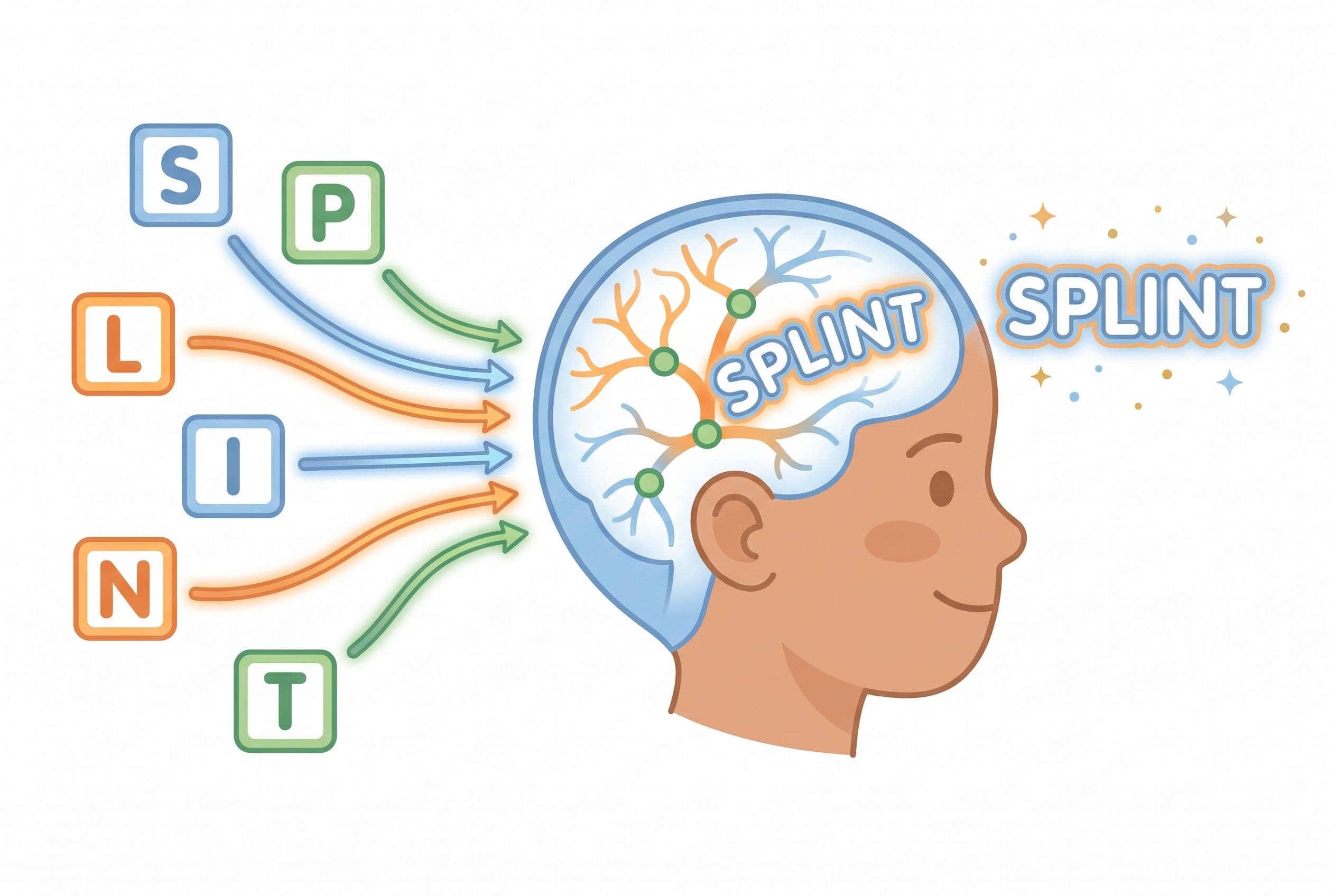
Decodable text is different. If your child has learned the sounds /s/, /a/, /t/, /p/, /i/, /n/, the book mostly uses words made from those sounds, plus a small set of explicitly taught high-frequency ("heart") words. "Sit, Pat, sit." "A pin is in a pan." It sounds boring. It IS boring. But your kid can actually READ every word on the page using the skills they've been taught. That's the whole point.
Real reading apps use decodable readers. Look for that feature specifically.
3. No Picture Clues for Decoding
If there's one red flag that tells me an app is teaching guessing, it's this: pictures that match the text so closely that a child can "read" without looking at the words.
Good phonics apps use pictures for comprehension AFTER the child has decoded the text — not as a crutch during decoding. There's a massive difference.
4. Blending Practice Built In
David Kilpatrick's research on orthographic mapping — laid out in his 2016 book Equipped for Reading Success — shows that the ability to blend and segment individual sounds (phonemic awareness) is the engine that drives word reading. Kids who can't blend /c/ - /a/ - /t/ into "cat" can't decode. Period.
The best reading app for a struggling 6-year-old drills blending explicitly. Not as an afterthought. As the core mechanic of the whole thing.
5. Progress Tracking That Shows Phonics Mastery, Not Screen Time
I don't care how many minutes your kid spent on the app. I care whether they mastered short-a CVC words before moving to short-i. An app that lets a child skip ahead or auto-advances regardless of accuracy is useless for a struggling reader.
The App I Actually Recommend: Teach Your Kid to Read
OK, I'm biased — I co-founded it. But I built this thing precisely because every other app failed my own kids on the criteria above.
Teach Your Kid to Read uses systematic synthetic phonics rooted in Orton-Gillingham principles. Here's what that looks like in practice:
- Explicit sound-by-sound instruction. Every lesson introduces specific grapheme-phoneme correspondences (that's the fancy term for "this letter makes this sound"). No guessing. No picture clues during decoding.
- Blending drills baked into every lesson. Your child doesn't just learn that "m" says /m/. They practice blending /m/ + /a/ + /p/ into "map" — over and over, with different word families, until it's automatic.
- Decodable reading practice. The stories use only the sounds your child has already mastered. They're reading real words on a real page. Not guessing from pictures. Not memorizing.
- Mastery-based progression. The app doesn't move forward until your child demonstrates accuracy. A struggling 6-year-old doesn't need speed. They need to get it right.
- A scope and sequence that mirrors what works in clinical reading intervention. The same progression you'd get from a $150/hour Orton-Gillingham tutor, delivered through an app your kid can use on the couch.
I had my 4-year-old practicing CVC words on this app last Tuesday at the kitchen table while I made dinner. She decoded "fig" independently for the first time and screamed "FIG! LIKE THE COOKIE!" That moment — when a child KNOWS they actually read a word, not guessed it — is everything.
How to Use a Reading App the Right Way: The 15-Minute Daily Plan
A reading app alone won't fix a struggling reader. I need you to hear that. But a good app, used consistently and paired with the right offline practice, can close gaps fast.
Here's the routine I use with my own kids and recommend to every parent I coach:
Step 1: Assess Where Your Child Actually Is (Day 1 Only — 10 Minutes)
Before you touch an app, figure out what your child can and can't do. You can use Kilpatrick's PAST (Phonological Awareness Screening Test) — it's available through various training resources and sites online, takes roughly 5–10 minutes depending on the child, and tells you exactly where the phonemic awareness breakdown is. Can they hear individual sounds in words? Can they blend sounds together? Can they segment? This is the starting line.
If you want something even quicker: ask your child to read these five words: sat, chip, best, slip, stump. No picture clues. No context. Just the words on a piece of paper. Where they break down tells you exactly what sounds to target.
Step 2: App Time — 10 Minutes, Every Single Day
Open Teach Your Kid to Read. Work through the lesson your child is on. Sit with them for the first few sessions. Watch how they respond. If they're guessing, gently redirect: "Don't guess. What sound does that first letter make?"
Tiger Rule: We Never Skip. Ten minutes on birthdays. Ten minutes on Christmas. Ten minutes on vacation. Consistency builds the neural pathways that Dehaene's research describes. Miss a day, lose momentum. Miss a week, you're re-teaching.
Step 3: Offline Practice — 5 Minutes of Real-World Decoding
After the app session, practice with physical materials. Magnetic letters on the fridge. A whiteboard. Flashcards with CVC words. A decodable reader from Flyleaf Publishing or the UFLI decodable reader sets.
The kicker is that the offline practice has to match what the app just taught. If the lesson covered the /sh/ digraph, your offline practice is writing and reading "ship, shop, shut, shed." Not random words. Not sight words. The exact phonics pattern from the lesson.
Step 4: Track Progress Weekly
Every Friday, I do a quick check. Can my kid read 5 words using the patterns we covered that week? If yes, move forward. If no, repeat the lessons. DIBELS benchmarks vary by edition and district, but by first grade most kids should be reading CVC and simple digraph words with growing fluency. If your child can't decode simple nonsense words and CVCs accurately, that's data — not a reason to panic, but a clear signal to keep drilling the code.
Red Flags: Apps That Will Waste Your Time (And Your Kid's Window)
I've tested a lot of apps. Here are the ones I steer parents away from and why:
- Apps that rely heavily on video content. Your kid is watching, not reading. Watching someone else read is not the same as decoding.
- Apps that reward "engagement" over accuracy. If your child gets coins, stars, or unlocks characters regardless of whether they got the phonics right, the app is optimizing for screen time, not learning.
- Apps based on Balanced Literacy or "three-cueing." If the app tells your child to "look at the picture for a clue" or "think about what word would make sense," close it. Delete it. Those are guessing strategies, and for a struggling reader, they're poison.
- Apps with no clear scope and sequence. If you can't find a document or screen that shows you exactly what sounds are taught in what order, the app wasn't designed by someone who understands reading science.
The 40+ states that have passed Science of Reading legislation since 2019 didn't do it because phonics was trendy. They did it because the evidence is overwhelming. Mississippi's 4th-grade NAEP reading scores improved dramatically after the state passed its Literacy-Based Promotion Act in 2013 — jumping from near the bottom of national rankings to 21st by 2019. The method works. Your app should use it.
But What About My Kid's Specific Situation?
I hear variations of this every week. Let me hit the most common ones.
"My 6-year-old knows all their letters but can't read words." That's a blending problem, not a letter knowledge problem. Linnea Ehri's phases of word reading development — from her 2005 meta-analysis — describe this as being stuck in the "partial alphabetic" phase. Your child recognizes letters but can't fully map all the sounds in a word. The fix is intensive blending practice. Sound by sound. /c/... /a/... /t/... "cat." The Teach Your Kid to Read app drills this exact skill.
"My kid reads at home but bombs the assessments at school." They might be memorizing books at home (reciting from memory, not decoding). Test this: show them a sentence they've never seen before with only CVC words. "The cat sat on a big red mat." Can they read it cold? If not, they're reciting, not reading. A phonics-based reading app forces real decoding because the content is always new.
"The school says he's fine but I know he's behind." Trust your gut. Schools using Fountas & Pinnell leveling systems often rate kids as "on level" when they're actually guessing their way through text. Ask the teacher a specific question: "Can my child decode unfamiliar words without picture clues?" If the answer is vague, you have your answer.
"She cries when I try to practice reading with her." This breaks my heart and I've been there. The crying usually means the child has been failing long enough to develop anxiety around reading. An app can actually help here — it removes the parent-as-teacher dynamic that triggers the stress. Let the app deliver the instruction. You sit nearby. You celebrate the wins. You don't correct — the app does that. Slowly, the association shifts from "reading = failure" to "reading = I can do this."
The Bottom Line on the Best Reading App for a Struggling 6-Year-Old
Look, I get it. You're a parent, not a reading specialist. You shouldn't have to know the difference between orthographic mapping and phonemic awareness to help your first grader read. But here we are in 2026, and the reality is that most schools are still catching up to the science, most apps are still built on debunked methods, and your kid is the one who pays the price.
The best reading app for a struggling 6-year-old is one that:
- Teaches systematic synthetic phonics
- Uses decodable text, not leveled readers
- Drills blending explicitly
- Requires mastery before moving on
- Doesn't let your child guess from pictures
That app is Teach Your Kid to Read. I built it because I couldn't find it anywhere else, and my own kids needed it.
Your 6-year-old is not "too young to worry about." They're not "a late bloomer." They're a kid whose brain is ready to learn the code — right now, today — if someone gives them the right tool and the consistency to use it.
Ten minutes a day. Every day. No skipping.
Start tonight. Your kid's reading life depends on the next 6 months more than any other window they'll ever have.
👉 Try Teach Your Kid to Read free at start lesson one free or call (407) 707-6850 with questions. Real humans answer. Usually me.
FAQ: Reading Apps for Struggling 6-Year-Olds
At what level should a 6-year-old be reading?
By age 6, most children should be able to decode simple CVC words (cat, sit, hop) independently and read short decodable sentences. DIBELS benchmarks indicate that by mid-first grade, a child should read approximately 23+ words correctly per minute on grade-level passages. If your 6-year-old can't blend three sounds together to read a simple word, that's a sign they need explicit phonics instruction — not more time.
Can an app really help a struggling reader, or do they need a tutor?
An app built on systematic synthetic phonics can absolutely help — if it follows the same instructional principles a good tutor would use. The key is that the app must teach sounds in a logical sequence, require blending practice, use decodable text, and demand mastery before advancing. Teach Your Kid to Read follows Orton-Gillingham principles, which is the same methodology used by clinical reading tutors. For kids with suspected dyslexia or severe reading difficulties, you may eventually want a trained specialist, but a strong phonics app paired with daily practice is an excellent first step — and often enough.
How much time should my 6-year-old spend on a reading app each day?
Ten to fifteen minutes of focused phonics practice is the sweet spot. More than that and most 6-year-olds lose focus, which leads to guessing and sloppy habits. Pair the app time with 5 minutes of offline practice — magnetic letters, a decodable reader, or a whiteboard — for a total of 15-20 minutes daily. Consistency matters more than duration. Ten minutes every single day beats 45 minutes twice a week.
What's the difference between a reading app and a phonics app?
A "reading app" is a broad category that includes everything from e-books to vocabulary games to story-listening apps. Many of these don't teach decoding at all — they just expose kids to text. A "phonics app" specifically teaches the relationship between letters and sounds and trains children to decode words. For a struggling 6-year-old, you need a phonics app — specifically one that uses systematic synthetic phonics, not random letter-sound games. Ask yourself: does this app teach my child to sound out words they've never seen before? If the answer is no, it's not a phonics app.
My child's school uses a reading app already. Should I use a different one at home?
It depends entirely on what the school app teaches. If the school is using a Science of Reading-aligned program — check if your state has passed legislation like Mississippi's Literacy-Based Promotion Act or North Carolina's SB 387 — the school app might be solid. But many schools still use apps rooted in Balanced Literacy methods. If the school app relies on picture clues, leveled readers, or three-cueing strategies, supplement at home with a systematic phonics app like Teach Your Kid to Read. Consistency in method matters more than consistency in platform.
Part of these guides

Xia Brody
Co-Founder, Teach Your Kid to Read
Mom of 4 who has successfully taught her kids to read. Currently in the trenches with her 4-year-old while her two oldest (10 and 7) devour books on their own. Passionate about phonics-based methods and building a lifelong love of reading.
Related Articles
Best Reading App for a 6-Year-Old with Dyslexia: 2026 Picks
If your 6-year-old with dyslexia is guessing at words, cute reading games won’t fix it. Here’s how to choose a structured literacy app that builds decoding skill instead of wasting precious time.
Read More →
Best Reading App for 3rd Graders Behind in 2026: Full List + Free Trial
Your 3rd grader is behind in reading and you're running out of time. Here's what the science says about which reading apps actually work — and which ones are expensive digital babysitters dressed up as 'learning tools.'
Read More →
Best Reading App for 2nd Graders Behind in 2026: Full List + Free Trial
Your 2nd grader is behind in reading and you need an app that actually works — not digital busy work. Here's a phonics-based ranking from a reading specialist mom who's helped her own kids catch up, plus warning signs you shouldn't ignore.
Read More →