Best Reading App for Kids with Dyslexia: 2026 Picks + What Actually Works
What You'll Learn
- Why 90% of "dyslexia reading apps" fail — and the one non-negotiable feature that separates real help from expensive screen time
- The specific phonics methodology backed by strong research showing measurable changes in how dyslexic brains process text (hint: it's not what most schools teach)
- How to spot the signs of dyslexia before your kid hits the 3rd Grade Cliff — and what to do the second you suspect it
- The reading app that uses Orton-Gillingham principles to build decoding skill letter by letter, sound by sound, no guessing allowed
Your Kid Isn't Lazy. The System Failed Them.
Let me guess. Your kid is smart — maybe even the sharpest one in the room. They can build LEGO sets from memory, explain how volcanoes work, and negotiate bedtime like a courtroom attorney.
But reading? Reading makes them cry.
They stare at the word "when" and say "went." They look at "house" and guess "home" because there's a picture of a building on the page. Their teacher calls it "using context clues." I call it what it is: guessing. And guessing is not reading.
If your child has dyslexia — or you suspect they might — you've probably already Googled "best reading app for kids with dyslexia" seventeen times and gotten a wall of shiny, cartoon-filled apps that promise miracles.
Here's the truth nobody wants to tell you: most of those apps are garbage.
They're built on the same Balanced Literacy philosophy that created the reading crisis in the first place. They reward guessing. They skip systematic phonics. They slap a "dyslexia-friendly" label on the same approach that's been failing kids for thirty years.
I'm done being polite about this.
The Tiger Truth: What Happens If You Do Nothing
I need you to sit with these numbers for a second.
The 2022 NAEP (The Nation's Report Card) showed that only 33% of 4th graders in the United States read at a proficient level. One in three. That means two out of every three kids in this country can't read well enough to learn from a textbook.
Now layer dyslexia on top of that.
The International Dyslexia Association estimates that 15-20% of the population has some symptoms of dyslexia — including slow or inaccurate reading, poor spelling, and difficulty with phonological processing. That's roughly 1 in 5 kids. And most of them don't get identified until 3rd grade or later, when the damage is already deep.
Kids who can't read by the end of 3rd grade are four times more likely to drop out of high school. That's not my opinion — it's from the Annie E. Casey Foundation's 2010 "Double Jeopardy" report.
The average private Orton-Gillingham tutoring session runs $75-$150 per hour. Most dyslexic kids need 2-3 sessions per week for 1-2 years. Do the math. That's $10,000 to $25,000. Insurance doesn't cover it. Most school districts won't provide it until a child is already 2+ years behind.
So what do parents do? They wait. They "give it time." They trust the school.
And the 3rd Grade Cliff gets closer every single day.
Stop waiting.
What Is Dyslexia, Really? (And What It Isn't)
Before we talk apps, let's get the science right. Because there's a lot of nonsense floating around.
Dyslexia is not a vision problem. Kids with dyslexia don't see letters backwards — that's a myth that needs to die. Stanislas Dehaene's Reading in the Brain (2009) proved that reading is a learned skill that requires the brain to repurpose a region called the visual word form area. In dyslexic readers, the neural pathways that connect sounds to letters don't develop automatically. The brain can learn to make those connections — but it needs explicit, systematic instruction to do it.
For most kids with dyslexia, the core bottleneck is phonological processing — specifically phonemic awareness and the ability to map sounds to print. They struggle to break words into individual sounds (phonemes), map those sounds to letters (graphemes), and then blend them back together into words. Some dyslexic kids also struggle with rapid naming speed, processing speed, or orthographic processing, but phonological deficits are the most common thread.
That's exactly why the right reading app matters so much. The wrong app lets your kid memorize word shapes or guess from pictures. The right app trains the phonological pathways that dyslexic brains need built from scratch.
Quick Signs of Dyslexia in Kids (Ages 4-7)
- Trouble rhyming — can't tell you that "cat" and "hat" sound alike
- Difficulty learning letter names and sounds — keeps mixing up b/d, p/q (after age 6)
- Avoids reading out loud or melts down when asked to try
- Guesses words based on the first letter or pictures instead of sounding them out
- Struggles to break a word into sounds ("What sounds do you hear in 'dog'?" — blank stare)
- Strong verbal ability but weak decoding — smart kids who "can't" read
If you're seeing three or more of these, don't wait for the school to test. Grab David Kilpatrick's PAST test (Phonological Awareness Screening Test) — it takes about 5 minutes and tells you exactly where the phonological breakdown is. You can administer it yourself at the kitchen table.
Why Most "Dyslexia Reading Apps" Are a Waste of Money
Here's where I get spicy.
The app stores are packed with reading apps that claim to help dyslexic kids. Most of them do one of three things wrong:
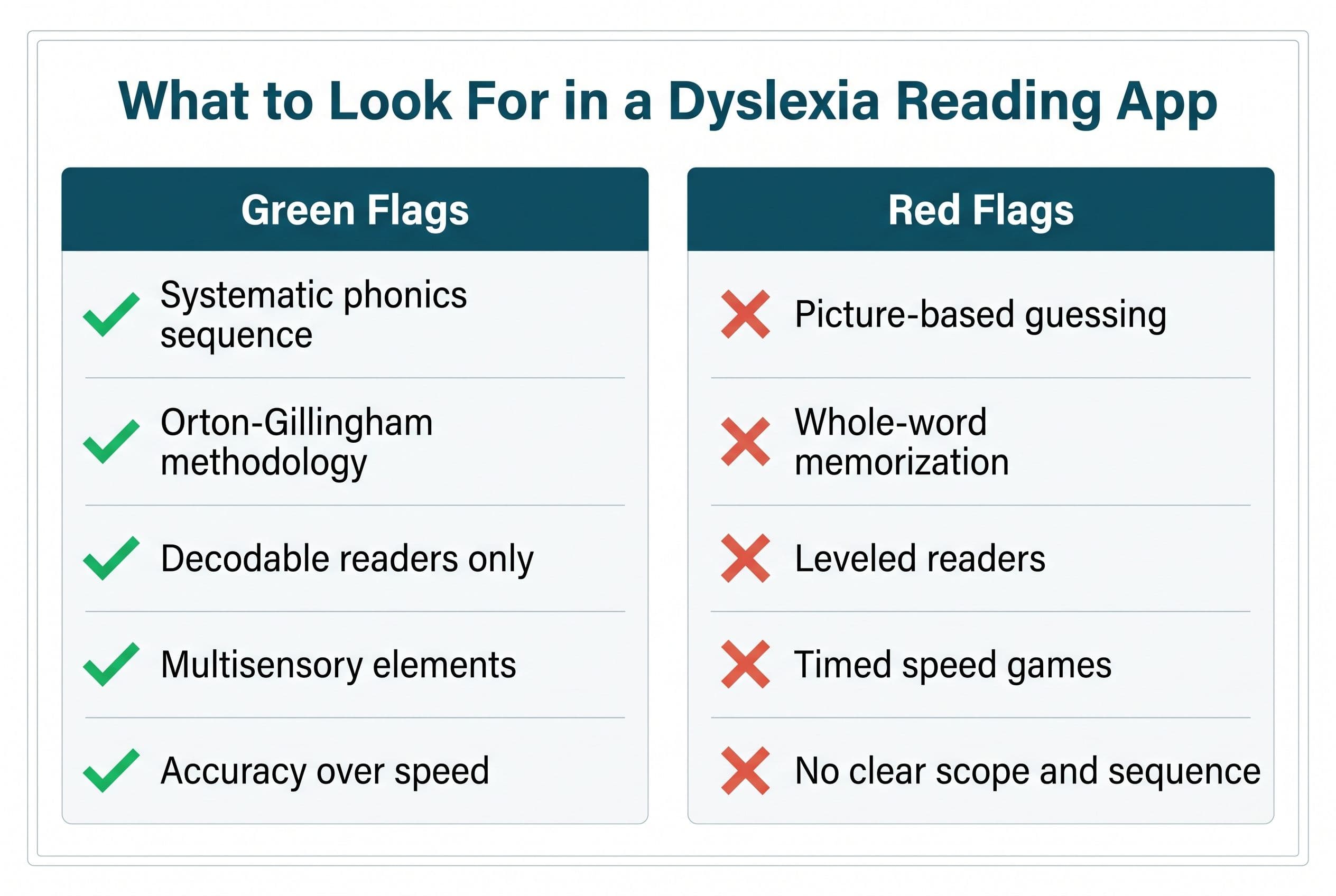
1. They use whole-word memorization. The app flashes a word, the kid taps the matching picture, and everyone gets confetti. That's not reading. That's a matching game. Dyslexic kids especially cannot rely on visual word memory — their brains need the phonological route. David Kilpatrick explained this in Equipped for Reading Success (2016): orthographic mapping — the process of storing words in long-term memory — depends on strong phonemic awareness. Skip that step, and nothing sticks.
2. They teach phonics out of order. They'll throw digraphs at a kid who hasn't mastered single letter-sound correspondence yet. Systematic means systematic. You don't teach "sh" before the kid can reliably decode "s" and "h" separately.
3. They reward speed over accuracy. Timed games, racing elements, point systems that push kids to rush. Know what a dyslexic child needs? The exact opposite. They need time to decode carefully, blend sounds, and self-correct. Speed comes later. Accuracy comes first.
Real talk — after Emily Hanford's Sold a Story investigation dropped, my neighbor called me almost in tears. She'd been a first-grade teacher for 18 years. Her entire career, she'd used Lucy Calkins' Units of Study curriculum — three-cueing, MSV, the whole guessing apparatus. She told me, "I've been teaching kids to guess for two decades and I didn't even know it."
She switched her classroom to UFLI Foundations mid-year. It was messy. She had to relearn everything herself first — phoneme-grapheme correspondence sequences, blending routines, the whole systematic scope and sequence. But by spring, her first graders' DIBELS NWF-CLS (Nonsense Word Fluency — Correct Letter Sounds) scores had jumped an average of 15 points in her class. One classroom, one anecdote — but she told me that was the first time in her career where every single kid could decode CVC words by February.
Every. Single. Kid. Including the ones she suspected had dyslexia.
That's what happens when you ditch guessing and use real phonics. Now imagine putting that same systematic approach into an app a parent can use at home.
What a Dyslexia Reading App Actually Needs (The Non-Negotiables)
If you're evaluating any reading app for a dyslexic child — or any struggling reader, honestly — here's your checklist. Don't compromise on any of these.
1. Orton-Gillingham Principles
The Orton-Gillingham approach has been the gold standard for dyslexia intervention since the 1930s. It's systematic (follows a logical sequence), explicit (nothing is left to chance), multisensory (see it, hear it, say it, write it), and cumulative (every lesson builds on what came before).
The International Dyslexia Association specifically recommends structured literacy approaches based on Orton-Gillingham principles. Programs like the Wilson Reading System, Barton Reading & Spelling, and Lindamood-Bell all follow this framework.
Your app should too. If it doesn't explicitly state that it follows systematic synthetic phonics or Orton-Gillingham methodology, walk away.
2. Systematic Phonics Sequence
The app must teach sounds in a controlled, deliberate order:
- Single consonants and short vowels first
- CVC words (cat, dog, sun)
- Consonant blends (bl, cr, st)
- Digraphs (sh, ch, th)
- Long vowel patterns (silent e, vowel teams)
- R-controlled vowels, diphthongs, and multisyllabic words
No skipping ahead. No random "word of the day." A kid with dyslexia needs the scaffolding even more than a typical learner.
3. Decodable Text (Not Leveled Readers)
This one drives me crazy. So many apps include "readers" that are actually Fountas & Pinnell-style leveled books packed with words the child hasn't been taught to decode. Those books require guessing. A dyslexic child handed a leveled reader is being set up to fail.
Look for apps that use decodable readers — stories built only from the letter-sound patterns the child has already learned. Decodable text forces decoding. That's the whole point.
4. No Picture Guessing
If the app shows a picture of a boat next to the word "boat" and counts it as "reading" when the kid taps the right image — that's not reading. It's a guessing game with extra steps. The app should require the child to decode the word independently before any image support.
5. Multisensory Elements
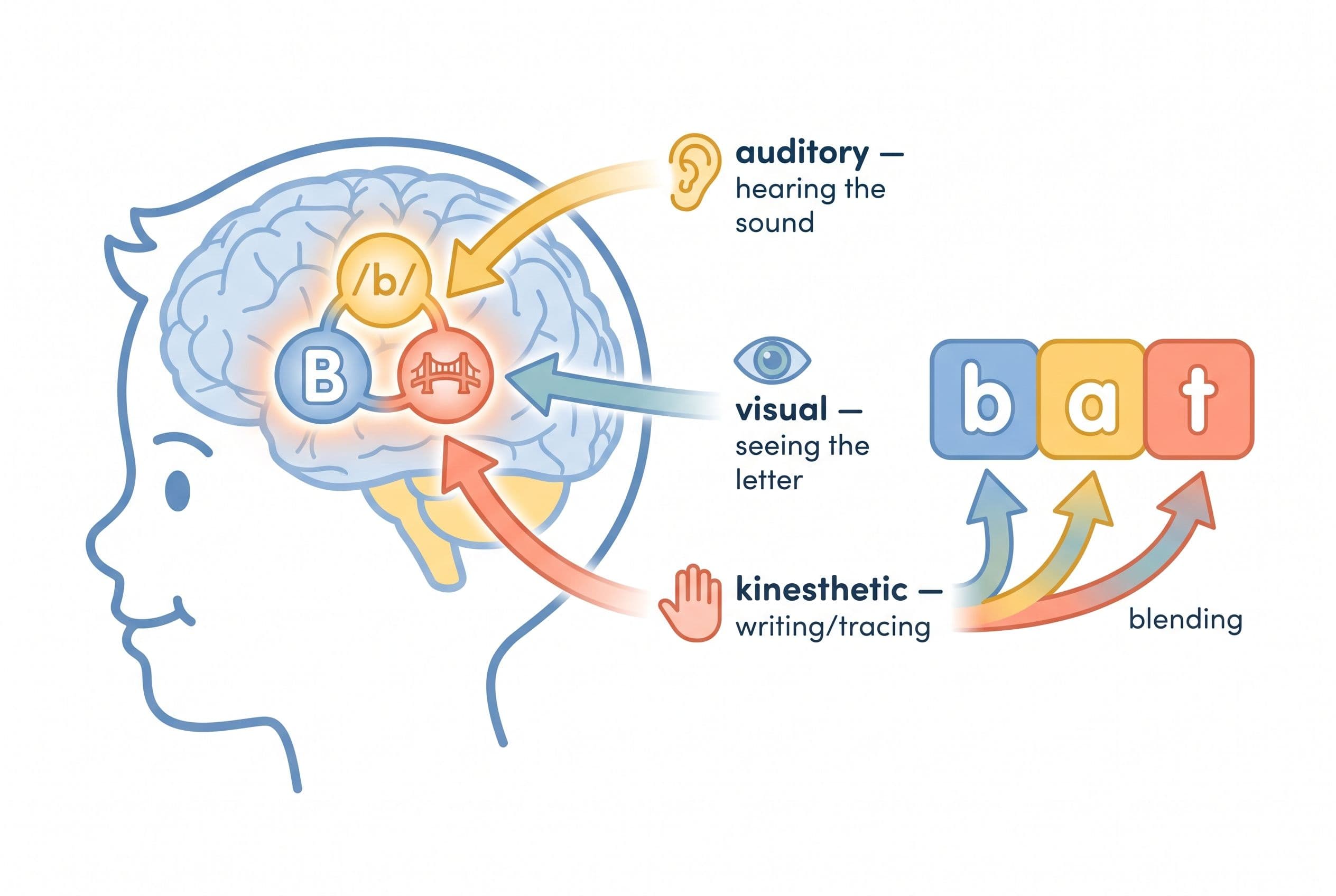
Dyslexic brains learn best when multiple pathways fire at once. Look for apps that combine:
- Visual: seeing the letter
- Auditory: hearing the sound
- Kinesthetic: tracing or tapping the letter
- Oral: saying the sound out loud
The 2026 Pick: Why Teach Your Kid to Read Stands Out
OK, I'm biased. I co-founded this company. But I'm biased because I built the thing I couldn't find anywhere else.
When I started teaching my oldest to read — he's 10 now — I tore through every app on the market. The flashy ones were all guessing games in disguise. The "educational" ones were boring worksheets on a screen. The Orton-Gillingham-based ones cost $40/month and required a parent to sit and administer every lesson like a tutor.
I wanted something different. Something that followed real reading science — the National Reading Panel report, Linnea Ehri's phases of word reading development, the Simple View of Reading (Gough & Tunmer, 1986) — but was actually usable for a busy parent with four kids and dinner to cook.
Teach Your Kid to Read is a phonics app built on Orton-Gillingham principles that teaches systematic synthetic phonics in a structured, sequential program. Here's what makes it different for dyslexic kids specifically:
No guessing. Ever. The app never shows a picture before the word is decoded. Your child sounds out every single word. There are no three-cueing shortcuts. No "look at the picture and think about what would make sense." Sound it out or try again.
Systematic scope and sequence. Every lesson builds on the last. The app follows the same logical progression used in clinical Orton-Gillingham tutoring — single letter sounds → CVC words → blends → digraphs → vowel patterns → multisyllabic words. A child with dyslexia can work through this sequence at their own pace, repeating lessons until mastery.
Decodable stories at every level. After each phonics unit, your child reads a story built exclusively from patterns they've already learned. No guessing required. No frustration. Just real decoding practice with real text.
Multisensory by design. The child hears the sound, sees the letter, and interacts with it on screen. We encourage parents to add a writing component — grab a whiteboard and have your child write the letters as they learn them. See it, hear it, say it, write it.
Built for daily practice. Lessons are short — 10 to 15 minutes. That matters. Louisa Moats' research (her 1999 paper Teaching Reading IS Rocket Science for the American Federation of Teachers) makes clear that struggling readers need consistent, daily practice in small doses. Marathon sessions don't work. Short, focused, every single day does.
And yes — we never skip. Not on birthdays. Not on vacation. Ten minutes. Every day. That's the Tiger Rule.
How to Actually Use a Reading App for a Dyslexic Child (Step-by-Step)
Downloading the app is step one. Here's the rest.
Step 1: Get a Baseline
Before you start, figure out where your child is right now. You can use Kilpatrick's PAST test at home — it screens phonological awareness in about 5 minutes and tells you whether the breakdown is at the syllable level, onset-rime level, or individual phoneme level.
If your child is in school, ask for their DIBELS scores. Benchmarks vary by DIBELS edition (6th vs. 8th) and by the specific subtest — so ask your school which version they use and compare to that edition's benchmark table. As a rough guide, the DIBELS 8th Edition NWF-CLS benchmark is around 28+ correct letter sounds per minute by mid-kindergarten. If your kid is well below benchmark, they need intervention — not "more time."
Step 2: Start at the Beginning (Even If It Feels "Too Easy")
I don't care if your child is 7 and "knows their letters." If they have dyslexia indicators, start at single letter-sound correspondence. Here's why: many dyslexic kids have shaky letter-sound automaticity. They "know" the sounds but can't access them quickly or reliably. Going back to the foundation isn't going backwards — it's filling cracks before the whole thing collapses.
With Teach Your Kid to Read, the app will guide this progression. Trust the sequence.
Step 3: Practice Every Single Day
10-15 minutes. Non-negotiable. I had my 4-year-old practicing CVC words at the kitchen table last Tuesday while her baby brother threw Cheerios at the dog. It wasn't glamorous. But she decoded "pig" for the first time and screamed "I DID IT!" loud enough to scare the cat.
That moment? That's what daily practice builds toward.
Consistency beats intensity every time. The Clackmannanshire study (Johnston & Watson, 2005) out of Scotland — 7 years of longitudinal data — showed that kids who got systematic synthetic phonics instruction maintained their advantage over analytic phonics kids for years. Daily, systematic, explicit. That's the formula.
Step 4: No Guessing Allowed
This is my biggest rule, and it matters double for dyslexic kids.
When your child gets stuck on a word, do NOT say "look at the picture" or "what would make sense?" Instead:
- Point to each letter
- Have them say each sound
- Help them blend the sounds together
- If they can't, model it: "/c/ /a/ /t/ — cat!"
- Then have them do it independently
Every time you let them guess, you're reinforcing the exact neural pathway that doesn't work for dyslexic readers. You're training them to use context instead of decoding. Stop it today.
Step 5: Track Progress Monthly
Every 4-6 weeks, reassess. Use the PAST test again or check DIBELS benchmarks. You should see measurable progress — more sounds identified, faster blending, more words decoded accurately.
If you're not seeing movement after 8-12 weeks of daily practice, that's when I'd recommend adding a human Orton-Gillingham tutor or exploring clinical programs like Barton Reading & Spelling or the Wilson Reading System. An app is a powerful daily practice tool, but some kids with severe dyslexia need the additional support of a trained specialist.
What About Other Apps? A Quick Honest Comparison
I'm not going to pretend other apps don't exist. Here's my take on what's out there in 2026:
Explode the Code Online: Based on the classic workbook series. Decent phonics sequence, but limited multisensory elements. Better as a supplement than a primary tool.
Reading Horizons: Uses a systematic approach and has a "marking system" for vowel sounds that some dyslexic kids find helpful. Pricey for individual families — it's really designed for schools.
Logic of English: Technically a curriculum, not an app, but their Foundations program is outstanding for dyslexic learners. Requires heavy parent involvement. If you have the time, it's the real deal.
Apps to AVOID: Anything that uses leveled readers as its core, anything that rewards speed over accuracy, and anything that lets kids tap pictures to "read" words. I won't name names (OK fine — I will: most of the top-10 "kids reading apps" in the App Store fall into this category). If the app description says "learn to read through stories" without mentioning systematic phonics, run.
The bottom line: Teach Your Kid to Read gives you Orton-Gillingham-based systematic phonics in a format that's affordable, daily-practice-friendly, and doesn't require you to become a reading specialist yourself.
The Policy Landscape Is Finally Catching Up
Here's some genuinely good news. Over 40 states have passed Science of Reading legislation since 2019. Mississippi's Literacy-Based Promotion Act of 2013 is often held up as the poster child — following a package of reforms that included mandated phonics-aligned instruction, coaching, and early screening, Mississippi's 4th-grade NAEP reading scores climbed from near the bottom to the middle of the pack between 2013 and 2019. Multiple factors contributed, but the results showed what's possible when a state gets serious about structured literacy.
Ohio's Third Grade Reading Guarantee, Colorado's READ Act, Florida's Just Read, Florida! initiative — states are finally acknowledging that the way we've been teaching reading doesn't work, especially for kids with dyslexia.
But here's the kicker: these laws change what happens in schools. Your kid spends maybe 90 minutes a day on reading instruction in a classroom of 25 kids. What happens during the other 22.5 hours? That's on you.
An Orton-Gillingham-based app at home isn't a replacement for school — it's the safety net that catches your kid when the system drops them. And for dyslexic kids, the system drops them constantly.
FAQ: Best Reading App for Kids with Dyslexia
How do I know if my child has dyslexia or is just a late reader?
Late readers usually catch up with a bit of extra phonics instruction. Dyslexic readers don't — the gap widens over time. Key red flags: persistent difficulty with rhyming, inability to segment words into individual sounds (phonemic awareness), slow letter-sound recall, and a big gap between verbal intelligence and reading ability. If your gut says something's off, grab Kilpatrick's PAST test and screen at home. Don't wait for the school to refer — that process can take a year or more.
At what age should I start using a dyslexia reading app?
As soon as you suspect a problem. The NICHD (National Institute of Child Health and Human Development) research by Reid Lyon showed that early intervention — before age 7 — is dramatically more effective than waiting until a child is formally diagnosed. You can start phonological awareness activities at age 3-4 and move into systematic phonics by age 4-5. Teach Your Kid to Read is designed for this early window.
Can an app really help a child with dyslexia, or do they need a tutor?
Both, ideally. A systematic phonics app like Teach Your Kid to Read provides the daily, consistent practice that dyslexic brains need. Think of it as physical therapy for the reading brain — short sessions, every day, building neural pathways. For mild to moderate dyslexia, an evidence-based app plus a parent who follows the no-guessing rules can make enormous progress. For severe dyslexia, I'd add a trained Orton-Gillingham tutor (look for someone certified through the Wilson Reading System or Barton Reading & Spelling) for weekly sessions, with the app filling in the daily practice.
What's the difference between a "phonics app" and an "Orton-Gillingham app"?
All Orton-Gillingham programs use phonics, but not all phonics apps follow Orton-Gillingham methodology. The difference is structure: OG is systematic (follows a specific scope and sequence), explicit (directly teaches every rule), multisensory (engages visual, auditory, and kinesthetic pathways), and cumulative (every lesson reviews and builds on previous ones). A random phonics app might teach "a says /æ/" but then jump to irregular sight words with no logical progression. For dyslexic kids, that randomness is a disaster. They need the scaffolding.
How long until I see improvement?
With consistent daily practice (10-15 minutes, no skipping), most families report noticeable improvement within 6-8 weeks. That means more accurate decoding, less guessing, and fewer meltdowns during reading time. Full "grade-level" reading fluency takes longer — often 6-18 months depending on the severity of dyslexia and how early you start. Track progress with monthly PAST screenings or DIBELS benchmarks so you can see the gains even when they feel slow.
Stop Waiting. Start Today.
Look, I get it. The word "dyslexia" is scary. It feels like a label that means your child is broken.
Your child is not broken.
Their brain just needs a different path to the same destination. And that path has a name — it's called systematic synthetic phonics, grounded in Orton-Gillingham principles, delivered consistently, every single day.
Mark Seidenberg wrote in Language at the Speed of Light (2017) that the reading education establishment has failed an entire generation of kids by ignoring what cognitive science knows about how the brain learns to read. He was talking about all kids, but dyslexic kids bear the heaviest cost of that failure.
You don't have to wait for the school. You don't have to spend $20,000 on private tutoring. You don't have to sit in that parent-teacher conference one more time and hear "let's give it more time."
You can start right now.
Teach Your Kid to Read gives your child systematic, Orton-Gillingham-based phonics instruction — the same methodology used in the most effective dyslexia interventions on the planet — in a 10-minute daily app that works at your kitchen table, in the car, or wherever your life happens.
No guessing. No shortcuts. Just real reading skill, built sound by sound.
Ready to get started? Download Teach Your Kid to Read at our reading programs or call us at (407) 707-6850 with questions. We're real people and we answer the phone.
Because your dyslexic kid doesn't need more time. They need the right method. And they need it today.
Part of these guides

Xia Brody
Co-Founder, Teach Your Kid to Read
Mom of 4 who has successfully taught her kids to read. Currently in the trenches with her 4-year-old while her two oldest (10 and 7) devour books on their own. Passionate about phonics-based methods and building a lifelong love of reading.
Related Articles
Reading App vs Tutor for Dyslexia: 2026 Cost Guide + What Actually Works
Dyslexia tutoring runs $60-$150/hour. Reading apps cost $10-$30/month. But which one actually teaches your kid to read? Here's the honest 2026 cost breakdown — and what the research says about when an app is enough and when it's not.
Read More →
Best Reading App for Struggling Readers in 2026 (Honest Reviews + What Actually Works)
Most reading apps for kids are glorified games that teach guessing, not reading. Here's what a phonics-obsessed homeschooling mom of four actually recommends for struggling readers in 2026 — and why the science behind the app matters more than the star ratings.
Read More →
Dyslexia Reading Curriculum: 7 OG Programs Compared for 2026
Your child has dyslexia and the school's 'wait and see' approach is burning months you don't have. Here are 7 Orton-Gillingham-based reading curriculum programs for dyslexia compared head-to-head for 2026 — by a homeschooling mom who's actually used them.
Read More →