Dyslexia Reading Curriculum: 7 OG Programs Compared for 2026
What You'll Learn
- The single methodology backed by 40+ years of research that actually works for kids with dyslexia — and why most schools still aren't using it
- 7 Orton-Gillingham-based programs broken down side-by-side so you can stop Googling at midnight and just pick one
- The hidden cost trap most parents fall into when choosing a dyslexia reading curriculum (hint: the most expensive option isn't always the best)
- Exactly how to test where your child is right now — a quick assessment you can do at your kitchen table tonight
The Reality No One Tells You at the IEP Meeting
Your kid's school just told you they're "monitoring" your child's reading. Maybe they threw around phrases like "developmental lag" or "he'll catch up" or my personal favorite, "every child learns at their own pace."
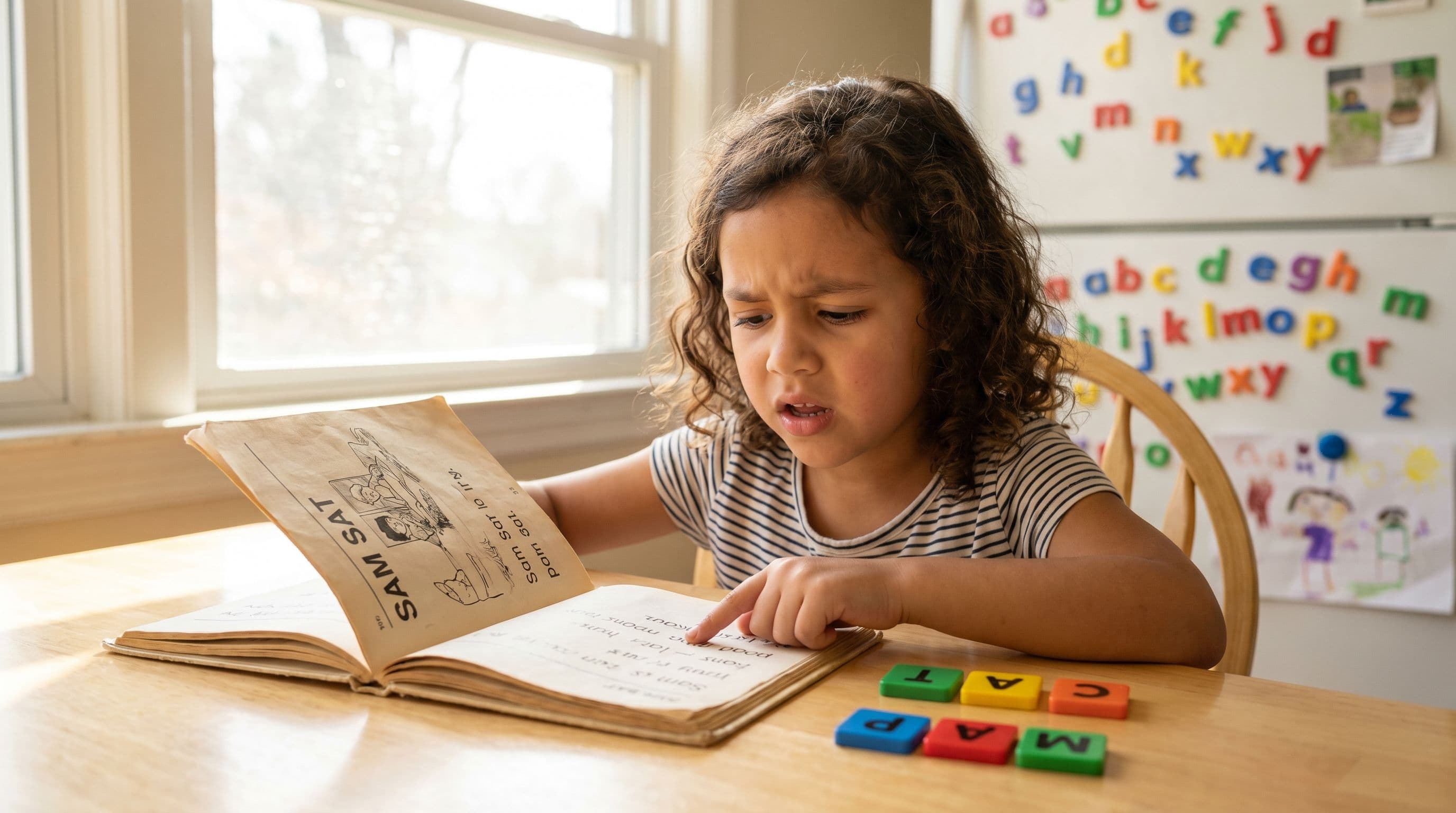
Meanwhile, your kid is in second grade and can't read the word "ship" without guessing "boat" because there's a picture of a sailboat on the page.
That's not reading. That's a parlor trick. And it's failing your child.
Here's what I know from teaching four of my own kids and coaching hundreds of parents through our work at Teach Your Kid to Read: if your child has dyslexia — or even suspected dyslexia — you cannot afford to wait. The "wait and see" approach is a lie wrapped in good intentions, and it costs kids years they'll never get back.
I'm Xia Brody, and I've been in the structured literacy trenches since my oldest was 4. I've compared more reading curriculum for dyslexia than any sane person should. This comparison is the article I wish existed when I started.
The 3rd Grade Cliff Is Real — and Dyslexic Kids Hit It Harder
Let me hit you with numbers that should make your stomach drop.
Only 33% of 4th graders read at a proficient level on the 2022 NAEP — that's the Nation's Report Card. One in three. And for kids with dyslexia? The odds are even worse unless someone intervenes early with the right methodology.
The Annie E. Casey Foundation's 2010 study found that kids who can't read proficiently by 3rd grade are 4 times more likely to drop out of high school. Four times. That's not a scare tactic. That's data.
And the financial hit? The average private Orton-Gillingham tutor charges $75-$150 per hour. Most kids need 2-3 sessions per week for 1-2 years. Do the math — you're looking at $10,000 to $30,000 out of pocket. Insurance doesn't cover it. Most school districts won't provide it unless you fight through due process hearings that take months.
So what do you do?
You learn the methodology yourself. You pick the right program. And you teach your kid at home — even if it's just 15-20 minutes a day on top of whatever the school is (or isn't) doing.
That's exactly why I wrote this comparison for 2026.
Why Orton-Gillingham? The Science in 60 Seconds
Before we compare programs, you need to understand why every single one on this list shares the same DNA.
Orton-Gillingham (OG) isn't a program. It's an approach — a methodology developed in the 1930s by Dr. Samuel Orton (a neuropsychiatrist) and Anna Gillingham (an educator). It's multisensory, systematic, explicit, and sequential. That means kids see it, say it, hear it, and write it — every single lesson, in a specific order that builds on what came before.
Why does this matter for dyslexia?
Stanislas Dehaene's Reading in the Brain (2009) — he's a French neuroscientist — showed that reading is a learned skill, not something brains come pre-wired to do like speech. Through what Dehaene calls "neuronal recycling," the brain builds a specialized reading network (including the visual word form area) by learning to link print to speech and meaning. For dyslexic kids, building that network is harder. The neural connections that map letters to sounds don't form as easily.
OG-based instruction attacks this head-on. It's the equivalent of physical therapy for the reading brain — repetitive, structured, explicit. No guessing. No "look at the picture and see if you can figure it out." Sound it out. Every. Single. Time.
David Kilpatrick's Equipped for Reading Success (2016) digs into the orthographic mapping research that explains exactly why this works. Most dyslexic readers struggle primarily with phonological processing — the ability to manipulate individual sounds in words — and often with naming speed and automaticity too, which makes accurate, fluent word reading hard without explicit instruction. OG programs drill these skills relentlessly until those neural connections solidify.
The 40+ states that have passed Science of Reading legislation since 2019? They're essentially codifying what OG practitioners have known for 90 years. Mississippi posted some of the largest NAEP 4th-grade reading gains in the 2010s after major literacy policy changes — including their 2013 Literacy-Based Promotion Act, which centered early intervention and phonics-based instruction. That kind of result was built on this exact foundation.
OK. Enough background. Let's compare programs.
7 Orton-Gillingham-Based Programs Compared for 2026
I'm ranking these based on five factors that actually matter to parents teaching at home:
- Ease of parent use — Can you open it and teach without 40 hours of training?
- Dyslexia-specific design — Was it built for struggling readers or adapted after the fact?
- Multisensory depth — Does it truly engage visual, auditory, and kinesthetic pathways?
- Cost — What's the real price tag for the full program?
- Evidence base — Is there research behind it, or just marketing?
1. Barton Reading & Spelling System
Best for: Parents with zero teaching background who need maximum hand-holding
The rundown: Susan Barton designed this program specifically for non-professional tutors. It's basically Orton-Gillingham in a box with a script. You don't have to think. You read the tutor instructions verbatim, follow the sequence, and the program does the heavy lifting.
There are 10 levels, each building on the last. It uses colored tiles for phoneme manipulation — the kinesthetic piece is baked in, not optional. Every lesson follows the same structure: review, new concept, practice, dictation.
What I love: The screening test is free on their website. It takes 10 minutes and tells you immediately if your child is ready for Level 1 or needs pre-reading work first. The scripted lessons mean you literally cannot mess this up. I've recommended Barton to parents who told me "I'm not a teacher" and watched their kids make real gains.
What bugs me: It's expensive — it's priced per level (check Barton's site for current pricing), and you need all 10 for the complete program. And it's tile-based, not workbook-based, so there's less independent written practice than some kids need. Also, it's not flashy. Your kid won't think it's "fun." But here's my tiger mom truth: fun doesn't teach reading. Mastery does.
Evidence: Directly based on OG principles. Recommended by multiple dyslexia organizations including the International Dyslexia Association. Susan Barton trained under OG master tutors.
Cost: Priced per level — check Barton's site for current pricing | 10 levels total
2. Wilson Reading System (WRS)
Best for: Severe dyslexia cases, especially kids who've already failed with other programs
The Wilson Reading System is the heavy artillery. It uses 12 steps and a controlled reader — it's intense, structured, and designed for students with persistent word-level deficits. Wilson has its own certification program for teachers (Wilson Level I and Level II certification), which tells you something about the depth here.
What I love: This is one of the most researched OG-based programs on the market. It's approved by ESSA (Every Student Succeeds Act) as evidence-based. The sound tapping system — where kids physically tap out each phoneme on their fingers — is brilliant for dyslexic learners. And the Wilson controlled readers (the "Wilson Readers") mean your child practices with decodable text that matches exactly what they've learned. No guessing from pictures.
What bugs me: It's really designed for trained professionals. Can you use it at home? Technically yes, if you buy the materials. But the learning curve for the parent is steep. You'll need to watch the training videos, study the manual, and probably stumble through the first few lessons. It's the opposite of "open and teach." For families with the budget, pairing a Wilson-certified tutor with at-home practice is the gold standard.
Cost: Check Wilson Language Training's site for current instructor kit pricing. Student materials are additional. Plus ongoing reader purchases.
3. All About Reading (AAR)
Best for: Families who want an OG-aligned program that feels like a homeschool curriculum, not clinical intervention
All About Reading is probably the most popular choice in homeschool circles, and I get why. It's colorful, well-organized, has a clear scope and sequence, and it includes readers that kids actually want to hold. It uses letter tiles, flashcard review, and fluency practice pages.
There are 4 levels (plus a pre-reading level). Each level includes a teacher's manual, student packet, and readers.
What I love: The multi-sensory approach feels organic, not clinical. The AAR readers are illustrated, engaging, and fully decodable. The teacher's manual is scripted but conversational, so you don't feel like you're reading a medical textbook. AAR's level kits are $159.95 each as of October 2026 ($119.95 for Pre-Reading).
The honest truth for dyslexia: AAR is OG-aligned, not OG-certified. It follows the principles — systematic, sequential, multisensory, explicit — but it wasn't built specifically as a dyslexia intervention. For mild to moderate reading difficulties, it can be fantastic. For severe dyslexia, you might need to supplement with more intensive phonological awareness drills. I'd pair it with Kilpatrick's PAST (Phonological Awareness Screening Test) to see if your child needs additional phonemic work beyond what AAR provides.
Cost: $159.95 per level kit, $119.95 for Pre-Reading | 4 levels + Pre-Level
4. UFLI Foundations (University of Florida Literacy Institute)
Best for: Budget-conscious families or parents supplementing school instruction
OK, real talk — UFLI Foundations came out of nowhere and became a phenomenon. It's a systematic phonics program developed at the University of Florida, and the lesson plans are free online. The teacher manual itself is $70.
I have a personal connection to this one. After Emily Hanford's Sold a Story investigation dropped in 2023, my neighbor — a first-grade teacher for 18 years — called me practically in tears. She'd been using Lucy Calkins' Units of Study curriculum her entire career. Three-cueing, MSV, the whole thing. She told me, "I've been teaching kids to guess for two decades and I didn't even know it."
She switched her classroom to UFLI Foundations mid-year. It was messy. She had to relearn everything herself first — unlearning 18 years of habits. But by spring, her kids' DIBELS scores had jumped an average of 15 points on nonsense word fluency. She told me that was the first time in her career where every single kid in her class could decode CVC words by February. Every one.
That story convinced me to look at UFLI seriously as a home option too.
What I love: The explicit lesson structure is clean. Each lesson introduces one phonics skill with a "new concept" phase, blending practice, connected text, and dictation. It aligns perfectly with what the Science of Reading research calls for.
For dyslexia specifically: UFLI wasn't designed as a dyslexia intervention per se — it's a Tier 1 curriculum. But its systematic structure means it's a solid starting point, especially if you pair it with additional multisensory reinforcement (letter tiles, sand trays, finger tapping). For a kid with diagnosed dyslexia, I'd use UFLI as a spine and layer on more intensive phonemic awareness work.
Cost: $70 for the teacher manual | Free lesson resources online
5. Logic of English (Foundations / Essentials)
Best for: Parents who want to understand English phonics deeply — like, really deeply
Logic of English takes a different angle. Instead of teaching "sight words" as exceptions to memorize, it teaches 74 phonograms and 31 spelling rules that explain why English words are spelled the way they are. The claim is that these rules account for 98% of English words. I haven't verified that number, but I can tell you the approach is thorough.
Foundations is the early elementary version. Essentials is for older struggling readers (which makes it relevant for dyslexic kids who are behind).
What I love: The linguistic depth is unmatched. If your child constantly asks "but WHY is it spelled that way?" — this is your program. The multisensory components include hand motions for each phonogram, which is a kinesthetic anchor that works beautifully for dyslexic learners. And the morphological awareness piece (prefixes, suffixes, roots) kicks in early, which aligns with Scarborough's Reading Rope — decoding is just one strand.
What bugs me: It's dense. Like, really dense. The parent/teacher manual reads more like a linguistics textbook in places. If you're the type of parent who wants a scripted 20-minute lesson, this might overwhelm you. Expect to spend real time reading through the Foundations A manual before you feel ready to teach from it. Some parents love that depth. Others bounce off it hard.
Cost: Varies by set — check Logic of English's site for current pricing | Multiple levels
6. Lindamood-Bell (LiPS Program)
Best for: Kids whose phonological awareness deficits are severe — when the problem is hearing the sounds, not just reading them
The Lindamood Phoneme Sequencing Program (LiPS) is different from everything else on this list. It doesn't start with letters. It starts with mouth formation. Kids learn to identify phonemes by how their mouth, tongue, and lips feel when producing each sound. A /p/ is a "lip popper." A /t/ is a "tip tapper."
This might sound weird. It's not. It's genius.
David Kilpatrick's research on phonological awareness as the core deficit in dyslexia points directly to why LiPS works. If a child can't perceive the difference between /b/ and /d/ auditorily, no amount of letter flashcards will help. You have to go deeper — to the articulatory level.
What I love: For kids who've plateaued with other programs, LiPS can break through the wall. Lindamood-Bell clinics have a strong track record (though they're expensive — an intensive program at their centers can run to thousands of dollars). The home version of LiPS is more affordable but requires significant parent training.
What bugs me: This is not a complete reading curriculum. It's a phonological awareness intervention. You'll still need a separate program for systematic phonics instruction, fluency, and comprehension. Think of LiPS as the foundation repair before you build the house.
Cost: Check Lindamood-Bell's site for home kit pricing | Clinic-based programs can run to thousands of dollars
7. Explode the Code
Best for: Extra practice and reinforcement alongside a core OG program
Explode the Code is a workbook-based phonics series that's been around since the 1970s. It's systematic, it's sequential, and it's cheap. Check EPS Learning's site for current workbook pricing.
What I love: As supplemental practice, the repetition in Explode the Code's workbooks can help cement decoding skills. The workbook format means kids get tons of independent written practice — circling, writing, matching. For a kid who needs high volume repetition (and most dyslexic kids do), it's a no-brainer supplement.
What bugs me for dyslexia: It's not multisensory enough on its own. There are no tiles, no tapping, no kinesthetic components. The instruction is minimal — it assumes someone is teaching the concepts elsewhere. I'd never use Explode the Code as a standalone dyslexia reading curriculum. But as a practice layer on top of Barton or Wilson? Absolutely.
Cost: Check EPS Learning's site for current pricing | 8+ books in the series
The Comparison Table
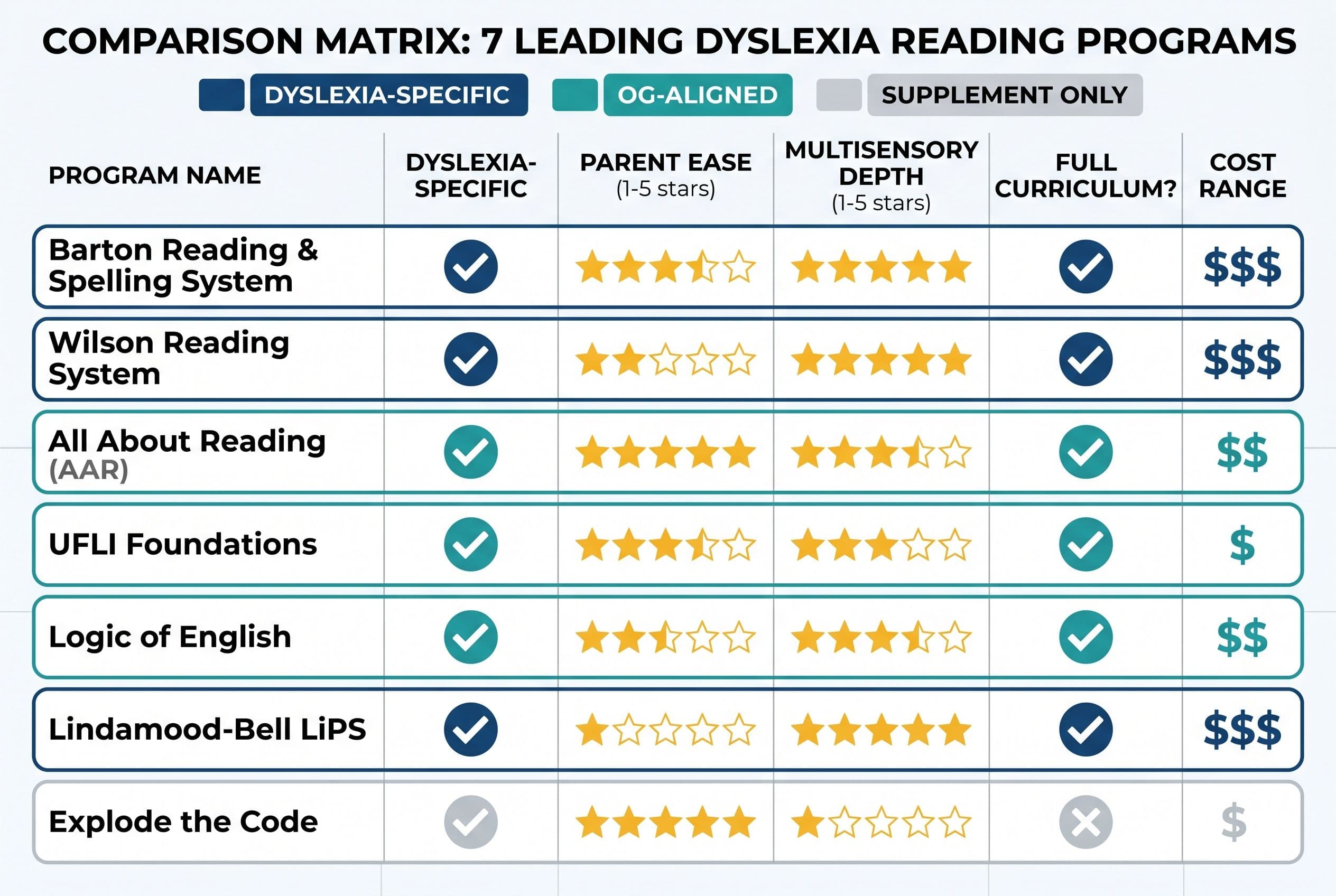
Here's the quick-reference breakdown:
| Program | Dyslexia-Specific? | Parent Ease | Multisensory Depth | Full Curriculum? | Cost Range |
|---|---|---|---|---|---|
| Barton | ✅ Yes | ⭐⭐⭐⭐⭐ | ⭐⭐⭐⭐ | ✅ Yes | Check site |
| Wilson | ✅ Yes | ⭐⭐ | ⭐⭐⭐⭐⭐ | ✅ Yes | Check site |
| All About Reading | OG-Aligned | ⭐⭐⭐⭐⭐ | ⭐⭐⭐⭐ | ✅ Yes | $159.95/level (Oct 2026) |
| UFLI Foundations | Tier 1 | ⭐⭐⭐⭐ | ⭐⭐⭐ | ✅ Yes | $70 (manual) |
| Logic of English | OG-Based | ⭐⭐⭐ | ⭐⭐⭐⭐ | ✅ Yes | Check site |
| Lindamood-Bell LiPS | ✅ Yes | ⭐⭐ | ⭐⭐⭐⭐⭐ | ❌ Supplement | Check site |
| Explode the Code | OG-Aligned | ⭐⭐⭐⭐⭐ | ⭐⭐ | ❌ Supplement | Check site |
So Which One Should You Pick?
Look, I can't tell you which program is "best" because I don't know your kid. But I can give you my decision tree — the one I give to every parent who calls me panicking.
If your child has diagnosed dyslexia and you want a do-it-yourself program: → Barton Reading & Spelling System. Hands down. It's scripted, it's dyslexia-specific, and you can't screw it up. Yes, it's expensive.
If your child has severe phonological deficits and has plateaued: → Start with Lindamood-Bell LiPS to rebuild the foundation, then transition to Barton or Wilson for the full reading curriculum.
If your child is a struggling reader but not formally diagnosed: → All About Reading is a fantastic starting point. It's affordable, well-structured, and engaging. If they stall, you can always level up to Barton.
If you're on a tight budget: → UFLI Foundations ($70 manual) as your core, supplemented with Explode the Code workbooks for extra practice. Add letter tiles from Amazon for $15 and you've got a budget multisensory program.
If you're a deep-dive, curriculum-nerd parent (I say this with love because I am one): → Logic of English. You'll love the linguistic depth. Your kid will understand English at a level most adults don't.
If you have the budget for professional-grade intervention at home: → Wilson Reading System with training videos. Steep learning curve but the research behind it is rock-solid.
Before You Buy: Test Where Your Child Is Right Now
Don't spend a dime on any program until you know exactly where the breakdown is.
Here's your action plan for tonight:
Step 1: Run Kilpatrick's PAST test. The Phonological Awareness Screening Test takes about 5–15 minutes depending on your child's age and attention span. You can access it through Equipped for Reading Success or ask your child's school — many districts already use it. It tells you exactly which level of phonological awareness your child has mastered and where they're stuck.
Step 2: Check letter-sound knowledge. Can your child produce the correct sound for all 26 letters? Not the letter names — the sounds. Show them "b" — do they say "bee" or "/b/"? If they can't do all 26 sounds automatically, that's your starting point. Period.
Step 3: Test CVC decoding. Write down 5 nonsense words: "bim," "tup," "feg," "zan," "hod." Can your child sound them out and blend them? Nonsense words are the gold standard because kids can't have memorized them. This is what DIBELS nonsense word fluency measures — on DIBELS 8th Edition, the benchmark is 17+ correct letter sounds per minute by mid-kindergarten, or 28+ by end of year. (Benchmarks vary by edition, so check which version your school uses.)
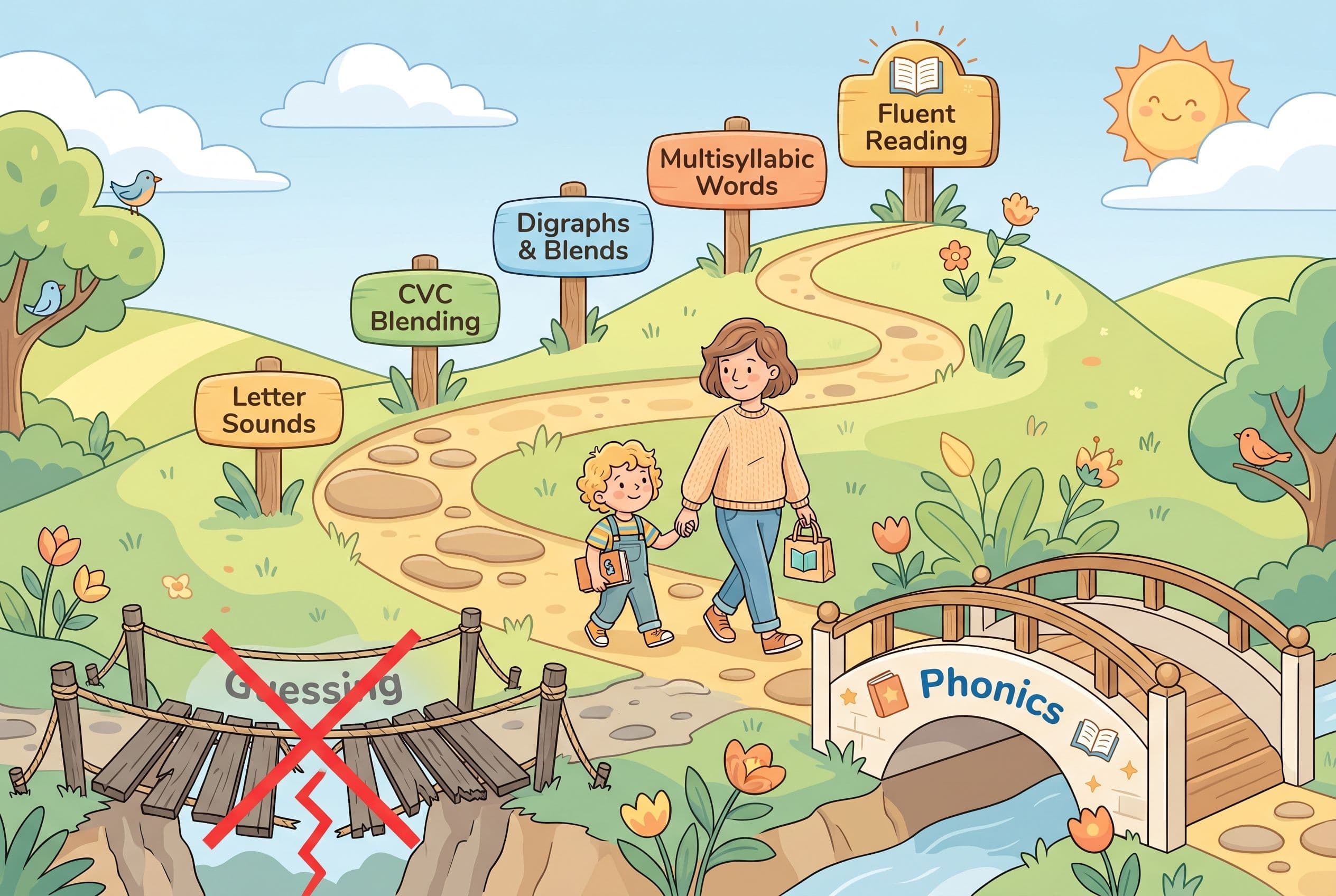
Step 4: Pick your program based on what you find. If they can't do letter sounds → You need pre-reading work (AAR Pre-Level or Barton's prerequisite screening). If they know sounds but can't blend → OG-based blending instruction (Barton Level 1, AAR Level 1). If they can blend but plateau on multisyllabic words → They need syllable division rules (Barton Level 4+, Wilson Steps 4-6).
The Teach Your Kid to Read Approach
Here's where I tell you about what we've built.
At start lesson one free, we designed our program on the same Orton-Gillingham principles that power every program on this list — systematic synthetic phonics, multisensory instruction, explicit teaching of grapheme-phoneme correspondences. We did this because the research is overwhelming. Louisa Moats' 1999 paper Teaching Reading IS Rocket Science for the American Federation of Teachers laid out exactly what effective reading instruction requires, and the 2000 National Reading Panel report confirmed it: systematic phonics instruction produces significant benefits for children's reading development.
Our program at Teach Your Kid to Read is built for parents. Not certified reading specialists. Not teachers with master's degrees. Parents who are scared, overwhelmed, and sitting at the kitchen table after bedtime Googling "how to help my kid with dyslexia."
The Simple View of Reading (Gough & Tunmer, 1986) tells us that reading comprehension = decoding × language comprehension. For dyslexic kids, the decoding piece is broken. That's exactly what structured literacy programs fix. And that's exactly what we focus on.
If you want a program that takes the guesswork out of teaching your child to read — whether they have dyslexia or just need a stronger foundation — visit TeachYourKidToRead.org or call us at (407) 707-6850. We're real people. I answer emails personally. And I've been where you are.
My Tiger Mom Bottom Line
I have a rule in my house: We Never Skip. Phonics on birthdays. Phonics on Christmas morning (after presents, I'm not a monster). Phonics on vacation. Fifteen minutes. Every single day.
For a kid with dyslexia, this consistency isn't just helpful. It's everything. Linnea Ehri's phases of word reading development — from pre-alphabetic all the way to consolidated — don't happen on their own for these kids. Each phase requires explicit instruction, massive repetition, and a program that doesn't let them skip steps or guess.
The programs on this list give you the tools. But you have to show up. Every day. Even when your kid cries. Even when you want to cry. Even when progress feels invisible for weeks.
And then one Tuesday morning, your 7-year-old picks up a book and reads a full sentence without stopping. No guessing. No looking at the pictures. Just... reading.
That moment? Worth every single hard minute.
Frequently Asked Questions
Can I teach my dyslexic child to read at home without a tutor?
Yes. Programs like Barton Reading & Spelling System and All About Reading were specifically designed for non-professional instructors. Barton's lessons are fully scripted — you read the instructions, follow the sequence, and the program guides you through every step. Thousands of homeschooling parents teach dyslexic kids at home using these programs. The key is consistency: 15-20 minutes a day, every day, following the program's sequence without skipping.
How do I know if my child needs a dyslexia-specific program or just a good phonics curriculum?
Run Kilpatrick's PAST (Phonological Awareness Screening Test) first. It takes 5–15 minutes and pinpoints exactly where your child's phonological awareness breaks down. If they struggle with basic phoneme segmentation and blending, that's a red flag for a dyslexia-specific program like Barton or Wilson. If they can manipulate sounds but just haven't been taught phonics systematically (which is shockingly common — thanks, Balanced Literacy), a strong OG-aligned program like All About Reading or UFLI Foundations may be enough.
What age should I start an OG-based reading program for my dyslexic child?
As early as you suspect there's a problem. The "wait and see" approach wastes the most neuroplastic years of your child's life. Most programs on this list can start as young as age 5-6, though Barton recommends a readiness screening first. Lindamood-Bell's LiPS can start even earlier for kids with severe phonological awareness deficits. The research is clear: early intervention produces dramatically better outcomes than remediation in later grades.
Is All About Reading enough for a child with dyslexia?
For mild to moderate reading difficulties, AAR can be highly effective. It follows Orton-Gillingham principles and includes multisensory components. For moderate to severe dyslexia, you may need to supplement AAR with additional phonemic awareness drills (like exercises from Kilpatrick's Equipped for Reading Success) or eventually transition to a more intensive program like Barton. Start with AAR, monitor progress monthly, and be willing to pivot if your child plateaus.
How long does it take for a dyslexic child to learn to read with an OG program?
Every child is different, and I refuse to give you a false promise. Some kids show measurable progress within weeks. Others grind for months before something clicks. The Barton system estimates 1-2 years to complete all 10 levels with consistent daily practice. Wilson's 12 steps can take 1-3 years depending on severity. The bottom line: progress comes from daily practice with the right methodology. Track it with regular nonsense word fluency checks (aim for DIBELS benchmarks for your child's grade level) so you can see growth even when it feels slow.
Part of these guides

Xia Brody
Co-Founder, Teach Your Kid to Read
Mom of 4 who has successfully taught her kids to read. Currently in the trenches with her 4-year-old while her two oldest (10 and 7) devour books on their own. Passionate about phonics-based methods and building a lifelong love of reading.
Related Articles

Homeschool Reading Curriculum for Kindergarten: 7 Picks
Most kindergarten reading programs sold to homeschoolers still teach kids to guess at words. Here are the 7 structured-phonics curricula I'd actually put in front of a 5-year-old — with honest pros, cons, and prices — plus the ones I'd throw in the recycling.
Read More →
Reading Eggs vs ABCmouse for Dyslexia: Parent Pick
Choosing between Reading Eggs and ABCmouse for a child with dyslexia signs? I’m comparing them as a phonics mom, not a sticker-chart enthusiast. Here’s the no-nonsense 2026 pick.
Read More →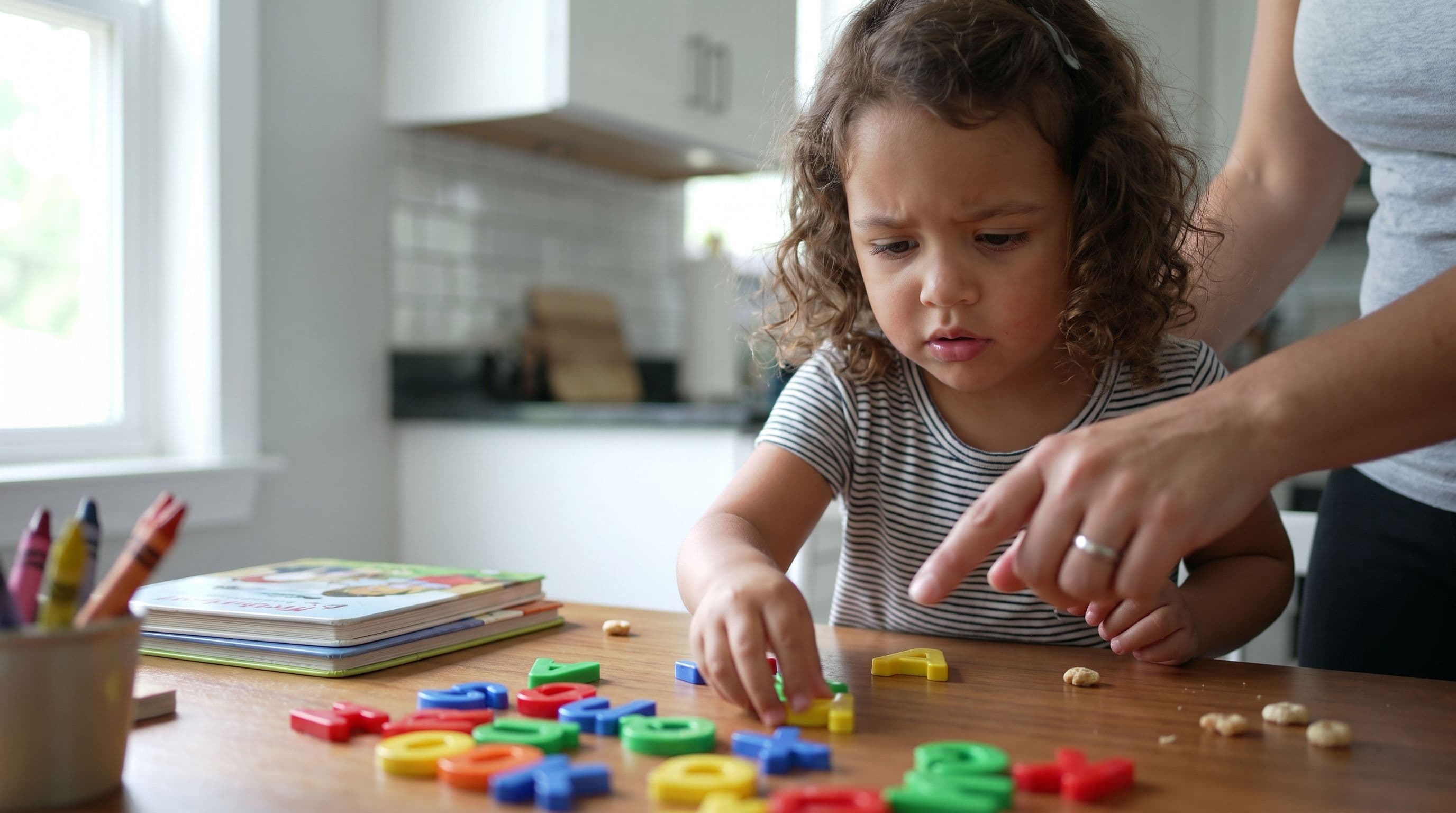
Best Reading App for a 4-Year-Old with Dyslexia Signs: My Top Pick
If your 4-year-old mixes up sounds, guesses from pictures, or avoids letters, don’t wait and see. Here’s my tiger-mom ranking of reading apps that help — and the ones I’d skip.
Read More →