Home Reading Program for Kids: Setup, Schedule & Materials
What You'll Learn
- The single biggest mistake parents make when setting up a home reading program (and it's not what you think)
- Why 10-15 minutes a day beats an hour on weekends — and the science behind daily consistency
- The only teaching method backed by decades of reading research (hint: it's not guessing from pictures)
- A step-by-step setup plan — where to sit, what to buy, how to schedule it, and how to stick with it when life gets chaotic
The Reality Check: You're Already Behind If You're "Waiting"
Let me guess. You've been meaning to start teaching your kid to read at home. You bought a couple of books. Maybe downloaded an app or two. But life happened — soccer practice, grocery runs, the baby's teething — and now your kid is 4 or 5 and you're Googling "home reading program for kids" at 11 PM with a knot in your stomach.
I've been there. Four times, actually.
Here's what nobody at the pediatrician's office will tell you straight: there's no magical age when kids just "get" reading. They don't absorb it from being surrounded by books any more than they absorb piano from hearing Spotify. Reading is a skill. Skills require instruction. Instruction requires a plan.
And that plan? It doesn't need to be complicated. It doesn't need to cost hundreds of dollars. It doesn't need a teaching degree.
But it does need to happen. Every. Single. Day.
The Tiger Truth: What Happens When You Don't Have a Plan
I talk to parents every week who tell me some version of this story: "My kid seemed fine in kindergarten, then first grade hit and suddenly they were behind." Or worse: "The teacher said to wait and see."
The "Wait and See" approach is the most dangerous advice in early education. And I'm not being dramatic.
Here's what the research actually shows:
- Kids who can't read proficiently by the end of third grade are four times more likely to drop out of high school. That's from the Annie E. Casey Foundation's 2011 report, Double Jeopardy. It's one of the most widely cited findings in education — and the link is especially stark for children from low-income households. It's a correlation, not a simple cause-and-effect, but the pattern is consistent and alarming.
- The reading gap widens every year. A kid who's behind in first grade doesn't magically catch up in third. The gap gets bigger because reading is how you learn everything else.
- By fourth grade, kids stop "learning to read" and start "reading to learn." If your child hits that wall without decoding skills, every subject — science, history, math word problems — becomes a struggle.
This is the 3rd Grade Cliff. It's real. And the kids who fall off it rarely climb back up.
So what's the answer? A structured home reading program for kids that starts early, uses phonics, and runs every single day. Not three days a week. Not "when we have time." Every day.
Let me tell you about my daughter Lian. She went from zero letter sounds at age 4 to reading simple chapter books by age 6. Not because she's gifted — trust me, she's not some prodigy. She's a normal kid who'd rather play with slime than sit still. But we did phonics practice every single day. Birthdays, Christmas, vacation. My husband thought I was insane. Other parents at the park would give me looks when I'd pull out flashcards by the swings.
She's 7 now and reads for fun. Actual fun — she'll curl up with a book instead of asking for the iPad. Every parent who judged me for the flashcards-at-the-park thing? They've all since asked me how I did it. And the answer is boring: consistency. Not a special program. Not expensive tutoring. Just 10-15 minutes a day of phonics, done without exception.
That's the home reading program. That's the whole secret.
Now let me show you exactly how to build one.
Step 1: Pick Your Spot (And Protect It Like a Dragon)
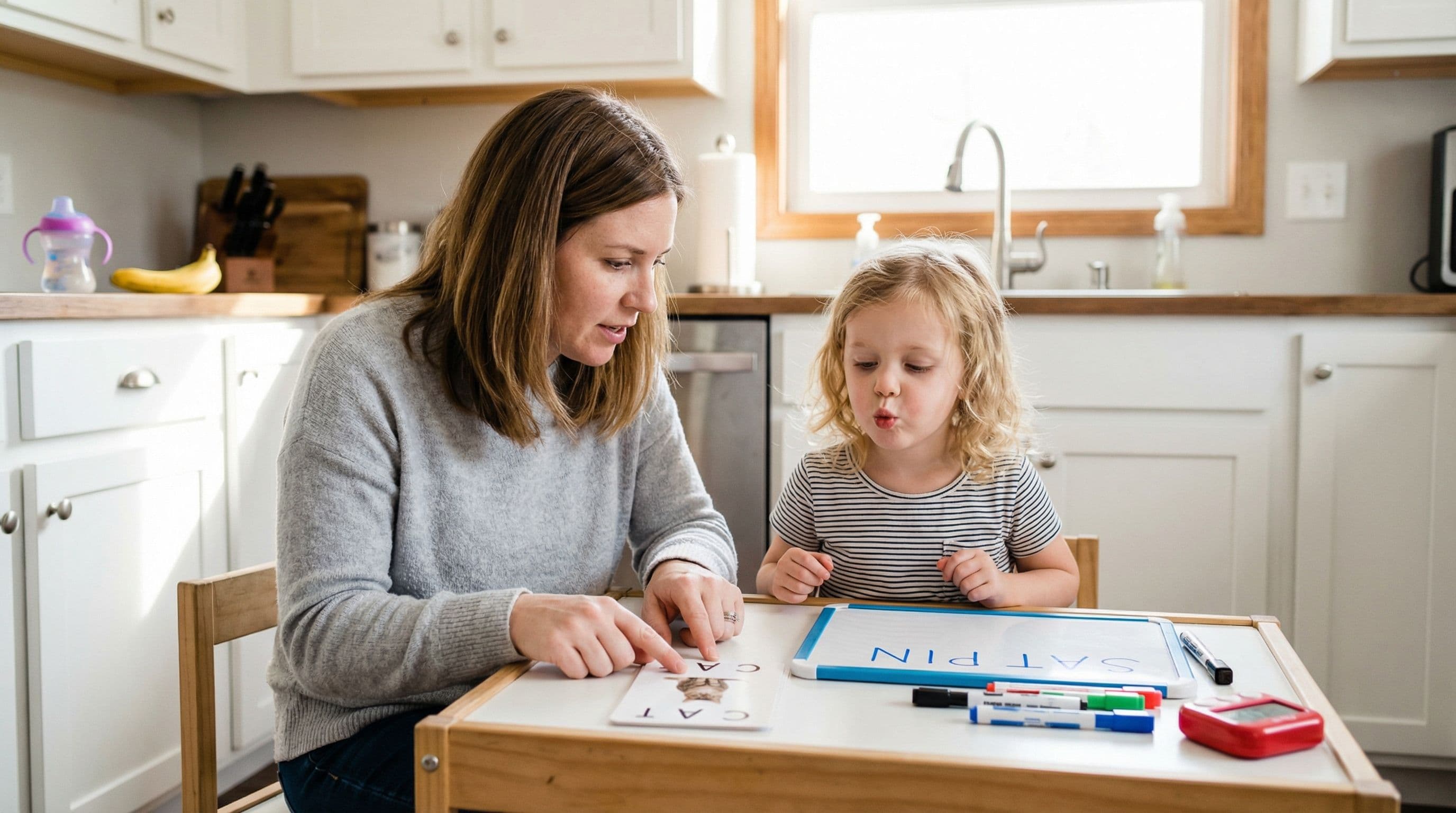
Before you buy a single thing, you need a quiet place to sit with your child where you won't be disturbed. This matters more than any curriculum or app.
I'm not talking about a Pinterest-worthy reading nook with fairy lights and a canopy. I'm talking about a spot where:
- There's no TV on in the background
- Siblings aren't screaming two feet away (I know — easier said than done with four kids)
- Your phone is face-down and silent
- Your child can focus for 10-15 minutes without distraction
For us, it's the kitchen table after the baby goes down for her morning nap. That's our window. Lian learned to read at that same table. My 4-year-old, Mei, is learning there now. It's not glamorous. There are usually Cheerios stuck to the surface. But it's quiet, it's consistent, and my kids know: when we sit here with the reading materials, it's go time.
Pick your spot. Same place every day. Your kid's brain will start associating that location with focused learning, and you'll spend less time fighting the "I don't wanna" battle.
Step 2: Set Your Daily Schedule (Yes, Daily — Non-Negotiable)
Here's where most parents blow it. They think a home reading program means marathon sessions on Saturday mornings or cramming 30 minutes in before bedtime when everyone's exhausted.
Nope.
You need 10-15 minutes a day. That's it. Fifteen minutes of focused, phonics-based instruction beats an hour of half-hearted "let's read this book together" where your kid is just memorizing the pictures.
Why daily? Because reading is built on neural pathways, and neural pathways strengthen through repetition. Skip two days and your kid's brain starts losing the connections you built. It's like working out — you don't get strong by hitting the gym once a week for three hours. You get strong from short, consistent effort.
Here's how to pick your daily time slot:
- Choose a time when your child is alert and fed. Not right before nap. Not when they're hangry. For most kids, mid-morning works best. For school-age kids, right after school before they crash.
- Anchor it to an existing routine. After breakfast. Before lunch. Right after the bus drops them off. Tying it to something that already happens makes it automatic.
- Set a timer. Seriously. Pull out your phone, set 15 minutes, and when it goes off, you're done. This does two things: it prevents burnout (yours and theirs), and it teaches your child that reading time has a clear beginning and end.
- Never, ever skip. Birthdays? Ten minutes of phonics before cake. Christmas morning? Ten minutes before presents. Vacation? Pack the materials. This is my Tiger Rule, and I will die on this hill.
I know that sounds extreme. My husband told me it was extreme when I had Lian doing letter sounds on Christmas Day at my in-laws' house. But here's the thing — when you never skip, your kid stops fighting it. It becomes like brushing teeth. They don't argue about brushing teeth because it's non-negotiable and they know it. Make reading time the same.
Step 3: Choose the Right Method (This Is Where It Gets Serious)
OK so this is the part where I get a little intense. Bear with me.
For teaching your child to decode words — to actually look at letters and turn them into sounds — the method you should use is systematic, explicit phonics. Not "balanced literacy." Not whole language. Not the three-cueing system where kids guess words based on pictures and context clues.
This isn't my opinion. This is what every major study on reading acquisition has shown for the past 30+ years. The National Reading Panel, the National Institute of Child Health and Human Development, and more recently the massive body of work called the "Science of Reading" — they all point to the same conclusion: kids learn to read by learning that letters represent sounds, and then blending those sounds together to decode words.
Now, here's something I need to be straight about: phonics is the backbone of learning to decode, but decoding alone doesn't make a reader. Researchers talk about the Simple View of Reading — reading comprehension = decoding × language comprehension. Your kid needs both. The decoding piece? That's your 15 minutes of daily phonics. The language comprehension piece? That's you reading aloud to them at bedtime, having conversations at dinner, explaining new words when you're at the grocery store. You're probably already doing a lot of that without realizing it. But the phonics part — the actual decoding instruction — that's the piece most homes are missing, and it's the piece that won't just happen on its own.
Imagine your child looks at the word "ship" and says "boat" because there's a picture of a boat on the page. That's not reading. That's guessing. And guessing is what Whole Language and Balanced Literacy teach kids to do.
Phonics teaches kids to look at S-H-I-P, know that "sh" makes the /sh/ sound, "i" makes the /ĭ/ sound, and "p" makes the /p/ sound, then blend them together: "ship." That's reading. That's a skill they can apply to any word they've never seen before.
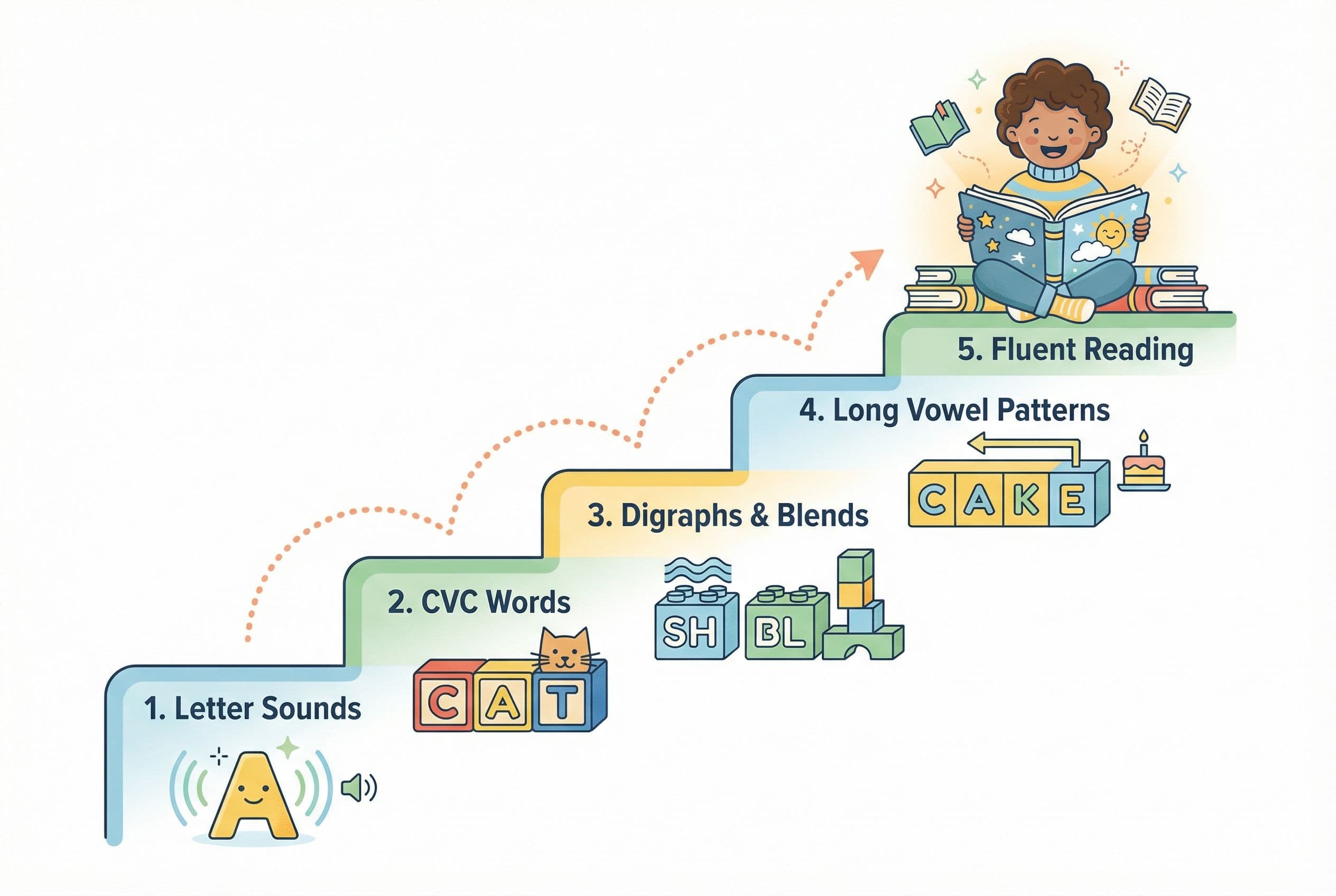
Your home reading instruction plan should follow a systematic phonics sequence:
- Start with phonemic awareness — hearing the sounds. Before your child even looks at letters, they should practice hearing and playing with sounds in words. Ask: "What's the first sound in cat?" or "Can you say mat without the /m/?" This is the skill of hearing individual sounds in spoken words, and it's the foundation everything else sits on. You can do this in the car, at the dinner table, anywhere — no materials needed.
- Move to letter-sound correspondence. Not letter names — letter sounds. Your kid doesn't need to know that it's called "ess." They need to know it says /s/.
- Practice blending CVC words. (That's consonant-vowel-consonant: cat, dog, sit, hop.)
- Introduce digraphs and blends. (sh, ch, th, bl, cr, etc.)
- Layer in long vowel patterns. (silent-e, vowel teams like "ai" and "ee")
- Build fluency with decodable texts. Books where every word follows phonics rules the child has already learned. No guessing required.
This sequence matters. Don't jump ahead. Don't skip steps because your kid seems bored with CVC words. Mastery before progress. Always.
Step 4: Pick Your Materials (The App vs. Book Decision)
Alright, let's talk tools. You've got your spot, your schedule, and your method. Now you need materials for your DIY reading curriculum.
I'll be straight with you: I recommend using the Teach Your Kid to Read app. start lesson one free
Here's why. The app walks you — the parent — through every single phonics lesson, step by step. You sit with your child, the app tells you what to teach, how to teach it, and in what order. It's designed for parents, not kids alone with a screen. This isn't one of those apps where you hand your child an iPad and walk away. You're right there, guiding every sound, every blend, every word.
And honestly? I haven't found another app that does this the same way. Most "reading apps" are heavy on screen time, full of animations and games that distract from actual phonics instruction, and designed to babysit rather than teach. Teach Your Kid to Read is light on screen time and heavy on real learning because the parent is the teacher. The app is just your guide.
Now — if you're the type who just doesn't want to use an app at all, I get it. There are some solid book-based options:
- "Teach Your Child to Read in 100 Easy Lessons" by Siegfried Engelmann — this is the classic. It's scripted, systematic, and follows a strict phonics sequence. It's not pretty, and the early lessons feel tedious, but it works.
- Bob Books — great for early decodable reading practice once your child knows some letter sounds
- Primary Phonics Storybooks — another good decodable reader series that follows a logical phonics progression
But here's the kicker with books: you have to figure out the pacing yourself. You have to decide when to move on, when to review, and how to handle the tricky spots. The app does that thinking for you. For busy parents (and let's be real — that's all of us), having a program that says "today, teach this sound, practice these words, read this passage" is a game-changer.
Whichever route you pick, do not use programs that mix in whole language strategies. If the instructions ever tell your child to "look at the picture for a clue" or "think about what word would make sense here" — throw it out. Sound it out or don't read it. No guessing. That's my other Tiger Rule.
Step 5: Add Writing Practice (The Secret Weapon Most Parents Miss)
Here's something I wish someone had told me when I started teaching my oldest to read: have your child practice writing the letters as they learn to read them.
This isn't about penmanship (although that's a nice bonus). It's about reinforcement. When a child writes the letter "m" while saying the /m/ sound, they're encoding that letter-sound relationship through a completely different neural pathway — the motor system. They're seeing it, saying it, hearing it, AND feeling it.
The research calls this multi-sensory learning. I call it common sense.
Here's what this looks like in practice:
- After teaching a new letter sound, hand your child a pencil and paper. Have them write the letter (or trace it if they're just starting) five times while saying the sound.
- When they're blending CVC words, have them write the words too. Sound it out: /c/ /a/ /t/. Now write it: c-a-t. This locks it in.
- Use a small whiteboard for daily practice. Kids love whiteboards. I don't know why. Maybe it's the ability to erase mistakes without stress. But my 4-year-old will happily write letters on a whiteboard for five minutes after our phonics lesson, and those five minutes are worth gold.
You don't need special handwriting workbooks for this. A lined notebook, a whiteboard and dry-erase markers, or even a finger tracing letters in a tray of salt — any of these work. The point is that reading and writing reinforce each other, so do both.
Your Complete Home Reading Program Setup Checklist
Let me put this all together. Here's your structured reading time at home plan, stripped down to the essentials:
What You Need
- ✅ A quiet spot with a table and two chairs (or the floor — we don't judge)
- ✅ The Teach Your Kid to Read app OR a systematic phonics book
- ✅ A small whiteboard and dry-erase markers for writing practice
- ✅ A pencil and lined paper or notebook
- ✅ A timer (your phone works fine)
- ✅ Decodable readers matched to your child's phonics level (Bob Books, Primary Phonics, or what the app provides)
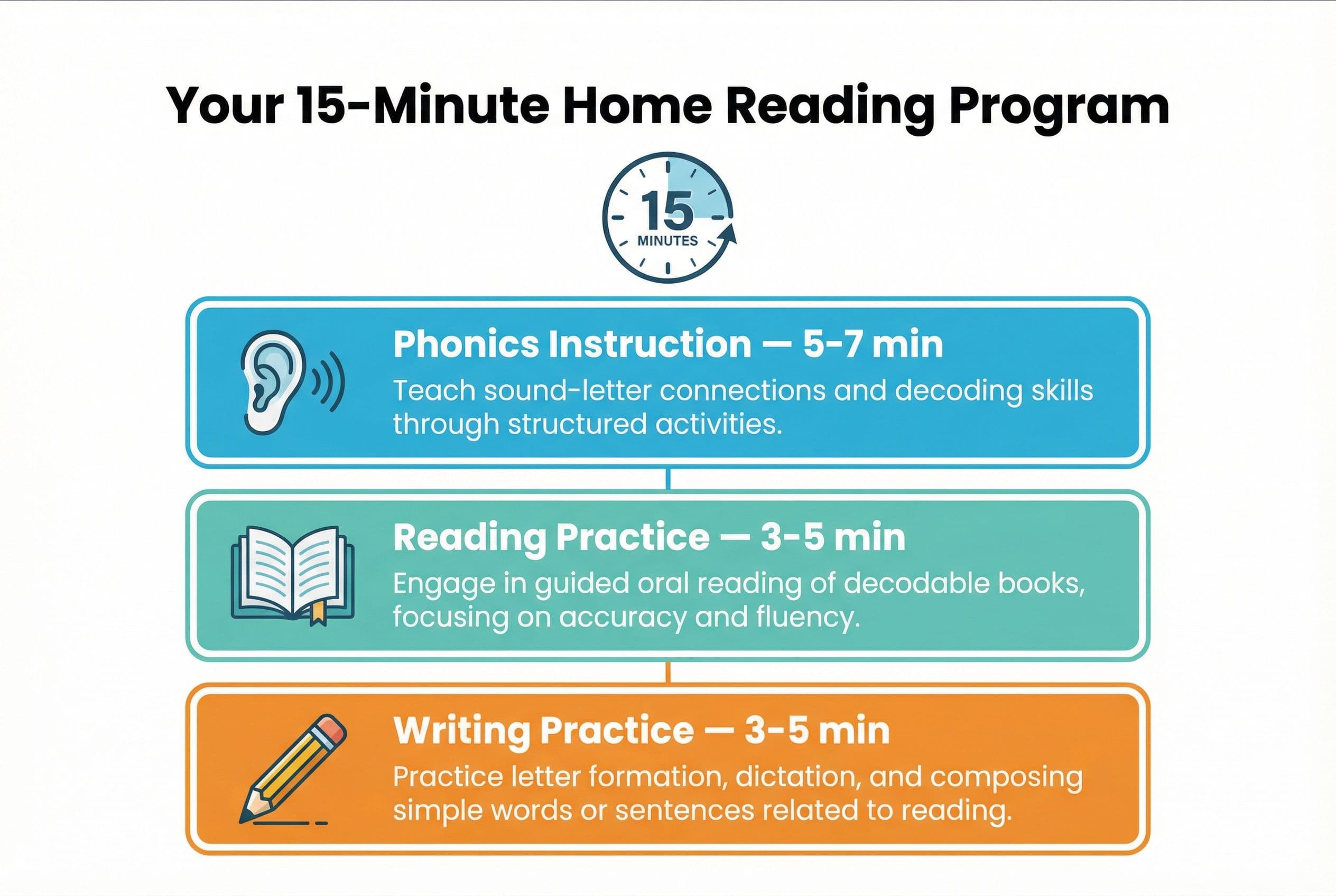
Your Daily Schedule (15 Minutes)
- Phonics instruction (5-7 minutes): Open the app or book. Teach the day's lesson. Drill the new sound. Review yesterday's sounds.
- Reading practice (3-5 minutes): Have your child read decodable words or a short passage using only the sounds they've learned. No guessing from pictures. If they get stuck, they sound it out.
- Writing practice (3-5 minutes): Have your child write the letters and words from today's lesson on the whiteboard or paper while saying each sound aloud.
That's it. Fifteen minutes. Then you're done and they can go play.
The Rules (Tiger Rules — Non-Negotiable)
- We Never Skip. Every day means every day.
- No Guessing. If they don't know a word, they sound it out. They don't look at the picture. They don't guess from context.
- Mastery Before Progress. Don't move to the next lesson until they've got today's lesson down cold. Rushing creates gaps, and gaps create readers who fall apart at the 3rd Grade Cliff.
"But My Kid Hates It" — Yeah, At First
Look, I'm not going to pretend my kids skip joyfully to the kitchen table every morning for phonics. Mei, my 4-year-old, went through a two-week stretch where she cried before every session. She wanted to watch Bluey. She wanted to play outside. She wanted to do literally anything else.
We did phonics anyway.
And you know what happened? She stopped crying. She started getting sounds right. She blended her first word — "sat" — and her face lit up like it was her birthday. Now she asks to "do the reading" most mornings. Not because she's some naturally motivated scholar. Because success is motivating. Getting it right feels good. And kids can't feel that success until they've pushed through the hard part.
Don't fall into the "fun" trap. I see it all the time — parents abandon a systematic program because their kid "isn't having fun" and switch to some colorful app that's basically a video game wearing a literacy costume. The kid has a blast. The kid learns nothing. Six months later, they still can't decode a three-letter word.
Fun comes from mastery. Mastery comes from daily practice. Daily practice isn't always fun in the moment. That's OK. Your kid doesn't need to enjoy every minute of learning to read. They need to learn to read.
What About Screen Time? Let's Talk About It
I know some parents are going to push back on using an app. "Isn't that just more screen time?"
Real talk — the way you use the Teach Your Kid to Read app, your kid isn't staring at a screen alone. You're sitting right there. You're the one teaching. The app is giving you instructions, showing you the phonics sequence, and providing the content. It's more like a digital teacher's manual than a kid's game.
Compare that to the apps most parents download: the kid sits alone, taps buttons, watches animations, and "reads" by memorizing patterns. That's screen time. What we're doing is instruction time that happens to use a screen as one of its tools.
There's a massive difference.
But if you still don't want any screen involved, that's fine. Grab one of the phonics books I mentioned and follow the same daily structure. The method matters more than the medium. Phonics is phonics whether it comes from an app or a paperback.
The Long Game: What a Consistent Home Reading Program Actually Produces
I want to come back to Lian for a second, because she's my proof of concept.
Two years of daily phonics practice. That's what it took. From age 4 to age 6. We started with letter sounds — she didn't know a single one. By 4.5, she was blending CVC words. By 5, she was reading decodable sentences. By 6, she picked up a Magic Tree House book and read the first chapter out loud to me without help.
Two years. Fifteen minutes a day. That's roughly 180 hours of total instruction. Less time than most adults spend scrolling Instagram in a year.
And the payoff? She reads independently now at 7. She reads for pleasure. She reads cereal boxes and street signs and chapter books and birthday cards. She reads everything. That's what a structured homeschool reading plan produces — not just a kid who can decode, but a kid who actually wants to read because they can.
You can build that. It starts with picking a spot, setting a timer, and committing to 15 minutes of phonics instruction every single day.
No excuses. No days off. No guessing.
Start today.
Frequently Asked Questions
What age should I start a home reading program?
Most kids are ready for letter-sound instruction around age 3.5 to 4. You're not looking for them to sit still for 30 minutes — you just need them to focus for 10-15 minutes and repeat sounds back to you. If your child is older and hasn't started yet, don't panic, but don't wait another day either. Start now with the same phonics sequence.
How long before my child starts actually reading words?
Every kid is different, so I won't give you a fake timeline. But with daily phonics practice, most children can blend simple CVC words (cat, sit, hop) within 4-8 weeks of starting letter sounds. The key variable isn't your child's intelligence — it's your consistency.
What if my child is already in school? Do I still need a home program?
Honestly? Yes. Many schools still use Balanced Literacy or mixed methods that include guessing strategies. A phonics-based reading program for parents to use at home gives your child the systematic decoding instruction they might not be getting in the classroom. Fifteen minutes a day at home won't conflict with school — it'll fill the gaps.
My child gets frustrated and cries. Should I stop?
No. Shorten the session if you need to — even 5 minutes is better than zero — but don't skip it entirely. Frustration means they're at the edge of their ability, which is exactly where learning happens. Stay calm, keep the tone warm, and celebrate every small win. The crying phase passes. The skill stays forever.
Can I use YouTube videos or free phonics games instead of a program?
You can try, but you'll be stitching together random content without a systematic sequence, and your kid will spend more time watching than doing. A structured program — whether it's our app or a phonics book — gives you the right sounds in the right order with the right amount of practice at each stage. That structure is what separates a real home reading program from random exposure.
Part of these guides

Xia Brody
Co-Founder, Teach Your Kid to Read
Mom of 4 who has successfully taught her kids to read. Currently in the trenches with her 4-year-old while her two oldest (10 and 7) devour books on their own. Passionate about phonics-based methods and building a lifelong love of reading.
Related Articles

Homeschool Reading Curriculum for Kindergarten: 7 Picks
Most kindergarten reading programs sold to homeschoolers still teach kids to guess at words. Here are the 7 structured-phonics curricula I'd actually put in front of a 5-year-old — with honest pros, cons, and prices — plus the ones I'd throw in the recycling.
Read More →
My First Grader Can't Read? The 90-Day Catch-Up Plan
If your 6-year-old is guessing at words, memorizing books, or melting down at the page, you don't have a motivation problem — you have an instruction problem. Here's the exact 90-day catch-up plan I'd run, starting tonight.
Read More →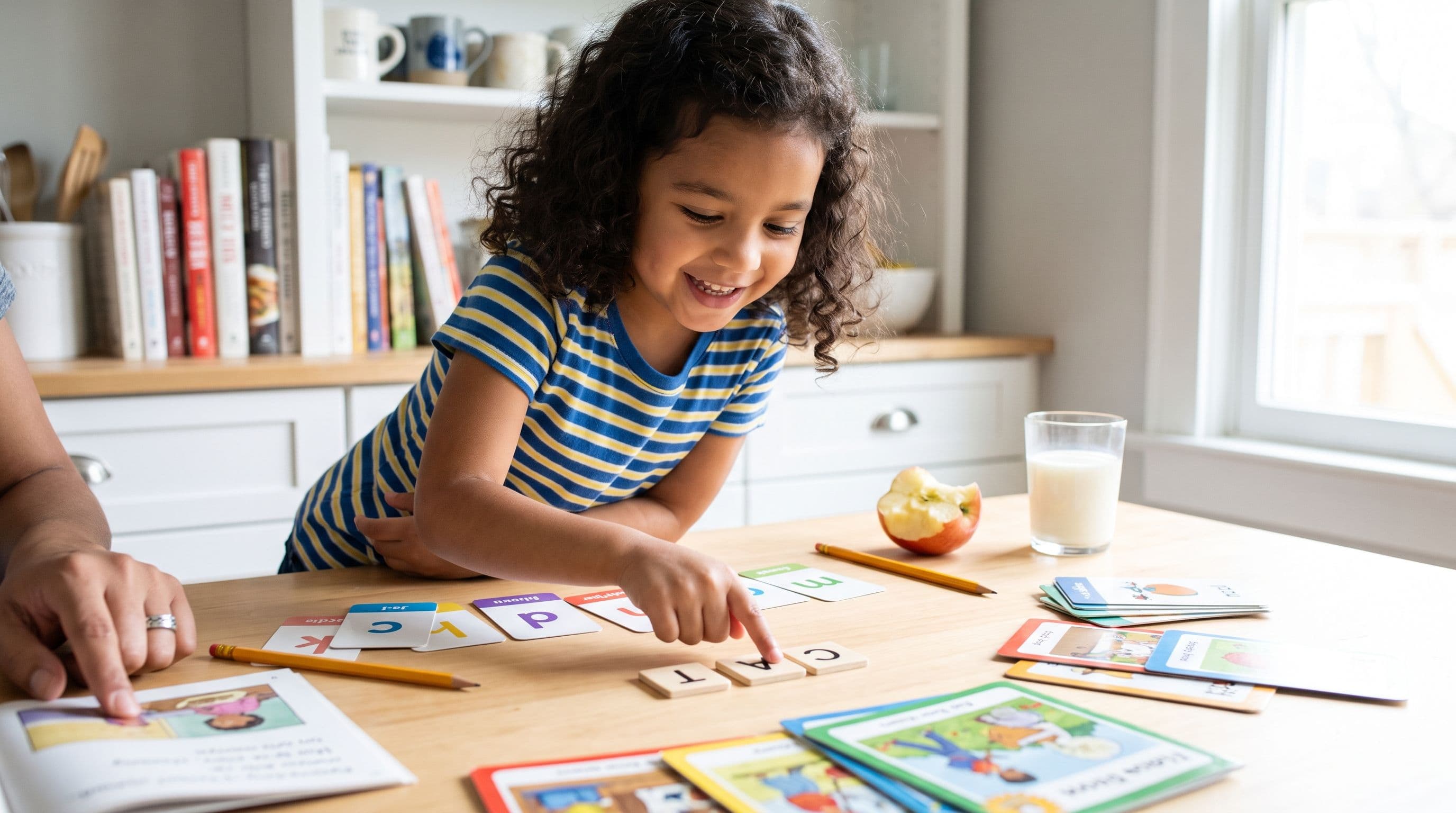
My 9 Year Old Can't Read: Parent Action Plan
If your 9-year-old can't read, don't wait for school to fix it someday. Here's how to check their reading level, stop guessing habits, and start a real phonics-based intervention at home.
Read More →