Best Reading App for Dyslexia: 2026 Picks That Actually Work
What You'll Learn
- Why 90% of "reading apps" are useless for kids with dyslexia — and the one approach that separates real help from expensive screen time
- The specific warning signs most parents miss before a dyslexia diagnosis (and the free screening test you can give at your kitchen table in 5 minutes)
- Which 2026 reading apps actually use evidence-based phonics — and which popular ones are secretly built on the same failed guessing methods your kid's school probably uses
- The honest math on apps vs. tutors — when an app is enough, when it's not, and how to stop burning money on the wrong solution
Your Kid Isn't Lazy. The App Is.
Let me say this bluntly: if you downloaded a reading app for your dyslexic child and they're still struggling six months later, the app failed them. Not the other way around.
I get emails every week from parents who've spent $200+ on reading app subscriptions — apps with cheerful cartoon animals and five-star ratings — and their kid still can't decode the word "ship" without guessing "boat" because there's a picture of a sailboat on the screen. That's not reading. That's a slot machine with a literacy skin on it.
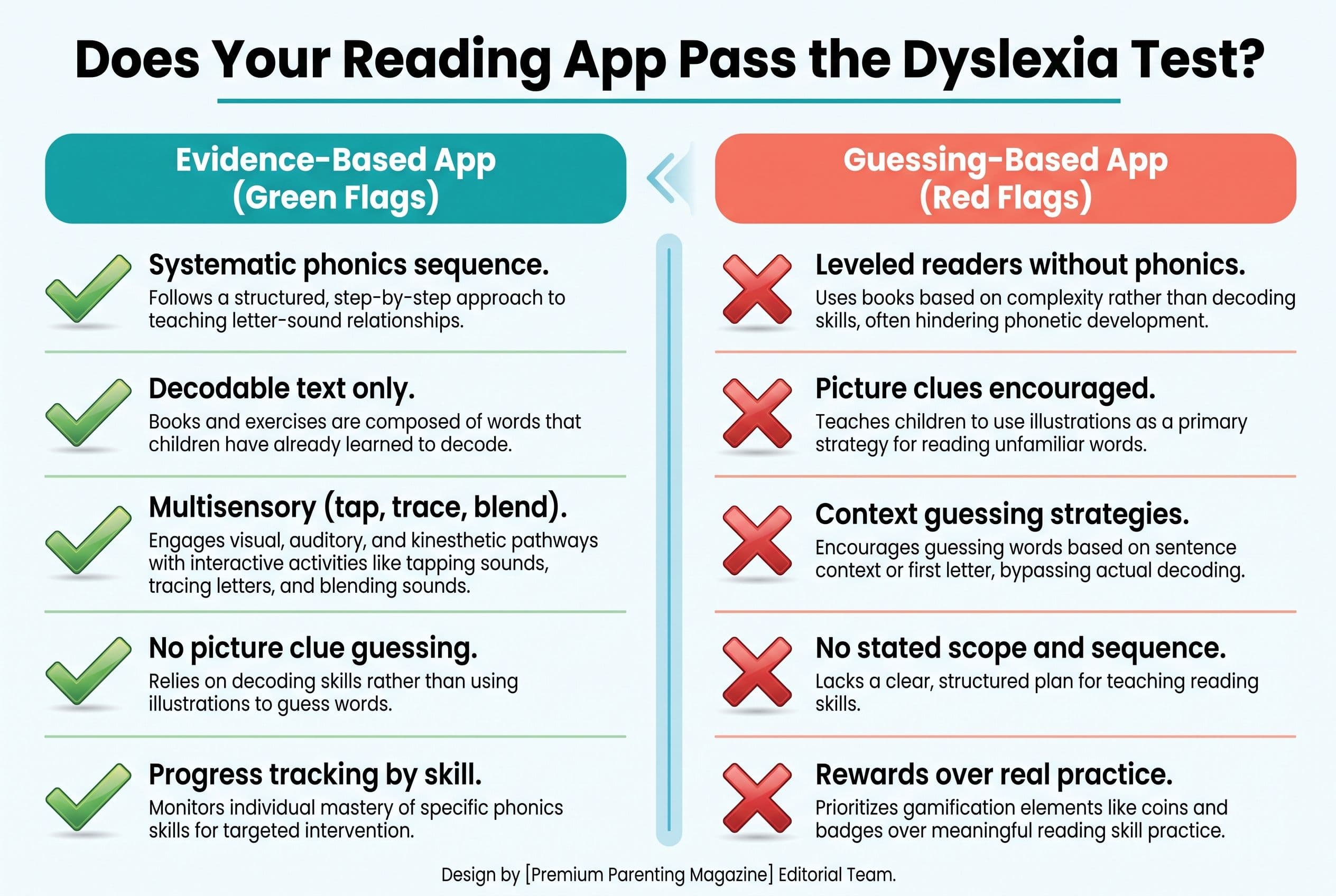
Here's what most app developers won't tell you: the best reading app for dyslexia isn't the one with the prettiest graphics or the most gamification badges. It's the one built on structured literacy — explicit, systematic phonics instruction, often inspired by the Orton-Gillingham approach that's been helping struggling readers since the 1930s. Programs like Wilson Reading, Barton, and others follow these same principles. Everything else is decoration.
And I say this as someone in the trenches. My 4-year-old is working through phonics right now, and my two older kids (10 and 7) both learned to read early using explicit, sequential phonics instruction. No guessing. No picture clues. No "what word would make sense here?" nonsense.
The Tiger Truth: What Happens When You Pick the Wrong App
Let's talk numbers, because vague warnings don't change behavior.
Dyslexia affects roughly 1 in 5 kids — that's 20% of the population, according to the International Dyslexia Association. And here's the kicker: most of those kids aren't identified until 3rd grade or later. By then, the damage is compounding.
The Annie E. Casey Foundation's 2010 study found that kids who can't read proficiently by the end of 3rd grade are four times more likely to drop out of high school. Four times. And the 2022 NAEP — that's the Nation's Report Card — showed only 33% of 4th graders read at a proficient level. The 2023 scores dropped another 3 points. The largest decline in 30 years. [INTERNAL_LINK: science-of-reading]
Now layer dyslexia on top of that.
A kid with unaddressed dyslexia using a whole-language-based app isn't just treading water. They're actively learning bad habits — guessing from context, memorizing word shapes instead of decoding, developing reading anxiety that hardens into full-blown avoidance by middle school.
The average private Orton-Gillingham tutor costs $60-$120 per hour, two to three sessions per week. That's $500-$1,400 a month. A full remedial reading program like Lindamood-Bell can run $10,000-$15,000 per year. Insurance doesn't cover it. Most school districts won't provide it until your kid is failing badly enough to qualify for an IEP — and even then, the intervention is often inadequate.
So yeah. Picking the right app matters. A lot.
How I Started Paying Attention (And You Should Too)
I was at a playground in Raleigh about a year ago when another mom mentioned her kid's school had just switched from Lucy Calkins' Units of Study to a Science of Reading curriculum. This was because of North Carolina's HB 521 — the Excellent Public Schools Act — which requires evidence-based reading instruction. She was confused and honestly kind of annoyed about it. "He was doing fine before," she told me.
So I asked her a simple question: can your son read the word "splint"?
He's in second grade. He could not.
I spent 20 minutes on that playground bench walking her through why the switch was happening — Emily Hanford's APM Reports investigation "Sold a Story" that exposed how Balanced Literacy was built on debunked theories, the NAEP data showing a generation of kids falling behind, the neuroscience from Stanislas Dehaene's lab (his book Reading in the Brain, 2009) proving that the brain doesn't learn to read naturally the way it learns to speak. Reading has to be explicitly taught. The neural circuits for decoding print have to be built through instruction. [INTERNAL_LINK: sold-a-story]
She texted me at 11pm that night after watching the entire "Sold a Story" podcast series: "I had no idea. Why didn't anyone tell us this sooner?"
That conversation changed how I talk about reading apps, because here's the thing — if your kid has dyslexia, or even if you just suspect it, the app you choose is either going to reinforce the broken system that failed that mom's son, or it's going to give your child the structured, explicit instruction their brain actually needs. There's no middle ground.
What Makes a Reading App Actually Work for Dyslexia
Before I give you my 2026 picks, you need to understand what you're looking for. Because app store descriptions are basically marketing fiction.
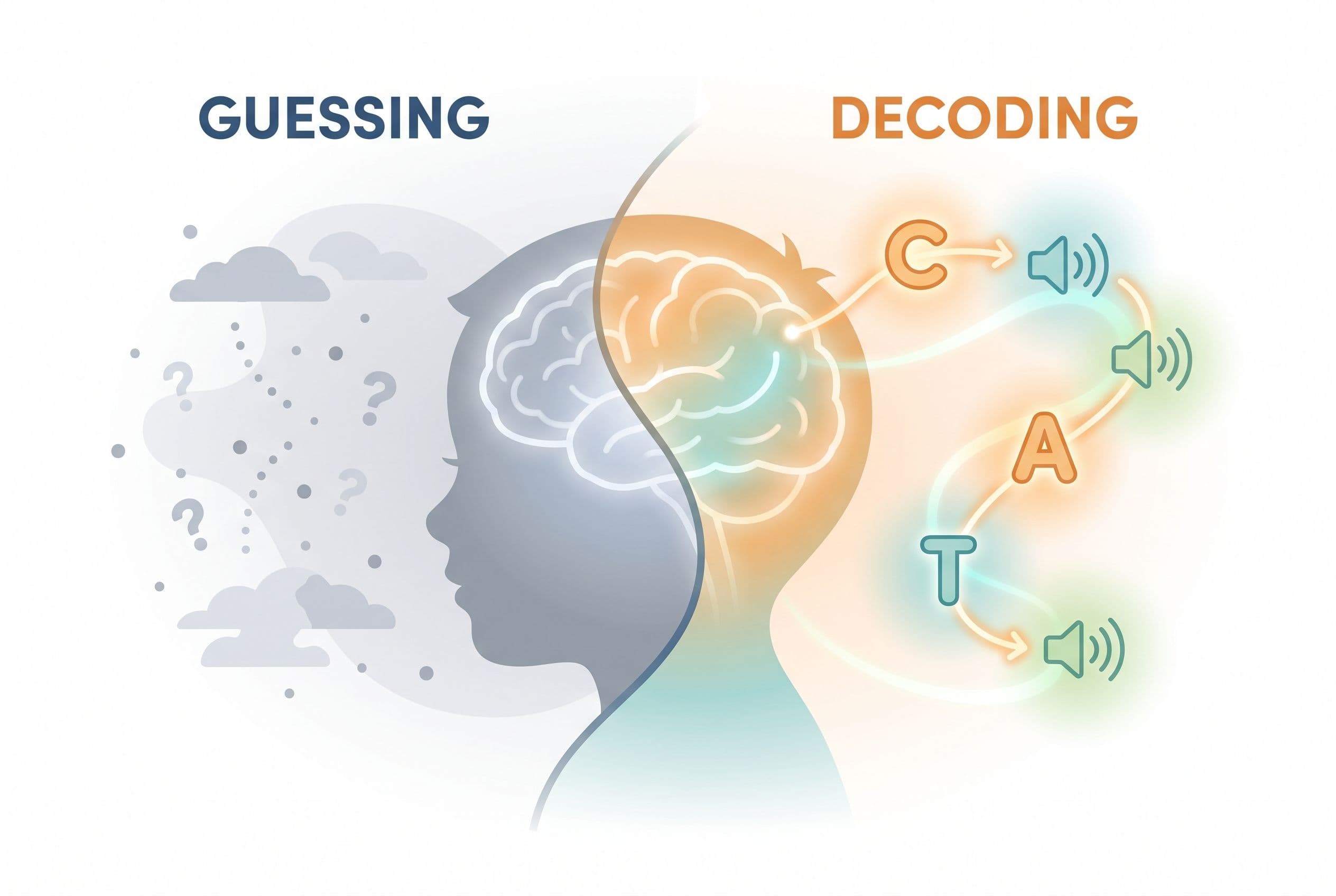
David Kilpatrick's research in Equipped for Reading Success (2016) explains the concept of orthographic mapping — the process by which the brain connects the sounds in a word to its letter patterns and permanently stores it for instant retrieval. Kids with dyslexia have a breakdown in this process. Many (not all) dyslexic readers have weaknesses in phonemic awareness and other phonological processing skills, which makes orthographic mapping harder — often alongside slow naming speed and reading fluency deficits. If phonological awareness is solid but reading is still painfully slow, fluency and rapid automatized naming (RAN) may be the bottleneck.
This means any app worth using for a dyslexic child must do these things:
1. Systematic Synthetic Phonics
The app teaches letter-sound correspondences (grapheme-phoneme correspondences) in a specific, logical sequence. Not random. Not "let's learn the letter of the week." A structured scope and sequence that builds on itself.
2. Explicit Blending and Segmenting
The app doesn't just show letter sounds — it teaches kids to blend them together (c-a-t → cat) and pull them apart (cat → c-a-t). This is where orthographic mapping happens.
3. Multisensory Input
Orton-Gillingham-style methodology uses simultaneous visual, auditory, and kinesthetic learning. The best apps incorporate tapping, tracing, and sound production — not just tapping a multiple-choice answer.
4. Decodable Text (Not Leveled Readers)
The app provides reading practice using only words the child has actually been taught to decode. Leveled readers — the Fountas & Pinnell kind — throw in words the child hasn't been taught and expect them to guess from context. That's poison for a dyslexic reader.
5. No Picture Guessing
If the app shows a picture of a dog next to the word "dog" and counts it as "reading" when your kid taps it, delete it. Right now.
The 2026 Picks: Best Reading Apps for Kids with Dyslexia
Real talk — I've tested a lot of apps. With my own kids, with families I coach through TeachYourKidToRead.org, and through obsessive research because this stuff keeps me up at night. Here's where I've landed for 2026.
Teach Your Kid to Read
Why it's my top pick for dyslexic learners:
This is our app, so yes, I'm biased — but I'm biased because we built it specifically to address the problems I just described. Teach Your Kid to Read uses systematic synthetic phonics rooted in structured literacy and Orton-Gillingham principles. The scope and sequence is explicit and cumulative. Every lesson builds on what came before.
What makes it different from most apps on the market:
- No guessing allowed. There are no picture clues to bail your kid out. They decode the word or they don't — and if they don't, the app guides them through the sounds again. My tiger rule — "No Guessing" — is literally baked into the design.
- Multisensory interaction. Kids tap, trace, blend, and segment. It's not passive screen time.
- Decodable reading practice. Every word in the reading passages is decodable based on what the child has already learned. No surprise vocabulary.
- Parent-friendly progress tracking. You can see exactly where your kid is in the phonics sequence and where they're struggling. No mystery.
I had my 7-year-old work through the early levels when we were beta testing, and even though she could already read, it reinforced her decoding accuracy in a way that surprised me. She stopped guessing at multisyllabic words and started breaking them apart systematically.
For a kid with dyslexia or dyslexia indicators, this structured approach is exactly what Kilpatrick's orthographic mapping research says they need — explicit phonological awareness training paired with systematic grapheme-phoneme instruction.
UFLI Virtual Teaching Resource
The deal: UFLI Foundations (University of Florida Literacy Institute) released virtual lesson supports that pair with their phonics scope and sequence. It's not a standalone app in the traditional sense — it's more of a structured digital resource — but it's research-aligned, and the phonics sequence is rock solid.
Best for: Parents who want a guided curriculum and are willing to sit with their child during lessons. This isn't a "hand them the iPad and walk away" solution. You're teaching alongside it.
Limitations: Requires significant parent involvement. Not gamified, so younger kids may lose focus without you there.
Reading Horizons
The deal: Reading Horizons has been around for decades and has a digital platform that uses a systematic phonics approach with what they call their "42 sounds of English" methodology. Their app-based instruction is structured and sequential.
Best for: Older struggling readers (ages 7+) who need a more mature-feeling interface. It doesn't feel "babyish," which matters a lot for a 9-year-old who's already embarrassed about reading.
Limitations: The subscription cost is higher than most parent-facing apps. The interface is functional but not flashy — some kids find it dry.
Explode the Code Online
The deal: Explode the Code has been a staple in phonics instruction for years (the workbooks have been around since the 1980s). The online version digitizes their systematic phonics approach with interactive exercises.
Best for: Kids who respond well to repetition and structured practice. The exercises are straightforward — no bells and whistles, just phonics drills that work.
Limitations: It's repetitive by design, which is great for dyslexic learners who need overlearning — but some kids burn out without variety. No multisensory tracing component.
Apps That LOOK Good But Fail Dyslexic Kids
I'm not going to name every offender, but here's what to watch for:
Red flags in any reading app:
- "Balanced" approach or "multiple strategies." This is code for "we still use guessing." If the app description mentions "using context clues" or "picture support" as reading strategies, run.
- Leveled reader libraries without decodable text. Huge collections of books organized by Fountas & Pinnell levels sound impressive, but they're built on the whole-language philosophy. Your dyslexic child doesn't need 500 books they can't actually decode.
- Heavy gamification with light phonics. If the app spends more time on reward animations than on actual decoding practice, it's an entertainment product, not a reading tool.
- "AI-powered personalization" with no stated scope and sequence. If you can't see exactly what phonics skills are taught and in what order, the app is winging it. Your dyslexic child cannot afford an app that wings it.
One app that gets recommended constantly in parent Facebook groups is essentially a leveled reader library with speech recognition. Kids read aloud, the app "listens," and it gives them a score. Sounds great, right? Except the books aren't decodable, the app can't tell whether your kid decoded the word or guessed it from memory, and there's zero explicit phonics instruction. For a typical reader, it might be fine supplemental practice. For a dyslexic reader, it's reinforcing every bad habit.
Signs of Dyslexia: Don't Wait for the School to Tell You
If you're reading this article, you might already suspect your child has dyslexia. Or maybe you're not sure. Here's what I tell every parent: don't wait for the school to flag it. Most schools don't screen for dyslexia until a child is already failing — and even in states with screening mandates, the screeners used aren't always sensitive enough.
Linnea Ehri's phases of word reading development (2005) describe how kids progress from pre-alphabetic (no letter-sound knowledge) through partial alphabetic, full alphabetic, and consolidated alphabetic phases. A child with dyslexia often gets stuck at the partial alphabetic phase — they know some letter sounds but can't fully decode unfamiliar words. They compensate by memorizing high-frequency words and guessing at everything else.
Warning signs by age:
- Ages 3-4: Difficulty with rhyming, trouble learning nursery rhymes, can't identify the first sound in a word
- Ages 5-6: Struggles to learn letter-sound correspondences, can't blend three sounds together (c-a-t), avoids "reading" activities
- Ages 7-8: Reads very slowly, guesses at words based on first letter, can't read nonsense words (like "bim" or "fot"), spelling is phonologically inconsistent
- Any age: A big gap between verbal ability and reading ability. Your kid is smart, articulate, and curious — but reading looks like pulling teeth
The free screening tool I recommend: David Kilpatrick's PAST (Phonological Awareness Screening Test). You can administer it yourself in about 5 minutes. It tells you exactly where in the phonological awareness hierarchy your child breaks down — syllable level, onset-rime, or individual phoneme level. That breakdown point tells you what kind of instruction they need.
Another benchmark: DIBELS nonsense word fluency can give you a rough idea of where your child stands. Exact cut scores vary by DIBELS edition (6th vs. 8th), subtest (NWF-CLS vs. NWF-WWR), and time of year — so check the official DIBELS benchmarks or ask your school for their specific benchmark report. The point is this: if your child is well below grade-level expectations on nonsense word reading, something needs to change. Now. Not next semester.
Reading Apps vs. Tutors for Dyslexia: The Honest Answer
Parents ask me this all the time: "Can an app replace a tutor?"
Honest answer? It depends on severity.
When an app is enough:
- Your child shows mild dyslexia indicators (some phonological awareness weaknesses but no severe processing deficits)
- You, the parent, are willing to sit with them during at least some of the app sessions
- You supplement the app with hands-on activities — magnetic letters, sound tapping, dictation practice
- Your child is young (4-6) and you're catching it early
When you need a tutor:
- Your child is 8+ and more than a year behind in reading
- They've been through one or more reading interventions that didn't work
- You suspect a severe phonological processing deficit (they can't do basic phoneme manipulation even with instruction)
- There's a co-occurring issue like ADHD, auditory processing disorder, or language delay
The smart play for most families: Start with a well-built phonics app like Teach Your Kid to Read to establish the daily practice habit and systematic phonics foundation. If after 8-12 weeks of consistent daily use (I mean daily — my tiger rule is "We Never Skip," and yes, that includes weekends and holidays) you're not seeing measurable progress, then invest in an Orton-Gillingham trained tutor or a structured program like the Wilson Reading System or Barton Reading & Spelling.
Mississippi's NAEP 4th-grade reading scores rose notably after statewide structured literacy policies took effect — proof that the right methodology works when it's actually implemented. The question is whether your kid is getting access to it. If their school isn't providing it (and statistically, many still aren't), an evidence-based app is the fastest way to fill that gap. Over 40 states have now passed Science of Reading legislation since 2019, but policy on paper doesn't always mean change in your kid's classroom.
Your Action Plan: What to Do This Week
Stop researching. Start acting. Here's your step-by-step plan:
Step 1: Screen your child at home. Download and administer Kilpatrick's PAST test. It's available through his book Equipped for Reading Success or through various educational resource sites. It takes 5 minutes. Note where your child breaks down.
Step 2: Choose one app and commit to daily use. Not three apps. Not a rotation. One app. Teach Your Kid to Read is my recommendation because it's built on the structured literacy and Orton-Gillingham principles your dyslexic child needs. Install it. Set a daily time. My family does phonics at 8:30 AM, right after breakfast, before the day gets chaotic. Find your time and protect it.
Step 3: Set a baseline and track progress. Before your child starts the app, note how many CVC words they can decode in one minute. Write it down. Test again in 4 weeks. Then 8 weeks. You need data, not feelings.
Step 4: Add multisensory reinforcement off-screen. Use magnetic letters on the fridge. Do sound tapping with your fingers on the table (one tap per phoneme). Have your child write words in shaving cream on a baking sheet. The app is the backbone. The hands-on stuff is the muscle.
Step 5: Decide on a tutor at the 12-week mark if needed. If you've done 12 weeks of daily app-based instruction and your child isn't showing measurable gains on nonsense word reading or oral reading fluency (check against your school's DIBELS benchmarks or the official norms), seek out an Orton-Gillingham certified tutor. Don't guess about whether they need more support. Measure it.
General targets to watch for (check your school's specific DIBELS edition for exact cut scores):
- End of kindergarten: solid performance on nonsense word fluency (letter sounds per minute)
- End of 1st grade: strong growth in both nonsense word fluency and oral reading fluency
- End of 2nd grade: reading at or above grade-level expectations on oral reading fluency passages
If your kid is well behind these benchmarks, they need intervention. Not next year. Now.
FAQ: Reading Apps for Kids with Dyslexia
Can a reading app actually help a child with dyslexia, or do they need a human tutor?
A well-designed reading app built on systematic synthetic phonics (like Orton-Gillingham-style structured literacy) can make a real difference — especially for early intervention and daily practice. The key is that the app must teach explicit phonics in a structured sequence, not use guessing strategies. That said, apps work best when a parent is involved and adds multisensory reinforcement. For severe cases or kids who haven't responded to 12+ weeks of consistent app-based instruction, an Orton-Gillingham certified tutor or a structured program like the Wilson Reading System is the next step.
What are the early signs of dyslexia I should watch for?
The biggest red flags before age 6: difficulty rhyming, trouble isolating the first sound in a word, slow learning of letter-sound correspondences, and an inability to blend three sounds together (like c-a-t). After age 6: heavy reliance on guessing words from pictures or context, very slow reading speed, inability to read nonsense words, and a big gap between how smart your child sounds when talking versus how they perform when reading. You can use Kilpatrick's PAST (Phonological Awareness Screening Test) at home in about 5 minutes to pinpoint exactly where the breakdown is happening.
How long does it take for a dyslexic child to improve with the right reading app?
Every child is different, and I won't make false promises. But with daily, consistent use of an evidence-based phonics app — and I mean daily, 15-20 minutes minimum — most families see measurable progress within 8-12 weeks. "Measurable" means gains on specific metrics like nonsense word fluency, not vague feelings that things are getting better. If you don't see gains after 12 weeks of consistent daily practice, that's your signal to add a tutor.
Are popular reading apps like leveled reader libraries helpful for dyslexic kids?
Mostly, no. Leveled reader libraries are built on the whole-language philosophy — they organize books by difficulty but don't teach decoding skills. For a dyslexic child, these apps often reinforce guessing habits because the text includes words the child hasn't been taught to decode. Look for apps that use decodable text — passages built only from letter-sound patterns the child has already learned. That's the difference between real reading practice and glorified guessing.
Is it too late if my child is already in 3rd grade and struggling to read?
No. But urgency matters. The research on the 3rd grade cliff is clear — kids who aren't reading proficiently by end of 3rd grade face significantly worse outcomes. The brain remains plastic and responsive to structured phonics intervention well beyond 3rd grade, but the gap gets harder to close every year. Start today. Use an evidence-based app for daily practice, get a phonological awareness screening done, and if the deficit is severe, invest in a structured tutoring program immediately.
Bottom Line
The best reading app for dyslexia in 2026 isn't the one with the cutest animations or the longest feature list. It's the one that follows the science — systematic synthetic phonics, structured literacy principles, explicit instruction, decodable text, and zero tolerance for guessing.
Your kid's brain can learn to read. It just needs the right instruction. Every single day.
We Never Skip.
Part of these guides

Xia Brody
Co-Founder, Teach Your Kid to Read
Mom of 4 who has successfully taught her kids to read. Currently in the trenches with her 4-year-old while her two oldest (10 and 7) devour books on their own. Passionate about phonics-based methods and building a lifelong love of reading.
Related Articles

Best Reading App for Struggling Readers in 2026 (Honest Reviews + What Actually Works)
Most reading apps for kids are glorified games that teach guessing, not reading. Here's what a phonics-obsessed homeschooling mom of four actually recommends for struggling readers in 2026 — and why the science behind the app matters more than the star ratings.
Read More →
Best Reading App for Kids with Dyslexia: 2026 Picks + What Actually Works
Most 'dyslexia-friendly' reading apps are just dressed-up guessing games. Here's what actually works for kids with dyslexia in 2026 — based on Orton-Gillingham principles, real reading science, and what I've seen work in my own home.
Read More →
Reading App vs Tutor for Dyslexia: 2026 Cost Guide + What Actually Works
Dyslexia tutoring runs $60-$150/hour. Reading apps cost $10-$30/month. But which one actually teaches your kid to read? Here's the honest 2026 cost breakdown — and what the research says about when an app is enough and when it's not.
Read More →