Best Reading App for a 6-Year-Old with Dyslexia: 2026 Picks
What You'll Learn
- The one app feature I’d run from if my 6-year-old was dyslexic
- Why “fun reading games” can quietly train guessing instead of decoding
- The research-backed method a dyslexia app for 6 year old readers needs
- A 7-step parent plan for using a reading app without turning into the iPad police
Reality Check: Your 6-Year-Old Doesn’t Need More Guessing
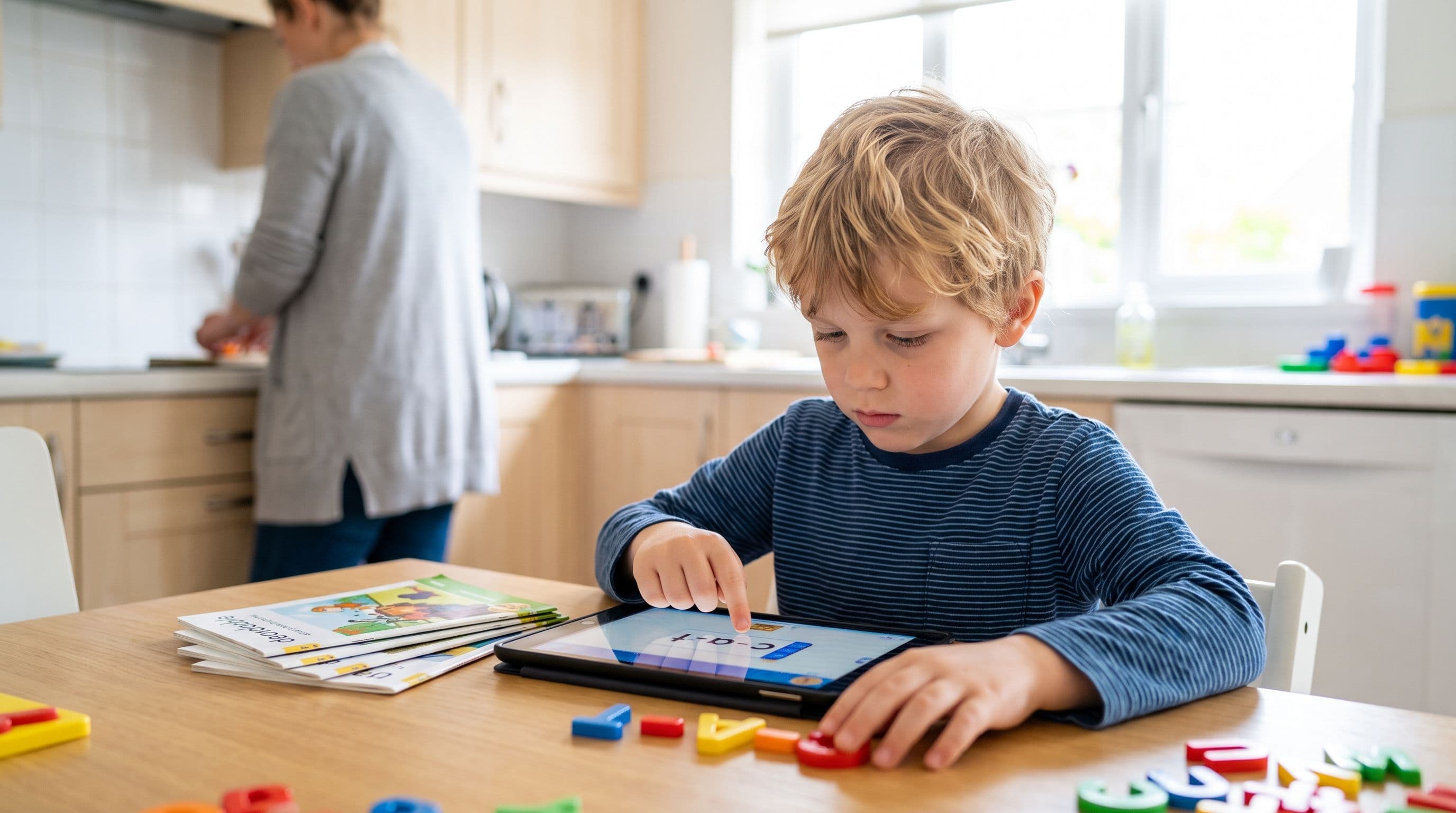
Your child is 6. Maybe they’re in first grade (ages 6-7). Maybe they’re bright, verbal, hilarious, Lego-obsessed, and somehow still freezes when they see the word “ship.”
Then the app says, “Try again!” with sparkles.
No. Nope. Absolutely not.
If you’re searching for the best reading app for a 6-year-old with dyslexia, you don’t need digital confetti. You need structured literacy, explicit phonics, daily decoding practice, and zero guessing from pictures.
Quick tiger-mom clarification before anyone starts diagnosing from the couch: an app can’t tell you for sure that your child has dyslexia. If warning signs stick around, pursue an evaluation. But while adults schedule meetings and waitlists do their slow little shuffle? You can start structured literacy support now.
I’m Xia Brody, co-founder of TeachYourKidToRead.org, Chinese-American homeschooling mom of four, and yes, I’m currently doing phonics at the kitchen table with my 4-year-old while the 1-year-old tries to eat magnetic letters. Glamorous? No. Effective? Hands down.
Here’s the thing: dyslexia doesn’t mean your child can’t learn to read. It means your child needs reading instruction that doesn’t waste time.
And apps can help.
But the wrong app? The wrong app can make the problem worse.
Tiger Truth: Waiting Is Expensive
Let’s get spicy.
The “wait and see” approach is where reading progress goes to die. I hate it. I hate it with the fire of a thousand laminated phonics cards.
US students on the 2022 NAEP / The Nation's Report Card showed only 33% of 4th graders (ages 9-10) read at or above proficient. That’s not a tiny problem. That’s a national five-alarm fire.
And dyslexic kids sit right in the blast zone when adults keep saying, “Maybe they’ll catch up.”
Kids who can’t read well by 3rd grade (ages 8-9) hit what I call the 3rd Grade Cliff. Is it a magic cliff where reading development suddenly stops? No. Children learn through reading before 3rd grade, and they keep building reading skills after it. But around that point, school texts usually get harder, longer, and less forgiving. Science, history, word problems, instructions on a test — suddenly the whole school day punishes weak decoding.
Donald Hernandez’s 2011 Annie E. Casey Foundation report, Double Jeopardy, found that children who don’t read proficiently by the end of 3rd grade are four times more likely to leave high school without a diploma than proficient readers. That’s an association, not proof that reading difficulty alone causes everything that follows. But that stat should still make every parent sit up straighter.
Real talk — remediation gets pricey, too. Private reading therapy can run US$10,000-US$15,000 a year in many US areas, and families outside the US often face long waitlists or pay privately for specialist dyslexia support. I’ve talked to parents who drained savings for tutoring because the school said, “Let’s monitor.”
Monitor what? The kid drowning?
The Playground Moment That Changed One Mom’s Mind
I was at a playground in Raleigh when another mom told me her kid’s school had just switched from Lucy Calkins to a Science of Reading curriculum because of North Carolina’s SB 387 — the Excellent Public Schools Act, a US state law. She was confused and honestly a little annoyed.
“He was doing fine before,” she said.
So I asked one question: “Can he read the word splint?”
Her son was in second grade (ages 7-8). Smart kid. Sweet kid. Could not read it.
That’s when I sat on that playground bench for 20 minutes explaining why the switch was happening — Emily Hanford’s APM Reports / “Sold a Story”, the NAEP data, and Stanislas Dehaene’s neuroscience from Reading in the Brain (2009), which shows the brain doesn’t learn to read naturally like it learns to talk. The brain has to be trained to connect sounds to print.
She went home and listened to Sold a Story that night.
At 11 p.m., she texted me: “I had no idea. Why didn’t anyone tell us this sooner?”
That question still makes me mad.
Because parents shouldn’t need a random tiger mom on a playground bench to explain why guessing at words isn’t reading.
What Makes the Best Reading App for a 6-Year-Old with Dyslexia?
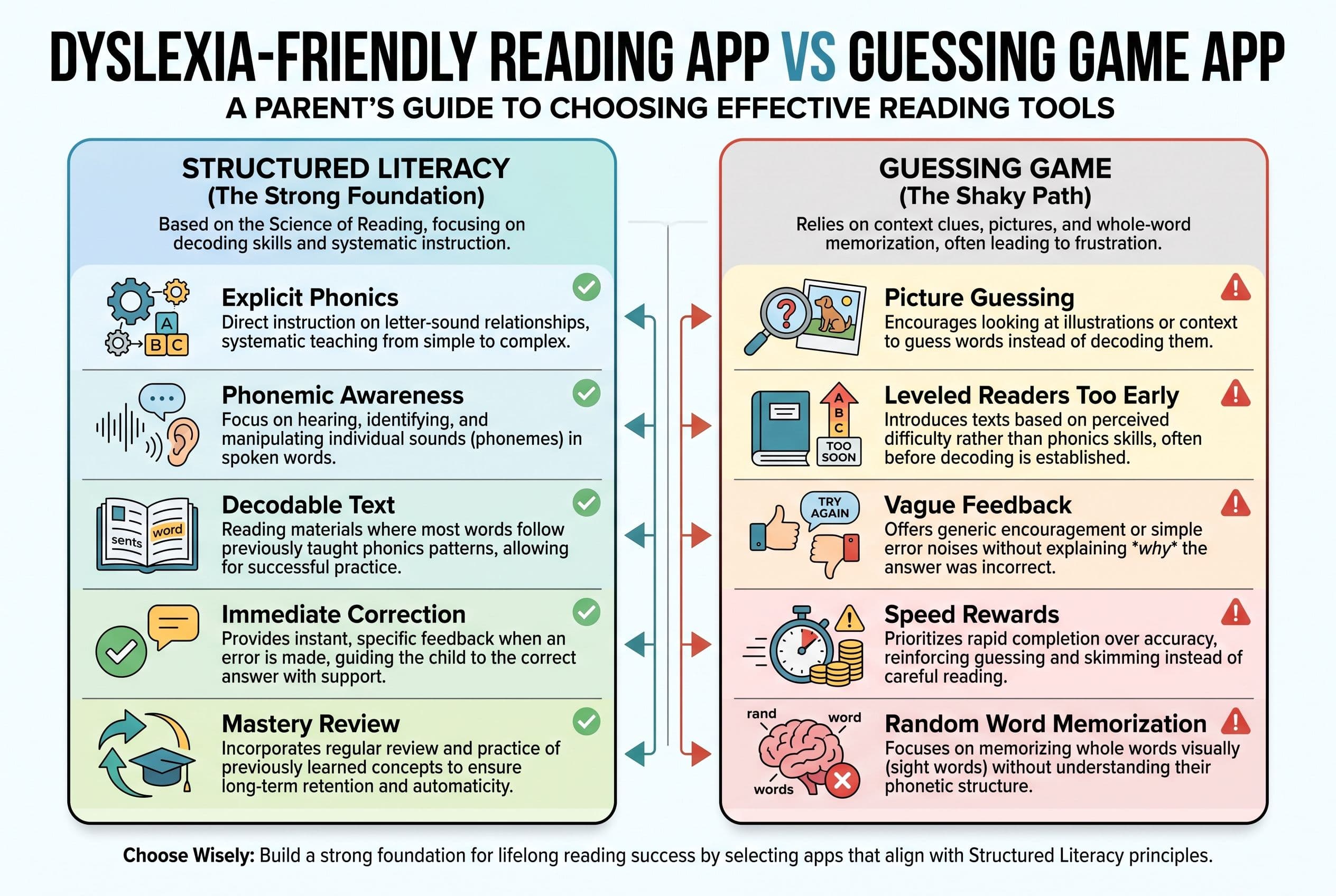
A good reading app for dyslexic first grader students should act like a calm, structured reading tutor. Not a carnival. Not a guessing game. Not a digital worksheet with stickers.
For dyslexia or strong dyslexia warning signs, the app needs these non-negotiables:
- Explicit, systematic sound-spelling instruction: teach letter-sound patterns in a planned order
- Synthetic phonics with blending: say the sounds, blend them, read the word
- Segmenting practice: pull spoken words apart into sounds for spelling
- Decodable words and sentences: only use patterns the child has learned
- Phonemic awareness practice: hearing and manipulating individual sounds in spoken words
- Helpful multisensory practice: see it, hear it, say it, tap it, write it
- Immediate correction: don’t let wrong patterns settle in
- Mastery tracking: move on only when the skill sticks
The 2000 National Reading Panel report found that systematic phonics instruction produces significant benefits, especially when children start early. Louisa Moats’ 1999 paper Teaching Reading IS Rocket Science said the quiet part loudly: teaching reading requires real knowledge of language structure.
And for dyslexic kids? That structure matters even more.
My 2026 Picks: Apps and Programs Worth Considering
No app replaces a trained specialist if your child has significant dyslexia signs. But the right app can give you daily drill, extra repetition, and a clear path when school support moves at turtle speed.
Here are my 2026 picks.
1. Teach Your Kid to Read — Best Parent-Led Structured Literacy App
Yes, I’m biased. I also built it because I was tired of parents getting sold glitter instead of decoding.
Teach Your Kid to Read uses systematic phonics, controlled practice, and parent-friendly lessons that tell you exactly what to do. It’s built for the parent sitting at the table thinking, “I’m not a reading specialist, but my kid needs help now.”
This is the best reading app for a 6-year-old with dyslexia if you want:
- short daily lessons
- clear phonics progression
- decoding practice instead of guessing
- parent scripts
- skill repetition without fluff
- a plan you can stick to on birthdays, holidays, and chaotic Tuesdays
Tiger Rule: We Don’t Disappear. Most days, we show up. Sick day? Take the break, then come back.
2. Nessy Reading and Spelling — Strong Dyslexia-Friendly Design
Nessy has been popular with dyslexic learners for years, especially because it uses structured phonics, spelling, and playful practice without relying only on leveled guessing books.
I like it for kids who need repetition and don’t melt down when the screen adds game elements. The kicker is this: parents still need to sit nearby. Don’t toss the tablet at your child and call it intervention.
Use it as a phonics app for struggling 6 year old readers, not as a babysitter.
3. Reading Eggs Fast Phonics — Useful for Extra Practice
Reading Eggs includes a Fast Phonics section that can help with sound-symbol practice and early decoding. Some kids enjoy the format, and motivation matters when a child already feels defeated.
But watch closely.
If your child starts clicking randomly, memorizing screens, or using pictures to guess words, pause. Bring it back to oral blending, finger tapping, and “Say the sounds.”
My rule: No Guessing. Ever.
4. Lalilo — Good Supplemental Practice
Lalilo can support phonics and comprehension practice, especially for young learners. It’s not my first pick for a child with clear dyslexia indicators, but it can help as a supplement.
Use it after direct instruction, not before. Apps work best when they reinforce a skill you’ve already taught.
5. Lexia Core5 — School-Friendly, Data-Heavy Option
Many schools use Lexia Core5, and it includes phonological awareness, phonics, fluency, vocabulary, and comprehension work. Some families like the progress data.
Here’s my beef: school apps can look productive while your child still struggles to decode real words on paper. So test outside the app.
Can your child read mop, shop, crash, blink, sprint on a plain white index card?
That’s the real deal.
Apps I’d Be Careful With
Some apps for kids with dyslexia look adorable and teach almost nothing.
Run from apps that:
- ask kids to guess from pictures
- use leveled readers before phonics mastery
- reward speed over accuracy
- skip phonemic awareness
- teach sight words as whole shapes only
- give vague feedback like “Try again!”
- let kids advance without mastery
Fountas & Pinnell levels are everywhere in schools, especially in the US, but they’re tied to leveled reading and whole-language-aligned habits. If an app pushes your 6-year-old to “look at the picture and think what makes sense,” I want you to hear my mom voice: No. Sound it out.
For books, choose decodable readers. Bob Books, Flyleaf Publishing, High Noon Books, and controlled passages from UFLI Foundations-style routines beat predictable patterned books for dyslexic beginners.
What to Check Before You Pick a Dyslexia App for 6 Year Old Readers
Before you pay for anything, open the trial and test it like a tiger mom with a clipboard.
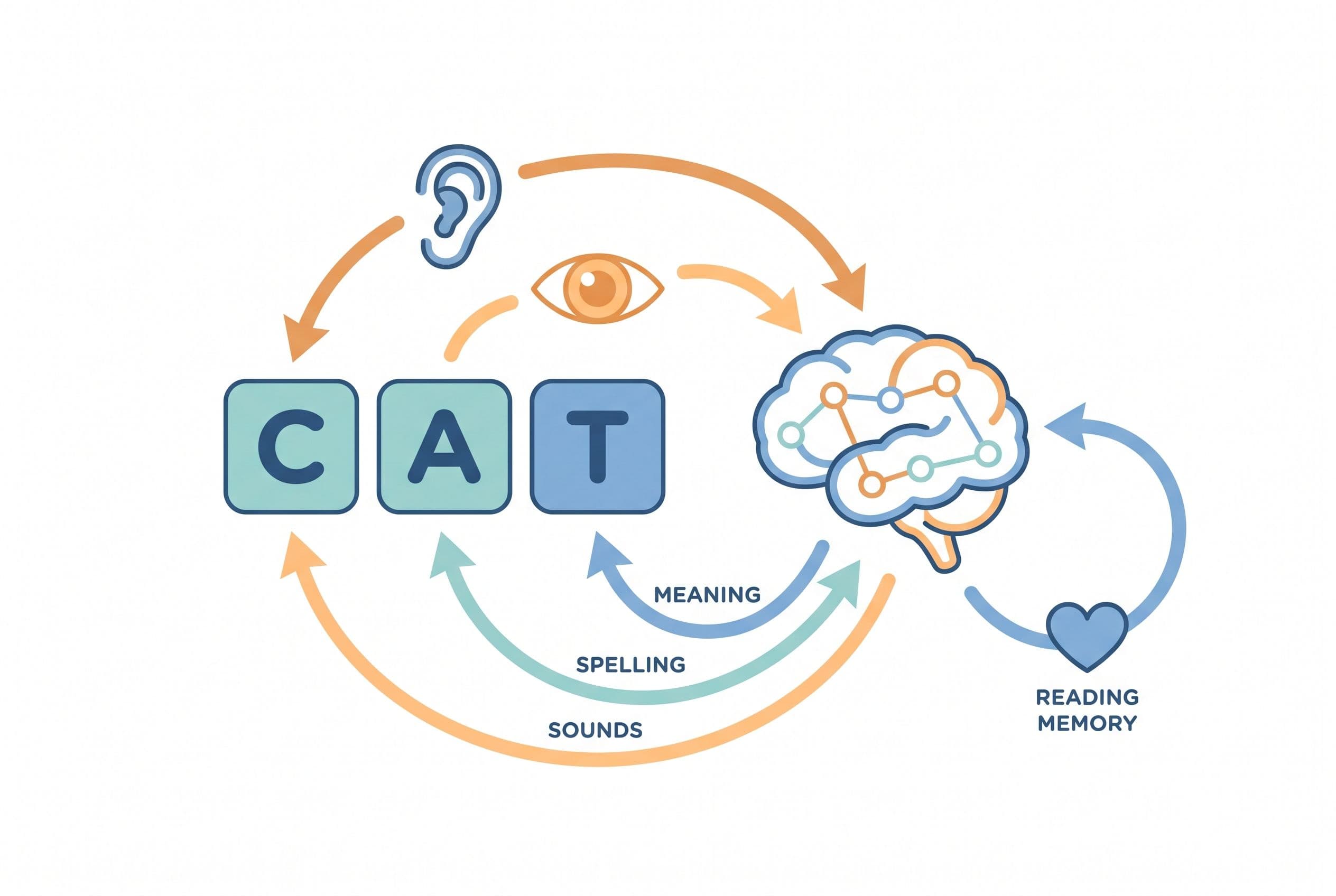
Check 1: Does it teach grapheme-phoneme correspondence?
That’s the fancy term for matching letters to sounds.
Your child needs to know that sh spells /sh/, ck spells /k/ after a short vowel, and ai often spells long /a/. A real structured literacy app teaches these patterns directly.
Check 2: Does it build phonemic awareness?
Phonological awareness covers spoken sounds, from rhymes and syllables down to individual phonemes. Phonemic awareness is that individual-sound piece.
Ask your child:
- “Say smile without /s/.”
- “What sounds do you hear in fish?”
- “Change /m/ in mat to /s/. What word?”
David Kilpatrick’s PAST, the Phonological Awareness Screening Test, takes about five minutes once you know how to give it, and it can show where the breakdown starts. His 2016 book Equipped for Reading Success explains why phonemic awareness and orthographic mapping matter so much for struggling readers.
Check 3: Does it use decodable text?
If the app teaches short a, m, s, t, then your child should read words like sat, mat, Sam.
Not “elephant.”
Not “beautiful.”
Not a predictable sentence where the picture gives away the answer.
Check 4: Does it stop guessing?
Imagine Lily sees a picture of a boat and says “boat” when the printed word says ship. Many adults smile and say, “Good try!”
No, friend. That’s not a good try. That’s a bad habit wearing a cute backpack.
Say: “Look at the letters. What sound comes first?”
Check 5: Does it give parents usable data?
You don’t need a 47-page dashboard. You need to know:
- which sounds your child knows
- which sounds they miss
- whether they can blend CVC words
- whether they can read nonsense words
- whether they retain skills after a few days
DIBELS, the Dynamic Indicators of Basic Early Literacy Skills, uses measures like nonsense word fluency because nonsense words show whether a child can decode unfamiliar words instead of just leaning on memory. That matters. Memorizing “cat” is cute. Reading lat, mib, shog cold? Now we’re seeing the code work.
The Parent Plan: How to Use a Reading App Without Wasting Time
A structured literacy app helps only if you use it like training, not entertainment.
Here’s your plan.
1. Test the starting point
Before choosing the best reading app for a 6-year-old with dyslexia, find the exact weak spot.
Can your child:
- name all letters?
- give the most common sound for each consonant?
- blend sat, pin, mop?
- segment dog into /d/ /o/ /g/?
- read sh, ch, th, ck?
- read nonsense words like lat, mib, shog?
If no, start there. Don’t jump to stories.
2. Pick one main app
Don’t download seven apps. That’s not intervention. That’s digital clutter.
Pick one main decoding practice app and use it daily for 10-15 minutes. Add paper practice right after.
App first. Index cards second. Real reading third.
3. Sit with your child
I know. You wanted the app to do the work.
Sorry. I’m ruining your day because I care.
Sit nearby and listen. Dyslexic kids often need more repetitions, more correction, and more encouragement than the app can give alone.
4. Use the “I do, we do, you do” routine
Try this:
- I do: “This says /sh/. Watch my mouth.”
- We do: “Say it with me: /sh/.”
- You do: “Now you read: ship.”
- Review: “What two letters spell /sh/?”
Simple. Boring. Magic.
5. Add handwriting
Dyslexic kids often benefit from multisensory work. Have your child say the sound while writing the grapheme.
For example:
- write m while saying /m/
- tap sounds in map
- draw one line for each sound
- blend slowly, then faster
Orton-Gillingham tutoring uses this kind of structured, multisensory practice. Programs like Wilson Reading System, Barton Reading & Spelling, Logic of English, and UFLI Foundations all build on explicit phonics principles in different ways.
6. Keep lessons short
A 6-year-old with dyslexia doesn’t need a 45-minute app marathon.
Try:
- 10 minutes app practice
- 5 minutes paper decoding
- 5 minutes decodable reader
- stop before tears if possible
If tears start at minute nine every day, do eight strong minutes. Mastery beats drama.
7. Track real-world reading
Once a week, write 10 words on plain paper. No pictures. No hints.
Use patterns your child has learned:
- cat
- ship
- chop
- ring
- splash
- thin
- locked
- frog
- best
- sprint
If your child can read them cold, progress is real. If they can only read them inside the app, the skill hasn’t transferred yet.
Best App Match by Need
Use this quick guide.
| Child’s Need | Best Fit |
|---|---|
| Parent-led structured literacy | Teach Your Kid to Read |
| Dyslexia-friendly games and spelling | Nessy |
| Extra phonics practice | Reading Eggs Fast Phonics |
| School-aligned practice | Lexia Core5 |
| Light supplemental review | Lalilo |
Bottom line: the best reading app for a 6-year-old with dyslexia teaches the code clearly and makes your child practice it until it sticks.
What If My Child Has Dyslexia Signs But No Diagnosis Yet?
Don’t wait for a diagnosis to begin structured phonics.
If your child has several of these signs, act now:
- struggles to rhyme
- mixes up similar sounds
- forgets letter sounds after repeated practice
- guesses from pictures
- avoids reading
- can understand stories aloud but can’t decode simple words
- has a family history of dyslexia
- reverses letters past the early learning stage along with decoding trouble
Contact your school or local education provider and ask for a reading evaluation. If you’re in the US, ask in writing. If you’re in the UK, Australia, Canada, or New Zealand, use your local special education or learning support process.
And while adults schedule meetings? Teach.
Use a structured literacy app. Drill phonemic awareness. Read decodable books. Keep going.
The Final Verdict
My top pick for the best reading app for a 6-year-old with dyslexia is Teach Your Kid to Read because it puts parents back in the driver’s seat with systematic phonics, decoding practice, and clear daily steps.
But I’ll say the quiet part loudly: no app saves a struggling reader while adults stay passive.
You need the app, the parent, the practice, and the non-negotiable rule: We Don’t Disappear.
Your child doesn’t need shame. Your child doesn’t need guessing. Your child needs the code.
And you can teach it.
Start with Teach Your Kid to Read at TeachYourKidToRead.org, then use the daily plan above for the next 30 days. If you want help choosing a starting point, use start lesson one free or reach out through contact us today.
FAQ
What is the best reading app for a 6-year-old with dyslexia?
The best reading app for a 6-year-old with dyslexia uses structured literacy: explicit phonics, phonemic awareness, decodable reading, review, and mastery checks. My top pick is Teach Your Kid to Read because it guides parents through daily decoding practice instead of handing kids random reading games.
Can an app really help a dyslexic first grader read?
Yes, an app can help if it teaches the sound-spelling code directly and gives enough repetition. But a dyslexic first grader usually needs adult support, correction, and short daily practice too. Don’t use the app as a babysitter.
How long should my 6-year-old practice reading each day?
Start with 10-20 minutes a day. For many dyslexic kids, short daily drill works better than long, exhausting sessions twice a week. Stop before the meltdown if you can, then come back tomorrow.
Should I use sight word apps for dyslexia?
Be careful. Dyslexic kids shouldn’t memorize every word as a visual shape. They need orthographic mapping, which means connecting sounds to letters in the word. Teach high-frequency words by sound patterns first, then explain the irregular parts.
When should I get a dyslexia evaluation?
If your 6-year-old struggles with letter sounds, blending, rhyming, or remembering words despite practice, ask for an evaluation now. You don’t need to wait until 3rd grade. Early action protects confidence and saves time.
Part of these guides

Xia Brody
Co-Founder, Teach Your Kid to Read
Mom of 4 who has successfully taught her kids to read. Currently in the trenches with her 4-year-old while her two oldest (10 and 7) devour books on their own. Passionate about phonics-based methods and building a lifelong love of reading.
Related Articles
Best Reading App for a 5-Year-Old with Dyslexia: 2026 Picks
A dyslexic 5-year-old doesn't need guessing games or pretty animations. They need systematic phonics, daily drill, parent coaching, and a plan that refuses to wait.
Read More →
Best Reading App for 1st Graders in 2026: 6 Apps Tested Side by Side
Not all reading apps are created equal — most first grade reading apps teach kids to guess, not read. I tested 6 of the most popular ones with my own kids and broke down exactly which ones use real phonics and which are dressed-up screen time.
Read More →
Best Reading App for 6-Year-Olds: 6 Tested & Compared (2026)
Most reading apps for 6-year-olds are glorified video games dressed up in educational clothing. I tested 6 of them with my own kids and my neighbor's first-grade class. Here's what actually works — and what's wasting your money.
Read More →