Best Reading App for a 5-Year-Old with Dyslexia: 2026 Picks
What You'll Learn
- The one feature a dyslexia reading app for 5 year old kids must have before you trust it
- Why “read the picture” methods can hurt struggling readers (yes, even if the app looks cute)
- How to use a phonics app for dyslexia without turning your child into an iPad zombie
- The 10-minute daily routine I’d use with a dyslexic kindergartener (age 5)
Reality Check: Your 5-Year-Old Doesn’t Need More Guessing
If your child looks at the word ship and says “boat” because there’s a picture of water, stop right there.
That’s not reading.
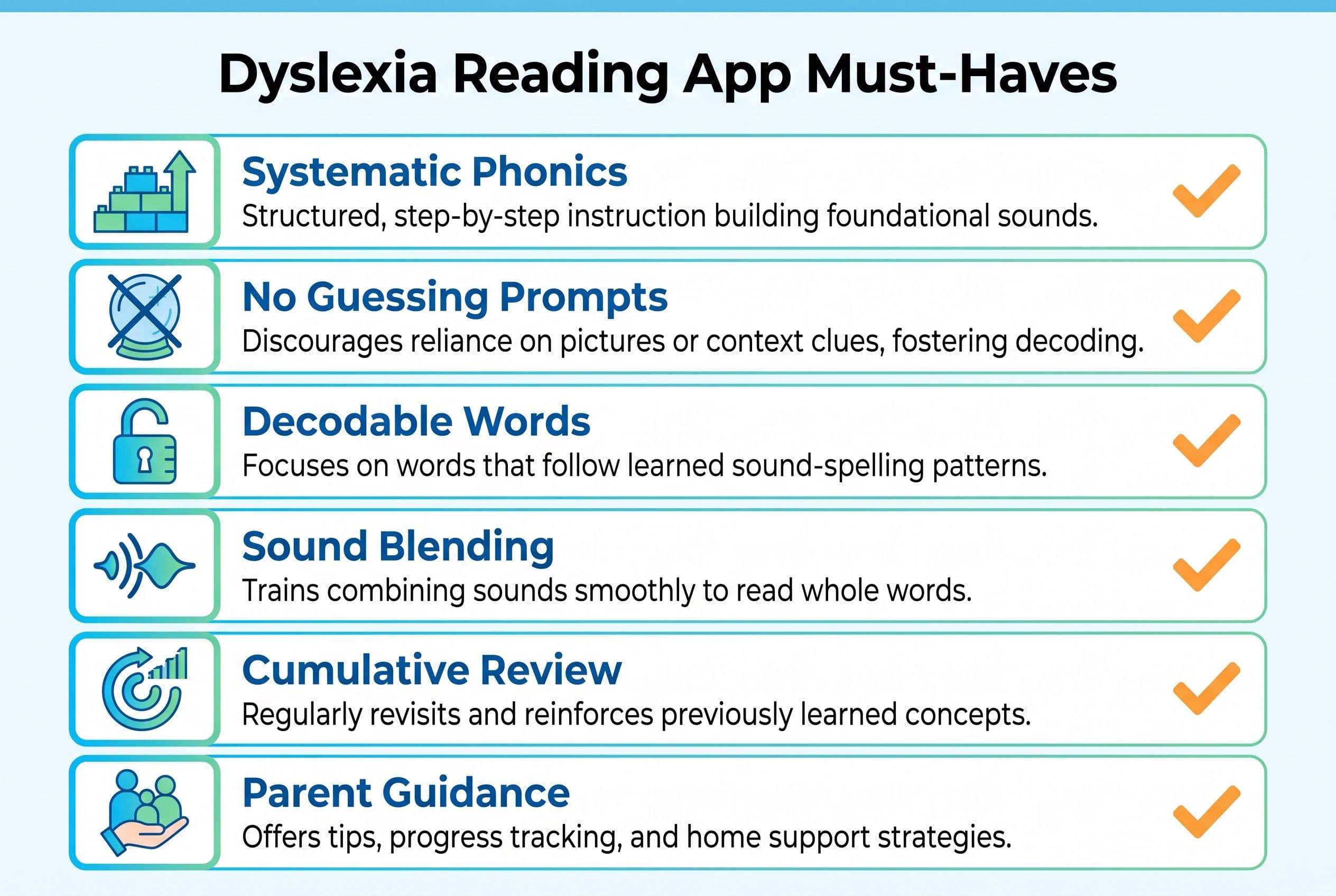
That’s guessing with confidence, which is somehow worse because everyone claps and says, “Great try!” Meanwhile, your child’s brain still hasn’t mapped sh to /sh/, i to /i/, and p to /p/.
Quick clarity before we go full tiger: at age 5, some kids already have a dyslexia diagnosis, and others show dyslexia risk signs. Either way, the instructional need is basically the same: explicit, systematic phonics and early support. We don’t wait around hoping the reading fairy handles it.
The best reading app for a 5-year-old with dyslexia or dyslexia risk signs must teach the code directly. No guessing. No memorizing whole words by shape. No “look at the picture and think what would make sense.”
I’m a homeschooling mom of four. I’ve taught my two oldest to read, and I’m currently at the kitchen table with my 4-year-old drilling CVC words like map, sit, and hen while my 1-year-old tries to eat the letter tiles. Glamorous? No. Effective? Hands down.
And for a dyslexic 5-year-old, effective beats cute every single time.
Tiger Truth: Waiting Can Cost Your Child Years
Look, I know five sounds young. I know people say, “Maybe he’ll grow out of it.”
That line drives me crazy.
Dyslexia doesn’t vanish because adults feel uncomfortable naming it. A child can be bright, verbal, funny, and still need explicit reading instruction. In fact, many dyslexic kids fool adults because they memorize books, charm teachers, and use context like tiny detectives.
But the bill comes due.
US students on the 2022 NAEP / The Nation's Report Card showed that only 33% of 4th graders read at or above proficient. That’s the US national report card, not my tiger-mom imagination running wild.
And Donald Hernandez’s 2011 Annie E. Casey Foundation report Double Jeopardy found that kids who weren’t reading proficiently by 3rd grade (ages 8-9) were four times more likely to leave high school without a diploma than proficient readers. That’s an association, not proof that reading difficulty alone causes dropping out. But if your smoke alarm is screaming, you don’t stand there debating whether smoke caused the whole fire.
This is why I don’t play the “wait and see” game.
A 5-year-old with dyslexia signs needs reading help now. Not panic. Not shame. A plan.
The Raleigh Playground Moment I Still Think About
I was at a playground in Raleigh when another mom told me her child’s school had switched from Lucy Calkins to a Science of Reading curriculum. In North Carolina, that shift was tied to the 2021 Excellent Public Schools Act, Senate Bill 387 / Session Law 2021-8, a US state law.
She looked confused and a little annoyed. “He was doing fine before,” she said.
So I asked one question: “Can he read the word splint?”
Her son was in second grade (ages 7-8). He couldn’t.
I spent 20 minutes on that playground bench explaining why so many schools were making this kind of switch: Emily Hanford’s APM Reports investigation Sold a Story, the NAEP data, and Stanislas Dehaene’s neuroscience from Reading in the Brain (2009), which shows that the brain doesn’t learn to read naturally. We train it.
That mom went home and listened to Sold a Story that night. She texted me at 11 p.m.: “I had no idea. Why didn’t anyone tell us this sooner?”
Exactly.
That’s why you’re here searching for the best reading app for a 5-year-old with dyslexia. You’re trying to tell the truth sooner.
Good. Let’s work.
What Makes an App Good for Dyslexia?
A good phonics app for dyslexia doesn’t just throw letters on a screen and call it literacy.
It teaches the sound-symbol code in a planned order. It makes your child hear sounds, say sounds, blend sounds, read words, spell words, and review until the skill sticks.
The 2000 National Reading Panel report found that systematic phonics instruction produces significant reading benefits, especially in the early grades. Louisa Moats’ 1999 paper Teaching Reading IS Rocket Science said the quiet part out loud: teaching reading well requires real knowledge of speech sounds, spelling patterns, and language structure.
So what should the best app for dyslexic kids include?
Non-Negotiable Features
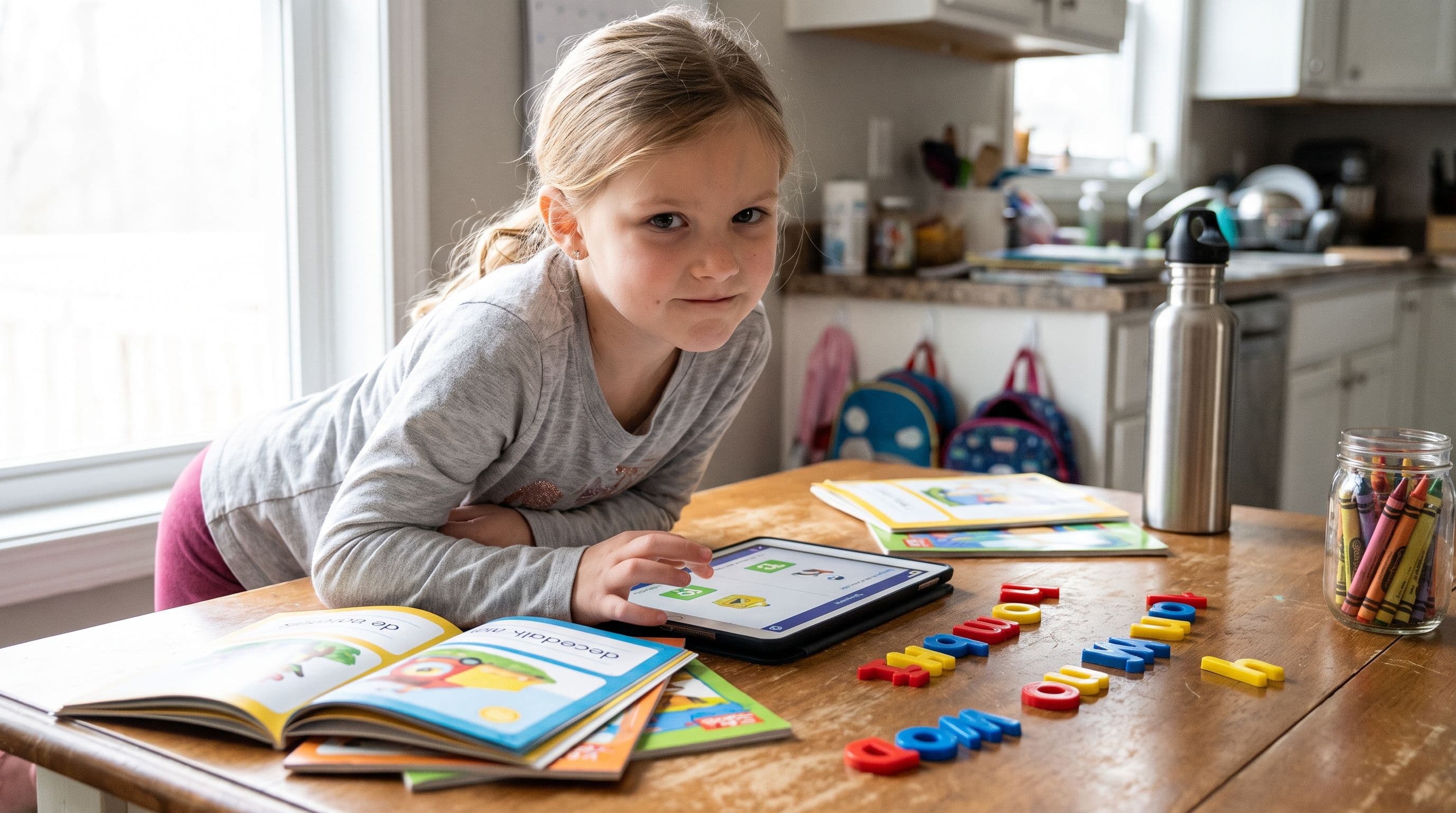
Your dyslexic kindergartener (age 5) needs an app with:
- Systematic synthetic phonics: Sounds first, then blending into words
- Explicit, sequential instruction: One skill at a time, in a sane order
- Cumulative review and corrective feedback: The app doesn’t just mark answers wrong and move on like a tiny robot with no mercy
- No guessing prompts: No “use the picture,” no “look at the first letter and guess”
- Decodable words and books: Your child reads only patterns they’ve learned
- Parent involvement: You can’t outsource reading to a tablet and go fold laundry forever (I wish)
- Short daily practice: 10-15 minutes beats one heroic Saturday meltdown
Orton-Gillingham is one structured literacy approach many parents hear about, and it can be helpful when it’s explicit, sequential, and cumulative. But don’t get hypnotized by the label. The app still has to teach the code clearly and give your child real practice with feedback.
The real deal? A struggling reader app should make your child work, but not drown.
That balance matters.
My 2026 Picks: Best Reading Apps and Tools for a 5-Year-Old with Dyslexia
Here’s my no-nonsense list. Some are apps. Some are programs with digital pieces. I’m including them because parents need practical options, not perfect labels.
1. Teach Your Kid to Read
Best for: Parents who want a clear daily phonics plan without becoming reading specialists overnight.
Yes, I’m biased. I co-founded TeachYourKidToRead.org because I got tired of parents being told to wait while their kids fell behind.
Teach Your Kid to Read focuses on systematic phonics, sound-by-sound decoding, and daily mastery. The goal isn’t to entertain your child for 45 minutes while you make dinner. The goal is to teach the code so your child can read independently.
For a 5-year-old with dyslexia indicators, that means:
- Direct letter-sound practice
- Blending drills
- Decodable word reading
- Review that actually repeats enough times
- Parent guidance so you know what to do when your child freezes
This matters because dyslexic kids often need more repetitions than typical readers. Not because they’re lazy. Not because they’re not smart. Their brains need cleaner instruction and more practice for orthographic mapping — the process David Kilpatrick explains in Equipped for Reading Success (2016), where spoken words, sounds, and spellings bond in long-term memory.
Bottom line: if you want the best reading app for a 5-year-old with dyslexia, pick one that teaches phonics like a skill, not a vibe.
2. Nessy Reading and Spelling
Best for: Dyslexic kids who need structured phonics with a playful feel.
Nessy has a strong dyslexia focus and uses explicit phonics, spelling patterns, and games. Many families like it because it feels friendly without going full circus.
My caution? Sit nearby. Apps can look like learning while your child clicks around, avoids hard tasks, and somehow ends up customizing a monster for 17 minutes. Ask me how I know.
Use Nessy as a practice tool, not the entire reading plan.
3. Logic of English
Best for: Parents who want deep phonics and spelling rules.
Logic of English teaches phonograms, spelling rules, and language structure in a way that fits many dyslexic learners. It’s not just “A says apple.” It gets into why English works the way it works.
For a 5-year-old, you may need to slow down and keep lessons short. Dyslexic kids need success, not a parent turning the dining room into a graduate seminar on grapheme-phoneme correspondence.
Use it well, and it’s powerful.
4. UFLI Foundations
Best for: Parents or tutors who want research-aligned phonics lessons.
UFLI Foundations isn’t a typical kid app, but I’m including it because it’s one of the most useful structured phonics resources out there. It gives a clear sequence, word lists, blending practice, dictation, and decodable text work.
If you’re supporting a dyslexic kindergartener, UFLI can pair nicely with a phonics app for dyslexia. App for practice. UFLI-style lesson for direct teaching.
That combo is a no-brainer.
5. Nessy + Decodable Books Combo
Best for: Kids who need screen practice and real book reading.
If your child has dyslexia, don’t let all reading happen on a screen.
Pair any app with decodable books like Bob Books, Flyleaf Publishing, or High Noon Books. Your child needs to transfer decoding from screen to page.
This is where parents often mess up. They buy the best app for dyslexic kids, then skip the actual reading aloud part because the app reports “80% complete.”
Nope.
Have your child read real decodable text to you daily. Two pages count. One page counts. Accuracy counts more than volume.
Apps I’d Avoid for Dyslexic 5-Year-Olds
I’m not naming every shiny app because some of them change weekly, and frankly, I don’t want to give bad tools free advertising.
But avoid any reading app that:
- Tells your child to guess from pictures
- Uses leveled readers instead of decodable readers
- Rewards speed over accuracy
- Teaches sight words as visual shapes with no phonics links
- Lets the child click endlessly without reading aloud
- Says “personalized” but never shows you the phonics sequence
Fountas & Pinnell levels are everywhere in schools, but they come from a whole-language aligned tradition. If an app talks more about levels than decoding, raise an eyebrow.
Actually, raise both.
How to Know If Your 5-Year-Old Might Have Dyslexia
You don’t need to diagnose dyslexia at the kitchen table. You do need to notice red flags.
Common dyslexia signs at age 5 include:
- Trouble rhyming words like cat, hat, mat
- Difficulty clapping syllables in words
- Mixing up letter sounds after lots of practice
- Guessing wildly at simple words
- Avoiding reading activities
- Strong vocabulary but weak decoding
- Family history of dyslexia or reading struggles
Here’s the thing: dyslexia is not a vision problem. Colored overlays don’t teach /m/ /a/ /t/.
A good evaluation may include phonological awareness testing, rapid naming, letter-sound knowledge, word reading, nonsense word reading, and spelling. The PAST test — David Kilpatrick’s Phonological Awareness Screening Test — samples phonological awareness skills and can help show what your child may need instructionally.
DIBELS also helps track early reading skills. For example, DIBELS nonsense word fluency checks whether a child can apply letter-sound knowledge to unfamiliar words, which matters because dyslexic kids often memorize familiar words but stumble when the word changes.
But hear me clearly: PAST and DIBELS don’t diagnose dyslexia by themselves, and they don’t tell you the one grand cause of a child’s reading struggle. Use age-appropriate measures, and have them administered and interpreted by someone who knows what they’re doing.
If your gut says something’s off, trust it.
The Daily Routine I’d Use With a Dyslexic Kindergartener
You don’t need three hours. You need consistency.
Tiger Rule: We Never Skip. Birthdays, holidays, vacation, weird Tuesdays when everyone cries because the banana broke wrong — we still do a tiny reading drill.
Here’s the routine I’d use with the best reading app for a 5-year-old with dyslexia.
Step 1: Warm Up Sounds for 2 Minutes
Show 5-8 letters or phonograms your child already knows.
Child says the sound, not the letter name.
You point to m. Child says /m/. You point to s. Child says /s/.
Fast. Clean. No drama.
Step 2: Blend 5 Words for 3 Minutes
Use words your child can decode:
- map
- sit
- lip
- hen
- hop
Touch each sound. Blend slowly. Then read it fast.
If your child guesses, say: “No guessing. Sound it out.”
Calm voice. Steel spine.
Step 3: Use the App for 5-10 Minutes
Now open your dyslexia reading app for 5 year old practice.
Stay close enough to hear whether your child actually says the sounds. If the app allows silent tapping, don’t count that as full reading practice.
Your child needs mouth, ears, eyes, and brain working together.
Step 4: Read One Decodable Page
Pick a decodable book that matches the phonics skill.
If your child knows short a, don’t hand them a book full of igh, ough, and silent e patterns. That’s not challenge. That’s sabotage with a bookmark.
Step 5: End With One Win
Ask your child to reread one word they struggled with and got right.
Say, “You sounded out ship. You didn’t guess. That’s reading.”
Kids with dyslexia need to feel mastery in their bones.
What About Orton-Gillingham Apps?
Parents search for an Orton-Gillingham app because they’ve heard OG helps dyslexia.
They’re partly right, with a catch.
Orton-Gillingham is an approach, not one magic product. It uses explicit, sequential, multi-sensory teaching. Programs like Wilson Reading System, Barton Reading & Spelling, and some Lindamood-Bell instruction draw from structured literacy principles.
But OG branding alone doesn’t prove an app is better, and the research support is strongest for explicit, systematic, cumulative reading instruction with plenty of practice and feedback. So don’t buy the shiny “OG-inspired” sticker and call it done. Tiger moms read the fine print.
A strong Orton-Gillingham-style app should include:
- Direct teaching of one pattern at a time
- Clear modeling and corrective feedback
- Cumulative review
- Spelling and reading together
- Controlled text
If an app slaps “dyslexia-friendly” on the sales page but lets your child guess words from pictures, run.
Screen Time: The Tiger Mom Compromise
I’m not anti-screen.
I’m anti-lazy-screen.
The American Academy of Pediatrics / HealthyChildren encourages families to create media plans and pay attention to content quality, not just minutes. That’s sensible.
For a dyslexic 5-year-old, I’d rather see 12 focused minutes on a phonics app than 45 minutes of “educational” tapping that teaches nothing except snack negotiation.
My rule:
- Parent teaches first
- App practices second
- Decodable book finishes the session
That’s the sandwich. Don’t serve only the app filling.
How Fast Should a Dyslexic 5-Year-Old Improve?
Careful here.
No honest person can promise your child will read in 30 days. Dyslexia varies. Attention, speech-language history, working memory, instruction quality, hearing, and practice time all matter.
But you should see some signs that the instruction fits:
- Your child remembers more letter sounds over time
- Blending gets less painful
- Guessing decreases
- Your child can read new CVC words, not just memorized ones
- Decodable books feel hard but possible
If you see no progress after 8-12 weeks of consistent practice, ask for more help. Talk to a qualified reading specialist, dyslexia evaluator, speech-language pathologist, or structured literacy tutor.
Don’t wait until 3rd grade.
Please.
My Final Verdict
The best reading app for a 5-year-old with dyslexia is the one that teaches systematic phonics, blocks guessing, supports parent-led practice, and builds mastery one sound at a time.
For me, Teach Your Kid to Read belongs at the top because it treats reading like the survival skill it is. Not a cute milestone. Not a school problem. A life skill.
Your child doesn’t need shame. Your child needs a better method.
Start today. Ten minutes. No guessing. We never skip.
Need help building your child’s reading plan? Visit Teach Your Kid to Read at start lesson one free or reach out through contact us today.
FAQ
What is the best reading app for a 5-year-old with dyslexia?
The best reading app for a 5-year-old with dyslexia or dyslexia risk signs teaches systematic synthetic phonics, uses decodable words, gives lots of review, and avoids guessing strategies. I’d start with Teach Your Kid to Read, then pair app practice with real decodable books and parent-led sound drills.
Can an app replace a dyslexia tutor?
Usually, no. A strong phonics app for dyslexia can support practice, but many dyslexic kids need direct human feedback. If your child makes little progress after consistent daily work, look for a structured literacy tutor trained in Orton-Gillingham, Wilson Reading System, Barton Reading & Spelling, or a similar approach.
How long should my 5-year-old use a reading app each day?
For most 5-year-olds, 10-15 focused minutes is plenty. Add 2-5 minutes of sound review and one short decodable reading session with you. Short daily drill beats long, emotional weekend sessions.
Should I get my kindergartener tested for dyslexia?
If you see strong red flags — weak rhyming, poor letter-sound memory, guessing, family history, or intense reading avoidance — don’t wait. Ask about screening tools like DIBELS or the PAST test, and talk with a qualified reading specialist or evaluator.
Are sight word apps good for dyslexic kids?
Be careful. Dyslexic kids don’t need to memorize hundreds of words by shape. They need phonics-based mapping, including irregular word parts taught clearly. A good app explains the sounds and spellings instead of treating every word like a flashcard mystery.
Part of these guides

Xia Brody
Co-Founder, Teach Your Kid to Read
Mom of 4 who has successfully taught her kids to read. Currently in the trenches with her 4-year-old while her two oldest (10 and 7) devour books on their own. Passionate about phonics-based methods and building a lifelong love of reading.
Related Articles
Best Reading App for Struggling Readers: 2026 Guide for 5-Year-Olds
Most reading apps for kids are glorified guessing games with cartoon characters. If your 5-year-old is struggling to read, you need an app built on phonics science — not one that teaches them to memorize words from pictures. Here's what actually works in 2026.
Read More →
Best App to Help a Kindergartner Learn to Read (2026)
Most reading apps for kindergartners are glorified guessing games. Here's how to tell the difference, what the science actually says about screen-based phonics instruction, and the one app I trust with my own kids in 2026.
Read More →
Best Reading App for a Struggling 7-Year-Old (2026): What Actually Works
Most reading apps for struggling 7-year-olds are glorified guessing games dressed up with cartoon characters. Here's what the science of reading actually says works — and the one app I trust with my own kids.
Read More →