6 Best Reading Apps for Gifted 8-Year-Olds, Ranked

The Verdict
I rank the best reading apps for gifted 8-year-olds by skill fit, useful challenge, adult visibility and practical access.
How we ranked
- Skill fit: Match decoding support or comprehension enrichment to the child's actual need.
- Useful challenge: Look for work beyond easy repetition, without treating difficulty as a prize.
- Adult visibility: Favor opportunities to hear reading and discuss answers rather than trust completion alone.
- Practical access: Consider subscriptions, school access and how much adult participation the program needs.
| Rank and app | What it teaches or describes itself as offering | Price / pricing model | Best-for age |
|---|---|---|---|
| 1. Teach Your Kid to Read | Step-by-step, parent-led phonics and decoding | Lesson one free, then 7-day trial, US$9.95/mo | My recommendation: age 8 when decoding needs work; no stated age range |
| 2. Reading Eggs | Describes Eggspress as reading, comprehension and vocabulary practice | US$13.99/month (checked October 2026) or US$99.99/year (checked October 2026); Reading & Math, up to 4 children; 30-day free trial | Eggspress states ages 7–13 |
| 3. Lexia Core5 | Describes its program as reading instruction across foundational skills and comprehension | School licenses; families can buy a 12-month license through Family Literacy Centers | States US pre-K through grade 5 |
| 4. Raz-Kids | Describes its offering as leveled digital books with comprehension quizzes | Annual license, mostly through schools and teachers | States US kindergarten through grade 5 |
| 5. Prodigy English | Describes itself as game-based English practice | Free game content with optional paid membership | States US grades 1–6 |
| 6. Nessy | Describes its reading and spelling offering as structured literacy practice | From US$15.50/month (checked October 2026), home subscription | States ages 6–11 |
Full disclosure: I co-founded Teach Your Kid to Read, so weigh my #1 pick accordingly; the rest of the ranking is based on the criteria above.
I recommend Teach Your Kid to Read when your eight-year-old needs decoding instruction with you beside them: start lesson one free. Lesson one is free, with no card and nothing to cancel. From lesson two, the whole program is a 7-day free trial, then US$9.95 a month.
For an already-fluent advanced reader, #2 is the closer match. My #1 placement reflects its parent-led decoding approach, not a claim that beginning phonics supplies gifted enrichment.
What You'll Learn
- Teach Your Kid to Read ranks #1 for parent-led decoding work, not advanced comprehension. Fluent readers who need enrichment should start with Reading Eggs’ Eggspress offering instead.
- Reading Eggs, Lexia Core5 and Raz-Kids offer broader reading practice; Prodigy English emphasizes game-based practice, while Nessy targets foundational reading and spelling.
- Choose the next skill your child needs—not the biggest age range or the flashiest reward system.
- A gifted label doesn't rule out reading difficulties. Check unfamiliar-word reading separately from vocabulary and understanding.
Reality Check: Gifted Isn't a Reading Level
An eight-year-old can explain black holes over breakfast and still stumble over the print on a cereal box. Another can race through a novel but struggle to explain why a character changed her mind. Those children don't need the same app.
As a homeschooling mom of four, ages 10, 7, 4 and 1, I've learned to separate impressive conversation from independent reading. Honestly, “gifted” tells me less about choosing a lesson than watching a child tackle one unfamiliar paragraph.
The best reading apps for gifted 8-year-olds must match the actual gap. This ranking includes both decoding support and enrichment because advanced thinking doesn't automatically mean advanced reading.
The Tiger Truth: Don't Let Strengths Hide a Gap
Only 31% of US fourth graders (ages 9–10) scored at or above Proficient in reading on the 2024 NAEP. That doesn't mean everyone below that threshold can't read, and it doesn't describe gifted children specifically. It does challenge the comforting assumption that reading always sorts itself out.
Gough and Tunmer's 1986 paper introducing the Simple View of Reading separates decoding from language comprehension. Strong spoken language can't permanently substitute for accurate word reading; accurate word reading alone doesn't guarantee understanding.
Doing nothing can leave a child guessing unfamiliar words or avoiding demanding books. Don't panic. Identify the weak skill and teach it while continuing to feed the child's strengths.
Ranked: The 6 best reading apps for gifted 8-year-olds
1. Teach Your Kid to Read: Best for Parent-Led Decoding Gaps
My first question isn't “How smart is this child?” It's “What happens when the next word looks unfamiliar?” If your eight-year-old substitutes a plausible word instead of reading the letters, begin there.
Teach Your Kid to Read provides a step-by-step phonics program that a parent and child complete side by side for about 15 minutes a day. The app teaches the adult what to listen for and how to correct mistakes. That gives the adult a specific teaching job—not just the password.
Lesson one introduces m, s, p and short a. Children hear the sounds, tap matching letters and blend and build am, map and sap. There's no story in that first lesson; short stories built from previously taught sounds begin in lesson two.
The course contains 50 lessons in a fixed order, moving through digraphs, blends, vowel teams and silent e to prefixes and suffixes. It also teaches a small set of common irregular words by sight, calling them “leap words.” Parents can view every lesson and jump to any lesson; a parent “mastered this” button skips some practice activities in later lessons.
For a child who already knows the basics, that access matters. I wouldn't require an accurate reader to demonstrate map endlessly just because an app starts there. I would listen carefully before deciding what to skip.
The 2000 report from the US National Reading Panel supports systematic phonics instruction generally. It doesn't establish that this particular app works better than another product, or that fluent readers need more beginning phonics.
Honest limitation: The app has no comprehension questions. Families seeking advanced comprehension or leveled-book practice should choose something else.
My verdict: strong alignment with adult visibility and targeted decoding work; the wrong enrichment purchase for a child who already reads unfamiliar words accurately. It runs on iPhone/iPad, Android and the web.
2. Reading Eggs: Best Match for Comprehension Enrichment
For reading apps for advanced 8-year-olds, look specifically at Reading Eggspress, not just the introductory Reading Eggs activities. The product states an Eggspress age range of 7–13, compared with ages 3–7 for Reading Eggs itself.
Eggspress describes its focus as comprehension, vocabulary and reading development. That makes it the closest match here for an eight-year-old who reads independently but needs to think harder about meaning.
I would judge the challenge by the answers your child must produce. Can they explain an inference? Can they distinguish the author's statement from their own opinion? Finishing another activity isn't the same as answering either question.
The subscription includes Reading & Math for up to four children. That's useful access information, but extra subjects don't make the reading work more suitable.
My verdict: the first option I'd investigate for a fluent reader seeking enrichment. Add a brief conversation after an activity so correct selections don't hide shallow understanding.
3. Lexia Core5: Best for a Structured Range of Reading Skills
Lexia Core5 describes a reading program spanning phonological awareness, phonics, structural analysis, fluency, vocabulary and comprehension. That breadth makes it worth considering when a child's skills don't line up neatly.
Imagine a child who understands sophisticated stories aloud but struggles with unfamiliar printed words containing prefixes and suffixes. A broad instructional sequence may suit that uneven profile better than simply assigning harder books.
Access deserves attention before you promise anything. Core5 uses school licenses, and families can purchase a 12-month license through Family Literacy Centers. Ask your child's school whether access already exists and who will help interpret the work.
Its stated range reaches US grade 5, but an upper grade label doesn't guarantee enough challenge for every advanced reader.
My verdict: a sensible structured option when you need several reading skills addressed. Check the available content and adult support before committing; don't buy solely because “adaptive” sounds reassuring.
4. Raz-Kids: Best for Book-Based Reading and Discussion
Raz-Kids describes a collection of leveled digital books with comprehension quizzes. For families who want actual reading material rather than a primarily phonics-focused sequence, that format deserves consideration.
Here's my caution: a book level doesn't tell you everything. Two children can finish the same book while understanding very different amounts. Listen to a short passage and ask what the author implied—not just what happened first.
For a fluent eight-year-old, compare passages on the same topic. Ask which author gives stronger evidence and which detail changes the child's thinking. That's useful reading comprehension enrichment, even when the app's own questions stop earlier.
An annual license, usually through schools or teachers, may also make access less straightforward than a household app subscription.
My verdict: a good candidate for book-centered practice with an adult adding depth. Don't treat a quiz score as a complete reading assessment, and don't use pictures to identify unfamiliar printed words.
5. Prodigy English: Best for Game-Motivated Extra Practice
Prodigy English describes game-based English practice for US grades 1–6. It offers free game content with an optional paid membership.
That format may appeal to an eight-year-old who resists another worksheet. Fine. Engagement can get practice started, but it can't tell you whether the practice targets the right skill.
Before choosing it, check whether the available activities match your child's needs. A fluent reader who needs sustained inference work won't necessarily get that from answering isolated language questions between game activities.
My test is simple: after the session, can your child explain one reading or language decision? “I collected something” isn't the answer I'm looking for (sorry, tiny entrepreneur).
My verdict: useful to consider as supplemental practice, not my first purchase for deep comprehension. Keep substantial reading and discussion outside the game.
6. Nessy: Best for Gifted Children Who Still Need Reading Support
Nessy states ages 6–11 and describes structured reading and spelling practice. It belongs on this list because giftedness and reading difficulties can coexist.
A child may reason brilliantly yet find decoding exhausting. Calling that child lazy—or assuming harder books will fix it—misses the problem entirely.
For that profile, inspect the reading and spelling content before prioritizing comprehension enrichment. If difficulty persists, seek assessment from a qualified reading specialist; an app subscription doesn't diagnose dyslexia.
Families considering support for overlapping needs can also read Top 5 Reading Apps for an 8-Year-Old with Dyslexia and ADHD.
My verdict: consider it for foundational support, not simply because your child needs something “advanced.” A confident, accurate reader seeking literary analysis will need a different kind of challenge.
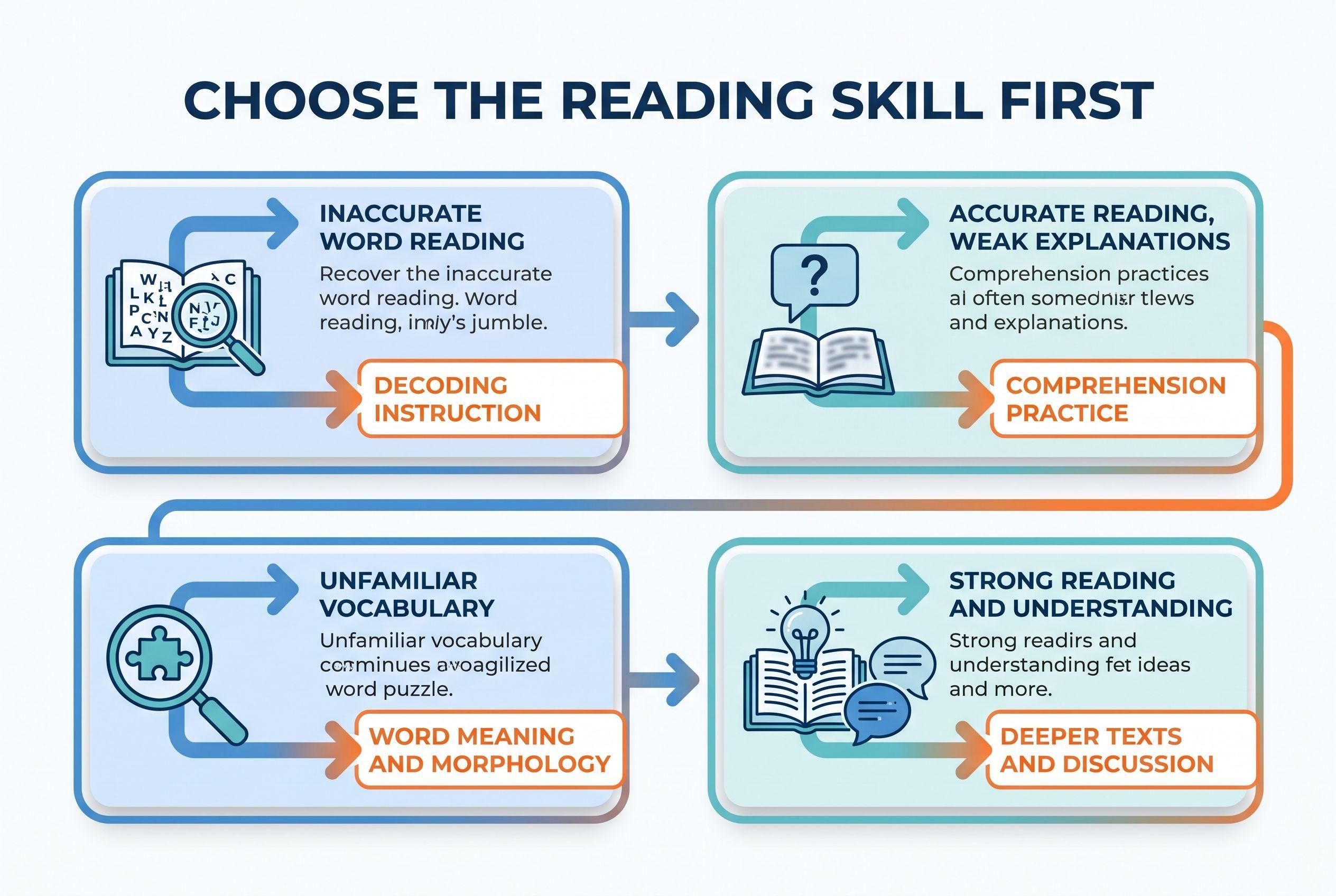
Choose by Skill, Not by the Gifted Label
Among reading comprehension apps for gifted kids, the strongest match depends on what “harder” needs to mean. Longer passages? Less familiar vocabulary? More demanding inferences? Those are different targets.
Imagine Maya reads a passage about nocturnal animals smoothly. Ask why an animal's large eyes help it survive. If she repeats a sentence without connecting it to nighttime hunting, work on explanation—not reading speed.
Now imagine Leo explains the science beautifully after you read aloud but guesses at adaptation. His thinking deserves advanced material, while his decoding deserves direct instruction. Give him both. Don't make access to interesting ideas a reward for fixing a weaker skill.
I use “No Guessing” for word identification: attend to the letters rather than substitute something plausible. Context still matters for understanding meaning and noticing when a reading error makes nonsense.
For challenging reading apps for third graders (ages 8–9), look beyond the grade label. Compare what to expect at age 8 with the skills you actually hear, then use the third grade reading benchmarks to frame questions for your child's teacher.
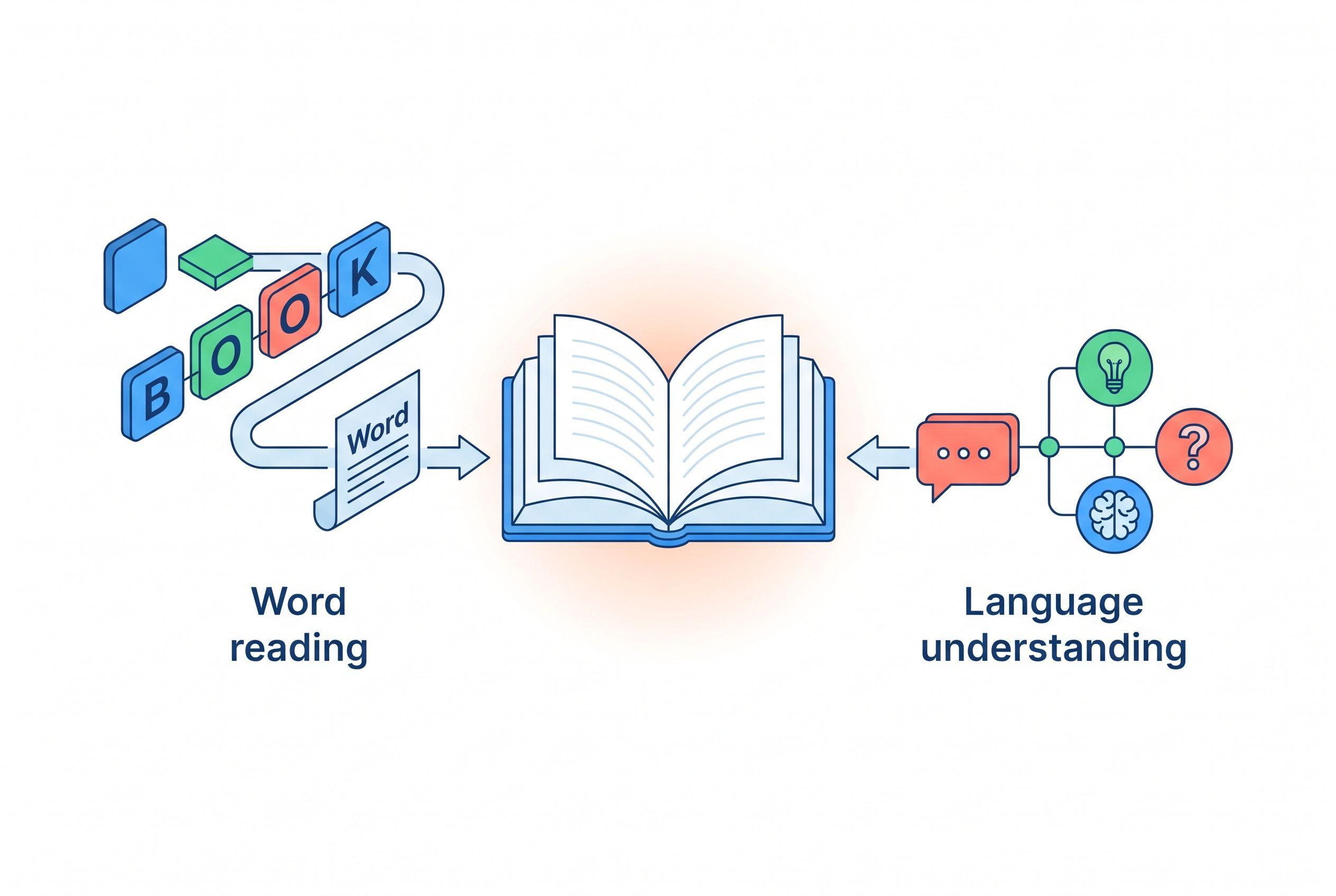
Action Step: Check the Need Before You Subscribe
Keep this informal. You're choosing a starting point, not conducting a clinical assessment.
- Hear a short unfamiliar passage. Choose age-appropriate content and note substitutions, hesitations or skipped endings. Don't supply every difficult word immediately.
- Ask for meaning. Request a brief retelling, then ask, “What makes you think that?” Look for an explanation tied to the passage.
- Separate listening from reading. Read another passage aloud and discuss it. Notice whether understanding improves when you handle the print.
- Check a specific concern. Use our free reading-level-by-age check to organize observations. If sound manipulation seems difficult, ask a qualified educator about Kilpatrick's PAST, the Phonological Awareness Screening Test; it isn't a giftedness or comprehension test.
- Choose one target and one product. Select decoding support for inaccurate word reading or comprehension practice for fluent reading with weak explanations. Write down what improvement would look like in actual reading.
- Review the match. Ask your child to tackle fresh material outside the app. If easy activities keep repeating, change the content; if reading remains persistently difficult, arrange specialist support rather than cycling through subscriptions.
If decoding needs attention, begin with a side-by-side lesson and listen to each response.
A daily routine helps, but don't turn it into a punishment. My “We Never Skip” principle means keeping a manageable learning habit—not forcing a distressed child through a session. Shorten the work when needed, and respond to the difficulty you see.
The best reading apps for gifted 8-year-olds leave room for real books, conversation and a parent who notices. Pick one clear need before buying six possible solutions.
If that need is decoding, lesson one is free.
FAQ
Which app best suits an already-fluent gifted eight-year-old?
Reading Eggs’ Eggspress offering is the closest match in this ranking for comprehension and vocabulary practice. Raz-Kids also merits consideration for book-based reading. Check the actual challenge; a stated age range doesn't guarantee a suitable level.
Should gifted eight-year-olds still practice phonics?
Only when their word reading shows a need. Gifted children can have decoding gaps, but fluent, accurate readers don't need endless beginning-phonics repetition. They may benefit more from vocabulary, morphology and discussion of demanding texts.
Does a high reading level prove strong comprehension?
No. Reading words accurately and understanding a passage involve related but distinct skills. Ask your child to explain motives, connect ideas and support an inference with evidence from the passage.
Can an app replace reading with a parent?
An app can supply instruction or practice, but conversation reveals thinking that a completion marker can't. Teach Your Kid to Read specifically requires an adult beside the child. For enrichment apps, keep discussing books and checking unfamiliar material together.
From teachyourkidtoread.org/blog/6-best-reading-apps-for-gifted-8-year-olds-ranked
Part of these guides

Xia Brody
Co-Founder, Teach Your Kid to Read
Mom of 4 who has successfully taught her kids to read. Currently in the trenches with her 4-year-old while her two oldest (10 and 7) devour books on their own. Passionate about phonics-based methods and building a lifelong love of reading.
Related Articles

Best Reading Apps for 3rd Grade Long Words: 6 Picks Ranked
Long words need a decoding plan, not a better guess. Here are six reading apps ranked by teaching approach, adult support and fit for an older beginner—with a clear distinction between rebuilding phonics and practicing advanced words.
Read More →
6 Best Reading Apps for 7-Year-Olds with Speech Delay, Ranked
A pronunciation error doesn't automatically mean a reading error. Here are six reading apps ranked for phonics practice with a speech-delayed seven-year-old, with clear limits on what each can offer.
Read More →
6 Best Reading Apps for 6-Year-Olds with Dyslexia and ADHD, Ranked
My first pick is parent-led phonics, not an app that keeps a child busy. Compare six options by teaching approach, adult involvement and price—and see when your child needs more than an app.
Read More →