6 Best Decodable Book Apps for 2nd Graders, Ranked
What You'll Learn
- My first pick among the best decodable book apps for 2nd graders is Teach Your Kid to Read for parent-led phonics instruction with short stories from lesson two—not for a standalone ebook library.
A beautiful ebook loses its teaching value the moment its spelling patterns outrun your child's instruction.
Imagine a child who reads ship confidently but guesses shout. Both words start with sh. Only one requires knowing ou. More books won't explain that missing correspondence; teaching it will.
I'm Xia Brody, a Chinese-American homeschooling mom of four, ages 10, 7, 4 and 1. I've taught my two oldest to read, and my 4-year-old keeps me firmly in the sounding-it-out trenches. For this list of the best decodable book apps for 2nd graders, I've included phonics programs alongside digital reading options because families often need instruction before they need another shelf of stories.
The Verdict
How we ranked
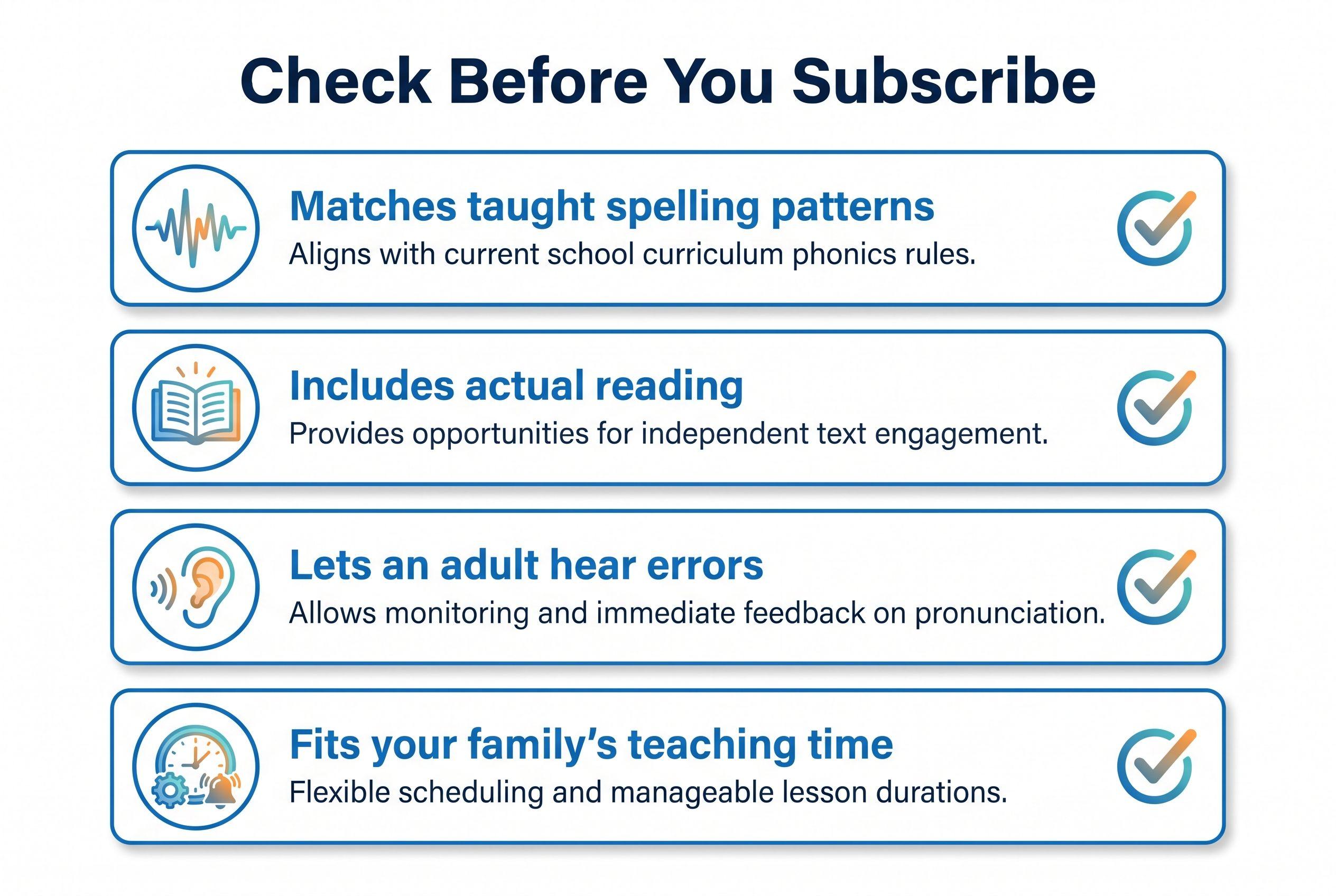
- Sequence fit: Clear sound-to-spelling instruction helps parents match stories to taught skills.
- Actual reading: Children need to read unfamiliar print, not just recognize pictures or finish activities.
- Adult visibility: Parents need a practical way to hear mistakes and choose the next step.
- Buying fit: Access, pricing model and intended audience must suit the family's actual need.
We're a team of teachers, and this ranking is our teaching team's pick.
| Rank and app | What it teaches or offers | Price / pricing model | Best-for age |
|---|---|---|---|
| 1. Teach Your Kid to Read | Step-by-step phonics; short stories from lesson two use sounds taught so far | Lesson one free, then 7-day trial, US$9.95/mo | My pick for ages 7–8 needing parent-led decoding instruction |
| 2. Reading.com | Describes its approach as parent-and-child reading lessons with phonics and books | US$12.49/month (checked October 2026) | Stated ages 3–8; consider for ages 7–8 needing foundational instruction |
| 3. Reading Eggs | Describes a wider reading offering with dedicated Fast Phonics instruction | US$13.99/month (checked October 2026), Reading & Math, up to 4 children | Fast Phonics states ages 5–10 |
| 4. Hooked on Phonics | Describes phonics lessons and reading practice | Subscription; 7-day free trial in the app | Stated ages 3–8 |
| 5. Nessy | Describes structured reading and spelling instruction | From US$15.50/month (checked October 2026), home | Stated ages 6–11 |
| 6. Raz-Kids | Describes a digital collection of leveled books and reading activities | Annual license, mostly bought by schools and teachers | My pick for ages 7–8 needing broader reading practice, not a decodable sequence |
Full disclosure: I co-founded Teach Your Kid to Read, so weigh my #1 pick accordingly; the rest of the ranking is based on the criteria above.
Prices checked October 2026.
For side-by-side decoding instruction, I recommend Teach Your Kid to Read: start lesson one free. Lesson one is free, with no card and nothing to cancel. From lesson two, the whole program is a 7-day free trial, then US$9.95 a month.
This ranking compares instructional fit, not results from hands-on competitor testing. Raz-Kids belongs here as a contrast: families shopping for decodable reading apps second grade often encounter leveled libraries, and those aren't interchangeable.
The Tiger Truth: More Books Can't Teach a Missing Pattern
The US National Reading Panel reported in 2000 that systematic phonics instruction benefits children's reading development. That supports explicit phonics teaching generally; it doesn't establish that any app in this ranking produces particular results.
For perspective, Hasbrouck and Tindal's 2017 oral reading fluency norms put the spring median for US second graders at 100 words correct per minute. That's a reference point from timed passage reading—not a diagnosis, a universal international target or a speed requirement for a new decodable story. Check the second grade reading benchmarks for context before waving a stopwatch over dinner.
Waiting without checking the gap can mean more avoidance and less successful practice. Struggling readers can improve. Start targeted teaching now rather than treating another birthday as an intervention.
Ranked: The Best Decodable Book Apps for 2nd Graders
1. Teach Your Kid to Read — Best for Parent-Led Decoding
This is my first pick when the parent needs help teaching, not just finding something for the child to read. The app guides the adult on what to listen for and how to correct a mistake while the child works alongside them for about 15 minutes a day.
Its 50 lessons follow a fixed order, moving from single letter sounds through digraphs such as sh, ch and th, blends, vowel teams and silent e, then prefixes and suffixes. Each lesson adds a few sounds before the child blends them into real words. That connection between instruction and reading earns its place at the top.
Lesson one teaches m, s, p and short a. Children hear each sound, tap its matching letter, then blend and build am, map and sap. There's no story yet. From lesson two, each lesson includes a short story built from the sounds taught so far; a small set of common irregular words appears along the way as “leap words.”
For an older beginner, I wouldn't automatically spend days reviewing already-secure sounds. The lessons page lets parents see every lesson and jump to any of them. A parent “mastered this” button skips some practice activities in later lessons. Choose the starting point from what your child can actually read, not from a hopeful guess.
Access includes iPhone/iPad, Android and the web, with several children on one account.
The limitation: There's no mode designed for a child to use alone. Families who need an independent activity while the adult handles something else should choose another option.
My verdict: Strongest fit for a parent who wants a clear teaching sequence and connected story practice. It's a phonics program, not a replacement for broad reading aloud and conversation.
2. Reading.com — Best Alternative for Shared Lessons
Reading.com describes a parent-and-child approach that brings phonics instruction and books into shared lessons. That makes it a sensible comparison for families who want an adult involved rather than a child tapping through reading time alone.
Its stated ages run from 3–8, so a second grader falls within its intended audience. Still, check the sample material. A child who needs vowel-team instruction has a different starting point from one still learning to blend three sounds.
On sequence fit, I'd ask to see how each book connects to the lesson before it. On adult visibility, the shared format matters: you're present to hear whether train becomes truck.
My verdict: I'd choose this route for a second grader who needs phonics lessons with a parent beside them; I'd rule it out if the adult can't join reading time. Before buying, confirm that its lesson entry point and books match your child's missing patterns; the age range alone can't answer that.
3. Reading Eggs — Best for Families Comparing a Wider Offering
Reading Eggs covers several reading stages. For this particular search, Fast Phonics, with stated ages 5–10, deserves closer attention than the overall platform's ages 2–13 label.
That's the buying trap with broad subscriptions: a large amount of content can distract from the small skill your child needs today. More choices don't automatically mean better-matched practice. Honestly, I want to know what happens after a child misses oa, not how many activities fill the home screen.
Ask how Fast Phonics connects its instruction to reading practice, then inspect the relevant material. Keep your own brief note of what the child reads aloud; activity completion and independent decoding answer different questions.
My verdict: My shortlist choice for a family wanting a broader subscription that covers up to four children; I'd rule it out if avoiding a recurring subscription is a requirement. For phonics aligned ebooks for 2nd graders, evaluate the specific phonics component instead of assuming every book across the offering follows one sequence.
4. Hooked on Phonics — Best for a Foundational Phonics Route
Hooked on Phonics describes phonics lessons alongside reading practice, with stated app ages 3–8. I'd put it on the shortlist for a second grader rebuilding foundational decoding, rather than a fluent reader seeking a large selection of challenging stories.
Check exactly what the subscription includes and which reading materials accompany the digital instruction. Don't assume that every plan provides the same format or access.
For sequence fit, inspect a lesson and its following reading material together. Can your child use the newly taught pattern? For actual reading, listen to unfamiliar words rather than accepting a remembered sentence as proof.
My verdict: I'd shortlist it for a seven- or eight-year-old rebuilding foundational decoding, but rule it out as my pick for a fluent reader whose only need is broader books. Choose it only after checking the instructional starting point and included materials; a familiar product name doesn't tell you whether Tuesday's lesson fits your child.
5. Nessy — Best to Investigate for Reading and Spelling Together
Nessy describes structured reading and spelling instruction and states ages 6–11. That makes it relevant when a seven- or eight-year-old's difficulties extend beyond reading a short story.
Reading and spelling can expose different gaps. A child might recognize shop on a page yet write sop. That gives you something specific to investigate: the connection between the sound /sh/ and its two-letter spelling.
For this ranking, I'd inspect Nessy's sequence, opportunities to read connected text and the information available to the adult. Don't assume a structured literacy offering automatically supplies the ebook library you pictured.
My verdict: I'd put Nessy on the shortlist when a child reads shop but spells it sop—reading and spelling both need attention. I'd rule it out as my pick if the only job is supplying more stories, not instruction. If difficulties persist despite explicit teaching, seek a qualified assessment too; another subscription isn't a substitute for understanding the problem.
6. Raz-Kids — Best for Broader Books, Not a Decodable Sequence
Raz-Kids describes leveled ebooks and reading activities. That can answer a genuine need for broader reading practice, but leveled doesn't mean decodable.
A book level reflects more than whether your child knows its spelling patterns. A short sentence can still contain several untaught correspondences. Likewise, controlled vocabulary books may repeat a limited set of words without following your child's phonics scope and sequence.
If school already provides access, inspect the assigned books before buying another service. Read a sample alongside your child and ask which words require teaching. Don't coach picture guessing to get through the page.
My verdict: Pick it for broader practice when that fits the child. For a strict requirement of decodable stories apps age 7, it ranks last because leveled-library access doesn't establish sound-by-sound alignment.
How to Tell Whether a Story Is Decodable for Your Child
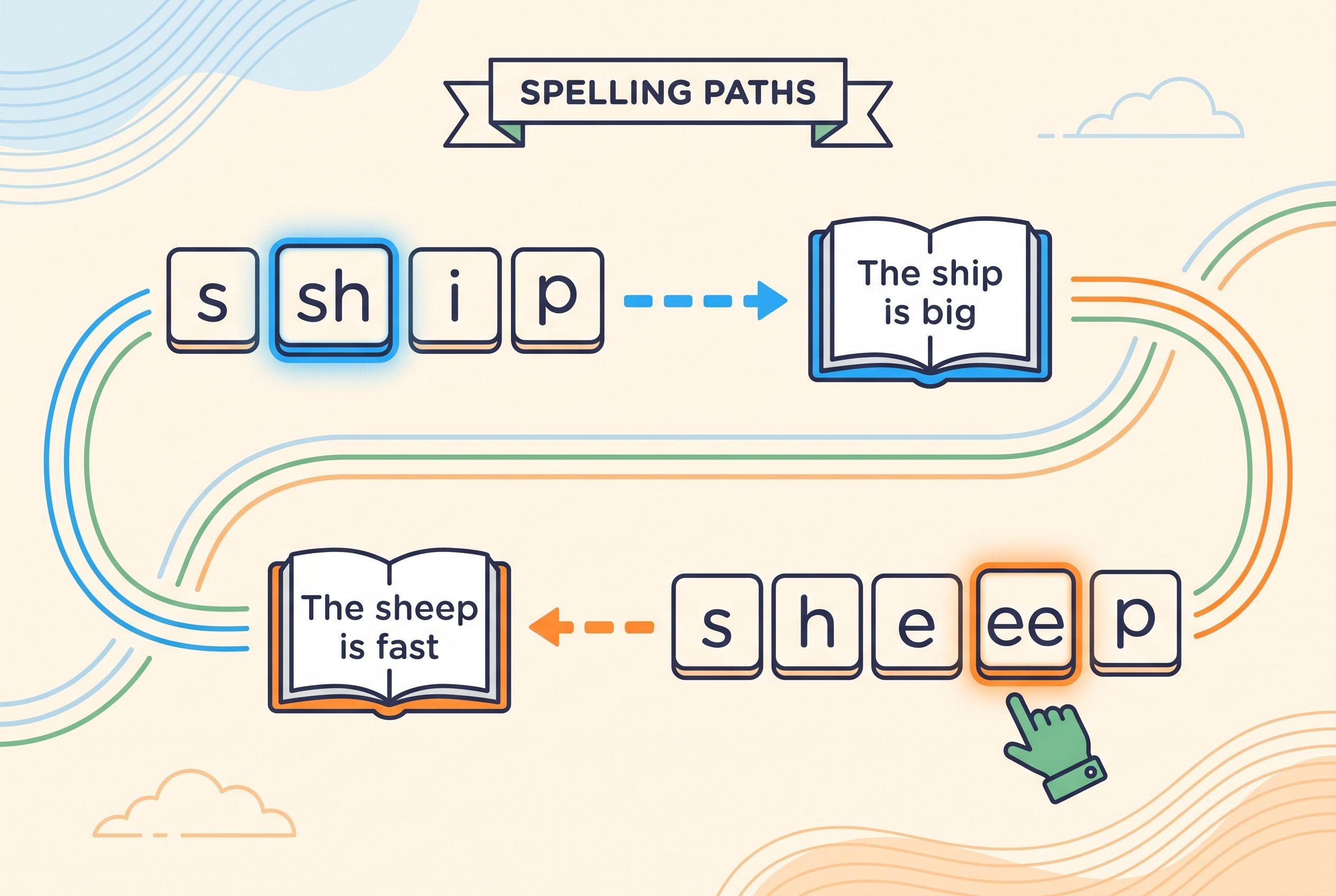
“Decodable” describes a relationship between the text and what the reader knows. It isn't a magic sticker.
Linnea Ehri's 2005 review, Learning to Read Words: Theory, Findings, and Issues, explains how connections between spellings and pronunciations support word learning. That's part of orthographic mapping—not memorizing a word's outline or its position beside a picture.
Compare The sheep can sleep with The ship can stop. A child who knows sh, short vowels and blends may handle the second sentence while still needing instruction for ee in the first. Neither sentence wins a universal “easier” contest.
Keep meaning in the conversation too. After accurate reading, ask what happened. If sap means nothing to your child, explain it; correct decoding and understanding need each other.
For matching physical books to instruction as well, see Decodable Readers Australia: Best Sets by Phonics Stage. The stage-matching principle travels across countries, even when accents and school terminology differ.
Your Action Step: Check, Match, Then Subscribe
- Find the first shaky pattern. Use our free phonics skill check. Your child reads real and made-up words while you mark responses; the result identifies a pattern to practice.
- Inspect a sample story. Circle spellings your child hasn't learned. A few explicitly taught irregular words differ from a page full of unknown patterns.
- Choose the job. Buy instruction for missing skills, matched stories for decoding practice or broader books for an already-secure reader. Don't expect one label to mean all three.
- Listen without rescuing. Say, “Look through the whole word. Say the sounds, then blend.” If a spelling is new, teach it rather than demanding a guess.
- Keep a tiny record. Write the pattern, one error and one accurate unfamiliar word. Follow change over repeated sessions, not one tired evening.
- Start side by side. If parent-led instruction fits, lesson one is free. Use that first session to observe the teaching format before committing.
My Tiger Rules are “We Never Skip” and “No Guessing.” I mean a dependable teaching habit—not forcing a miserable session through illness or exhaustion. On a busy day, keep the practice manageable and the correction calm.
If the difficulty extends beyond one pattern, Is My 2nd Grader Behind in Reading? 9 Signs can help you organize observations for a teacher or reading specialist.
Choose the best decodable book apps for 2nd graders by the reading they make possible, not the number of titles they advertise. Start with the next teachable skill and a real adult listening.
FAQ
What makes an app's books decodable?
The text mostly uses sound-spelling relationships the child has learned, alongside any explicitly taught irregular words. Check how the app connects each story to its instruction. A grade label or book level doesn't establish that match.
Should all second graders use decodable stories?
No. They're especially useful while children learn or repair decoding skills. A child who reads unfamiliar spelling patterns accurately also needs broader texts, vocabulary and comprehension work. Keep reading richer books aloud regardless of decoding level.
Can I use a fluency score to choose an app?
Not by itself. Fluency reflects accuracy and automaticity in connected text, but it doesn't identify every missing spelling pattern. Pair observations from reading aloud with a phonics skill check, and consult a qualified professional when concerns persist.
Does Teach Your Kid to Read include stories immediately?
Lesson one teaches four sounds and blends them into words, without a story. From lesson two, each lesson includes a short story built from sounds taught so far. An adult sits beside the child throughout the lesson.
From teachyourkidtoread.org/blog/6-best-decodable-book-apps-for-2nd-graders-ranked

Xia Brody
Co-Founder, Teach Your Kid to Read
Mom of 4 who has successfully taught her kids to read. Currently in the trenches with her 4-year-old while her two oldest (10 and 7) devour books on their own. Passionate about phonics-based methods and building a lifelong love of reading.
Related Articles
6 Best Decodable Book Apps for 1st Graders, Ranked (2026)
A book isn't decodable just because its sentences look short. Here are six apps ranked for first-grade decoding practice, with clear distinctions between phonics courses, book activities and broader reading programs.
Read More →
Best Phonics Apps for 2nd Graders: 6 Picks Ranked
My first pick favors parent-led decoding practice, but it won't suit families who need independent screen time. Compare six apps by teaching approach, price and the reading gaps they can help you address.
Read More →
Best Phonics Apps for 3rd Graders: 6 Picks Ranked
My first pick suits families who want to teach decoding side by side—not hand over a tablet and hope. Compare six options by phonics coverage, adult involvement and fit for the reading difficulty you actually see.
Read More →