Should I Correct My Child When They Misread a Word? Yes. Every Time.
What You'll Learn
- Why the popular advice to "let them figure it out" is actually training your child to guess — and what reading science says about that
- The one mistake 90% of parents make when their kid substitutes a wrong word while reading aloud
- The exact 3-step correction method I use with my own kids — it takes 10 seconds and it works
- How to tell the difference between a mistake that needs correction and a pronunciation issue that's developmentally normal
The Real Answer: Yes. Every Single Time.
Let me save you 2,000 words of suspense.
Should you correct your child when they misread a word? Yes. Every single time. Not sometimes. Not "when they seem frustrated." Not "only if it changes the meaning of the sentence." Every. Single. Time.
Now — one quick clarification before you think I'm saying you should literally interrupt every micro-second: if your child misreads a word, catches their own mistake, looks back at the letters, and decodes the correct word within a couple of seconds? That's not guessing. That's self-correction through decoding, and it's exactly what you want. Let them finish that process, then praise it. But if they don't self-correct by actually looking at the letters — if they guess, stall, or swap one guess for a different guess — you step in. Every time.
I know that's not the gentle, nuanced answer the internet usually gives you. You've probably read blog posts that say things like "let your child self-correct" or "too much correction kills their love of reading" or my personal favorite, "just skip the word and move on."
That advice is wrong. And it's actively making your kid a worse reader.
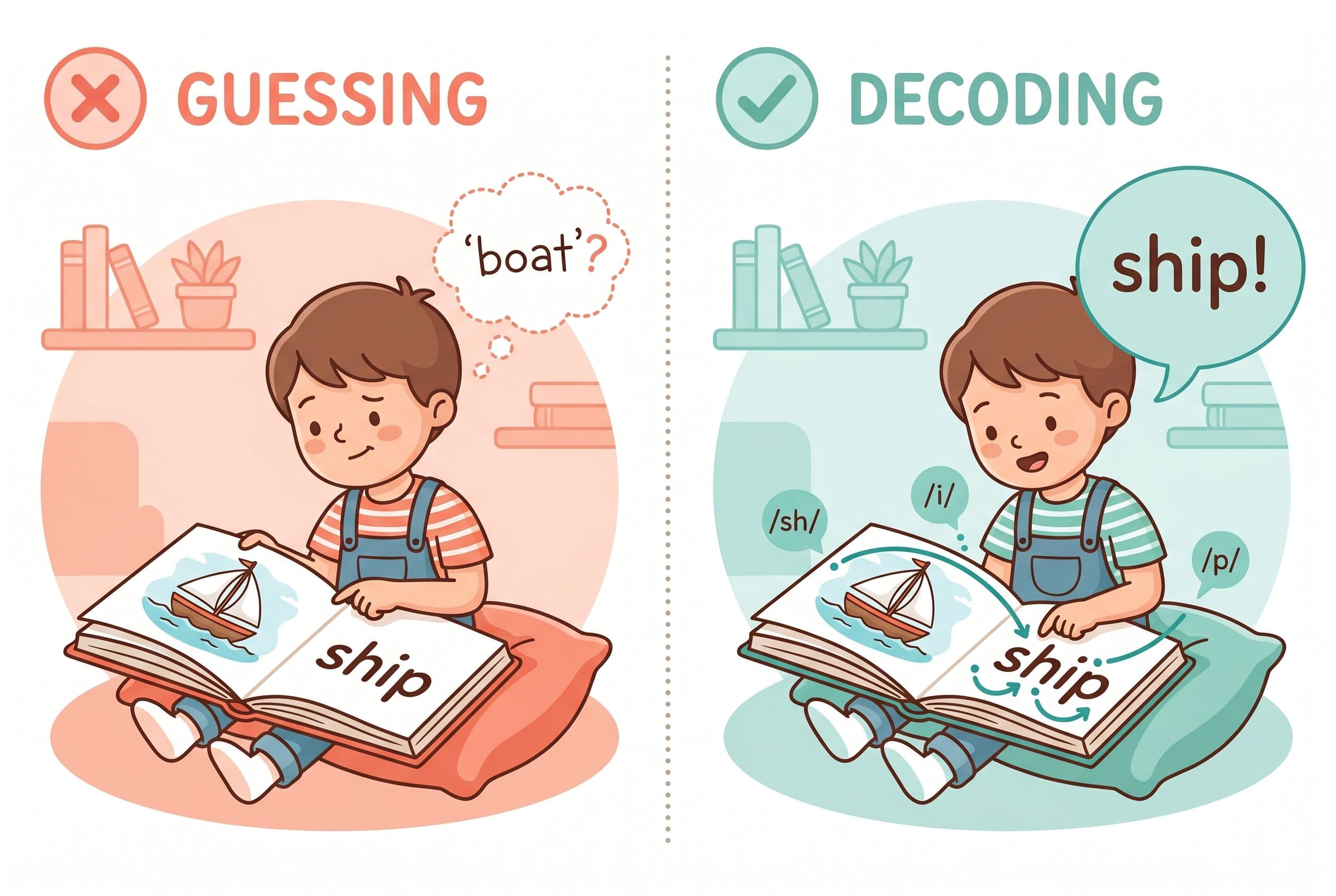
Here's why: a bad reading habit that goes uncorrected doesn't stay small. It metastasizes. Your child's brain is building neural pathways every time they read a word — right or wrong. So when your 5-year-old looks at the word "house," sees the picture of a house on the page, says "home," and you just smile and nod and keep going? You just reinforced guessing. You taught their brain that reading is a game of context clues and pictures, not a system of decoding letters into sounds.
And that child will keep guessing. At 5, they guess "home" for "house" and it seems cute. At 8, they guess "conversation" for "conservation" and can't pass a science test. At 12, they stop reading altogether because it's exhausting to fake your way through every page.
Fix a bad habit immediately before it becomes permanent. That's not tiger mom extremism. That's neuroscience.
The "Wait and See" Correction Myth
Somewhere along the way, a well-meaning reading educator told parents that correcting too many mistakes would damage a child's self-esteem. This became gospel. It spread through parenting forums, teacher training programs, and — I'm not exaggerating — actual school district policy.
The roots of this go back to Whole Language and Balanced Literacy philosophy, which treated reading errors not as mistakes but as "miscues" — meaningful attempts at constructing meaning from text. The idea was that if a child said "pony" instead of "horse," that was evidence of comprehension, not a reading failure.
Ken Goodman, the father of Whole Language, literally called reading a "psycholinguistic guessing game" in his 1967 paper. A guessing game.
Sit with that for a second.
The problem? Stanislas Dehaene's neuroscience research — laid out in his 2009 book Reading in the Brain — proved that reading is not natural. The human brain doesn't have a dedicated reading module. It has to repurpose the visual cortex, map graphemes to phonemes, and build orthographic representations through repeated, accurate practice. The brain has to be trained to read. And when you train it with inaccurate input — when you let wrong words slide — you're literally building the wrong wiring.
David Kilpatrick hammers this home in Equipped for Reading Success (2016). His research on orthographic mapping shows that the brain stores words for instant recognition only after the reader has accurately connected the word's spelling to its pronunciation multiple times. When a kid reads "house" and says "home" and nobody corrects it, the brain doesn't map "h-o-u-s-e" to the sounds in "house." It maps... nothing. Or worse, it maps the wrong thing.
Every uncorrected error is a missed opportunity for orthographic mapping. And those missed opportunities add up fast.
What Happens When You Don't Correct Mistakes
OK so here's the scary part. And I don't apologize for scaring you because this stuff matters.
Only 33% of 4th graders read at proficient level on the 2022 NAEP — that's the Nation's Report Card. That means two-thirds of American kids can't read well enough to actually learn from what they're reading. And the NAEP Long-Term Trend assessment in 2023 showed reading scores for 13-year-olds dropped 3 points since 2019 — the largest decline in over 30 years. And the problem isn't getting better. And it's getting worse.
The Annie E. Casey Foundation did a study back in 2010 that should terrify every parent: kids who can't read proficiently by 3rd grade are four times more likely to drop out of high school.** Four times.
And here's the kicker: many of those struggling readers started out looking "fine." They were the kids who seemed to be reading in kindergarten and first grade — turning pages, saying words that roughly matched the pictures, performing reading. But they were guessing. And nobody corrected the guesses because some well-meaning adult said, "Don't interrupt their flow."
The 3rd Grade Cliff is real. Before 3rd grade, kids are "learning to read." After 3rd grade, they're "reading to learn." If your child hits that cliff still relying on picture clues and context guessing instead of actual decoding, every subject falls apart. Science textbooks don't have pictures of every vocabulary word. History passages don't come with context clues for "constitutional" and "amendment."
States know this. Mississippi passed the Literacy-Based Promotion Act in 2013 and went from 49th to 21st in national reading rankings in six years — by requiring evidence-based reading instruction and, yes, holding kids back in 3rd grade if they couldn't read. Ohio has the Third Grade Reading Guarantee. North Carolina passed SB 387 — the Excellent Public Schools Act — requiring schools to ditch Balanced Literacy guessing methods for Science of Reading curriculum.
I actually saw this play out in real life. I was at a playground in Raleigh when another mom told me her son's school had just switched from Lucy Calkins' Units of Study to a Science of Reading curriculum because of SB 387. She was confused and honestly a little annoyed. "But he was doing fine before," she told me, kind of defensive about it. So I asked her if her kid could read the word "splint." He was in second grade. He could not. He looked at it and said "split." Close — but close isn't reading. That's guessing with a good poker face.
I spent 20 minutes on that playground bench explaining why the switch was happening. I told her about Emily Hanford's Sold a Story investigation that blew the lid off Balanced Literacy in 2023. I told her about the NAEP data. I walked her through Dehaene's neuroscience research showing the brain doesn't learn to read naturally — it has to be explicitly trained. She went home and listened to the Sold a Story podcast that night. Texted me at 11pm: "I had no idea. Why on earth didn't someone tell us this years ago?"
Nobody told her because the system spent 30 years telling parents that guessing was reading. And that correcting guesses was harmful.
It's not harmful. Not correcting them is harmful.
"But What About Their Confidence?"
Oh, I hear this one constantly — trust me. "If I correct every mistake, my kid will hate reading."
Real talk — your kid will hate reading a lot more at age 10 when they can't keep up with their classmates and get pulled out for intervention. That destroys confidence. A gentle, consistent correction at age 4 or 5? That builds competence. And competence is the foundation of real confidence.
Here's how I think about it. If your kid was learning to ride a bike and kept veering into the street, would you stay quiet to "protect their confidence"? Or would you grab the handlebars and redirect them?
Reading errors are the same thing. You're not crushing their spirit by saying, "Hold on — let's look at that word again." You're keeping them on the road.
In my house, we have a rule: No Guessing. My kids know it. My 7-year-old actually says it to my 4-year-old now — I'm not even kidding. You don't skip it, you don't guess from the picture, and you sure as heck don't make something up that "sounds right." You sound it out. And if you can't sound it out on your own, I'm sitting right here to help you through it.
My 4-year-old, Mei, was reading a decodable reader last Thursday — one of the Flyleaf Publishing ones, which are actual decodable texts, not the Fountas & Pinnell leveled readers that are stuffed with sight words and picture clues. She hit the word "fast" and said "fun." Looked right at the picture of a kid running and guessed.
Did I stay quiet? Absolutely not.
Did she cry? Also no.
I said, "Wait. Look at those letters. What sound does /f/ make? Good. OK, what's next? /a/. Now /s/. Now /t/. Blend them. Faaasst. Fast! You got it."
Took maybe 12 seconds. She smiled. She moved on. No tears, no trauma, no shattered self-esteem. Just one more correct neural pathway built.
That's what correction looks like. It's not yelling. It's not shaming. It's redirecting.
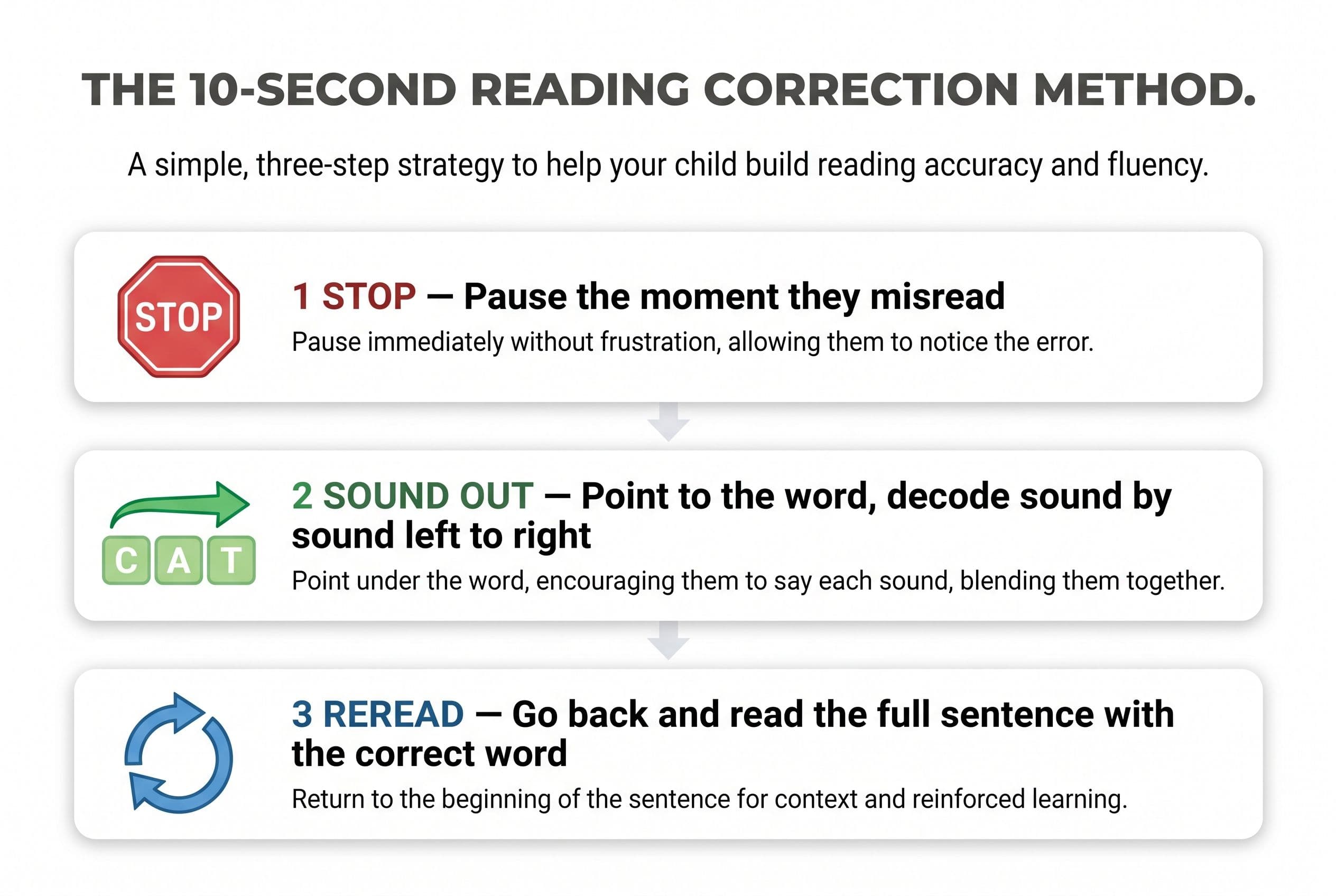
The Exact Correction Method I Use (3 Steps, 10 Seconds)
Here's my actual process. I've used this with all three of my reading-age kids, and it works whether your child is on CVC words or multisyllabic monsters.
Step 1: Stop Immediately
The second your child says the wrong word — and doesn't immediately self-correct by looking back at the letters — stop them. Don't let them finish the sentence. Don't wait to see if they'll guess a different word that fits better. Don't keep reading and hope they noticed.
Why? Because Linnea Ehri's research on word reading development (her 2005 meta-analysis on phases of reading) shows that accurate, repeated exposure to the correct grapheme-phoneme correspondence is what moves kids from partial alphabetic readers to full alphabetic readers. Every second that wrong word hangs in the air, the brain is encoding bad data.
Just say: "Hold on. Let's look at that word."
Keep it calm. Neutral. No big deal whatsoever.
The quick rule: If they self-correct by decoding (actually looking at the letters and sounding it out), let it happen and praise it. If it's a guess or they stall for more than 2-3 seconds, step in.
Step 2: Point to the Word and Have Them Sound It Out
Don't tell them the correct word. That's the other mistake parents make — they swing from "never correct" to "just give them the answer." Neither works.
Point to the word. Cover up everything except the first grapheme. Ask them to produce the sound. Move through the word left to right, sound by sound. Then ask them to blend.
If the word is "ship" and they said "boat":
- Point to "sh" — "What sound does this make?" (/sh/)
- Point to "i" — "And this?" (/ĭ/)
- Point to "p" — "And this?" (/p/)
- "Now blend them together. Shhhiiip. Ship!"
This is basic Orton-Gillingham methodology — multisensory, sequential, explicit. You're not reinventing anything. You're using the same approach that reading specialists charge $100/hour for.
Step 3: Have Them Reread the Whole Sentence
Once they've actually decoded the word right, have them go back to the start of that sentence and read the whole thing from the beginning. This matters because it puts the correct word into context, reinforces fluency, and gives their brain one more accurate pass at the word.
"OK, great. 'Ship.' Now go back and read the whole sentence."
That's the whole thing, honestly. Three steps. Ten seconds. Do it every single time — no exceptions.
When You Might Adjust (But Still Correct)
Look, I said correct every time, and I meant it. But look — I'm not a robot, and I'm guessing you aren't either. Here are some situations where the method of correction shifts — but the principle stays the same.
Your child is exhausted and melting down. If they've been reading for 15 minutes and they're falling apart, the answer isn't to stop correcting — it's to stop the session. We have a rule in our house: We Never Skip. But "never skip" means we do phonics practice every single day, including birthdays and Christmas and vacation. It doesn't mean we push through a 30-minute session when a 10-minute session is what the kid can handle that day. End the session. Come back fresh tomorrow. But while you're in the session? Correct every error.
The error is a pronunciation issue, not a decoding issue. My 4-year-old says "wabbit" for "rabbit." That's a speech development thing, not a reading error. If she looks at the word "rabbit" and says "wabbit," she decoded correctly — her mouth just isn't producing the /r/ yet. I don't correct that during reading. (I do work on it separately.)
The word is an exception word they haven't been taught yet. If your kid is in CVC words and they encounter "the" or "said" or some other irregular word that doesn't follow the phonics rules they know, don't make them try to decode it. Just tell them the word. Say, "That word is 'said.' It's a tricky word. It's a tricky one — we'll come back to it later." Then move on. But this is rare if you're using proper decodable readers, because decodable readers are specifically designed to only include words the child can actually decode at their current skill level.
The Tools That Make This Easier
Here's where I'll be honest: correcting every error is exhausting if your child is guessing constantly. If they're misreading 3-4 words per sentence, something upstream is broken. They're not reading at the right level, they haven't mastered their grapheme-phoneme correspondences, or they have a phonological processing weakness that needs attention.
First, check the level. If your child is making more than 1 error per 10 words, the text is too hard. Drop down. Honestly, there's zero shame in that — and I mean zero. I'd rather my kid read a "baby" book accurately than struggle through a "big kid" book while guessing every fifth word.
Second, assess their phonological awareness. Kilpatrick's PAST (Phonological Awareness Screening Test) takes about 5 minutes and tells you exactly where the breakdown is. It's free, too — just search for it online and you'll find the PDF. If your kid can't segment and blend individual phonemes, they're not going to decode words reliably no matter how many times you correct them. You have to go back and fix the foundation.
Third, make sure you're using decodable readers, not leveled readers. This one drives me crazy. Fountas & Pinnell leveled readers are everywhere — schools hand them out like candy — but they're Whole Language aligned. They're designed for kids to use picture clues and sentence patterns to "read" the text. Decodable readers from Flyleaf Publishing, High Noon Books, or the ones built into programs like UFLI Foundations are designed so that every word on the page can be sounded out using phonics rules the child has already learned. When you use decodable texts, your kid can sound out every word — which means correction becomes quick and productive instead of a slog.
And if you want a structured system that does all of this — the right sequence, the right decodable texts, the built-in correction approach — that's exactly what we built Teach Your Kid to Read to do.
How Teach Your Kid to Read Handles This
Our app at start lesson one free is built on systematic synthetic phonics principles — the same Orton-Gillingham-based methodology that the National Reading Panel identified as the most effective approach in their landmark 2000 report. That's the report Congress actually commissioned after years of reading wars.
Here's what that means in practice: your child learns letter-sound correspondences in a systematic sequence. Each lesson builds on the last. The practice reading uses decodable text — meaning every word on the screen follows the phonics rules your child has already been taught. No guessing. No picture clues. No "three-cueing system" garbage.
The app prompts your child to sound out each word. If they get it wrong, it doesn't just skip ahead. It walks them through the correction — sound by sound, left to right, then blend. Exactly like the 3-step method I described above, but built right into the program so it happens consistently whether you're sitting next to them or making dinner.
Because here's the thing: I can correct my kid perfectly at the kitchen table. But I'm also a human with three other children, a business to run, and a 1-year-old who treats books like chew toys. Having a tool that reinforces the same approach I use — that never gets tired, never gets frustrated, never decides to "let it slide just this once" — is a no-brainer.
You can check out exactly how our program works at contact us today, or just pick up the phone and call us at (407) 707-6850.
Your Action Plan: Starting Today
Here's exactly what to do, starting with your next reading session.
-
Set the expectation before you start. Tell your child: "When we read, we don't guess. If you're not sure about a word, we sound it out together — you and me." No guessing from pictures." My kids hear this so often they mouth along.
-
Use decodable text at the right level. If you're not sure where your child is, grab a set of Bob Books (Series 1 for beginners) or the free decodable texts from UFLI Foundations. If they can read 9 out of 10 words correctly, the level is right.
-
Correct every error using the 3-step method. Stop immediately (unless they self-correct by decoding within a couple seconds). Point and sound out. Reread the sentence. Every time. No exceptions.
-
Keep sessions short but daily. 10-15 minutes for kids 4-5. 15-20 minutes for kids 6-7. We Never Skip. Consistency beats marathon sessions every time.
-
Track progress with a quick assessment. Run Kilpatrick's PAST test once a month to check phonological awareness. Check DIBELS 8th Edition nonsense word fluency benchmarks — by mid-kindergarten, you're looking for 17+ correct letter sounds per minute. By end of kindergarten, the target is 28+.
-
If errors are constant — more than 1 per 10 words — drop down a level and fill the gaps. Don't keep pushing through harder text hoping they'll "catch up." They won't. Go back, re-teach the grapheme-phoneme correspondences they're missing, and build back up.
-
Consider Teach Your Kid to Read for a structured program that builds in all of these principles automatically. Reach out to us at contact us today to learn how it works.
Frequently Asked Questions
Won't constant correction make my child hate reading?
No — struggling to read makes kids hate reading. Think about it from your child's perspective: if every page is a frustrating guessing game where they get things wrong and don't know why, that's what kills motivation. When you correct quickly and calmly — "Hold on, let's look at that word. /sh/... /ĭ/... /p/. Ship! Great job." — you're giving them the tools to succeed. Competence builds confidence. I've watched this play out with three of my own kids now. The correction itself takes 10 seconds. The smile when they get it right lasts all day.
What if my child self-corrects before I say anything?
If your child reads "home," immediately catches their own error, goes back to the word, sounds it out, and says "house" — that's great. Self-correction that happens through decoding is exactly what you want. But watch carefully. Are they actually looking at the letters and decoding? Or are they just swapping one guess for another guess that fits the sentence better? True self-correction involves the child looking at the printed word and using phonics to fix their error. If that's what's happening, let them complete the process — then praise the heck out of it. "You caught that! You went back and sounded it out. That's exactly what good readers do."
How is this different from what teachers do in school?
Honestly? Many teachers were trained in Balanced Literacy programs that explicitly told them NOT to correct reading errors the way I'm describing. The "three-cueing system" — where kids are taught to use meaning, sentence structure, and visual cues (the first letter) to guess at words — was standard teacher training for decades. Mark Seidenberg, the University of Wisconsin cognitive scientist, called this out in his 2017 book Language at the Speed of Sight. He documented how teacher preparation programs were teaching methods that contradicted everything cognitive science knew about how reading works. The good news is that 40+ states have now passed Science of Reading legislation since 2019, and teacher training is changing. But it's slow. And if your kid's in school right now, you honestly can't afford to sit around waiting for the system to catch up. Start doing this at home tonight.
At what age should I start correcting reading errors?
The moment your child starts reading words — even just CVC words like "cat" and "sit" — you start correcting. For most kids, that's somewhere between ages 3 and 5. Linnea Ehri's phases of word reading development tell us that kids in the "partial alphabetic" phase (where they know some letter-sound connections but not all) are the ones most vulnerable to developing guessing habits. That's exactly when consistent correction matters most. Don't wait until bad habits are entrenched. Start early, stay consistent.
My child gets upset when I correct them. So what do you actually do about it?
Keep your voice calm, keep it quick, and keep it routine. If correction feels like a big dramatic event, your child will react dramatically. If it feels like a normal, boring part of reading — "Oops, let's check that word. /m/... /a/... /p/. Map! There you go. Keep reading." — they'll absorb it the same way they absorb you saying "use your fork" at dinner. It's not a punishment — I promise you that. It's guidance. If your child is getting genuinely distressed, check the text level first. If they're misreading half the words on the page, the text is too hard. Drop down to a level where they're mostly successful and corrections are occasional, not constant.
Bottom line: don't let anyone tell you that staying quiet while your child guesses is "supporting their reading development." It's absolutely not. It's letting bad wiring get built, one uncorrected error at a time.
Your kid deserves better than guessing. They deserve to actually read.
Get started with Teach Your Kid to Read today at start lesson one free, or call us at (407) 707-6850 to talk about where your child is and what they need next.
Part of these guides

Xia Brody
Co-Founder, Teach Your Kid to Read
Mom of 4 who has successfully taught her kids to read. Currently in the trenches with her 4-year-old while her two oldest (10 and 7) devour books on their own. Passionate about phonics-based methods and building a lifelong love of reading.
Related Articles
Best App for Kids Who Guess Words: 2026 Phonics Picks
If your child guesses words from pictures, context, or the first letter, you don't have a reading problem to ignore — you have a decoding problem to fix. Here are the 2026 phonics app picks I’d actually consider as a no-nonsense homeschooling mom.
Read More →
Best Reading App for a 1st Grader Who Guesses Words
If your 1st grader guesses words from pictures, that’s not reading — that’s coping. Here’s the no-nonsense app comparison I’d use with my own kids.
Read More →
Best App for a 6-Year-Old Who Guesses Words: 5 Picks
If your 6-year-old guesses words from pictures, they don't need more leveled books. They need systematic phonics, daily decoding practice, and a parent who stops the guessing cold.
Read More →