How to Improve Reading Comprehension for Kids: 7 Tips That Work
What You'll Learn
- Why your child can decode perfectly but still bomb comprehension questions — and the brain science that explains the disconnect
- The one conversation technique that doubles comprehension gains (it takes 30 seconds and you're probably skipping it)
- How to tell if your kid has a decoding problem disguised as a comprehension problem — because most parents get this wrong
- 7 specific, do-tonight strategies that build real understanding, not just word-calling
Your Kid Can Read the Words. They Can't Tell You What They Mean.
Here's a scene I see constantly. A parent hands their 7-year-old a short book. The kid reads every word out loud — fairly smooth, decent pace, even gets the tricky ones. Parent beams. "She's such a good reader!"
Then I ask: "So what was the story actually about?"
Blank stare. Maybe a shrug. Maybe a vague "It was about a dog?" when the story was actually about a girl who lost her dog, searched the entire neighborhood block by block, and finally found him curled up at the fire station.
That's not reading. That's word-calling.
And it's an epidemic. Only 33% of 4th graders scored at or above Proficient on the 2022 NAEP — the Nation's Report Card. NAEP Proficient is a high bar that signals strong, grade-level reading performance. But flip that number around and it means roughly two out of three kids need more support in comprehension, decoding, or both. The 2024 NAEP results for grade 4 reading (main NAEP) were even worse — scores dropped compared to 2019, continuing the largest decline in over 30 years.
Let me say that differently so it lands: the majority of American kids aren't hitting the reading benchmarks they need to thrive in school.
If your kid's one of them — or even if you've just got that nagging worry in your gut — you're exactly where you need to be right now.
The "Third Grade Cliff" Is Real, and Comprehension Is the Edge
You've probably heard people say "kids learn to read until 3rd grade, then they read to learn." It's an oversimplification, but the core truth is brutal.
Starting around 3rd grade, every subject — math, science, social studies — assumes your child can read a passage and understand it. If they can't, they don't just fall behind in reading. They fall behind in everything.
The Annie E. Casey Foundation published a study in 2010 — and the finding still haunts me — showing that kids who can't read proficiently by the end of 3rd grade are four times more likely to drop out of high school. Four times. And for kids living in poverty who also can't read by 3rd grade? The dropout rate climbs even higher than that.
And you know what the worst part is? Comprehension problems are sneaky. A kid with poor decoding skills gets flagged early because you can hear them struggling. A kid who decodes fine but doesn't comprehend? They slide under the radar for years. Teachers see a "fluent reader" and move on. By the time someone catches the comprehension gap, that kid has been faking it through entire school years.
I had my 7-year-old read a passage from a 2nd-grade science reader last month about how caterpillars turn into butterflies. She read it beautifully. I asked her to explain metamorphosis in her own words. She said, "The caterpillar goes to sleep." That told me everything. The decoding was there. The understanding was not. We had serious work to do.
Don't you dare "wait and see." Don't assume fluent-sounding reading means fluent comprehension. Test it. Ask questions. Demand they tell you what they read — in their own words, not parroted back.
First, Rule Out the Real Problem: Decoding vs. Comprehension
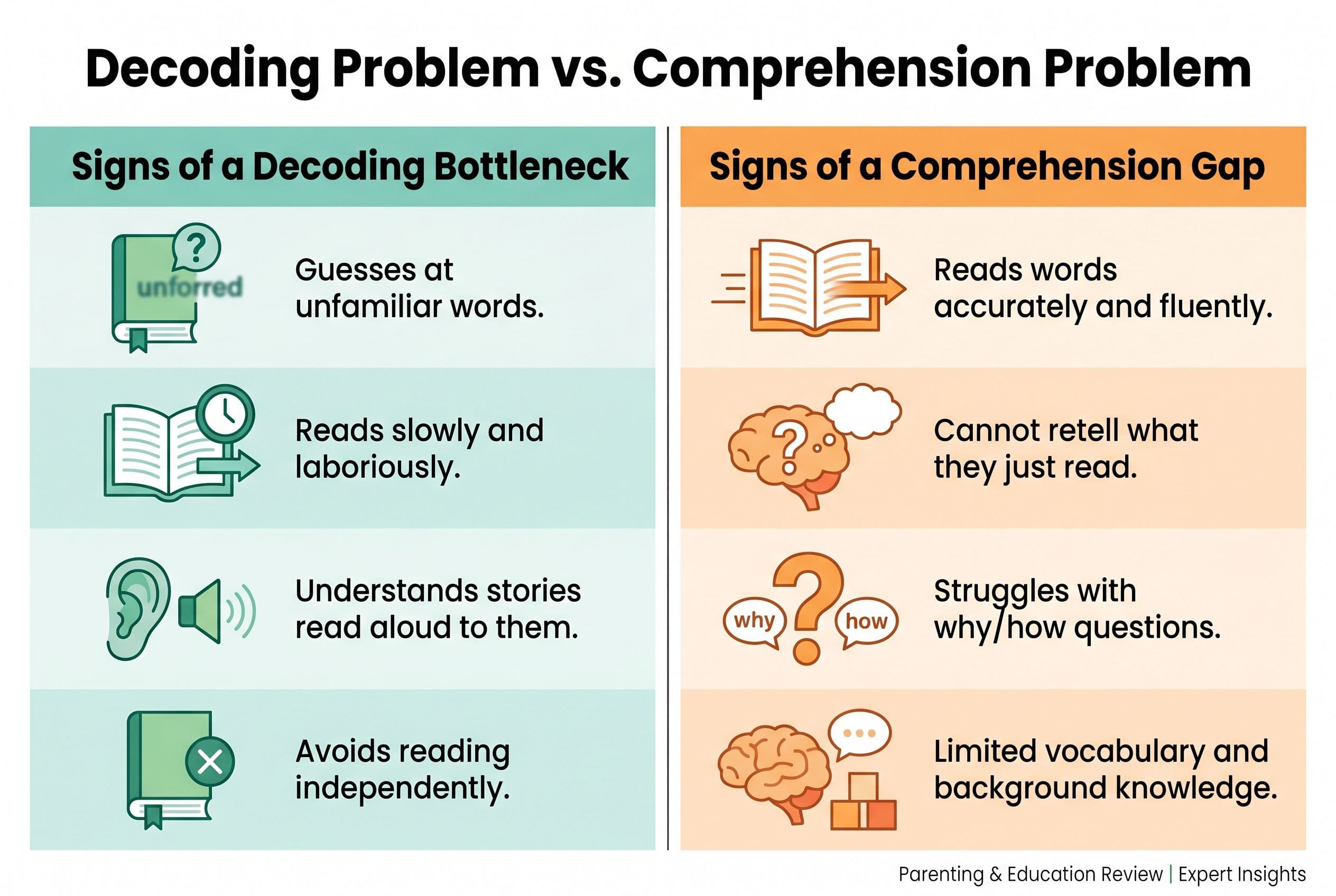
Before we talk about comprehension strategies, I need you to check something. Because here's the thing — a lot of "comprehension problems" are actually decoding problems wearing a mask.
The Simple View of Reading, first proposed by Gough and Tunmer in 1986, breaks it down like this:
Reading Comprehension = Decoding × Language Comprehension
It's a multiplication equation, not addition. That means if either factor is zero (or close to it), comprehension craters — even if the other factor is strong.
So if your kid is spending so much mental energy just sounding out words that they have nothing left for meaning? That's not a comprehension problem. That's a decoding problem that's causing a comprehension problem.
So how do you actually tell the difference?
The Listening Test: Read a grade-level passage out loud to your child. Then ask comprehension questions. If they can understand and discuss the passage when you read it but not when they read it — the bottleneck is decoding, not comprehension. Their language comprehension is fine. Their word-level reading needs work.
If they can't comprehend the passage even when you read it to them? Now you're looking at a true language comprehension issue — vocabulary gaps, weak background knowledge, trouble with sentence structure.
If decoding is the problem: Stop here and go fix that first. Use a systematic synthetic phonics program — Teach Your Kid to Read is built on Orton-Gillingham principles and does exactly this. You can also look at David Kilpatrick's PAST (Phonological Awareness Screening Test) to pinpoint exactly where the phonological breakdown is. It takes about 5 minutes and tells you whether the issue is at the syllable, onset-rime, or individual phoneme level.
If comprehension is the real problem: Keep reading. The 7 strategies below are for you.
7 Proven Strategies to Improve Reading Comprehension for Kids
1. Build Background Knowledge Before They Read a Single Word
This one drives me crazy because almost nobody does it — and it's arguably the most powerful comprehension lever you have.
Mark Seidenberg nailed this in Language at the Speed of Sight (2017). Seidenberg's a cognitive scientist over at the University of Wisconsin, and he makes this point that I think every parent needs to hear: comprehension depends heavily on what the reader already knows walking into the text. A kid reading about volcanoes who has never heard the word "eruption" or seen a volcano documentary isn't going to comprehend that passage no matter how well they decode.
The research is clear: background knowledge accounts for a massive portion of reading comprehension variance. E.D. Hirsch has been banging this drum for decades with his Core Knowledge curriculum — the idea that broad knowledge about history, science, art, and geography directly fuels reading comprehension.
OK so what do you actually do about this?
Before your kid reads anything, prime the pump. Going to read a book about the ocean? Spend 5 minutes looking at a world map, finding the Pacific Ocean, talking about what lives underwater. Going to read a story set on a farm? Talk about what farmers do, what seasons mean for crops, whether your kid has ever fed a chicken.
I do this every single time with my 4-year-old — and honestly, it's become one of my favorite parts of our routine. Last week before we read a picture book about a rainstorm, we stood at the window and watched actual rain. We talked about clouds, thunder, puddles. When we sat down with the book, she already had a mental framework to hang the story on.
No special materials. No apps. Just a conversation.
2. Stop Asking "What Happened?" — Start Asking "Why?"
Most parents ask terrible comprehension questions. I'm sorry, but honestly? It's true.
"What happened in the story?" is a recall question. It checks memory, not understanding. Your kid can parrot back plot points without understanding any of them.
The questions that actually build comprehension are inferential and evaluative:
- "Why do you think the character did that?"
- "How do you think she felt when that happened? What clues tell you that?"
- "What do you think will happen next? Why?"
- "Would you have done the same thing? Why or why not?"
These questions force your kid to think about what they read, not just remember it. They have to connect events, infer emotions, predict outcomes, and evaluate decisions.
Real talk — when I first started doing this with my oldest (who's 10 now), he hated it. "Mom, can't I just read?" Tough luck, buddy. We never skip. Now he naturally thinks about why things happen in stories. He'll stop mid-chapter and say, "I think the villain is actually the uncle because of what he said on page 12." That's comprehension. That's what we're building here, brick by brick.
3. Teach Them to Visualize — "Make a Movie in Your Head"

Some kids read words and process... nothing. No mental images. No internal movie. The words go in their eyes and disappear into a void.
Here's the good news though — visualization is a trainable skill, and it's one of the most effective comprehension strategies you can teach at home. The Lindamood-Bell program actually has an entire intervention called "Visualizing and Verbalizing" built around this exact concept.
Here's exactly how I teach this at home (it takes like two minutes):
I read a sentence: "The old dog lay on the warm porch, watching the squirrels."
Then I ask: "Close your eyes. What do you see in your head?"
At first, my kids gave me nothing. "A dog." Great, what color? How big? What kind of porch? Is it sunny? Are there trees? Where are the squirrels — sitting on the ground or up in the branches of a tree?
You're teaching their brain to generate images from text. It takes practice. Start with single sentences, then paragraphs, then pages. Within a few weeks, they start doing it automatically.
My 7-year-old told me last Tuesday, "Mom, I can see the whole scene in my head" — just blurted it out mid-chapter like it was no big deal. That sentence is worth more to me than any test score.
4. Read Aloud to Them — Even After They Can Read Themselves
I don't care if your kid is 8, 9, or 10 — I don't care if they just got a great score on their MAP Growth assessment. Read aloud to them.
When you read aloud, you eliminate the decoding burden entirely. Your kid can focus 100% of their brainpower on meaning, vocabulary, story structure, and inference. You're training the comprehension half of Gough and Tunmer's equation without the decoding half getting in the way.
And here's the kicker: you can read them books that are above their independent reading level. A 6-year-old who can independently read level-D decodable books can comprehend a chapter book like Charlotte's Web if you read it to them. That's where the rich vocabulary lives. That's where the complex sentence structures are. That's where background knowledge gets built.
I read aloud to all four of my kids every night. Yes, even the 1-year-old (he chews on board books mostly, but he's hearing language). My 10-year-old and I just finished The Hobbit. He could've read it alone, but reading it together meant we stopped every few pages to discuss Bilbo's decisions, predict what Gollum would do, and debate whether the dwarves were being ungrateful. That's comprehension training disguised as bedtime.
5. Explicitly Teach Text Structure
Kids who understand how texts are organized comprehend them better. This is research-backed and not complicated.
For fiction, teach the basics: character, setting, problem, events, solution. Every story has these. After reading, have your kid identify each one. "Who was the main character? Where did the story happen? What was the big problem in the story? What happened to solve it?" Do this enough times and their brain starts automatically looking for these elements while reading.
For nonfiction, teach the common structures: cause and effect, compare and contrast, sequence/order, problem and solution, description. Signal words help — "because" and "as a result" signal cause-effect; "first, next, then, finally" signal sequence; "however" and "unlike" signal comparison.
I made a poster-sized chart of nonfiction text structures and taped it to the wall next to our reading table. Now every time my 7-year-old reads a nonfiction passage, she's gotta tell me which structure it uses before we talk about anything else. It took about three weeks before she started identifying them without looking at the chart.
6. Build Vocabulary Relentlessly (But Not With Flashcards)
Here's the thing — vocabulary and comprehension are so tangled up together that you really can't pull them apart. If your kid doesn't know roughly 30% of the words in a passage, they're not going to understand that passage. Period.
But here's where most parents go wrong: they think vocabulary means flashcards and word lists. It doesn't.
The best vocabulary instruction happens in context — during read-alouds, conversations, and real experiences. When you encounter a word your kid doesn't know, stop and explain it right there. Don't skip it. Don't say "you'll learn that later." Define it right there on the spot, use it in another sentence, and keep going.
I keep a running list on the fridge of words my kids have learned in context. Last week's additions: "reluctant" (from a read-aloud), "metamorphosis" (from the caterpillar debacle I mentioned), and "furious" (from my 4-year-old's reaction when her sister took her crayon — teachable moment).
Stanislas Dehaene's work in Reading in the Brain (2009) shows that the brain stores words in interconnected networks. A word learned in rich context — with mental images, emotional associations, and connections to known words — gets stored more deeply than a word memorized from a list. So talk to your kids. A lot. About everything. Take them places. Cook with them. That background knowledge and vocabulary you're building? It's reading comprehension fuel.
7. Practice Retelling and Summarizing — Every Single Time
This one's my non-negotiable, no exceptions, I don't want to hear excuses. Every time my kids read something — whether it's a three-sentence decodable book or a chapter of Magic Tree House — they have to tell me about it afterward.
Not "did you like it?" Not a thumbs up or down. A retelling.
"Tell me what happened. Beginning, middle, end. In order."
Retelling forces your child to organize information, identify main ideas, distinguish important details from unimportant ones, and put it all in sequence. It's a full-brain comprehension workout.
For younger kids (ages 4-6), start simple: "What happened first? Then what? How did it end?"
For older kids (ages 7+), push for summaries: "Tell me the most important thing that happened in this chapter. Why was it important? What do you think's gonna happen next?""
If your kid can't retell what they just read, they didn't comprehend it. That's your diagnostic tool, and it's free. Use it every single day — it costs you nothing.
A Playground Conversation That Changed a Mom's Mind
I was at a playground in Raleigh a while back when another mom struck up a conversation about her son's school. They'd just switched from Lucy Calkins' Units of Study to a Science of Reading curriculum because of North Carolina's SB 387 — the Excellent Public Schools Act. She was confused and honestly a little annoyed. "He was doing just fine before," she told me, arms crossed.
I asked if her kid could read the word "splint." He's in second grade. He could not. He looked at it and guessed "split." Then "spent." Then he just shrugged.
See, this is the comprehension vs. decoding thing in action. Her son had been "reading" by memorizing whole words and guessing from pictures and context — classic Balanced Literacy strategies. It looked like reading. His teacher said he was on track. But his decoding foundation was Swiss cheese, and his comprehension was about to collapse under the weight of increasingly complex texts.
I spent 20 minutes on that playground bench explaining why the switch was happening. I told her about Emily Hanford's 2023 APM Reports investigation "Sold a Story" that blew the lid off Balanced Literacy. About the NAEP data showing most American kids aren't hitting grade-level reading benchmarks. About Dehaene's neuroscience research proving the brain doesn't learn to read naturally — it has to be explicitly trained through systematic phonics.
She went home and listened to the "Sold a Story" podcast that night. Texted me at 11pm: "I had no idea. Why didn't anyone tell us this sooner? Why didn't her school catch it?"
I'm telling you this story because it's literally the same story I see playing out in millions of homes across the country — and it lines up exactly with what the 2022 NAEP results showed us about where American kids actually are. A kid who "seems fine" because they've developed workarounds — guessing, memorizing, relying on pictures. The comprehension problem is there, but it's hidden. By the time it surfaces (usually around 3rd or 4th grade, when texts get longer and pictures disappear), the gap is enormous.
Don't be the parent who finds out in 4th grade. Check now.
How Teach Your Kid to Read Builds Comprehension From the Ground Up
Look, I built Teach Your Kid to Read because I saw what was happening in schools and I refused to let my kids be part of those NAEP statistics.
The app is built on Orton-Gillingham principles — the same systematic synthetic phonics methodology recommended by the National Reading Panel's 2000 report (the one Congress actually commissioned). But here's what makes it different from a pure phonics drill program: it builds comprehension from day one.
Every lesson includes decodable text that uses only the phonics patterns your child has already mastered. That means your kid isn't guessing. They're reading real words they can actually decode — and because they're not burning all their mental energy on sounding things out, they have brainpower left for meaning.
That's the Simple View of Reading in action. Strong decoding × strong language comprehension = actual reading.
What to Do Right Now: Your Action Plan
Here's your step-by-step plan, and you can literally start tonight:
-
Do the Listening Test. Read a grade-level passage to your child and ask comprehension questions. Can they understand it when you read it? If yes, they may have a decoding bottleneck, not a comprehension problem. If no, language comprehension is the issue.
-
If decoding is the bottleneck: Start systematic phonics immediately. Download Teach Your Kid to Read and work through the sequence. Consider running Kilpatrick's PAST test to pinpoint the phonological breakdown.
-
If comprehension is the issue, pick TWO strategies from the list above and start today. Don't try all seven at once. I'd start with #1 (background knowledge) and #7 (retelling). They're the highest-impact, lowest-effort combo.
-
Read aloud every single day. No exceptions. Birthdays, vacation, sick days. We never skip. Choose books above your kid's independent reading level to build vocabulary and complex comprehension.
-
Track progress weekly. After 4 weeks, your kid should be able to retell stories with more detail, answer "why" questions with evidence from the text, and — here's the real test — actually enjoy reading more. Because comprehension makes reading meaningful. And meaningful reading is the kind kids actually want to do.
As a rough reference, many oral reading fluency benchmarks (like DIBELS or Acadience) place end-of-first-grade targets in the neighborhood of 45–60 words correct per minute with accuracy around 95%+, though exact numbers vary by assessment version, time of year, and district. If your child's accuracy looks solid but comprehension isn't there, you know exactly where to focus.
Frequently Asked Questions
Why does my child struggle with reading comprehension even though they can read the words?
OK so — this is the single most common question I hear from parents, and it almost always traces back to one of three things. First, their decoding might not be as automatic as it sounds — if they're spending mental effort on word-level reading, there's nothing left for meaning. Or — and this is the one Hirsch's Core Knowledge work has been hammering for years — they just don't have the background knowledge or vocabulary to make sense of the content they're reading. Third, nobody has explicitly taught them comprehension strategies like visualizing, predicting, and retelling. Use the Listening Test I described above to figure out which factor is the biggest culprit.
At what age should my child start showing reading comprehension skills?
Comprehension starts before your kid reads a single word on their own. When you read aloud to a 2-year-old and they point to the picture of the sad puppy, that's comprehension. By ages 5-6, kids who are decoding CVC words should be able to answer simple questions about decodable sentences they've read. By ages 7-8, they should retell stories with beginning-middle-end structure and answer inferential "why" questions. If your child is significantly behind these milestones, don't wait — start the strategies above and consider a screening like the DIBELS assessment suite, which measures both fluency and comprehension indicators.
How long does it take to improve reading comprehension?
Honest answer? It depends on the root cause. If decoding is the bottleneck, you can see comprehension jump dramatically within weeks once phonics instruction clicks — because the comprehension ability was always there, just blocked. If the issue is true language comprehension (vocabulary, background knowledge, inferencing), expect 2-3 months of consistent daily work before you see meaningful gains. The key word is consistent. Five minutes of retelling practice every day beats a 45-minute comprehension worksheet once a week.
Should I use comprehension worksheets or workbooks?
I'm going to be blunt: most comprehension worksheets are garbage. They test comprehension — they don't teach it. Your kid fills in a bubble or writes a one-sentence answer, and what did they learn? Nothing. The strategies that actually build comprehension are interactive and conversational: asking questions during reading, discussing the book afterward, having your kid retell in their own words. If you want a workbook, look for one that teaches strategies (predicting, visualizing, questioning, summarizing) rather than just quizzing recall.
What's the difference between reading comprehension and decoding?
Decoding is turning printed letters into spoken words — seeing "c-a-t" and saying "cat." Comprehension is understanding what "cat" means in context — and understanding what the whole sentence, paragraph, and passage mean together. Gough and Tunmer's Simple View of Reading (1986) shows these are separate skills that multiply together. A kid can be excellent at decoding but terrible at comprehension (the word-caller), or have great language comprehension but terrible decoding (the kid who understands everything read aloud but can't read independently). You need both. Scarborough's Reading Rope model shows comprehension as the intertwining of word recognition strands AND language comprehension strands — vocabulary, syntax, verbal reasoning, background knowledge, and literacy knowledge all woven together.
Part of these guides

Xia Brody
Co-Founder, Teach Your Kid to Read
Mom of 4 who has successfully taught her kids to read. Currently in the trenches with her 4-year-old while her two oldest (10 and 7) devour books on their own. Passionate about phonics-based methods and building a lifelong love of reading.
Related Articles
Is My 3rd Grader Behind in Reading? Signs + App Plan
If your 3rd grader is guessing, avoiding books, or melting down over homework, don't wait. Here's how to tell if they're behind, which reading apps actually teach phonics, and what to do this week.
Read More →
My First Grader Can't Read? The 90-Day Catch-Up Plan
If your 6-year-old is guessing at words, memorizing books, or melting down at the page, you don't have a motivation problem — you have an instruction problem. Here's the exact 90-day catch-up plan I'd run, starting tonight.
Read More →
Best App for Kids Who Guess Words: 2026 Phonics Picks
If your child guesses words from pictures, context, or the first letter, you don't have a reading problem to ignore — you have a decoding problem to fix. Here are the 2026 phonics app picks I’d actually consider as a no-nonsense homeschooling mom.
Read More →