How to Teach a Child to Retell a Story (Narration Tips)
What You'll Learn
- Why most kids who "read" can't actually retell what they read — and the red flag parents keep missing
- The science behind narration and why retelling a story builds deeper comprehension than answering worksheet questions
- The exact retelling sequence I use with my kids — broken into age-appropriate steps you can start today
- How story retelling connects to decoding — because comprehension without phonics is a house built on sand
Your Kid Read the Book. Can They Tell You What Happened?
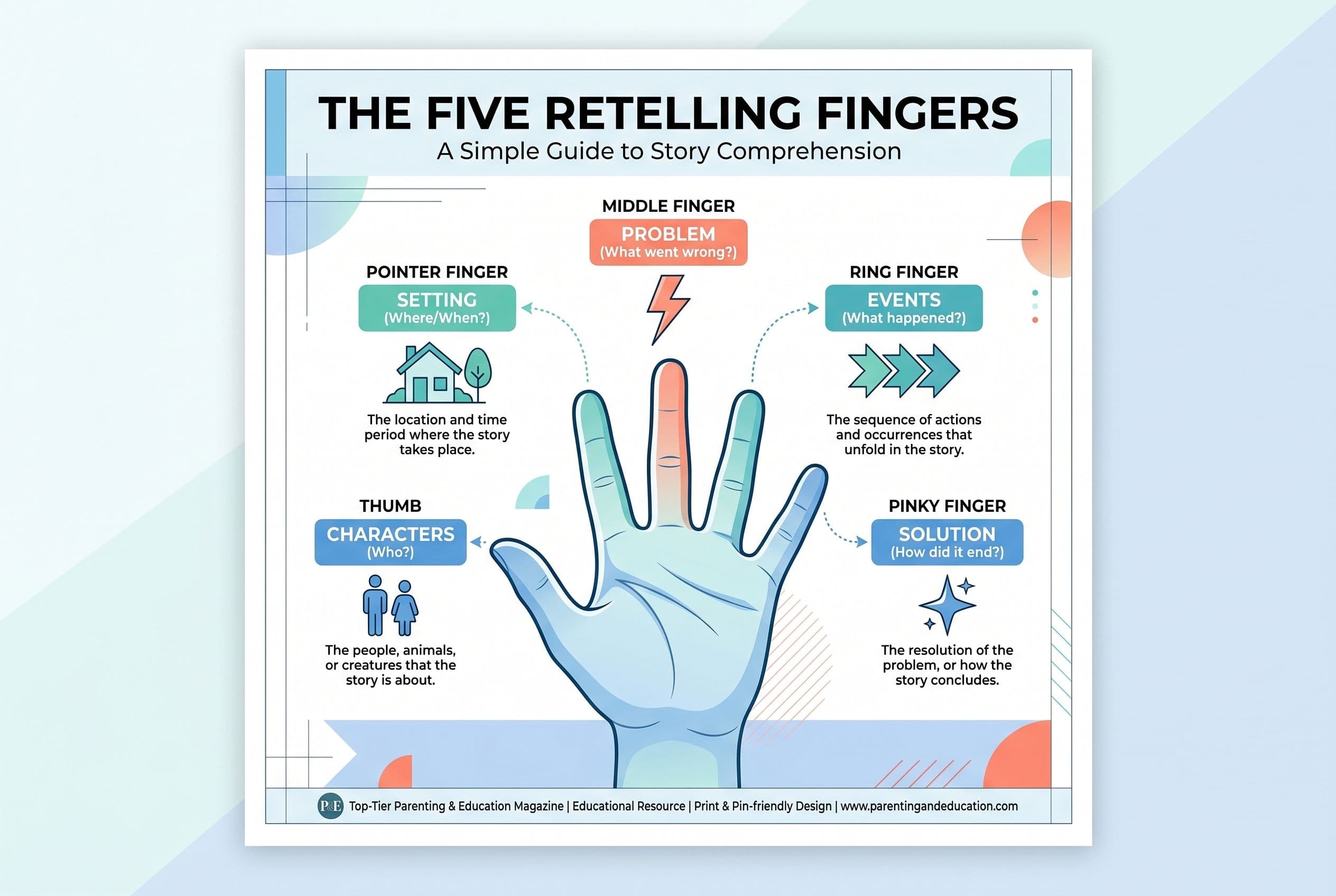
Here's a scene I see constantly. A kid finishes a book, closes it proudly, and the parent asks, "What was it about?" The kid stares. Shrugs. Says something like, "A dog. And stuff happened."
That's not reading. That's word-calling.
And honestly? Most parents don't even catch it. They hear their kid sounding out words (or worse, guessing from pictures) and assume comprehension is just... happening. Automatically. Like some magical side effect of moving your eyes across a page.
It doesn't work that way.
The Simple View of Reading — that's Gough and Tunmer's 1986 formula that reading researchers still rely on — breaks it down clean: Reading Comprehension = Decoding × Language Comprehension. Multiply. Not add. If either side is zero, the whole thing is zero. Your kid can decode every word on the page, but if they can't organize those words into meaning, into a story they can retell to you in their own words? They're not reading. They're performing.
Story retelling is the skill that bridges decoding and real comprehension. And it's the skill almost nobody teaches explicitly.
I'm going to fix that for you right now.
The Tiger Truth: What Happens When You Ignore Comprehension
Let me hit you with the numbers first.
Only 33% of 4th graders scored at or above the Proficient level on the NAEP 4th-grade reading assessment in 2022 — that's the Nation's Report Card. One in three. (And NAEP's "Proficient" is a rigorous benchmark — it's a high bar, not just "on grade level.") The 2023 scores? They dropped another 3 points from 2019, the largest decline in 30 years.
But here's what those numbers hide: a huge chunk of those struggling kids can decode. They can sound out words. They look like readers. They pass the early screeners. Then they hit the 3rd Grade Cliff — where the curriculum flips from "learning to read" to "reading to learn" — and they fall off a ledge.
The Annie E. Casey Foundation's 2010 study found that kids who can't read proficiently by 3rd grade are 4 times more likely to drop out of high school. Four times. And we're not just talking about kids who can't sound out words. We're talking about kids who can decode but can't comprehend. Can't summarize. Can't retell.
They can pronounce "photosynthesis" in a 4th grade science text but have zero idea what the paragraph was actually saying.
Know what the worst part is? By the time the school catches a comprehension-only deficit, your kid is usually in 3rd or 4th grade. And the remediation options? Expensive. We're talking $10,000-$15,000 per year for private reading specialists, and insurance doesn't cover it. The school might offer a pull-out group, but those groups are overwhelmed and under-resourced.
You don't want to be in that position. So let's talk about how story retelling — plain old narration, the simplest tool in the world — prevents it.
Why Story Retelling Is the Real Deal for Comprehension
Retelling a story is not the same as answering comprehension questions. Not even close.
When a kid answers a question like "What color was the dog?" they're scanning for a detail. It's retrieval. Low-level. A kid can answer ten comprehension questions correctly and still have no idea what the story was about — the arc, the problem, the resolution, how the character changed.
Retelling forces the brain to do something much harder: reconstruct the entire narrative from memory, in sequence, in their own words. That's active processing. That's Scarborough's Reading Rope in action — where language comprehension strands (vocabulary, background knowledge, verbal reasoning, narrative structure) twist together with decoding strands into skilled reading.
David Kilpatrick talks about this in Equipped for Reading Success (2016). He focuses heavily on orthographic mapping for word-level reading, but he's also clear that comprehension is the point of all that decoding work. The phonological processing that makes decoding automatic frees up cognitive resources so the brain can focus on meaning. And the best way to check whether your kid is actually building meaning? Ask them to retell.
Not "What happened?" — that's too vague.
Not a worksheet with blanks to fill in.
"Tell me the story. From the beginning. In your own words."
That one sentence will reveal more about your child's reading comprehension than any standardized test I've seen. Including DIBELS, which I love for tracking decoding and fluency progress, but which doesn't deeply measure narrative comprehension.
If They Can't Retell It, Check Whether They Actually Read It
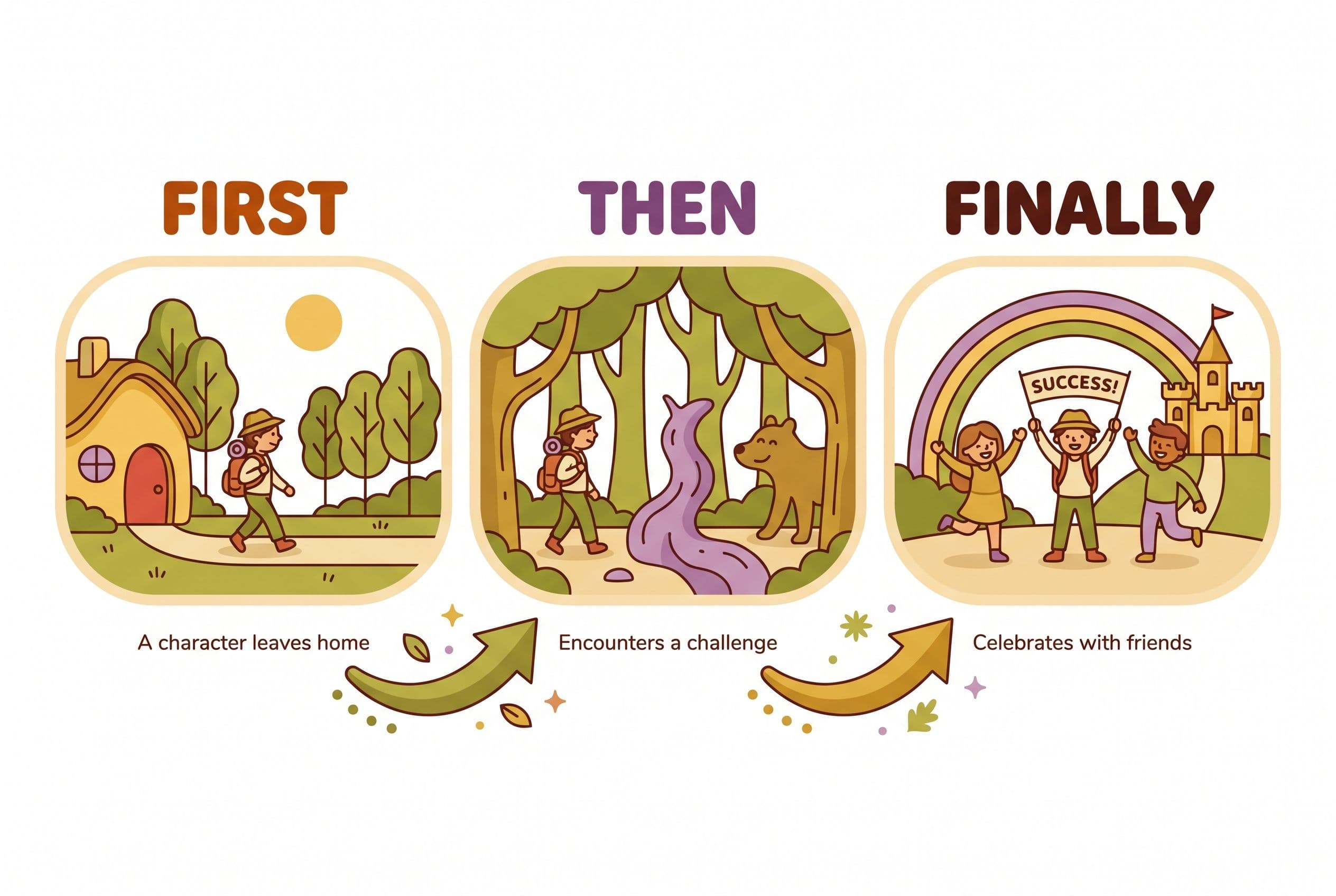
A surprising number of "comprehension problems" are decoding problems in disguise. A kid who spends all their working memory sounding out (or guessing) every fourth word has nothing left over to remember what happened. Their retelling is thin because the reading was exhausting, not because they don't understand stories — they retell movies just fine.
Quick check: have them read the passage aloud with the pictures covered. Three or more misread words in a minute of grade-level text means the words aren't automatic yet, and that's what to fix first. take the 2-minute reading check for an age-adjusted score.
If decoding is the bottleneck, Teach Your Kid to Read makes the words automatic — systematic phonics, decodable text, 10-15 minutes a day. Lesson one is free with no card, then a 7-day trial, then $9.95 a month. start lesson one free, then use the retelling steps below on text they can read easily.
The Decoding Connection: You Can't Retell What You Can't Read
Before I give you the retelling strategies, I need to say this plainly: story retelling strategies don't replace phonics instruction. They build on top of it.
If your kid is still guessing at words — looking at the picture and saying "boat" when the word is "ship" — they don't have a retelling problem. They have a decoding problem. And no amount of narrative comprehension work will fix that.
I was at a playground in Raleigh a few months back when another mom told me her kid's school had just switched from Lucy Calkins to a Science of Reading curriculum because of North Carolina's SB 387 — the Excellent Public Schools Act. She was confused and honestly a little annoyed. "He was doing fine before," she said.
So I asked if her son could read the word "splint." He's in second grade. He could not.
That kid had been getting by on guessing and memorization for two years, and his mom had no idea because he could retell stories — the ones the teacher read aloud. He could narrate beautifully. His language comprehension was strong. But his decoding was Swiss cheese. Which meant he couldn't independently comprehend anything he read on his own because he wasn't actually reading the words on the page.
I spent 20 minutes on that playground bench explaining why the curriculum switch was happening. Emily Hanford's Sold a Story reporting. The NAEP data. The neuroscience from Stanislas Dehaene's lab — he's the French neuroscientist whose book Reading in the Brain (2009) summarized strong evidence that the brain has to be trained to read; it doesn't happen naturally like speech does. She went home and watched the Sold a Story podcast that night. Texted me at 11pm: "I had no idea. Why didn't anyone tell us this sooner?"
Bottom line: decoding comes first. Use systematic synthetic phonics — Orton-Gillingham principles, programs like UFLI Foundations or Logic of English, whatever fits your family. Get that foundation solid. Then layer in retelling work. Both sides of Gough and Tunmer's equation matter, but you can't multiply by zero.
OK so — now let's get into the actual strategies.
How to Teach a Child to Retell a Story: The Step-by-Step Method
I've taught retelling to three of my four kids (the 1-year-old gets a pass for now). Here's the system I use, and it's the same progression I'd give any parent. It works whether your kid is 3 and you're retelling picture books from a read-aloud, or 7 and retelling chapter books they decoded themselves.
Step 1: Start With Read-Alouds (Even If They Can Decode)
This surprises people. If you want to teach retelling, start by reading aloud to your child — even if they can read independently.
Why? Because when you read the story, you eliminate the decoding load entirely. Your child's full brainpower goes toward comprehension. Toward following the plot. Toward building that mental movie.
I had my 7-year-old doing retelling work with read-alouds for months before I transitioned him to retelling stories he'd decoded himself. That's not a step backward — it's building the comprehension muscle in isolation before asking it to work alongside decoding.
Pick a short story. Read it with expression. Then close the book.
Step 2: Use the "First, Then, Finally" Scaffold
Don't just say, "Tell me what happened." That's like handing a kid a blank piece of paper and saying, "Write an essay." Too open-ended. The kid freezes.
Give them structure. Here's the simplest scaffold that works for kids ages 3-6:
- First: What happened at the beginning?
- Then: What happened in the middle?
- Finally: How did it end?
Three parts. That's it. My 4-year-old can handle this with picture books. Last Tuesday, we read Caps for Sale and I asked her to retell using "First, Then, Finally." She said: "First the man had all the caps on his head. Then the monkeys took them. Finally he got mad and the monkeys threw them down."
Is that a perfect literary analysis? No. But she just sequenced three major plot events in order from memory and used her own words. That's story retelling. That's comprehension in action.
Step 3: Add the Five Retelling Fingers
Once your kid can handle "First, Then, Finally" without prompting, level up. I teach my kids the Five Retelling Fingers — each finger represents one story element:
- Thumb: Characters — Who was in the story?
- Pointer: Setting — Where and when did it happen?
- Middle: Problem — What went wrong? What did the character want?
- Ring: Events — What happened? (This is the story sequencing piece — the "then, then, then")
- Pinky: Solution — How did it end? How was the problem solved?
I literally have my kids hold up their hand and touch each finger as they retell. It looks goofy. It works incredibly well. My 7-year-old started doing this in January and by March he was retelling chapter book episodes — multiple characters, subplot threads, the whole deal — without the finger prompts at all.
The fingers are a graphic organizer for retelling, except the graphic organizer is attached to their body, so they can't lose it. (If you've homeschooled, you know the "I lost my worksheet" problem is real.)
Step 4: Transition to Independent Reading Retells
Here's where it gets interesting. Once your kid can retell a read-aloud story using the Five Fingers consistently, have them retell stories they decoded themselves.
This is the moment of truth. Because now both sides of the Simple View of Reading are active simultaneously — decoding AND comprehension. If your kid suddenly can't retell a story they just read independently, but they can retell stories you read aloud, you've just identified a decoding bottleneck. The cognitive effort of sounding out words is eating up all their processing power, leaving nothing for meaning.
That's not a comprehension problem. That's a fluency problem. Go back to phonics work. Build automaticity. Kilpatrick's PAST — the Phonological Awareness Screening Test — is a quick screening tool (usually around 5–15 minutes) that zeros in on phonological awareness specifically and can tell you where the breakdown is happening. It's available from reputable SoR sources online. If results concern you, that's your signal to get a full evaluation from a reading specialist.
Step 5: Make It Daily (Yes, Daily)
Tiger Rule: We Never Skip.
Retelling isn't a Friday activity. It's an every-day-you-read thing. Every book. Every chapter. "Close the book. Tell me what happened."
My family does this at dinner sometimes. I'll ask my 7-year-old, "What did you read today? Tell me the story." He rolls his eyes (he's 7, it's his job), but he does it. And I can hear his comprehension getting stronger month by month. His retells are more detailed. He includes character motivations now — "The boy was scared because he'd never been in a cave before" — instead of just listing events.
That shift from events to motivations is the shift from surface comprehension to deep comprehension. And it happens through practice, not magic.
Story Retelling Activities That Actually Build Skill
Let me give you some specific retelling activities for reading comprehension that go beyond "just talk about it."
Activity 1: Story Sequencing Cards
After reading a story, draw (or have your kid draw) 3-5 simple pictures of key events on index cards. Shuffle them. Have your kid put them in order and retell the story using the cards as prompts.
This is a story sequencing activity that makes the abstract (narrative order) concrete (physical cards they can move around). My 4-year-old loves this. She'll argue with me about whether the monkeys stealing the caps comes before or after the man falls asleep. (She's wrong. But the arguing is the learning.)
Activity 2: The "Retell to a Stuffed Animal" Trick
Your kid won't retell to you? Fine. Have them retell to a stuffed animal. Or a sibling. Or a grandparent on FaceTime.
Real talk — my 7-year-old is way more enthusiastic about retelling when he's "teaching" his 4-year-old sister what the story was about. He uses bigger vocabulary, more detail, more expression. He's not doing it for me; he's doing it for an audience that he perceives as needing the information.
This is a well-documented comprehension strategy — the "teach it to learn it" effect. If you can explain it to someone else, you understand it.
Activity 3: Graphic Organizers for Retelling
For kids ages 6+, a simple graphic organizer for retelling takes the Five Fingers framework and puts it on paper. Draw five boxes on a page:
- Box 1: Characters (draw or write them)
- Box 2: Setting (draw the place)
- Box 3: Problem
- Box 4: Key Events (3 bullets)
- Box 5: Solution
Have your kid fill it in after reading, then use it as a retelling guide. Over time, phase out the organizer. The goal is internalization — they should carry this structure in their head, not on a worksheet.
I keep a stack of blank retelling organizers in our homeschool binder. We use them 2-3 times a week. They take maybe 5 minutes. No-brainer.
Activity 4: "Add One Detail" Game
This one's great for reluctant retellings. You start: "There was a boy named Max." Your kid adds a detail: "He had a wolf suit." You add another: "His mom sent him to bed without dinner." Back and forth until the whole story is retold.
This scaffolds the retelling collaboratively and takes the pressure off the kid to produce the whole thing alone. I use this with my 4-year-old when she's tired or cranky (so... most days at 4pm).
How Teach Your Kid to Read Builds the Foundation for Retelling
Everything I've described above requires that your child can actually decode the words on the page. And that's where start lesson one free comes in.
Teach Your Kid to Read is built on systematic synthetic phonics — the same Orton-Gillingham principles endorsed by the National Reading Panel's 2000 report. It's the same type of methodology Mississippi adopted alongside major literacy policy shifts — including the Literacy-Based Promotion Act of 2013, new coaching requirements, and curriculum overhauls — that helped the state jump from near the bottom to 21st on NAEP 4th-grade reading scores between 2013 and 2019.
The app teaches grapheme-phoneme correspondence systematically. No guessing. No picture clues. Your kid learns to decode, and as decoding becomes automatic, their brain frees up cognitive resources for comprehension — for building meaning, following narratives, retelling stories.
Decoding is the engine. Retelling is the destination. You need both.
The Age-by-Age Retelling Roadmap
Because every child is different, here's a general framework — not a rigid timeline, but a guide for what to aim for:
Ages 2-3: Retelling From Read-Alouds
- Can say a character's name from a story you just read
- Can recall one event ("The bear ate honey")
- May need heavy prompting ("What did the bear do next?")
Ages 4-5: "First, Then, Finally" Retells
- Can retell a simple picture book in 3 parts with scaffold
- Beginning to include character names and setting
- Can sequence 3 story events with picture card support
Ages 5-6: Five Finger Retells
- Can identify characters, setting, problem, events, and solution
- Can retell a short story without prompting
- Beginning to retell stories they've decoded independently
Ages 7-8: Independent Retelling
- Can retell chapter book episodes with detail
- Includes character motivations and feelings
- Can distinguish main events from minor details
- Retells independently without graphic organizer support
If your kid isn't hitting these benchmarks, don't panic — but don't wait, either. The "Wait and See" approach is how kids fall behind. Start retelling practice today. Literally today. Read a book tonight and ask, "Tell me what happened. From the beginning."
What About Schools? Aren't They Teaching This?
Some are. Many aren't. Or they're teaching it badly.
The 40+ states that have passed Science of Reading legislation since 2019 — including North Carolina's SB 387, Colorado's READ Act, Ohio's Third Grade Reading Guarantee — are pushing schools toward evidence-based reading instruction. That's a massive win. But most of that legislation focuses on decoding instruction (ditching Balanced Literacy, adopting phonics curricula). The comprehension piece — narrative comprehension, retelling, language comprehension development — gets way less attention in policy mandates.
And here's the kicker: even Fountas & Pinnell leveled reading programs, which are whole-language aligned and being phased out across the country (for good reason), at least included retelling as an assessment component. But the retelling was used to level kids, not to teach them the skill. Kids who couldn't retell just got bumped to a lower level. Nobody taught them how to retell.
So whether your kid is in public school, private school, or homeschool — the retelling work falls on you. Which is fine. You're already reading to your kid (right?). Now you just add five minutes of retelling practice afterward.
FAQs About Teaching Kids to Retell Stories
My child can retell TV shows perfectly but can't retell books. What's going on?
Good observation — and it actually tells you something important. TV provides the visual narrative for free. The kid doesn't have to build a mental image; the screen does it. Books require the child to construct meaning from text (or from your read-aloud voice and their imagination). If your kid retells movies but not books, they likely need more support building mental imagery during reading. Try pausing during a read-aloud and asking, "What do you see in your head right now?" Train them to build the movie internally.
At what age should I start teaching story retelling?
You can start as young as 2 with very simple read-alouds. "What did the bunny do?" counts as an early retelling prompt. Formal retelling practice — "First, Then, Finally" — works well starting around age 4. But honestly, if your kid is 7 or 8 and nobody's ever asked them to retell, start now. Better late than never, and the skill develops fast with daily practice.
My child resists retelling — they say "I don't remember" or "I don't want to." What do I do?
Two different problems. "I don't remember" usually means they weren't attending to meaning during the reading — they were word-calling. Shorten the text. Read one page. Ask for a retell. Build up from there. "I don't want to" is a motivation issue. Use the stuffed animal trick, the "Add One Detail" game, or have them retell to a sibling. Make the audience someone other than you. And don't give in — retelling is non-negotiable. Tiger Rule: We Never Skip.
How is retelling different from summarizing?
Retelling is the full version — everything that happened, in order, in the child's own words. Summarizing is the condensed version — main idea and key details only. Retelling comes first developmentally. You have to be able to retell before you can summarize, because summarizing requires you to decide what's important and what's not. That's a higher-level skill. Start with retelling. Move to summarizing around ages 7-8.
Can story retelling help with writing skills too?
Absolutely. Retelling builds narrative structure awareness — beginning, middle, end, problem, solution. That's the exact same structure kids need for narrative writing. I've watched my 7-year-old's writing improve dramatically since we started daily retelling practice. He used to write stories that were just a string of "and then... and then... and then." Now they have a character with a problem, events that lead to a solution, and an ending. Retelling gave him the template.
Start Tonight: Your Three-Step Retelling Action Plan
I don't do vague advice. Here's what you're going to do:
Step 1: Tonight, read your child a book. Any book. Close it. Say, "Tell me what happened from the beginning."
Step 2: If they freeze, prompt with "First, Then, Finally." If they still struggle, use the "Add One Detail" game and build the retelling together.
Step 3: Do it again tomorrow. And the next day. And every single day after that. Within 2-3 weeks, your kid will start retelling automatically — you won't even have to ask.
And if your child is still struggling with decoding — if they're guessing at words, skipping words, or reading so slowly that comprehension is impossible — fix that first. contact us today Start building that phonics foundation with Teach Your Kid to Read so your child can actually read the stories they're going to retell.
Decoding is the engine. Comprehension is the destination. Retelling is the bridge.
Build all three. Start today.
Part of these guides

Xia Brody
Co-Founder, Teach Your Kid to Read
Mom of 4 who has successfully taught her kids to read. Currently in the trenches with her 4-year-old while her two oldest (10 and 7) devour books on their own. Passionate about phonics-based methods and building a lifelong love of reading.
Related Articles
CVC Words Activities for Struggling Readers: 12 Drills That Build Real Skill
If your kid is guessing at three-letter words instead of sounding them out, these CVC words activities for struggling readers will change everything. Here are 12 drills that actually build blending skill — no fluff, no worksheets-for-the-sake-of-worksheets, just phonics that works.
Read More →
Best Reading App for 2nd Graders in 2026: 6 Tested & Compared
Most reading apps for 2nd graders are dressed-up guessing games. I tested 6 of the most popular ones against actual reading science — here's what I found, what I'd skip, and what I'm using with my own kids.
Read More →
Reading Eggs vs ABCmouse Cost: 2026 Price Breakdown
Comparing Reading Eggs vs ABCmouse cost? Here’s the 2026 price breakdown, what each app teaches, and why I’d choose phonics-first instruction over reward-heavy screen time.
Read More →