How to Teach Context Clues: 5 Strategies That Build Real Comprehension

What You'll Learn
- The dangerous line between using context clues and guessing — and why most schools have been on the wrong side of it for decades
- Why context clues only work AFTER your child can decode — and the specific reading phase where it's safe to introduce them
- 5 concrete strategies you can use at the kitchen table this week to build real comprehension (not word-guessing habits)
- The one question to ask your child when they get stuck on a word that separates a strong reader from a struggling guesser
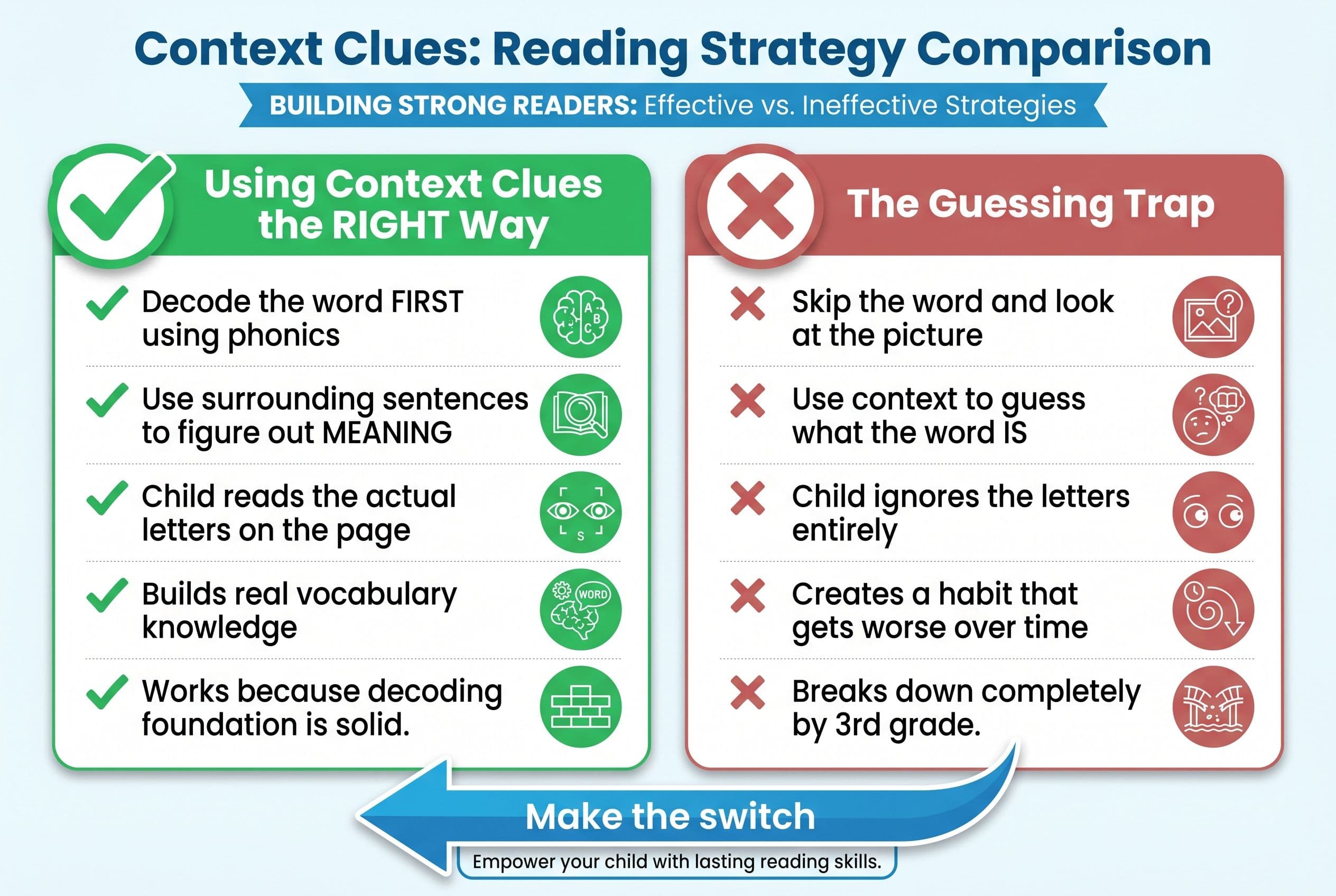
Let's Get Something Straight: Context Clues Are Not a Decoding Strategy
Picture this: your kid stares at the word "enormous" and says "elephant" because there's a picture of one on the page.
That's not using context clues. That's guessing.
And guessing is the most damaging habit your child can develop for building word-reading skill. The more they guess, the worse it gets. Every time a child skips the actual letters on the page and pulls a word out of thin air based on a picture or a vague sense of the sentence, they're reinforcing a neural pathway that says: I don't need to look at the word. I can fake it.
Here's the thing — guessing is almost always a symptom of shaky decoding instruction, not some character flaw in your kid. But honestly? That doesn't make it any less dangerous. That pathway gets stronger every single day you let it slide.
Now here's where it gets tricky — and I see this all the time. Context clues are a real, legitimate comprehension strategy. Skilled adult readers use them constantly — we figure out the meaning of unfamiliar words based on surrounding text all the time. But there's a massive difference between a fluent reader using context to infer the meaning of a word they've already decoded and a beginning reader using context to avoid decoding altogether.
That difference? It's the whole ballgame.
And for the last 30+ years, a lot of American schools have been coaching kids to guess. Emily Hanford's 2023 APM Reports investigation "Sold a Story" documented exactly how the Lucy Calkins Units of Study and Fountas & Pinnell programs taught children to use pictures, sentence patterns, and "what makes sense" as their primary reading strategy — instead of actually sounding out words. The [INTERNAL_LINK:three-cueing-explained] system (meaning, structure, visual) put context clues on equal footing with phonics. That's like telling a new driver they can steer using the rearview mirror — technically it's part of the car, but you're gonna crash.
So when I talk about teaching context clues to kids, I need you to understand: we're talking about a comprehension tool, not a decoding crutch. If your child can't decode the word first, context clues aren't the answer. Phonics is.
Let's make sure we don't ever confuse those two things.
The Tiger Truth: What Happens When Guessing Goes Unchecked
I need to scare you a little. Because this matters.
Only 33% of 4th graders read at a proficient level on the 2022 NAEP — that's the Nation's Report Card. That means two out of every three kids in this country can't read well enough to actually understand what's on the page at their grade level. The 2023 NAEP scores showed reading dropped another 3 points since 2019, the largest decline in 30 years.
A huge chunk of those struggling readers aren't kids with learning disabilities. They're kids who were taught to guess.
I was at a playground in Raleigh last year when another mom told me her son's school had just switched from Lucy Calkins to a Science of Reading curriculum because of North Carolina's SB 387 — the Excellent Public Schools Act. She was confused and honestly kind of annoyed. "He was doing fine before," she told me, arms crossed. I asked if her kid could read the word "splint." He's in second grade. He could not. He looked at me, looked at the sky, and said "split?" then "sprint?" He was cycling through words that looked vaguely similar, fishing for the right one. Classic guessing behavior.
I sat on that playground bench for a solid 20 minutes breaking it all down — Hanford's reporting, the NAEP data, Dehaene's brain imaging studies at the Collège de France proving the brain doesn't just "pick up" reading naturally. (Seriously, go read his 2009 book Reading in the Brain — it's the nail in that coffin.) She went home and watched the "Sold a Story" podcast that night. Texted me at 11pm: "I had no idea. Why didn't anyone tell us this sooner?"
Nobody told her because the guessing approach looks like reading for a long time. Kids who guess can fake their way through predictable early readers. "The dog ran to the ___" — of course the answer is "park," right? They look fluent. They sound fluent. And then they hit third grade, where the texts get complex, the pictures disappear, and the vocabulary gets harder. That's the 3rd Grade Cliff.
The Annie E. Casey Foundation published a study in 2010 — and the finding that stuck with me was brutal: kids who can't read proficiently by the end of third grade are four times more likely to drop out of high school. Four times. And the guessing habits that seemed harmless in first grade? They're almost impossible to undo by fifth.
You need to stop guessing early. Like, today.
Before Context Clues: The Decoding Foundation Has to Be Solid
Linnea Ehri's phases of word reading development — from her landmark research, consolidated in her 2005 meta-analysis — give us a clear roadmap. Kids move through specific stages — Ehri calls them pre-alphabetic, partial alphabetic, full alphabetic, and consolidated alphabetic.
Context clues have no business being a primary strategy until a child is in the full alphabetic phase or beyond. That's when they can reliably decode words by mapping all the graphemes to phonemes. Before that? They don't have the decoding muscle to even attempt the word. So if you hand them "context clues" as a strategy, what you're really handing them is permission to guess.
OK, think about it this way. The Simple View of Reading (Gough & Tunmer, 1986) tells us:
Reading Comprehension = Decoding × Language Comprehension
If decoding is zero — or close to it — it doesn't matter how good their language comprehension is. Zero times anything is zero. You have to build the decoding side first.
So what does that actually mean for you at the kitchen table? It means if your kid is still working on blending CVC words (cat, sit, map), you don't introduce context clues as a reading strategy. You drill [INTERNAL_LINK:systematic-synthetic-phonics]. You use a systematic phonics program — structured literacy-aligned programs like UFLI Foundations, or explicitly Orton-Gillingham-derived programs like Wilson Reading System or Barton Reading. You build the decoding foundation until it's automatic.
Then — and only then — you layer on context clues as a comprehension strategy for figuring out what unfamiliar words mean.
Not what they are. What they mean.
That distinction will save your child's reading life.
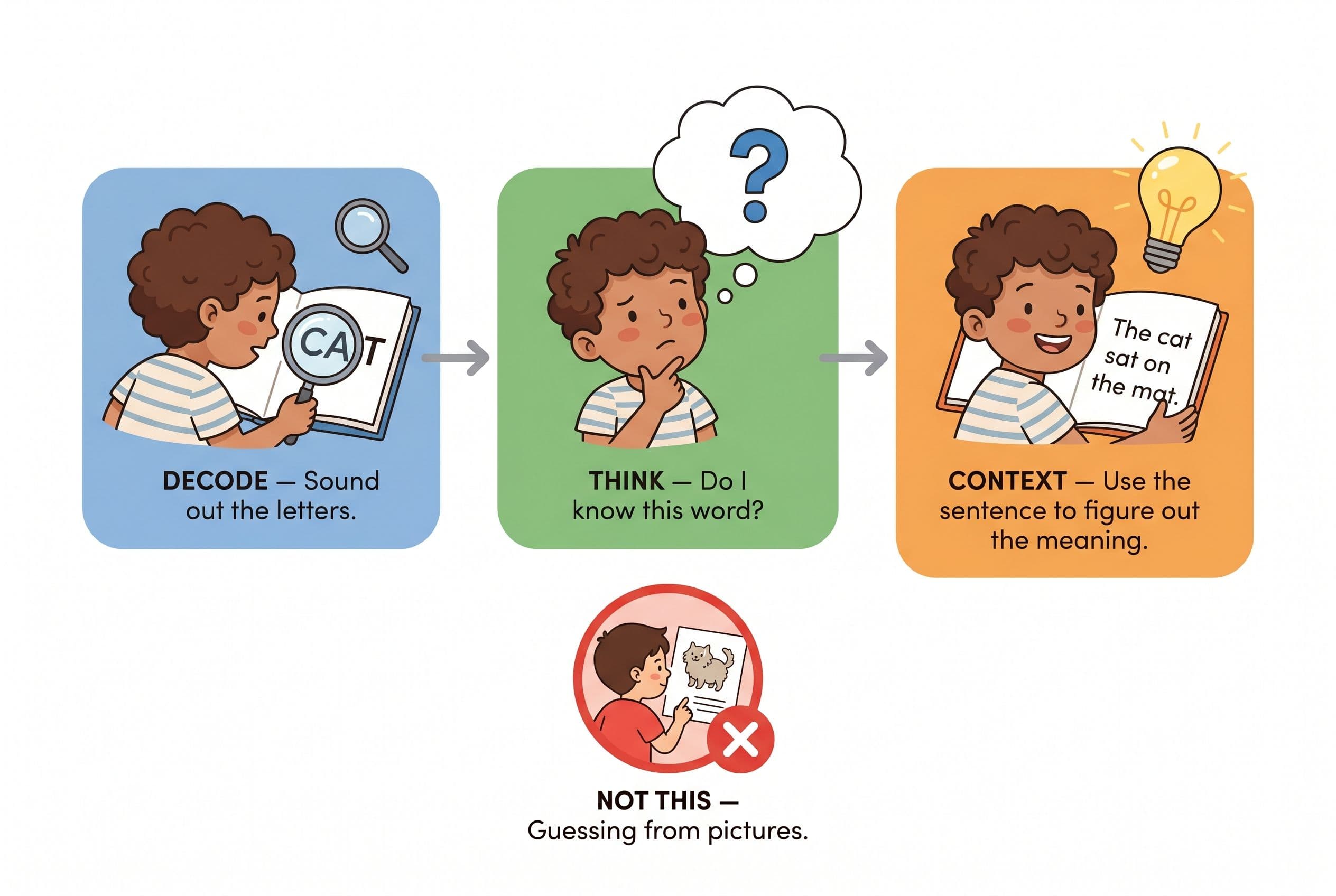
5 Strategies for Teaching Context Clues the Right Way
OK, so your child can decode. They can sound out multisyllabic words, they've got solid phonics skills, and they're starting to hit words in books that they can read but don't understand. Now we're in context clue territory.
Here are the five strategies I actually use with my own kids — same ones I tell every parent who asks me about this stuff.
Strategy 1: Decode First, Then Detective
This is my non-negotiable, don't-even-try-me rule. Tiger Rule #1: No Guessing. When my 7-year-old hits an unfamiliar word, the protocol is always the same:
- Sound it out. Use your phonics. Get the word off the page.
- Say it out loud. Does it sound like a word they've heard before?
- If you don't know what it means, THEN look around it. Read the sentence before. Read the sentence after. What clues does the author give you?
The order matters. Decode, then detect. Never the reverse.
Just last week, my 7-year-old was reading a chapter book — one of those Magic Tree House ones — and she hit the word "reluctant." She decoded it — slowly, syllable by syllable: re-luc-tant. "What does that mean?" she asked. Nope — I didn't tell her. I said, "Read the whole sentence again."
The sentence was: "Maya was reluctant to jump into the cold pool, shivering at the edge while her friends splashed below."
"Oh! "She didn't want to do it," my daughter said. That's a context clue doing its job — revealing the meaning of a word that was already decoded. Night-and-day different from guessing "jumped" because there's a picture of a pool.
Strategy 2: Teach the Five Types of Context Clues (Yes, There Are Types)
Most parents don't realize context clues aren't just one vague skill. There are distinct patterns authors use to signal word meanings, and you can explicitly teach your child to spot them.
- Definition Clues: The author flat-out defines the word. "The arid, or very dry, desert stretched for miles."
- Synonym Clues: A word with a similar meaning appears nearby. "The boy was famished. He was so hungry he could eat a horse."
- Antonym Clues: The opposite meaning appears. "Unlike her timid sister, Rosa was bold and outgoing."
- Example Clues: The author gives examples. "The farmer grew many legumes, such as beans, lentils, and peas."
- Inference Clues: You have to piece it together from the overall context. "After three days without rain, the wilted flowers drooped toward the cracked earth."
I literally taught these to my 7-year-old as "detective moves." We have a little chart on the fridge. When she finds a context clue in her reading, she tells me which type it is. She loves it. (OK, she tolerates it. But she's getting really good at it.)
The kicker is that this kind of explicit vocabulary instruction aligns directly with what David Kilpatrick describes in "Equipped for Reading Success" (2016) — the idea that strong readers build deep word knowledge through orthographic mapping, connecting spellings to pronunciations to meanings. Context clues are one pathway to locking in those meanings. But only if the decoding came first.
Strategy 3: The "Cover the Word" Test
This is my favorite trick for catching guessing in the act. Here's how you do it.
When your child gets stuck on a word, cover it with your finger. Then ask: "Based on the rest of the sentence, what word do you THINK might go here?"
Let them guess. Whatever they say — "big," "happy," "fast" — write it down or remember it.
Now uncover the word. Ask them to decode it using phonics.
If the word they guessed doesn't match the decoded word? That's the teaching moment. You get to show them: "See? If you'd just guessed, you would have said 'big.' But the actual word is 'enormous.' Sure, they mean something close — but they're not the same word. And an author chose 'enormous' for a reason."
This exercise makes the difference between guessing and reading viscerally real for a child. They can feel it. They can see that guessing gets them in the neighborhood but not in the house.
I did this with my oldest when he was 6, and it completely rewired how he approached hard words. He stopped guessing cold. Because he'd seen — over and over — that his guesses were wrong enough to matter.
Strategy 4: Read Aloud with "Stop and Think" Moments
Read-alouds aren't just for bedtime. They're a comprehension training ground.
When I read aloud to my kids (yes, even my 10-year-old — we're currently reading "The Phantom Tollbooth"), I deliberately stop at rich vocabulary words and model the context clue process out loud.
"Hmm, it says Milo felt 'despondent.' I don't know if you know that word yet. But look — the next sentence says he stared at the floor and couldn't even eat his dinner. So what do you think 'despondent' means?""
This is explicit instruction in comprehension monitoring. You're showing your child what a skilled reader's inner monologue sounds like. Mark Seidenberg, the University of Wisconsin cognitive scientist who wrote "Language at the Speed of Sight" (2017), argued that one of the biggest failures in reading instruction is that we never show kids the invisible processes that good readers use. We just expect them to somehow figure it out on their own — which, trust me, they won't.
Read-alouds with deliberate stops fix that.
Here's my protocol:
- Pick a book slightly above your child's independent reading level (this guarantees encountering unfamiliar vocabulary)
- Pre-select 3-5 words per chapter that are rich targets for context clue work
- When you hit one, stop. Don't define it. Don't define it for them. Ask your kid: "What do you think this means based on what's happening in the story?"
- Discuss. Confirm or correct. Move on.
- At the end of the chapter, review the 3-5 words. Can they remember the meanings?
Five minutes of this during read-aloud time is worth more than a stack of worksheets. Real talk.
Strategy 5: Build Background Knowledge Like Your Child's Life Depends on It
Here's something most context clue guides won't tell you: context clues don't work without background knowledge.
If a sentence says "The mitochondria are the powerhouse of the cell," that's a beautiful definition clue. But if your child has zero concept of what a cell is, or what a powerhouse does, the context clue is useless. The words around the word only help if the child understands those words and the concepts they represent.
This is Scarborough's Reading Rope in action. Comprehension isn't just decoding plus vocabulary. It's decoding plus vocabulary plus background knowledge plus verbal reasoning plus literacy knowledge, all braided together.
So how do you build background knowledge?
- Read nonfiction. A lot of it. Science books, history books, biographies. My 7-year-old has been on a weird kick about volcanoes lately. And guess what happened? She now understands words like "eruption," "molten," "dormant," and "ash" from context — because she has deep background knowledge about the topic.
- Talk about everything. Dinner table conversation is vocabulary instruction. Explain how the dishwasher works. Talk about why the moon looks different each night. Use big words and explain them.
- Go places. Museums, nature centers, farmers markets, construction sites. Every experience adds to the mental database your child draws on when they encounter new words in text.
Bottom line: a child with rich background knowledge will extract far more from context clues than a child who reads in an information vacuum. And that's a gift no worksheet can give them.
How Teach Your Kid to Read Fits Into This
Everything I've described above starts with one non-negotiable foundation: your child has to be able to decode.
That's exactly what Teach Your Kid to Read is built to do.
Our app uses systematic synthetic phonics rooted in structured literacy principles — explicit, sequential, cumulative, and diagnostic. It's the same evidence-based methodology behind programs like Wilson Reading System and UFLI Foundations. Your child doesn't guess. They decode. Every. Single. Time.
And because the decoding foundation is airtight, your child is actually ready to use context clues the way they're meant to be used — as a comprehension tool, not a crutch. They can sound out "reluctant" and THEN figure out what it means from the surrounding sentence. They don't skip the word and hope for the best.
We've set this up so you can practice at home — 15 to 20 minutes a day is all it takes. No guessing games. No picture walks. Just real [INTERNAL_LINK:phonemic-awareness] and phonics that builds real readers.
The One Question That Changes Everything
Whenever your child gets stuck on a word, ask them this:
"What do the letters tell you?"
Not "What word would make sense here?" Not "Look at the picture — what do you think it says?" Not "What starts with that letter?"
"What do the letters tell you?"
That single question forces decoding. It redirects the brain away from guessing and toward the actual printed word. Once they've actually decoded it, then you ask: "OK, do you know what that word means? Let's look at the sentence for clues."
This is the sequence. Decode, then comprehend. Letters first, context second. Always.
I've drilled this into my kids so deeply that my 7-year-old now corrects her 4-year-old sister when she tries to guess a word in her Bob Books reader. "Nope! What do the letters say?" she announces, like a tiny phonics drill sergeant. Honestly? Honestly? I've never been prouder of that kid.
Action Steps: Start This Week
Here's your homework. (Yes, you get homework too.)
-
Assess where your child actually is. If they can't decode reliably, stop all context clue instruction and focus on phonics. Kilpatrick's [INTERNAL_LINK:PAST-test-guide] (Phonological Awareness Screening Test) takes about 5 minutes and tells you if a phonological awareness gap is part of what's blocking decoding. But phonological awareness isn't the only piece — you'll also want to check actual decoding by having your child read a short list of real words and nonsense words aloud (think CVC words like "rit" and "blap"). If they can't get through those accurately, decoding instruction is the priority. Start with Teach Your Kid to Read's systematic phonics program.
-
Establish the "Decode First" rule. Starting today, when your child gets stuck on a word, the only acceptable first response is to sound it out. No guessing. No looking at pictures. Period. This is Tiger Rule territory — we don't negotiate.
-
Pick one context clue type to teach this week. I'd start with definition clues because they're the most obvious. Find 5 sentences that use them. Practice during read-aloud time.
-
Do the "Cover the Word" test at least three times this week. Let your child see the gap between their guess and the real word. That gap is the most powerful teaching tool you have.
-
Read nonfiction together for 10 minutes a day. Build that background knowledge. Let your child choose the topic. Volcanoes, dinosaurs, space, baking — it all counts.
-
Track progress. If your child is in school, ask the teacher what assessment they use. If it's Fountas & Pinnell levels, know that it's whole-language aligned and may overstate reading ability. Ask for DIBELS or AIMSweb data instead. If you're homeschooling, use the PAST test quarterly and track [INTERNAL_LINK:phonemic-awareness] growth yourself.
Mississippi did something remarkable starting in 2013. Their Literacy-Based Promotion Act required evidence-based reading instruction across the state. Their NAEP 4th-grade reading scores? They shot up dramatically over the next several years — Mississippi went from 49th to 21st, one of the biggest jumps any state has ever pulled off. They didn't do it with context clue worksheets. They did it with systematic phonics instruction, teacher training, and a commitment to the evidence. The context clue skills came after — built on a foundation that could actually support them.
That's the model. Build the floor, then build the house.
FAQ
Aren't context clues part of reading? Why are you against them?
I'm not against context clues. I'm against using them as a substitute for decoding. Context clues are a legitimate comprehension strategy — skilled readers use them constantly to figure out what unfamiliar words mean. The problem is when schools teach beginning readers to use context to figure out what words are instead of teaching them [INTERNAL_LINK:systematic-synthetic-phonics]. That's the guessing trap. Decode first, then use context to build meaning. That order is everything.
At what age should I start teaching context clues?
It depends on where your child is developmentally, not their age. Using Linnea Ehri's framework, context clues become useful once a child is in the full alphabetic phase — meaning they can reliably decode words by mapping all the graphemes to phonemes. For most kids with solid phonics instruction, that's around late kindergarten to early first grade for simple context clues, and second to third grade for the more complex types (inference clues, antonym clues). Don't rush this part. Get the decoding right first.
My child's school teaches the three-cueing system. Should I be worried?
Yes, you should. The [INTERNAL_LINK:three-cueing-explained] system (MSV: meaning, structure, visual) encourages children to use context and sentence structure as primary decoding strategies, which trains them to guess instead of decode. Over 40 states have now passed Science of Reading legislation since 2019 to move away from this approach. If your child's school still uses it, supplement at home with systematic phonics — programs like UFLI Foundations or Teach Your Kid to Read can fill the gap. And talk to your child's teacher. Many educators are in the middle of this transition and welcome the conversation.
How can I tell if my child is guessing vs. actually reading?
Watch their eyes. A guesser looks at the first letter (maybe), then looks at the picture, then looks at you for confirmation. A decoder moves their eyes across the whole word, left to right. Try this: give your child a sentence with no pictures and no context — just a list of isolated words. If they can read the words accurately, they're decoding. If they freeze up or start throwing out random words, they've been relying on context as a crutch. Kilpatrick's PAST test is another excellent diagnostic — it takes about 5 minutes and pinpoints where phonological awareness breaks down (which is one common root of decoding struggles, though not the only one).
What's the best way to build vocabulary if not through context clues?
Context clues are ONE way to build vocabulary, but they work best alongside explicit vocabulary instruction and wide reading. Read aloud to your child from books above their independent reading level — this exposes them to words they wouldn't encounter on their own. Discuss new words at dinner. Build background knowledge through nonfiction, field trips, and conversation. And when your child does encounter an unfamiliar word in text, make sure they decode it first, then use context to figure out the meaning, then use it in a sentence themselves. That three-step process (decode → context → use) is what locks the word into long-term memory through orthographic mapping.
Part of these guides

Xia Brody
Co-Founder, Teach Your Kid to Read
Mom of 4 who has successfully taught her kids to read. Currently in the trenches with her 4-year-old while her two oldest (10 and 7) devour books on their own. Passionate about phonics-based methods and building a lifelong love of reading.
Related Articles

CVC Words Activities for Struggling Readers: 12 Drills That Build Real Skill
If your kid is guessing at three-letter words instead of sounding them out, these CVC words activities for struggling readers will change everything. Here are 12 drills that actually build blending skill — no fluff, no worksheets-for-the-sake-of-worksheets, just phonics that works.
Read More →
Best Reading App for 2nd Graders in 2026: 6 Tested & Compared
Most reading apps for 2nd graders are dressed-up guessing games. I tested 6 of the most popular ones against actual reading science — here's what I found, what I'd skip, and what I'm using with my own kids.
Read More →
Best Phonics App for Letter Sounds: 6 Picks for 2026
Looking for the best phonics app for letter sounds? Xia Brody compares 6 popular apps for real phonics, explicit instruction, price, and best age range.
Read More →