How Many Words Per Minute Should a Child Read? Norms by Grade

What You'll Learn
- The exact words-per-minute benchmarks your child should hit at every grade level (and where those numbers actually come from)
- Why reading speed alone is a terrible measure of whether your kid is actually a good reader — and what to track instead
- The one fluency red flag that most parents miss because it looks like "slow and steady" progress
- How to do a simple fluency check at home in under 3 minutes — no teaching degree required
Your Kid Reads Slowly. Is That a Problem or Not?
Let me set the scene. Your second grader is reading aloud from a chapter book at bedtime. She's sounding out every. Single. Word. Like she's defusing a bomb. You're timing it in your head — not because you're cruel, but because something feels off. Her classmates are breezing through Magic Tree House books and she's still grinding through Frog and Toad.
So you Google "reading fluency norms by grade." And you land on a chart. And your stomach drops.
Hold on. Before you spiral, let me tell you something I wish someone had told me three years ago when my oldest was in that exact spot: the number matters, but it's not the whole story.
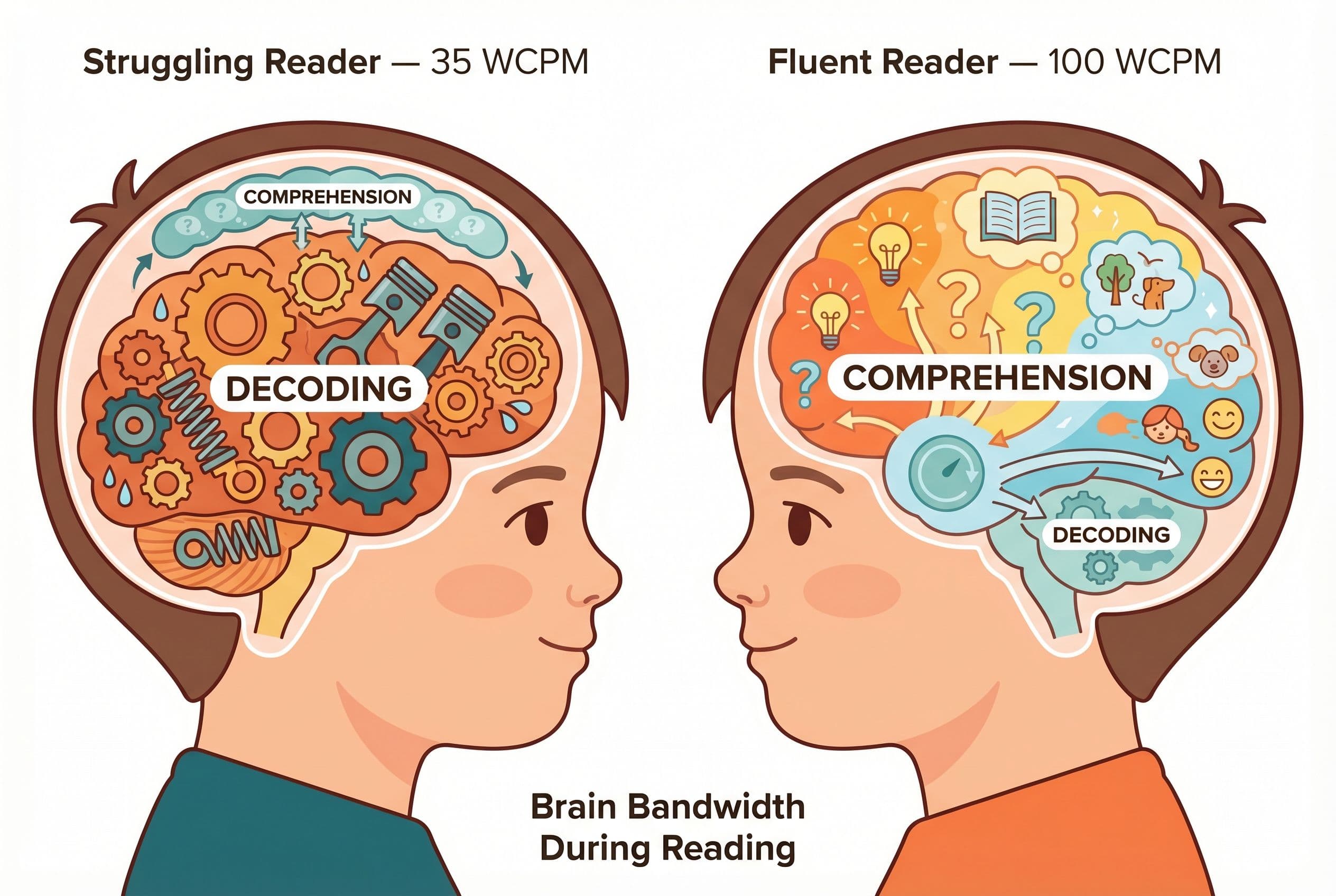
Some kids pick up reading faster than others. That's just reality. But there IS a baseline your child should hit to make sure they're actually getting something from the books they read. A kid reading at 25 words per minute in second grade isn't "taking their time" — they're drowning. Their brain is spending so much energy on decoding that there's nothing left for comprehension.
That's the part nobody talks about.
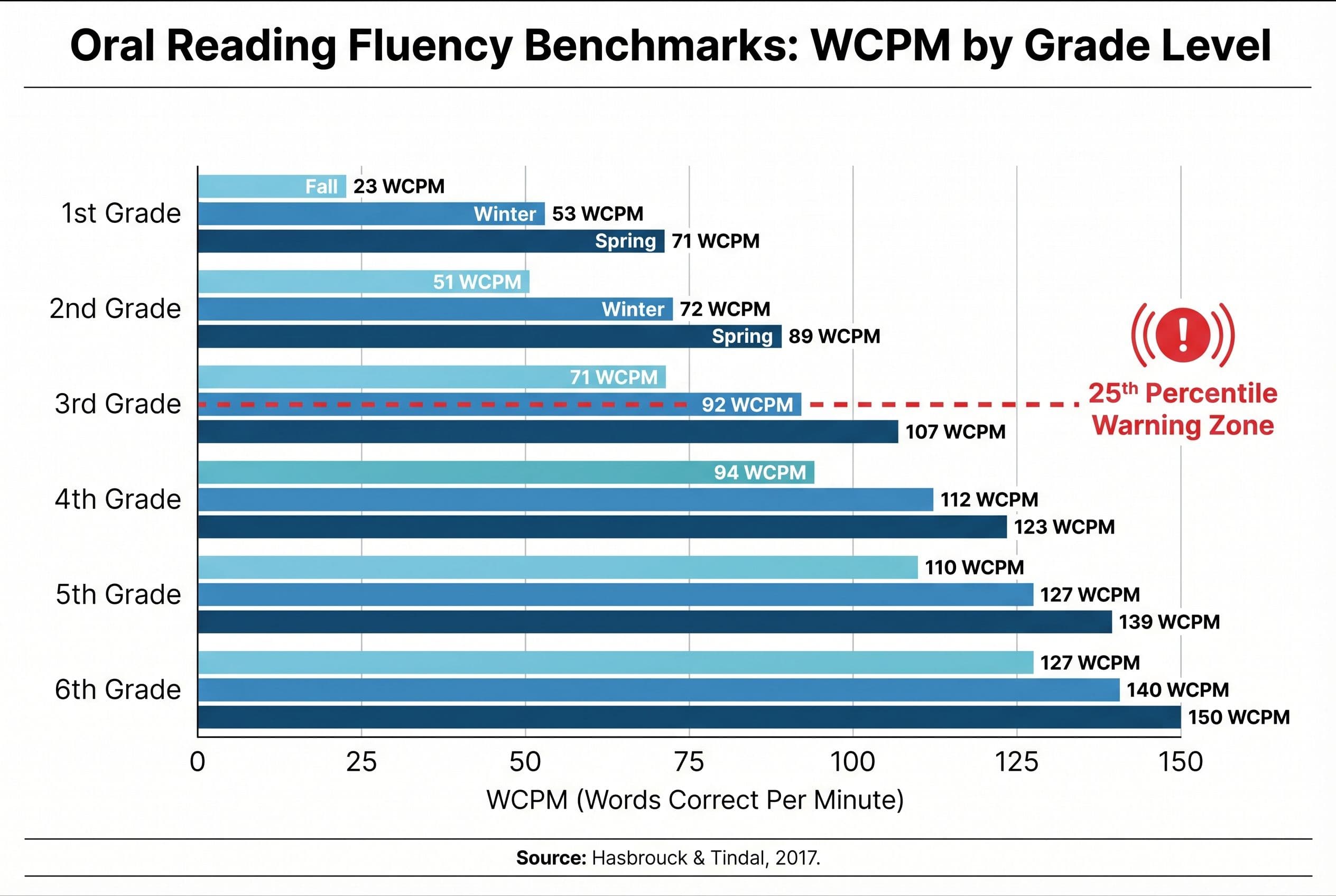
The Actual Numbers: WCPM Benchmarks by Grade Level
OK, let's get specific. The most widely used oral reading fluency benchmarks come from DIBELS (Dynamic Indicators of Basic Early Literacy Skills) and the Hasbrouck & Tindal norms — Jan Hasbrouck and Gerald Tindal published their fluency norms table in 2017, and it's based on data from over a million students across the country. These are the numbers that reading specialists, school psychologists, and intervention teams actually use.
Here are the 50th percentile benchmarks — meaning the "middle of the pack" kid at each grade level. These are measured in WCPM (Words Correct Per Minute) during oral reading:
Oral Reading Fluency Norms (50th Percentile, Hasbrouck & Tindal 2017)
1st Grade:
- Fall: ~23 WCPM
- Winter: ~53 WCPM
- Spring: ~72 WCPM
2nd Grade:
- Fall: ~72 WCPM
- Winter: ~89 WCPM
- Spring: ~100 WCPM
3rd Grade:
- Fall: ~94 WCPM
- Winter: ~112 WCPM
- Spring: ~123 WCPM
4th Grade:
- Fall: ~110 WCPM
- Winter: ~127 WCPM
- Spring: ~133 WCPM
5th Grade:
- Fall: ~127 WCPM
- Winter: ~140 WCPM
- Spring: ~146 WCPM
6th Grade:
- Fall: ~132 WCPM
- Winter: ~145 WCPM
- Spring: ~146 WCPM
Notice how the growth rate slows down after 3rd grade? That's because the explosive decoding gains happen early. By 4th grade, the game shifts from "learning to read" to "reading to learn." Third grade is a common inflection point — text demands jump, and suddenly weaknesses in decoding and in vocabulary and background knowledge both start hurting more. If your kid has gaps in either area, they're now trying to learn content through a tool they can't fully operate.
That's the 3rd Grade Cliff. And it's real — not just because of decoding, but because everything gets harder at once.
The Red Zone: When to Actually Worry
If your child is at or below the 25th percentile, that's a red flag. Here's what that looks like:
- 1st Grade Spring: Below 47 WCPM
- 2nd Grade Spring: Below 72 WCPM
- 3rd Grade Spring: Below 95 WCPM
Below the 10th percentile? That's not a "wait and see" situation. That's a "call someone today" situation.
If Your Child Is Below That Line
Take the number seriously, but read it correctly. A kid 10 words under the benchmark who reads every word accurately is fine — they need more miles on the road. A kid 10 words under who's guessing at "shrimp" and "blend" has a decoding gap, and no amount of "just read more" closes it. Those are different problems with different fixes.
Two minutes tells you which one you're looking at. Run the 1-minute check further down this page, and count the errors, not just the speed. Three or more errors in a minute on grade-level text means the words aren't automatic yet. If you'd rather have it scored for you, take the 2-minute reading check.
Below the line and making errors? Go back to systematic phonics, even in 3rd or 4th grade. That's exactly what Teach Your Kid to Read does — a fixed scope and sequence, decodable text, no guessing allowed. Lesson one is free with no card, then a 7-day trial, then $9.95 a month. start lesson one free tonight and re-run the fluency check in four weeks.
Why Speed Reading Isn't the Goal (Yes, Even for School)
Here's where I need to be honest with you, because I see parents go off the deep end with this fluency data.
I can speed read. I've been able to for years. And you know what? I hate it. When I speed read, I can't actually think about the ideas I'm reading. I'm just moving my eyes across the page, absorbing surface-level information, processing nothing deeply. So nowadays I read slower on purpose — and it's a good thing. I can think about how to actually apply what I'm reading in real time instead of just trying to get through the material.
The same principle applies to your kid.
The goal of tracking reading fluency norms by grade is NOT to create a little speed-reading machine. The goal is to make sure your child's decoding is automatic enough that their brain has bandwidth left for comprehension. That's the whole point.
Think of it this way. If your kid is reading at 35 WCPM in second grade, their brain is spending 90% of its energy on sounding out letters. There's almost nothing left to actually understand the story. But a kid reading at 95 WCPM? Decoding is on autopilot. Their brain is free to wonder what's going to happen next, to picture the scene, to connect ideas.
That's the sweet spot. Fluent enough to comprehend. Not so fast that meaning evaporates.
Now, here's a nuance I want to address because I know some of you are thinking it. If your kid is in public or private school — meaning their education is heavily test-focused — teaching speed reading strategies to find answers to assignments quickly can seem helpful. And in that narrow context, sure, it might help them locate an answer on a timed reading comprehension test.
But that skill only helps in that one specific scenario. And it might actually hurt them in the future. Kids who learn to skim for answers instead of reading deeply develop terrible habits. They become adults who can't sit with a complex text. They become college students who can't get through a dense chapter without zoning out.
I've watched my own kids struggle with this tension. My 10-year-old reads for pleasure and reads deeply — she'll stop mid-page and say, "Wait, that doesn't match what happened in chapter two." That's real reading. That's the skill that transfers to everything.
So when you look at those WCPM benchmarks, think of them as a floor, not a ceiling. Your child needs to be at or above those numbers so comprehension can happen. But pushing them past that floor into speed-reading territory? That's a different game, and not one I'd recommend.
What the Research Actually Says About Fluency and Comprehension
The connection between fluency and comprehension isn't my opinion. It's one of the most well-established findings in reading science.
The Simple View of Reading, proposed by Gough and Tunmer in 1986, breaks it down into a clean equation:
Reading Comprehension = Decoding × Language Comprehension
If either factor is zero (or close to it), comprehension tanks. A kid who decodes beautifully but has limited vocabulary? Poor comprehension. A kid who has a rich vocabulary and strong language skills but can't decode? Also poor comprehension.
Fluency is what happens when decoding becomes automatic. David Kilpatrick explains this brilliantly in Equipped for Reading Success (2016) — he lays out the orthographic mapping research showing that skilled readers don't actually "sound out" familiar words anymore. They've mapped those words into long-term memory through repeated, accurate decoding. The word gets stored as a unit. Recognition becomes instant.
That instant recognition is what WCPM is actually measuring. When your kid reads 100 words per minute in second grade, it's not because they're speed-reading. It's because they've orthographically mapped enough words that decoding is automatic for most of the text.
Kids who haven't built that mapped vocabulary? They're stuck sounding out every word, every time. And their WCPM shows it.
The Scare: What Happens When You Ignore Low Fluency Numbers
Real talk — I'm about to hit you with some uncomfortable data.
The 2022 NAEP (that's the Nation's Report Card) showed that only 33% of 4th graders read at a proficient level. One in three. The 2023 NAEP scores were even worse — reading scores dropped 3 points since 2019, the largest decline in 30 years.
Kids who can't read fluently by 3rd grade are 4 times more likely to drop out of high school. That's from the Annie E. Casey Foundation's 2010 study, Early Warning! Why Reading by the End of Third Grade Matters. And it's not just about school. It's about confidence, self-image, and opportunity.
I've seen what happens when parents take the "wait and see" approach to low fluency scores. They tell themselves their kid is a "late bloomer." They assume the school will catch it. They wait.
And then 3rd grade hits. And suddenly the reading demands explode — social studies textbooks, word problems in math, science passages — and their kid is underwater. The school recommends testing. Maybe an IEP. Maybe retention.
The average private reading intervention program costs between $10,000 and $15,000 per year. Insurance doesn't cover it. Most families can't afford it.
Mississippi figured this out. Their Literacy-Based Promotion Act of 2013 required 3rd grade retention for kids who couldn't read on grade level, plus mandatory intervention. They went from 49th in the nation to 21st in reading scores in just 6 years. The lesson? Early identification and aggressive intervention work. Waiting doesn't.
If your child's WCPM is below the 25th percentile at any grade level, you don't have time to wait.
A Story About What Happens When Teachers Get the Right Tools
After Emily Hanford's Sold a Story investigation came out in 2023 through APM Reports — the one that blew the lid off how Balanced Literacy had been failing kids for decades — my neighbor called me almost in tears. She's a first-grade teacher. Eighteen years in the classroom. She'd been using Lucy Calkins' Units of Study curriculum her entire career. Three-cueing, MSV, the whole guessing approach.
She said, "I've been teaching kids to guess for two decades and I didn't even know it."
She decided to switch her classroom to UFLI Foundations mid-year. And let me tell you, it was messy. She had to relearn everything herself first — new routines, new lesson structure, new understanding of how phonics actually works. Her principal wasn't fully on board. Some parents were confused by the homework changes.
But by spring, her kids' DIBELS scores had jumped an average of 15 points on nonsense word fluency. She told me that was the first time in her career where every single kid in her class could decode CVC words by February.
Every. Single. Kid.
And here's the kicker for our fluency conversation — those kids didn't just decode better. Their oral reading fluency scores went up too. Because when you can decode accurately and automatically, speed follows naturally. You don't have to drill speed. You drill accuracy and automaticity, and fluency is the byproduct.
That's what Linnea Ehri's phases of word reading development tell us. Kids move from pre-alphabetic (no letter-sound knowledge) through partial alphabetic, full alphabetic, and finally to the consolidated alphabetic phase where they recognize common patterns instantly. Each phase builds on the last. You can't skip to fast reading without going through accurate reading first.
How to Check Your Child's Reading Fluency at Home
You don't need a teaching degree for this. You need a book, a timer, and 3 minutes.
The 1-Minute Fluency Check
Step 1: Pick the right text. Grab a book at your child's current grade level — not above, not below. If your kid is in 2nd grade, pick a 2nd grade level passage. If you're not sure what's grade-level, use a passage from a reading assessment like AIMSweb (many sample passages are available free online) or grab a decodable text appropriate for their level.
Step 2: Set a timer for 60 seconds. Have your child read aloud while you follow along with your own copy. Mark any word they skip, misread, or take more than 3 seconds to decode.
Step 3: Count the words. Total words read minus errors = WCPM (Words Correct Per Minute).
Step 4: Compare to the benchmarks. Use the Hasbrouck & Tindal norms I listed above. Where does your child fall — 50th percentile? 25th? Below?
Step 5: Listen for quality, not just speed. Does your child read in phrases, or word-by-word? Do they pause at commas and periods? Does their voice go up for questions? This is prosody — the expression and rhythm of reading — and it matters as much as raw speed.
A kid reading 90 WCPM in a flat robotic monotone is not truly fluent. A kid reading 80 WCPM with expression, phrasing, and natural pauses? That kid is comprehending.
What to Do With the Results
At or above 50th percentile: Great. Keep reading daily. Increase text complexity gradually.
Between 25th and 50th percentile: This is the "watch closely" zone. Do the fluency check every 2-4 weeks. Make sure daily reading practice is happening — 15-20 minutes minimum. Consider adding explicit phonics review if you notice decoding breakdowns.
Below 25th percentile: Action time. Don't wait for the school to flag it. Start phonics intervention now. Run Kilpatrick's PAST test (Phonological Awareness Screening Test) — it takes about 5 minutes and tells you exactly where the phonological breakdown is happening. If your kid can't segment and blend phonemes, that's your starting point. Speed work is pointless until decoding accuracy is solid.
The Solution: Building Real Fluency Through Systematic Phonics
Here's what I've learned teaching four kids to read (well, three so far — my 1-year-old gets a pass): fluency is the output, not the input.
You don't teach fluency by saying "read faster." You build it by making decoding so automatic that speed happens on its own. And the way you make decoding automatic is through systematic synthetic phonics — the kind backed by decades of research.
The 2000 National Reading Panel report — the one Congress actually commissioned — found that systematic phonics instruction produces significant benefits for reading accuracy, fluency, and comprehension. Not "some" benefits. Significant ones. Across every study they reviewed.
Stanislas Dehaene's research in Reading in the Brain (2009) showed that the brain has to be trained to read. There's no reading gene. There's no natural timeline where kids just "click" with reading if you wait long enough. The neural pathways for reading are built through explicit instruction and practice.
This is exactly the approach behind Teach Your Kid to Read. We use Orton-Gillingham-based systematic phonics — the same methodology that programs like Wilson Reading System and Barton Reading & Spelling are built on. Each lesson builds on the last. Every sound-spelling pattern is taught explicitly, practiced to mastery, then reviewed.
My 4-year-old is working through CVC words right now. Last Tuesday at the kitchen table, she read "mop," "sit," "hug," and "fan" without hesitation. Not because she memorized them. Because she can segment each sound and blend them together. That skill will scale. When she hits two-syllable words, she'll have the decoding foundation to handle them.
That's how you build fluency that actually means something.
What About Kids Who Read Fast But Don't Understand?
This drives me crazy because I see it all the time. Parents brag about their kid's words-per-minute count like it's a sprint time. "My daughter reads 160 words per minute!" Great. What did she read about? "...Um."
Fast reading without comprehension is not reading. It's word-calling.
I had my 7-year-old read a passage from a nature book last week. She clocked about 115 WCPM — solid for her grade. Then I asked her three questions about what she'd read. She nailed two and had to go back and reread for the third. That's fine. That's real reading. She's engaging with the material.
If your child zooms through text but can't tell you what happened, the problem isn't fluency. The problem might be:
- Vocabulary gaps — they can decode the words but don't know what they mean
- Speed-reading habits — they've learned to move fast without processing
- Attention issues — their eyes are moving but their brain isn't engaged
- Comprehension strategy gaps — nobody taught them to visualize, predict, or summarize while reading
Scarborough's Reading Rope model shows this beautifully — reading is a braid of multiple strands, and word recognition (decoding, sight recognition) is only half the rope. The other half is language comprehension: vocabulary, background knowledge, verbal reasoning, inference. Both halves have to be strong.
The DIBELS Connection: What Schools Are Measuring and What It Means
If your kid is in a public school in one of the 40+ states that have passed Science of Reading legislation since 2019, there's a good chance they're being assessed with DIBELS (Dynamic Indicators of Basic Early Literacy Skills). Here's what those subtests actually measure and how they connect to fluency:
- Letter Naming Fluency (LNF): How many letter names per minute. Kindergarten benchmark.
- Nonsense Word Fluency (NWF): Can your kid decode made-up words like "bif" and "rog"? This tests pure phonics knowledge — no memorization possible. The mid-kindergarten benchmark is 28+ correct letter sounds per minute.
- Oral Reading Fluency (ORF): This is the WCPM measure. Connected text, timed reading, accuracy counted.
NWF is the one I want you to pay attention to early on. If your child scores low on nonsense word fluency, it means their phonics foundation has holes. And you can't build reading speed on a cracked foundation.
That's exactly what my neighbor saw when she switched to UFLI Foundations. The nonsense word fluency gains came first. Then the oral reading fluency followed. Because the kids were finally learning to decode rather than guess.
Here's a benchmark I want you to remember: By end of 1st grade, DIBELS ORF benchmark is around 47 WCPM. If your 1st grader is below that in spring, it's time to act. Don't wait for the school's next round of testing. Do the 1-minute check at home. Run the PAST. Get specific about where the breakdown is.
Your Action Plan: What to Do Right Now
Here's your step-by-step. No fluff.
1. Do the 1-minute fluency check today. Pick a grade-level passage. Time your child. Count errors. Calculate WCPM.
2. Compare to Hasbrouck & Tindal norms. Where does your child fall? 50th percentile? 25th? Lower?
3. If below 25th percentile: Run Kilpatrick's PAST test. You can find instructions in David Kilpatrick's Equipped for Reading Success. It pinpoints exactly which phonological awareness skills are missing.
4. Start systematic phonics instruction immediately. Don't wait for school to flag it. Teach Your Kid to Read gives you a structured, Orton-Gillingham-based program you can do at home in 15-20 minutes a day. start lesson one free
5. Recheck fluency every 4-6 weeks. Track progress. You're looking for growth of about 1-2 WCPM per week during active intervention.
6. Don't chase speed — chase accuracy first. Once decoding is accurate and automatic, speed follows. I've seen it with my own kids. I've seen it with my neighbor's first graders. Accuracy first. Always.
7. Read aloud together every single day. Even after your child can read independently, reading aloud builds prosody, vocabulary, and the love of reading that makes all of this stick.
FAQ: Reading Fluency Norms by Grade
What is a normal reading speed for a 2nd grader?
According to the Hasbrouck & Tindal (2017) oral reading fluency norms, the 50th percentile for a 2nd grader is approximately 72 WCPM in fall, 89 WCPM in winter, and 100 WCPM in spring. If your 2nd grader is below 72 WCPM by spring, that's a red flag worth investigating. Run a phonics assessment to see if decoding accuracy is the bottleneck.
Should I be worried if my child reads slowly but understands everything?
It depends on how slow. If your child is at or near the 50th percentile and reads with good expression and comprehension, slower reading might just mean they're a thoughtful reader — and honestly, that can be a strength. I read slower on purpose now because I comprehend and apply ideas better that way. But if your child is significantly below grade-level benchmarks (25th percentile or lower), slow reading usually signals decoding struggles that are eating up cognitive resources — even if comprehension seems OK now, it'll catch up with them as texts get harder.
How do DIBELS fluency scores translate to the benchmarks in this article?
DIBELS Oral Reading Fluency (ORF) measures the same thing — words correct per minute from a grade-level passage. The DIBELS benchmark targets and the Hasbrouck & Tindal norms track closely, though they're derived from different data sets. If your school reports DIBELS ORF scores, you can compare them directly to the WCPM benchmarks listed above. DIBELS also measures Nonsense Word Fluency (NWF), which is a separate and equally important indicator of phonics skill.
Can I teach my child to read faster?
Yes, but not by drilling speed. Fluency improves when decoding becomes automatic through systematic phonics practice and repeated reading of appropriately leveled text. Pushing a child to "read faster" without solid decoding skills just teaches them to skip words and guess — which destroys comprehension. Build accuracy first. Automaticity and speed follow naturally.
What if my child's school doesn't do fluency testing?
You can do it yourself in 3 minutes. Use a grade-level passage, a timer, and the 1-minute fluency check process described in this article. For a deeper phonological assessment, look into Kilpatrick's PAST test. And if you want ongoing progress monitoring, Teach Your Kid to Read tracks your child's phonics mastery so you always know where they stand. Call us at (314) 285-9505 or visit contact us today for help getting started.
Bottom Line
Reading fluency norms by grade exist for a reason. They're not there to stress you out. They're a diagnostic tool — a way to catch problems early, before the 3rd Grade Cliff, before the confidence damage, before the $15,000-a-year tutoring bills.
But don't worship the numbers. A kid who reads at 110 WCPM with deep comprehension and genuine curiosity is a better reader than a kid who reads at 160 WCPM and can't tell you what the paragraph was about.
Accuracy before speed. Comprehension above all. And daily practice is non-negotiable.
That's the Teach Your Kid to Read approach. Systematic phonics. Real mastery. No guessing.
Ready to build a foundation your child can actually read on? Visit TeachYourKidToRead.org or call (314) 285-9505 today.
Part of these guides

Xia Brody
Co-Founder, Teach Your Kid to Read
Mom of 4 who has successfully taught her kids to read. Currently in the trenches with her 4-year-old while her two oldest (10 and 7) devour books on their own. Passionate about phonics-based methods and building a lifelong love of reading.
Related Articles
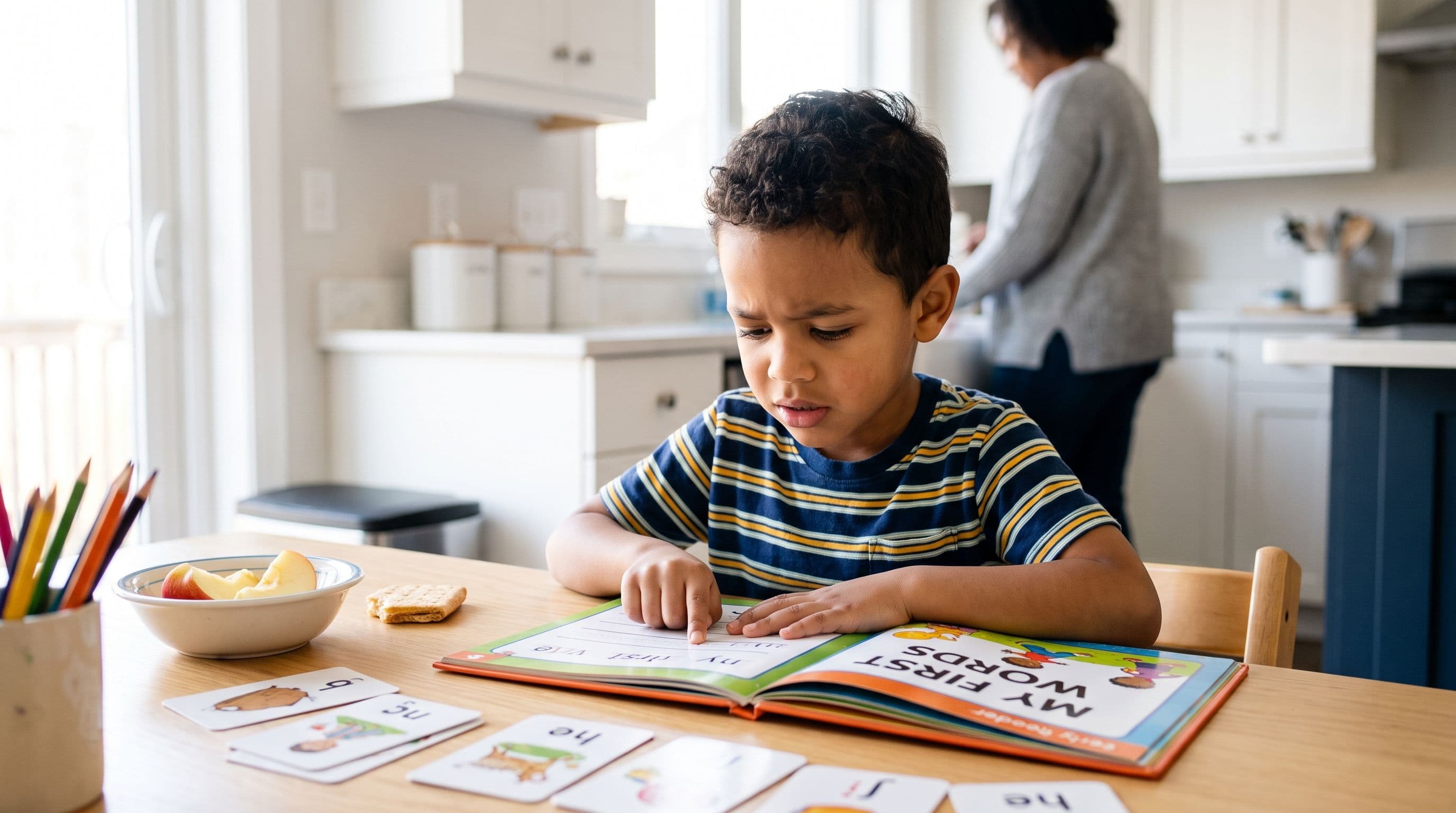
Is My 2nd Grader Behind in Reading? 9 Signs
Wondering if your 2nd grader is behind in reading? Here are the real warning signs, what 2nd graders should be able to do, and what to do next if your child is guessing, slow, or stuck.
Read More →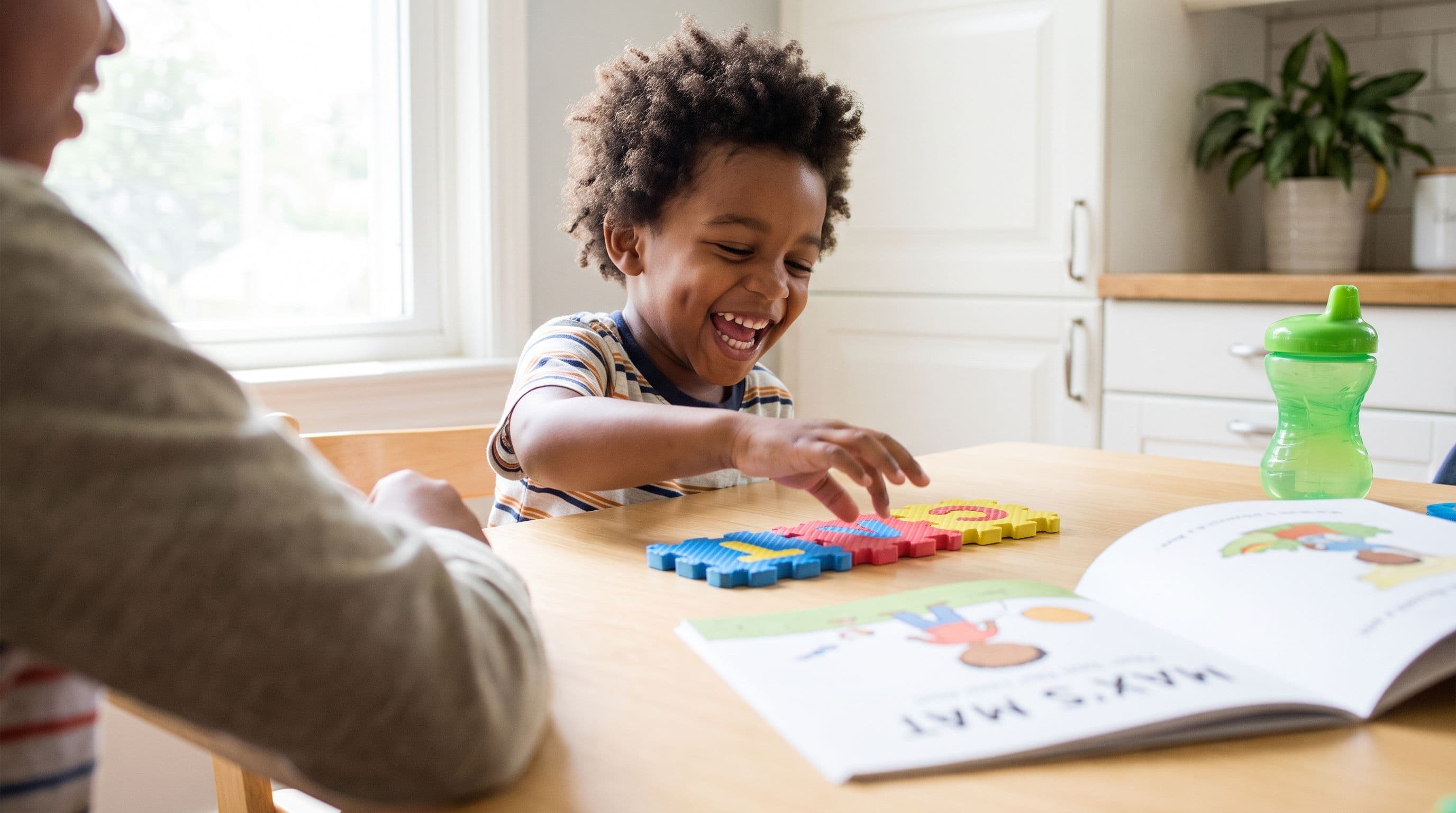
My First Grader Can't Read? The 90-Day Catch-Up Plan
If your 6-year-old is guessing at words, memorizing books, or melting down at the page, you don't have a motivation problem — you have an instruction problem. Here's the exact 90-day catch-up plan I'd run, starting tonight.
Read More →
Best Reading App for 2nd Graders in 2026: 6 Tested & Compared
Most reading apps for 2nd graders are dressed-up guessing games. I tested 6 of the most popular ones against actual reading science — here's what I found, what I'd skip, and what I'm using with my own kids.
Read More →