Reading Readiness Checklist for Kindergarten: Free PDF
What You’ll Learn
- The reading readiness checklist for kindergarten I’d actually use with my own 5-year-old — not a fluffy “loves books” list.
- The one mistake parents make when a child gets stuck on a word (hint: it’s guessing from pictures).
- How to check letter sounds and phonemic awareness in 5 minutes at home.
- What to do if your child is below the line before kindergarten (age 5) starts.
Reality Check: Kindergarten Reading Readiness Means Sounds, Not Vibes
Your child isn’t “ready to read” just because they like storytime.
I love a cozy read-aloud as much as the next mom. I’ve got four kids, a couch full of crumbs, and approximately 900 picture books breeding in my living room. But kindergarten reading readiness isn’t about whether your child enjoys books.
It’s about whether their brain is starting to connect speech sounds to printed letters.
Here’s the quick answer. A child heading into kindergarten (age 5) is in a strong spot if they’re building skills like these:
- Name many uppercase and lowercase letters
- Say many common letter sounds, with 20–25 as a strong goal to work toward
- Hear and play with sounds in words
- Rhyme simple words
- Clap syllables in words like banana and tiger
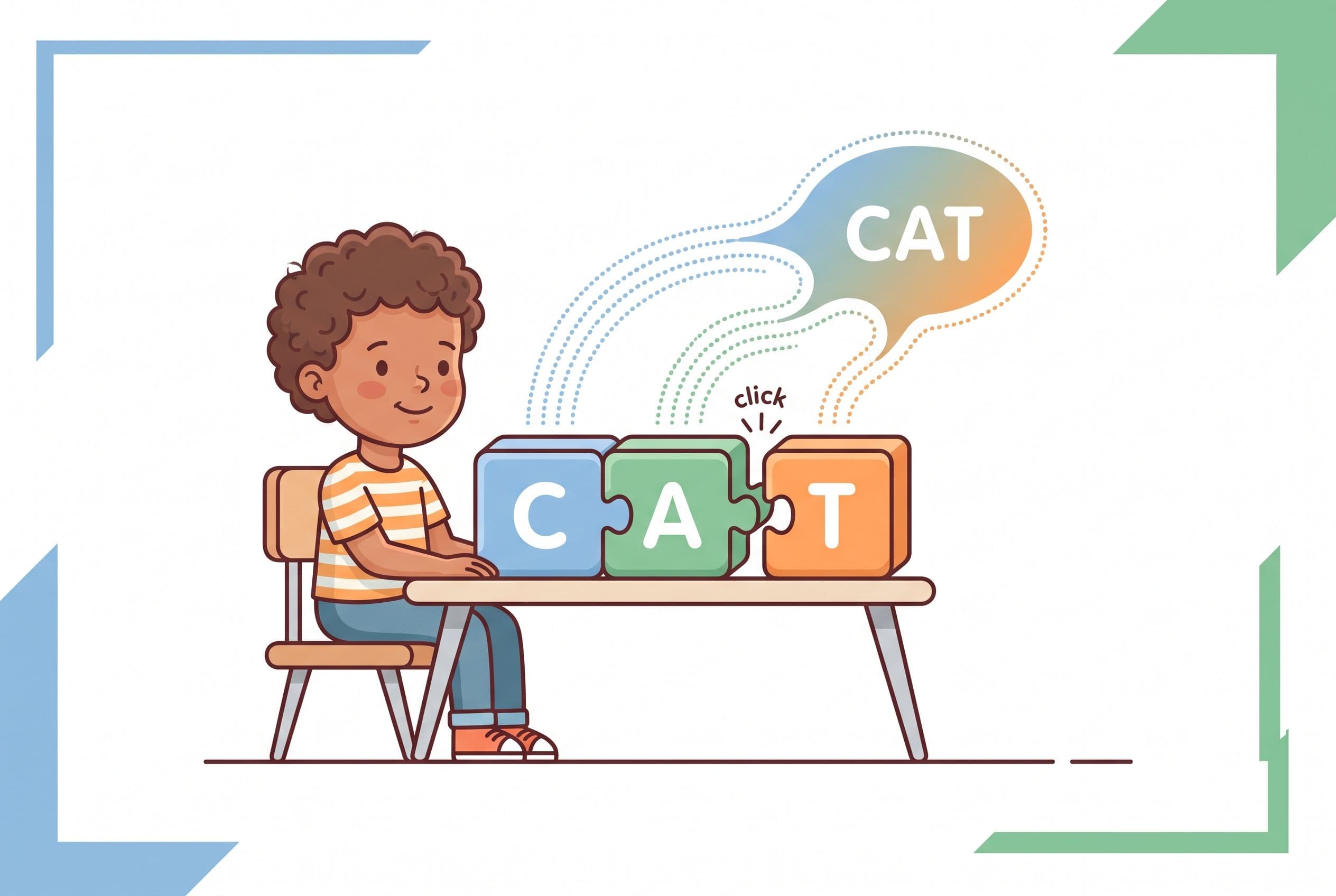
- Blend 2–3 spoken sounds, like /m/ /ă/ /t/ = mat
- Segment simple words, like dog = /d/ /ŏ/ /g/
- Recognize their own name in print
- Hold a book correctly and track print left to right
- Sit for a short 5–10 minute lesson without turning into a feral raccoon
That’s your working baseline.
Not perfection. Not chapter books. Not “my kid reads Harry Potter at 4” internet nonsense. And no, this isn’t a kindergarten entrance exam carved into stone by the literacy gods. Some of these are beginning skills. Some are “great, keep building” skills.
But if your child can’t identify many letter sounds or can’t hear the first sound in sun, don’t shrug and say, “They’ll get it later.” That’s how kids slide into kindergarten already behind.
Free PDF: Kindergarten Reading Readiness Checklist
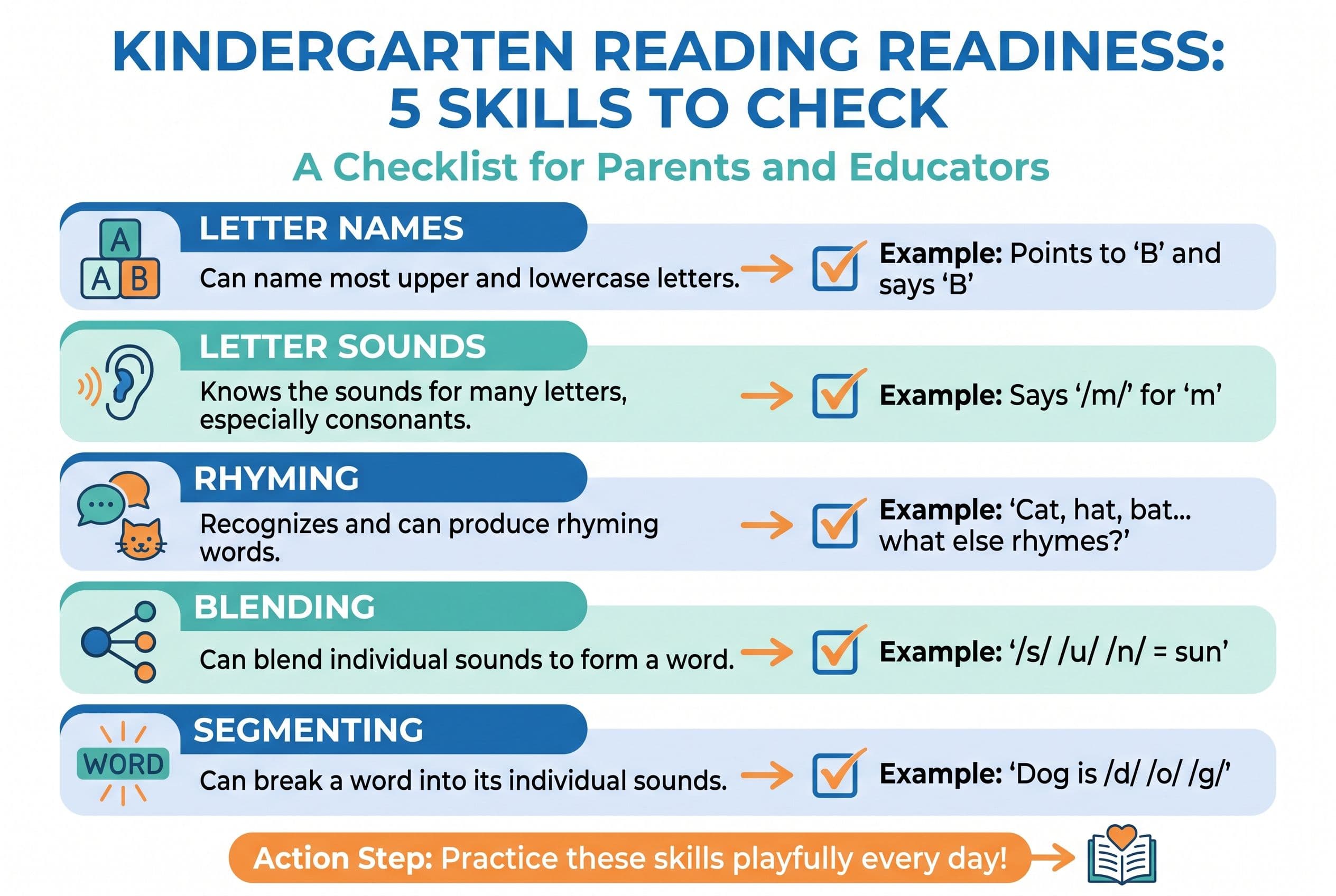
Use this kindergarten reading readiness checklist as your kitchen-table screen. Print it, grab a pencil, and check what your child can do without coaching.
Letter Knowledge
Your child can:
- Name 20+ uppercase letters
- Name 20+ lowercase letters
- Match uppercase to lowercase for common letters
- Recognize letters in their own name
- Point to letters in books, signs, cereal boxes, or magnets
Letter Sounds Checklist
Your child can say the common sounds for:
- Short vowels: a, e, i, o, u
- Continuous consonants: m, s, f, l, r, n
- Stop sounds: b, d, p, t, k, g
- Common early letters: h, j, w, y, z, v, x, q
Tiger mom note: don’t accept “buh” for /b/ if your child can learn the clipped sound. Extra “uh” sounds make blending harder. /m/ /ă/ /t/ blends into mat. “Muh-a-tuh” turns into alphabet soup.
Phonological and Phonemic Awareness Checklist
Phonological awareness means your child can hear and play with the sound parts of spoken language — rhymes, syllables, and word chunks.
Your child can:
- Tell whether cat and hat rhyme
- Produce a rhyme for log
- Clap syllables in words like banana
Phonemic awareness is the sharper knife in the drawer. It means your child can hear and work with individual sounds in spoken words. No letters needed.
Your child can:
- Identify the first sound in fish
- Identify the last sound in map
- Blend /s/ /ŭ/ /n/ into sun
- Segment pig into /p/ /ĭ/ /g/
- Delete a sound: “Say smile without /s/” = mile
That last one — deleting sounds — is more advanced. If your almost-kindergartener can’t do it yet, don’t faint dramatically onto the kitchen floor. Just note it and keep building.
This is where many “bright” kids secretly struggle. They can memorize logos, sing songs, and charm grandparents, but they can’t pull apart spoken sounds. That matters.
Linnea Ehri’s 2005 work on phases of word reading development explains why. Kids move from guessing based on visual cues into full alphabetic reading only when they connect graphemes to phonemes. Translation: they need sound-symbol mastery, not vibes.
Print Awareness and Book Skills
Your child can:
- Hold a book right side up
- Turn pages from front to back
- Understand that print carries meaning
- Track words left to right in English print
- Know the difference between a letter, word, and sentence
- Notice punctuation, even if they don’t fully understand it yet
Oral Language and Listening
Your child can:
- Follow 2-step directions
- Retell a simple story in order
- Answer who, what, where, and why questions
- Use complete sentences most of the time
- Understand common vocabulary from read-alouds
Reading comprehension grows from language comprehension. The Simple View of Reading from Gough and Tunmer in 1986 still holds up: reading comprehension = decoding × language comprehension. Weak decoding? The whole thing wobbles. Weak language comprehension? Same problem, different door.
What to Do If They’re Not There Yet
If your child misses several items on this reading readiness checklist for kindergarten, don’t panic.
But don’t wait.
Take 2 minutes today and take the 2-minute reading check. You’ll get a quick sense of whether this is normal “needs practice” territory or a real early reading gap.
Most gaps at this age fall into one of two buckets: your child doesn’t know enough letter sounds, or your child hears words as whole blobs instead of individual sounds. That second one drives me crazy because schools often miss it until the child starts guessing.
Guessing is not reading.
If your child sees the word ship and says “boat” because there’s a picture of water, that’s not cute. That’s three-cueing. That’s the same Balanced Literacy mess that trained kids to look away from the word.
Start structured phonics now. Keep read-alouds going — always. But don’t confuse being read to with learning to decode. Teach Your Kid to Read gives you short, systematic lessons based on synthetic phonics and Orton-Gillingham principles, so you’re not winging it at the kitchen table with random worksheets from the internet. You can start lesson one free — lesson one is free with no card and nothing to cancel; from lesson two the whole program is a 7-day free trial, then US$9.95 a month.
Tiger Truth: Waiting Can Get Expensive Fast
Look, I’m not saying every child must read fluently before kindergarten.
I am saying early warning signs matter.
US students on the 2022 NAEP / The Nation’s Report Card showed only 33% of 4th graders (ages 9–10) reading at proficient level. That’s not a tiny problem. That’s a national five-alarm fire.
And yes, that’s US data. But the brain science applies whether you live in Florida, Manchester, Toronto, Sydney, or Auckland.
The scary part? Reading failure compounds. A child who can’t decode well in 1st grade (ages 6–7) often spends 2nd grade (ages 7–8) avoiding books, guessing words, and deciding they’re “bad at reading.” By 3rd grade (ages 8–9), text gets heavier, vocabulary gets bigger, and school expects kids to learn more from what they read.
That’s the cliff.
The Annie E. Casey Foundation’s 2010 report found that US children who don’t read proficiently by the end of 3rd grade are four times more likely to leave high school without a diploma than proficient readers.
Four times.
I wish I was kidding.
Then families start looking at tutoring, evaluations, private therapy, and intervention programs. Specialized reading help can run US$10,000–US$15,000 a year in some areas. Insurance often doesn’t touch it. Schools may help, but parents usually have to fight like caffeinated lawyers.
The bottom line: a weak foundation costs more later.
Why This Checklist Focuses on Sounds First
Reading is not natural.
Talking is natural. Kids absorb spoken language because human brains evolved for speech. Reading? Nope. The brain has to build that system.
Stanislas Dehaene’s Reading in the Brain (2009) explains this beautifully. He shows that the brain recycles visual and language systems to recognize print. That means children need explicit teaching.
The 2000 National Reading Panel report — the one the US Congress commissioned — found that systematic phonics instruction produces significant benefits, especially in kindergarten and 1st grade.
That’s why a strong reading readiness skills check must include:
- Phonological awareness
- Phonemic awareness
- Letter-sound knowledge
- Oral blending
- Oral segmenting
- Print awareness
- Vocabulary and listening comprehension
Notice what I didn’t list first: sight word flashcards.
Yes, some high-frequency words matter. But if your child knows 40 memorized words and can’t decode sat, we have a problem. That’s a house with cute curtains and no foundation.
My Neighbor’s Wake-Up Call After Sold a Story
After Emily Hanford’s APM Reports / “Sold a Story” came out in 2023, my neighbor called me almost in tears.
She’d taught 1st grade for 18 years. She loved her students. She worked late. She bought classroom books with her own money, which is basically teacher martyrdom bingo.
But she’d used Lucy Calkins’ Units of Study her whole career. Three-cueing. MSV. “Look at the picture.” “Think what would make sense.” The whole thing.
She said, “Xia, I’ve been teaching kids to guess for two decades and I didn’t even know it.”
That sentence wrecked me.
Then she did the brave thing. She switched her classroom to UFLI Foundations mid-year. It was messy. She had to relearn the code herself, which no one likes admitting after 18 years in a classroom. But by spring her kids’ DIBELS scores had jumped an average of 15 points on nonsense word fluency.
She told me it was the first time in her career every single child in her class could decode CVC words by February.
That’s what happens when adults stop asking kids to guess and start teaching the code.
The No-Guessing Kindergarten Reading Readiness Test
Here’s my 10-minute version. Do this when your child is fed, rested, and not emotionally destroyed because their banana broke in half.
1. Check Letter Names
Show 10 uppercase and 10 lowercase letters in random order.
Use common letters first: m, s, t, a, p, f, c, b, r, n.
Mark:
- Knows instantly
- Knows after thinking
- Doesn’t know yet
Don’t sing the alphabet song during the test. That’s like giving them the answers with a kazoo.
2. Check Letter Sounds
Point to each letter and ask, “What sound?”
Use a simple letter sounds checklist. Start with:
- m = /m/
- s = /s/
- t = /t/
- a = /ă/
- p = /p/
- f = /f/
- n = /n/
- i = /ĭ/
- c = /k/
- o = /ŏ/
If your child knows fewer than 10 letter sounds, start there — but don’t stop reading books aloud. Drill sounds daily for 5 minutes, and begin tiny supported blending with the sound-spellings they already know.
3. Check Rhyming
Say: “Do these rhyme? cat, hat.”
Then try:
- dog, log
- sun, run
- pig, pan
- fish, dish
Then ask your child to give you a word that rhymes with top. Nonsense words count if they actually rhyme. If they say mop, great. If they say zop, fine. We’re checking sound play, not dictionary membership.
4. Check First Sounds
Ask: “What’s the first sound in moon?”
Try:
- sun
- fish
- dog
- map
- lake
If they answer with the letter name instead of the sound, model it once: “Yes, M is the letter. The sound is /m/.”
5. Check Blending
Say sounds slowly: /m/ /ă/ /t/.
Ask: “What word?”
Try:
- /s/ /ŭ/ /n/ = sun
- /p/ /ĭ/ /g/ = pig
- /r/ /ĕ/ /d/ = red
- /f/ /ă/ /n/ = fan
If your child can blend orally, they’re much closer to decoding printed words. If they’re still shaky, don’t wait forever to show letters. Pair oral blending with a few known letters and keep it painfully simple.
6. Check Segmenting
Say: “Tell me the sounds in cat.”
You want /k/ /ă/ /t/.
Try:
- map
- sit
- dog
- lip
This skill predicts reading and spelling. David Kilpatrick’s Equipped for Reading Success (2016) digs into this through orthographic mapping — the process that lets kids store words for instant recognition after connecting sounds to letters.
7. Try One CVC Word
Only if your child knows the sounds in that word.
Write sat.
Ask them to touch each letter and say each sound, then blend.
No pictures. No guessing. No “what would make sense?” Just sound it out.
If they decode it, celebrate like they won a tiny Olympic medal. If they don’t, back up. More sound work first.
What Scores Mean on This Reading Readiness Checklist
Use this quick guide as an informal parent check, not a diagnosis, not a school placement test, and not a reason to spiral at midnight with a flashlight and a stack of flashcards.
Green Zone
Your child can:
- Name most letters
- Say 20+ letter sounds
- Rhyme simple words
- Blend and segment 3-sound spoken words
- Decode a few CVC words with help
Great. Keep going with systematic phonics. Don’t let school undo this with guessing habits.
Yellow Zone
Your child can:
- Name many letters but knows fewer than 15 sounds
- Rhyme sometimes
- Blend with help
- Struggle to segment words
This is common. It means your child needs daily practice, not panic. Five to ten focused minutes beats an hour of chaotic worksheet drama.
Red Zone
Your child:
- Knows very few letter sounds
- Can’t identify first sounds
- Can’t rhyme at all after modeling
- Guesses wildly at printed words
- Avoids sound games or gets frustrated fast
Don’t wait six months. Use a structured program, ask the school about screening, or look into assessments like DIBELS, AIMSweb, or the PAST — the Phonological Awareness Screening Test by Kilpatrick. The PAST takes about 5 minutes when you know how to give it, and it tells you where the phonological breakdown sits.
If you suspect dyslexia indicators, check resources from the International Dyslexia Association. Dyslexia doesn’t mean your child can’t read. It means they need explicit, systematic teaching with lots of review.
The Solution: Teach the Code Before the Guessing Habit Starts
Balanced Literacy trained too many kids to treat words like little mysteries.
Look at the picture. Guess from the first letter. Think what would make sense.
Nope. No thank you. Hard pass.
A child who learns to decode early gains Independence. A child who guesses starts building bad habits that adults later have to rip out like weeds.
Teach Your Kid to Read uses systematic synthetic phonics. That means children learn sound-spelling relationships in a planned order, then apply them immediately to words they can actually decode.
This is the same general direction you’ll see in strong programs like UFLI Foundations, Logic of English, Fundations, Wilson Reading System, and Orton-Gillingham-based intervention. Different tools, same big principle: teach the code directly.
The app works especially well for parents because it removes the “What do I teach next?” panic. You open the lesson. You do the drill. You don’t skip.
We Never Skip.
That’s one of my Tiger Rules. Phonics happens on birthdays, vacations, and yes, even when someone lost the blue crayon and now the whole house has entered a constitutional crisis.
The Action Step: Your 7-Day Kindergarten Reading Readiness Plan
Do this for one week. Keep it short. Keep it calm. Keep it non-negotiable.
- Day 1: Run the checklist. Test letter names, letter sounds, rhyming, blending, and segmenting. Don’t teach during the check. Just observe.
- Day 2: Drill 5 letter sounds. Pick m, s, t, a, p. Say the sound, trace the letter, find it in a book.
- Day 3: Play first-sound games. “I’m thinking of something that starts with /m/.” Use real objects: mug, mat, milk.
- Day 4: Blend orally. Say /s/ /ă/ /t/ and have your child blend sat. Do 5 words max.
- Day 5: Segment orally. Say map. Child taps /m/ /ă/ /p/. Use fingers, blocks, or crackers. Crackers motivate my 4-year-old like tiny edible bribes.
- Day 6: Try 3 CVC words. Use only letters your child knows. Try sat, mat, map.
- Day 7: Recheck and choose the next step. If progress looks good, keep building. If your child still can’t hear sounds in words, use a structured program and consider a screening tool.
In many districts using DIBELS, a common mid-year kindergarten target on Nonsense Word Fluency Correct Letter Sounds is somewhere in the 20s–30s correct letter sounds per minute, depending on the DIBELS edition and benchmark table. Don’t obsess over one number at home, and don’t confuse that timed task with plain old “does my child know letter sounds?” But do respect the message: automatic sound-spelling knowledge matters.
If your child needs a clear path, start with Teach Your Kid to Read. Lesson one is free with no card and nothing to cancel; from lesson two the whole program is a 7-day free trial, then US$9.95 a month.
What Not to Do
Please don’t hand your child a leveled reader full of patterns and pictures and call it reading.
Fountas & Pinnell levels are everywhere, but they grew out of whole-language aligned practices. Many early leveled books encourage memorizing patterns and guessing from pictures. That’s the opposite of what a beginning reader needs.
Use decodable books instead. Bob Books, Flyleaf Publishing, High Noon Books, and decodable passages from strong phonics programs give children words they can sound out with the code they’ve learned.
Also don’t turn reading readiness into a three-hour homeschool boot camp.
Small drills win.
Five minutes of accurate phonemic awareness practice beats 45 minutes of “fun literacy centers” where nobody learns anything except how to glue pom-poms to a paper plate.
The Free PDF Checklist: How to Use It Without Overthinking
Print the checklist and keep it on the fridge.
Check skills once every 2–3 weeks. Not every day. We’re raising readers, not running a parole office.
Use three marks:
- ✅ Mastered
- ~ Almost there
- X Not yet
Then pick the weakest area and drill that for the next two weeks.
If letter sounds are weak, drill letter sounds.
If rhyming is weak, play rhyme games in the car.
If blending is weak, practice oral blending and connect it to letters your child already knows.
If your child guesses from pictures, cover the picture and point to the word. Calmly say, “No guessing. Sound it out.”
That sentence has left my mouth approximately one billion times.
Kindergarten Reading Readiness Is a Skill, Not a Personality Trait
Some kids look ready because they’re verbal, charming, and obsessed with books.
Some kids look not ready because they’re wiggly, silly, or allergic to pencils.
Ignore the performance. Check the skills.
Can they hear sounds? Can they connect sounds to letters? Can they blend? Can they segment? Can they attend for a short lesson?
That’s the real deal.
And if your child isn’t there yet, you haven’t failed. You just found the gap early, which is exactly what a good checklist should do.
Use the checklist. Take the quick reading check. Start systematic phonics if your child needs it. Don’t wait for the school year to magically fix what five focused minutes a day could start fixing now.
Lesson one is free with no card and nothing to cancel; from lesson two the whole program is a 7-day free trial, then US$9.95 a month.
FAQ
What is reading readiness for kindergarten?
Reading readiness for kindergarten means your child has the early skills needed to start formal reading instruction. The big ones are letter recognition, letter sounds, phonological awareness, phonemic awareness, oral language, print awareness, and the ability to sit for short lessons.
Is my child ready to read if they know the alphabet song?
Not necessarily. The alphabet song shows memorization of a sequence. Reading readiness requires your child to recognize individual letters and connect them to sounds. A child can sing “L-M-N-O-P” beautifully and still not know what sound M makes.
How many letter sounds should my child know before kindergarten?
I like to see at least 20–25 common letter sounds before kindergarten as a strong goal, with short vowel sounds included. If your child knows fewer than 10, start daily sound drills now.
What’s the difference between phonological awareness and phonemic awareness?
Phonological awareness is the bigger bucket: rhyming, syllables, word parts, and sounds. Phonemic awareness is narrower and more advanced: hearing and working with individual sounds in words, like knowing cat has /k/ /ă/ /t/.
Should I teach sight words before phonics?
Teach phonics first. Some high-frequency words matter, but children need decoding skills so they can read unfamiliar words. Otherwise they start memorizing shapes and guessing, which falls apart fast.

Xia Brody
Co-Founder, Teach Your Kid to Read
Mom of 4 who has successfully taught her kids to read. Currently in the trenches with her 4-year-old while her two oldest (10 and 7) devour books on their own. Passionate about phonics-based methods and building a lifelong love of reading.
Related Articles

Reading Readiness Checklist for 5-Year-Olds: Free Printable + Parent Guide
Is your 5-year-old ready to read? Most parents can't answer that question — because nobody gave them the right checklist. Here's the one I use with my own kids, backed by reading science, not wishful thinking.
Read More →
Reading Readiness Checklist for 4-Year-Olds: Free Printable + Parent Guide
Is your 4-year-old ready to start reading? This free reading readiness checklist covers every pre-reading skill that matters — phonological awareness, letter knowledge, print concepts, and more — with clear action steps if your child isn't there yet.
Read More →
My Kindergartner Isn't Reading Yet: When to Worry (And When to Act)
If your kindergartner isn't reading yet, you're probably hearing 'don't worry, they'll catch up.' Here's what the research actually says — and the exact steps you should take right now before the window closes.
Read More →