Best App for Phonemic Awareness: 2026 Parent Picks
What You'll Learn
- The one app I’d pick first if your child needs real phonemic awareness practice, not digital babysitting
- Which popular apps teach sounds and blending — and which ones drift into guessing
- The red flag I watch for when an app lets pictures replace decoding
- A simple 7-day action plan for using a phonemic awareness app without letting the iPad raise your kid
Reality Check
Your child can sing the alphabet song and still have weak phonemic awareness.
That sentence makes parents twitchy, but it’s true. Phonemic awareness means your child can hear and work with the individual sounds in words — like knowing that ship has three sounds: /sh/ /i/ /p/. It’s not letter names. It’s not cute alphabet puzzles. It’s the sound work underneath reading.
And if your child can’t hear sounds, blending sounds later feels like trying to build IKEA furniture without the tiny wrench. Rage. Tears. Everyone regrets their choices.
The Verdict: Best App for Phonemic Awareness
Here’s my short list if you’re choosing a phonemic awareness app for kids right now.
| Rank | App | What it teaches | Pricing model | Best for |
|---|---|---|---|---|
| #1 | Teach Your Kid to Read | Systematic phonemic awareness, letter sounds, blending, phonics-based reading | Lesson one is free with no card and nothing to cancel; from lesson two the whole program is a 7-day free trial, then US$9.95/month | Ages 3-7, especially parents who want direct instruction |
| #2 | Reading.com | Early reading lessons and parent-led practice | Subscription, monthly or yearly | Ages 3-8 |
| #3 | HOMER | Early literacy, stories, and skill games | Subscription with 30-day free trial | Ages 2-6 or 2-8 depending on listing |
| #4 | Reading Eggs | Broad literacy games, phonics, Fast Phonics pathway | Subscription with 30-day free trial | Ages 3-7 for Reading Eggs, older for other levels |
| #5 | Khan Academy Kids | Free early learning, stories, letters, listening | Free, no ads, no subscriptions | Ages 2-8 |
| #6 | Teach Your Monster to Read | Letter-sound games and early reading practice | Free on computers; paid one-time app | Ages 3-6 |
My #1 pick for the best app for phonemic awareness is Teach Your Kid to Read because it keeps the child on the actual reading skill: hear the sound, say the sound, map the sound, blend the word. If you want parent-friendly lessons without the guessing nonsense, start lesson one free.

Tiger Truth: Weak Sound Skills Don’t Stay Cute
Look, preschool guessing can look adorable. Your 4-year-old sees a picture of a dog, says “puppy,” and everyone claps.
But guessing isn’t reading.
The 2000 National Reading Panel report found that systematic phonics instruction gives children significant reading benefits, especially when they start early. Linnea Ehri’s 2005 work on phases of word reading development explains why: children need to connect sounds to spellings so words stick in memory. That’s orthographic mapping. Fancy term, dead simple idea.
Here’s the scary part. In the US, only 33% of 4th graders (ages 9-10) scored at or above NAEP Proficient in reading on the 2022 NAEP / The Nation's Report Card. NAEP Proficient is an achievement standard, not the same thing as “reading on grade level,” and kids below it are not all nonreaders. But still? That number is not “some kids need time.” That’s a five-alarm literacy fire.
I was at a playground in Raleigh when another mom told me her child’s school had just switched from Lucy Calkins to a Science of Reading curriculum because of North Carolina’s SB 387 — the Excellent Public Schools Act, a US state law. She felt confused and annoyed. “He was doing fine before,” she told me.
So I asked one question: “Can he read splint?”
He was in 2nd grade (ages 7-8). He couldn’t.
I spent 20 minutes on that playground bench explaining why the switch was happening — Emily Hanford’s APM Reports / Sold a Story, the NAEP data, and Stanislas Dehaene’s neuroscience in Reading in the Brain (2009), which shows the brain doesn’t naturally learn to read the way it learns to speak. She went home, listened that night, and texted me at 11 p.m.: “I had no idea. Why didn’t anyone tell us this sooner?”
Exactly.
So I’m telling you now.
What Makes a Phonemic Awareness App Worth Your Time?
A good phonological awareness app does more than shout “Yay!” when your child taps a cartoon.
It should train specific skills in a clean, connected way:
- Rhyming: cat, hat, mat
- Syllables: rainbow = rain + bow
- Onset-rime: /m/ + at = mat
- Phoneme isolation: first sound in sun is /s/
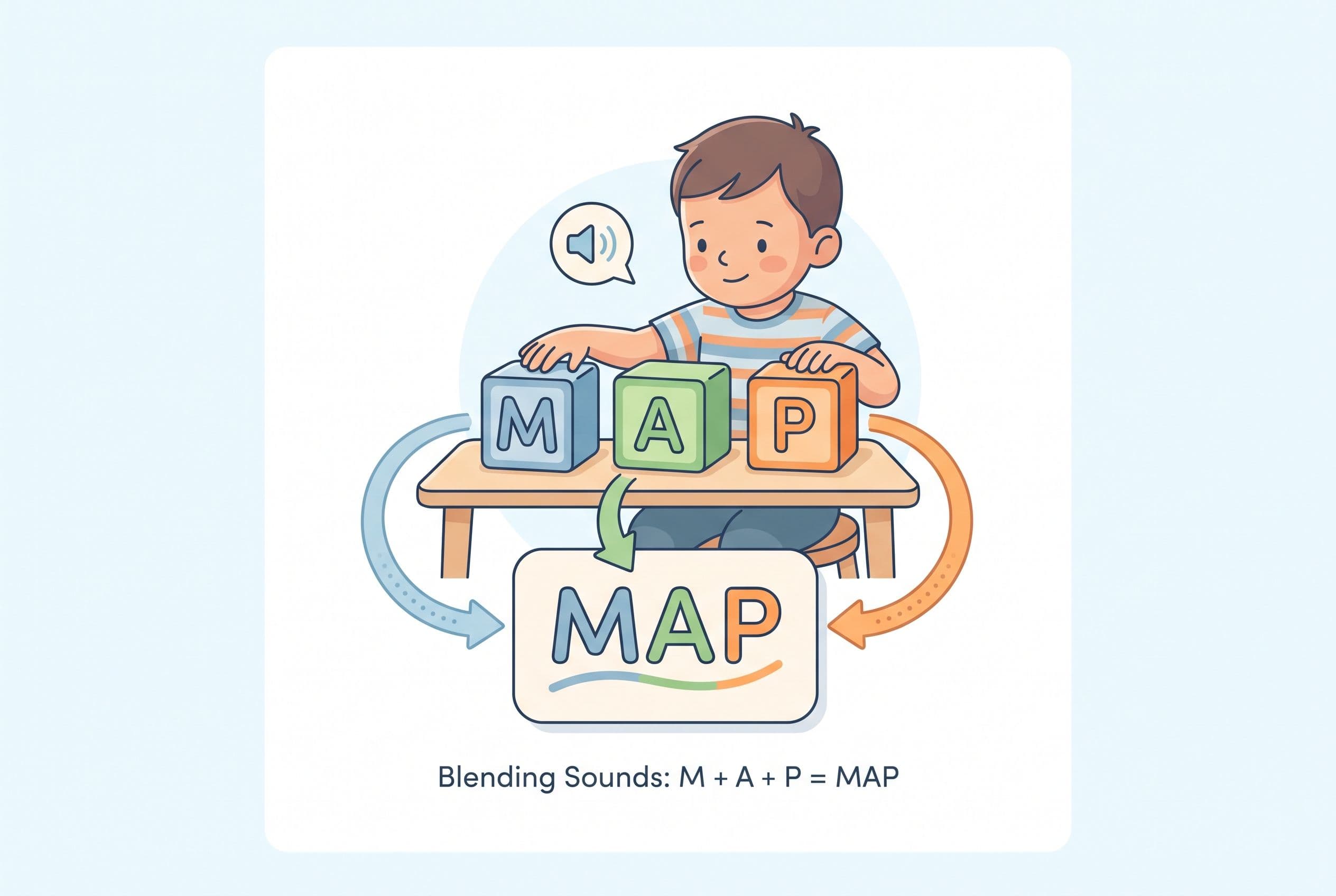
- Phoneme blending: /m/ /a/ /p/ = map
- Phoneme segmentation: fish = /f/ /i/ /sh/
- Letter sounds: connect /m/ to m
- Blending sounds into words: m-a-t, mat
That list is not a sacred ladder where your child must conquer rhyming before anyone dares show the letter m. Please don’t do that. Phonemic awareness and phonics can grow together. The point is that the app should teach real sound skills and connect them to print instead of throwing random literacy confetti at your child.
Here’s the kicker: phonological awareness includes bigger sound chunks like rhyme and syllables. Phonemic awareness zooms in on individual sounds. If an app mixes those terms, I don’t panic. If it skips sound work and jumps into memorizing whole words from pictures? Red flag. Big one.
Pictures aren’t evil. They can help with vocabulary, attention, and oral sound games. But if the child is supposed to read ship and the picture lets them say “boat” and still win? Nope. That’s not decoding. That’s guessing in a cute outfit.
A solid app should also match what programs like UFLI Foundations, Logic of English, All About Reading, and Orton-Gillingham-based instruction do well: teach in a planned sequence, review often, and require the child to respond accurately.
No guessing. We don’t guess in my house.
Deep Dive: Best Phonemic Awareness Apps Compared
1. Teach Your Kid to Read — Best Overall for Phonemic Awareness
Teach Your Kid to Read is my top pick because it treats phonemic awareness like a real reading Foundation, not a warm-up game before “fun” starts.
And yes, I’m biased. I co-founded it because I needed something I could use at the kitchen table with my own kids without fighting bloated screens, vague levels, and “try again!” animations that don’t teach anything.
Last Tuesday, my 4-year-old worked on CVC words while my 1-year-old tried to eat a blue crayon. Glamorous? No. Effective? Hands down.
The program focuses on:
- Hearing sounds in words
- Saying sounds clearly
- Matching letter sounds to print
- Blending sounds without picture-guessing
- Building toward real decoding
That’s why I like it as a pre reading app for preschoolers and as a catch-up tool for young school-age kids who still stumble on basic sounds.
It follows the same broad Science of Reading logic behind Orton-Gillingham principles: explicit instruction, tight sequence, lots of review, and mastery before moving on. No mystery sauce. No “just expose them to books and magic happens.”
The offer is simple and honest: lesson one is free with no card and nothing to cancel; from lesson two the whole program is a 7-day free trial, then US$9.95 a month.
Best for: parents who want a direct, no-nonsense phonemic awareness app for kids that moves into letter sounds and blending sounds.
2. Reading.com — Strong Parent-Led Reading Practice
Reading.com, from Teaching.com, states that it serves ages 3-8 and uses a subscription model. It’s one of the stronger options for parents who want structured early reading lessons rather than a giant carnival of unrelated games.
What I like from a reading-science angle: it appears built around parent-child interaction. That matters. A 4-year-old left alone with an app will click until dopamine wins. A 4-year-old with a parent beside them can practice, correct, repeat, and actually learn.
The question I’d ask before subscribing: does the app make your child decode, or can your child succeed by memorizing screens and tapping cues?
That’s my no-brainer filter for every phonological awareness app.
Best for: parents who can sit with the child and guide the lesson.
3. HOMER — Broad Early Literacy, But Watch the Path
HOMER by Begin, with App Store seller HomerLearning, Inc., lists ages 2-8 in major app stores and ages 2-6 on Begin’s product page. It uses a subscription model with a 30-day free trial.
HOMER includes early literacy, stories, and skill-based activities. For very young children, that broad mix can feel warm and inviting. I get the appeal. Some kids need a gentle entry point, especially if they’re resistant to anything that smells like school.
But real talk — broad early learning can water down phonemic awareness if parents don’t know what to look for.
If you choose HOMER, don’t just count screen time as reading time. Sit nearby and listen:
- Can your child identify the first sound in a word?
- Can they blend /s/ /a/ /t/ into sat?
- Can they do it without a picture clue?
If yes, great. If no, you need more direct sound practice.
Best for: young kids who need a gentle start, with a parent checking the sound skills.
4. Reading Eggs — Big Program, Many Paths
Reading Eggs is made by Blake eLearning, an Australian-owned company that merged with 3P Learning in 2021. It states ages 2-13 overall, with Reading Eggs for ages 3-7 and Fast Phonics for ages 5-10. It uses a subscription model with a 30-day free trial.
Reading Eggs has a lot inside it. That can help families with multiple children, especially if one child needs early phonics and another needs more reading practice.
The downside? Big programs can hide weak spots. A child can spend plenty of time earning rewards while still struggling to segment sounds.
This one drives me crazy across the whole app market: rewards can replace instruction if parents don’t watch closely. The child feels busy. The parent feels relieved. The reading skill? Still wobbly.
If you use Reading Eggs, pay close attention to the Fast Phonics-style work. Ask your child to do sound tasks off-screen too:
- “Say map without /m/.”
- “What’s the last sound in fish?”
- “Blend /r/ /a/ /n/.”
That’s where you’ll see what stuck.
Best for: families who want a broad literacy subscription and will supervise the phonics path.
5. Khan Academy Kids — Best Free Early Learning Option
Khan Academy Kids is made by Khan Academy, a 501(c)(3) nonprofit. It states ages 2-8 and stays free with no ads or subscriptions, though the site asks for donations.
Free matters. I have four kids. I respect free.
Khan Academy Kids gives children books, early literacy activities, and learning games in a calm format. For families who can’t pay for a subscription right now, it’s a strong starting point.
But if you’re searching specifically for the best app for phonemic awareness, I wouldn’t rely on a broad early learning app alone. Use it for exposure, language, listening, and letter play. Then add direct phonemic awareness drills.
Bottom line: free is wonderful, but free doesn’t excuse skipping mastery.
Best for: families who need a no-cost early learning app and will add oral sound drills.
6. Teach Your Monster to Read — Good for Letter-Sound Play
Teach Your Monster to Read is made by Teach Your Monster Limited in the UK and developed by the Usborne Foundation, a charity set up by Peter Usborne. The organisation renamed itself Teach Your Monster in 2021. It states ages 3-6, is free on computers, and has a paid one-time app.
This app has charm. The monster theme pulls kids in, and the early letter-sound practice fits nicely for preschool and reception-age children in the UK or kindergarten (age 5) in the US.
My caution: don’t let the game world become the goal. Your child should leave the app able to say sounds, blend sounds, and read simple words in a real book.
After screen time, grab Bob Books or another decodable reader and test the transfer. If your child can read sat, pin, and mop on paper, the learning moved. If they freeze without the monster? You’ve got more work to do.
Best for: playful letter-sound practice, especially as a supplement.
The Feature That Disqualifies an App for Me
If an app teaches a child to guess from pictures, I’m out.
Imagine Lily sees a picture of a boat beside the word ship and says “boat.” The app cheers because the meaning is close enough. Cute? Maybe. Reading? Absolutely not.
Again, pictures themselves aren’t the villain. A picture of a fish can be perfectly fine if the task is “What first sound do you hear in fish?” That’s oral phonemic awareness. Different job.
But if the task is reading the printed word, the print has to matter.
That guessing habit came straight out of Balanced Literacy and Whole Language thinking: use meaning, structure, and visual cues. The 2023 Sold a Story reporting by Emily Hanford exposed how that approach spread while many children missed explicit phonics.
I don’t care how pretty the app looks. If it rewards guessing, it trains the wrong reflex.
Your child needs this reflex instead:
- Look at the letters.
- Say the sounds.
- Blend the sounds.
- Check the word.
No picture rescue. No “what would make sense?” No vibes-based reading.
How to Use a Phonemic Awareness App Without Raising an iPad Zombie
Here’s my rule: apps assist. Parents teach.
A best app for rhyming and sounds can save your sanity, but it can’t replace your ears. You need to hear your child say the sounds. You need to catch /b/ and /d/ confusion. You need to stop the guessing before it hardens into habit.
Use this 7-day plan.
Day 1: Check Rhyming
Ask:
- “Do cat and hat rhyme?”
- “Tell me a word that rhymes with sun.”
- “Which one doesn’t rhyme: dog, log, cup?”
If your child can’t rhyme by age 4 or 5, don’t panic. Do start practicing daily.
Day 2: Check First Sounds
Ask:
- “What’s the first sound in moon?”
- “What starts the same as fish: fan or top?”
Use sounds, not letter names. Say /m/, not “em.” Tiny difference, huge payoff.
Day 3: Blend Two and Three Sounds
Say:
- /m/ /e/ = me
- /s/ /u/ /n/ = sun
- /f/ /i/ /sh/ = fish
Keep it oral first. No letters needed yet if the sound skill is weak.
Day 4: Segment Words
Ask your child to stretch words:
- map = /m/ /a/ /p/
- leg = /l/ /e/ /g/
- shop = /sh/ /o/ /p/
Use fingers or blocks. One sound per tap.
Day 5: Add Letter Sounds
Now connect sounds to print:
- m says /m/
- s says /s/
- a says /a/
This is where a good phonemic awareness app should become a real reading tool.
Day 6: Blend CVC Words
Practice:
- sat
- pin
- map
- red
- hop
Short. Daily. Non-negotiable.
Day 7: Check With a Real Assessment
Use a quick screening tool like the PAST — David Kilpatrick’s Phonological Awareness Screening Test from Equipped for Reading Success (2016). Follow the administration instructions, because winging it gives you mushy information. The Kilpatrick PAST can be one useful clue about phonological awareness, but it’s not a full reading diagnosis and it doesn’t tell the whole story by itself.
Schools may use DIBELS, AIMSweb, MAP Growth, or PALS depending on country and system. These don’t all measure the same thing. Some screen phonological awareness or decoding. Some track fluency. Some are broader achievement tests. With DIBELS nonsense word fluency, benchmarks vary by version, benchmark period, score type, and school system, so ask the school what measure and cut score they use. Don’t obsess over one number at home, but do respect the pattern.
If your child can’t rhyme, isolate first sounds, or blend three sounds after steady practice, don’t wait six months. Talk to the teacher or a reading specialist and get help.
My Parent Buying Rules
Before you pay for any phonemic awareness app for kids, ask these questions:
- Does it teach sounds before asking for reading?
- Does it require blending, or can the child guess?
- Does it use decodable words early?
- Does it give parents a clear lesson path?
- Does it review old skills often?
- Does it stay calm enough for learning?
I don’t need an app to throw fireworks every 12 seconds. I need it to build Skill.
And honestly? The “fun” trap gets parents. We want reading to feel happy. Of course we do. But fun without mastery becomes glitter-covered failure, and I say that as a mom who has scraped actual glitter off a phonics workbook.
Final Pick: The Best App for Phonemic Awareness
If you want one app to start with, pick Teach Your Kid to Read.
Use it 10 minutes a day. Sit with your child. Listen to the sounds. Demand accuracy kindly, but firmly. We Never Skip.
If you’re comparing options, use Khan Academy Kids when cost blocks you, Teach Your Monster to Read for extra playful letter-sound practice, Reading.com for parent-led structure, HOMER for gentle early literacy, and Reading Eggs for a broader subscription path.
But don’t confuse activity with reading growth.
The best app for phonemic awareness trains your child to hear sounds, connect sounds to letters, and blend sounds into words. That’s the Foundation. That’s the real deal.
Lesson one is free with no card and nothing to cancel; from lesson two the whole program is a 7-day free trial, then US$9.95 a month.
FAQ
What is the best app for phonemic awareness?
My top pick is Teach Your Kid to Read because it focuses on sound awareness, letter sounds, blending, and decoding in a systematic way. I want an app that builds the reading reflex: look at letters, say sounds, blend the word.
What age should kids start phonemic awareness practice?
Many kids can start playful phonological awareness around ages 3-4 with rhyming, syllables, and first sounds. By age 5, most children should work on blending and segmenting simple sounds. Keep it short, warm, and daily.
Is phonemic awareness the same as phonics?
No. Phonemic awareness is hearing and working with sounds in spoken words. Phonics connects those sounds to letters. A strong reading program teaches both.
Can an app teach my child to read by itself?
No app should raise your reader alone. A good app can guide lessons, but your child still needs a parent or teacher listening, correcting, and making sure guessing doesn’t sneak in.
What if my child hates sound drills?
Make drills shorter, not easier. Do 3 minutes of rhyming in the car, 2 minutes of first sounds at breakfast, and 5 minutes of app practice later. Tiny daily reps beat one giant weekend battle.
From teachyourkidtoread.org/blog/best-app-for-phonemic-awareness-2026-parent-picks

Xia Brody
Co-Founder, Teach Your Kid to Read
Mom of 4 who has successfully taught her kids to read. Currently in the trenches with her 4-year-old while her two oldest (10 and 7) devour books on their own. Passionate about phonics-based methods and building a lifelong love of reading.
Related Articles
Best Phonics App for Letter Sounds: 6 Picks for 2026
Looking for the best phonics app for letter sounds? Xia Brody compares 6 popular apps for real phonics, explicit instruction, price, and best age range.
Read More →
Child Knows Letters but Can't Read? 5 App Next Steps
If your kindergartner knows the alphabet but can't read words yet, don't panic — but don't wait either. Here's the no-nonsense app comparison and next-step plan I’d use at my own kitchen table.
Read More →
Best Reading App for Pre-K: 6 Smart Picks for 2026
Looking for the best reading app for pre-k? Here’s my no-nonsense mom comparison of 6 preschool reading apps, with phonics-first picks and the red flags I’d skip.
Read More →