Best Reading App for Pre-K: 6 Smart Picks for 2026
What You'll Learn
- The one feature I demand before I let a pre-k reading app anywhere near my 4-year-old
- Which apps teach real phonics, and which ones mostly dress up guessing with cute animation
- Why “reading readiness” can’t mean waiting around until kindergarten (age 5)
- How to test whether a learn to read app for preschool actually helps your child decode words
Reality Check
Your preschooler doesn’t need another screen babysitter with dancing animals and fake trophies.
They need letter sounds, blending, phonemic awareness, and daily practice. Cute is fine. Cute without instruction? Nope. That’s digital glitter on top of weak teaching.
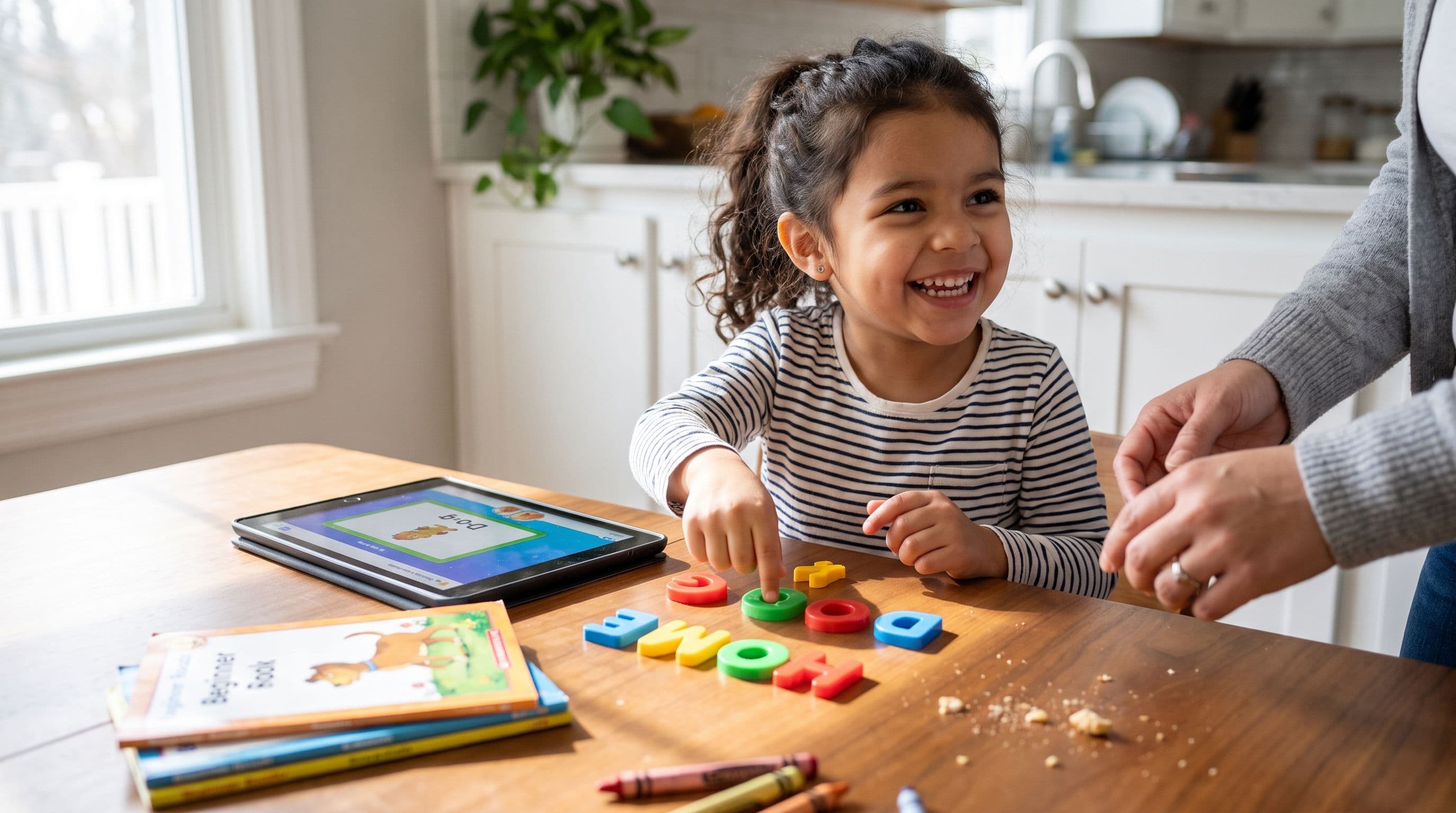
I’ve got four kids. I’ve taught my two oldest to read, and I’m currently sitting at the kitchen table with my 4-year-old drilling CVC words like sat, map, and pin while the baby tries to eat a crayon. So yes, I care about the best reading app for pre-k — but only if it helps a real child read real words.
The Verdict: Best Reading App for Pre-K in 2026
Here’s my quick take before we get into the weeds. If you’re choosing right now, this is the shortlist.
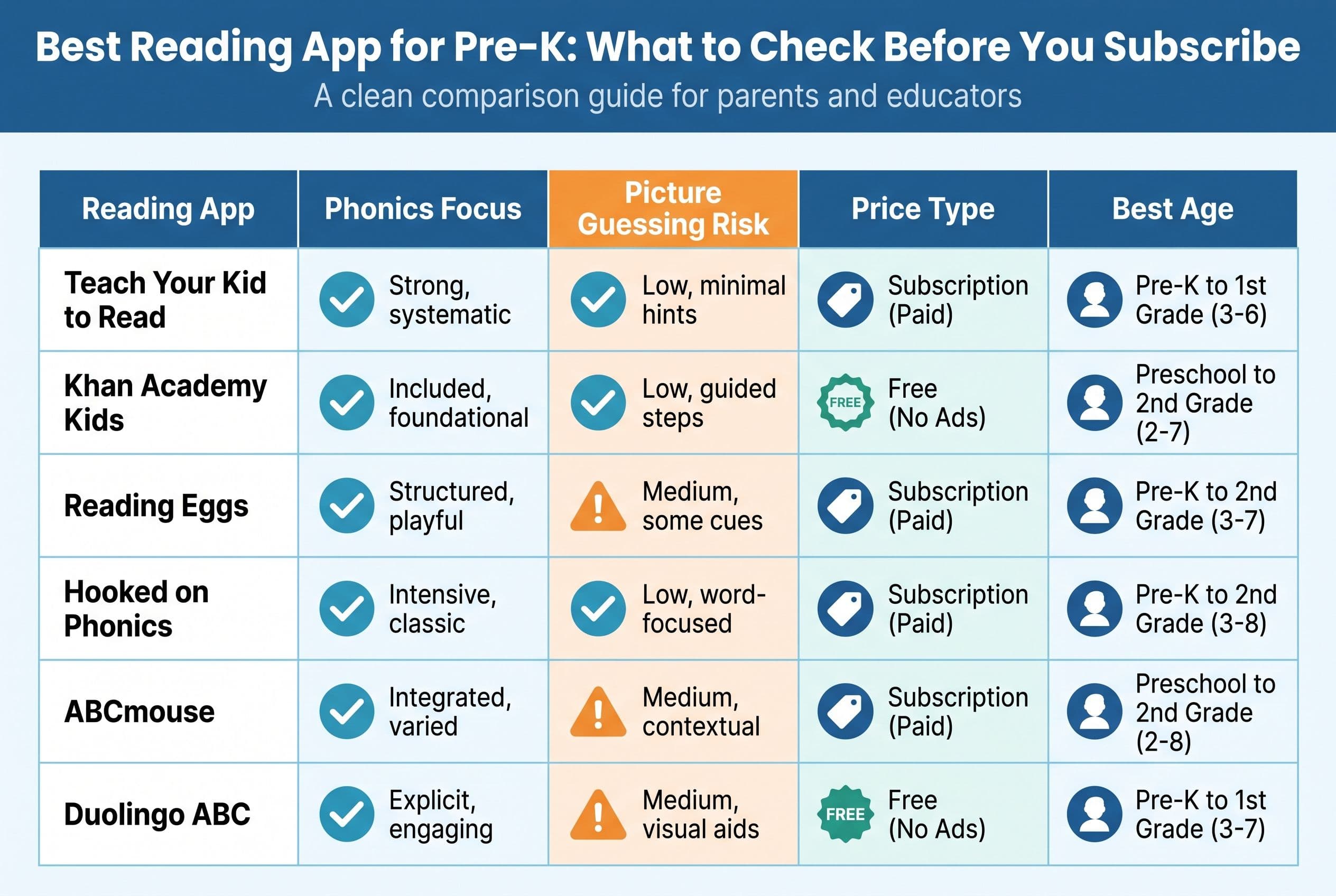
| Rank | App | What It Teaches | Price | Best Age |
|---|---|---|---|---|
| 1 | Teach Your Kid to Read | Systematic phonics, letter sounds, blending, decoding | Lesson one free with no card and nothing to cancel; from lesson two, 7-day free trial, then US$9.95/month | Pre-k ages 4-5 |
| 2 | Khan Academy Kids | Early literacy, vocabulary, stories, general pre-k skills | Free | Ages 3-5 |
| 3 | Reading Eggs | Phonics, sight words, stories, games | Paid subscription, price varies by plan | Ages 4-7 |
| 4 | Hooked on Phonics | Sequential phonics lessons and practice | Paid subscription, price varies | Ages 4-8 |
| 5 | ABCmouse | Broad early learning, letters, stories, games | Paid subscription, price varies | Ages 3-6 |
| 6 | Duolingo ABC | Letter sounds, tracing, early decoding | Free | Ages 3-6 |
My #1 pick is Teach Your Kid to Read because it keeps the focus where it belongs: phonics, sound-by-sound decoding, and practice that builds independence. You can start lesson one free — lesson one is free with no card and nothing to cancel; from lesson two the whole program is a 7-day free trial, then US$9.95 a month.
Tiger Truth: The Pre-K Years Matter More Than People Admit
Look, I’m not saying your 4-year-old needs to read Charlotte’s Web by Tuesday. Calm down, Aunt Linda.
But I am saying the “wait and see” approach wrecks kids. The US 2022 NAEP / The Nation's Report Card showed only 33% of US 4th graders (ages 9-10) read at proficient level. That’s not a tiny hiccup. That’s a five-alarm literacy fire.
The 2000 National Reading Panel report found that systematic phonics instruction produces significant benefits, especially for young children learning to read. Stanislas Dehaene’s Reading in the Brain (2009) explains why: the brain doesn’t naturally read the way it naturally learns spoken language. We train it.
I saw this play out at a playground in Raleigh. Another mom told me her son’s school had switched from Lucy Calkins to a Science of Reading curriculum because of North Carolina’s SB 387 — the Excellent Public Schools Act, a US state law. She felt annoyed. “He was doing fine before,” she said.
I asked if her son could read the word splint. He was in 2nd grade (ages 7-8). He couldn’t.
So I spent 20 minutes on that playground bench explaining why schools had started changing course: Emily Hanford’s 2023 APM Reports / “Sold a Story” investigation, the NAEP data, and Dehaene’s neuroscience showing that kids don’t pick up reading by osmosis. That night, she watched the podcast and texted me at 11 p.m.: “I had no idea. Why didn’t anyone tell us this sooner?”
That’s the kicker. Parents keep getting told “they’ll get it.” Some kids do. Many don’t. And by the time everyone admits there’s a problem, the child has already learned to hate reading.
What I Look for in a Pre-K Reading App
A strong pre k reading app needs to do more than entertain. I want instruction that matches what we know from reading science.
For pre-k, I look for:
- Letter-sound practice, not just letter names
- Phonemic awareness, like hearing /m/ at the start of map
- Blending, so /s/ /a/ /t/ becomes sat
- Decodable words, not picture guessing
- Short lessons, because preschool attention spans are adorable chaos
- Parent visibility, so you know what your child actually practiced
This is where many reading apps for preschoolers fall apart. They reward tapping, swiping, collecting gems, and memorizing story patterns. That might look like learning, but it doesn’t always build decoding skill.
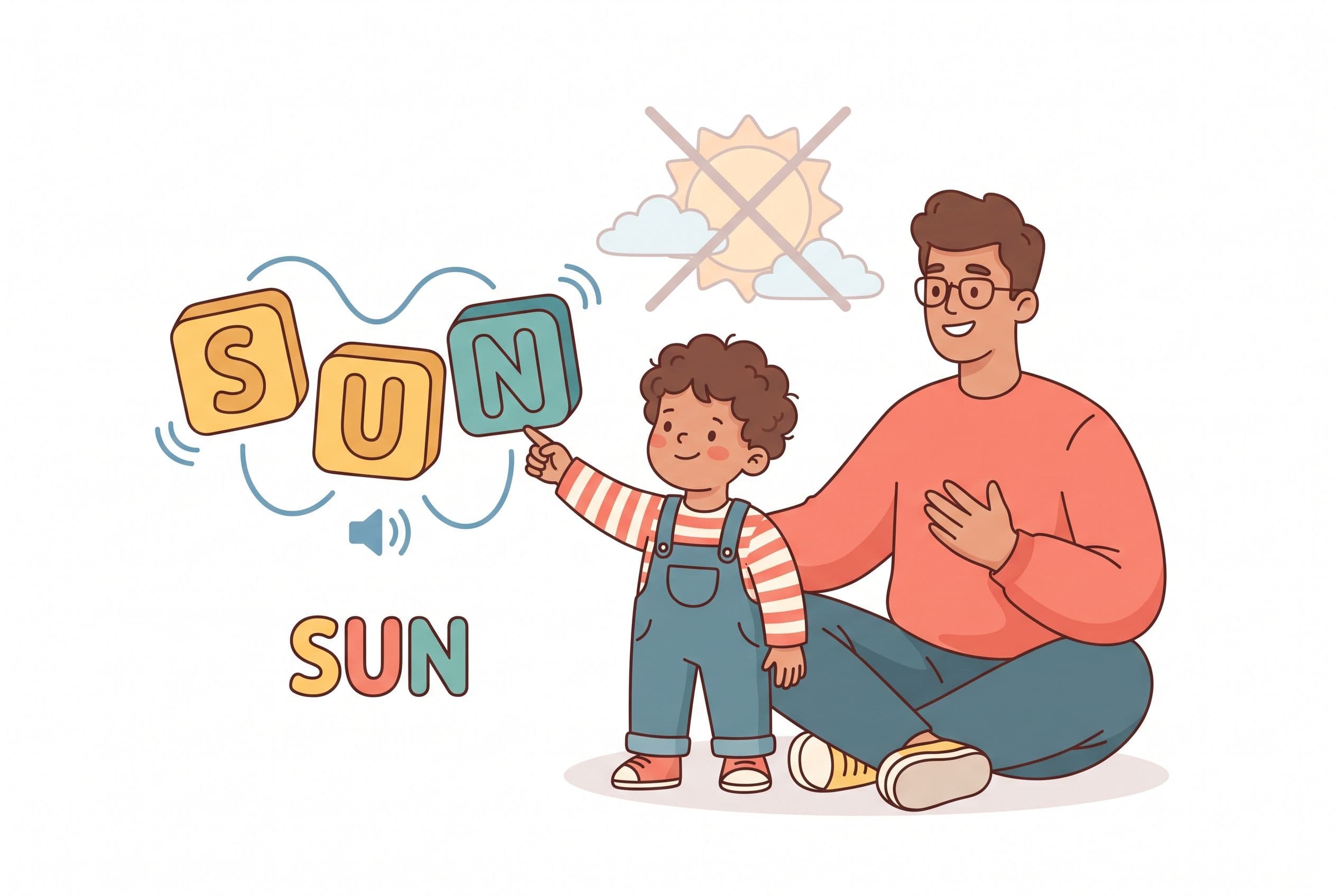
Real phonics means your child sees mat, says /m/ /a/ /t/, blends it, and reads mat. No guessing from the picture. No “look at the first letter and say something that makes sense.” No nonsense.
1. Teach Your Kid to Read — Best Overall Pre-K Reading App
Teach Your Kid to Read is my top pick because it acts like reading is a skill, not a vibe.
The lessons use systematic synthetic phonics, which means children learn sound-spelling relationships in a planned order and use them to read words. That lines up with Orton-Gillingham principles: explicit instruction, multisensory practice, careful sequencing, and lots of review.
For pre-k, that matters. You can’t throw a 4-year-old into random stories and hope they infer the alphabetic code. That’s like tossing a kid into a pool and calling it swim instruction. Hard pass.
What I like most:
- It focuses on letter sounds, not just alphabet singing
- It teaches blending in small steps
- It avoids the “guess from the picture” trap
- It gives parents a clear path instead of a giant activity buffet
- It works well for a daily 10-minute drill
My 4-year-old does better with short, direct lessons. Last Tuesday, we sat at the kitchen table with a stack of magnetic letters, and I had him blend mop, sip, and tan after app practice. He got sip, then tried to turn tan into train because he saw a toy train nearby. I stopped him right there.
Tiger Rule: No Guessing. Sound it out.
That’s why I like a phonics app for pre k that trains the same habit. The child looks at the letters. The child says the sounds. The child blends. That’s the foundation.
Price-wise, the offer is clean: lesson one is free with no card and nothing to cancel; from lesson two the whole program is a 7-day free trial, then US$9.95 a month. I appreciate that because parents deserve to know the cost before they get emotionally trapped by a cartoon owl.
Best for: pre-k kids ages 4-5 who are ready for letter sounds, blending, and early decoding.
Watch for: If your child doesn’t know any letters yet, sit beside them at first. Don’t hand over the tablet and wander off. Lazy iPad parenting doesn’t teach reading. Parent plus app? That’s the real deal.
2. Khan Academy Kids — Best Free Early Learning App
Khan Academy Kids is a no-brainer if you want a free app with a wide range of preschool skills. It includes stories, vocabulary, letters, social-emotional lessons, and early math.
For reading readiness, it gives young children exposure to books, language, rhyming, and print concepts. That’s useful. A child who has heard thousands of words and played with rhyme has a stronger base for phonics later.
But here’s my mom-warning label: Khan Academy Kids is broader than a dedicated learn to read app for preschool. It supports early literacy, but it doesn’t replace a structured phonics sequence.
Use it for:
- Vocabulary growth
- Listening comprehension
- Story exposure
- Letter play
- General pre-k practice
Don’t use it as your only reading plan if your child is ready to decode words. Pair it with direct phonics practice. The Simple View of Reading from Gough and Tunmer (1986) says reading comprehension comes from decoding times language comprehension. You need both sides of the equation.
Best for: ages 3-5, especially kids who need playful exposure before formal blending.
Watch for: If your child spends 30 minutes listening to stories but never practices /m/ /a/ /t/, that’s not reading instruction. That’s story time on a screen.
3. Reading Eggs — Best for Game-Loving Kids Who Need Structure
Reading Eggs has been around for years, and many families like it because it feels polished and motivating. It includes phonics, sight words, stories, songs, and games.
For some preschoolers, the game format keeps them engaged long enough to practice. That can help if your child resists anything that smells like a lesson. I get it. My second child once flopped under the table like a fainting goat because I asked him to read three CVC words. Parenting builds character (mostly yours).
Reading Eggs can work well when parents supervise and check whether the child actually reads or just clicks through. The rewards can motivate, but they can also become the main event. If your kid cares more about collecting things than reading words, pause and reset.
Use it for:
- Extra phonics practice
- Sight word exposure
- Game-based review
- Kids who need a fun hook
But don’t confuse completion with mastery. A child can pass levels and still struggle to decode an unfamiliar word. That’s where a quick assessment helps.
The PAST test — David Kilpatrick’s Phonological Awareness Screening Test — takes about 5 minutes when you know what you’re doing and shows where the phonological breakdown is. You don’t need to become a reading specialist overnight, but you do need to know whether your child can hear and manipulate sounds.
Best for: ages 4-7, especially kids who like rewards and games.
Watch for: Too much screen sparkle. If the app distracts from the skill, it’s time to tighten the routine.
4. Hooked on Phonics — Best Familiar Phonics Brand
Hooked on Phonics has strong name recognition for a reason. It uses a step-by-step phonics approach with lessons, practice, and books. Many parents feel comfortable with it because it doesn’t pretend reading is magic.
For pre-k, I like that it gives children repeated practice with sounds and words. A good letter sounds app should help kids connect graphemes to phonemes — written letters to spoken sounds — again and again until the connection sticks.
That repeated mapping supports what researchers call orthographic mapping. Linnea Ehri’s 2005 work on phases of word reading development explains how children move from partial alphabetic guesses to full alphabetic reading. Translation: they stop guessing and start storing words correctly because they understand the sound-spelling structure.
Use Hooked on Phonics for:
- Sequential phonics practice
- Early readers who need repetition
- Families who want a known brand
- Extra practice after parent-led lessons
Best for: ages 4-8.
Watch for: Make sure your child reads the words, not just memorizes the lesson flow. If they can read cat in the app but not on a sticky note at breakfast, the skill hasn’t transferred yet.
5. ABCmouse — Best Broad Preschool App, Not Best Pure Phonics App
ABCmouse covers a lot: letters, numbers, art, songs, books, games, and early school skills. It’s colorful, busy, and packed with activities.
That can help if you want one app for general preschool learning. But if your question is “What’s the best reading app for pre-k if I care about phonics?” then ABCmouse isn’t my first pick.
Here’s the problem: broad apps can make parents feel productive while reading instruction stays thin. Your child may complete puzzles, hear songs, drag shapes, listen to books, and still not blend /s/ /u/ /n/ into sun.
Use it for:
- General preschool practice
- Letter exposure
- Fine motor clicking and tracing
- Kids who like variety
Don’t rely on it as your main phonics plan unless you actively choose lessons that teach sounds, blending, and decoding.
Best for: ages 3-6.
Watch for: Activity overload. More choices don’t always mean more learning. Sometimes they mean your kid spends 12 minutes changing an avatar’s shoes.
6. Duolingo ABC — Best Free Letter Sounds App
Duolingo ABC is a solid free option for young children working on letters, tracing, sounds, and early word reading. It’s simple and friendly, and I like that it doesn’t feel as cluttered as some preschool apps.
For a child just beginning reading readiness work, Duolingo ABC can help build comfort with print. It gives practice with letter forms and early phonics tasks, which makes it useful as a starter app.
But again, free doesn’t mean complete. If your child already knows most letter sounds and can blend orally, you’ll probably want a more direct phonics path.
Use it for:
- Letter recognition
- Letter formation
- Basic sound practice
- Gentle early literacy exposure
Best for: ages 3-6.
Watch for: Don’t stop at tracing. Writing letters helps, but reading requires hearing sounds, matching them to letters, blending them, and practicing until the brain stores the patterns.
The Feature That Disqualifies a Reading App for Me
If an app teaches a child to guess from pictures, I’m out.
I don’t care how cute the dragon is. I don’t care if the dashboard says “advanced reader.” If the app shows a picture of a dog and lets the child say puppy for the printed word dog, that’s not reading.
This is why I side-eye Fountas & Pinnell levels when parents treat them like a clean measure of decoding. Those leveled readers often line up with whole-language habits: predictable text, picture support, and pattern memorization. For actual decoding practice, I’d rather see decodable readers like Bob Books, or controlled text from programs such as UFLI Foundations, Fundations, Logic of English, or All About Reading.
A strong pre k reading app should teach the child to attend to the word itself.
Bottom line: pictures can support comprehension, but they can’t replace decoding.
How to Choose the Best Reading App for Your Preschooler
Here’s the practical checklist. Don’t overthink it, but don’t abdicate your job to a tablet either.
- Check letter knowledge first. Ask your child to name letters and give sounds. If they know fewer than 10 sounds, start there.
- Test phonemic awareness. Say cat. Ask, “What’s the first sound?” Then ask, “What word do we get if we say /m/ /a/ /p/ fast?”
- Pick a phonics-first app. Choose one that teaches letter sounds, blending, and decoding in order.
- Sit with your child for the first week. Watch what they do when they get stuck. Guessing? Clicking randomly? Sounding out?
- Use real-world transfer. After the app, write three words on paper: sat, pin, mop. Can your child read them without app cues?
- Keep lessons short. Ten focused minutes beats 45 minutes of tapping and whining. Ask me how I know.
- Track progress weekly. Many schools use DIBELS or similar screeners to watch early reading skills. In kindergarten, they often monitor things like letter naming, letter sounds, phoneme segmentation, and—depending on the edition, district, and time of year—nonsense-word decoding. Benchmarks vary, so don’t tattoo one random number on your brain. Ask your school which measure they use and what “on track” means for your child’s grade and season.
- Practice daily. We Never Skip. Birthdays, vacations, holidays — five minutes still counts.
If you want the simplest starting point, use Teach Your Kid to Read for daily phonics and then take the 2-minute reading check if you’re unsure whether your child is behind.
My Pre-K App Routine at Home
Here’s what I’d do with a typical 4- or 5-year-old.
- Minute 1: Quick sound review with 5 letters
- Minutes 2-8: App lesson with parent sitting nearby
- Minutes 9-10: Read three words on paper with no pictures
- Bonus: One decodable book page if nobody is crying
That’s it. No giant production. No laminated binder that takes longer to prep than to use.
For my own kids, I’d rather do 10 minutes every day than one heroic 60-minute session on Sunday. Reading grows through repetition. Skill loves routine.
And if your child melts down? Stop before everyone hates literacy. Come back later. Tiger mom does not mean screaming mom. It means disciplined, consistent, and allergic to excuses.
Final Ranking: Which App Should You Pick?
If you want the best reading app for pre-k for actual phonics, pick Teach Your Kid to Read.
If you want a free general preschool app, pick Khan Academy Kids.
If your child needs game-heavy motivation, try Reading Eggs.
If you want a familiar phonics brand, try Hooked on Phonics.
If you want broad preschool content, use ABCmouse carefully.
If you want a free letter sounds app, try Duolingo ABC.
Just don’t let any app replace you. Preschoolers need eye contact, correction, encouragement, and a parent who says, “Try the sounds again,” instead of letting the screen do the parenting.
Teach Your Kid to Read gives you that phonics-first path without burying you in fluff: lesson one is free with no card and nothing to cancel; from lesson two the whole program is a 7-day free trial, then US$9.95 a month.
FAQ
What is the best reading app for pre-k?
My top pick is Teach Your Kid to Read because it focuses on systematic phonics, letter sounds, blending, and decoding. For pre-k, I want an app that teaches children to read words from the letters, not guess from pictures.
Should a preschooler use a reading app every day?
Yes, but keep it short. Ten focused minutes a day works better than long, exhausting sessions. Sit nearby, listen, and check whether your child can read a few words outside the app.
Are free reading apps for preschoolers enough?
Sometimes they’re enough for early exposure, especially for letters and vocabulary. But if your child is ready to blend sounds and read words, use a structured phonics app or parent-led phonics lessons.
What should a pre-k child know before learning to read?
A pre-k child benefits from oral language, rhyming, print awareness, letter recognition, and letter sounds. The big bridge into reading is phonemic awareness: hearing and working with individual sounds in spoken words.
Are phonics apps better than leveled reading apps?
For beginning readers, yes. Phonics apps teach the code. Leveled readers can tempt kids to rely on pictures and patterns, especially if the books aren’t decodable. I want preschoolers sounding out words from left to right.
Part of these guides

Xia Brody
Co-Founder, Teach Your Kid to Read
Mom of 4 who has successfully taught her kids to read. Currently in the trenches with her 4-year-old while her two oldest (10 and 7) devour books on their own. Passionate about phonics-based methods and building a lifelong love of reading.
Related Articles
Best Phonics App for a 3-Year-Old: 5 Tested & Compared (2026)
Most phonics apps for toddlers are glorified cartoons with a letter slapped on top. I tested 5 of the most popular ones with my own kids and ranked them by what actually matters: systematic phonics instruction, not flashy animations. Here's what I found.
Read More →
Reading Apps for 5-Year-Olds: 6 Skill-Level Picks
Most reading apps for 5-year-olds look cute. Too many teach guessing, tapping, and screen-zombie habits instead of real decoding. Here’s how I’d pick a phonics app by skill level if I were sitting at your kitchen table.
Read More →
HOMER vs ABCmouse for Reading: Side-by-Side Breakdown + Better Option
Both HOMER and ABCmouse promise to teach your kid to read. One leans toward personalized phonics pathways, the other is a massive content buffet. But here's what neither app tells you — and what actually matters for early reading.
Read More →