Reading Apps for 4-Year-Olds: 6 Worth Trying in 2026
What You'll Learn
- Why 90% of "reading apps" for preschoolers are actually teaching your kid to guess — and the one feature that separates real phonics instruction from dressed-up screen time
- The specific red flags I look for before I let any app near my 4-year-old (one of them will surprise you)
- 6 reading apps that survived my tiger mom vetting process — what each one does well, where each one falls short, and which kids they're best for
- The non-negotiable daily routine that makes any app actually work instead of becoming another digital pacifier
Let's Get Something Straight About "Educational" Apps
Your 4-year-old doesn't need another app that lets them pop bubbles shaped like letters.
I know that sounds harsh. But I've been down this road three times now — my oldest is 10, my second is 7, and I'm currently in the phonics trenches with my 4-year-old. I've downloaded, tested, and deleted more preschool reading apps than I can count. And here's what I've learned: most of them are garbage.
Not garbage in a "this isn't age-appropriate" way. Garbage in a "this is actively teaching my kid bad habits" way.
The worst offenders? Apps that show your kid a picture of a dog, display the word "dog," and then congratulate them when they tap the right answer. That's not reading. That's matching. That's a memory game with an alphabet skin.
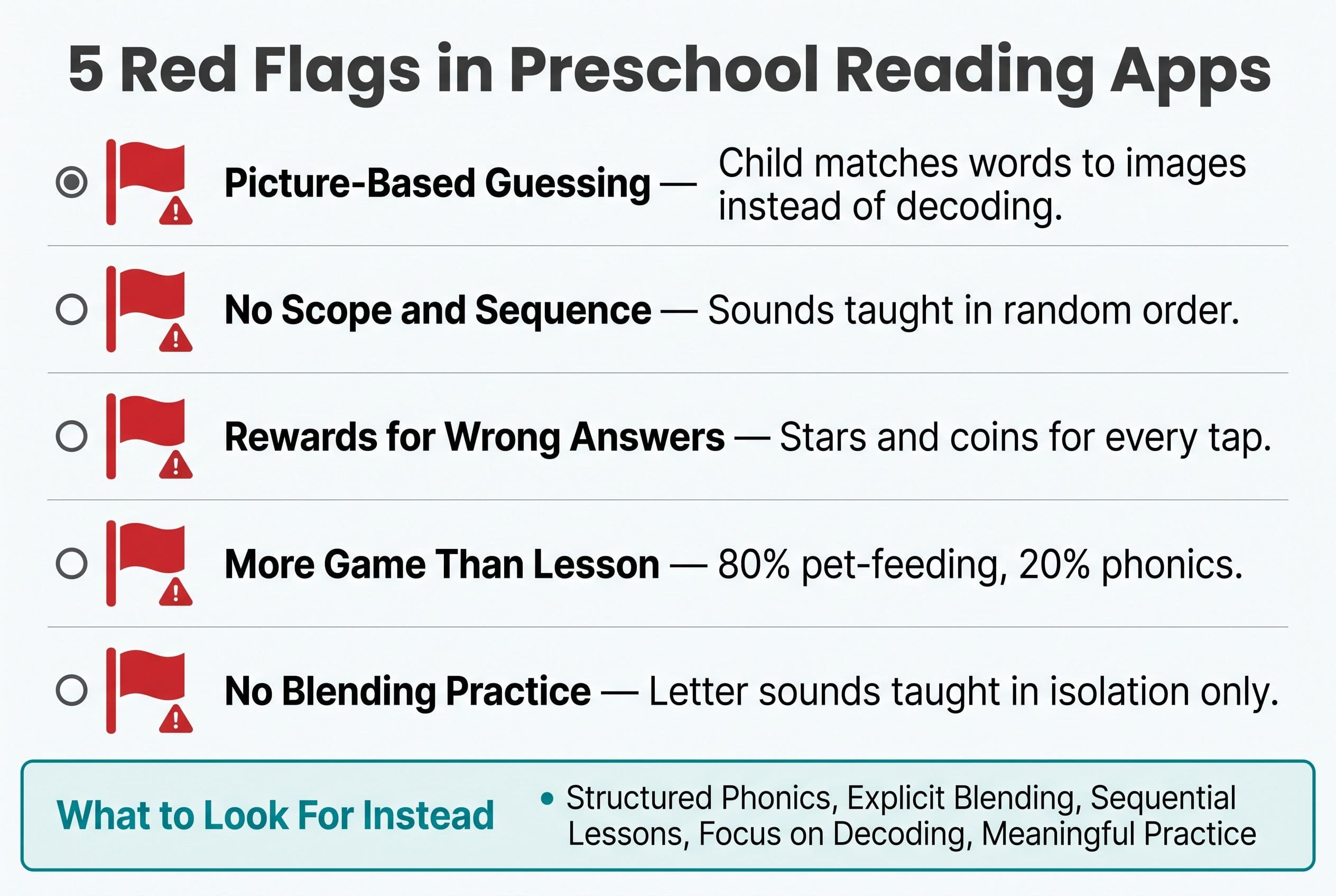
Real reading — the kind backed by decades of cognitive science — requires your child to look at letters, connect those letters to sounds, and blend those sounds together into words. That's systematic synthetic phonics. Stanislas Dehaene's Reading in the Brain (2009) showed us exactly what happens in the brain when a child learns to read: specific neural circuits get repurposed for decoding text. The brain doesn't learn to read naturally the way it learns to speak. It has to be trained.
So when an app skips the training and goes straight to picture-matching? It's building neural pathways for guessing, not reading.
The Tiger Truth: What Happens If You Pick the Wrong App
Here's what keeps me up at night.
The 2022 NAEP scores showed that only 33% of 4th graders read at a "Proficient" level. One in three. And reading scores dropped 3 points since 2019 — the largest decline in 30 years. Now, NAEP's "Proficient" bar is intentionally set high — it's not the same as "at grade level" — but it's the most consistent national yardstick we have for tracking trends. And that trend is ugly.
You want to know what a big chunk of those struggling readers have in common? They were "doing fine" in preschool and kindergarten. Their parents thought they were learning to read because they could recognize words in their favorite apps and books. But they were memorizing. Guessing from pictures. Using context clues instead of decoding.
Then 3rd grade hit. The texts got harder. The pictures disappeared. And those kids hit a wall.
The Annie E. Casey Foundation's Double Jeopardy report (2011), building on Donald Hernandez's analysis, found that kids who can't read proficiently by 3rd grade are 4 times more likely to drop out of high school. Four times. That's not a scare tactic. That's a data point.
And remedial reading intervention? You're looking at $10,000 to $15,000 per year for a program like Wilson Reading System or Lindamood-Bell — and insurance doesn't cover it.
A bad reading app won't destroy your child's future. But a bad reading app combined with a "wait and see" attitude? That's a recipe for falling behind before anyone notices.
The Playground Conversation That Changed Everything
I was at a playground in Raleigh last year when another mom told me her kid's school had just switched from Lucy Calkins to a Science of Reading curriculum because of North Carolina's SB 387 — the Excellent Public Schools Act. She was confused and, honestly, a little annoyed. "He was doing fine before," she said.
I asked if her son could read the word "splint." He's in second grade. He could not.
He looked at it, squinted, and said "split." Close — but he was guessing based on the first few letters, which is exactly what the old curriculum trained him to do. That's a classic partial-alphabetic reader in Linnea Ehri's framework: a kid who uses some letter cues but hasn't mastered full grapheme-phoneme correspondence.
I spent 20 minutes on that playground bench explaining why the switch was happening — Emily Hanford's "Sold a Story" reporting, the NAEP data, the neuroscience from Dehaene's lab showing the brain doesn't learn to read naturally. She went home and watched the Sold a Story podcast that night. Texted me at 11pm: "I had no idea. Why didn't anyone tell us this sooner?"
So why am I telling you this in an article about reading apps for 4-year-olds?
Because that second-grader started with apps. His mom had given him a popular preschool reading app at age 4 — one I won't name here, but it's one of the ones that teaches kids to guess from pictures and memorize whole words. She thought she was giving him a head start. Instead, she was reinforcing the exact habits his school would later have to undo.
The app you choose at 4 matters. It sets the foundation.
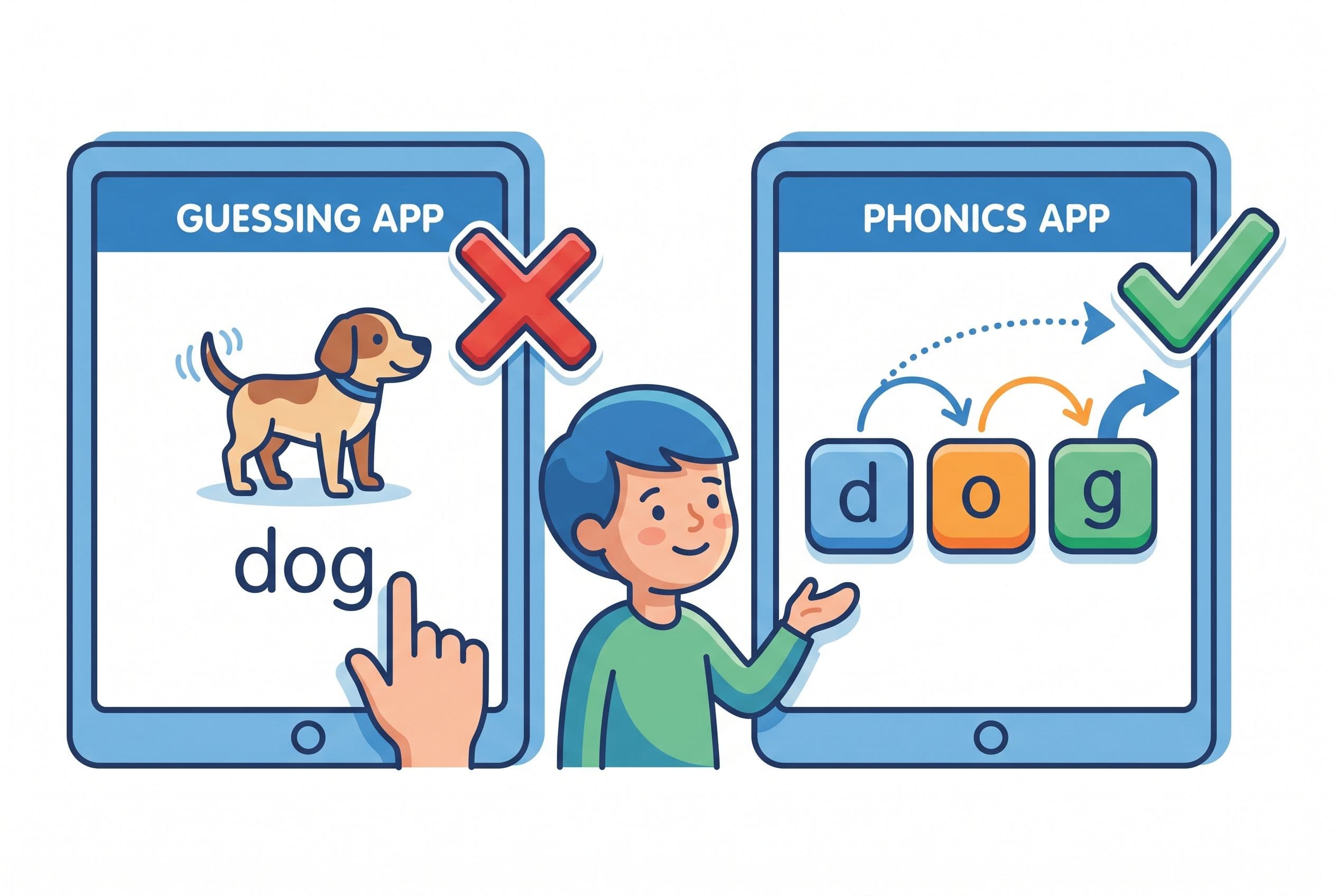
My Red Flags: What to Avoid in Any Preschool Reading App
Before I show you the 6 apps that made my list, here's what gets an app deleted from my kids' tablets within 60 seconds.
🚩 Red Flag #1: Picture-Based Guessing
If the app shows a picture and asks the child to "read" the word below it, that's not reading instruction. That's a visual matching game. David Kilpatrick's Equipped for Reading Success (2016) makes this crystal clear: real reading fluency comes from orthographic mapping — the process of bonding letter sequences to pronunciations in long-term memory. That requires phonemic awareness and letter-sound knowledge, not picture clues.
🚩 Red Flag #2: No Systematic Scope and Sequence
A good phonics app introduces sounds in a deliberate order. Short vowels before long vowels. CVC words (cat, sit, mop) before blends (stop, clap) before digraphs (ship, chat). If the app jumps randomly between concepts, it's edutainment, not education.
🚩 Red Flag #3: Rewards for Wrong Answers
This one drives me crazy. Some apps give your kid stars or coins just for tapping — even when they get the answer wrong. "Great try!" No. Wrong answers need correction, not celebration. My house rule: no guessing. Sound it out.
🚩 Red Flag #4: More Game Than Lesson
If your kid is spending 80% of the app time feeding a virtual pet and 20% on actual letter-sound work, the ratio is backwards. The phonics should be the main course, not the garnish.
🚩 Red Flag #5: No Blending Practice
This is the big one. An app can teach individual letter sounds all day long, but if it never asks your child to blend /c/ /a/ /t/ into "cat," it's missing the entire point. Blending is where decoding happens — it's how your kid turns letters on a page into actual words. (Of course, reading is decoding plus understanding, so vocabulary and comprehension matter too. But without blending, your kid can't get the words off the page in the first place.) The National Reading Panel report in 2000 — the one Congress actually commissioned — identified systematic phonics with blending as one of the five pillars of effective reading instruction.
6 Reading Apps for 4-Year-Olds That Passed My Tiger Mom Test
Look, I want to be honest with you: no app is a complete reading program. An app is a supplement. It's the side dish. The main course is you — sitting with your kid, drilling sounds, listening to them blend, correcting their mistakes. But a good app can reinforce what you're teaching and give your kid extra practice in a format they'll actually engage with.
Here are the 6 apps I've either used with my own kids or evaluated closely enough to recommend. I'm listing what I like, what I don't, and who each one is best for.
1. Teach Your Kid to Read (TeachYourKidToRead.org)
What it is: A structured, parent-guided reading program built on Orton-Gillingham principles and systematic synthetic phonics. It walks your child through letter-sound correspondence, blending CVC words, and progressing through a carefully sequenced scope and sequence.
What I love: This is the real deal. It doesn't hide behind gamification — the focus is on actual phonics mastery. It follows the same progression that the Science of Reading research supports: phonemic awareness → letter-sound mapping → blending → decodable reading. My 4-year-old uses it, and the difference between this and the "edutainment" apps is night and day.
What to know: It requires parent involvement. This isn't a "hand your kid the iPad and walk away" situation. You sit with them. You guide them. That's a feature, not a bug — but it means you need to show up. Every day.
Best for: Parents who are serious about teaching their kid to read and want a structured program, not a game.
2. HOMER
What it is: A personalized learn-to-read app that adjusts to your child's level. It covers phonics, sight words, and reading comprehension.
What I like: HOMER does include a phonics component with letter-sound instruction, and the scope and sequence is more systematic than many competitors. The stories are engaging and there's a decent amount of blending practice.
What I don't love: It mixes in sight-word memorization pretty heavily, which leans toward a balanced literacy approach. It also has a lot of extras — drawing, music, social-emotional content — that dilute the reading instruction. You're paying for a big platform, not a focused phonics program.
Best for: Parents who want a broad "educational app" and are OK supplementing the phonics side with additional instruction.
3. Phonics Hero
What it is: An Australian-made app specifically designed around synthetic phonics. It uses a systematic scope and sequence based on the Letters and Sounds framework.
What I like: This one is tight. It teaches letter-sound correspondence, blending, and segmenting in a logical order. There's a parent dashboard that shows you exactly where your child is and what they're struggling with. The activities require actual decoding — not picture guessing.
What I don't love: The interface looks a little dated, and the game mechanics can feel repetitive. My 4-year-old got bored with the reward system after about two weeks. Also, some of the pronunciation examples use Australian English, which can confuse American kids on certain vowel sounds.
Best for: Parents who want a purely phonics-focused app and don't mind a less flashy interface.
4. Teach Your Monster to Read
What it is: A UK-developed app (also available as a free web game) that takes kids through letter-sound learning, blending, and reading sentences.
What I like: The progression is solid — it starts with single letter sounds, moves to blending, then introduces digraphs and longer words. It's backed by the UK's phonics-first approach, and the Usborne Foundation helped fund its development. The game format keeps kids engaged without drowning out the instruction.
What I don't love: The "monster" theme can be a distraction. Some kids get more invested in decorating their monster than doing the phonics work. And while the early levels are strong, the later levels start introducing trickier words without enough scaffolding for kids who aren't ready.
Best for: Kids who need a "fun wrapper" around their phonics and parents who want a free or low-cost option.
5. Endless Reader (and Endless Alphabet)
What it is: A polished app with animated characters that teaches vocabulary and word recognition. Letters jump around and kids drag them into place.
What I like (sort of): The production quality is stellar. Kids love the animation. And the app does pronounce individual letter sounds, which is better than nothing.
What I DON'T like — and this is a big one: Endless Reader is fundamentally a whole-word recognition app. It teaches kids to recognize words as complete units, not to decode them phonetically. The animated letters are cute, but they don't teach blending. A child can "learn" the word "gigantic" in this app without any ability to decode a simple CVC word like "fig." That's backwards.
I'm including it on this list specifically as a cautionary tale. It's wildly popular. It looks educational. Parents love it. But it's teaching memorization, not reading. If you use it, use it only as a vocabulary supplement alongside a real phonics program.
Best for: Vocabulary exposure only. NOT a reading instruction app despite what the name implies.
6. Bob Books Reading Magic
What it is: A digital companion to the beloved Bob Books series. It uses a phonics-based approach with drag-and-drop letter activities and simple decodable stories.
What I like: Bob Books has been a phonics staple for decades, and the app version follows the same systematic approach: start with simple CVC words using a limited set of letters, then gradually expand. The decodable stories at each level mean your child reads words they've actually been taught — no guessing required.
What I don't love: The app is a bit bare-bones compared to flashier competitors. There's less interactivity and the graphics feel like they haven't been updated in a while. My 7-year-old used the physical Bob Books when she was 4 and loved them, but the app version didn't hold my current 4-year-old's attention as long.
Best for: Families who already use Bob Books and want a digital supplement for car rides or waiting rooms.
The Non-Negotiable: How to Actually Use a Reading App
Here's where most parents go wrong. They download a good app, hand the tablet to their kid, and walk away to start dinner. Then they wonder why their child isn't making progress.
An app is a tool. A hammer doesn't build a house by itself. You have to swing it.
Here's my daily routine with my 4-year-old:
Step 1: 10 minutes of parent-led phonics first. Before any app touches her hands, we sit at the kitchen table and do real phonics work. Right now we're on CVC words with short /a/ and short /i/. I use letter tiles. She blends. I correct. No guessing allowed.
Step 2: 10-15 minutes on the app. She uses start lesson one free Teach Your Kid to Read for structured practice. I sit next to her — not across the room, not in another room. Next to her. When she gets stuck, I don't let the app just give her the answer. We sound it out together.
Step 3: 5 minutes of decodable book reading. We read a decodable reader that matches what she's been practicing. Not a leveled reader from Fountas & Pinnell — those are whole-language aligned and full of predictable patterns that encourage guessing. We use decodable texts where every word follows phonics rules she's already learned.
Total time: 25-30 minutes. Every day. Birthdays, holidays, vacation. We Never Skip.
And yes, she complains sometimes. That's fine. She also complains about brushing her teeth. Some things aren't negotiable.
What Benchmark Should a 4-Year-Old Hit?
I get this question constantly. Here's a realistic target based on where the research lands.
By the end of age 4 (assuming you've been doing consistent phonics work), your child should be able to:
- Identify all 26 uppercase and lowercase letters — both name and sound
- Produce the most common sound for each letter (not every variation, just the main one)
- Blend at least some simple CVC words — sat, pin, hog, etc.
- Demonstrate basic phonemic awareness — rhyming, identifying first sounds in words, clapping syllables
Is every 4-year-old going to hit all of these? No. Kids develop differently. But these are reasonable targets if you're doing 20-30 minutes of daily instruction.
If you want to measure where your child stands, ask their preschool about PALS (Phonological Awareness Literacy Screening) or use Kilpatrick's PAST test at home — it takes about 5 minutes and tells you exactly where the phonological breakdown is. Don't guess about your kid's reading level. Measure it.
But What About Screen Time?
Real talk — I know some parents reading this are thinking, "Wait, you're a tiger mom who's PRO screen time?"
Nope. I'm a tiger mom who's pro-results.
The American Academy of Pediatrics recommends limiting screen time for preschoolers to 1 hour per day of high-quality content, and using it with an adult co-viewing. That's exactly what I do. My daughter's 10-15 minutes on a reading app counts toward that hour, and I'm sitting right there.
Here's what the research actually shows: heavy passive screen time — think autoplay YouTube rabbit holes and endless cartoons — can be harmful, especially when it's displacing sleep, play, and real human interaction. But interactive, adult-guided educational screen time in small doses? That can actually be helpful. The variable that matters most isn't the screen — it's whether a parent is engaged.
So yes, a reading app can be part of the solution. But it's never the whole solution. The 40+ states that have now passed Science of Reading legislation since 2019 are mandating evidence-based instruction in schools. Mississippi's Literacy-Based Promotion Act of 2013 took them from 49th to 21st in national reading scores in 6 years. What drove those gains? Systematic phonics instruction. Teacher training. And accountability.
Your home reading program needs the same ingredients. An app is just one of the tools in the kit.
FAQ: Reading Apps for 4-Year-Olds
Can a 4-year-old really learn to read from an app?
A 4-year-old can learn phonics skills from a well-designed app — letter-sound correspondence, blending, segmenting. But learning to read requires more than an app. It requires a parent or teacher guiding instruction, correcting errors, and providing decodable reading material. Think of the app as the practice field and yourself as the coach.
How much time should my 4-year-old spend on a reading app each day?
10-15 minutes of focused, parent-supervised app time is plenty. Pair it with 10-15 minutes of offline phonics instruction and 5 minutes of decodable book reading. Total daily commitment: about 30 minutes. That's less time than one episode of Bluey.
What's the difference between a phonics app and a sight word app?
A phonics app teaches your child to decode words by sounding them out — connecting letters to sounds and blending those sounds together. A sight word app teaches your child to memorize whole words as visual units. Phonics builds a skill that transfers to any new word. Sight word memorization only works for words the child has already memorized. The research — including the National Reading Panel's 2000 report — overwhelmingly supports systematic phonics as the more effective approach.
My kid's preschool says he's "not ready" for phonics. Should I wait?
No. This is the "wait and see" approach, and the research does not support it. Linnea Ehri's phases of word reading development show that children move from pre-alphabetic awareness through increasingly sophisticated decoding stages — but they don't move through those stages without instruction. Waiting doesn't help. Early, systematic instruction does. If your child can speak in sentences and identify at least some letters, they're ready for beginning phonics.
Are free reading apps as good as paid ones?
Some free apps are excellent — Teach Your Monster to Read, for example, is free and has solid phonics content. But many free apps rely on ads or in-app purchases that disrupt learning. The price tag isn't what matters. What matters is whether the app uses systematic synthetic phonics, requires actual blending (not guessing), and follows a logical scope and sequence. Evaluate the methodology, not the price.
The Bottom Line
Your 4-year-old is at the starting line of the most important academic skill they'll ever learn. The app you choose right now either builds the right neural pathways or reinforces bad habits that someone will have to undo later — at enormous cost in time, money, and your child's confidence.
Pick an app that teaches real phonics. Sit with your kid while they use it. Supplement with offline instruction and decodable books. And do it every single day.
That's not helicopter parenting. That's not tiger parenting. That's just parenting.
Ready to start? Teach Your Kid to Read gives your child the systematic, phonics-based instruction that actually works — built on the same Orton-Gillingham principles used in the best intervention programs. Visit start lesson one free TeachYourKidToRead.org or call (407) 707-6850 to get started today.
Part of these guides

Xia Brody
Co-Founder, Teach Your Kid to Read
Mom of 4 who has successfully taught her kids to read. Currently in the trenches with her 4-year-old while her two oldest (10 and 7) devour books on their own. Passionate about phonics-based methods and building a lifelong love of reading.
Related Articles
Best Phonics App for a 3-Year-Old: 5 Tested & Compared (2026)
Most phonics apps for toddlers are glorified cartoons with a letter slapped on top. I tested 5 of the most popular ones with my own kids and ranked them by what actually matters: systematic phonics instruction, not flashy animations. Here's what I found.
Read More →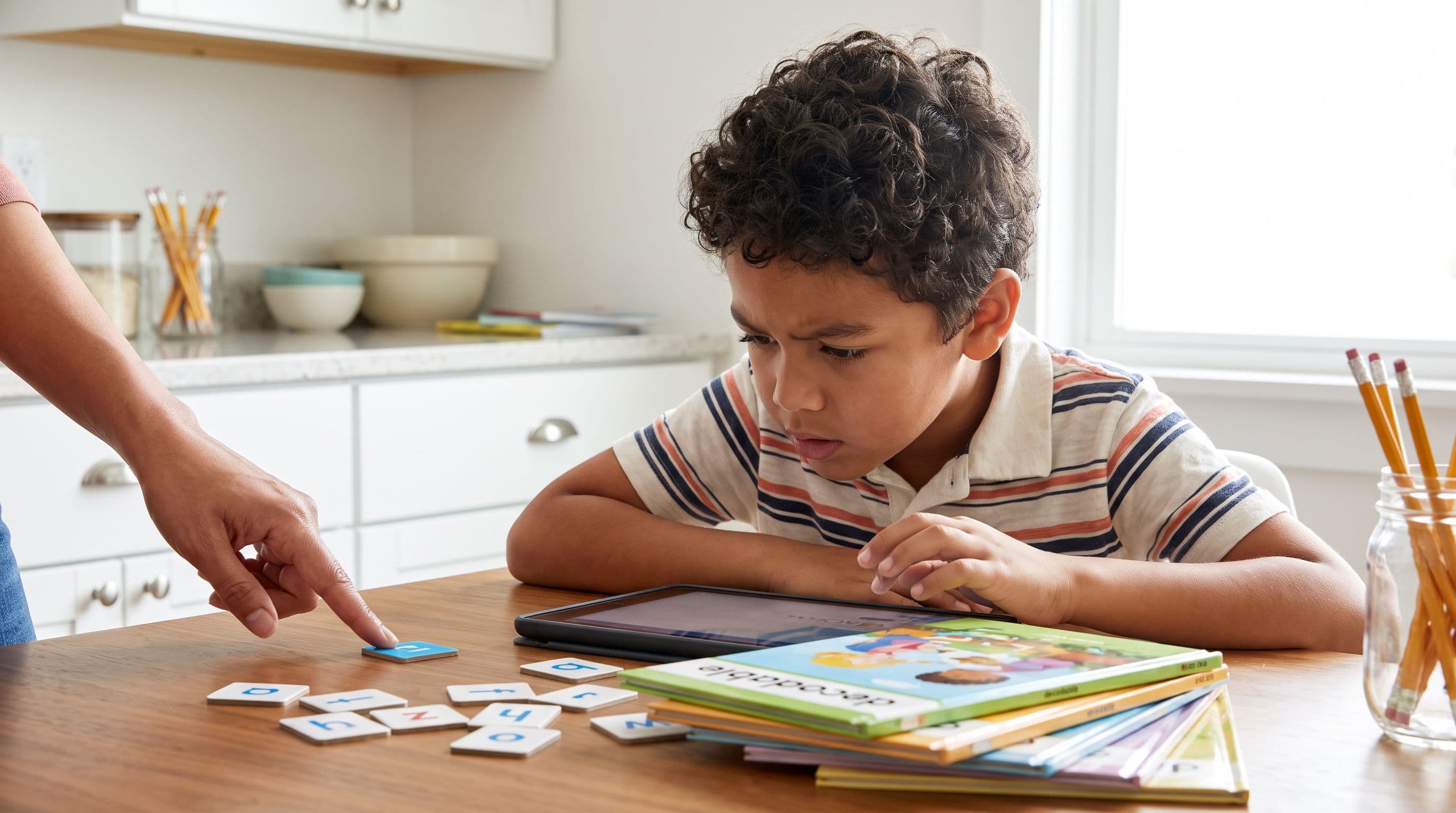
Reading Eggs vs ABCmouse for 5-Year-Olds: Best Pick
Choosing between Reading Eggs and ABCmouse? Here’s the no-fluff mom verdict on which app actually teaches a 5-year-old to read — and where both fall short.
Read More →
Reading Apps for 5-Year-Olds: 6 Skill-Level Picks
Most reading apps for 5-year-olds look cute. Too many teach guessing, tapping, and screen-zombie habits instead of real decoding. Here’s how I’d pick a phonics app by skill level if I were sitting at your kitchen table.
Read More →