Read Write Inc vs Jolly Phonics: UK Parent Comparison

Read Write Inc vs Jolly Phonics: 5 Phonics Programmes Ranked for UK Parents
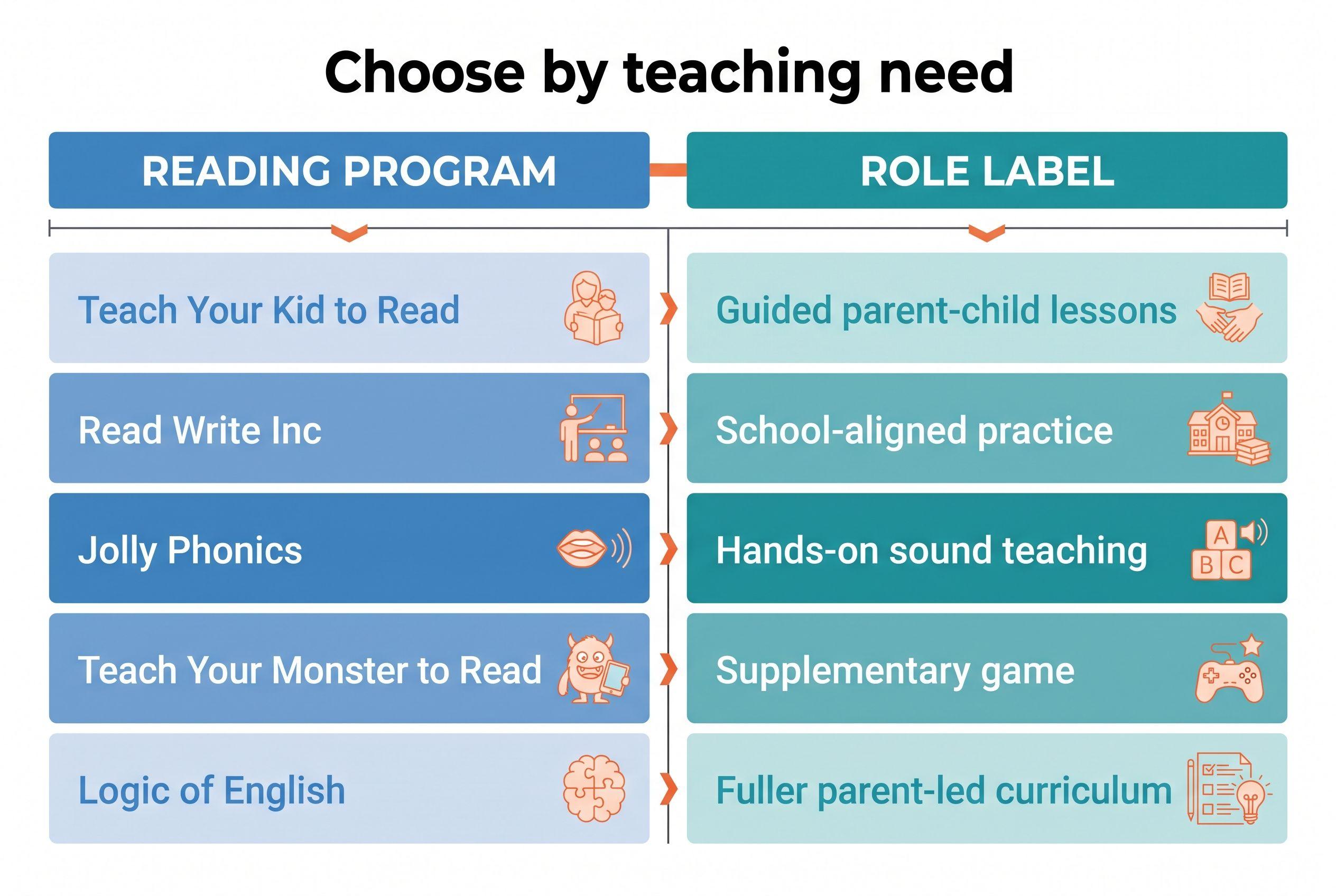
Between Read Write Inc and Jolly Phonics, I'd choose Read Write Inc for a child whose school already uses it, and Jolly Phonics for a parent starting home phonics who likes actions and hands-on teaching. In this read write inc vs jolly phonics comparison, school fit matters more than which cover looks friendliest.
What You'll Learn
- Match school first: familiar sounds, prompts and decodable books reduce unnecessary confusion.
- Jolly Phonics suits hands-on home teaching; Read Write Inc suits school-aligned practice. Neither replaces an adult listening carefully.
- My first-ranked parent-led option is Teach Your Kid to Read, for families wanting step-by-step lessons together rather than a school scheme to organise.
- England's Year 1 phonics check contains 40 words: 20 real words and 20 pseudo-words. It's a decoding check, not a whole-reading assessment.
A book bag isn't a teaching plan. If the phonics homework says “practise these sounds” but nobody explains how to turn them into a word, parents understandably start shopping.
I'm Xia Brody, a Chinese-American homeschooling mum of four, aged 10, 7, 4 and 1. I've taught my oldest two to read, and I'm currently teaching my four-year-old; honestly, a clear correction beats a cupboard full of resources. You need to know what to say when your child looks at map and announces “mat”.
The Verdict
I've widened this comparison to five choices because parents weighing two school schemes may actually need a parent-led lesson or a supplementary game. These aren't five interchangeable apps.
How we ranked
- Clear teaching sequence: new reading tasks should build on previous teaching.
- Adult guidance: parents need useful prompts, not just activities.
- Decoding practice: children must read the letters rather than guess.
- Home and school fit: materials should serve your child's current learning.
| Rank and programme | What it teaches or offers | Pricing model | Best-for age: my judgement unless stated |
|---|---|---|---|
| 1. Teach Your Kid to Read | Step-by-step parent-and-child phonics, with short stories from lesson two | Lesson one free with no card; from lesson two, 7-day trial, then US$9.95/month (billed in US dollars) | Around 4–6 for beginning decoding, with an adult |
| 2. Read Write Inc phonics | Presents a structured approach linking sounds, blending, reading and writing | Check the specific home resource's current purchasing terms | Around 4–7, especially alongside the same school scheme |
| 3. Jolly Phonics programme | Describes a synthetic phonics approach using actions alongside sound teaching | One-time print purchases; app free with in-app purchases | Around 4–6 for parent-led beginnings |
| 4. Teach Your Monster to Read | Describes games practising sounds, blending and early reading | Free on computers; one-time paid app | Stated app ages 3–6 |
| 5. Logic of English | Presents explicit teaching connecting phonograms, reading and spelling | One-time purchase | Foundations: stated ages 4–7 |
Full disclosure: I co-founded Teach Your Kid to Read, so weigh my #1 pick accordingly; the rest of the ranking is based on the criteria above.
Prices checked October 2026.
For a parent who wants guided teaching rather than another pile of materials, I recommend Teach Your Kid to Read: start lesson one free. Lesson one is free, with no card and nothing to cancel; from lesson two, the whole programme offers a 7-day free trial followed by US$9.95/month (billed in US dollars). Check the billing currency and amount before activating the trial; I won't invent a sterling price.
Ranked: Five Phonics Choices for UK Families
1. Teach Your Kid to Read — my pick for guided home lessons
Teach Your Kid to Read gives the adult a specific job. You sit beside your child for about 15 minutes a day, and the app teaches you what to listen for and how to correct a mistake. The child does the reading. You aren't the tablet's chauffeur.
Lesson one teaches m, s, p and short a. Your child hears each sound, taps the matching letter, then blends and builds am, map and sap. There's no story in that first lesson; short stories begin in lesson two and use sounds the programme has already taught.
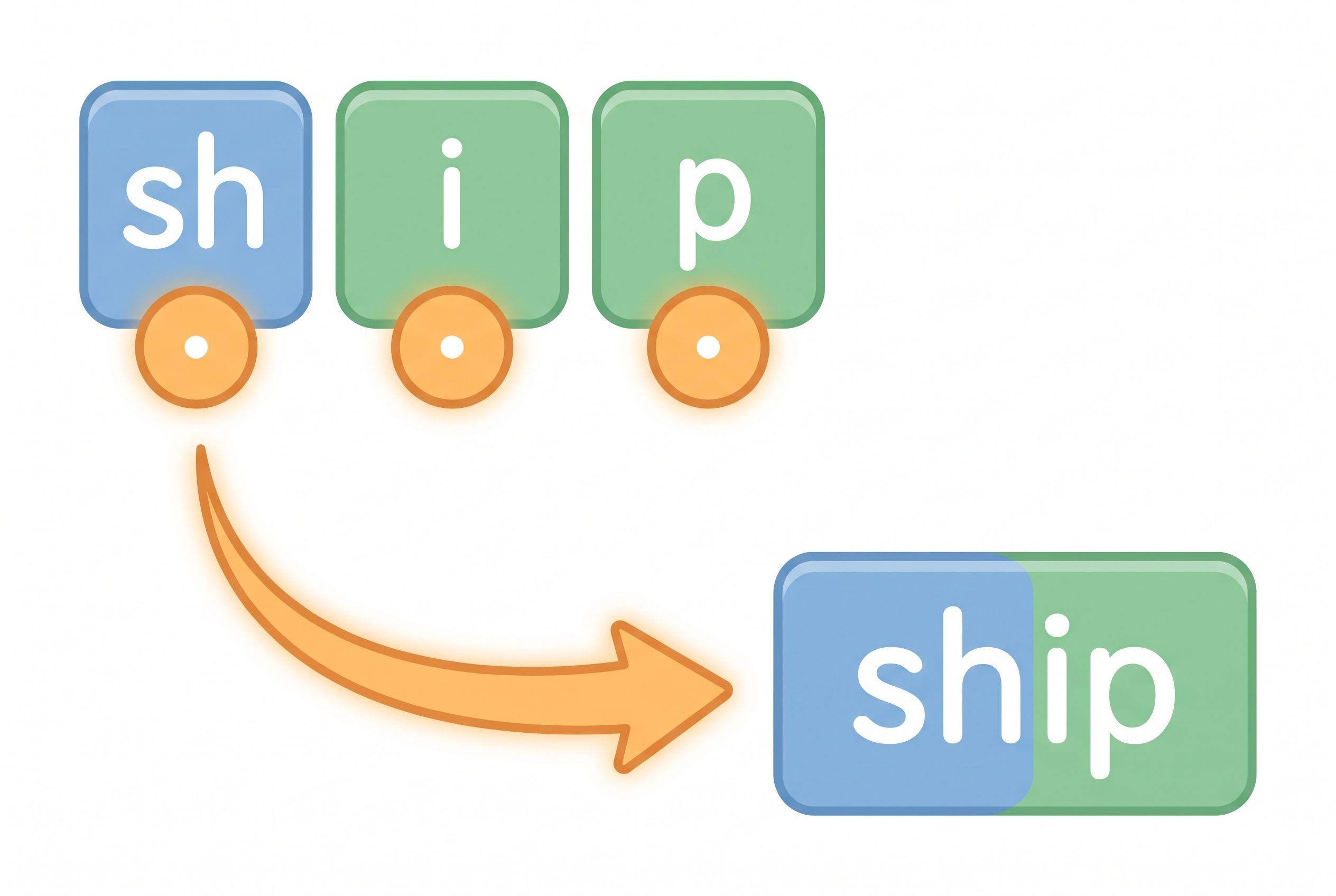
That earns my strongest marks for adult guidance and a clear sequence. The 50 lessons move from single-letter sounds through digraphs such as sh, ch and th, blends, vowel teams and silent e, then prefixes and suffixes. A small set of common irregular words, called “leap words”, appears through sight teaching along the way.
I like the immediate teaching target: connect a sound to a letter, then use that knowledge in a real word. That's much more useful than asking whether a child enjoyed tapping colourful objects. Enjoyment matters. Accurate reading matters too.
For school fit, ask which sounds your child currently practises before adding a second sequence. Parents can see every lesson and jump to any of them, but that doesn't make skipping prerequisite knowledge sensible. Start where your child can work accurately, not where their birthday suggests they ought to start.
One limitation: the app has no speech recognition, so you must hear and correct pronunciation yourself. Choose something else if you need a child-alone activity or software that listens to reading and supplies corrections.
2. Read Write Inc phonics — best when school already uses it
Read Write Inc phonics presents a structured route through sound teaching, blending and connected reading, with writing alongside. Its familiar language includes “Fred Talk” for saying the sounds in a word before blending them.
My strongest reason to choose it at home isn't a claim that its mascot beats every other approach. It's consistency. If the reception teacher uses a particular prompt, repeating that prompt saves your child the work of interpreting a second adult's terminology.
Ask which sounds and books currently match your child's teaching. A book can look wonderfully simple yet contain spellings your child hasn't learnt; buying the next-looking pack doesn't solve that mismatch.
Against my criteria, Read Write Inc scores particularly well for school fit when the school uses it. Adult guidance depends on the actual home resource you choose and the explanation your school supplies. Don't assume a pack of cards provides the same support as a teaching handbook.
My verdict: choose it over Jolly Phonics when it continues the teaching your child already receives. Ask the teacher to demonstrate one correction before you leave parents' evening.
3. Jolly Phonics — best of the pair for hands-on home beginnings
The Jolly Phonics programme describes synthetic phonics teaching with actions that accompany sounds. Its approach connects letter sounds with blending, identifying sounds in words and learning tricky words.
For a parent choosing independently, those actions offer a concrete way to introduce and revisit sounds. That's why Jolly gets my home-start recommendation between the two headline choices—not because actions themselves teach reading.
Here's the trap: a child might perform the snake action beautifully but hesitate when they see s without your demonstration. Test the letter-sound connection without the performance occasionally. Then blend sounds into words. The action supports the teaching; it doesn't replace it.
Jolly Phonics scores well for a clear approach and practical adult involvement. School fit depends on what your child's teacher uses, and you still need reading material that matches the spellings you've taught.
My verdict: a useful choice for a parent happy to organise hands-on lessons. If school uses Little Wandle, read Jolly Phonics vs Little Wandle: Best UK Home Pick before introducing different routines.
4. Teach Your Monster to Read — best supplementary game here
Teach Your Monster to Read describes games covering letter-sound relationships, blending and early reading. Its stated app range is ages 3–6, and computer access is free.
That makes it an accessible extra practice option, rather than my first choice for a parent asking, “How exactly do I teach this?” A game's response to a tap doesn't tell you everything about how your child blends aloud.
Against my criteria, its strongest fit is supplementary decoding practice. Adult guidance is a different proposition from a parent-led lesson, so listen to some actual reading away from the game.
My verdict: choose it for extra practice, not as permission to stop listening. For another digital comparison, see Teach Your Monster vs Reading Eggs UK: Phonics Winner.
5. Logic of English — best for parents wanting a fuller print route
Logic of English presents explicit instruction connecting sounds, spellings, reading and writing. Its Foundations programme states an age range of 4–7.
This is worth considering if you're choosing the main teaching route at home, rather than supporting ten minutes of phonics homework. A fuller curriculum also asks more of the adult: preparation and following the teaching sequence become part of your job.
It fits the clear-sequence and adult-teaching criteria. For a UK child attending school, check terminology, pronunciation examples and teaching order against classroom practice rather than assuming different materials line up automatically.
My verdict: consider it for substantial parent-led teaching. I wouldn't choose a whole new curriculum simply because this week's book bag caused an argument.
The Tiger Truth: Check Decoding, Not Brand Loyalty
In England, the Department for Education's Phonics Screening Check at the end of Year 1 (ages 5–6) contains 40 words: 20 real words and 20 pseudo-words, often called alien words. The expected standard is 32 out of 40; children who don't meet it normally take the check again in Year 2 (ages 6–7). Don't assume this assessment applies across every UK nation.
Below the standard means your child needs closer attention to decoding. It doesn't diagnose dyslexia, and passing doesn't prove strong comprehension. Waiting without a teaching plan can leave the same gaps obstructing next year's reading.
The research supports phonics teaching, not a victory trophy for one brand. The US National Reading Panel, in its 2000 report, found benefits from systematic phonics instruction. Johnston and Watson's 2005 Clackmannanshire report, following pupils in Scotland over seven years, also supports attention to explicit phonics teaching; it wasn't a head-to-head trial of these products.
And Linnea Ehri's 2005 review, “Learning to Read Words: Theory, Findings, and Issues”, explains how connections between spellings and pronunciations support word learning. That's the point of orthographic mapping—not memorising a word's outline and hoping for the best.
Read Write Inc vs Jolly Phonics: What Changes at Home?
Match the teaching, not just the brand
For Reception (ages 4–5), ask which sounds your child knows securely, which sound comes next and which book matches that knowledge. “They're on Phase 3” helps only if someone tells you the actual spellings to practise.
Letters and Sounds phase labels, including Phases 2 through 5, don't map neatly onto every scheme's sequence. Read Write Inc uses its own organisation. Little Wandle has its own teaching guidance too. Don't translate between schemes by cover colour.
Use our US / UK / Australia school-year chart if your family has moved between school systems. Age labels and local school-year names can otherwise make a perfectly sensible conversation surprisingly confusing.
Don't confuse actions with guessing
A sound action prompts a sound you've taught. A picture-based guess replaces attention to the written word. Those aren't the same thing.
Imagine a child sees ship beside a boat and says “boat”. I wouldn't ask, “Does that make sense?” It does make sense—which is precisely the problem. I'd point to sh, help with that sound and guide the child through sh–i–p.
My Tiger Rule is “No Guessing”. Pictures can support discussion and comprehension after reading; they shouldn't supply an unidentified word.
Your Action Step: Check, Choose, Practise
- Ask school for the current teaching target. Request the sounds, blending prompt and matching decodable reading material. Ask what happens when your child makes a mistake.
- Find the first insecure pattern. Use our free phonics skill check for short real-word and made-up-word lists. You mark responses right or wrong and see the first pattern to practise; treat it as a teaching aid, not a diagnosis.
- Choose one main home route. For read write inc vs jolly phonics, continue the school scheme where practical. If you're teaching independently, choose the adult guidance you can follow consistently.
- Model, then hand over. For map, point to each letter, say its sound and blend. Then ask your child to try. Keep stop sounds such as /p/ short rather than adding “uh”.
- Record the useful detail. Write “confused short a with short i” rather than “bad reading day”. If difficulties persist despite clear teaching, discuss targeted support with the teacher or special educational needs coordinator.
If you want a guided parent-and-child starting point, begin with lesson one.
My other Tiger Rule, “We Never Skip”, means protecting the habit—not making an exhausted or ill child perform. A brief review can keep practice familiar; distress calls for adjustment, not a longer drill.
Choose the Programme You Can Teach Clearly
The best phonics programme for home isn't automatically the biggest box. In this read write inc vs jolly phonics decision, my answer stays simple: Read Write Inc for continuity with school, Jolly Phonics for hands-on independent beginnings.
For parents wanting guided lessons together, my first-ranked option offers a different route. Sit beside your child and try lesson one before deciding whether the approach fits.
FAQ
Is Read Write Inc better than Jolly Phonics?
Not for every family. I'd choose Read Write Inc when school already uses it, and Jolly Phonics for a parent who wants hands-on home teaching with sound actions. Neither recommendation proves superior results for every child.
Can I use Jolly Phonics if school uses Read Write Inc?
Yes, but avoid introducing conflicting prompts or rushing ahead through a different sequence. Ask the teacher which sounds need practice, then match your home activities to those targets.
Do all UK children take the Phonics Screening Check?
No. The check described here belongs to England's assessment system. It contains 40 words, with an expected standard of 32; ask your school about the assessment arrangements where you live.
What if my child knows sounds but can't blend?
Model blending with a short word containing familiar spellings, then let your child try with help. Don't respond by adding more sound cards. If the difficulty persists, ask the teacher to assess blending and phonemic awareness—the ability to notice and work with individual speech sounds.
Should I buy both programmes?
Usually, I'd start with one clear teaching route and matching reading material. Buying both doesn't automatically fill a learning gap, and different sequences can create extra work for you.
From teachyourkidtoread.org/blog/read-write-inc-vs-jolly-phonics-uk-parent-comparison
Part of these guides

Xia Brody
Co-Founder, Teach Your Kid to Read
Mom of 4 who has successfully taught her kids to read. Currently in the trenches with her 4-year-old while her two oldest (10 and 7) devour books on their own. Passionate about phonics-based methods and building a lifelong love of reading.
Related Articles

Jolly Phonics vs Little Wandle: Best UK Home Pick
Choosing between Jolly Phonics and Little Wandle for home? Here’s the blunt parent version: both can teach real phonics, but one fits home use better than the other. I’ll show you what to use, what to avoid and how to start this week.
Read More →
Read Write Inc vs Little Wandle: UK Parent Guide
Choose Read Write Inc or Little Wandle to match your child’s school, rather than starting a competing sequence at home. Here’s how the two compare, plus four home-support options and a clear plan for spotting gaps.
Read More →
Hooked on Phonics vs Reading Eggs: Which Is Better?
I'd choose Hooked on Phonics for a narrower phonics focus and Reading Eggs for broader reading practice across different stages. Here's how those two compare with two alternatives—and what I'd check before paying.
Read More →