Jolly Phonics vs Little Wandle: Best UK Home Pick

What You'll Learn
- The one thing that makes jolly phonics vs little wandle a very different decision at home than in school
- Why a brilliant school phonics scheme can still feel like wrestling an octopus at your kitchen table
- The biggest mistake parents make when a child gets stuck on a word (hint: it starts with “look at the picture”)
- A simple 10-minute home plan for Reception (ages 4-5), Year 1 (ages 5-6) and Year 2 (ages 6-7)
Reality Check
Your child doesn’t need prettier worksheets. Your child needs to read the word on the page.
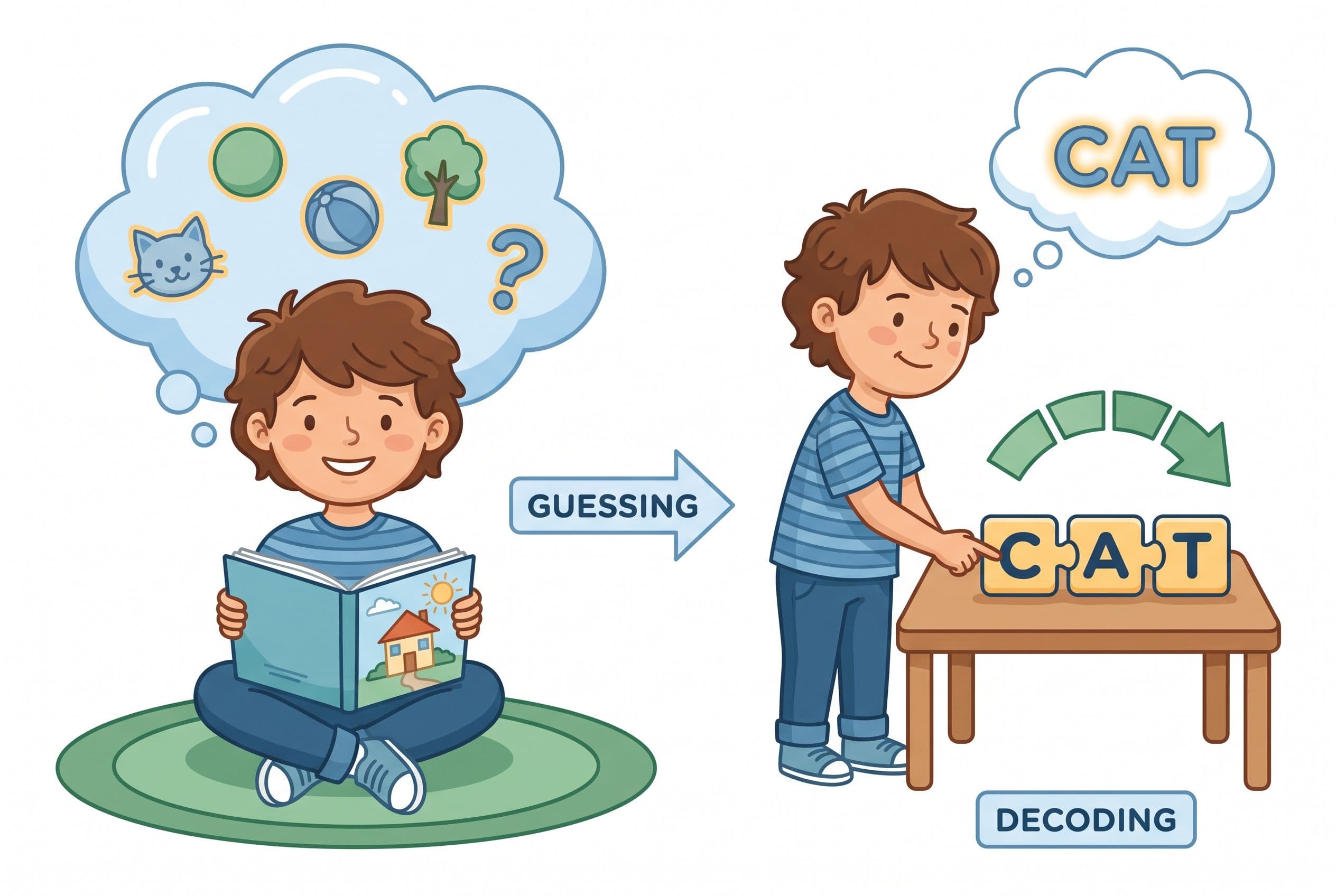
If they look at ship and say “boat” because there’s a picture of water, that’s not reading. That’s guessing with confidence. Cute? Maybe. Dangerous? Absolutely.
I’m Xia Brody, a Chinese-American homeschooling mum of four, and I’m bossy about reading because I’ve seen what happens when adults “wait and see”. I’m in the US, but the phonics problem doesn’t care about borders. Children still have to crack the alphabetic code, and children in England also sit the Year 1 Phonics Screening Check. Either way, they need to read actual books without mum whispering every third word from the sofa.
The Verdict: Jolly Phonics vs Little Wandle for Home Use
Here’s the short version before we get into the weeds.
| Rank | Option | What it teaches | Pricing model | Best fit |
|---|---|---|---|---|
| #1 | Teach Your Kid to Read | Systematic synthetic phonics with parent-led daily lessons | Lesson one free with no card and nothing to cancel; from lesson two the whole programme is a 7-day free trial, then US$9.95/month | Home parents who want structure without school-scheme overwhelm |
| #2 | Jolly Phonics | Synthetic phonics with actions, songs and print resources | One-time print purchase; app free with in-app purchases | Nursery to Year 1 home practice, especially playful sound work |
| #3 | Little Wandle | Full school phonics programme aligned to Letters and Sounds | School programme; home resources depend on school access | Children already taught Little Wandle at primary school |
| #4 | Read Write Inc | Synthetic phonics with mnemonics and decodable books | Mostly school-led materials | Families whose school already uses it |
| #5 | UFLI Foundations | Explicit scope and sequence, strong for decoding | Free online Toolbox; manual is a one-time purchase | Confident parents who can run teacher-style lessons |
My honest pick? If you’re a parent choosing the best phonics scheme for home, start with Teach Your Kid to Read because it gives you the structure of systematic phonics without asking you to become a reception teacher overnight. You can start lesson one free, and the offer is plain: lesson one is free with no card and nothing to cancel; from lesson two the whole programme is a 7-day free trial, then US$9.95 a month.
Now let’s earn that verdict.
Tiger Truth: The Year 1 Check Is Not a Vibe Check
In England, the Phonics Screening Check happens at the end of Year 1. It has 40 words: 20 real words and 20 pseudo-words, sometimes called alien words. The expected standard has commonly been 32 out of 40, and children who don’t meet it re-sit in Year 2.
That matters because pseudo-words expose guessing. A child can’t memorise “strom” from a reading book. They have to know grapheme-phoneme correspondence, blend the sounds and read left to right.
The US National Reading Panel found in its 2000 report that systematic phonics instruction gives children significant reading benefits. The Clackmannanshire study from Scotland, Johnston and Watson (2005), tracked children taught synthetic phonics and found strong long-term reading and spelling outcomes. Stanislas Dehaene’s Reading in the Brain (2009) makes the brain point even sharper: reading doesn’t develop naturally like speech. We train the brain to connect print to sound.
So no, I’m not relaxed about “they’ll get it eventually”. Some children do. Many don’t. And the ones who don’t start avoiding books, losing confidence and needing paid tutoring that can easily run into hundreds of pounds a term.
Deep Dive: Which Programme Fits Your Kitchen Table?
#1 Teach Your Kid to Read: Best Home Fit for Busy Parents
Teach Your Kid to Read wins for home use because it assumes you’re a parent, not a school literacy lead with a laminator and a staff meeting agenda.
That matters. A good home phonics programme needs to answer four questions every single day:
- What sound do we teach today?
- What words can my child read using only sounds they already know?
- What do I do when they guess?
- When do we move on?
The app focuses on systematic synthetic phonics: sounds first, blending next, decodable words after that. No guessing from pictures. No “use the first letter and make a smart prediction”. No fluffy reward circus that replaces instruction.
Here’s my Tiger Rule: No Guessing. Ever.
If your child sees mat and says “mouse” because the picture has a mouse, stop them warmly and firmly. Say, “Eyes on the letters. Sound it out.” Then point: /m/ /a/ /t/. Blend. Read.
That little correction feels tiny, but it changes everything. You’re teaching the child that print carries the message. Not the picture. Not the sentence pattern. Not adult mind-reading.
The offer stays honest: lesson one is free with no card and nothing to cancel; from lesson two the whole programme is a 7-day free trial, then US$9.95 a month. I like that for parents because you can see whether the rhythm fits your child before you commit.
Best for: Reception, Year 1 and Year 2 children who need daily phonics practice at home, especially if the school book bag feels random.
#2 Jolly Phonics: Strong, Playful and Very Parent-Friendly
Now for the big comparison: jolly phonics vs little wandle.
Jolly Phonics, from Jolly Learning Ltd in the UK, was written by Sue Lloyd and Sara Wernham. It’s been around since 1992, according to the fact sheet, and many UK parents recognise the actions: snake arms for /s/, ants on the arm for /a/, that whole multisensory thing.
I like Jolly Phonics for home because it gives parents something concrete to do. Actions help young children remember sounds. Songs can make daily practice less miserable. The print resources work well if your child needs hands-on practice away from a screen.
But here’s the kicker: you still need a sequence.
If you buy a pile of Jolly materials and hop around because your child likes one page better than another, you’ve just turned a structured phonics approach into phonics confetti. Fun confetti, sure. Still confetti.
Use Jolly Phonics well and it can support:
- Letter-sound knowledge
- Oral blending
- CVC word reading
- Early digraph work
- Tricky word practice
- Spelling through segmenting
Use it casually and your child may know a bunch of cute actions but still freeze at shop, thin and rain.
Best for: Nursery and Reception children who like movement, songs and visual memory hooks. Also a solid support for Year 1 children who need extra sound recall.
The disqualifier? Jolly Phonics can become too adult-managed. You have to know what to teach next. If you’re exhausted at 6:15pm with dinner stuck to the hob, that’s where parents drift.
#3 Little Wandle: Excellent School Scheme, Awkward Home Programme
The Little Wandle phonics programme is a complete systematic synthetic phonics programme based on Letters and Sounds. Many UK primary schools use it, and if your child’s school uses Little Wandle, you should absolutely match the school’s terminology at home.
That means if the teacher says “Phase 3 digraphs”, don’t randomly start teaching Phase 5 alternatives because you found a shiny worksheet online. Stay aligned. Your child doesn’t need three adults using three different scripts for the same sound.
Little Wandle’s strength is that it’s built for whole-school consistency. Teachers get a progression. Children read decodable books matched to the sounds they’ve learnt. The whole point is fidelity.
That’s also why it can feel clunky at home.
A school programme assumes trained staff, group routines and access to matched materials. A parent at the kitchen table needs “do this for 10 minutes, then stop before someone cries”. Different beast.
So in the Jolly Phonics vs Little Wandle decision, I’d say this:
- If your school uses Little Wandle, use its home reading guidance and decodable books.
- If you’re choosing from scratch for home, Little Wandle may be more programme than you need.
- If your child struggles, don’t just reread the same book bag book. Drill the missing sound.
Best for: Children whose primary school already uses Little Wandle, especially Reception and Key Stage 1.
The disqualifier? It’s not designed primarily as a parent-led home product. That doesn’t make it bad. It means the fit matters.

#4 Read Write Inc: Useful If Your School Uses It
Read Write Inc is another big name in UK phonics programmes compared by parents. Schools like it because it gives routines, mnemonics and decodable texts.
At home, I treat Read Write Inc the same way I treat Little Wandle: if school uses it, don’t fight it. Learn the sound phrases. Practise the same graphemes. Read the matched book. Keep the language consistent.
But I wouldn’t tell a new home parent to buy into a school-style scheme just because everyone at parents’ evening mentions it. Your child needs daily mastery, not a brand-name shrine.
Best for: Families already attached to a Read Write Inc school.
Watch for this: any time a child memorises the book rather than decodes the words, change the task. Write the words on a plain card. No pictures. No pattern. Now you’ll see what they know.
#5 UFLI Foundations: Brilliant, But Parent Skill Matters
I have a soft spot for UFLI Foundations because it taught me a painful lesson.
I tried three different phonics programmes before finding one that worked for Mei. First came a popular app: all games, zero systematic progression. She tapped, cheered and collected silly rewards, but her decoding barely moved. Then I tried a workbook series that jumped from simple words to much harder words with no bridge. One minute she read cat, next minute the page wanted fantastic. Excuse me? We’re not teleporting across the alphabetic code, thank you very much.
Finally I landed on UFLI Foundations. It’s explicit. It follows a scope and sequence that makes actual sense: letter-sound instruction, blending and word reading are built together, then the patterns get more complex in a careful order. Children don’t have to “finish consonants” before they read words. They learn enough sounds to blend, then keep adding more code.
Within the first two weeks, Mei made more progress than she’d made in the previous two months combined.
The difference wasn’t magic. It was sequence.
Each lesson built on the last one. She wasn’t getting random skills thrown at her like educational spaghetti. I wish I’d started there instead of wasting two months on apps that taught her almost nothing.
For confident parents, UFLI can work beautifully. But you have to run the lessons. You have to correct errors. You have to keep the pacing tight. Some parents love that. Others need a simpler parent-facing path.
Best for: Parents who don’t mind teacher-style lesson plans and want strong, explicit phonics.
Jolly Phonics vs Little Wandle: The Real Home-Use Difference
Let’s put the two head-to-head.
1. Parent workload
Jolly Phonics usually feels easier for home because the actions and songs give you a quick entry point. You can practise /s/, /a/, /t/, /p/ with a four-year-old without needing a training portal.
Little Wandle works best when school leads and home reinforces. If your school sends matched decodable books, great. Use them. But don’t expect the whole programme to behave like a simple home app.
2. Sequence
Both can fit systematic synthetic phonics. The question is whether you, the parent, can see the sequence clearly.
For home, I want the next step to feel obvious. If today is sh, tomorrow shouldn’t randomly be air, igh and “write a sentence about your favourite dinosaur”. No. One skill. Practise. Master. Move.
3. Decodable reading
This is non-negotiable.
A decodable reader uses sounds your child has already learnt. If your child knows /s/ /a/ /t/ /p/ /i/ /n/, then sat, pin, tap and sit make sense. If the book throws in elephant before your child has been taught the spellings they need, they can’t fully decode it independently yet.
That doesn’t mean we panic and throw the book across the room (tempting, but no). An adult can supply the word or teach the missing spelling. But for independent reading practice? Use matched decodable texts. That’s how you build the right habit: eyes on print, sounds to words, no guessing circus.
4. Tricky words
UK schools talk a lot about tricky words. Fine. Some words have irregular parts. But don’t let “tricky” become code for “don’t teach the code”.
Linnea Ehri’s 2005 work on phases of word reading shows that children move towards full alphabetic reading when they connect letters and sounds. David Kilpatrick’s Equipped for Reading Success (2016) explains orthographic mapping: children store words for instant recognition by linking sounds to spellings.
Translation for normal tired parents: even sight words need sound work. Don’t just flash-card them to death.
5. Home consistency
The best scheme is the one you’ll actually practise every day.
I’d rather see 10 minutes of accurate phonics daily than a £180 box set that sits under the coffee table next to half a packet of raisins.
What I’d Choose by Child Age
Nursery children
Keep it oral and playful. Practise rhyming, syllables, initial sounds and a few letter-sound links. Jolly Phonics actions can work well here.
Don’t push long worksheets. Tiny children need short drills, movement and success.
Reception children
Start systematic synthetic phonics properly. This is where Teach Your Kid to Read, Jolly Phonics or a school-aligned Little Wandle path can work.
By late Reception, many children should blend simple CVC words like map, sit, red and cup. Some will move faster. Some need more repetition. Repetition isn’t failure. It’s the gym.
Year 1 children
Year 1 is serious business in England because the Phonics Screening Check is coming.
Practise pseudo-words. Yes, alien words feel weird. Do them anyway. They tell you whether your child can decode or whether they’ve memorised book patterns.
Try examples like:
- zog
- chab
- thim
- splen
- vair
If your child panics, go back to the missing grapheme. Don’t lecture. Drill.
Year 2 children
If your child re-sits the check or still guesses heavily, act now. Don’t wait for another parents’ evening where everyone smiles kindly and says, “Let’s give it time.”
Use a quick phonological awareness screen like Kilpatrick’s PAST if you suspect sound-level weakness. The PAST takes only a few minutes when administered by someone who knows it, and it can show whether the breakdown sits in syllables, onset-rime or phonemes.
Action Step: Pick Your Home Phonics Plan This Week
Here’s what I’d do if this were my child.
- Find out what school uses. Ask: “Do you use Little Wandle, Read Write Inc, Jolly Phonics or another Letters and Sounds-based programme?”
- Check the current sound. Don’t ask “Is she behind?” Ask: “Which graphemes should she know this half term?”
- Test without pictures. Write five words using known sounds on plain paper. Treat it as a quick practice check, not a full diagnosis. If your child struggles, check two things separately: can they remember the sounds, and can they blend them? If the same errors keep showing up across sessions, talk to the teacher or a qualified reading specialist.
- Choose one main home path. Pick Teach Your Kid to Read, school-aligned Little Wandle practice, Jolly Phonics or UFLI. Don’t mash four schemes together like phonics soup.
- Practise 10 minutes daily. Same time. Same table. No drama. We Never Skip.
- Correct guessing instantly. Say, “No guessing. Sound it out.” Calm voice. Steel spine.
- Use decodable books only for reading practice. Save picture books for read-aloud cuddle time. Both matter, but they do different jobs.
- Review every Friday. If your child misses the same sound three times, teach it again next week.
If you want the simplest parent-led starting point, use Teach Your Kid to Read: lesson one is free with no card and nothing to cancel; from lesson two the whole programme is a 7-day free trial, then US$9.95 a month.
Bottom Line: Jolly Phonics vs Little Wandle
If your school uses Little Wandle, support it at home. Use the matched decodable books. Practise the graphemes your child’s teacher sends. Don’t freelance wildly unless your child needs intervention.
If you’re choosing a home programme yourself, Jolly Phonics is usually easier to pick up than Little Wandle because it has parent-friendly actions, songs and print resources. But you still need a clear sequence.
My #1 home pick is Teach Your Kid to Read because it gives parents the daily structure they’re usually missing. The best phonics scheme for home is the one that teaches the code directly, stops guessing and tells you what to do next.
That’s the real answer to jolly phonics vs little wandle. It’s not “which brand sounds nicer?” It’s “which one will get my child decoding accurately at 6:47pm on a wet Tuesday when everyone’s tired?”
Choose that one.
Ready to stop guessing and start decoding? Lesson one is free with no card and nothing to cancel; from lesson two the whole programme is a 7-day free trial, then US$9.95 a month.
FAQ
Is Jolly Phonics better than Little Wandle for home?
For most home parents, Jolly Phonics feels easier to use because the actions, songs and print resources are more parent-friendly. Little Wandle is a strong school programme, but it works best when your child’s primary school leads it and sends matched home practice.
Should I use Little Wandle at home if my child’s school uses it?
Yes. If school uses Little Wandle, match the school’s sequence and language. Ask the reception teacher or Year 1 teacher which sounds your child should practise, then drill those at home with decodable words.
What is the best phonics scheme for home in the UK?
For parent-led daily practice, I’d choose Teach Your Kid to Read first, then Jolly Phonics for playful support or UFLI Foundations if you’re comfortable running teacher-style lessons. If school uses Read Write Inc or Little Wandle, align with that for consistency.
Are Letters and Sounds, Jolly Phonics and Little Wandle the same thing?
No. Letters and Sounds is the phonics progression many UK programmes build from. Jolly Phonics is a synthetic phonics programme with actions and songs. Little Wandle is a complete school phonics programme based on Letters and Sounds.
What if my Year 1 child is guessing words from pictures?
Stop the guessing immediately. Cover the picture if you need to, point to the letters and have your child sound out the word. In England, the Year 1 Phonics Screening Check includes pseudo-words, so guessing won’t carry them through.
Part of these guides

Xia Brody
Co-Founder, Teach Your Kid to Read
Mom of 4 who has successfully taught her kids to read. Currently in the trenches with her 4-year-old while her two oldest (10 and 7) devour books on their own. Passionate about phonics-based methods and building a lifelong love of reading.
Related Articles

Child Knows Letters but Can't Read? 5 App Next Steps
If your kindergartner knows the alphabet but can't read words yet, don't panic — but don't wait either. Here's the no-nonsense app comparison and next-step plan I’d use at my own kitchen table.
Read More →
Best App for Kids Who Know Letters But Can't Read
Your child knows the alphabet but still can't read words? That's not laziness. It's a blending problem, and the right phonics app can help you fix it fast.
Read More →
Best Reading App for Pre-K: 6 Smart Picks for 2026
Looking for the best reading app for pre-k? Here’s my no-nonsense mom comparison of 6 preschool reading apps, with phonics-first picks and the red flags I’d skip.
Read More →