My Kindergartner Isn't Reading: 6-Week Catch-Up Plan That Works
What You'll Learn
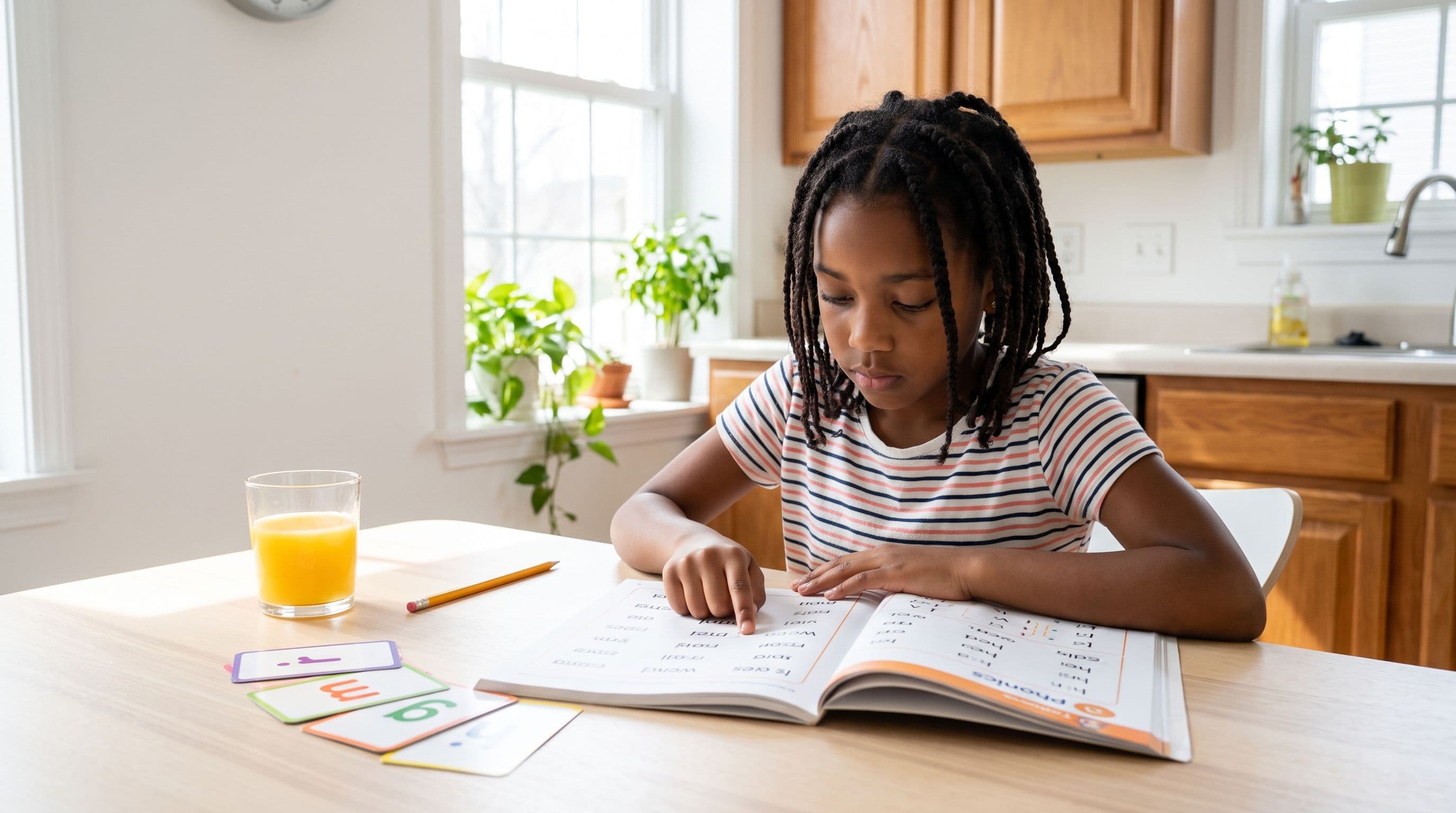
- Why your kindergartner not reading yet might NOT be "normal" — and how to tell the difference between a late bloomer and a kid who needs intervention right now
- The one mistake 90% of parents make when their kindergartner gets stuck on a word (hint: it involves looking at the picture)
- A week-by-week phonics catch-up plan you can start today at your kitchen table — 15 minutes a day, no fancy materials
- The specific benchmarks your child should hit by the end of each week so you know the plan is actually working
Reality Check: Your Gut Is Right
Your kindergartner isn't reading yet and someone — a teacher, a relative, your pediatrician — has told you to "just wait." They'll catch up. They're not ready. Boys develop later. Give it time.
Stop listening to those people.
Look, I'm not saying every 5-year-old should be reading chapter books. That's absurd. But if your child is halfway through kindergarten and can't reliably sound out a three-letter word like "sat" or "pig"? That's not a developmental pace issue. That's an instruction issue. And instruction issues don't fix themselves with time — they compound.
I say this as a mom who's been through this exact panic. When my oldest was in the early stages of learning to read, I spent way too long listening to the "he'll get it when he's ready" crowd. Know what happened? He didn't get it. Not until I sat down, ditched the guessing strategies his school was teaching, and started doing systematic phonics with him every single day. Christmas morning included. (Yes, really. Tiger Rules.)
The research backs this up. Linnea Ehri's work on phases of word reading development — published in her 2005 meta-analysis — shows that kids move through predictable stages: pre-alphabetic, partial alphabetic, full alphabetic, consolidated alphabetic. They don't skip stages. They don't magically jump from "I recognize the golden arches means McDonald's" to "I can read a sentence." Each stage requires explicit instruction to reach the next one.
If your kindergartner is stuck in the pre-alphabetic or partial alphabetic phase, waiting isn't a strategy. It's neglect dressed up as patience.
The Tiger Truth: What Happens If You Do Nothing
Here's where I get aggressive, and I'm not sorry about it.
The Nation's Report Card (NAEP) from 2022 showed that only 33% of 4th graders read at a proficient level. One-third. That means two out of every three kids in America are struggling readers by the time they're 9 years old.
But here's the kicker — it's almost never the kids whose parents intervened early. The Annie E. Casey Foundation published a study in 2010 that found kids who can't read proficiently by the end of 3rd grade are four times more likely to drop out of high school. Four times.
The 3rd Grade Cliff is real. Before 3rd grade, kids are learning to read. After 3rd grade, they're reading to learn. Science textbooks. Word problems in math. Social studies passages. If your child can't decode text fluently by then, every single subject falls apart.
And here's what nobody tells you about the cost of waiting: remedial reading programs — the good ones, like Lindamood-Bell or Wilson Reading System — can run to thousands of dollars a year. Insurance doesn't cover it. Most school districts have waitlists months long for their reading specialists. By the time your kid gets "services," they've already internalized the belief that they're stupid.
They're not stupid. They were just never taught correctly.
I was at a playground in Raleigh a couple years back when another mom and I got talking. Her son's school had just switched from Lucy Calkins to a Science of Reading curriculum because of North Carolina's SB 387 — the Excellent Public Schools Act. She was confused and honestly kind of annoyed about it. "He was doing fine before," she told me. So I asked a simple question: could her son read the word "splint"? He was in second grade. He could not. He stared at it, looked around for a picture clue that didn't exist, and then guessed "split." Close — but guessing isn't reading.
I spent twenty minutes on that playground bench explaining why the switch was happening. I told her about Emily Hanford's "Sold a Story" reporting that blew the lid off Balanced Literacy. I told her about the NAEP data. I told her about the neuroscience — Stanislas Dehaene's lab in France showed that the brain doesn't learn to read naturally the way it learns to speak. Reading is a trained skill. The neural pathways for decoding text have to be deliberately built through instruction.
She went home and listened to the "Sold a Story" podcast that night. Texted me at 11pm: "I had no idea. Why didn't anyone tell us this sooner?"
No one tells you because the education establishment spent 30 years telling teachers that kids would learn to read "naturally" if you just surrounded them with enough books. That was a lie. And your kindergartner is paying for it right now.
So let's fix it.
Where Does Your Kindergartner Actually Stand? (A 10-Minute Assessment)
Before you start any catch-up plan, you need to know exactly where the breakdown is happening. Not "behind in reading" — that's too vague. You need to pinpoint which specific skill is missing.
Here's a quick diagnostic you can do at home right now:
Letter Knowledge Check (2 minutes)
Write out all 26 uppercase and lowercase letters on index cards. Shuffle them. Show each one and ask: "What's the name of this letter? What sound does it make?"
Score it:
- Knows fewer than 15 letter names: Start at Week 1 of the plan (letter-sound boot camp)
- Knows most names but fewer than 15 sounds: Start at Week 1 but move faster
- Knows 20+ sounds: Jump to Week 2 (blending)
Blending Check (2 minutes)
Say three separate sounds slowly: "/s/... /a/... /t/." Ask your child: "What word is that?" Try 5 words: sat, pig, fun, red, hop.
Score it:
- Gets 0-1 right: Blending is the bottleneck. Weeks 2-3 will be critical.
- Gets 2-3 right: They're getting it but need more practice and speed.
- Gets 4-5 right: Move to decoding written words — the issue might be connecting sounds to printed letters.
Decoding Check (2 minutes)
Write these 5 words on paper: mat, dip, sun, bed, hot. Point to each and say: "Sound this out for me."
Score it:
- Gets 0-1 right: The full plan starts at Week 1.
- Gets 2-3 right: Start at Week 2 but reinforce shaky letter sounds.
- Gets 4-5 right: Your kid might be further along than you think. Skip to Week 3.
For a more precise assessment, David Kilpatrick's PAST test (Phonological Awareness Screening Test) takes about 5 minutes and tells you exactly where the phonological processing breakdown is. It's free — you can find it online. If your school uses DIBELS, ask for your child's scores. Benchmarks vary by edition (6th, Next, or 8th) and time of year, so ask specifically for their Nonsense Word Fluency (NWF) and Letter Naming/Letter Sounds scores and have the teacher show you how those compare to the current benchmark goals for your child's grade and testing period.
The 6-Week Catch-Up Plan
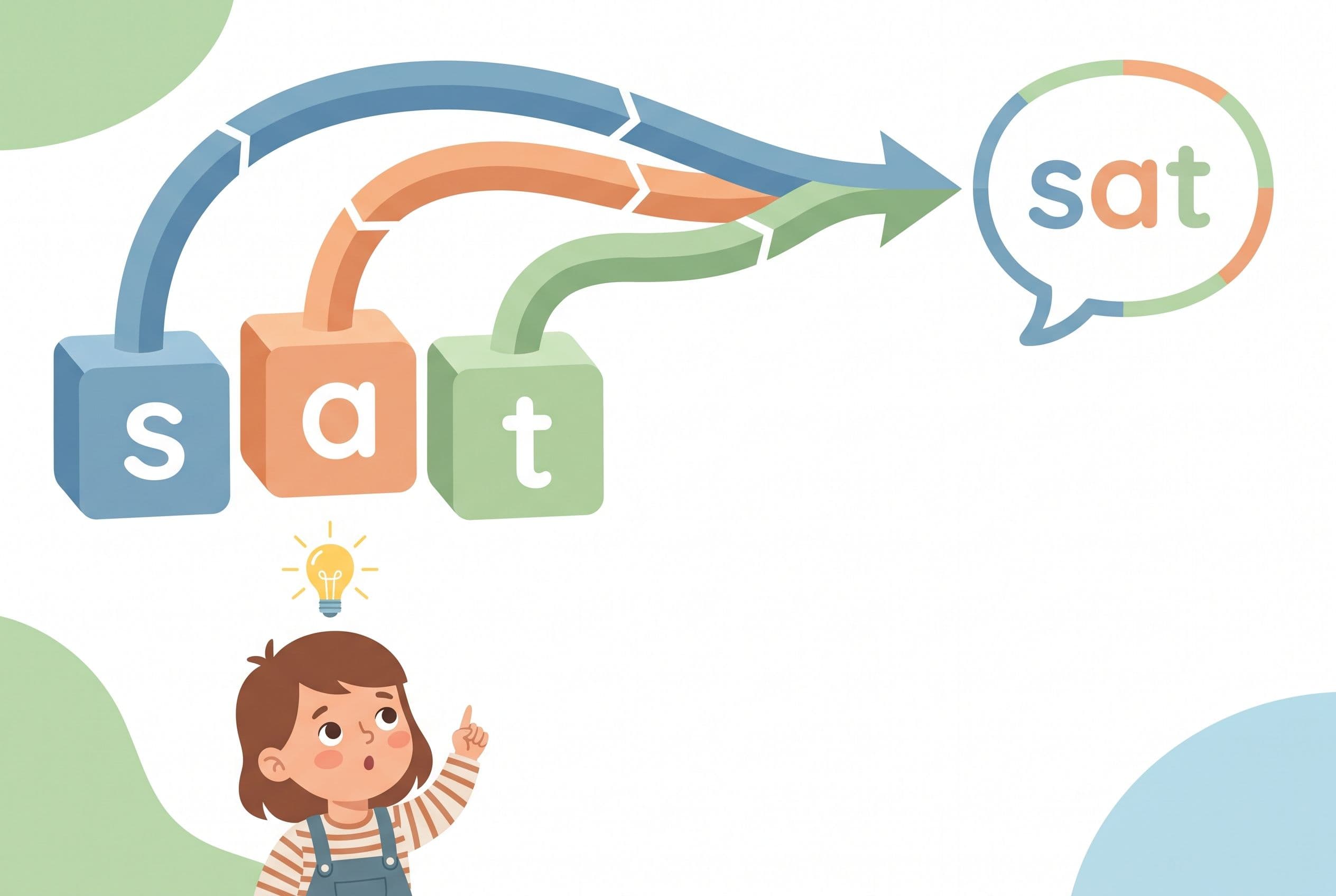
This plan assumes your child is starting from roughly the beginning — knows some letters but can't reliably decode CVC (consonant-vowel-consonant) words. If your assessment showed they're further along, jump ahead to the appropriate week.
The ground rules:
- 15 minutes a day. Every day. Birthdays. Weekends. Snow days. We Never Skip.
- No guessing from pictures. If your child looks at a picture to figure out a word, cover the picture. Sound it out. Always.
- Praise effort, not intelligence. "You worked so hard to sound that out!" not "You're so smart!"
- Stop if there are tears — but come back in 30 minutes. We're building readers, not breaking spirits.
Week 1: Letter-Sound Boot Camp
Goal: Your child knows the sounds (not just names) of at least 20 letters.
Daily session (15 min):
- Review known sounds (3 min): Flash through letter cards your child already knows. Speed matters — you want automatic recall, not slow guessing.
- Teach 2-3 new sounds (5 min): Introduce new letters with a keyword. "This is 'm.' It says /m/ like 'mouse.'" Have your child trace the letter while saying the sound. This multisensory approach comes straight from Orton-Gillingham methodology — linking the visual, auditory, and kinesthetic pathways simultaneously.
- Practice new + old together (5 min): Shuffle all cards (known and new). Go through the whole stack. Any sound they miss goes back in the "review" pile for tomorrow.
- Phonological awareness warm-up (2 min): Say a word and ask your child to tell you the first sound. "What's the first sound in 'dog'?" (/d/) Do 5-6 words.
By Friday of Week 1: Your child should be producing sounds for at least 20 letters without hesitation. Not naming them — producing the sounds.
Week 2: Blending — The Hardest Part
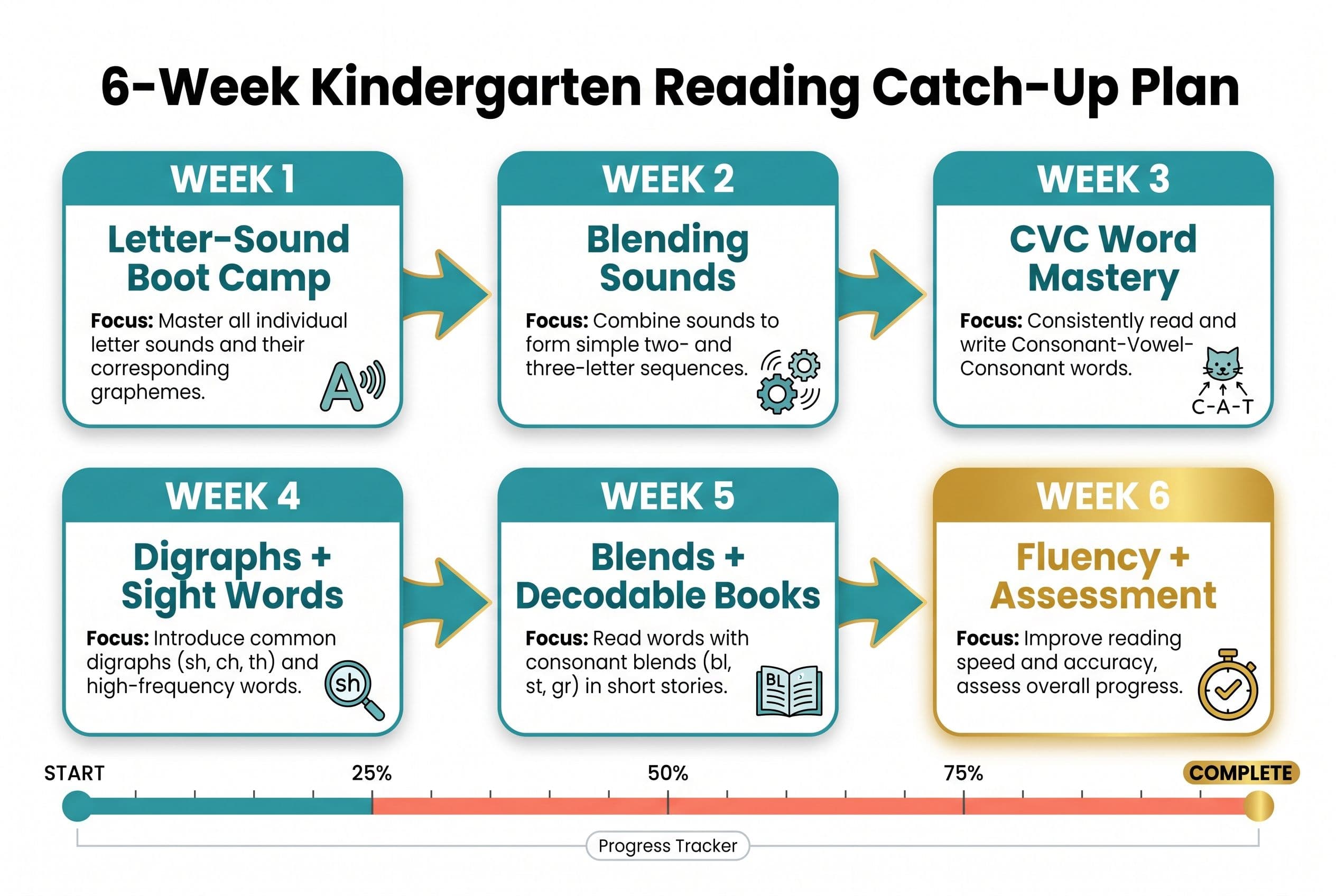
Real talk — blending is where most kids hit a wall. They know that "s" says /s/ and "a" says /a/ and "t" says /t/, but when you ask them to push those sounds together into "sat"? Blank stare.
This is normal. This is also where you earn your stripes as a parent-teacher.
Goal: Your child can orally blend 3 sounds into a word AND decode at least 5 written CVC words.
Daily session (15 min):
- Sound review (2 min): Quick flash of letter cards. Keep it snappy.
- Oral blending — no letters yet (5 min): Say sounds separately and have your child blend them: "/b/... /i/... /g/" → "big." Start with continuous sounds (m, s, f, l, n, r) because they're easier to stretch. Avoid starting with stop sounds (b, d, g, t, p, k) — those are harder to blend because they have a "puff" of air.
- Blending with letters (5 min): Write a CVC word. Point to each letter. Your child says each sound, then blends. Use your finger to slide under the letters smoothly — this physical motion helps the brain connect the "separate sounds" to "one word."
- Word reading (3 min): Write 3-5 CVC words. Have your child decode each one independently. Celebrate every success. I mean it — high-fives, fist bumps, the works.
Pro tip from the trenches: When I was teaching my 4-year-old last month, I used magnetic letters on the fridge. I'd set up "s-a-t" and physically slide the letters together while she said the sounds. Something about the tactile movement clicked for her in a way that paper and pencil didn't. Every kid has a thing that works. Find your kid's thing.
Week 3: CVC Word Mastery
Goal: Your child can decode any CVC word with short vowels — not just the ones you've practiced.
Daily session (15 min):
- Sound review (2 min): By now this should be fast. If it's not, you need more time in Week 1. Go back. Don't push ahead with shaky foundations.
- Word families (5 min): Work through word families: -at (cat, bat, mat, sat, rat), -ig (big, dig, fig, pig, wig), -op (hop, mop, pop, top, cop). This isn't memorization — it's showing your child that swapping one letter changes the whole word. That's the phonics principle in action.
- Mixed CVC decoding (5 min): Write random CVC words that aren't in families: bug, hen, lip, cod, yam. Can your child decode words they've never seen before? That's the real test.
- Sentence reading (3 min): Write super simple sentences using only decodable words: "The cat sat." "A big pig." "Mom can hop." Reading words in context — even tiny sentences — builds confidence fast.
Week 4: Consonant Digraphs + Common Sight Words
Goal: Your child can read words with sh, ch, th, ck AND knows 10-15 high-frequency words by sight.
Daily session (15 min):
- Introduce digraphs (5 min): "Sometimes two letters team up to make one sound." Teach sh (ship), ch (chip), th (this/thin), ck (duck). Use the same multisensory approach — say it, trace it, read it.
- Digraph word reading (5 min): Decode words with digraphs: shop, chin, them, sock, chap, thin, shed, chick. Mix these with plain CVC words so your child practices switching between them.
- Sight words (5 min): Some words just don't follow the rules yet at this level — "the," "was," "said," "have." Teach 2-3 per day using flashcards. I have my kids write each one three times while saying it. Not glamorous. It works.
Important: Do NOT teach sight words as "whole word memorization" the way Balanced Literacy programs do. Even irregular words have parts that follow the rules. "Said" — the "s" and "d" are regular. Only the "ai" is irregular (it says /e/ instead of /ā/). Point this out. It matters for how the brain stores the word through what David Kilpatrick calls orthographic mapping.
Week 5: Blends + Short Decodable Books
Goal: Your child can read words with consonant blends (bl, cr, st, mp, nd) and can read a simple decodable book.
Daily session (15 min):
- Introduce blends (5 min): Unlike digraphs, blends keep both sounds: "bl" = /b/ + /l/. Practice: black, crop, stop, jump, land. These are harder than CVC words because there are more sounds to track.
- Decodable book reading (10 min): This is where it all comes together. Get decodable readers — NOT leveled readers like Fountas & Pinnell, which are whole-language aligned and encourage guessing from pictures and context. Look for decodable books from publishers like Flyleaf Publishing, High Noon Books, or use Bob Books if you're starting from the very beginning.
Have your child read the book to you. When they get stuck, don't say the word. Don't tell them to look at the picture. Say: "What sounds do you see? Put them together."
No guessing. Ever. This is non-negotiable.
Week 6: Fluency Building + Assessment
Goal: Your child can read simple decodable text with enough speed and accuracy that it sounds like talking — not painful, letter-by-letter grinding.
Daily session (15 min):
- Repeated reading (7 min): Pick one decodable passage (3-5 sentences). Read it together first (you read, they follow along). Then they read it alone. Then read it again, faster. Repeated reading builds fluency because the neural pathways for those specific words get stronger each time.
- New text (5 min): Now read something they haven't seen before. This tests whether the skills transfer. Can they decode new words on the fly?
- End-of-plan assessment (3 min): Go back to the same diagnostic you did at the start. How many letter sounds? Can they blend? Can they decode CVC words? Words with digraphs? Blends?
What you should see by the end of Week 6:
- Automatic letter-sound recognition for all 26 letters
- Ability to decode CVC words, digraph words, and words with beginning/ending blends
- 10-15 sight words recognized instantly
- Ability to read a simple decodable book with minimal help
That's not "reading at grade level." That's "on the right track with a strong foundation." And honestly? That foundation is worth more than a kid who's memorized 100 sight words but can't sound out "splint."
What If the Plan Isn't Working?
Let me be straight with you. If you've done this plan faithfully — truly every day, 15 minutes, with systematic instruction — and your child still can't blend sounds after 3-4 weeks, it's time to dig deeper.
That doesn't mean your child is broken. It might mean they have a phonological processing weakness that needs more targeted intervention. Here's what to do:
- Ask your school for a formal evaluation. You have a legal right to request one. They have 60 days to complete it in most states.
- Get a private evaluation if the school drags its feet. Look for a reading specialist who uses DIBELS or the Kilpatrick PAST test, not one who puts your kid on a computer program and calls it "reading intervention."
- Look into structured literacy programs. Orton-Gillingham-based programs like Barton Reading & Spelling or UFLI Foundations are designed for kids who need more intensive, explicit instruction. The International Dyslexia Association recommends structured literacy as the gold standard.
- Don't stop the daily practice at home. Whatever the school does or doesn't do, your 15 minutes a day continues. We Never Skip.
Mississippi's a good example of what's possible when a whole system gets serious. After its Literacy-Based Promotion Act of 2013, the state overhauled how reading was taught — stronger phonics-aligned curriculum, universal screening, intensive intervention for struggling readers, and heavy investment in teacher coaching and training. Between the 2013 and 2019 NAEP 4th-grade reading assessments, Mississippi's scores climbed from near the bottom of state rankings into the middle of the pack. Multiple factors drove that improvement, but the throughline was exactly what I'm asking you to do at your kitchen table: teach phonics explicitly, intervene early, and refuse to accept "wait and see."
Teach Your Kid to Read: Your Partner in This Plan
You don't have to figure out the sequencing, the pacing, or the lesson plans on your own. That's exactly why we built start lesson one free Teach Your Kid to Read.
Our program is built on the same systematic synthetic phonics methodology that underpins this 6-week plan — the same science-backed approach recommended by the National Reading Panel in their landmark 2000 report. Every lesson follows a carefully sequenced progression from letter sounds to blending to decoding to fluency. No guessing. No pictures as crutches. Just the real deal.
If your kindergartner is behind, the worst thing you can do is nothing. The second worst thing is to use a program that teaches guessing strategies disguised as "reading."
The best thing? Start today. Fifteen minutes. Your kitchen table. Go.
Frequently Asked Questions
Is it normal for my kindergartner to not be reading yet?
It depends on what you mean by "not reading." If your child is at the beginning of kindergarten and can't decode words yet, that's within the range of typical development — but they should know most letter sounds by now. If your child is in the second half of kindergarten and still can't blend three sounds into a word, that's a red flag. The National Reading Panel was clear: systematic phonics instruction should start early, and waiting for a child to "be ready" is not supported by the research. Don't wait.
Should I be worried if my kindergartner is behind in reading?
Yes — but channel that worry into action, not anxiety. The data from the 2022 NAEP shows that two-thirds of American 4th graders aren't reading proficiently. Most of those kids showed warning signs in kindergarten. The Annie E. Casey Foundation found that kids who can't read by 3rd grade are 4x more likely to drop out. Early intervention is everything. A structured 15-minute daily phonics routine can close gaps fast.
How long does it take a kindergartner to learn to read?
Every child is different, and I refuse to give you a magic number. But here's a realistic range: a child with solid phonological awareness and daily systematic phonics instruction can typically decode simple CVC words within 4-8 weeks and read basic decodable books within 3-4 months. Kids with phonological processing weaknesses may need 6-12 months of intensive, structured literacy instruction. The key variable isn't your child's intelligence — it's the quality and consistency of instruction.
What's the difference between decodable books and leveled readers?
This is a big deal and most parents don't know the difference. Decodable books use only letter-sound patterns the child has already been taught — so a kid who knows short vowels and basic consonants can actually sound out every word in the book. Leveled readers (like the Fountas & Pinnell system) include words the child hasn't been taught and expect them to use pictures, context, and guessing to figure them out. That's a Balanced Literacy strategy, and it trains kids to guess instead of decode. Use decodable readers. Bob Books, Flyleaf Publishing, and the UFLI decodable texts are all solid options.
Can an app really teach my kindergartner to read?
An app alone? No. A well-designed app that uses systematic synthetic phonics AND is paired with a parent who reinforces lessons? Absolutely. That's how Teach Your Kid to Read works — it gives you the structured, sequenced lessons based on Orton-Gillingham principles, and you provide the daily 15 minutes of attention and practice. The combination of screen-based instruction and real-world reinforcement at the kitchen table is powerful. The app handles the methodology. You handle the consistency.
Part of these guides

Xia Brody
Co-Founder, Teach Your Kid to Read
Mom of 4 who has successfully taught her kids to read. Currently in the trenches with her 4-year-old while her two oldest (10 and 7) devour books on their own. Passionate about phonics-based methods and building a lifelong love of reading.
Related Articles
Is My 5 Year Old Behind in Reading? Age-by-Age Signs
Wondering if your 5-year-old should already be reading? Here’s the no-panic, no-waiting checklist for age 5 reading milestones, warning signs, and next steps.
Read More →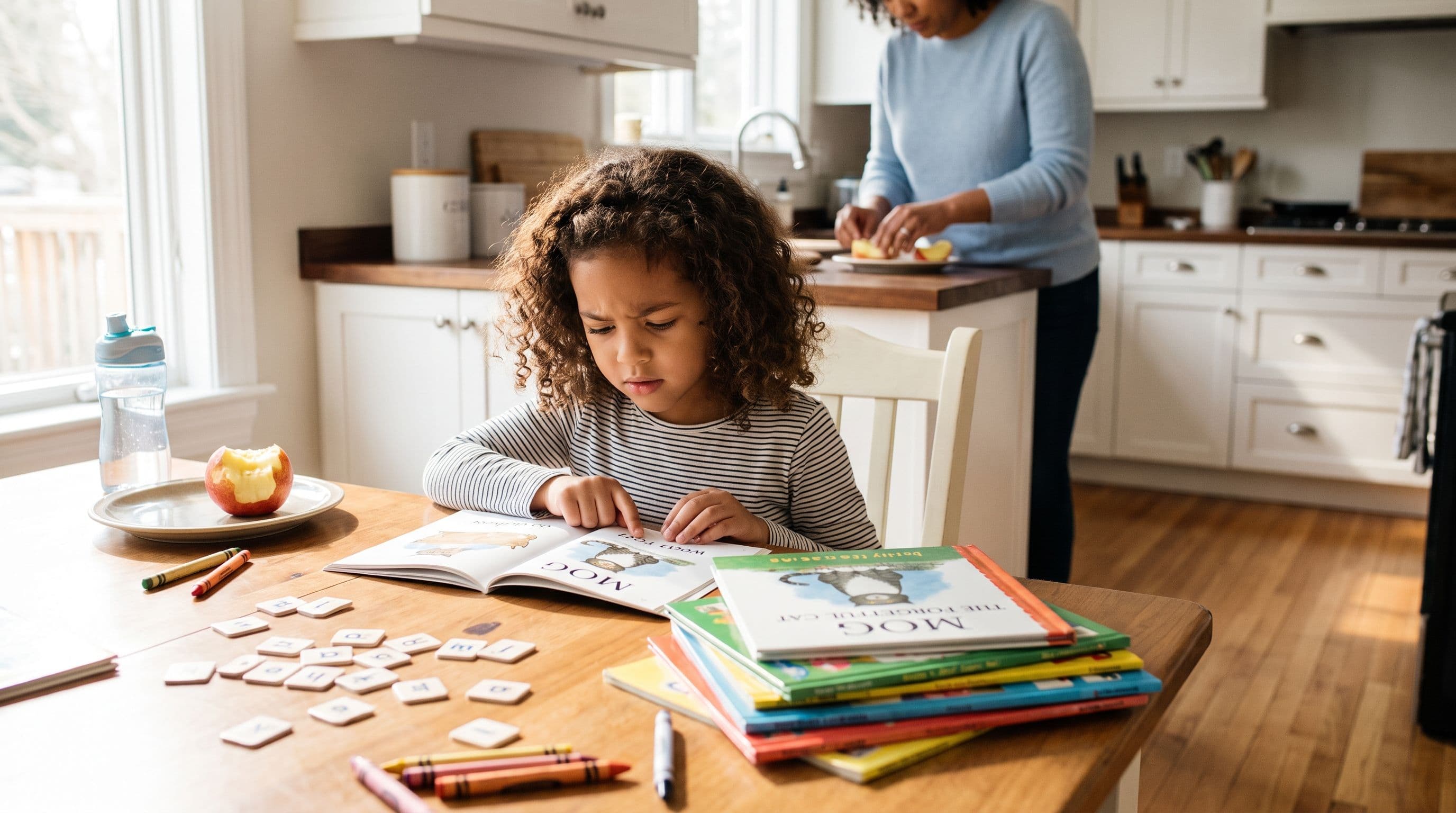
My 5 Year Old Can't Read: What to Do This Week
If your 5-year-old can't read yet, don't panic — but don't wait and see either. Here's what age-5 reading should look like, when to worry, and the phonics plan I'd start this week.
Read More →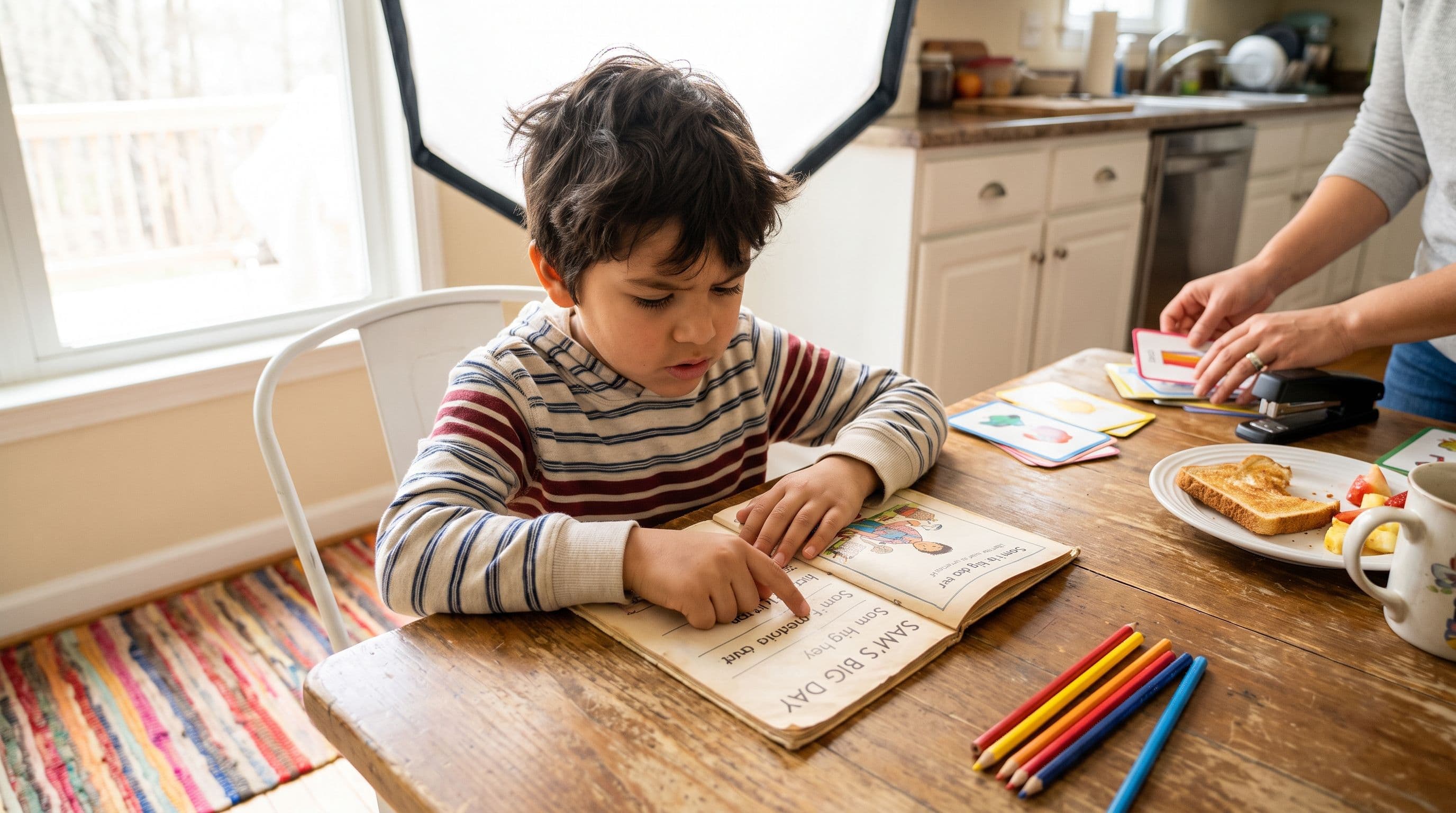
My 7 Year Old Can't Read: 9 Steps to Act Now
If your 7-year-old still can't read, don't panic—but don't wait. Here's how to check the gap, stop guessing habits, and start a real phonics plan at home.
Read More →