Khan Academy Kids vs HOMER: Reading App Showdown (2026)
What You'll Learn
- Why the most popular reading apps aren't always the most effective — and the one phonics gap both Khan Academy Kids and HOMER share
- How each app handles phonics vs. sight words — and which approach the brain science actually supports
- The specific skill neither app fully covers that research says predicts reading success better than IQ
- What to do if your kid is already using one of these apps and you're not sure it's enough
The Real Question Nobody's Asking
Let me save you the suspense: both Khan Academy Kids and HOMER are beautifully designed apps. Both have cute characters. Both will keep your preschooler busy for 20 minutes while you make dinner.
But that's not what you asked me, is it?
You asked me which one actually teaches your kid to read. And that's a completely different question — one that requires me to stop being polite and start being specific.
Here's the uncomfortable truth. Most "reading apps" for kids are engagement machines first and literacy tools second. They're built to keep kids tapping, swiping, and earning stickers. The reading instruction? It's there, but it's often watered down, out of sequence, or mixed with so many games and songs that your kid spends 15 minutes on the app and gets maybe 3 minutes of actual phonics practice.
I'm not saying fun is bad. I'm saying fun without systematic phonics instruction is just... entertainment. And entertainment doesn't teach reading.
Why This Matters More Than You Think
Only 33% of 4th graders read at a proficient level on the 2022 NAEP — that's the Nation's Report Card, not some random survey. Two out of three American kids can't read well enough to learn from a textbook by 4th grade.
The 2023 NAEP scores? Even worse. Reading scores dropped 3 points since 2019 — the largest decline in 30 years.
And here's the part that should keep you up tonight: kids who can't read by 3rd grade are four times more likely to drop out of high school. That's from the Annie E. Casey Foundation's 2010 study. Not a blog post. Not an opinion. A longitudinal study tracking real kids.
So when parents ask me "Is Khan Academy Kids good for reading?" or "Should I use HOMER?" — I don't just compare features. I compare each app against what the actual reading science says works. Because getting this wrong isn't a minor inconvenience. It's a trajectory change.
The average remedial reading program costs $10,000-$15,000 per year, and insurance doesn't cover it. You know what costs less? Getting phonics right the first time.
Khan Academy Kids: The Honest Breakdown
What It Gets Right
Khan Academy Kids is free. Completely free. No ads, no in-app purchases, no premium tier. In a world where every app wants $9.99/month, this is genuinely impressive.
The app covers a massive range — math, social-emotional learning, reading, writing, logic. It's basically a preschool curriculum in your pocket. The characters (Kodi the bear, Ollo the owl) are adorable without being annoying, and the interface is clean enough that a 3-year-old can navigate it.
For reading specifically, Khan Academy Kids includes:
- Letter recognition activities
- Some letter-sound correspondence (phonics!)
- Vocabulary building through read-aloud stories
- Basic sight word practice
- Rhyming and phonological awareness games
What It Gets Wrong
Here's where I put on my tiger mom hat.
Khan Academy Kids' phonics instruction is not systematic. Let me explain what that means, because it's the whole ballgame.
The National Reading Panel — the one Congress actually commissioned back in 2000 — found that systematic phonics instruction produces significant benefits for reading. The key word is systematic. That means teaching letter-sound correspondences in a planned, sequential order. Not randomly. Not "today we'll do B because our story has a bear in it."
Khan Academy Kids introduces letter sounds, yes. But the sequence isn't tightly controlled, and the app mixes phonics with whole-language strategies like memorizing sight words and using picture context. A kid might practice the /m/ sound one day, then jump to a story activity where they're guessing words from illustrations the next.
Stanislas Dehaene, the French neuroscientist behind Reading in the Brain (2009), proved that the brain has to be explicitly trained to map sounds to letters. It doesn't happen naturally from exposure. You can't just surround a kid with books and hope the neural pathways wire themselves. That's like hoping your kid learns to swim by watching the pool.
Khan Academy Kids is fantastic for general kindergarten readiness. But as a standalone phonics program? It's not enough. Not even close.
The Phonics Gap
Khan Academy Kids doesn't explicitly teach blending. A child can tap on the letter M and hear /m/, and tap on A and hear /a/ — but the app doesn't systematically walk her through blending /m/ + /a/ + /t/ into "mat." That blending step — that's the magic trick. That's where reading actually happens.
David Kilpatrick's research in Equipped for Reading Success (2016) makes this point clearly: orthographic mapping — the process by which the brain permanently stores a word — is powered by phoneme-level skills like segmenting and blending, working together with solid letter-sound knowledge. The stronger those skills are, the easier it is for kids to bond spellings to pronunciations and meanings. Kids need to segment and blend sounds at a level that most apps don't even attempt to build.
HOMER: The Honest Breakdown
What It Gets Right
HOMER takes a more structured approach to reading than Khan Academy Kids. It creates a personalized "learning pathway" based on your child's age and interests, and it does introduce phonics concepts in a somewhat sequential order.
Here's what HOMER does well:
- Phonics stories that use decodable text (meaning kids read words using sounds they've actually been taught)
- Letter-sound instruction that covers common grapheme-phoneme correspondences
- Blending practice — it actually walks kids through sounding out words, which is more than many apps do
- A reading confidence assessment that adjusts difficulty
HOMER also includes a big library of stories. Some are read-alouds (good for vocabulary and comprehension), and some are "read along" where the kid practices reading text.
What It Gets Wrong
HOMER costs money — it's a paid subscription (check HOMER's site for current pricing). For families on a tight budget, that matters.
But the bigger issue isn't the price — it's the methodology. HOMER blends phonics with a "balanced" approach. There are sight word lists. There are leveled readers that aren't always decodable. And the app leans heavily on engagement features (stickers, rewards, characters, mini-games) that can distract from the actual reading instruction.
I was at a playground in Raleigh a few months ago when another mom told me her kid's school had just switched from Lucy Calkins to a Science of Reading curriculum because of North Carolina's SB 387 — the Excellent Public Schools Act. She was confused and a little annoyed. "He was doing fine before," she said. I asked if her son could read the word "splint." He's in second grade. He could not. I spent 20 minutes on that playground bench explaining why the switch was happening — Emily Hanford's reporting at APM, the NAEP data, the neuroscience from Dehaene's lab showing the brain doesn't learn to read naturally. She went home and listened to the Sold a Story podcast that night. Texted me at 11pm: "I had no idea. Why didn't anyone tell us this sooner?"
That mom? She'd been using HOMER with her younger daughter. She assumed the app was handling the reading part. And HOMER was teaching letter sounds, sure. But it was also teaching her daughter to look at pictures for clues — which is literally the three-cueing strategy that Sold a Story exposed as ineffective.
Real talk — prompting kids to rely on pictures or context instead of letter-sound decoding is not supported as an effective method for teaching word-reading. It actively undermines decoding habits. Share's self-teaching hypothesis shows kids learn new words by decoding them, not by guessing from context. So if an app tells your kid to "look at the picture for a clue," that app is working against the very skill your child needs to build. Full stop.
Head-to-Head: Khan Academy Kids vs HOMER
Phonics Quality
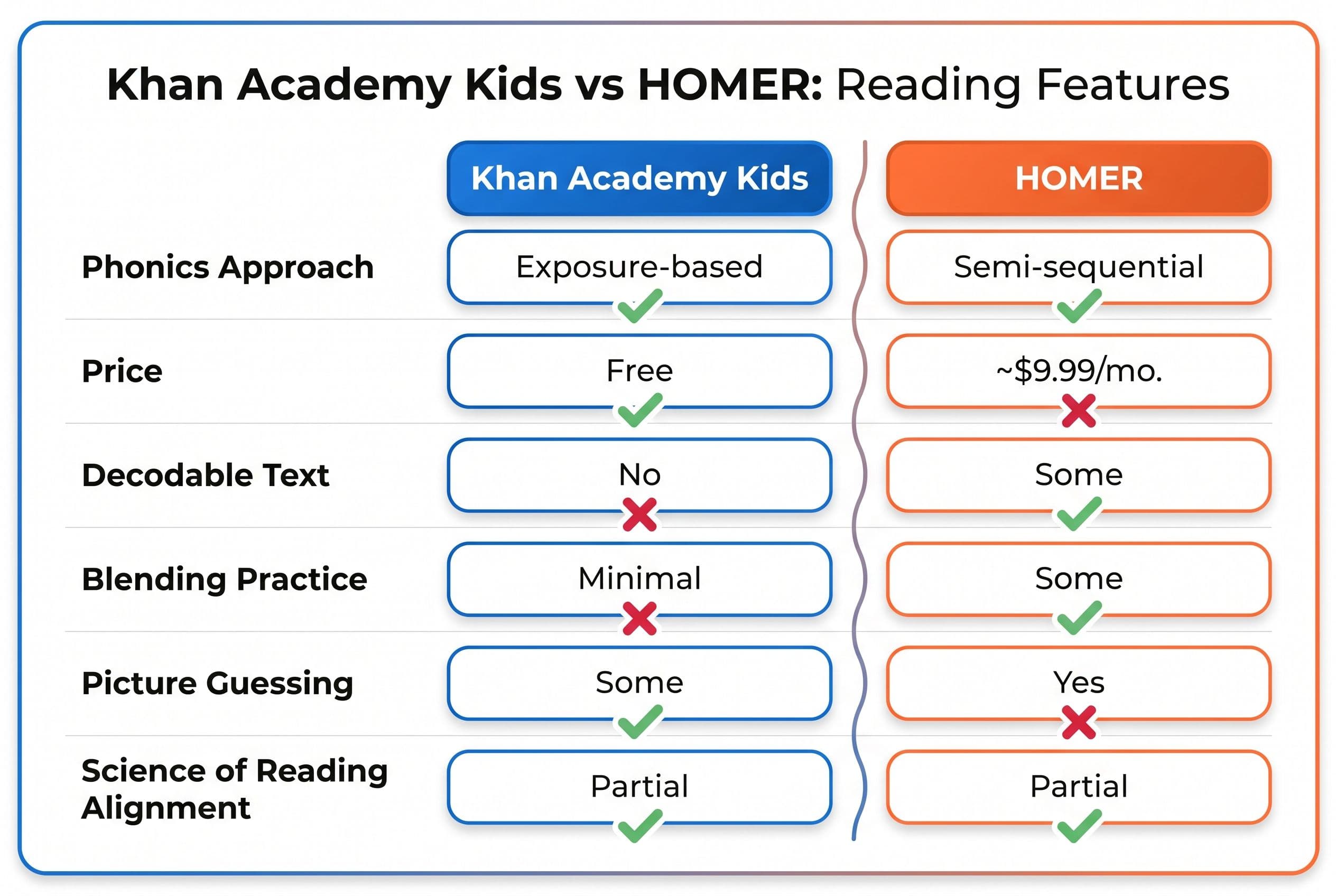
| Feature | Khan Academy Kids | HOMER |
|---|---|---|
| Letter-sound instruction | Yes, but not sequential | Yes, more sequential |
| Blending practice | Minimal | Some |
| Decodable text | No | Some stories |
| Systematic progression | No | Partial |
| Three-cueing / guessing | Some picture cues | Yes, uses picture cues |
| Phonemic awareness drills | Basic rhyming | Basic |
Winner on phonics: HOMER, but it's a B-minus beating a C-plus. Neither app follows a truly systematic synthetic phonics sequence like you'd find in programs built on Orton-Gillingham principles — think UFLI Foundations, Fundations, or Logic of English.
Price
- Khan Academy Kids: Free. Zero. Nada.
- HOMER: Paid subscription — check HOMER's site for current pricing
Winner on price: Khan Academy Kids, hands down.
Engagement
Both apps are gorgeous. Both keep kids coming back. HOMER has a slight edge for reading-specific engagement because its stories are more interactive. Khan Academy Kids wins for breadth — it covers math, logic, and social-emotional learning too.
Winner on engagement: Tie. Both are excellent at keeping small humans entertained.
Science of Reading Alignment
Here's the kicker. Neither app fully aligns with the Science of Reading.
Linnea Ehri's research on word reading development (her 2005 meta-analysis is the gold standard) shows that kids move through phases: pre-alphabetic, partial alphabetic, full alphabetic, and consolidated alphabetic. To progress through those phases, kids need systematic, explicit phonics instruction paired with phonemic awareness training and practice with decodable text.
Khan Academy Kids offers exposure, not systematic instruction. HOMER gets closer but muddles its phonics with balanced literacy strategies.
The Simple View of Reading (Gough & Tunmer, 1986) tells us that reading comprehension = decoding × language comprehension. Both apps do a decent job on the language comprehension side (vocabulary, read-alouds, stories). But decoding — the phonics part — is where both apps leave gaps.
Winner on Science of Reading alignment: Neither. I'm serious. Neither one is sufficient as your child's primary reading instruction.
So What Should You Actually Do?
OK, I know that's not what you wanted to hear. You wanted me to say "pick this one" and call it a day. But I'd be lying to you, and I don't do that.
Here's what I tell every parent who asks me about reading apps:
An app is a supplement. It is not a teacher.
Mississippi proved this at scale. Their Literacy-Based Promotion Act of 2013 didn't hand kids iPads and hope for the best. They retrained teachers in systematic phonics, used Science of Reading curricula, and held kids to real benchmarks. They went from 49th to 21st in national reading scores in six years. That happened because of structured, explicit, human-led instruction. Not apps.
Now look — I get it. You're busy. I have four kids. My one-year-old is currently chewing on a board book as I write this. You need something your kid can do independently while you handle life.
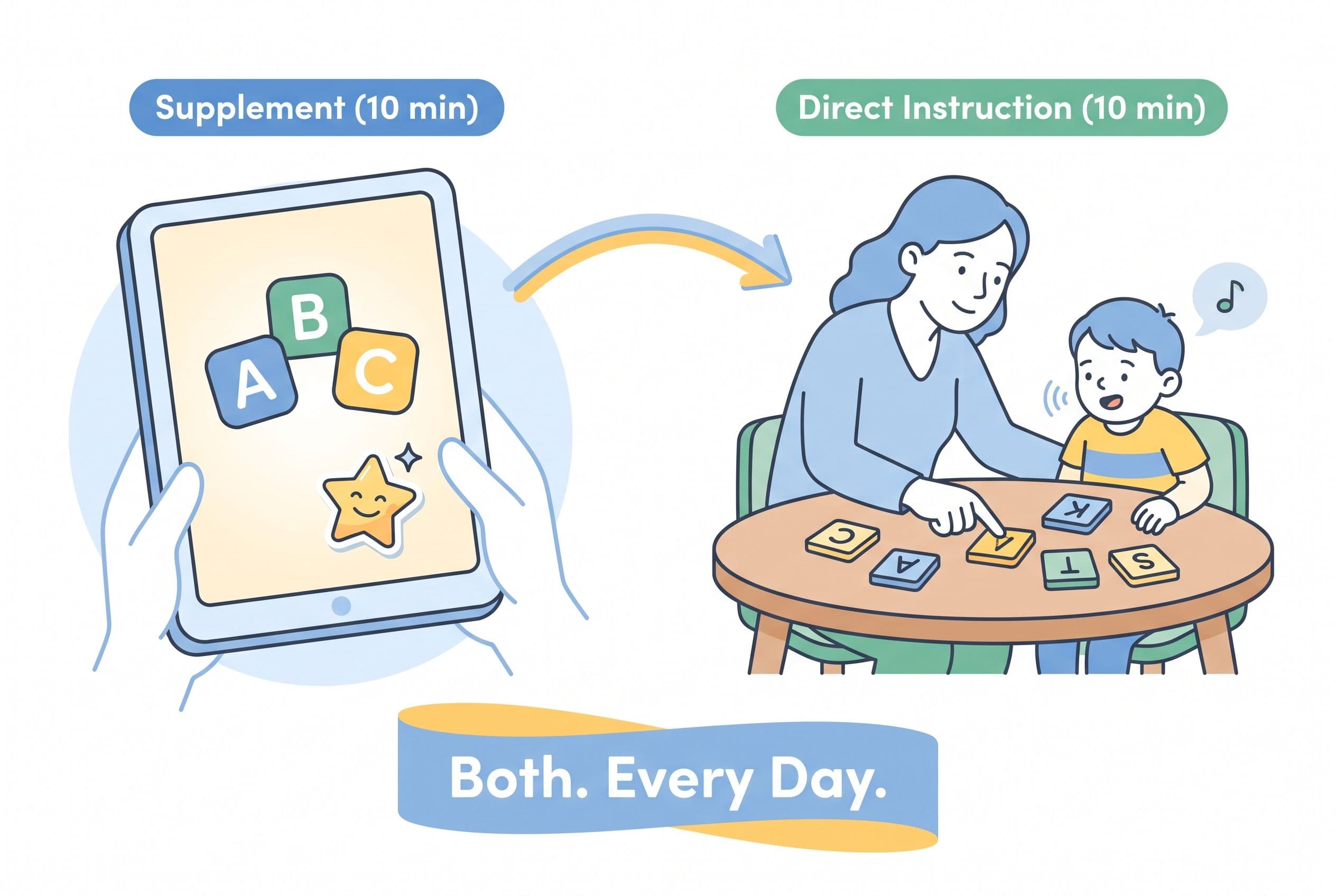
But here's my no-negotiable: the app gets 10-15 minutes. You get 10-15 minutes. Every single day. Birthday? We still do phonics. Christmas morning? After presents, before pie, we do phonics. Vacation? We packed the flashcards.
Those 10-15 minutes of direct instruction — you sitting with your kid, sounding out words, drilling letter sounds, reading decodable texts together — that's where the real learning happens. The app is the warm-up. You're the main event.
Here's Your Actual Plan
Step 1: Assess Where Your Kid Is Right Now
Don't guess. Use Kilpatrick's PAST (Phonological Awareness Screening Test). It takes about 5 minutes and tells you exactly where the phonological breakdown is. If your kid can't segment and blend individual phonemes, you need to start there — no app will fix that for you.
Here's a quick gut check: can your child quickly produce letter sounds and read simple CVC nonsense words (like "nup" or "tat") without hesitating? If not, you need more explicit phonics than any app provides. That's your signal to get serious.
Step 2: Use the App Strategically
If budget is a factor, use Khan Academy Kids for letter recognition and general academic readiness. It's free and it's solid for what it is. Don't rely on it for phonics.
If you can afford HOMER, its phonics stories are better than Khan's. Use them as supplementary reading practice after you've taught the sounds yourself. But watch out for the picture-guessing activities. Skip them. I'm serious — if you see your kid looking at a picture instead of sounding out a word, intervene immediately.
Step 3: Add a Real Phonics Program
Neither Khan Academy Kids nor HOMER replaces a systematic phonics curriculum. Here are programs that actually follow the Science of Reading:
- UFLI Foundations — free, developed at the University of Florida, explicit and systematic
- Teach Your Kid to Read — this is what we built, and it follows Orton-Gillingham principles with a systematic synthetic phonics sequence designed specifically for parents teaching at home
- Logic of English — thorough and research-based, good for kids who need more structure
- Explode the Code — workbook-based, sequential, and affordable
Step 4: Practice With Decodable Readers (Not Leveled Readers)
This is where so many parents go wrong. Fountas & Pinnell leveled readers are everywhere — in schools, libraries, and apps like HOMER. But they're whole-language aligned. A Level C book might throw the word "beautiful" at a kid who just learned the letter B. The kid guesses from the picture. The parent thinks they're reading. They're not.
Decodable readers only use words the kid can actually sound out based on what they've been taught. Look for decodable readers from Flyleaf Publishing, High Noon Books, or the ones built into UFLI Foundations.
Step 5: 10 Minutes a Day With Your Kid. Non-Negotiable.
Sit with them. Drill the sounds. Practice blending. Read a decodable text together. Correct every guess — "Don't look at the picture. Look at the letters. What sound does this one make?"
That's it. That's the plan. It's not glamorous. It works.
The Bottom Line on Both Apps
Khan Academy Kids is a wonderful free app that does many things well. Reading instruction isn't one of them. Use it for math, for stories, for keeping your kid engaged with learning. Don't count on it to teach phonics.
HOMER is a step up for reading specifically, with better phonics stories and more sequential instruction. But it still uses balanced literacy strategies, it costs money, and it's not rigorous enough to be your child's primary reading program.
The 40+ states that have now passed Science of Reading legislation since 2019 didn't do it because apps were handling the job. They did it because an entire generation of kids was taught to guess at words instead of decode them, and the results were catastrophic.
Don't outsource the most important skill your child will ever learn to a monthly-subscription app. Or a free one, for that matter.
Be the teacher. Use the app as a tool. Drill the sounds. Demand accuracy. Do it every day.
That's how kids learn to read.
Frequently Asked Questions
Is Khan Academy Kids good enough to teach my child to read?
No — not on its own. Khan Academy Kids is excellent for general kindergarten readiness, letter recognition, and vocabulary building. But its phonics instruction isn't systematic or sequential enough to teach a child to decode words independently. Think of it as a great supplement to real phonics instruction, not a replacement for it.
Is HOMER worth paying for over Khan Academy Kids?
If reading is your primary concern, HOMER does offer better phonics content — decodable stories, some blending practice, and a more structured progression. But it still mixes phonics with balanced literacy strategies like picture guessing. Whether it's worth the subscription price depends on your budget, but either way, you'll still need a dedicated phonics program alongside it.
What's the best free reading app for kids in 2026?
Khan Academy Kids is the best truly free reading app available — no ads, no premium tier, no hidden costs. But "best free app" and "best way to teach reading" are different questions. For actual phonics instruction, look at UFLI Foundations (free curriculum from the University of Florida) combined with Teach Your Kid to Read for a systematic, Science of Reading-aligned approach that goes far beyond what any single app offers.
At what age should I start using reading apps with my child?
Khan Academy Kids is designed for ages 2-8, and HOMER targets ages 2-8 as well. You can introduce them around age 3 for letter recognition and early phonological awareness. But here's my rule: app time should never replace direct instruction time. At age 3-4, focus on letter sounds and phonemic awareness games — in person, with you. Add an app for 10-15 minutes of reinforcement, not as the main event.
My kid loves HOMER but still can't sound out simple words. What's going on?
This is more common than you'd think. Your child is probably memorizing words by shape or guessing from picture context — which is exactly what balanced literacy apps train them to do. Run Kilpatrick's PAST test to see where the phonological awareness breakdown is. Then start systematic blending practice with CVC words (consonant-vowel-consonant, like "mat," "sit," "hop"). Work through them with physical letter tiles or flashcards, not a screen. The app kept your kid busy. Now you need to teach them to actually decode.
Part of these guides

Xia Brody
Co-Founder, Teach Your Kid to Read
Mom of 4 who has successfully taught her kids to read. Currently in the trenches with her 4-year-old while her two oldest (10 and 7) devour books on their own. Passionate about phonics-based methods and building a lifelong love of reading.
Related Articles

Best Free Reading Apps for Kids: 7 Truly Free Picks (2026)
Most "free" reading apps aren't free — they're a 7-day trial with a credit card form at the end. Here are 7 that are genuinely free, which ones actually teach phonics, and the one thing no app can do for your child.
Read More →
Reading.com vs HOMER: Which App Is Better in 2026?
Reading.com and HOMER are two of the most popular reading apps for young kids, but they take very different approaches. Here's a brutally honest comparison of what each app actually does — and what the reading science says about both.
Read More →
Reading.com vs Teach Your Monster to Read: Parent Pick
Choosing between Reading.com and Teach Your Monster to Read? Here’s the no-fluff parent pick from Xia Brody: what each app teaches, where it falls short, and which reading app I’d use for kindergarten phonics.
Read More →