Best Free Reading Apps for Kids: 7 Truly Free Picks (2026)

What You'll Learn
- Which 7 reading apps are actually free — not "free with a 7-day trial and a US$12.99/month autorenew"
- The sneaky feature inside three popular kids' apps that trains your child to guess at words instead of read them
- Why the most effective free phonics resource on this list isn't an app at all (and it's a PDF)
- The 20-minute conversation I had on a playground bench in Raleigh that made a mom text me at 11pm saying "why didn't anyone tell us this sooner?"
Reality Check: "Free" Usually Means "Free For Six Days"
You searched for the best free reading apps for kids because you want your child reading and you don't want to hand over US$120 a year to do it.
Fair. I've been there.
But here's what happens. You download an app labeled FREE, your 4-year-old plays it for four days, gets attached to the cartoon owl, and on day seven a payment screen appears. Now you're the villain.
I've compared a lot of these apps. Most "free learn to read app" listings fall into three buckets: free trials, ad-stuffed junk, or genuinely free but pedagogically useless.
And honestly? The pedagogically useless ones scare me more than the paywalls. An app that costs nothing but teaches your kid to look at the picture and guess is doing damage you'll pay to undo later.

The Tiger Truth: What Bad Free Apps Actually Cost You
Let me put numbers on this.
On the 2022 NAEP — that's the US Nation's Report Card, run by the federal government — only 33% of 4th graders (ages 9-10) read at or above proficient. The 2024 NAEP results released in early 2025 dropped it again, to around 31%. That's the lowest 4th grade reading score in over 30 years of US testing.
Quick honesty note before you spiral: NAEP "Proficient" is a stretch bar, not a pass/fail line. Think solid B-level work, not "can this child read a menu." Plenty of kids below that line can read basic text just fine. But the trend line has been sliding for a decade, and that part is still unacceptable — so don't let anyone talk you into calming down about it.
Those kids had iPads. Lots of them. Screens didn't save anybody.
The Annie E. Casey Foundation's 2010 report found that children who aren't reading proficiently by the end of 3rd grade (ages 8-9) are four times more likely to leave school without a diploma. For kids from low-income households who also read poorly, it's six times.
And if you end up in remediation? A private Orton-Gillingham tutor in the US runs US$60-US$120 an hour. Twice a week for a school year is US$5,000-US$10,000. Lindamood-Bell intensive clinics can run to thousands of dollars for a summer. In the UK and Australia, specialist dyslexia tutoring lands in a similar range.
So yes — pick a free app. But pick one that teaches grapheme-phoneme correspondence, not one that teaches your kid to look at a picture of a boat and say "boat" when the word says "ship."
The Playground Conversation That Sums Up This Whole Problem
Last spring I was at a playground in Raleigh, North Carolina, kids everywhere, my 1-year-old eating mulch. Another mom and I got talking. Her son's school had just switched off Lucy Calkins' Units of Study to a Science of Reading curriculum, because of North Carolina's SB 387 — the Excellent Public Schools Act, one of the US state laws that mandated evidence-based reading instruction.
She was annoyed. "He was doing fine before," she told me. "And we do reading apps at home every night anyway."
I asked what apps. Epic and one of the big subscription ones with the character avatars. Then I asked if her son could read the word splint.
He's in 2nd grade (ages 7-8). He could not. He looked at it and said "splash." He'd taken the first two letters and guessed.
I spent 20 minutes on that bench explaining why the switch was happening. Emily Hanford's reporting in "Sold a Story" from APM Reports. The NAEP numbers. Stanislas Dehaene's neuroscience work in Reading in the Brain (2009), which showed the human brain has no reading module — it hijacks the visual word form area and has to be trained, letter by sound, or it doesn't happen.
She went home and listened to the whole podcast that night. Texted me at 11pm: "I had no idea. Why didn't anyone tell us this sooner?"
Nobody told her. That's the whole problem. Her app subscription looked like reading instruction. It was a digital library with a leveling system.
So let's fix that.
Are Reading Apps Free? Here's the Honest Breakdown
Three categories:
- Truly free. No ads, no in-app purchases, no trial. Usually funded by a nonprofit, a university, or a very large company's goodwill budget.
- Freemium. A real free tier exists, but the good stuff is gated. Sometimes still worth it.
- Free trial. Not free. Stop calling it free.
Everything below is category 1 or 2 — but check each one's current terms before you download.
The 7 Best Free Reading Apps for Kids in 2026
1. Khan Academy Kids — The Best Truly Free Option, Full Stop
Zero cost. Zero ads. Zero in-app purchases. Available in the US, UK, Australia, Canada, New Zealand — anywhere with the app stores.
Khan Academy Kids covers letter names, letter sounds, blending, and early decodable text for ages 2-8. It's not a full systematic synthetic phonics program — the sequence wanders and it mixes in math, social-emotional learning, and drawing — but the phonics content that's there is sound-first, not guess-first.
Letting your kid do the letter-sound activities while you're nursing the baby is a legitimate use case, and I'm not going to pretend otherwise.
Weakness: No mastery gate. Your child can skate past a skill they haven't actually learned.
2. Teach Your Monster to Read — Free on a Computer Browser
This is the one people always ask about: is teach your monster to read free? On a desktop or laptop browser at teachyourmonster.org, yes, completely free. The mobile app version is a one-time US$8.99 (as of October 2026).
It was built by the Usborne Foundation in the UK with input from reading researchers, and it follows a synthetic phonics sequence — the same approach validated by the Clackmannanshire study out of Scotland (Johnston & Watson, 2005), where synthetic phonics kids finished 3.5 years ahead of their chronological reading age.
Set the difficulty level honestly. Parents pick "Champion" because their kid "knows their letters." Knowing letter names is not knowing letter sounds. Start at the beginning.
3. Starfall — The Free Tier Still Earns Its Spot
Starfall's been around since 2002 and the "ABCs" and "Learn to Read" sections are still free without an account. The paid Home Membership is US$35/year, which is genuinely cheap, but you don't need it for phonics.
The Learn to Read section is organized by short vowel — short a, short e, short i — with decodable text. That's the right structure. It's dated-looking. Kids don't care.
4. Duolingo ABC — Free, No Ads, Surprisingly Systematic
Duolingo made this one free and kept it free. For ages 3-8. It runs a phonics-first sequence with letter sounds, blending, and short decodable stories, and it does gate progression better than most.
Good for: a kid who's already got most letter sounds and needs blending reps. Not a replacement for you sitting next to them.
5. PBS Kids Games — Free Everywhere, Genuinely Educational
US public broadcasting, free globally on the app stores. The literacy games tied to Super Why! and Martha Speaks hit rhyming, letter sounds, and word families.
Here's my honest take: this is the best phonological awareness filler on the list. Rhyming, syllable clapping, sound matching. David Kilpatrick's Equipped for Reading Success (2016) makes the case that phonemic awareness at the advanced level — deleting and substituting individual sounds — is what separates kids who orthographically map words easily from kids who don't. PBS games hit the early end of that skill ladder.
6. Libby (or BorrowBox) — Free Books, Not Free Instruction
With a library card, Libby gives you thousands of ebooks and audiobooks at no cost — US, Canada, UK, Australia, New Zealand. BorrowBox is the common alternative in Australian and UK library systems.
This is not a free phonics app. It's a book supply. But once your child can decode, volume matters enormously, and Libby is how you get volume without a book budget.
Audiobooks count too. Per the Simple View of Reading (Gough & Tunmer, 1986), reading comprehension = decoding × language comprehension. Audiobooks build the second half while you're drilling the first.
7. UFLI Foundations Free Resources + FCRR Activities — Not an App, Better Than Most Apps
The University of Florida Literacy Institute posts free virtual teaching resources for its UFLI Foundations program — the scope and sequence, the sound cards, the online decodable word lists. The Florida Center for Reading Research (FCRR) posts hundreds of free Student Center Activities PDFs by skill level.
Cost: nothing. Format: PDFs and web pages. Cool factor: zero.
Effectiveness: highest on this list, by a wide margin, because it's a systematic scope and sequence rather than a pile of games. Print the word lists. Sit at the table. Nine minutes.

The "Free" Apps I'd Skip (And Why)
Anything built on leveled readers with heavy picture support. If the strategy your child learns is "look at the picture, look at the first letter, guess a word that makes sense" — that's the three-cueing system. That's the exact method Hanford's reporting dismantled. Fountas & Pinnell leveling is everywhere in free app libraries, and it's whole-language aligned. Want digital decodables instead? Flyleaf Publishing offers free online decodable books, and High Noon Books is worth the money for older struggling readers.
Sight word flashcard apps that drill whole-word memorization. Linnea Ehri's phase theory (2005) is clear that kids move through partial-alphabetic to full-alphabetic reading by mapping sounds to letters, not by photographing word shapes. Even irregular words like said and was should be taught by sound with the odd part flagged.
Ad-supported "ABC" apps. If a free app is monetized by ads, your 4-year-old is going to tap an ad. Then you're in a casino game. Ask me how I know.
What No Free App Can Do (And What Actually Works)
Here's the part nobody wants to hear.
The 2000 National Reading Panel report — the one the US Congress actually commissioned — found systematic, explicit phonics instruction significantly outperformed non-systematic or no phonics. The operative word is systematic. A sequence. Skill one, then skill two, with mastery required before moving on.
Free apps are almost never systematic. They're a buffet. Your kid eats the dessert.
And most apps won't reliably catch what's happening in your child's mouth. Yes, a few now use speech recognition — but they're inconsistent, and they miss the small stuff a human catches instantly. When my 7-year-old was 4 and blending, she'd say "buh-a-tuh" for bat — the schwa on the end of every consonant made the word unblendable. No app flagged it. I caught it, in about four seconds, because I was sitting next to her.
That's why we built Teach Your Kid to Read the way we did. It's a structured, Orton-Gillingham-informed synthetic phonics sequence — sounds before names, blending before sight words, mastery gates before progression — designed so a parent with no teaching background can run a 10-minute lesson and know exactly what comes next. Not a buffet. A staircase.
Use Khan Academy Kids for the extra reps. Use Libby for the books. But run one real sequence, every day, with a human.
Your Action Step: The 10-Minute Free Stack
Do this starting tomorrow. Total cost: zero.
- Screen for the gap first (5 minutes). Run Kilpatrick's PAST — the Phonological Awareness Screening Test. It's free, takes about five minutes, and tells you exactly where the sound processing breaks down. If your child can't delete the first sound from ship and say ip, that's your starting point, not letter flashcards.
- Pick ONE sequence and stay in it. UFLI Foundations' free scope and sequence, or the structured lessons in the Teach Your Kid to Read app. Not three apps. One.
- Ten minutes daily. Non-negotiable. Birthdays. Holidays. In the car. We never skip. Ten minutes every day beats an hour on Sunday, and it isn't close.
- No guessing. Ever. Your child stalls on a word, you don't say "look at the picture." You say "sound it out" and you tap under each letter. If they still can't, the word is above their level — that's information about your sequence, not a failure on their part.
- Layer the free apps as dessert. Khan Academy Kids or Teach Your Monster after the real lesson, capped at 15-20 minutes. The American Academy of Pediatrics recommends about one hour a day of high-quality media for ages 2-5 — reading apps count toward that hour, they don't sit outside it.
- Check your benchmarks. On DIBELS 8 nonsense word fluency (the correct letter sounds score, middle-of-kindergarten window), a rough target for a 5-year-old is around 28+ correct letter sounds per minute, with end-of-year pushing toward 40+ plus whole words read. Fair warning: these goals shift between DIBELS 8 and DIBELS Next, and between the CLS and WWR measures — so pull your district's actual benchmark goals sheet instead of taking my number as gospel. If your child is nowhere near the target by spring, you don't wait and see. You get a screener and you get help.
FAQ
Is Khan Academy Kids really 100% free? Yes. No subscription, no ads, no in-app purchases. It's from the Khan Academy nonprofit. It's the strongest genuinely free option available in 2026.
What's the best free reading app for kindergarten specifically? For a 5-year-old working on letter sounds and blending, Teach Your Monster to Read on a browser is the most systematic free option. Pair it with the free UFLI or FCRR word lists so you're covering a real sequence, not just games.
Can a free app teach my child to read on its own? No. And I say that as someone whose company sells a reading app. Apps give practice reps; they don't reliably correct pronunciation, catch schwa errors in blending, or notice when your child is guessing from context. A daily 10-minute lesson with you is the engine. The app is the trailer.
My child's school uses reading apps every day — isn't that enough? Ask what curriculum sits behind the apps. If the answer is Units of Study, Reading Recovery, or anything organized around leveled books and "reading strategies," your child may be learning to guess. Over 40 US states have passed Science of Reading legislation since 2019, but implementation is uneven and slow. Test at home: hand your child an unfamiliar word like splint or chomp and watch what they do.
How much screen time is too much for a 4-year-old doing phonics apps? Cap it around 15-20 minutes for a preschooler, and only after the offline lesson. Reading on a screen is still screen time. A Khan Academy Kids session belongs after the sound cards at the kitchen table, not instead of them.
Part of these guides

Xia Brody
Co-Founder, Teach Your Kid to Read
Mom of 4 who has successfully taught her kids to read. Currently in the trenches with her 4-year-old while her two oldest (10 and 7) devour books on their own. Passionate about phonics-based methods and building a lifelong love of reading.
Related Articles
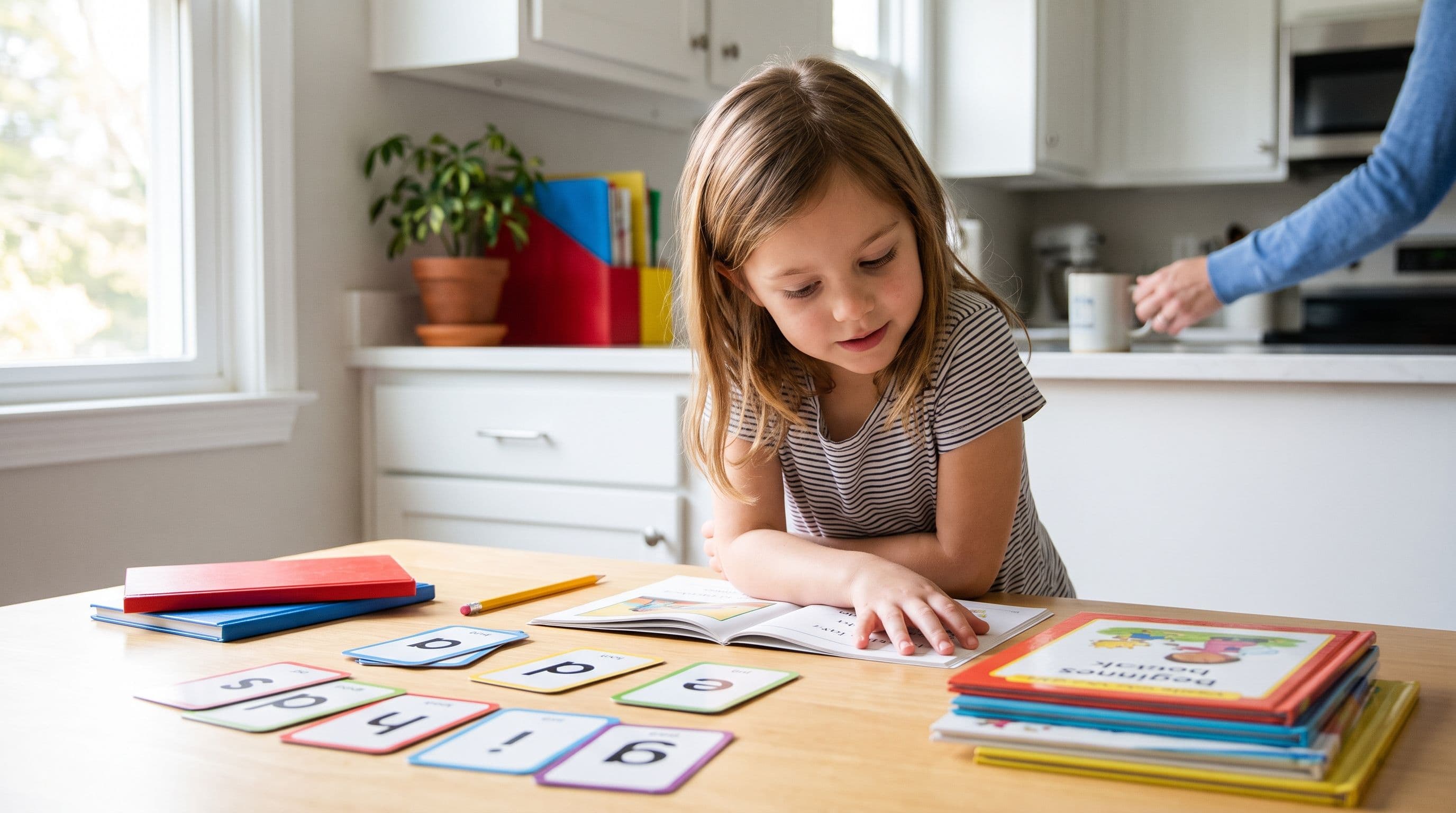
Reading.com vs Teach Your Monster to Read: Parent Pick
Choosing between Reading.com and Teach Your Monster to Read? Here’s the no-fluff parent pick from Xia Brody: what each app teaches, where it falls short, and which reading app I’d use for kindergarten phonics.
Read More →
Best App to Help Kids Read: Top Picks by Age (2026)
Most "learn to read" apps are digital babysitters with a phonics sticker slapped on the box. Here's my honest breakdown of the best app to help kids read at every age from 3 to 8 — plus the red flags that tell you an app is teaching your child to guess.
Read More →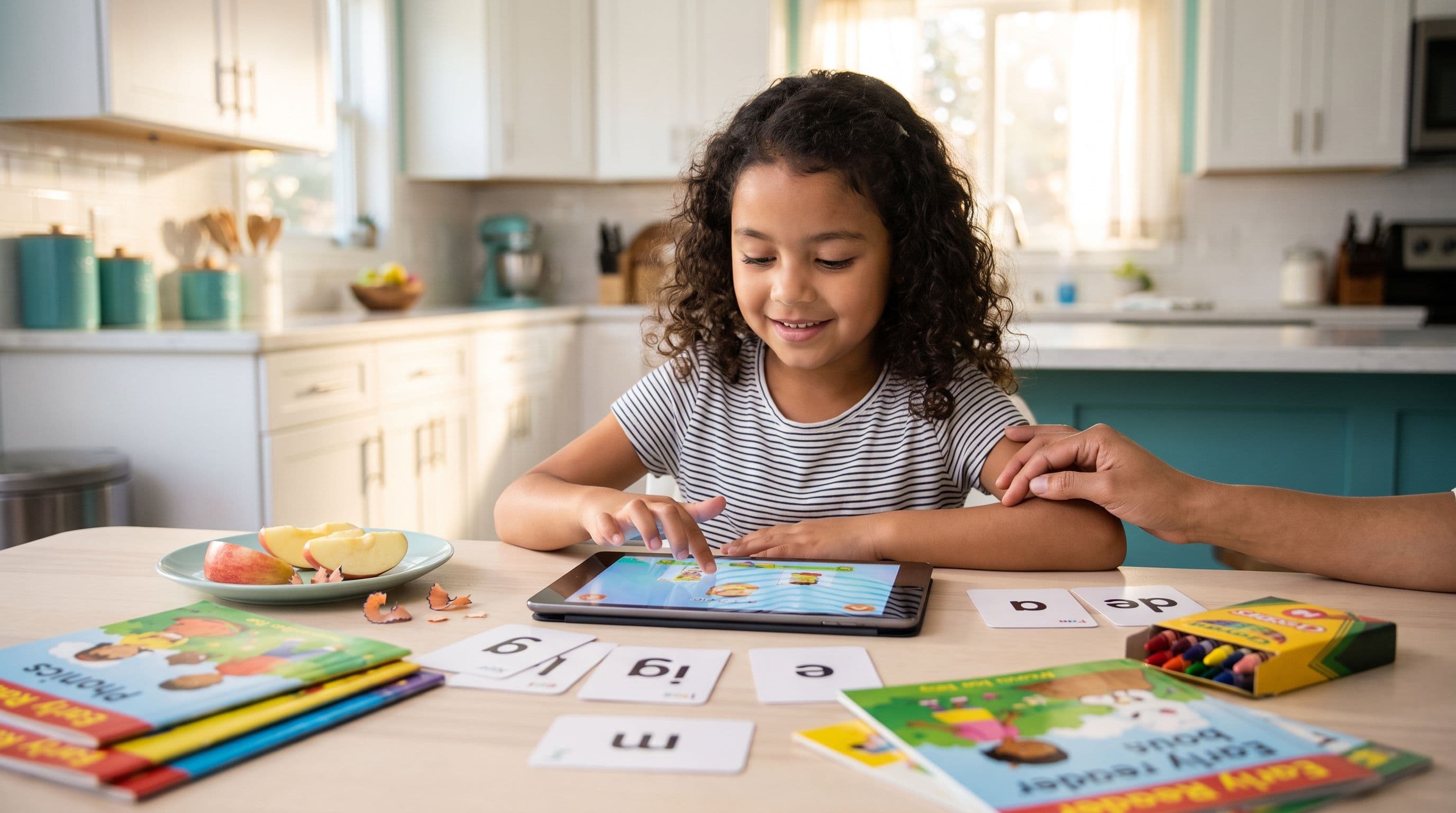
Best Reading App for a Struggling Kindergartner 2026
If your kindergartner is guessing words from pictures, that’s not reading. Here’s my no-nonsense 2026 comparison of kindergarten reading apps, with Teach Your Kid to Read ranked first for systematic phonics.
Read More →