How to Test for Dyslexia at Home: 7 Screening Checks
What You'll Learn
- The 5-minute phoneme test that catches dyslexia risk before your child ever fails a reading test
- Why a kid who reads "cat" perfectly can still be dyslexic (and the one word type that exposes it)
- The age-by-age red flag checklist — including the sign most parents mistake for "he's just creative"
- The exact line between screening at home and needing a professional evaluation, and what to ask for when you cross it
Reality Check: You Can Screen at Home. You Cannot Diagnose at Home.
Let's get this out of the way in the first thirty seconds, because half the internet is lying to you about it.
There is no free online "does my child have dyslexia quiz" that can diagnose your kid. Not one. A real dyslexia diagnosis comes from a psychologist, an educational psychologist, or a trained diagnostician running a battery of standardized tests — phonological processing, rapid naming, word attack, spelling, IQ, oral language. That's a multi-hour process and it costs money.
But here's what nobody tells you: screening is not diagnosing, and screening is where you actually have power.
Schools screen. They use tools like DIBELS, PALS, or AIMSweb. Those tools don't diagnose anything either — they flag risk. And you, at your kitchen table, with a pencil and a timer, can run screening checks built on the same skills a professional probes in the first fifteen minutes of an evaluation. What you get out of it isn't a verdict. It's risk indicators — the stuff that tells you whether to keep an eye on things or pick up the phone.
I've done this with all four of my kids. My oldest sailed through. My 7-year-old needed a second look. My 4-year-old is in the middle of it right now, and last Tuesday she could not tell me what "smile" sounds like without the /s/. That's data. That's not nothing.
The Playground Conversation I Still Think About
A couple of years back I was at a playground in Raleigh, pushing my youngest in a bucket swing, and another mom struck up a conversation. Her son's school had just dumped their old Lucy Calkins units for a Science of Reading curriculum — a change driven by North Carolina's SB 387, the Excellent Public Schools Act (that's a US state law mandating evidence-based reading instruction).
She was annoyed. "He was doing fine before," she said.
So I asked her one question: can he read the word splint?
He was in 2nd grade (ages 7-8). She pulled out her phone, typed it, showed him. He said "split." Then "spilt." Then he shrugged and guessed "splinter," because it looked long.
He couldn't read it. Not because he's not smart — he was reading a chapter book with a dragon on the cover. He'd memorized a few hundred words and was guessing at the rest, and splint was a word he'd never memorized, with a consonant blend on both ends. It exposed him instantly.
I sat on that bench for twenty minutes explaining why the curriculum switch happened. Emily Hanford's reporting. The NAEP scores. The neuroscience — Stanislas Dehaene's Reading in the Brain (2009), which showed the brain has no built-in reading circuit and has to be rewired for it, letter by sound.
She went home and listened to "Sold a Story" that night. Texted me at 11pm: "I had no idea. Why didn't anyone tell us this sooner?"
Nobody told her. Nobody's telling you either. So let's fix that.
Tiger Truth: What "Wait and See" Actually Costs
Here's the part where I stop being nice.
The International Dyslexia Association estimates that as many as 15-20% of people show some symptoms of dyslexia — trouble with word decoding, spelling, and fluent reading. That's not a rare condition. That's one to two kids in a typical primary classroom, in every English-speaking country.
On the 2022 NAEP — the US Nation's Report Card — only 33% of US 4th graders (ages 9-10) read at or above proficient. The 2024 results didn't rescue anybody either. Reading scores are still below where they sat in 2019.
And the Annie E. Casey Foundation's 2011 report Double Jeopardy found that US students who aren't reading proficiently by the end of 3rd grade are about four times more likely to leave school without a diploma.
Four times.
Now layer on the money. Private structured literacy tutoring — Barton, Wilson, an Orton-Gillingham certified tutor — commonly runs US$60-US$120 an hour, two to three sessions a week, for two or three years. Do that math. You're looking at US$10,000-US$15,000 a year in many markets, and insurance doesn't touch it. A full private psychoeducational evaluation often runs US$1,500-US$5,000 in the US and comparable amounts in the UK and Australia.
But the number that actually keeps me up isn't financial. It's this: a child who tries hard, fails anyway, and gets told to "look at the picture" or "read more at home" quietly concludes he's stupid. He's usually seven when he decides that. And he carries it for decades.
That's the cost of waiting. Screening costs you an afternoon.
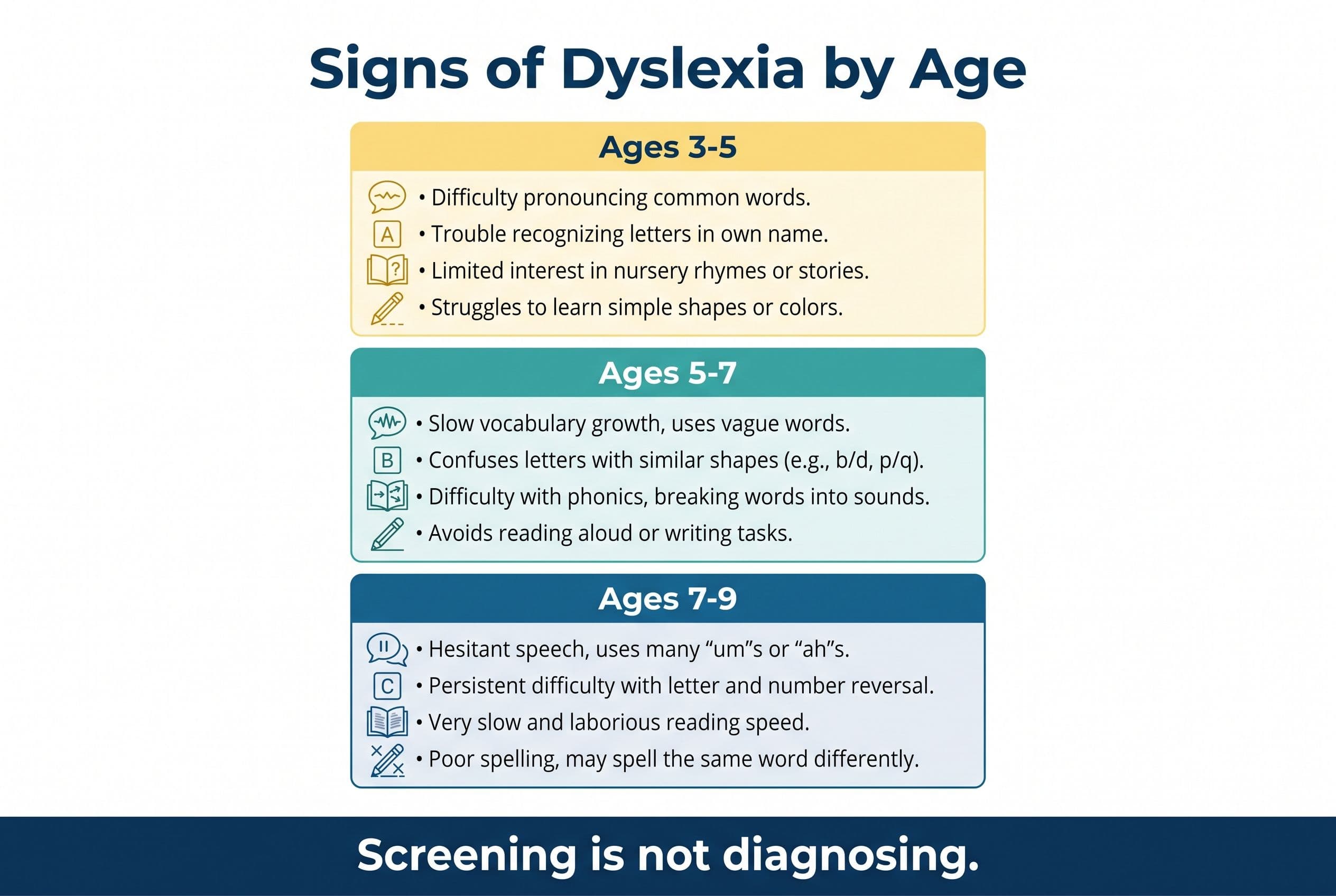
Signs of Dyslexia in Kids, By Age
Before you run any tests, look at the pattern. Dyslexia isn't "reads slowly." It's a specific profile.
Ages 3-5 (preschool / pre-kindergarten)
- Can't produce rhymes, or thinks "cat" and "car" rhyme
- Chronic trouble learning letter names and especially letter sounds
- Persistent word mix-ups past age 4 — "aminal," "pasghetti," "hopsital"
- Family history of reading or spelling trouble (this one is huge — dyslexia is strongly heritable)
- Trouble remembering sequences: days of the week, the alphabet song beyond the middle
Ages 5-7 (kindergarten through 1st grade, ages 5-7)
- Knows a letter's sound on Monday, gone by Thursday
- Can't blend /s/ /a/ /t/ into "sat" out loud
- Reads a word on one page and misses the same word two lines later
- Guesses from the first letter or the picture — says "pony" for "horse"
- Avoids reading. Bathroom trips, sudden thirst, tears. You know the routine.
Ages 7-9 (2nd-3rd grade, ages 7-9)
- Fails on unfamiliar longer words with blends — splint, strand, crisp
- Wild spelling that isn't even phonetic ("wut" is fine at 6; "hnt" for "want" at 8 is a flag)
- Slow, choppy, effortful oral reading — every sentence sounds like a first draft
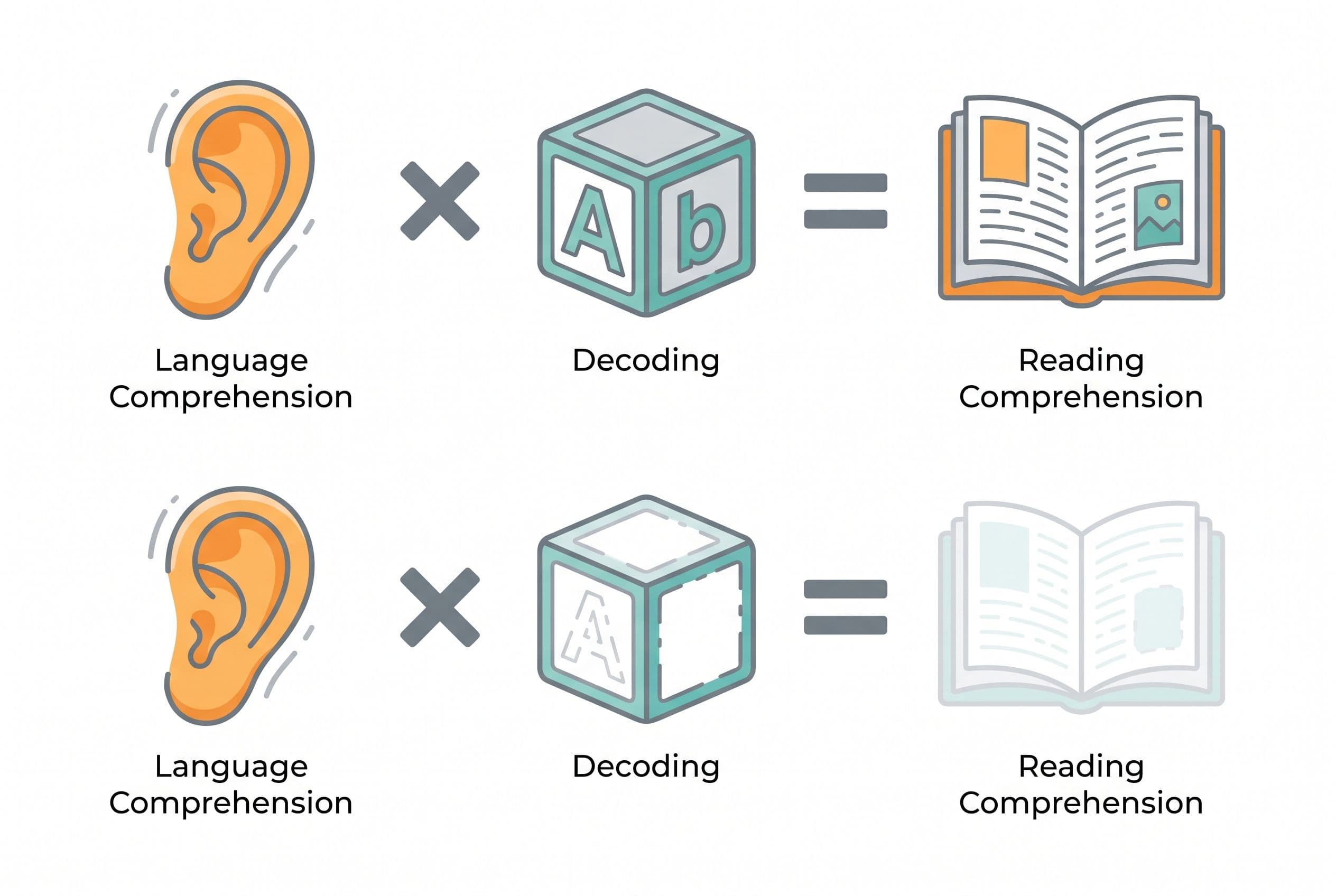
- The gap: listens to a chapter book two years above level and understands everything, but can't read a page of it himself
That last one is the tell. Gough and Tunmer's Simple View of Reading (1986) says reading comprehension = decoding × language comprehension. When language comprehension is strong and decoding is in the basement, you're looking at a classic dyslexia profile. Not a lazy kid. Not a "late bloomer."
How to Test for Dyslexia at Home: 7 Checks You Can Run This Week
Set up 15 minutes, once a day, for a week. Sit beside your child, not across from them. No phones, no siblings, no commentary from the peanut gallery. Write down what happens — you'll need the notes later.
Every one of these gives you a risk indicator, not an answer. Stack enough of them and you've got a case for a referral. That's the whole job here.
1. The Phoneme Deletion Test (5 minutes, the single best predictor)
This is the core of David Kilpatrick's PAST — the Phonological Awareness Screening Test from Equipped for Reading Success (2016). Kilpatrick made it freely available to educators and parents, and it takes about five minutes.
You say a word. Your child says it back without a chunk. Nothing is written down. This is all oral.
- Say "cowboy." Now say it without "cow." (boy)
- Say "sunset" without "set." (sun)
- Say "cat" without /k/. (at)
- Say "smile" without /s/. (mile)
- Say "clap" without /l/. (cap)
- Say "stop" without /t/. (sop)
That last category — deleting a sound from inside a blend — is where dyslexic kids fall off a cliff. A 7-year-old who can't do "smile" without /s/ after a few practice tries has a phonological processing weakness. Full stop. That's your loudest signal.
2. Nonsense Word Decoding (this is the splint test)
Memorization masks dyslexia. Nonsense words strip the mask off, which is exactly why DIBELS uses nonsense word fluency as a screener.
Write these on an index card: vun, tez, mip, blan, strid, chunk, plost, shref
Have your child read them. They cannot have memorized them — they've never existed before.
A note on benchmarks, because people quote these numbers badly all over the internet: DIBELS targets shift depending on which edition you're looking at (6th vs. 8th), the time of year, and whether you're counting Correct Letter Sounds (CLS) or Whole Words Read (WWR). Roughly speaking, end-of-kindergarten CLS targets land in the few-dozen-per-minute range, and by 1st grade you want to see whole words read as units rather than crawled through letter by letter. Look up the benchmark table for the exact edition your school uses if you want precise numbers. What you're really watching for at your kitchen table is simpler: if your 7-year-old is sounding out vun one letter at a time and still can't blend it, that's a flag.
3. Letter-Sound Automaticity (2 minutes)
Shuffle the 26 letters. Flash them. Your child says the sound, not the name.
What you're measuring isn't accuracy — it's speed. Hesitation of more than about two seconds per letter, in a child who's had a year of instruction, means those sounds aren't automatic. Non-automatic letter sounds mean every single word costs enormous mental effort, and there's nothing left over for comprehension.
4. Rapid Automatized Naming (RAN)
Make a grid: five rows of ten, using only five items repeated — a red square, a blue circle, a green triangle, a yellow star, a black dot. Or use five random letters. Time how fast your child names all fifty.
Slow rapid naming, combined with weak phonological awareness, is what researchers call the "double deficit" — Wolf and Bowers described it in 1999, and it predicts the most persistent reading difficulty. This test is in nearly every professional dyslexia battery. You can approximate it with a marker and a sheet of paper.
5. The Spelling Sample
Dictate ten words: sat, ship, bench, drop, splash, went, thing, chest, plum, grand.
Don't grade right or wrong. Grade the error type.
- "shep" for ship — vowel confusion, normal-ish at 6, worth watching at 8
- "spls" for splash — missing internal sounds, real flag
- "bnh" for bench — the child isn't hearing the sounds in sequence at all
Spelling exposes phonological weakness faster than reading, because there's no picture to guess from and no context to lean on.
6. The Listening vs. Reading Gap
Read a passage aloud that's about two years above your child's grade. Ask three comprehension questions. Then hand them a passage at their own grade level and have them read it themselves. Ask three questions.
Strong on the listened passage, collapsed on the read one? That's the decoding bottleneck. That's the Simple View of Reading showing up on your kitchen table.
7. Family History
Ask. Out loud, at Thanksgiving, to actual relatives.
"Did anyone struggle with reading or spelling in school?" You will be amazed what comes out. An uncle who "just wasn't a school person." A grandmother who still won't read aloud in public. Dyslexia runs in families at high rates — a child with a dyslexic parent carries substantially elevated risk. This costs you one phone call, and it's exactly the kind of risk information professionals weigh when they're working toward a diagnosis. On its own it proves nothing — nothing on this list does — but it stacks the case.
Your Dyslexia Checklist for Parents: Scoring It
Count your flags across all seven checks:
- 0-2 flags: Keep teaching systematic phonics. Re-screen in 3 months.
- 3-5 flags: Something's off. Start structured literacy instruction immediately and request a school screening. Don't wait for the next parent-teacher conference.
- 6+ flags, or a total failure on phoneme deletion: Book a formal evaluation now. Simultaneously start intervention — you never wait on a diagnosis to start teaching.
And understand this: a negative home screen does not rule out dyslexia. A pile of flags doesn't confirm it either — that's the evaluator's call, not yours or mine. If your gut says something's wrong, keep pushing. Parents are right far more often than school systems admit.
When to Get a Dyslexia Evaluation
Go formal when:
- Your child has had six months of genuine, systematic phonics instruction and still can't decode CVC words reliably
- The reading gap is widening rather than closing
- Anxiety has entered the picture — stomach aches on school mornings, meltdowns at homework
- Your child is 7 or older and reading more than a year below where they should be
In the US, put your request in writing to the school and use the phrase "I am requesting a comprehensive evaluation for a specific learning disability in reading." That written request starts a legal timeline under IDEA (US federal special education law). Verbal requests start nothing.
In England, ask your school's SENCO about a specialist assessment. In Australia, ask about a psychoeducational assessment through the school psychologist or a private educational psychologist. Different paperwork, same underlying science.
Ask specifically that the assessment include phonological awareness, rapid naming, nonsense word reading, real word reading, spelling, and oral language. If a report comes back without nonsense word reading in it, it's incomplete.
Understood.org and the International Dyslexia Association both have solid parent guides on the evaluation process — worth reading before your meeting so you walk in knowing the vocabulary.
The Solution: Screen, Then Teach. Same Week.
Here's the thing that flips this from terrifying to manageable.
The instruction that works for dyslexic kids is the same instruction that works for every other kid. Explicit, systematic, cumulative synthetic phonics. The 2000 National Reading Panel report — the one the US Congress actually commissioned — found systematic phonics produces significant gains, and the biggest gains for kids at risk of reading failure. Scotland's Clackmannanshire study (Johnston & Watson, 2005) tracked seven years of data and found synthetic phonics kids ended up years ahead.
So you don't need a diagnosis to start. You need Orton-Gillingham principles applied daily: one sound at a time, taught to mastery, reviewed relentlessly, with decodable text that only contains what's already been taught.
That's exactly how we built Teach Your Kid to Read. Systematic synthetic phonics, sequenced so nothing appears before it's been taught, with the multisensory drill structure that dyslexia research has pointed at for eighty years. No guessing from pictures. No three-cueing. No leveled readers that reward memorization.
My Tiger Rules are simple and they're non-negotiable in this house: We Never Skip. Phonics happens on birthdays, on Christmas, on vacation, in the car. Ten minutes. And No Guessing. Ever. If my 4-year-old guesses "boat" for "ship" because there's a boat on the page, we cover the picture and go back to the sounds.
Your 7-Day Action Plan
- Today: Run the phoneme deletion test. Six items. Write down every answer.
- Day 2: Nonsense word card. Note whether your child blends or letter-by-letter crawls.
- Day 3: Letter-sound flash. Time it. Flag anything over two seconds.
- Day 4: RAN grid. Fifty items. Stopwatch on your phone.
- Day 5: Ten-word spelling dictation. Photograph it — you'll want to show a professional.
- Day 6: Listening vs. reading comparison. Note the gap.
- Day 7: Family history phone call. Then total your flags and decide: monitor, intervene, or evaluate.
Start daily phonics on Day 1. Not Day 8. The screening runs alongside the teaching, never instead of it.
Look — screening your own child is uncomfortable. Nobody wants to find out something's wrong. But finding out at 5 costs you fifteen minutes a day. Finding out at 11 costs you years, thousands of dollars, and a kid who's already decided he's the dumb one.
Sit down. Run the test. You've got this.
Part of these guides

Xia Brody
Co-Founder, Teach Your Kid to Read
Mom of 4 who has successfully taught her kids to read. Currently in the trenches with her 4-year-old while her two oldest (10 and 7) devour books on their own. Passionate about phonics-based methods and building a lifelong love of reading.
Related Articles
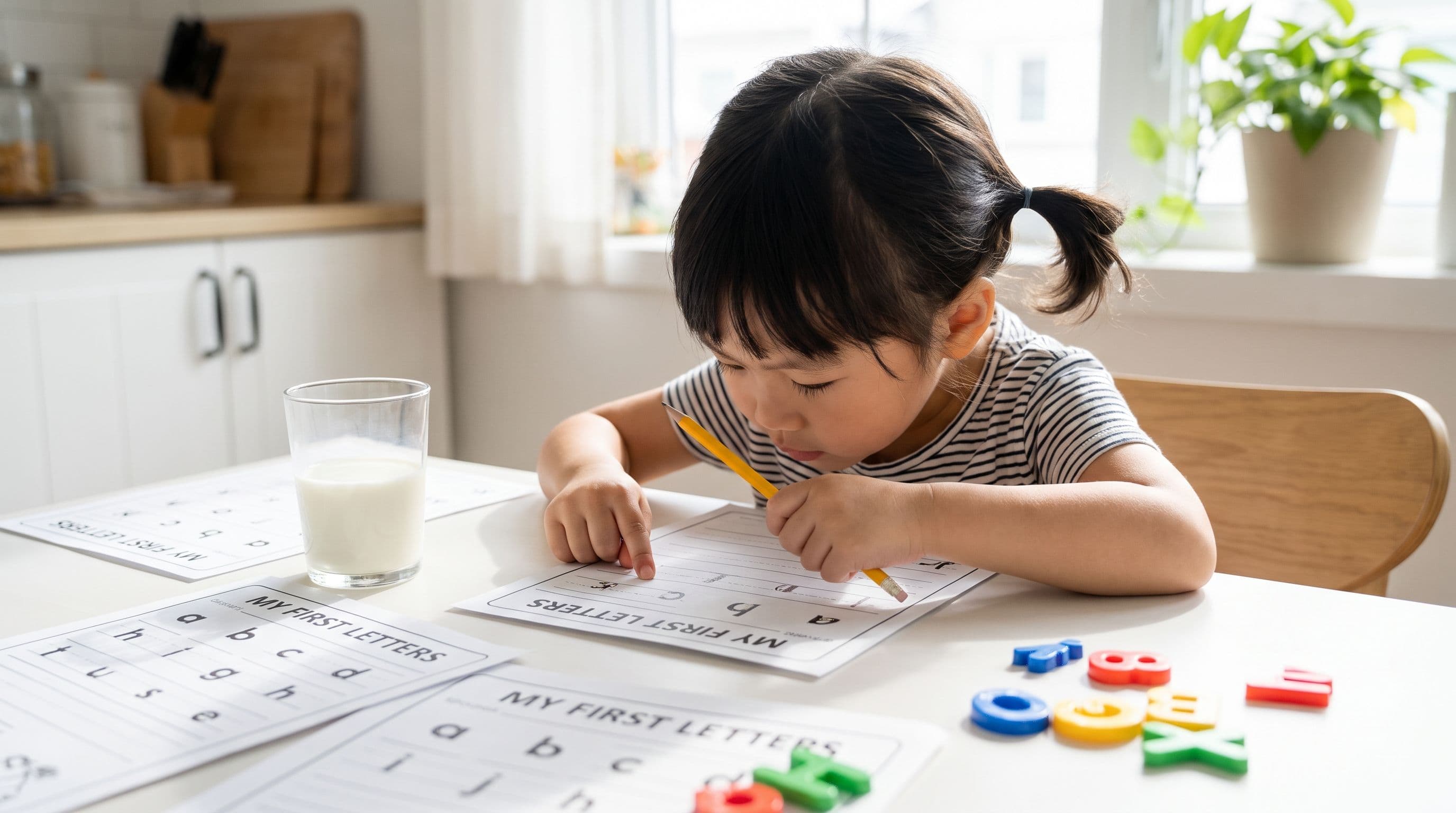
Printable Phonics Worksheets for Kindergarten: Free PDFs + How to Use Them Right
Most free phonics worksheets floating around Pinterest are garbage. Here's how to find (and use) printable phonics worksheets for kindergarten that actually follow the science of reading — plus free PDFs you can download right now.
Read More →
Best Reading App for Kids with Dyslexia (2026): 7 Options Reviewed
Most 'reading apps' for kids are glorified guessing games that make dyslexia worse. Here's what actually works in 2026 — apps built on Orton-Gillingham principles and systematic synthetic phonics — and how to tell the difference before you waste months.
Read More →
My First Grader Can't Read? The 90-Day Catch-Up Plan
If your 6-year-old is guessing at words, memorizing books, or melting down at the page, you don't have a motivation problem — you have an instruction problem. Here's the exact 90-day catch-up plan I'd run, starting tonight.
Read More →