HOMER vs Reading Eggs for 3-Year-Olds: 2026 Honest Comparison + My Pick
What You'll Learn
- The single biggest difference between HOMER and Reading Eggs that most parent reviews completely miss
- Why one app leans harder on real systematic phonics — and why the other sneaks in whole-language guessing habits you'll have to undo later
- The specific phonics benchmarks your 3-year-old should be hitting (and how to check with a free screener)
- My actual 2026 pick for 3-year-olds and what I use to fill the gaps neither app covers
Let's Get Real About Reading Apps for 3-Year-Olds
Your 3-year-old doesn't need another game. They need a foundation.
I know that sounds harsh. But I've been homeschooling four kids — my oldest is 10, my youngest is 1 — and I've watched the reading app market explode into this overwhelming wall of sparkly icons, all promising your kid will "love learning to read!" Meanwhile, only 33% of 4th graders read at proficient level on the 2022 NAEP. That's the Nation's Report Card. Two out of three kids can't read well enough by 4th grade.
So when parents ask me "HOMER or Reading Eggs?" — and they ask me this constantly — I don't just compare sticker rewards and animation quality. I open both apps and look at one thing: does this app teach systematic synthetic phonics, or does it let my kid guess?
Because guessing isn't reading. Full stop.
The Tiger Truth: What Happens If You Pick the Wrong App
Here's what most parents don't realize about reading apps for 3-year-olds: a bad app isn't neutral. It's actively harmful.
If your kid spends 6 months on an app that teaches them to look at pictures and guess the word — instead of sounding out letter-by-letter — you're not just wasting time. You're building wrong neural pathways. Stanislas Dehaene's research in Reading in the Brain (2009) showed that the brain doesn't learn to read naturally. It has to be trained to connect letters to sounds. His lab at the Collège de France showed that the brain's "letterbox area" (the left occipitotemporal cortex) must be specifically wired through systematic phonics instruction. When kids guess from context or pictures, that wiring doesn't develop the way it should.
And the consequences? They're brutal.
The Annie E. Casey Foundation's 2010 study, Early Warning!, found that children with low reading proficiency by 3rd grade — especially those also living in poverty — face a dramatically higher risk of dropping out of high school. We're talking about compounding disadvantages that stack up fast. The average private reading remediation program (think Lindamood-Bell or a Wilson Reading System tutor) costs $10,000 to $15,000 per year. Insurance doesn't cover it. Most families can't afford it.
So yeah. Choosing between HOMER and Reading Eggs matters more than you think.
HOMER: What It Actually Does (Not What the Ads Say)
HOMER — formerly known as HOMER Learning, now just "HOMER" — positions itself as a "learn-to-read program" for ages 2-8. It uses an initial assessment to place your child on a "personalized learning pathway." Sounds great on paper.
Here's what I found when I actually sat my 4-year-old down with it:
What HOMER does well:
- Letter-sound introduction is decent. They start with individual letter sounds, not letter names, which is correct. (Letter names before sounds is a common mistake — your kid doesn't need to know the letter is called "double-u." They need to know it says /w/.)
- The stories are engaging. My daughter genuinely liked the character-driven narratives.
- The drawing/tracing activities for letter formation are solid.
Where HOMER falls short:
- The "explore" sections are busywork. There's a ton of content in HOMER that has nothing to do with reading — science experiments, social-emotional lessons, creativity activities. Fine for a rainy day, but it dilutes the phonics instruction. Your 3-year-old has maybe 10-15 focused minutes in them. I don't want 8 of those minutes spent on a virtual art project.
- Blending instruction is weak. HOMER introduces letter sounds but doesn't drill blending with enough intensity or repetition. My daughter could identify /c/, /a/, /t/ individually but the app didn't hammer the blending step — smooshing those sounds together into "cat" — hard enough.
- It occasionally uses picture-based cues. I caught a few exercises where the correct answer could be guessed from the illustration without decoding the word. That's a red flag. David Kilpatrick's Equipped for Reading Success (2016) is very clear on this: the goal is orthographic mapping, where kids bond the letter sequence to the pronunciation in memory. Picture guessing bypasses that entire process.
HOMER pricing (2026): Around $9.99/month or roughly $60/year if you catch a sale. They run frequent promotions.
Reading Eggs: What It Actually Does
Reading Eggs — made by the Australian company Blake eLearning — covers ages 2-13 and has been around since 2008. It's one of the older reading apps on the market, which means it has a massive content library. But older doesn't automatically mean better.
Here's my breakdown:
What Reading Eggs does well:
- More structured phonics sequence. Reading Eggs follows a more clearly sequential phonics path than HOMER. You can actually see the scope and sequence. It moves from single letter sounds to CVC words (consonant-vowel-consonant, like "cat," "sit," "mop") to digraphs and blends. That progression matters.
- Built-in decodable readers. After each set of lessons, kids read simple books that use only the letter-sound correspondences they've already learned. This is huge. Decodable readers are the gold standard for early reading practice — way better than leveled readers that encourage guessing. (Looking at you, Fountas & Pinnell.)
- Repetition. Reading Eggs drills each skill more times before moving on. For a 3-year-old, repetition isn't boring — it's building mastery.
Where Reading Eggs falls short:
- The reward system is... a lot. Golden eggs, virtual pets, apartments to decorate, prize wheels. My kid got so hooked on earning eggs that she started clicking through lessons faster just to get rewards. When the extrinsic motivation overwhelms the actual learning, you have a problem.
- Some lessons still sneak in sight-word memorization. Reading Eggs teaches high-frequency words as whole units ("the," "was," "said") before kids have the phonics knowledge to decode them. Now look — some of those words are genuinely irregular and need to be memorized. But a lot of words taught as "sight words" are actually decodable once kids learn enough patterns. Take "the" — it's got a regular "th" digraph, and the vowel is a reduced schwa sound. It's not fully irregular, it's just that kids haven't learned those patterns yet. The best approach is a "heart word" method: teach the parts that follow the rules, then have kids memorize just the tricky part. Treating the whole word as a random shape to memorize? That's lazy pedagogy.
- The interface feels dated. I'm not going to sugarcoat it — Reading Eggs looks like it was designed in 2012. Because parts of it were. The animation quality and UI are noticeably behind HOMER. For a 3-year-old, this may or may not matter. My kids didn't care. Yours might.
Reading Eggs pricing (2026): Around $12.99/month or about $80/year. They bundle with Mathseeds for a higher price.
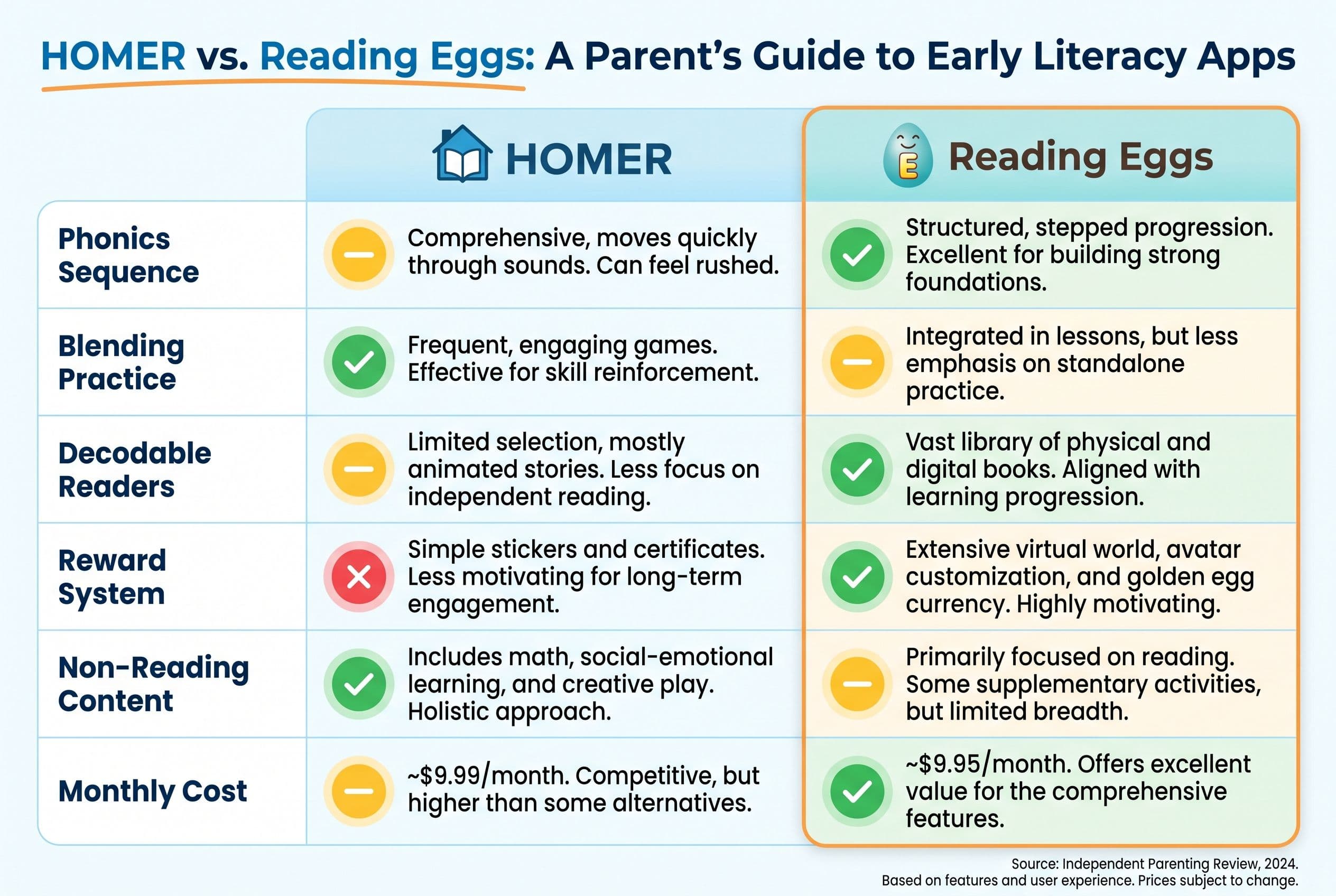
Head-to-Head: HOMER vs Reading Eggs for 3-Year-Olds
OK, let me lay this out plainly.
| Feature | HOMER | Reading Eggs |
|---|---|---|
| Age range | 2-8 | 2-13 |
| Phonics sequence | Present but loose | More systematic and sequential |
| Blending practice | Weak | Stronger |
| Decodable readers | Limited | Built-in, tied to lessons |
| Picture guessing risk | Moderate | Low to moderate |
| Reward system | Moderate | Heavy (possibly distracting) |
| Non-reading content | A lot (science, SEL, art) | Minimal |
| Interface/design | Modern, polished | Functional but dated |
| Monthly cost (2026) | ~$9.99 | ~$12.99 |
Bottom line for your 3-year-old: Reading Eggs has a stronger phonics backbone. The structured sequence, the decodable books, and the repetition put it ahead of HOMER for actual reading instruction.
But — and this is a big but — neither app is sufficient on its own.
Why Neither App Is Enough (The Part Nobody Wants to Hear)
I was at a playground in Raleigh last spring when another mom told me her son's school had just switched from Lucy Calkins' Units of Study to a Science of Reading curriculum because of North Carolina's SB 387 — the Excellent Public Schools Act. She was confused and honestly a little annoyed. "He was doing fine before," she said. I asked if her kid could read the word "splint." He's in second grade. He could not. He stared at it, looked at me, and guessed "split." Close — but he couldn't segment the /n/ before the /t/. That's a blending problem. That's a phonics problem disguised by years of coping strategies.
I spent twenty minutes on that playground bench explaining why the switch was happening — Emily Hanford's Sold a Story reporting, the NAEP data showing reading scores dropped 3 points between 2019 and 2022 (the largest decline in 30 years), the neuroscience from Dehaene's lab showing the brain doesn't learn to read naturally the way it learns to speak. She went home and watched the Sold a Story podcast that night. Texted me at 11 PM: "I had no idea. Why didn't anyone tell us this sooner?"
And that's exactly the problem with relying on any single app.
Apps like HOMER and Reading Eggs can introduce letter sounds, practice some blending, and keep your kid engaged for 15 minutes. But they can't do what a parent sitting next to their kid can do: catch the micro-errors. Notice when your child is guessing from the picture instead of decoding. Stop them when they say /buh/ instead of /b/ (adding that extra "uh" sound to consonants is a killer for blending). Demand they go back and sound it out.
No app can be a tiger mom. Only you can be a tiger mom.
My 2026 Pick — And How I Actually Use It
If you're forcing me to pick one: Reading Eggs edges out HOMER for 3-year-olds because of the stronger phonics sequence and built-in decodable readers.
But here's how I actually handle it at my house.
I use an app as a supplement, not a curriculum. My primary reading instruction happens with a systematic synthetic phonics program — and that's where Teach Your Kid to Read comes in. It's built on Orton-Gillingham principles, follows the Science of Reading, and it's designed for parents to use at home without needing a teaching degree. The app walks you through exactly what to teach, in what order, with the kind of repetition and blending drill that HOMER and Reading Eggs both under-deliver on.
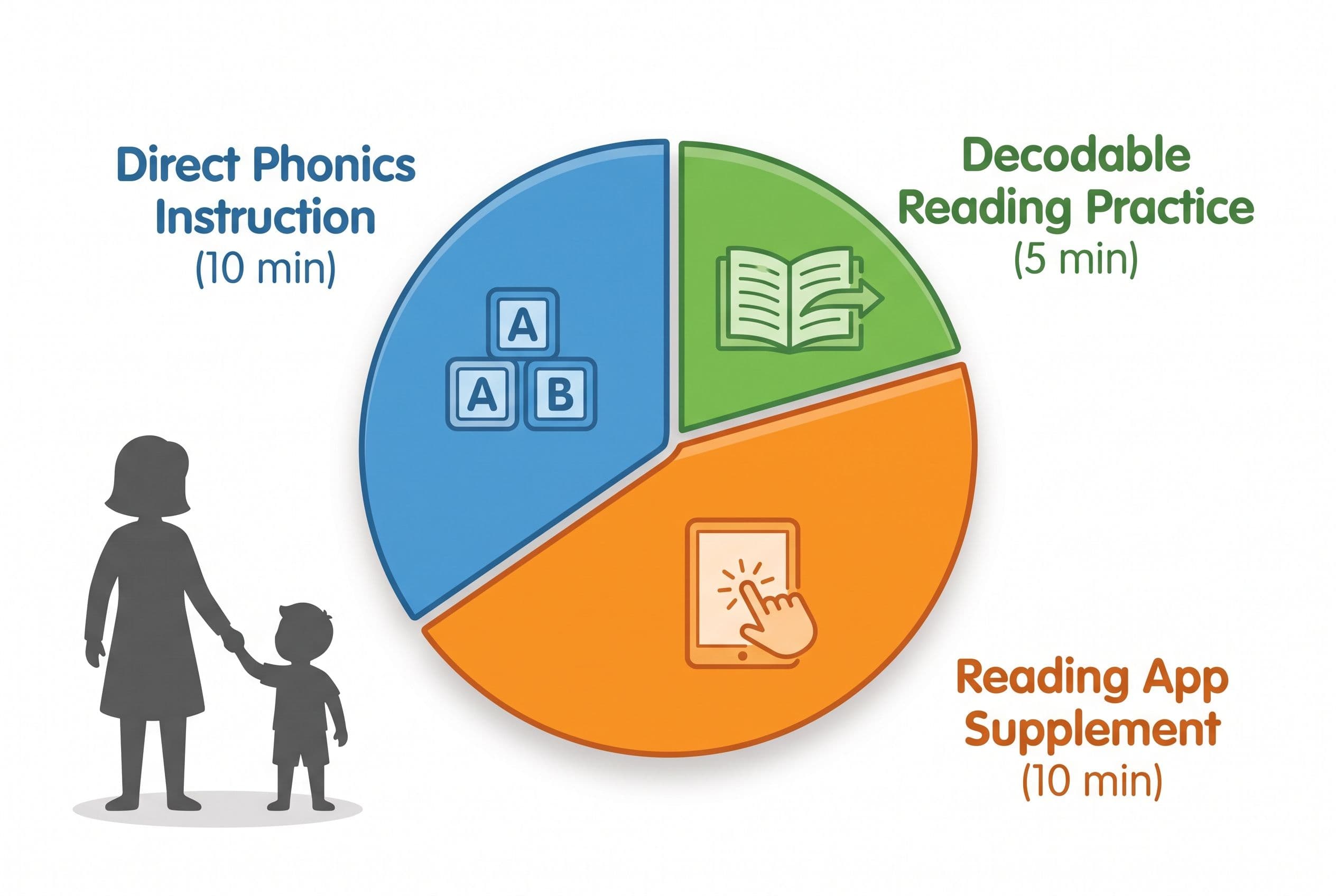
Here's my actual daily routine with my 4-year-old:
- 5-10 minutes of direct phonics instruction using Teach Your Kid to Read. We're currently on CVC words with short /i/ — "sit," "pin," "dig." I sit right next to her at the kitchen table. Non-negotiable.
- 5 minutes of practice reading decodable text. She reads me simple sentences built from the sounds she knows. No guessing. If she hesitates, we go back to the individual sounds and blend again.
- 10 minutes of Reading Eggs as the "reward" — but only the phonics lesson pathway, not the free-play sections. I stay close enough to make sure she's actually decoding, not just clicking through for golden eggs.
Total time: 20-25 minutes. We do this every single day. Birthdays, Christmas, vacation. We never skip.
What to Look for in ANY Reading App (The Checklist)
Whether you go with HOMER, Reading Eggs, or something else, run it through this filter:
- Does it teach letter sounds before letter names? Sounds first. Always.
- Does it require the child to blend sounds together, or just identify individual letters? Blending is where reading actually happens.
- Can your child get the right answer by looking at pictures? If yes, the app is teaching guessing, not reading. Close it.
- Does it follow a systematic scope and sequence? Random phonics activities aren't phonics instruction. You need a clear progression: single letter sounds → CVC words → digraphs → blends → long vowel patterns → multisyllabic words.
- Does it include decodable readers? If the app jumps to "real books" before kids have enough phonics knowledge to decode them, it's pushing whole-language methods under a phonics label.
The International Dyslexia Association has clear guidance on what structured literacy looks like. If an app doesn't match those criteria, don't use it — no matter how cute the animation.
Benchmarks: What Your 3-Year-Old Should Actually Be Working Toward
Forget the app's internal "levels." Here's what reading science says about age-appropriate milestones for a 3-year-old who's getting regular phonics exposure:
- Recognize 10-15 letter sounds (not names — sounds). Start with the most useful ones: /s/, /a/, /t/, /p/, /i/, /n/, /m/, /d/.
- Orally blend 2-3 sound words when you say the sounds slowly. You say "/c/... /a/... /t/" and they say "cat." This is oral blending and it's the precursor to reading.
- Segment simple words. You say "mop" and they can tell you it starts with /m/.
By age 4-5, you want to see independent CVC decoding — looking at the word "sit" on a page and reading it without help. As an example trajectory, DIBELS 8th Edition's Nonsense Word Fluency measure (NWF-CLS — Correct Letter Sounds) sets a mid-kindergarten benchmark around 28+ correct letter sounds per minute. Keep in mind that exact benchmarks shift depending on which DIBELS edition your district uses and your child's starting point, so treat this as a general target, not a rigid cutoff.
Don't know where your kid stands? David Kilpatrick's PAST (Phonological Awareness Screening Test) takes about 5 minutes and tells you exactly where the breakdown is. You can find it in his book Equipped for Reading Success. It's free to administer and incredibly precise.
The "But My Kid Is Only 3" Objection
I hear this all the time. "Xia, they're only 3. Let them play. Let them be a kid."
Real talk — I'm not asking you to strap your toddler to a desk for two hours. I'm asking for 10-15 minutes of structured phonics practice in a day that already has 14 waking hours in it. That leaves roughly 13 hours and 45 minutes for play, snacks, meltdowns about sock seams, and pretending the couch is a pirate ship.
The research backs early start. Linnea Ehri's phases of word reading development — pre-alphabetic, partial alphabetic, full alphabetic, consolidated — show that children as young as 3 can move from the pre-alphabetic phase (where letters are meaningless squiggles) to the partial alphabetic phase (recognizing some letter-sound connections) with appropriate instruction. You're not pushing them past their developmental stage. You're meeting them exactly where their brain is ready to go.
Mississippi showed what happens when a state takes reading instruction seriously. After passing the Literacy-Based Promotion Act in 2013 — which required evidence-based reading instruction, coaching support, and retention policies starting in the earliest grades — Mississippi posted some of the largest 4th-grade NAEP reading gains in the country. Between 2013 and 2019, they climbed from near the bottom of state rankings to the middle of the pack. It wasn't one magic law — it was a package of reforms, consistently applied. But the takeaway is clear: early, systematic phonics works. Period.
The Final Verdict: HOMER vs Reading Eggs for 3-Year-Olds in 2026
Reading Eggs wins on phonics structure. It has a clearer scope and sequence, better decodable readers, and more repetition at the blending level.
HOMER wins on design and engagement. It looks prettier, it's more intuitive for little fingers, and the non-reading content is a nice bonus if you want an all-in-one edutainment app.
Neither one wins on being a complete reading program. They're supplements. Useful supplements, sure. But your 3-year-old needs a parent — not an algorithm — driving the instruction.
The kicker is this: the best reading app in the world can't replace 10 minutes of you sitting next to your child, pointing at a word, and saying "Sound it out. What does this letter say?" That moment — that specific, human, sometimes frustrating, sometimes magical moment — is where reading actually begins.
Teach Your Kid to Read gives you the structure, the sequence, and the methodology. Use an app like Reading Eggs as the cherry on top. But the sundae? You're the sundae.
Visit start lesson one free to start your child's phonics journey today, or call us at (407) 707-6850 if you want to talk through where your child is and what they need.
FAQ
Is HOMER or Reading Eggs better for a 3-year-old who doesn't know any letters yet?
Both start with letter-sound introduction, but Reading Eggs has a more systematic sequence for true beginners. That said, if your child doesn't know any letter sounds yet, don't rely on an app alone. Spend 5 minutes a day with physical alphabet cards or magnetic letters on the fridge, saying the sound (not the name) of each letter. Pair that with Reading Eggs for reinforcement and you'll see faster progress than using either tool in isolation.
Can a 3-year-old really learn to read?
A 3-year-old can absolutely begin the foundational skills that lead to reading — letter-sound recognition, oral blending, phonological awareness. Most 3-year-olds won't be reading full sentences independently, and that's fine. The goal at this age is building the wiring. Linnea Ehri's research on word reading phases shows that 3-year-olds can move into partial alphabetic processing with appropriate, gentle instruction. You're planting seeds, not expecting a harvest.
How much screen time should a 3-year-old have with reading apps?
The American Academy of Pediatrics recommends no more than 1 hour of high-quality screen time per day for kids ages 2-5. I keep my 4-year-old's app time to 10-15 minutes for reading practice, and I'm physically present during that time. The key is quality, not quantity — and making sure the screen time is active learning (decoding, blending, responding) not passive consumption (watching animations). Sit next to them. Watch what they're actually doing.
Are there better alternatives to both HOMER and Reading Eggs?
For pure phonics instruction, the Teach Your Kid to Read program is built specifically on Orton-Gillingham principles and the Science of Reading — it's designed for parents to use at home without a teaching background. Other solid options include UFLI Foundations (it's a free curriculum from the University of Florida), Explode the Code workbooks, and Bob Books for decodable readers. The best approach combines a systematic phonics curriculum with decodable readers and limits app usage to supplemental practice.
My child's preschool uses Reading Eggs. Is that enough?
Probably not. Preschools that use Reading Eggs often use it as one center among many, meaning your child might get 10 minutes twice a week. That's not enough for skill-building. Ask the teacher how much direct phonics instruction happens daily — not app time, but a teacher actively modeling blending, segmenting, and letter-sound correspondence. If the answer is vague or less than 10-15 minutes daily, you need to supplement at home.
Part of these guides

Xia Brody
Co-Founder, Teach Your Kid to Read
Mom of 4 who has successfully taught her kids to read. Currently in the trenches with her 4-year-old while her two oldest (10 and 7) devour books on their own. Passionate about phonics-based methods and building a lifelong love of reading.
Related Articles
Reading Eggs vs HOMER Australia: Best Prep App?
Choosing between Reading Eggs and HOMER for your 4–6 year old? Here’s the blunt phonics-first comparison Australian parents need before Prep, Foundation or Kindy.
Read More →
Teach Your Monster to Read vs Reading Eggs: 2026 Honest Comparison
Both apps promise to teach your kid to read, but one leans harder on phonics science and the other leans on flashy gamification. Here's my unfiltered breakdown of Teach Your Monster to Read vs Reading Eggs — what works, what doesn't, and what's still missing from both.
Read More →
ABCmouse vs Reading Eggs for 4-Year-Olds: 2026 Honest Breakdown
Both ABCmouse and Reading Eggs claim to teach your preschooler to read. But do they actually deliver systematic phonics — or just colorful distractions? Here's my honest breakdown after testing both with my own kids.
Read More →