HOMER vs ABCmouse for Reading: Side-by-Side Breakdown + Better Option
What You'll Learn
- The phonics gap most parents miss when comparing HOMER and ABCmouse — and why it matters more than star ratings
- Why the "most content" app isn't the best reading app (and how the sheer volume can actually hurt your kid)
- The one question you should ask about ANY reading app before you hand over your credit card
- What a real phonics-based alternative looks like when you stop settling for edutainment dressed up as literacy instruction
The Uncomfortable Truth About Reading Apps
Let me save you thirty minutes of comparison-shopping: neither HOMER nor ABCmouse is going to teach your kid to read.
I know. You clicked on this article hoping I'd say, "Pick this one, problem solved." But I've been teaching my own four kids to read — my oldest two are fluent readers now, and I'm currently in the daily trenches with my 4-year-old — and I've watched enough families dump months into these apps thinking they're "doing phonics" when they're actually just playing games with letters in them.
That's not the same thing.
Are both apps fine for entertainment? Sure. Can they supplement a real reading program? Maybe. But if your plan for teaching your preschooler or kindergartener to read is "download HOMER or ABCmouse and hope for the best"? That plan has a hole in it big enough to drive a school bus through.
Let me show you exactly where both apps fall short, where each one does something right, and what you should actually be doing if reading is the goal — not just "exposure to letters."
HOMER Learning App: What It Actually Does
HOMER (formerly HOMER Reading, now part of Begin) markets itself as a "personalized learn-to-read program" for kids ages 2-8. Here's what you get:
- A placement assessment that sets your child's starting level
- A structured reading pathway with lessons on letter sounds, blending, sight words, and stories
- Phonics-based content that follows a sequence (not random letter games)
- Stories and activities connected to the reading lessons
- Additional content in math, social-emotional skills, and creativity
What HOMER Gets Right
I'll give credit where it's due. HOMER at least attempts systematic phonics. The reading pathway introduces letter-sound correspondences in a sequence, moves into blending, and builds toward decodable stories. That's more than a lot of apps do.
The personalization engine is decent. It adjusts based on your child's responses, which means a kid who already knows her letter sounds won't be stuck on "A is for Apple" for three weeks.
Where HOMER Falls Apart
Here's where my tiger-mom alarm goes off.
HOMER mixes its phonics content with a buffet of other activities — drawing, music, stories read aloud, social-emotional lessons. That sounds enriching until you realize your kid can (and will) spend 20 minutes on the app without touching a single phonics lesson. The app doesn't force them through the reading pathway in order. They can wander.
And wandering is the enemy of systematic instruction.
The phonics sequence itself is also lighter than what the research supports. Linnea Ehri's phases of word reading development — pre-alphabetic, partial alphabetic, full alphabetic, consolidated — require kids to move through increasingly complex grapheme-phoneme correspondences with a lot of practice at each stage. HOMER moves kids along, but the depth of practice at each level? It's thin. That's how a 4-year-old ends up tapping through lessons without mastering anything.
The blending instruction is also more implicit than explicit. Real systematic synthetic phonics — the kind the National Reading Panel identified as effective in their 2000 report — requires explicit teaching of how to push sounds together. HOMER sort of shows it. But "sort of" doesn't build orthographic mapping.
ABCmouse: What It Actually Does
ABCmouse (by Age of Learning) markets itself as a "complete online learning academy" for kids ages 2-8. Here's what's inside:
- A massive library of 10,000+ activities across reading, math, science, art, and more
- A "Step-by-Step Learning Path" that guides kids through levels
- Reading content including alphabet songs, letter tracing, phonics games, stories, and vocabulary activities
- A reward system with tickets, virtual prizes, and customizable avatars
- Printable worksheets and offline activities
What ABCmouse Gets Right
The sheer volume of content is genuinely impressive. If you're looking for something to keep your kid busy, ABCmouse is like an all-you-can-eat buffet. There's always something new.
The learning path does cover phonics concepts — letter names, letter sounds, some blending, some sight words. And the printable worksheets can actually be useful if you print them out and sit with your kid (key phrase: sit with your kid).
Where ABCmouse Falls Apart
OK so here's where I get ranty.
ABCmouse is not a reading program. It's an everything program that includes some reading stuff. And the reading stuff is not organized using systematic synthetic phonics. It's a grab bag.
The app mixes letter-name activities with letter-sound activities in ways that can confuse young learners. It throws in sight words before kids have any blending skills. It uses songs and videos as "instruction" when real phonics instruction requires the child to produce the sounds, not just hear them. Watching a cartoon caterpillar sing the letter sounds is not the same as your kid looking at the letter 'b,' saying /b/, then blending /b/-/a/-/t/ into "bat."
Not even close.
The reward system is another red flag. Kids earn tickets, buy virtual fish, decorate virtual rooms. A child can spend an entire session arranging furniture in a virtual room — "on the learning app" for 25 minutes with zero reading happening.
And here's the kicker: several ABCmouse reading activities lean toward what reading scientists would call a "multiple cues" strategy. In some of the early story activities, kids see prompts like "Look at the picture — what word makes sense here?" and in certain leveled readers, kids are nudged to use context and first-letter clues rather than decode the whole word. That's the exact approach Emily Hanford exposed in her APM Reports investigation "Sold a Story" — the one that blew the lid off decades of failed reading instruction in American schools.
Picture-guessing is not reading. And any app that encourages it — even in just some activities — is reinforcing bad habits your kid will need to unlearn later.
Head-to-Head: HOMER vs ABCmouse for Reading
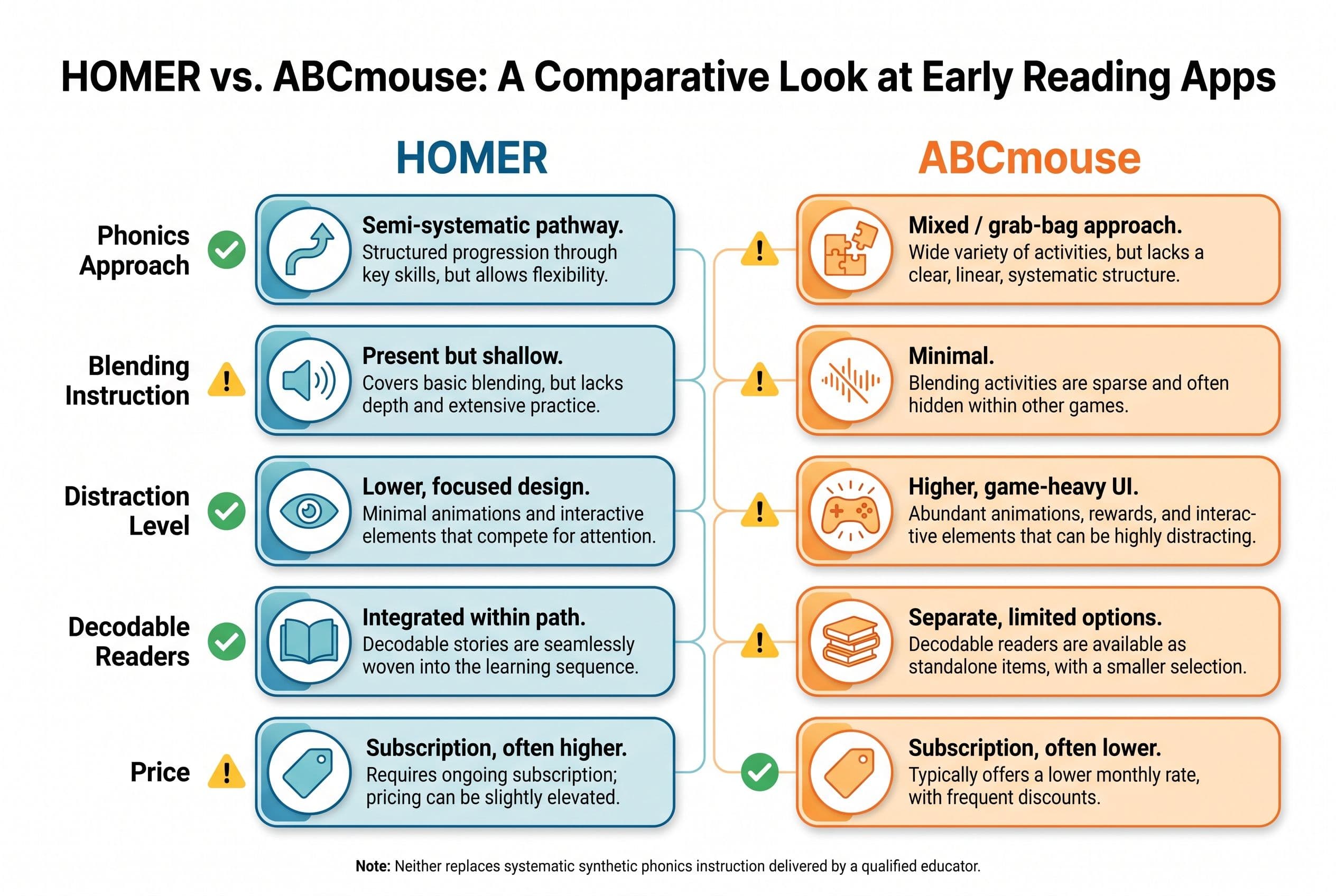
| Feature | HOMER | ABCmouse |
|---|---|---|
| Phonics approach | Semi-systematic; follows a pathway | Grab-bag; mixed with whole-language strategies |
| Blending instruction | Present but shallow | Minimal and inconsistent |
| Decodable readers | Some (limited) | Very few; most stories are leveled, not decodable |
| Personalization | Yes — adaptive placement | Basic — follows a fixed path |
| Distraction level | Moderate (other subjects mixed in) | High (rewards, virtual rooms, 10K+ activities) |
| Price | Check HOMER's site for current pricing | Check ABCmouse's site for current pricing |
| Age range | 2-8 | 2-8 |
| Offline use | Limited | Limited |
If I Had to Pick One
Gun to my head? HOMER. It's closer to real phonics instruction. It at least follows a sequence. It doesn't drown your kid in virtual sticker rewards.
But "closer to real phonics" is like saying a tricycle is closer to a car than a skateboard is. You're still not getting where you need to go.
The Real Problem With Both Apps
Here's what drives me crazy about the HOMER vs ABCmouse debate. Parents are comparison-shopping between two apps when the real question is: does your child actually need an app, or do they need direct phonics instruction from a human?
The research is overwhelming on this.
Stanislas Dehaene — he's a French neuroscientist at the Collège de France — published Reading in the Brain in 2009 and demonstrated that the brain is not wired to read naturally. It has to be trained. The visual word form area in the left hemisphere has to be deliberately built through explicit instruction connecting letters to sounds. No amount of tapping a screen builds that neural pathway the way direct, systematic, human-led instruction does.
I was at a playground in Raleigh last year when another mom told me her kid's school had just switched from Lucy Calkins to a Science of Reading curriculum because of North Carolina's SB 387 — the Excellent Public Schools Act. She was confused and honestly kind of annoyed. "He was doing fine before," she said. So I asked if her son could read the word "splint." He was in second grade. He could not. He stared at it, looked at me, and guessed "split." Close — but wrong, and he was guessing based on the first few letters, not decoding. That's what picture-guessing and balanced literacy trains kids to do. Guess. Approximate. Hope.
I spent 20 minutes on that playground bench explaining why the switch was happening — Hanford's reporting, the NAEP data showing that on the 2022 assessment, only 33% of 4th graders scored at or above NAEP Proficient in reading. (Quick note: NAEP Proficient is a high bar — it means "solid academic performance," not just "passing." But even at the Basic level, a third of kids didn't make it. Let that sink in.) I told her about the neuroscience from Dehaene's lab showing the brain doesn't learn to read naturally the way it learns to speak. She went home and watched the Sold a Story podcast that night. Texted me at 11pm: "I had no idea. Why didn't anyone tell us this sooner?"
That mom's kid had been using ABCmouse since age 3. Four years on the app. He still couldn't decode a consonant blend cluster.
Apps are not instruction. They're supplements at best.
What Happens When You Rely on Apps Alone
I'm not trying to scare you. Actually — yes I am. A little healthy fear is appropriate here.
The 2022 NAEP scores showed 4th-grade reading scores dropped 3 points since 2019 — the largest decline in over 30 years. The Annie E. Casey Foundation's 2010 KIDS COUNT report found that children who aren't reading proficiently by 3rd grade are four times more likely to drop out of high school — and that risk is even steeper for kids from low-income families.
The 3rd Grade Cliff is real. After 3rd grade, kids stop "learning to read" and start "reading to learn." Every subject — science, social studies, even math word problems — requires reading. A kid who can't decode fluently by then falls behind in everything. Not just reading.
And guess what private remedial reading programs like Lindamood-Bell cost? They can run to thousands of dollars a year. Insurance doesn't cover it. Most families can't afford it.
So let me ask the question that matters: do you want to pay a monthly subscription for an app that gives your kid the illusion of learning to read? Or do you want to invest in something that actually gets the job done?
What a Real Phonics-Based Reading Program Looks Like
When I taught my oldest to read, I didn't use an app. I used Orton-Gillingham-based systematic synthetic phonics — the same methodology behind programs like Wilson Reading System, UFLI Foundations, and Barton Reading & Spelling. Here's what that looks like:
- Explicit letter-sound instruction — not "A is for Apple," but "This letter makes the /a/ sound. Say it. Now say it three times."
- Blending from Day 1 — as soon as kids know 3-4 sounds, they blend them into real words. /s/-/a/-/t/ = "sat."
- No guessing — if a kid looks at the picture instead of the word, you cover the picture. If they guess, you stop them and say, "Sound it out."
- Decodable text only — stories that use only the letter-sound patterns the child has learned. No leveled readers full of words they can't decode yet.
- Cumulative review — every lesson revisits previously taught sounds. Mastery before moving on.
- Daily practice — short sessions (10-15 minutes for preschoolers, 15-20 for kindergarteners), every single day. Birthdays, Christmas, vacation. We never skip.
That last part is my Tiger Rule. My kids know it. My husband knows it. The grandparents know it. Phonics happens every day, the same way brushing teeth happens every day.
Why Teach Your Kid to Read Was Built to Be Different
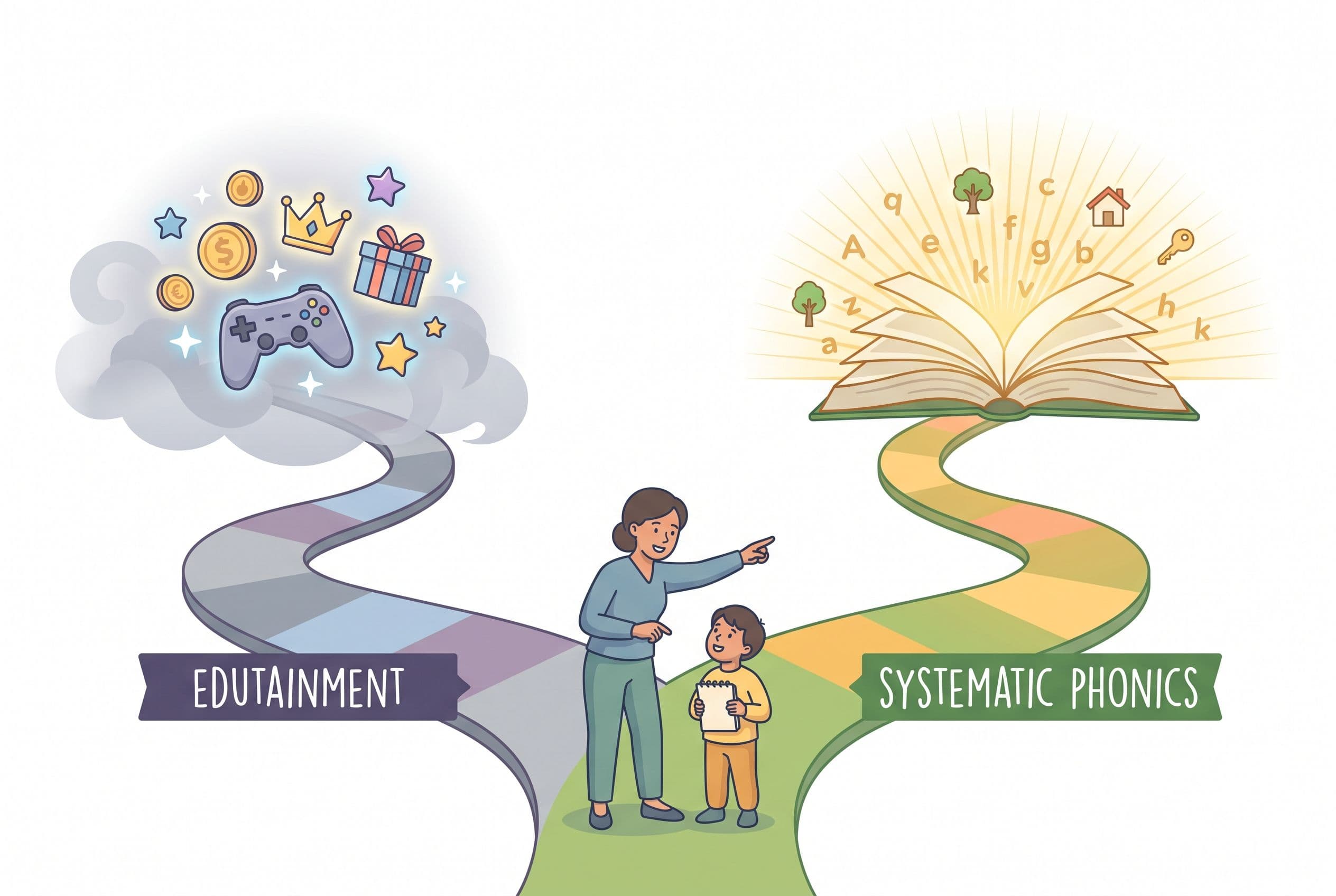
Look, I co-founded Teach Your Kid to Read because I was frustrated by exactly this problem. Parents want to teach their kids to read. They download HOMER or ABCmouse in good faith. And those apps take their money and give them... edutainment.
Teach Your Kid to Read is built on systematic synthetic phonics — the same Orton-Gillingham principles that decades of research support. It's not a buffet of 10,000 activities. It's a focused, structured reading program that does one thing: teaches your child to decode.
Here's what that means in practice:
- Strict phonics sequence — letter sounds introduced in a research-backed order, not alphabetical
- Forced mastery — your child can't skip ahead until they've demonstrated they know the current sounds
- Blending built in from the start — not as a game, but as explicit instruction with feedback
- No picture-guessing — ever
- Decodable reading passages that match exactly what your child has learned
- Parent dashboard so you know exactly where your child is and what they're struggling with
Is it as "fun" as decorating a virtual fish tank? No. Does it teach reading? Yes.
And real talk — when my 4-year-old successfully sounded out "frog" last Tuesday at the kitchen table and literally jumped off her chair yelling "I DID IT!" — that was more fun than any virtual sticker. Mastery is the reward.
Your Action Plan: Stop Guessing, Start Teaching
Here's exactly what I want you to do this week:
Step 1: Assess where your child actually is. Don't assume. Use David Kilpatrick's PAST (Phonological Awareness Screening Test) — it takes about 5 minutes and tells you exactly where your child's phonological processing breaks down. You can find instructions in his book Equipped for Reading Success (2016). If your child can't isolate individual sounds in words ("What's the first sound in 'map'?"), they're not ready for blending — and no app is going to fix that without explicit phonemic awareness work first.
Step 2: Set a daily practice window. Pick a time. Same time every day. For my family, it's right after breakfast when the 1-year-old naps. Ten to fifteen minutes for your preschooler. That's it. But it happens every day. No exceptions.
Step 3: Ditch the apps that let your kid wander. If your child can spend 20 minutes "on the app" without doing a single phonics lesson? That app is babysitting, not teaching. Unsubscribe. Redirect that money toward something structured.
Step 4: Start with Teach Your Kid to Read. It's built for this. Systematic phonics. Explicit blending. No guessing. No virtual fish tanks. Your kid learns to read — that's the whole point.
Step 5: Track benchmarks. Here's a parent-friendly way to check progress: by mid-kindergarten, your child should be able to look at simple CVC nonsense words (like "mip" or "tob") and sound them out accurately. By end of kindergarten, they should handle words with consonant blends ("brim," "slap") without guessing. If you want the official numbers, look up the DIBELS 8th Edition benchmark tables — you're looking at the NWF-CLS (Nonsense Word Fluency – Correct Letter Sounds) score for your child's time of year. If your child isn't hitting those targets, don't panic — but don't "wait and see" either. Adjust. Intensify. Get help if needed.
The Bottom Line
HOMER is better than ABCmouse for reading. That's the honest answer.
But "better" doesn't mean "good enough." HOMER is a semi-structured phonics-adjacent app. ABCmouse is an edutainment empire with some letter games tossed in. Neither one follows the kind of systematic synthetic phonics that the Clackmannanshire study (Johnston & Watson, 2005) — seven years of data out of Scotland — showed produces readers who outperform their peers years later.
Your kid deserves more than "phonics-adjacent."
Mississippi proved what happens when you commit to real reading instruction. Their Literacy-Based Promotion Act of 2013 mandated evidence-based reading programs in every school. They went from 49th in national reading scores to 21st in six years. Six years! Not because they found a magic app. Because they committed to systematic phonics instruction delivered by trained humans.
You can do the same thing at your kitchen table. I do it at mine.
Stop comparing apps. Start teaching your kid to read.
Frequently Asked Questions
Is HOMER or ABCmouse better for a 4-year-old learning to read?
HOMER is closer to real phonics instruction for a 4-year-old. It follows a reading pathway and introduces letter sounds in a sequence. ABCmouse has more total content but less phonics focus — and the reward system tends to distract young kids away from reading activities. That said, neither app replaces systematic, explicit phonics instruction. A structured program like Teach Your Kid to Read gives your 4-year-old the direct, sequential phonics teaching the research supports.
Can ABCmouse actually teach my kid to read?
ABCmouse can teach your child letter names, some letter sounds, and expose them to early literacy concepts. But it doesn't follow a systematic synthetic phonics sequence, and some of its reading activities rely on whole-language strategies like picture-guessing that reading scientists have widely discredited. Mark Seidenberg, a cognitive scientist at the University of Wisconsin, called out these methods in his 2017 book Language at the Speed of Sight. ABCmouse is fine as a supplement — but don't make it your child's primary reading instruction.
How much screen time should my preschooler spend on reading apps?
The American Academy of Pediatrics recommends no more than 1 hour of high-quality screen time per day for kids ages 2-5. For reading specifically, 10-15 minutes of focused app time is plenty — but only if the app is doing real phonics instruction, not just games with letters in them. The rest of your child's reading practice should be offline: sounding out words with flashcards, reading decodable books together, and practicing phonemic awareness through oral games ("What word do you get if you take the /s/ off 'stop'?").
What's the best reading app for kindergarten in 2026?
The best phonics app for kindergarten follows systematic synthetic phonics, uses decodable text (not leveled readers), doesn't allow guessing from pictures, and tracks mastery before advancing. Teach Your Kid to Read was built on these principles. Other strong options for supplemental practice include Explode the Code Online and the UFLI Foundations virtual resources. Avoid apps that prioritize engagement metrics and reward systems over actual reading instruction.
Is HOMER worth the money?
At its current subscription price (check HOMER's site), HOMER isn't a bad value for what it offers — a semi-structured reading pathway with some decent phonics content, plus extras in math and creative thinking. The problem isn't the price; it's the expectation. If you use HOMER as a 10-minute daily supplement alongside real phonics instruction from a parent or tutor, it can reinforce skills. If you use it as your entire reading program, your child will likely have gaps in blending, decoding multisyllabic words, and phonemic awareness that the app doesn't adequately address.
Part of these guides

Xia Brody
Co-Founder, Teach Your Kid to Read
Mom of 4 who has successfully taught her kids to read. Currently in the trenches with her 4-year-old while her two oldest (10 and 7) devour books on their own. Passionate about phonics-based methods and building a lifelong love of reading.
Related Articles
Reading Eggs vs ABCmouse for 5-Year-Olds: Best Pick
Choosing between Reading Eggs and ABCmouse? Here’s the no-fluff mom verdict on which app actually teaches a 5-year-old to read — and where both fall short.
Read More →
HOMER Learning App vs ABCmouse: Reading Skills Compared
Choosing between HOMER and ABCmouse? Here’s the no-nonsense reading comparison parents need before handing over the iPad. I compare phonics, decoding, app structure, pricing, and what actually helps kids sound out words.
Read More →
HOMER vs Reading Eggs for 6-Year-Olds: Best Fit?
Choosing between HOMER and Reading Eggs for a 6-year-old? Here’s the no-nonsense parent breakdown: which app teaches decoding, which one fits which child, and where Teach Your Kid to Read beats both for focused phonics.
Read More →